Chapter Six: Rate/Duration
Objectives:
•
To identify the best rate of speech for most speakers
•
To explain the roles of rate and the pause in speech
•
To present the integration of language rhythms in a discussion of speech phrasing
•
To present a series of exercises in rate of speech
Content:
•
Terms: Rate, duration, pause, syllabic stress, speech phrasing
Activities:
•
Invite your college’s best debaters to debate in your class. Assess their use of rate.
•
If you have access to a local comedian, invite that person to speak to your class on the role
of timing in telling jokes.
•
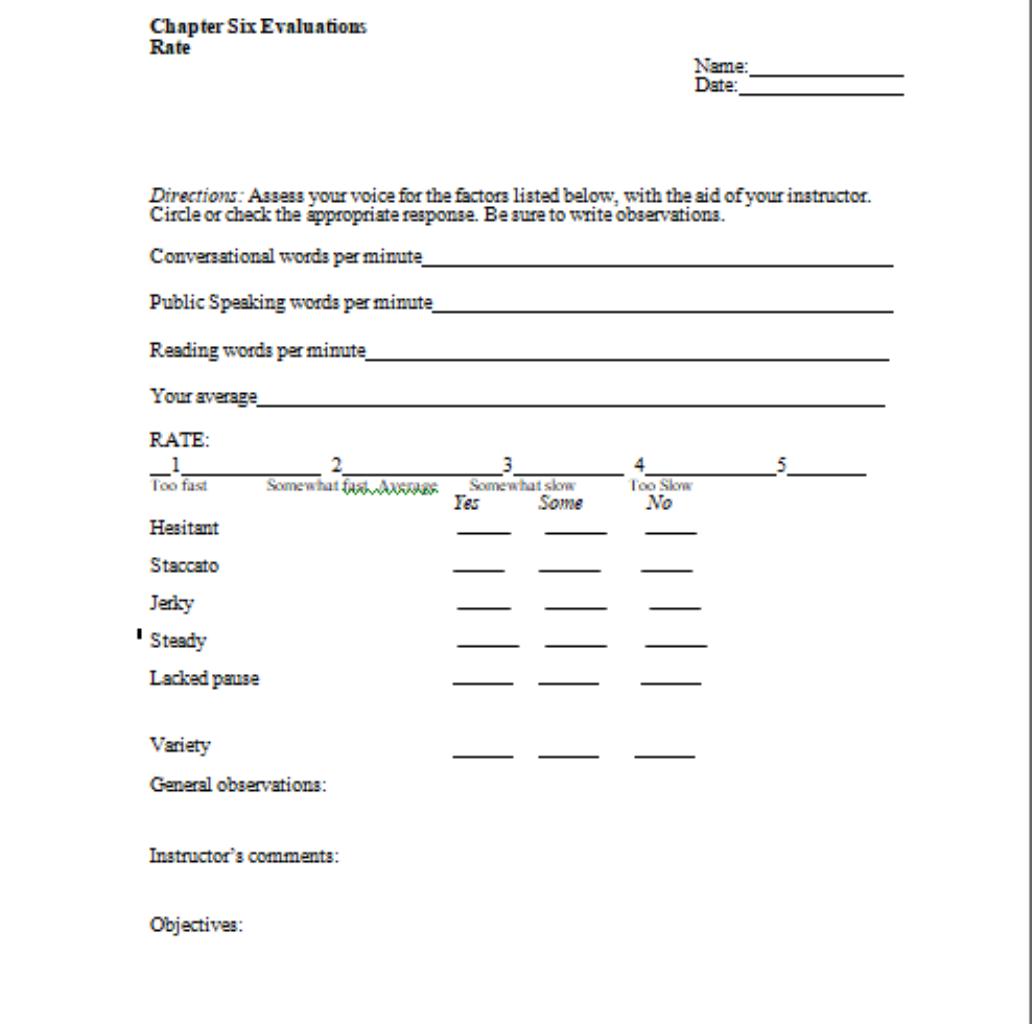
Using guidelines in text, help students to assess their rates of speech.
•
Use cold readings to assist students in grasping speech phrasing.
•
Distribute to students several highly rhymed and rhythmic poems. You might try sonnets,
•Use song lyrics for exercise in pacing. When the student tries to read or recite the lyrics, it
is all too easy to fall into the trap of the song’s rhythm. The challenge is to read or recite
for meaning.
•Use song lyrics in another way. Have students recite the lyrics in the exact rhythm of the
song. Rap is particularly rhythmical.
Application Questions:
Ask your student to write responses to these questions; use them for in class
discussion; or simply ask student to personally apply the questions.
1.
How does your rate of speech indicate your mood or attitude?
2.
How is your own speech rate or duration indicative of your regional origins?
3.
How do you use the “uhms”? In personal conversations? In public?
Focus Messages:
•
Try using a segment of class time to drill on speech phrasing for ESL students. You might
gather those students concerned together while giving other students another assignment. It
could be helpful for more advanced students to try one of the activities below.
•
Assign short (2-3 minute) scenes to acting students to rehearse together focusing on
character’s speech rhythms.
•
Give broadcasting students news copy (you can get this from a radio station or use
newspaper clippings) to arrange and rehearse a brief 3-minute news delivery.
Discussion questions:
1.
At what point in a conversation do you begin to feel that the person to whom you are
speaking is confident or not?
2.
When do you use vocal pauses?
3.
What role does speech-phrasing play in dialects?
Quiz questions:
True/false
Multiple choice
(d) [k].
(a)
gloomy, (b) sad, (c) uplifting, (d) ponderous.
(c) closing your eyes, (d) taking a deep breath at the start of each sentence.
(b)
the time of day, (c) the level of intelligence, (d) speech defects.
Short answer
1.
Explain how rate of speech can pinpoint your geographic residence, mood, and
2.
What is the role of the vocal pause in interpersonal situations? (Coupled with
3.
How can you assess your own rate of speech? (By speaking and reading for about a
4.
Explain how you can slow your rate of speech in a public speaking situation.
5.
Using this question as your example, indicate which words you would stress with
pauses or elongation and which you would gather into shorter, quicker phrases. Explain