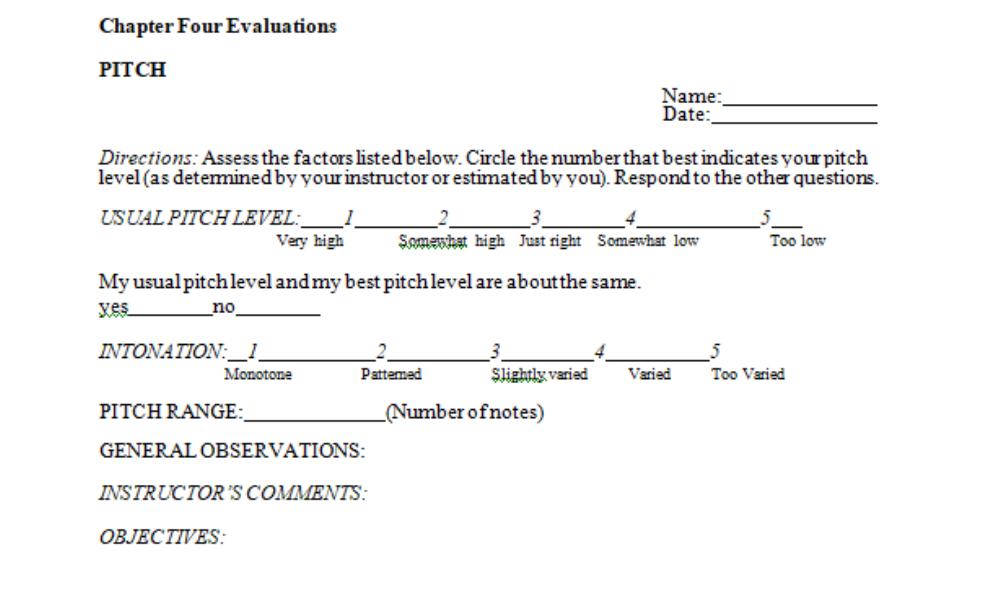
Chapter Four: Pitch
Objectives:
•
To explain the components of the pitch of the human voice.
•
To identify the means by which we paralinguistically communicate with pitch change.
•
To relate the role of intonation in language and communication.
•
To present exercises for identifying pitch level, increasing pitch range, and for
integrating pitch variety.
Content:
•
Terms: Pitch, Habitual and optimum pitch, inflection, intonation, variety
•
Inflection: the paralinguistics of pitch
•
Rising inflection
•
Falling inflection
•
Circumflex inflection
•
Step inflection
•
Intonation
•
Extralinguistic features of pitch
•
Pitch variety
•
Exercises: Pitch levels, raising/widening range, lowering/widening range, upward
inflection, downward inflection, step inflection, circumflex inflection and variety.
Activities:
•
Tape record students reading the passages in this chapter or any excerpt of material they
bring to class. Playing back the recordings, discuss your perception and their perception
Application Questions:
Ask your students to write responses to these questions; use them for in class
discussion; or simply ask student to personally apply the questions.
1.
Identify the various social and business contexts of your life. When visiting with friends,
what seems to be the general pitch level of your voice? In business situations does that
pitch level change? How has it changed over the last several years?
2.
Does your pitch level change depending upon whether you are speaking to a person
of the opposite gender? How do others react?
3.
How varied does your pitch level become: when you are excited? When you are afraid?
When you are bored? When you are reading aloud? When you are speaking?
4.
Do you frequently end declarative sentences with upward inflection?
5.
Maintain a record of times when the pitch of your voice obviously changes. To whom
were you speaking? How were you feeling? What is the context of your
communication? Why might your pitch level have risen or fallen?
Focus Messages
•Discuss the cultural and gender implications of pitch differences.
•Assign student actors scenes from plays to perform that demonstrate pitch
differences. Allow females to perform male roles and vice versa.

Discussion Questions:
1.
Are there times when your voice seems lower/higher than at other times? When?
2.
How do you feel about the pitch level of your own voice?
True/False
Multiple choice
(c) six inches, (d) two inches.
(b) falling inflection, (c) step inflection, (d) circumflex inflection.
notes, (d) 52 notes.
pitch level, (c) music of a language, (d) the measurement in cps of frequency.
(b) complete thoughts, (c) connect items in a list, (d) show surprise.
Short answer
1.
Discuss the cultural implications of vocal pitch. (Persons from other linguistic cultures
2.
What is pitch variety? (Employing sufficient pitch change in a manner
3.
When might you use circumflex inflection? (When you are excited, dramatic, or
4.
What are some general “rules” of intonation? (Pitch change occurs on the stressed
5.
Discuss the extralinguistic vocal features that are related to pitch. (Indicates the