CHAPTER OVERVIEWS: Discussion/ Activities/Test questions
The chapter overviews will briefly delineate the goals, objectives, and content
of each chapter. Since teaching is unique both to the instructor and to the class, the
suggestions here are for additional activities and test questions for each chapter.
Chapter One: An Introduction
Objectives:
• To present to the reader an overview of the process of communication.
• To introduce major aspects of voice.
• To delineate the subjects of the remaining chapters of the text.
Content:
• Terms: Voice, Diction, Paralinguistics
• The communication process
• Speech as a learned process and advocacy for improvement
• Internal and external influences on voice and diction
• A program for voice improvement
Activities:
• Tell a joke. Ask students to come prepared to tell a joke to the class as you sit in a circle.
Jokes are tidy little units of information that require vocal variety to deliver well. This is
one way to hear and assess students in a relaxed atmosphere.
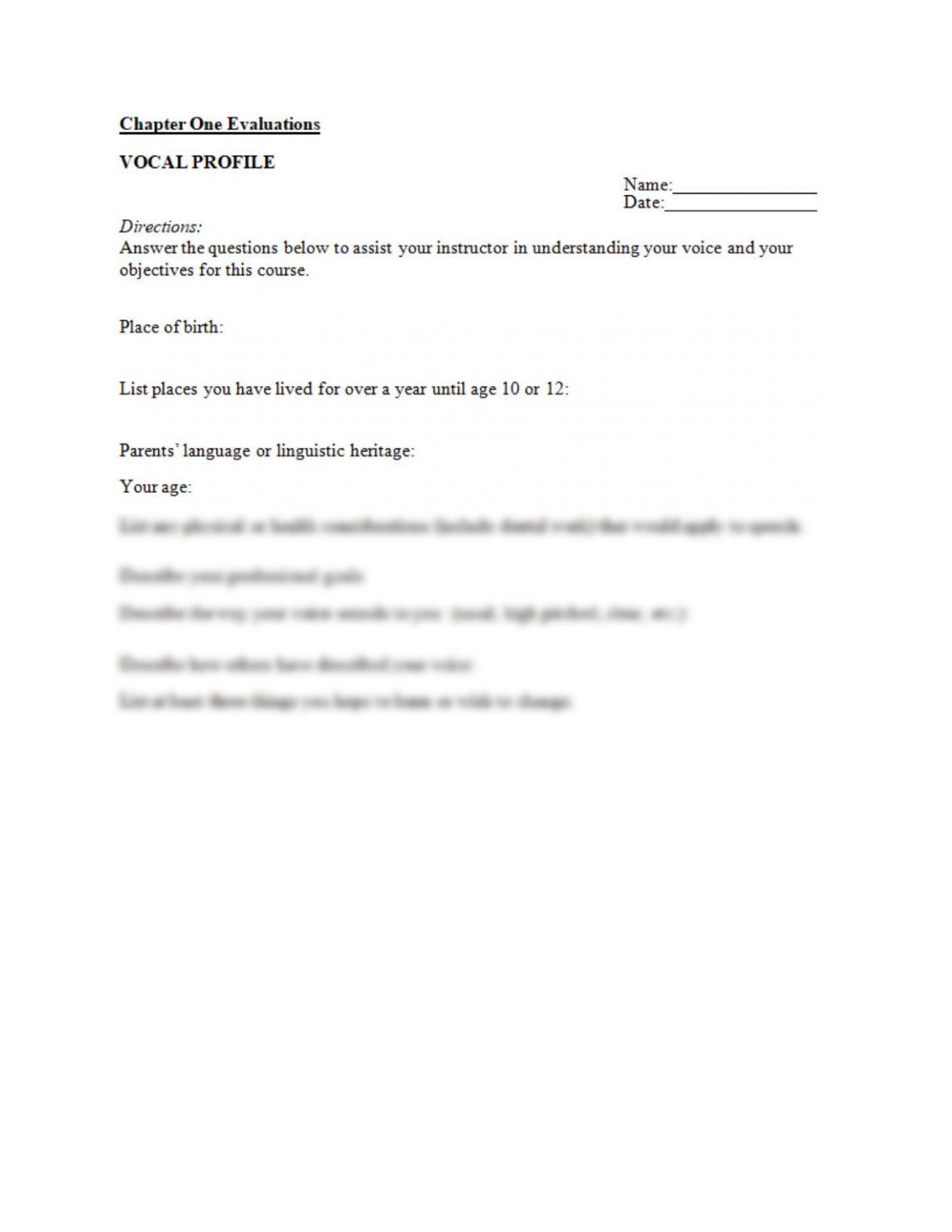
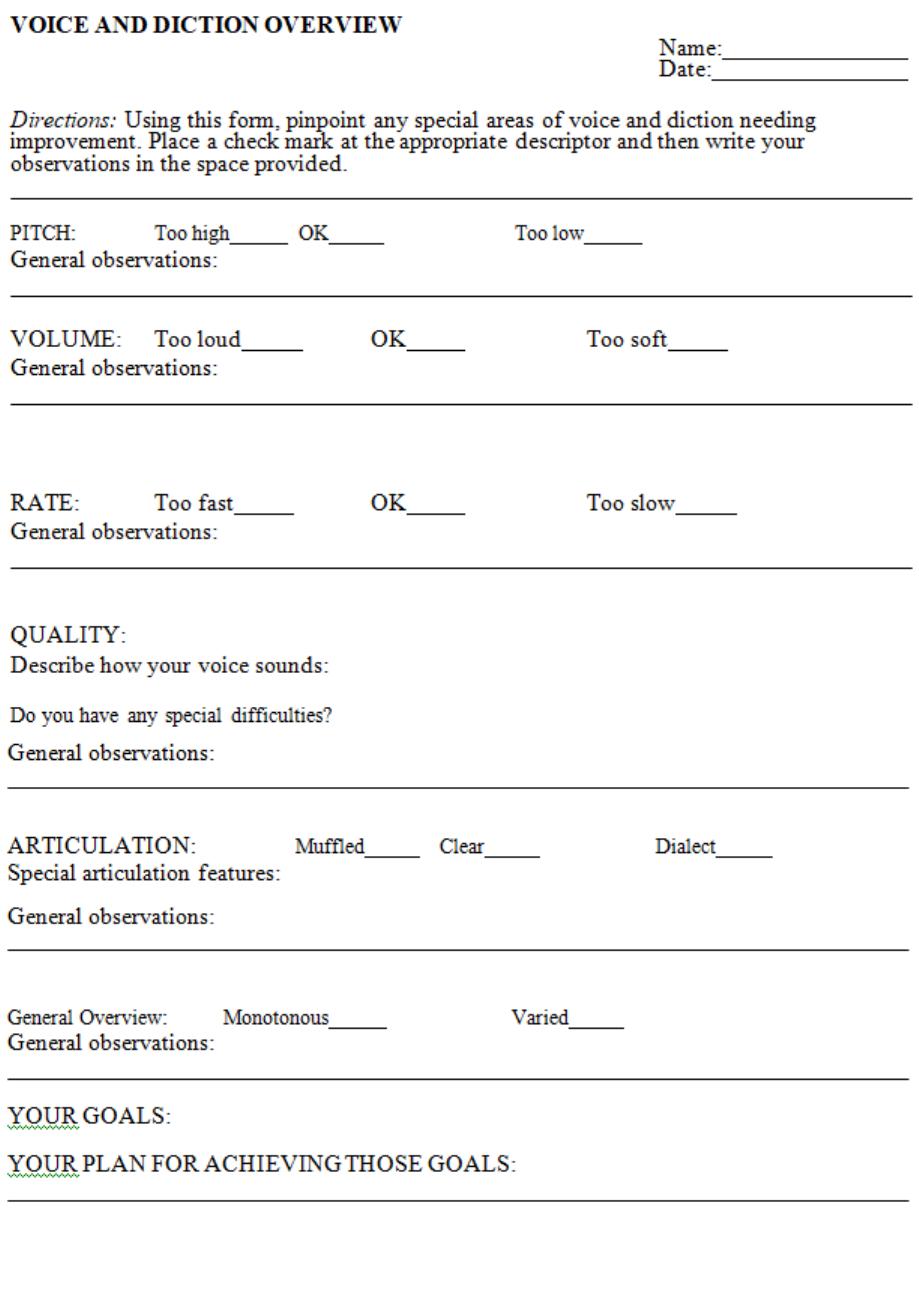
• Personal objectives. Students need to become comfortable speaking in front of this
particular class. Give them the opportunity to explain their individual objectives in
Application Questions
Ask your students to write responses to these questions; use them for in class
discussion; or simply ask students to personally apply these queries.
1. What roles have your parents, friends, teachers or others had in influencing your voice?
2. How does your voice characterize you? Among your social group? At work? At school?
3. What is your plan for vocal improvement?
Focus Messages
You can apply these messages to various interest groups in several ways.
•You might reserve a part of class time (or schedule out of class time) to address
individuals or groups of individuals with like interests. Breaking the class into these focus
groups can facilitate instruction. You can then drill with those interested only in a
Discussion questions
2. Why do you think you sound the way you do?
4. How can you tell if someone is telling the truth?
5. What were some situations wherein someone said to you, “It’s not what you said, it’s
how you said it?”
Quiz questions:
True/False
Multiple choice
transposition, (d) substitution.
linguistics, (c) paralinguistics, (d) voice improvement.
projection, (c) vocal control, (d) breath support.
Short answer
1. What is paralinguistics? Cite an example. (Employing rate, pitch, volume, etc. in such a
2. Explain the cycle of communication. (Involves encoding, transferring, receiving,
3. What role do parents, teachers and friends play in speech development? (As we grow we
4. Discuss the following concept: “A particular sound of voice is clearly associated with
5. What are the characteristics of a good voice? (Clear, strong, well-supported and