Chapter 9: The School Curriculum in an Era of Standards
CHAPTER NINE
THE SCHOOL CURRICULUM IN AN ERA OF STANDARDS
What is Curriculum?
* 1. Which of the following statements best describes curriculum?
a. Everything teachers teach and students learn in schools
b. All the academic knowledge and skills that teachers hope to have students reach
c. Everything students study in formal classroom settings
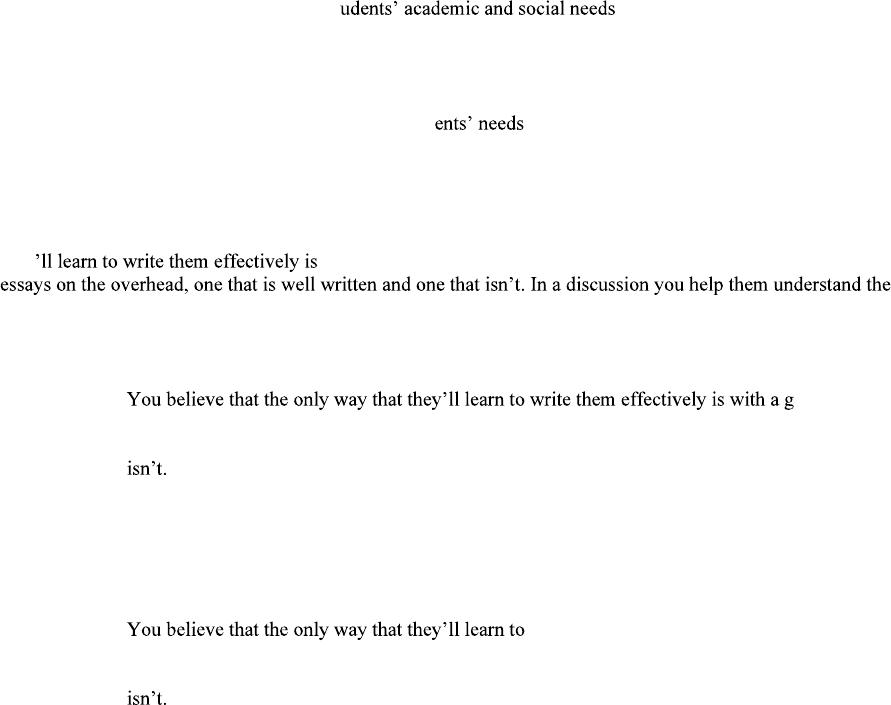
d. Learning goals based on st
* 2. Which of the following best describes instruction?
a. Learning goals and the reasons the goals have been selected
b. The ways teachers help students reach learning goals
c. Learning goals and a diagnosis of stud
d. Learning goals and the philosophy on which the goals are based
Use the following information for items 3 and 4.
You believe that learning to write persuasive essays is essential for students. You also believe that the only way that
they with a great deal of practice. To begin, you display two sample persuasive
characteristics of an effective persuasive essay.
** 3. Of the following, which are curriculum decisions?
1. You believe that learning to write persuasive essays is essential for students.
2. reat deal of
practice.
3. You display two sample persuasive essays on the overhead, one that is well written and one that
4. In a discussion you help them understand the characteristics of an effective persuasive essay.
a. 1, 2, 3 b. 1 c. 1, 2 d. 2, 3
** 4. Of the following, which are decisions about instruction?
1. You believe that learning to write persuasive essays is essential for students.
2. write them effectively is with a great deal of
practice.
3. You display two sample persuasive essays on the overhead, one that is well written and one that
4. In a discussion you help them understand the characteristics of an effective persuasive essay.
a. 2, 3, 4 b. 3, 4 c. 2, 4 d. 4
Essay Item
** 5. Describe the relationship between curriculum and instruction, and provide an example to illustrate your
description.
Chapter 9: The School Curriculum in an Era of Standards
Components of the Curriculum
* 6. Which of the following best describes the explicit curriculum?
a. What students learn as communicated through the kinds of routines teachers establish
b. What students learn in clubs and organizations (such as a science club)
c. What students learn through the ways teachers interact with them
d. What students learn that is found in their textbooks
* 7. Of the following, which is the most accurate description of curriculum in elementary schools?
a. Strong emphasis on science and math and relatively little emphasis on reading and social studies
b. Strong emphasis on reading and science and relatively little emphasis on math and social studies
c. Strong emphasis on reading and math and relatively little emphasis on science and social studies
d. Strong emphasis on reading and language arts and relatively little emphasis on math and science
* 8. Of the following, which is the most accurate description of curriculum in middle schools?
a. Strong emphasis on reading and math and relatively little emphasis on science and social studies
b. Strong emphasis on making connections among topics and real-world applications
c. Strong emphasis on individual content areas such as math, science social, studies and English
d. Strong emphasis on math and science, moderate emphasis on reading and language arts, and little
emphasis on social studies
* 9. Of the following, which is the most accurate description of the curriculum in middle schools compared to
the curriculum in junior high schools?
a. The curriculum in middle schools is more likely to be integrated and focus on real-world problems
than is the curriculum in junior high schools.
b. The curriculum in middle schools is more likely to emphasize reading, language arts, and math than
is the curriculum in junior high schools.
c. The curriculum in middle schools is more likely to emphasize math topics that are advanced for
adolescents, such as pre-algebra and algebra than is the curriculum in junior high schools.
d. The curriculum in middle schools is more likely to be delivered with teacher-centered approaches to
instruction, such as lecture, than is the curriculum in junior high schools.
* 10. Which of the following best illustrates integrated curriculum?
a. Having students test how quickly different aspirin tablets dissolve and then read an article that
describes how quickly different pain relievers begin to work
b. Having students do word problems in math, where they have to carefully identify what information
is given and what information they need to provide
c. Having students use rulers and protractors to measure the angles and the lengths of sides of triangles
d. Having students identify important dates from different historical periods
* 11. Which of the following best describes the implicit curriculum?
a. What students learn in clubs and organizations (such as a science club)
b. What students learn through curriculum guides and state standards
c. What students learn that is found in their textbooks
d. What students learn as communicated by the way teachers interact with them
* 12. Topics teachers decide to leave out of courses of study are best described as making up which of the
following?
a. The explicit curriculum
b. The implicit curriculum
c. The null curriculum
d. The missing curriculum
Chapter 9: The School Curriculum in an Era of Standards
* 13. Which of the following best describes students who are involved in the extracurriculum (such as sports,
clubs, and school plays)?
a. Marginal students more often participate in extracurricular activities than do high achievers, because
these activities help marginal students feel a sense of accomplishment.
b. Students who participate in extracurricular activities tend to get lower grades than students who
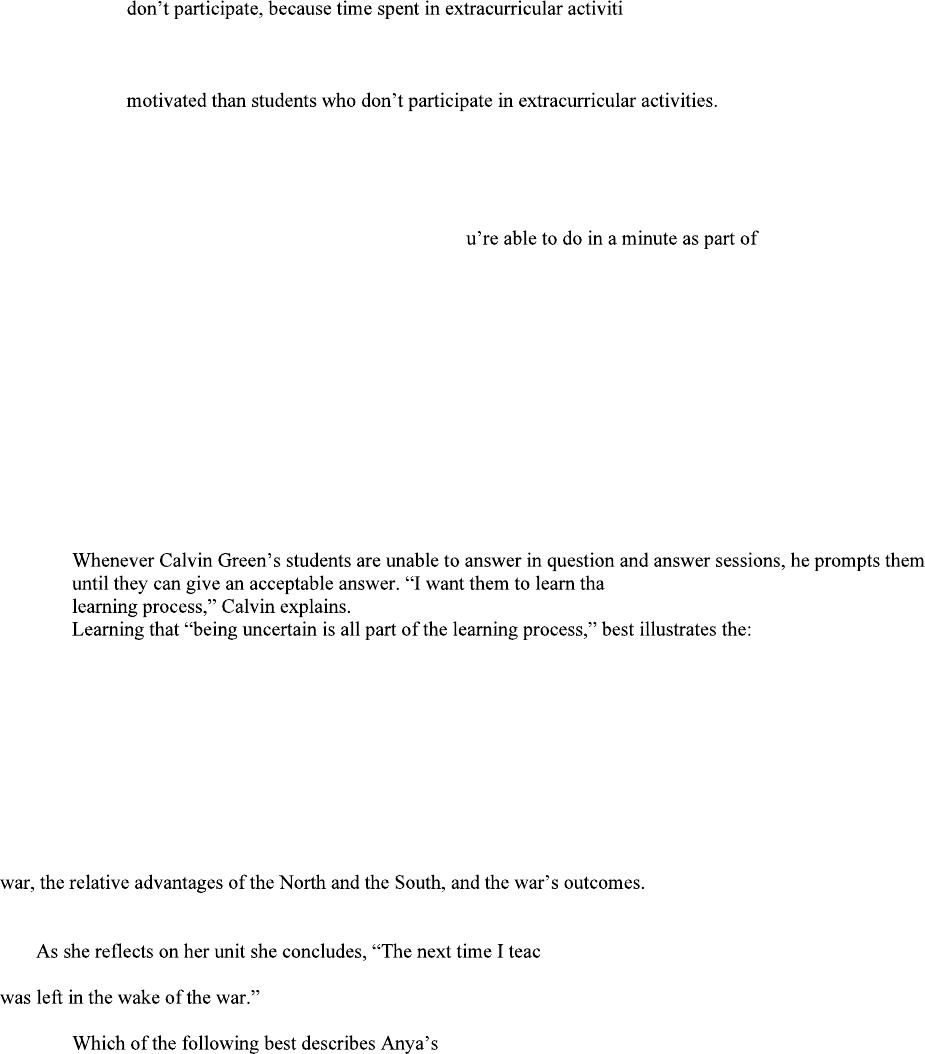
es is taken away from studying.
c. Cultural minorities tend to participate in extracurricular activities more than non-minorities, because
these activities give minorities a feeling of cultural identity.
d. Students who participate in extracurricular activities tend to get higher grades and to be more
* 14. Which of the following best illustrates an activity in the extracurriculum?
a. Learning, in an environmental science class, that global warming is becoming an increasing problem
b. Learning lines for your part in Our Town, the play your school is putting on in the spring
c. Practicing your saxophone for your jazz music class
d. Trying to increase the number of situps yo your physical
education class
* 15. Which of the following statements best describes the relationship between extracurricular activities and
effective schools?
a. A well-developed and comprehensive extracurricular program is one of the characteristics of an
effective school.
b. Schools that are academically effective de-emphasize extracurricular activities, because
extracurricular activities tend to detract from the academic orientation of the school.
c. Effective schools emphasize extracurricular activities that are academically related (such as an
astronomy club or debate team), but they de-emphasize athletics.
d. Effective schools for at-risk students emphasize extracurricular activities, but effective schools for
students who are not at risk de-emphasize extracurricular activities.
** 16.
t being uncertain is all a part of the
a. explicit curriculum.
b. implicit curriculum.
c. extracurriculum.
d. integrated curriculum.
Use the following information for items 17-19.
Anya Kuertan, an eighth-grade American history teacher, teaches a week-long unit on the American Civil War.
She emphasizes the relationships between the fact that the North was industrial, whereas the South was more
agricultural, and the geography of the two parts of the country. She also relates theses factors to the causes of the
Anya is animated in her discussions of the topic and her own interest in it is obvious. She also emphasizes that
all the students have a right to express their opinions and conclusions about the topic as they study it.
h it, I need to put more emphasis on the human
sides of the issues, slavery and racism, the suffering of the people in the North and the South, and the bitterness that
** 17. emphasis on the relationships between industry, agriculture,
geography and the causes and outcomes of the war?
a. They make up the explicit curriculum.
b. They make up the implicit curriculum.
c. They make up the focused curriculum.
d. They make up the null curriculum.
Chapter 9: The School Curriculum in an Era of Standards
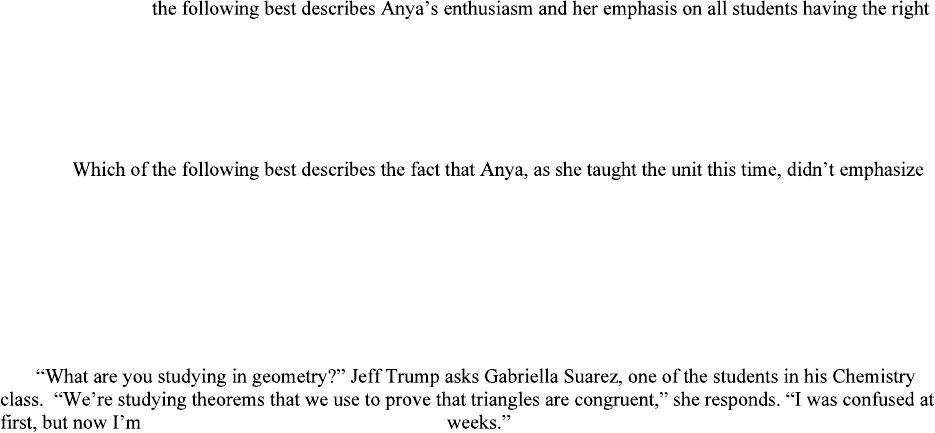
** 18. Which of
to express opinions and conclusions?
a. They make up the explicit curriculum.
b. They make up the implicit curriculum.
c. They make up the focused curriculum.
d. They make up the null curriculum.
** 19.
the human side of the issues and other topics, such as slavery, suffering and bitterness after the war?
a. They make up the explicit curriculum.
b. They make up the implicit curriculum.
c. They make up the missing curriculum.
d. They make up the null curriculum.
Use the following information for items 20-23.
catching on, and I have a B for this 9
Janet Wilson, a science teacher, strongly emphasizes integration of her math topics with science topics, and she
regularly works with Joe Nagel, the math teacher on her team to try and meet these goals. For example, when they
study genetics, Joe has the students calculate the proportions and percentages of students who have blue eyes
compared to those that have brown or green eyes.
Rosano Ramos makes a strong attempt to integrate her science topics with language arts, which she strongly
emphasizes by spending about an hour a day on it. For example, she recently had the students read stories about
different animals and they way they adapted to their environments, and she had the students make oral reports on
what they read.
David Nalbandian, a life science teacher, sees that Jeremy Smith, one of his students, is having difficulty in his
class. He asks Jeremy to come in after school, and he works with Jeremy on content he is having problems with.
When they talk, David emphasizes how important the content will be for other topics Jeremy will study in high
school.
** 20. Based on the curriculum information above, the teacher who most likely teaches in an elementary school is:
a. Jeff.
b. Janet.
c. Rosano.
d. David.
** 21. Based on the curriculum information above, the teacher who most likely teaches in a middle school is:
a. Jeff.
b. Janet.
c. Rosano.
d. David.
** 22. Based on the curriculum information above, the teacher who most likely teaches in a junior high is:
a. Jeff.
b. Janet.
c. Rosano.
d. David.
** 23. Based on the curriculum information above, the teacher who most likely teaches in a high school is:
a. Jeff.
b. Janet.
c. Rosano.
d. David.
Chapter 9: The School Curriculum in an Era of Standards
Essay Items
** 24. Describe the differences between the explicit curriculum, the implicit curriculum, and the null curriculum,
and provide an example of each.
** 25. Describe the differences in curriculum in elementary schools, middle schools, and junior high and high
schools.
** 26. Describe the controversy involved in integrating curriculum. What does research indicate about the
effectiveness of integrating curriculum (compared to not integrating curriculum) for increasing student
learning?
** 27. Describe research that has examined the impact of participating in sports. Include its impact on both boys
and girls in your response.
Forces that Influence the Curriculum
* 28. Of the following, which most influences the curriculum?
a. States and local districts
b. Professional organizations
c. The individual teacher
d. Textbooks
* 29. With respect to the amount of control middle and secondary teachers have over the curriculum, which of
the following is the most accurate statement?
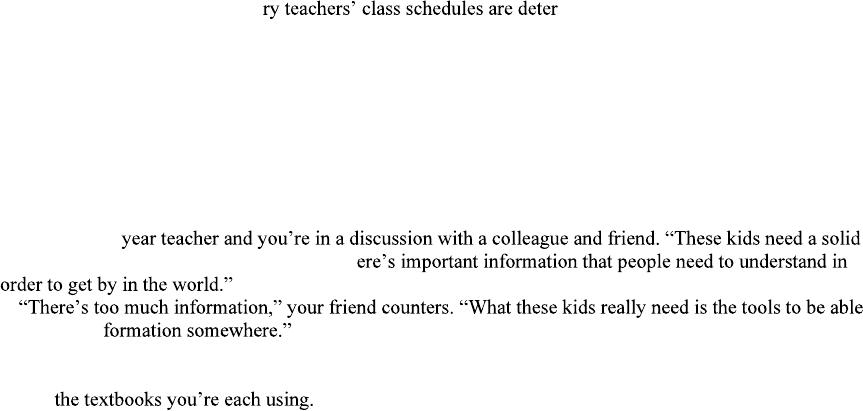
a. Since middle and seconda mined by specified period lengths,
they have little or no control over the curriculum.
b. Since states publish lists of standards that students are expected to meet , middle and secondary
teachers have little or no control over the curriculum.
c. Since most states have statewide assessment tests for students, middle and secondary teachers have
little or no control over the curriculum.
d. Middle and secondary teachers decide what emphasis to place on different topics in the curriculum
and the depth in which the topics will be studied, so they have a great deal of control over the
curriculum.
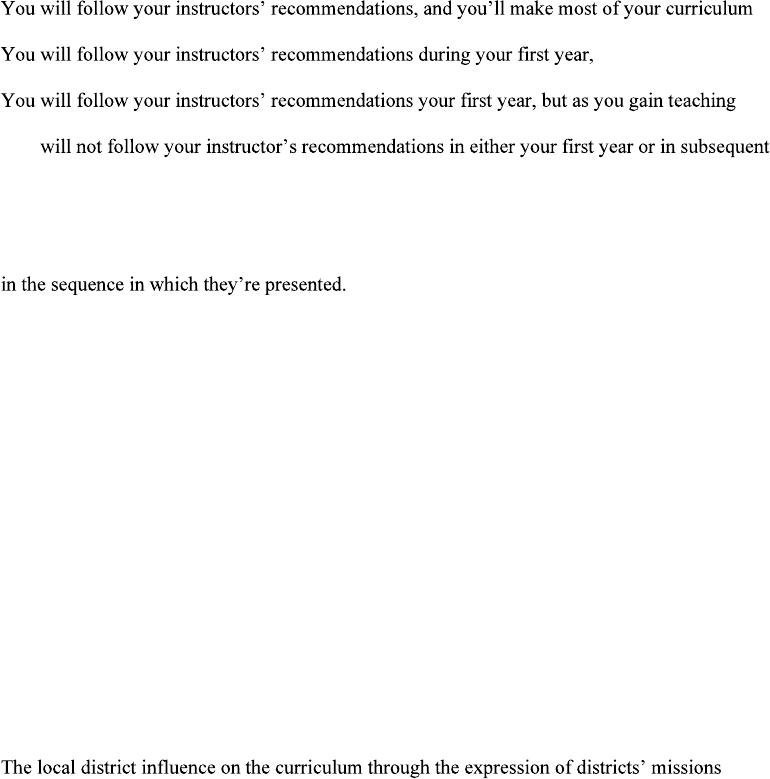
** 30. You are a first-
background in as many areas as possible. Th
to find the in
You and your friend are in a discussion about curriculum, and of the following, your respective views are
most strongly influenced by:
a.
b. your local district.
c. state standards.
d. your personal philosophies.
Chapter 9: The School Curriculum in an Era of Standards
** 31. In some of your classes, your instructors are likely to encourage you to not depend heavily on textbooks as
a basis for making curriculum decisions. If your behavior is consistent with patterns identified by research,
which of the following is most likely?
a.
decisions on bases other than textbooks.
b. but you will then revert to
using textbooks as an important basis for making curriculum decisions.
c.
experience you will largely ignore textbooks as a basis for making curriculum decisions.
d. You
years of teaching.
** 32. If you make decisions about using textbooks based on research examining their effective use, which of the
following is your best decision?
a. Since textbooks are written by experts in the field, you should cover the topics included in them and
b. You should cover the topics included in the textbooks and supplement those topics with other topics
you feel are important.
c. You should cover some of the topics in detail, de-emphasize or eliminate others, and add topics you
feel are important.
d. You should abandon textbooks completely and generate your own curriculum based on your
professional judgment.
** 33. Reading, writing, and math are the most strongly emphasized areas of the curriculum in elementary
schools. Of the following, which is the most likely reason for this emphasis?
a. Reading, writing, and math are the areas in which students are most commonly tested.
b. Most teachers philosophically believe that reading, writing, and math are the most important areas of
the curriculum.
c. Reading, writing, and particularly math, are the curriculum areas elementary teachers most enjoy
teaching.
d. Reading, writing, and math are the areas in which the most hands-on learning activities can be done.
* 34. The curriculum since the 1960’s includes a much stronger emphasis on science and math than existed
before that time. Of the following, what is the most likely reason for this increased emphasis?
a. The federal influence on the curriculum through the passage of specific pieces of legislation
b. The state influence on education through statewide testing in the area of environmental education
c.
d. The influence of textbooks on the curriculum, because more environmental education textbooks now
exist than did before the early 1990’s
* 35. The process of focusing curriculum on predetermined goals or benchmarks that identify the content
students should understand and the skills they should have after completing an area of study is best
described as:
a. an explicit curriculum.
b. an implicit curriculum.
c. content-driven education.
d. standards-based education.
Chapter 9: The School Curriculum in an Era of Standards
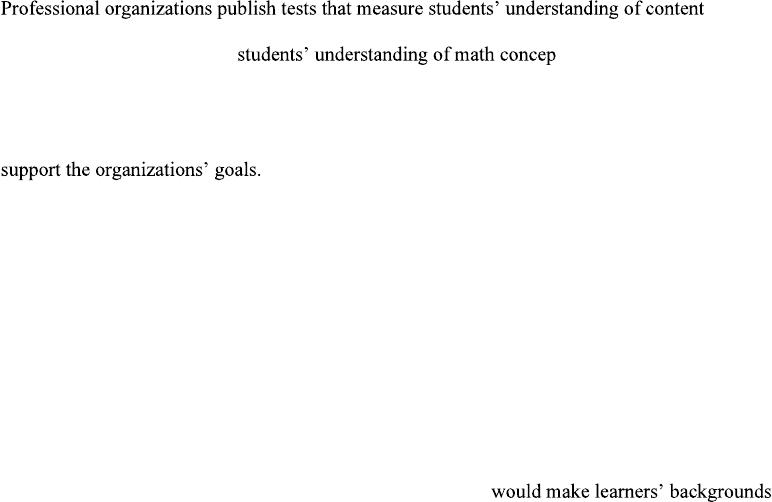
* 36. Of the following, which statement best describes the way professional organizations (such as the National
Council of Teachers of Mathematics) influence curriculum?
a.
recommended by the organization (such as the National Council of Teachers of Mathematics
publishing tests that measure ts at different ages).
b. Professional organizations publish standards which students are expected to meet.
c. Professional organizations recommend textbooks that then become part of state adopted textbook
lists.
d. Professional organizations lobby the federal government to try and influence legislation that will
* 37. Documents published by states that typically include standards, learning activities, and performance
expectations for students are best described as:
a. curriculum guides.
b. lesson plans.
c. explicit curricula.
d. implicit curricula.
* 38. Which of the following are arguments supporting a national curriculum?
1. Other industrialized countries with high-achieving students (such as Japan) have national standards
and national testing.
2. A national curriculum would narrow the achievement gap between cultural minorities and non-
minorities.
3. American society is highly mobile and a national curriculum
more consistent.
4. Standards and levels of achievement vary significantly from state to state.
a. 1, 2, 3, 4 b. 1, 2, 3, c. 1, 3, 4 d. 2, 3, 4 e. 1, 2
* 39. Which of the following are arguments made by opponents of a national curriculum?
1. Local school and local district autonomy would be weakened.
2. A huge federal bureaucracy would be created.
3. A national curriculum would not be responsive to the diversity that exists in different states.
4. A national curriculum would lower the standards that exist in many states.
a. 1, 2, 3, 4 b. 1, 2, 3 c. 1, 3, 4 d. 2, 3, 4 e. 3, 4
Essay Items
** 40. Describe three ways in which states influence the curriculum.
** 41. Explain how the federal government influences curriculum.
** 42. Explain how textbooks influence the curriculum.
** 43. Explain how philosophy and teacher professionalism influence the curriculum.
Controversial Issues in the Curriculum
* 44. Which of the following is the closest approximation of the percentage of middle and high school parents
who favor some form of sex education and believe that young people should be given information to
protect themselves from unplanned pregnancies and sexually transmitted diseases?
a. 25%
b. 50%
c. 75%
d. 90%
Chapter 9: The School Curriculum in an Era of Standards
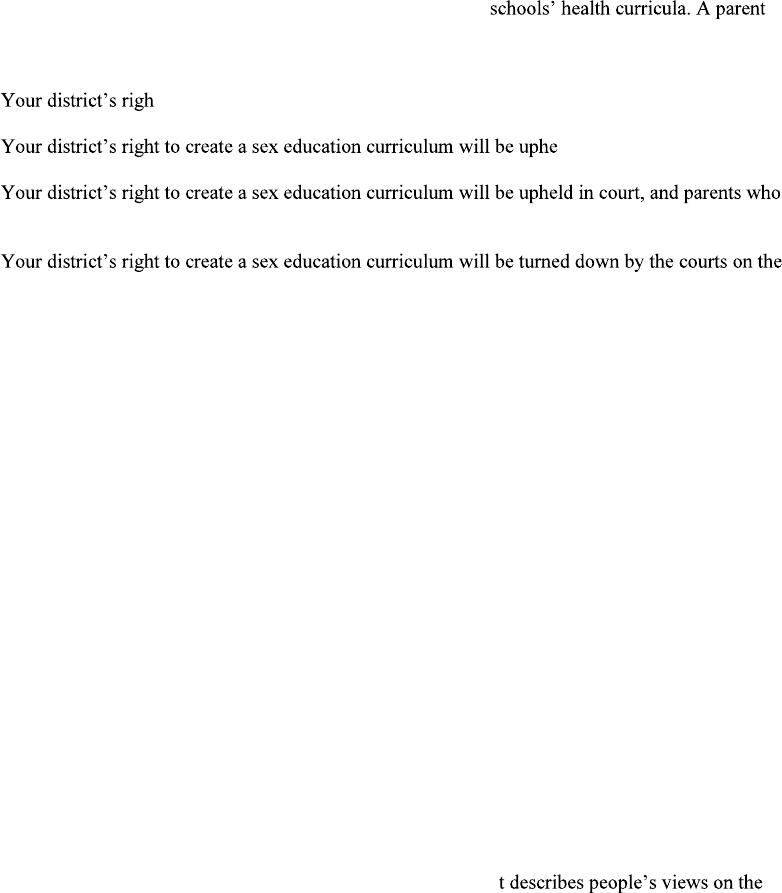
** 45. Your school district, concerned about issues such as teen pregnancy and sexually transmitted diseases,
wants to create and implement a sex education course as part of the
group sues, contending that sex education is outside the scope of the public school curriculum.
If resolution of this case is consistent with other cases involving sex education, which of the following
is the most likely outcome?
a. t to create a sex education curriculum will be upheld in court, and parents who
object will be free to remove their children from attendance.
b. ld in court, and all students
will be required to attend.
c.
object will be free to remove their children from attendance if they can demonstrate that the
curriculum is a violation of their religious beliefs.
d.
grounds that schools must be responsive to the wishes of parents in curriculum issues that are
controversial.
* 46. Which of the following is the most accurate description of the character education versus moral education
debate?
a. Both agree that education in morality is needed, but they differ primarily in the terminology they
use.
b. Moral education believes that teaching moral values is necessary (hence the name), whereas
character education believes that teaching moral values is not necessary.
c. Both agree that education in morality is needed, but they differ in what they believe the goals and
methods of instruction should be.
d. Moral education believes that the development of morality should focus on groups, whereas
character education believes that the development of morality should focus on individuals.
* 47. Which of the following is not a criticism of character education?
a. Character education emphasizes indoctrination versus education.
b. Character education focuses on behavior instead of understanding.
c. Character education overemphasizes thinking at the expense of action.
d. Character education doesn’t consider transfer of values into behavior.
* 48. Which of the following is not a criticism of moral education?
a. Moral education overemphasizes thinking at the expense of behavior.
b. Moral education has a relativistic view of morality with no right or wrong answers.
c. Moral education deals with issues that are removed from the real world of the classroom.
d. Moral education overemphasizes hypothetical versus actual moral issues.
* 49. Based on public opinion polls, which of the following statements bes
inclusion of moral education in the curriculum?
a. Public opinion polls indicate that most people believe that morals and values, such as honesty,
tolerance and fairness should be in integral part of the curriculum, and they should be explicitly
taught, emphasized, and rewarded.
b. Public opinion polls indicate that the vast majority of people favor teaching values, such as honesty,
tolerance, and fairness, and they should be developed with a curriculum emphasizing moral
reasoning.
c. Public opinion polls indicate that most people believe that teaching morals and values, such as
honesty, tolerance, and fairness, should be part of the curriculum, but the people disagree about how
the morals and values should be taught.
d. Public opinion polls indicate that most people believe that morals and values, such as honesty,
tolerance, and fairness should taught in the home, and these polls indicate that people believe that
teaching morals and values should not be part of the school curriculum.
Chapter 9: The School Curriculum in an Era of Standards
* 50. Of the following, which best describes the goal of service learning (involving students in social service
projects)?
a. To clarify the implicit curriculum for all learners
b. To expand the extracurriculum to involve more students placed at risk
c. To make all students more socially responsible
d. To meet state standards for improved environmental education
* 51. Of the following, which is the best description of evolution?
a. A theory suggesting that all living things change in response to environmental conditions
b. A theory suggesting that all organisms and events in the world change in response to a
predetermined sequence
c. A theory suggesting that changes in living things are the result of work done by God
d. A theory suggesting that organisms evolve because of the will of a supreme being
* 52. Of the following, which is the best description of creationism?
a. The belief that all the events in the universe exist in a predetermined sequence
b. The belief that the existence of the universe and all its parts are the result of work done by God
c. The belief that the organisms that exist on the earth at a certain time are the result of environmental
conditions
d. The belief suggesting that the most righteous people on earth will have eternal life and the less
righteous will not
* 53. The relationship between creationism and intelligent design is that:
a. intelligent design and creationism both advocate the teaching of evolution.
b. neither intelligent design nor creationism advocate the teaching of evolution.
c.
d. creationism advocates the teaching of evolution, but intelligent design doe
* 54. Which of the following is the best description of censorship?
a. The process of determining what knowledge students should have and what skills they should
possess after completing a course of study
b. The process of requiring teachers to follow the specifications outlined in curriculum guides
c. The process of removing students from school for engaging in lewd or immoral behavior
d. The process of not allowing the use of certain books or ideas in the school curriculum
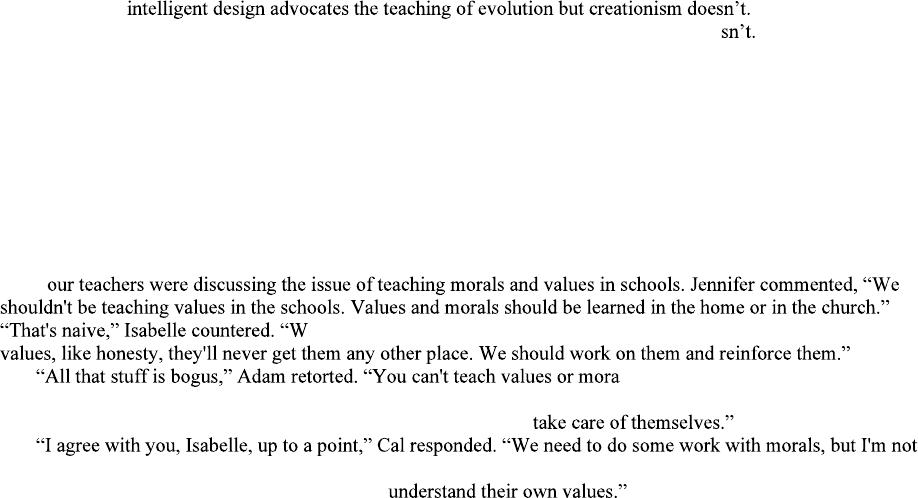
Use the following information for items 55 and 56.
F
e teach values whenever we work with our kids. And, if we don’t teach some
ls. The values the kids have are the
ones they are either born with or learn before they’re five years old. What we should be doing is focusing on the
rules we’ve set up and trying to be fair to everybody. Then, values
comfortable with deciding for the kids what values they ought to have. I think we should have some serious
discussions with the kids and help them learn to
** 55. The teacher whose position is most closely aligned with character education is:
a. Jennifer.
b. Isabelle.
c. Adam.
d. Cal.
Chapter 9: The School Curriculum in an Era of Standards
** 56. The teacher whose position is most closely aligned with moral education is:
a. Jennifer.
b. Isabelle.
c. Adam.
d. Cal.
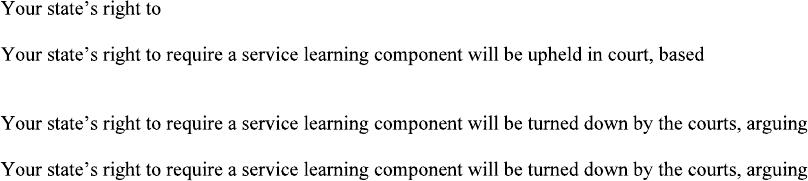
** 57. Your state has implemented a 60-hour service learning component which all students must complete before
they will be allowed to graduate from high school. A parent group has protested and has challenged the
legality of the requirement in court. If resolution of this case is consistent with other cases involving service
learning requirements, which of the following is the most likely outcome?
a. require a service learning component will be upheld in court, based on the
argument that service learning courses promote citizenship and social responsibility.
b. on the
argument that curriculum decisions have been placed in the hands of states, and all reasonable
curricula can be offered.
c.
that an effective rationale for requiring service learning cannot be made.
d.
that service learning is technically an extracurricular activity, and participation in extracurricular
activities cannot be required.
Essay Items
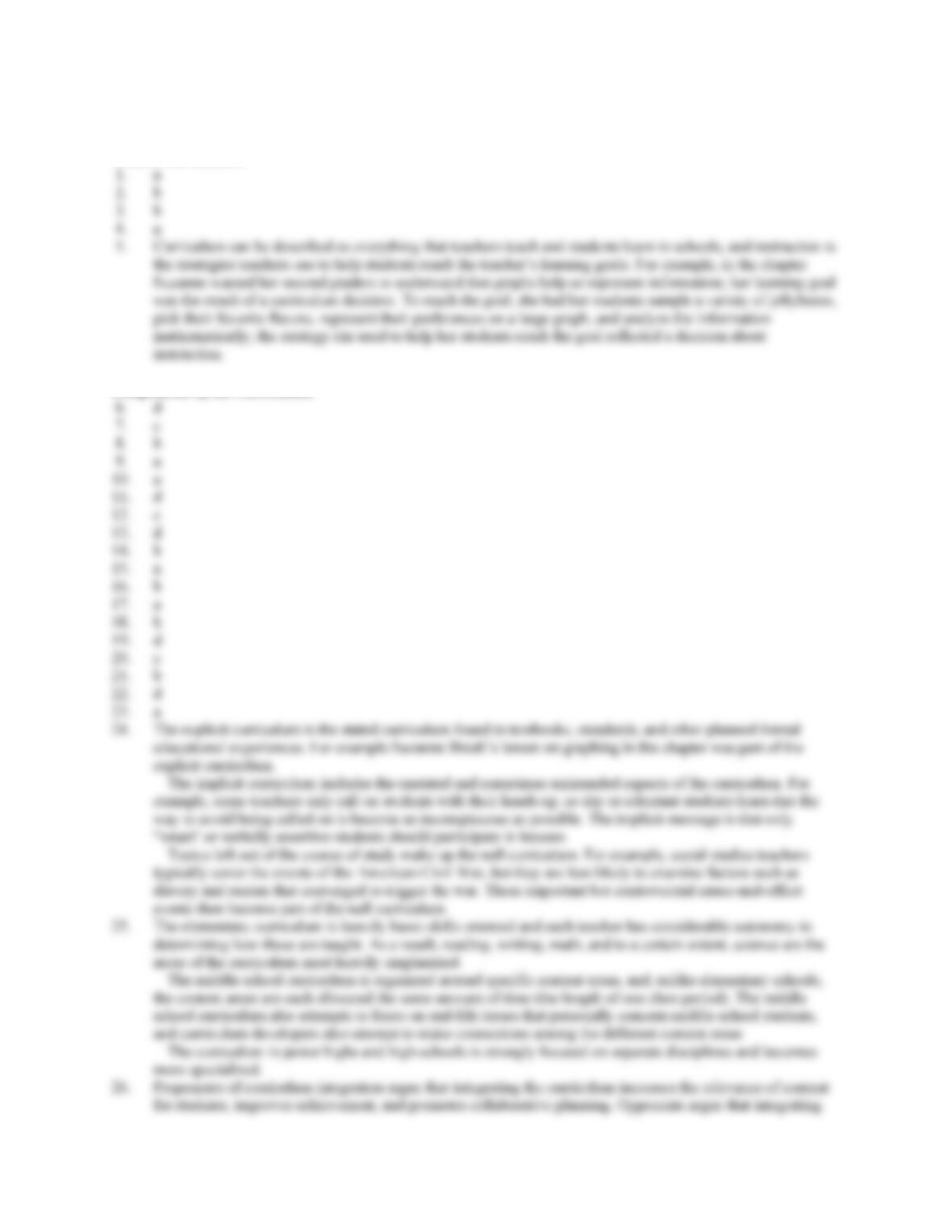
** 58. Describe and explain the controversy involved in textbook censorship. Include both sides of the issue in
your response, and describe typical court responses in legal cases involving censorship.
** 59. Describe and explain the controversy involved in the representation of women and cultural minorities in the
curriculum. Include both sides of the issue in your response, and describe the history that has led to the
controversy.
Chapter 9: The School Curriculum in an Era of Standards
CHAPTER NINE ANSWERS
What is Curriculum?
Components of the Curriculum
Chapter 9: The School Curriculum in an Era of Standards
Forces That Influence the Curriculum
Controversial Issues in the Curriculum
Chapter 9: The School Curriculum in an Era of Standards