125
CHAPTER 9
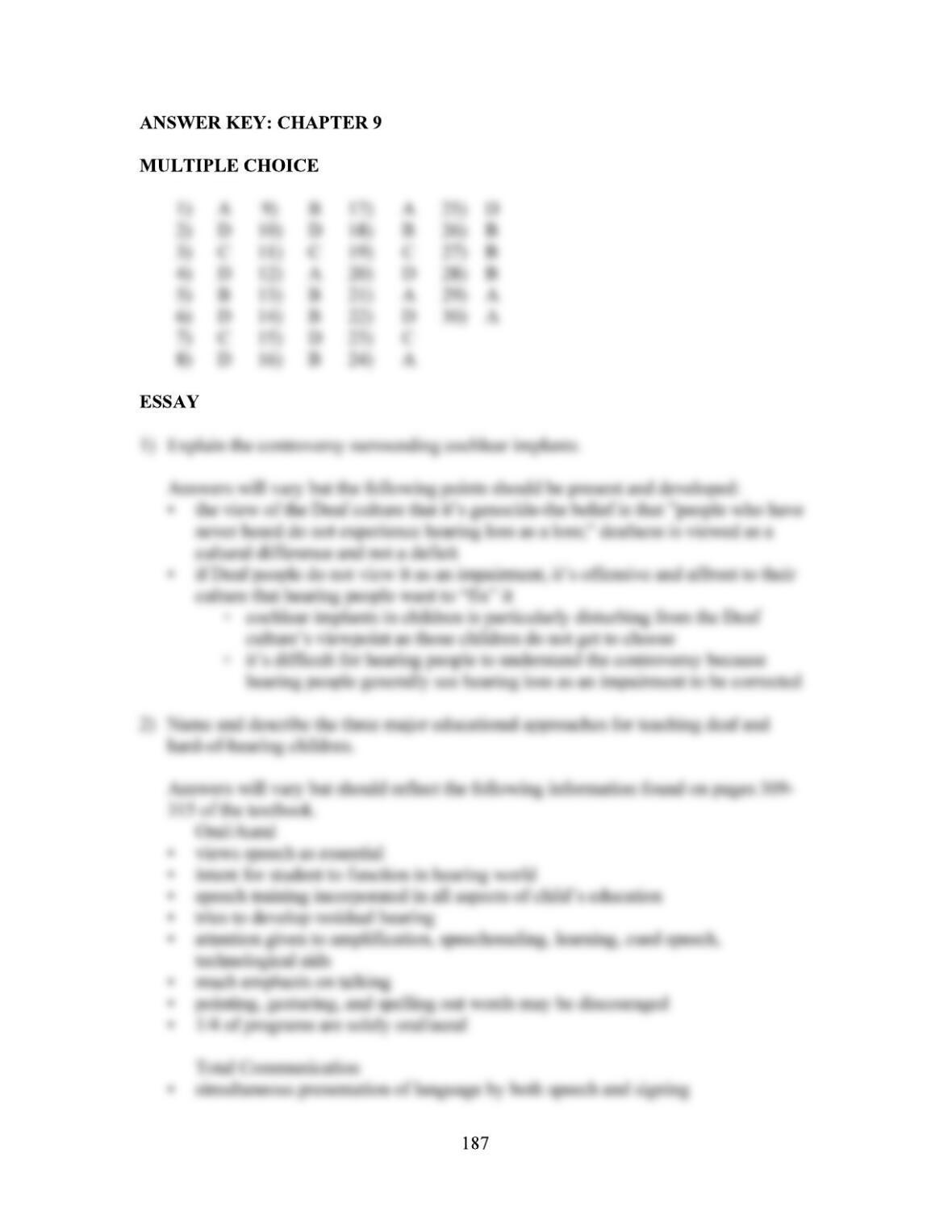
MULTIPLE CHOICE
1) At what age are infants who can hear first able to discriminate speech sounds?
A) 1 month
B) 3 months
C) 6 months
D) 9 months
2) Which of the following is an example of a student who would qualify for special
education services as a student who is deaf?
A) Aimee, who had tubes in her ears in kindergarten
B) Brad, who currently has an ear infection in both ears
C) Chandra, who understand speech but needs an interpreter to sign in social studies
class
D) Demetrius, who wears hearing aids but still cannot understand speech
3) Residual hearing is defined as _____.
A) sounds amplified by a hearing aid
B) sounds measured by a hearing test
C) sounds that can be heard after a hearing loss
D) sounds that can no longer be heard after a hearing loss
4) The eardrum is also known as the _____.
A) auricle
B) meatus
C) ossicle
D) tympanic membrane
5) Which of the following is NOT a factor that determines how a hearing loss affects
language and communication?
A) The degree of hearing loss
B) The language spoken in the community
C) The attitudes of parents and siblings
D) The presence or absence of other disabilities
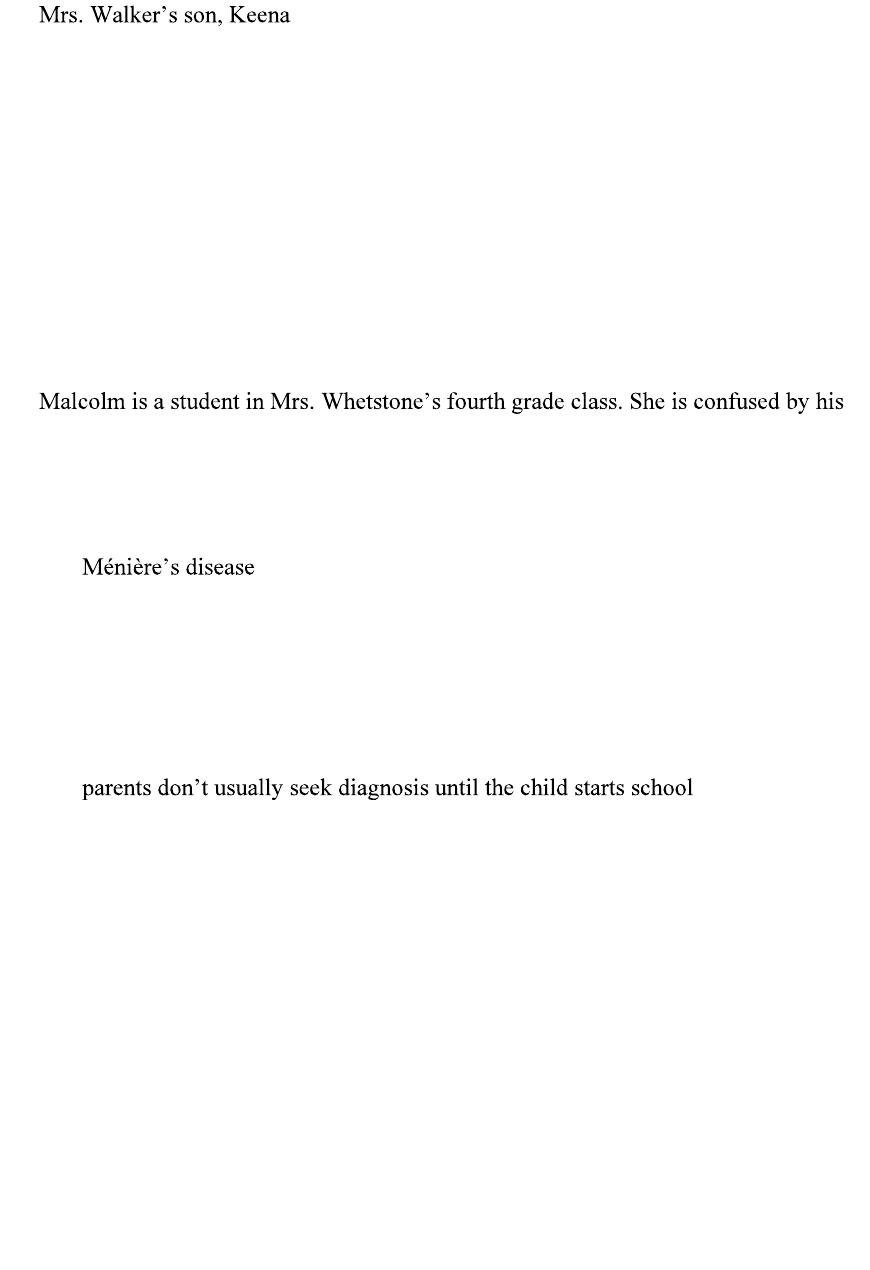
6) other complains that the music on his car radio is hurting her ears. The
sound level is probably _____.
A) between 60-70 dB
B) between 85-90 dB
C) between 50-60 dB
D) 125 dB and above

126
7) Which of the following does NOT describe zero dB?
A) Audiometric zero
B) Zero hearing threshold level (HTL)
C) The smallest sound that can be perceived by a normally hearing person
D) The smallest sound that can be perceived by a person who is deaf
8) The part of the ear that controls balance is the _____.
A) cochlea
B) eardrum
C) ossicles
D) semicircular canal
9) The academic achievement gap between deaf and hard-of-hearing students and their
hearing peers _____.
A) remains constant over time
B) increases as students get older
C) decreases as students get older
D) increases in reading but decreases in math as students get older
10) In the United States, the majority of people with hearing loss are _____.
A) between the ages of birth and 5
B) between the ages of 6 and 21
C) between the ages of 35 and 60
D) 65 years or older
11) Current research indicates that deaf students experience problems in education due to
_____.
A) limitations in cognitive functioning
B) inability to read
C) inadequate development of a first language
D) the mismatch between reading and sign language
12) Causes of conductive hearing loss include all of the following EXCEPT _____.
A) damage to the cochlea
B) improper movement of the ossicles
C) malformations of the auditory canals
D) excessive wax buildup in the auditory canals
13) Which of the following statements is NOT true regarding sensorineural hearing
losses?
A) They may not be helped by hearing aids.
B) They can be corrected with surgery.
C) The term includes sensory and neural hearing impairments.
D) They cannot be corrected with medication.
127
14) n, was born at 26 weeks with a severe hearing loss. This
loss is _____.
A) bilateral
B) congenital
C) postlingual
D) unilateral
15) Sources of noise sufficient enough to induce hearing loss include all of the following
EXCEPT _____.
A) Target shooting
B) Jet aircraft
C) Amplified music
D) Conversation
16)
difficulties. Some days, he is so dizzy that he spends most of the day with the nurse.
He also reports that he hears noises or ringing sounds that nobody else hears.
Sometimes, Malcolm does not seem to hear and other days his hearing is much better.
Malcolm has symptoms associated with _____.
A) cytomegalovirus
B)
C) otitis media
D) toxoplasmosis
17) Hearing loss may NOT be detected in very young children because _____
A) all infants smile, babble
B) most deaf children are born to deaf parents
C) screening for hearing loss in infants is not possible
D)
18) Colby is a year old and has cleft palate. He needs an evaluation to determine if
problems associated with this condition are affecting his hearing. Which of the
following tests can be used?
A) Pure-tone audiometry
B) Operant conditioning audiometry
C) Speech reception threshold (SRT)
D) Voice recognition testing (VRT)
19) How do cochlear implants benefit students with hearing loss?
A) They restore normal hearing.
B) They reduce background noise.
C) They help students understand speech.
D) They deliver amplified sound directly to the middle ear.
128
20) Which of the following is true about advances in hearing aids?
A) Newer hearing aids are less costly.
B) Newer hearing aids are still unsuitable for preschoolers.
C) Newer hearing aids amplify all sounds indiscriminately.
D) Newer hearing aids can be preprogrammed for optional listening.
21) Which educational approach emphasizes training in the production and understanding
of speech?
A) Oral/aural
B) Cued speech
C) Bilingual/bicultural
D) Total communication
22) Which educational approach emphasizes the use of both speech and sign language?
A) Oral/aural
B) Cued speech
C) Bilingual/bicultural
D) Total communication
23) Which of the following is true regarding C-Print speech-to-text service for deaf
students?
A) Deaf students must learn shorthand to use the service.
B) The presenter or lecturer types notes and comments for deaf students.
C) The system provides meaning-for-meaning translation of class lectures.
D) The system provides verbatim, word-for-word translations of class lectures.
24) Activities to improve the listening skills of students with hearing loss _____.
A) are appropriate for all students with hearing loss
B) are most appropriate for students who prefer oral communication
C) are most appropriate for students who prefer manual communication
D) are most appropriate for students with mild or moderate hearing loss
25) The most likely sequence of activities related to sound for children involved in
auditory training is _____.
A) awareness, discrimination, identification, localization
B) awareness, identification, discrimination, localization
C) awareness, identification, localization, discrimination
D) awareness, localization, discrimination, identification
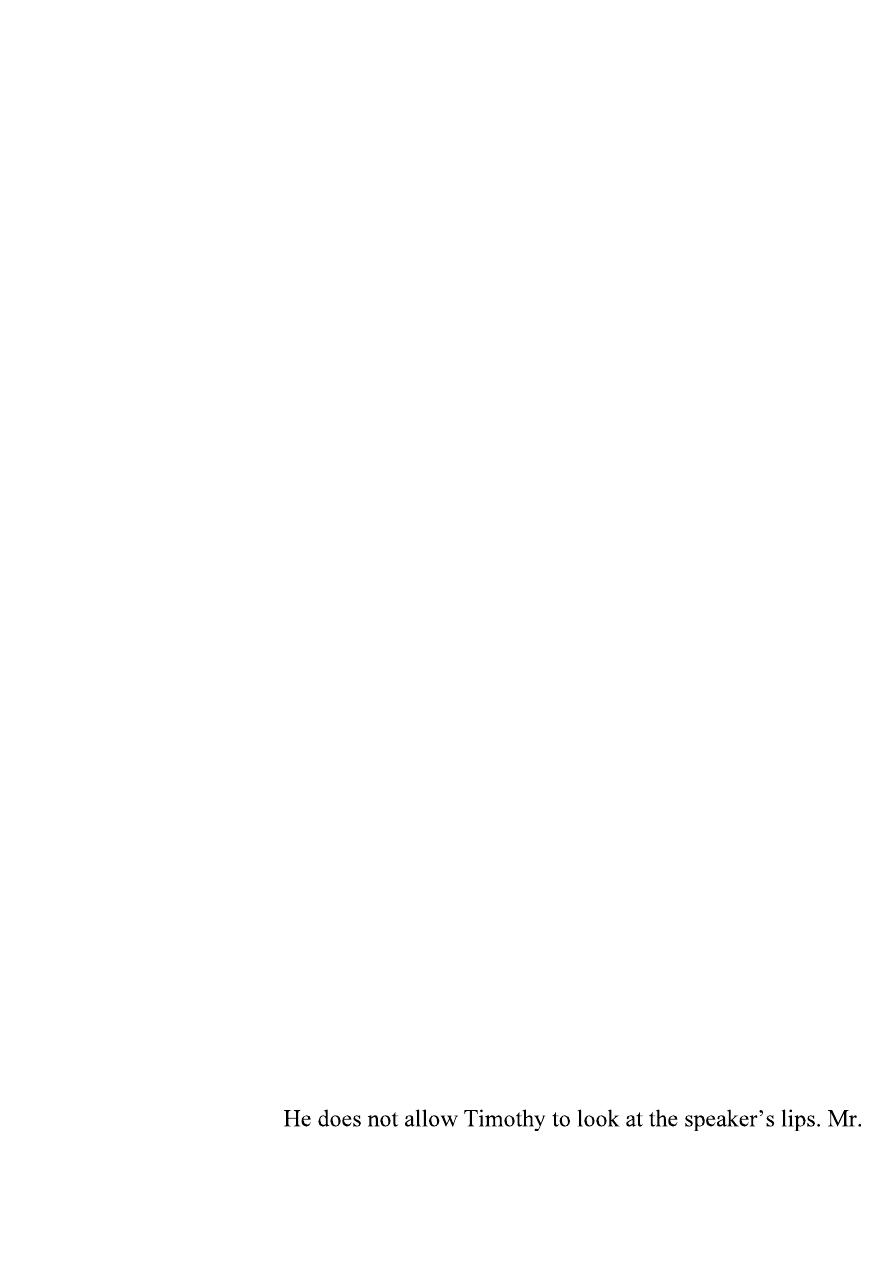
26) Mr. Johansen is trying to teach Timothy, a young child with a hearing loss, to use his
residual hearing to learn.
Johansen is using _____.
A) auditory learning
B) auditory-verbal-therapy
C) interactive-linguistic communication
D) oral-aural communication
129
27) Which of the following is NOT true of cued speech?
A) The hand signals must be used along with speech.
B) The hand signals constitute a manual alphabet.
C) It does not disrupt the natural rhythm of speech.
D) It helps students identify speech features such as syllables.
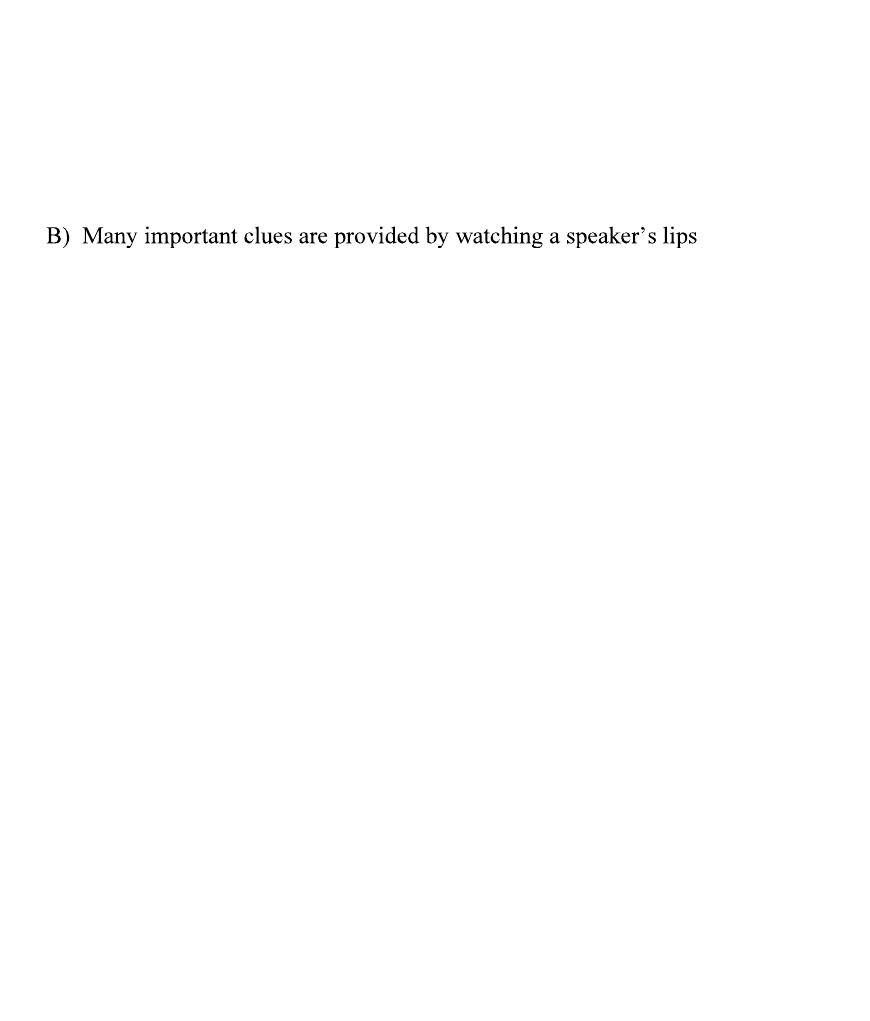
28) Which of the following is NOT a limitation associated with speechreading?
A) Many words look alike on the lips.
C) Many speakers are able to talk while barely moving their lips.
D) Many students experience fatigue after speech reading for a short time.
29) Which of the following is the language of the Deaf culture in the United States and
Canada?
A) American Sign Language (ASL)
B) English Sign Language (ESL)
C) Signing Essential English (SEE I)
D) Signing Exact English (SEE II)
30) What percentage of students who are deaf or hard of hearing are educated in
residential schools?
A) 4%
B) 54%
C) 16%
D) 17%
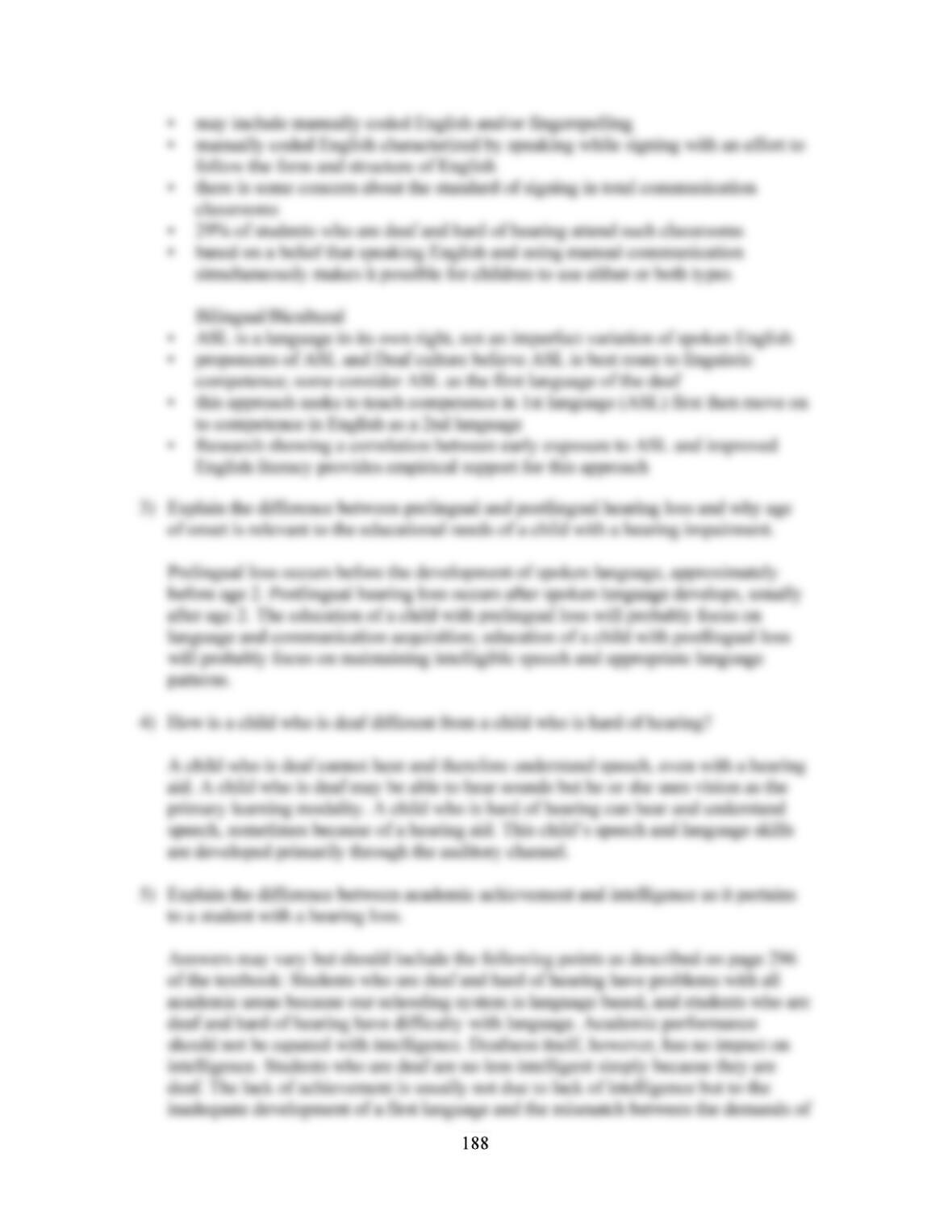
ESSAY
1) Explain the controversy surrounding cochlear implants.
2) Name and describe the three major educational approaches for teaching deaf and
hard-of-hearing children.
3) Explain the difference between prelingual and postlingual hearing loss and why age
of onset is relevant to the educational needs of a child with a hearing impairment.
4) How is a child who is deaf different from a child who is hard of hearing?
5) Explain the difference between academic achievement and intelligence as it pertains
to a student with a hearing loss.