Chapter 8: School Law: Ethical and Legal Influences on Teaching
CHAPTER EIGHT
SCHOOL LAW: ETHICAL AND LEGAL INFLUENCES ON TEACHING
Law, Ethics and Teacher Professionalism
* 1. Of the following, what is the best definition of a professional?
a. A person able to complete tasks according to well-defined criteria
b. A person able to make decisions in ill-defined situations
c. A person who cares about the well-being of young people
d. A person who is able to effectively explain complex forms of knowledge
* 2. Of the following, which best describes laws that regulate the rights and responsibilities of teachers?
a. They are purposely written in general terms so they can be applied to a variety of specific situations.
b. They are written in very specific terms with the intent of avoiding misinterpretation.
c.
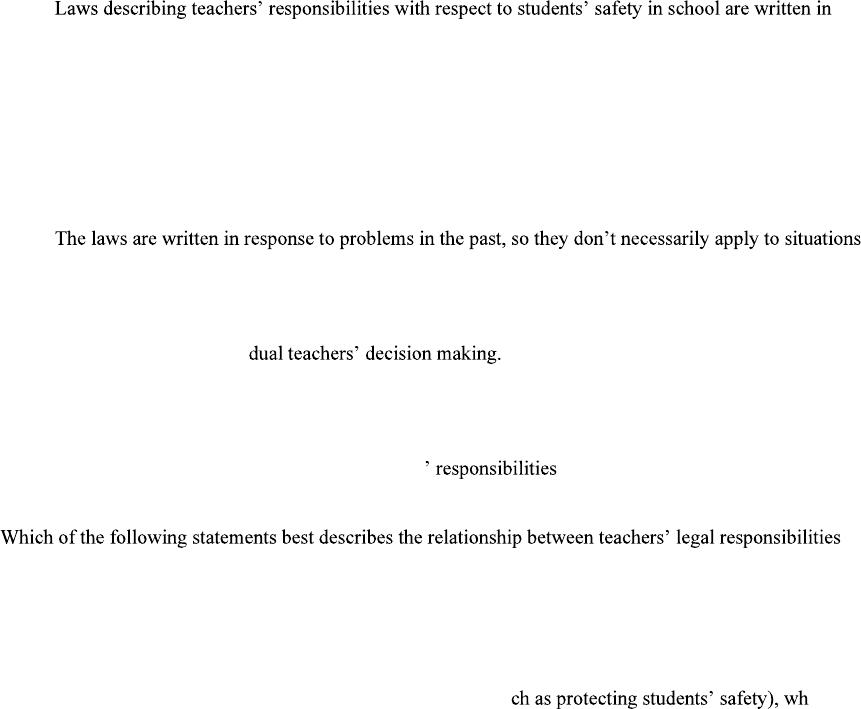
very specific terms, whereas laws describing the required behavior of teachers in instructional
situations are written in general terms.
d. Laws regulating the professional preparation of teachers are very specific, and all other laws are
described in general terms.
* 3. Of the following, which best describes an important limitation of laws that regulate the rights and
responsibilities of teachers?
a. They are written so specifically that the huge volume of laws and regulations are virtually
impossible to remember.
b.
that exist today.
c. The laws apply primarily to the protection of students, and few laws regulate the professional
behavior of teachers.
d. The laws apply primarily to the administration of schools within school districts, and they provide
little guidance for indivi
* 4. Which of the following is the best definition of ethics?
a. Legal mandates that specify acceptable conduct for classroom teachers
b. Constitutional amendments that provide standards for moral behavior
c. School district guidelines that outline teachers
d. Principles used to decide whether or not acts are right or wrong
* 5.
and their ethical responsibilities?
a. Both their legal and ethical responsibilities describe what teachers must do, as required by law, when
they work with students.
b. Their legal responsibilities describe the limitations for teachers (such as requiring that teachers avoid
romantic relationships with students), whereas ethical responsibilities describe what teachers must
do to protect students (such as intervening in an issue involving student safety).
c. Legal responsibilities describe what teachers must do (su ereas
ethical responsibilities describe what teachers should do (such as objectively presenting both sides of
a controversial issue).
d. Legal responsibilities describe what teachers must do in working with administrators and colleagues,
whereas ethical responsibilities describe what teachers much do in working with students.
Chapter 8: School Law: Ethical and Legal Influences on Teaching
* 6. Which of the following statements best describes codes of ethics in different professions?
a. All professions have codes of ethics that are designed to guide practitioners and protect clients.
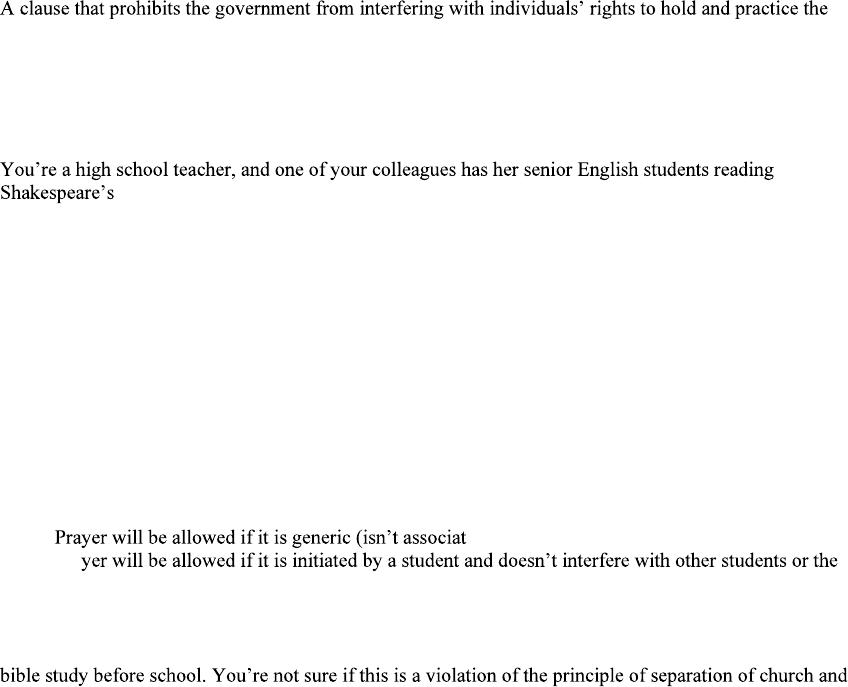
b. Education, because helping young people learn is involved, has a code of ethics, but other
professions do not.
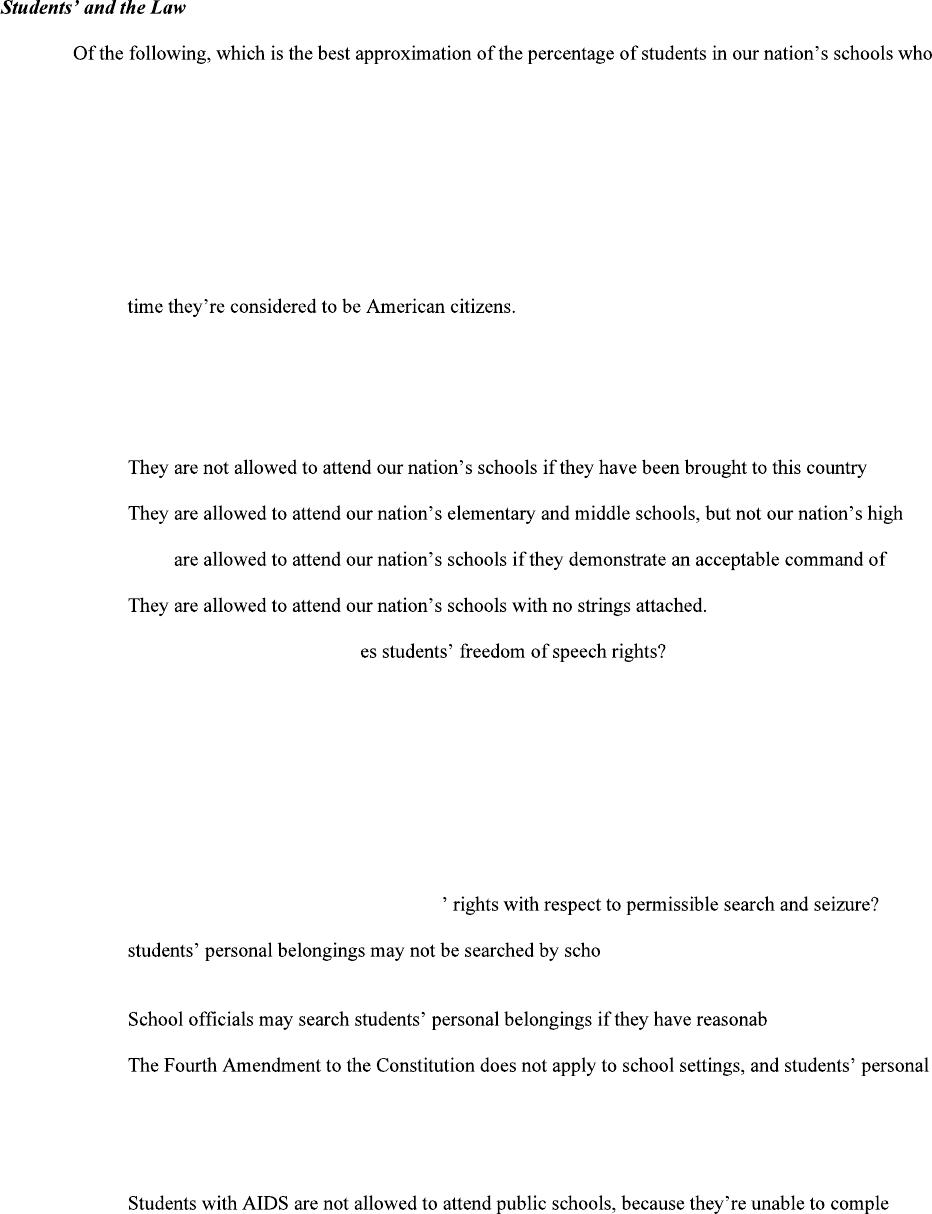
c. Professions, such as medicine and education, which directly involve health and education of people
have codes of ethics, but professions that create products (such as architecture) do not.
d. Professions that involve supervision from administrators, such as education, have codes of ethics,
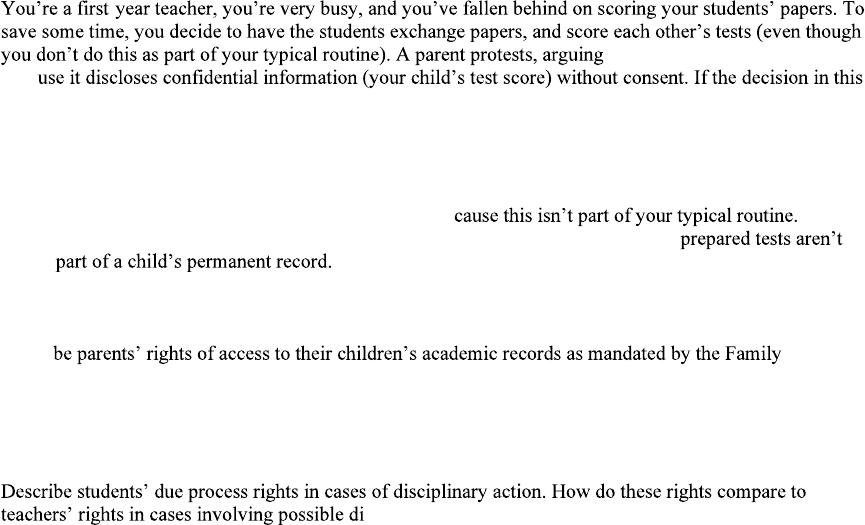
but professions with high levels of autonomy, such as medicine, do not.
** 7. As a new teacher, you realize that both your legal rights and responsibilities and codes of ethics are limited
because they provide only general guidelines for your professional practice. Of the following, what is the
most effective and practical process you can use to accommodate the general nature of laws and ethics?
a. Know as many of the laws that apply to education as possible and keep your code of ethics handy as
a reference.
b. In cases involving decision making, contact a supervisor, such as a grade-level chairperson,
department head, or assistant principal.
c. Develop a well-defined personal philosophy that will guide your specific decisions in your day-to-
day work as a professional.
d. Create a relationship with another teacher who can be your confidant and mentor to help you with
your day-to-day decisions.
Essay Items
** 8. Describe two limitations of laws that regulate the rights and responsibilities of teachers. Illustrate each with
a specific example.
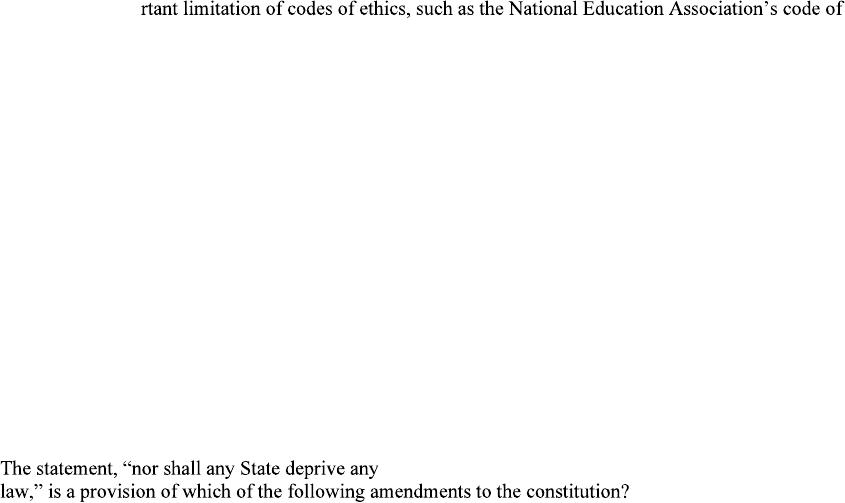
** 9. Describe an impo
ethics, for teachers. Illustrate the limitation with a specific example.
The U.S. Legal System
* 10. Which of the following are ways in which the federal government influences teachers and education?
1. Federal laws
2. Amendments to the Constitution
3. School district policies
4. Teacher licensure
a. 1, 2, 3, 4 b. 1, 2, 4 c. 1, 3, 4 d. 1, 2
* 11. Within limits your freedom of speech rights are protected by the Constitution. Which amendment protects
this right?
a. The 1st Amendment
b. The 4th Amendment
c. The 10th Amendment
d. The 23rd Amendment
* 12. person of life, liberty, or property without due process of
a. The 1st Amendment
b. The 4th Amendment
c. The 10th Amendment
d. The 14th Amendment
Chapter 8: School Law: Ethical and Legal Influences on Teaching
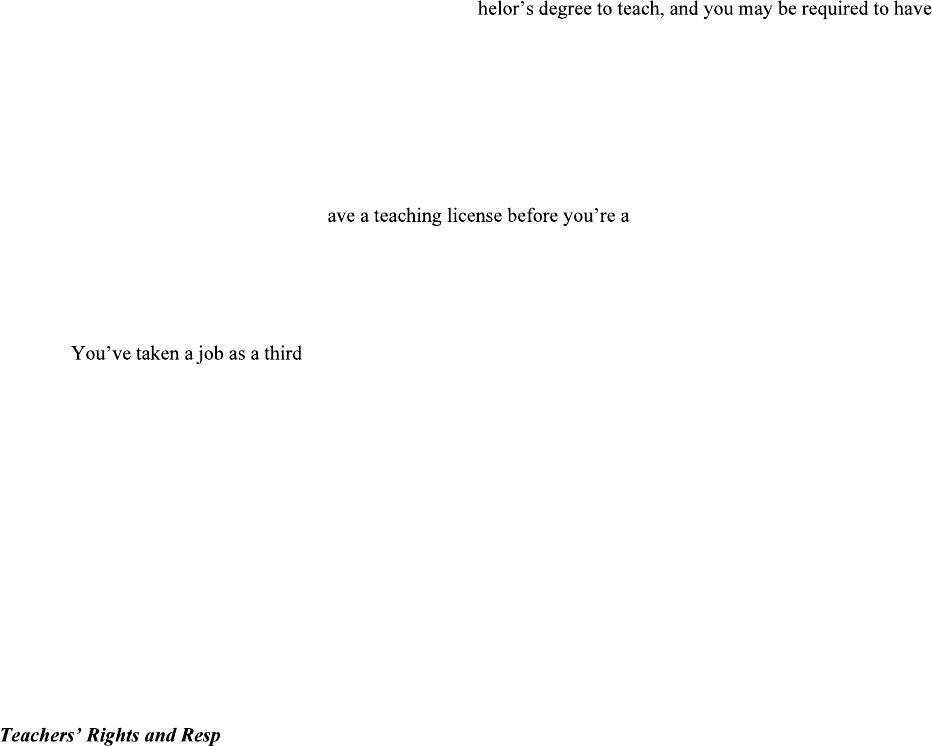
* 13. You will almost certainly be required to hold a bac
a major in an academic area, such as math, science, or history. These mandates come from:
a. the federal government.
b. the state in which you hope to teach.
c. the local district in which you hope to teach.
d. the school in which you hope to teach.
** 14. Which of the following best illustrates a legal influence on you as a teacher that is generated by the federal
government?
a. You will be required to h llowed to accept a job as a teacher.
b. You will be a candidate for tenure, most commonly after three years of successful teaching
experience.
c. You will be required to use a textbook from a state-adopted list.
d. You will have cultural minorities in your classes, as a result of the Civil Rights Act of 1964.
** 15. -grade teacher. Which of the following best illustrates a legal influence on you
that comes from your state?
a. You are likely to have some students pulled out of your class because they are receiving Title I
support.
b. You are virtually certain to have some students with exceptionalities in your class, because of the
Individuals with Disabilities Education Act, which mandates that learners with exceptionalities be
taught in as normal an education setting as possible.
c. You will be required to have a teaching license before you are allowed to take the job in your school.
d. You will have been hired as a result of a recruiting process that most likely includes an interview
with your school principal.
Essay Item
** 16. Explain how the federal government, the states, and local districts, respectively each influence teachers and
education. Provide an example to illustrate each.
onsibilities
* 17. A process designed to ensure that teachers are competent and morally fit to work with youth is best
described as:
a. ethical endorsement.
b. validation.
c. accountability.
d. licensure.
* 18. A legal agreement between a teacher and a local school board is best described as:
a. teacher licensure.
b. a teaching contract.
c. a code of ethics.
d. a high-stakes test.
Chapter 8: School Law: Ethical and Legal Influences on Teaching
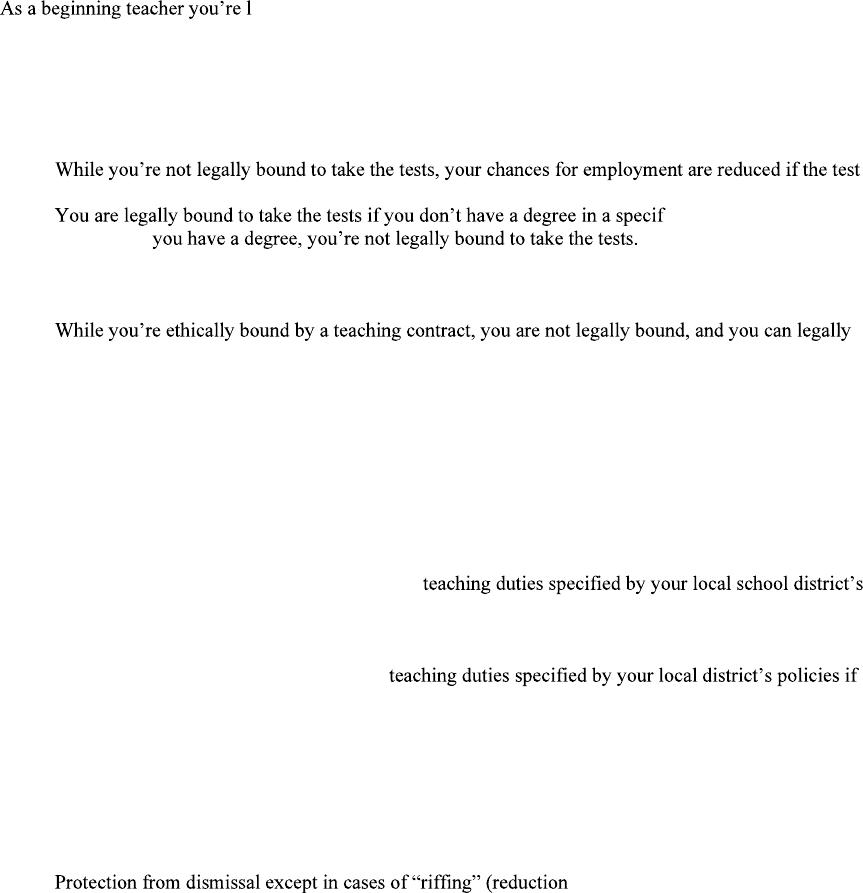
** 19. ikely to be asked to pass a competency test that measures: basic skills, such
as reading, writing, and math; your background in a content area, such as biology or history; and an
understanding of learning and teaching. With respect to the legality of these tests, which of the following is
the most accurate response?
a. While generally required for employment, you are not legally bound to take the tests in order to
apply for employment.
b. You will be legally bound to take the tests if you want to become eligible for a teaching license.
c.
results are not on your record.
d. ic content area, such as
math, but if
** 20. You have signed a contract to teach in a local school district, and later you decide that you want to take
another job in a different state. Which of the following best describes your legal obligations?
a.
take the job in the other state.
b. You are neither legally nor ethically bound by the contract, since you want to move out of the state.
c. You are legally bound by the contract, and in many states you could lose your license for breaking
the contract.
d. You are legally bound by the contract, and you could be subject to some forfeiture of your first-year
salary if you take the job in the other state.
** 21. Which of the following best describes your legal obligations to perform non-teaching duties (such as
sponsor a debate club or coach an athletic team) as part of your teaching job?
a. You have no legal obligations to perform non-teaching duties as part of your job.
b. You are legally obligated to perform any non-
policies.
c. You are legally obligated to perform non-teaching duties specified by your state, but your district
cannot impose additional non-teaching duties.
d. You are legally obligated to perform non-
the duties are connected to your teaching assignment (such as a science teacher being required to be
a science club sponsor).
* 22. Which of the following is the best description of teacher tenure?
a. Protection from dismissal without cause and without observing due process
b. Promotion to the rank called tenured teacher after completing three years of experience and earning
an advanced degree
c. Protection from dismissal except in cases of overstaffing or reduced student enrollments
d. in force)
* 23. For which of the following may a new teacher be legally dismissed?
1. Incompetence
2. Overstaffing
3. Controversial political views
4. Reduced student enrollments
5. Dishonesty in a job application
a. 1, 2, 3, 4, 5 b. 1, 2, 4, 5 c. 1, 3, 5 d. 1, 3, 4 5
Chapter 8: School Law: Ethical and Legal Influences on Teaching
* 24. For which of the following may a tenured teacher be legally dismissed?
1. Incompetence
2. Controversial political views
3. Immoral behavior
4. Unethical conduct
5. Insubordination
a. 1, 2, 3, 4, 5 b. 1, 3, 4, 5 c. 1, 2, 3, 4 d. 1, 3, 4
** 25. A tenured teacher in your school has been charged with gross incompetence and the school is following due
ted by:
a. local school policies.
b. local district policies.
c. state law.
d. federal law.
* 26.
a. The process of eliminating incompetent teachers before
b. The process of eliminating non-tenured teachers in the event of declining student numbers, program
cancellations or budget cuts
c. The process of eliminating either tenured or non-tenured teachers in the event of declining student
numbers, program cancellations, or budget cuts
d. The process of eliminating tenured teachers who have demonstrated incompetence for three
consecutive years
** 27. A first-year teacher in your school is not being offered a contract for her second year because the school
enrollments have gone down, and the teaching staff is being reduced. Which of the following best describes
a. The school has to follow a due process procedure just as it would in the case of a tenured teacher
being dismissed for incompetence.
b. The school has to follow a due process procedure just as it would in the case of a non-tenured
teacher being dismissed for incompetence.
c. In some states a hearing will be required, but in most states the teacher can be dismissed without a
hearing.
d. The teacher cannot be dismissed after the first year for any reason other than immoral behavior or
committing a felony. Once the teacher has signed a legal contract, a district is legally obligated to
give her a second year of employment.
* 28.
described as:
a. due process.
b. tenure.
c. freedom of speech.
d. academic freedom.
* 29. Of the following, which is the best description of academic freedom?
a.
on their professional judgment
b. r the curriculum, but not the content of
the curriculum itself
c.
guidelines of the National Education Association code of ethics
d. input into administrative decisions that ensure the smooth functioning of the
school
Chapter 8: School Law: Ethical and Legal Influences on Teaching
* 30. Policies that specify limitations on the use of print, video, and software materials are best described as:
a. copyright laws.
b. fair use guidelines.
c. academic principles.
d. academic freedom.
* 31. A principle requiring teachers to use the same judgment and care as parents in protecting children under
their supervision is best identified as:
a. a code of ethics.
b. academic freedom.
c. unconditional positive regard.
d. in loco parentis.
* 32. To prevent charges of negligence, for which of the following are teachers always responsible?
1. Making reasonable attempts to anticipate dangerous situations
2. Establishing procedures to prevent injuries
3. Warning students of possible dangerous situations
4. Providing proper supervision
5. Preventing student injury
a. 1, 2, 3, 4, 5 b. 1, 2, 3, 4 c. 2, 3, 4, 5 d. 1, 3, 4 e. 3, 4, 5
* 33. Of the following, which is the best description of notoriety?
a. A teacher being prosecuted for violating a copyright law
b. A teacher with AIDS failing to report his or her condition to school authorities
c. A teacher committing a felony
d. A teacher behaving in a way that becomes known and controversial
* 34.
behavior?
a. Context. Is the behavior consistent with the norms of behavior for the community in which the
teacher works?
b. -known and controversial?
c. Leadership. Does the school leadership condone or condemn the behavior?
d. g religious beliefs for community in which
the teacher works?
* 35.
a. cisions have historically
varied.
b. Once under contract, teachers are legally prohibited from having sexual experiences outside
c. ual lives except in relationships with
students; a sexual relationship with a student will result in dismissal.
d. Teachers are legally restricted from having sexual relationships with students or colleagues, but the
lives outside the professional environment.
Chapter 8: School Law: Ethical and Legal Influences on Teaching
** 36. A fifth-grade teacher, in an effort to motivate his students, allows them to go out and play on the
playground for designated periods of time as rewards for turning in their homework on time. Students who
ork on time are required to serve detention after school. The principal warns the
motivation has increased significantly as a result of this practice. The teacher is dismissed, but then sues,
arguing that his academic freedom has been violated. If this case is consistent with other cases involving
academic freedom and freedom of speech, which of the following is the most likely outcome?
a. The dist
b.
l activities.
c. issal will be upheld in court, since the teacher used unconventional methods, and
the teacher was warned three times.
d. tting
the students play) and punishers (keeping students after school) as part of his methods.
** 37. –
the students to understand the signs of sexual abuse as well as understand some of the emotions that can
is too
t be a part of the school curriculum. You defend your decision, citing
academic freedom as a rationale. With respect to your academic freedom, which of the following is the
most valid conclusion?
a. Your right to teach the topic will likely be overturned, since a number of parents have complained.
b.
mainstream health curriculum.
c. Your right to teach the topic will likely be upheld, since you have cited academic freedom as a
rationale.
d. Your right to teach the topic will likely be upheld, since you have a clear educational goal and
rationale for wanting to teach the topic.
** 38. You want to tape a television program for use in your classroom. Which of the following statements best
describes the copyright restriction in this case?
a. You may copy and show the program as many times as you want, since television programs are not
subject to copyright laws.
b. You may copy the program if given written permission by the network or independent station that
airs the program.
c. You may copy the program and show it twice, but it must be erased within 45 days.
d. You may not legally copy any television program (even though many people do).
** 39. walking across the courtyard at your school and you see two large boys pushing a smaller boy back
be hurt, he is shouting at the other boys to stop. Which of the following best describes your responsibility in
this case?
a. You have no legal or ethical responsibility in this case, since the boys are not in your classes.
b. You have no legal or ethical responsibility in this case, since the incident is occurring outside of
your classroom.
c. You have no legal responsibility, since the boys are not in your classes, and the incident is occurring
outside your classroom, but you have an ethical responsibility to pro
d. You are legally required to intervene, and failing to do is grounds for a lawsuit charging negligence.
Chapter 8: School Law: Ethical and Legal Influences on Teaching
** 40. You notice that Sanchia, one of your third graders, frequently comes to school disheveled with bruises on
her arms. When you ask her what caused the bruises, she says that she got them rough-housing with her
After an
investigation, it turns out that Sanchia has told the truth, and the bruises were indeed the result of rough-
against you and the school. Of the following, which is the most accurate assessment of your situation?
a. You are not protected from liability, since you mistakenly alleged that the parents abused Sanchia.
b.
appearance and bruises on her arms.
c. Because of the seriousness of child abuse, teachers are protected from liability in all allegations of
child abuse, so you are protected from liability.
d. You are protected from liability since you honestly reported the allegation based on her disheveled
appearance and bruises.
** 41. As a first-year teacher, you went to a weekend party, had a bit too much to drink, and were picked up and
s
the most valid conclusion?
a. The incident has no professional implications for you as a teacher, since it occurred outside of
normal working hours.
b. The incident has no legal implications for you as a teacher, but you may be reprimanded for a
violation of professional ethics.
c. A description of the incident will be placed in your permanent record, and a second similar incident
will result in a letter of reprimand.
d. The incident could result in dismissal, since teachers are legally and ethically responsible for being
role models for students.
** 42. A teacher in your school has been diagnosed with AIDS. If the issue is resolved in a way that is consistent
with legal precedent, which of the following is the most likely legal outcome?
a. The teacher will be dismissed, since AIDS-infected teachers are a health risk to young people.
b. The teacher will be dismissed, since AIDS-infected are viewed as negative role models for students.
c. The teacher will be dismissed, since AIDS-infected teach jobs
effectively
d.
infecting students.
Essay Items
** 43. s rights in the case of charges being filed for
incompetence, immoral behavior, insubordination, or unprofessional conduct.
** 44. Describe the copyright laws that regulate what printed materials you may reproduce. Include a description
of fair-use guidelines and the regulations for copying consumable materials (such as workbooks) in your
response.
** 45. Describe and explain the connection between in loco parentis and negligence.
Religion and the Law
* 46. A clause that prohibits the creation of a national religion in the United States is best described as:
a. the establishment clause of the First Amendment to the Constitution.
b. the free exercise clause of the First Amendment to the Constitution.
c. the freedom of religion clause of the Fourteenth Amendment to the Constitution.
d. the separation of church and state clause of the Fourteenth Amendment to the Constitution.
Chapter 8: School Law: Ethical and Legal Influences on Teaching
* 47.
religion of their choice is best described as:
a. the establishment clause of the First Amendment to the Constitution.
b. the free exercise clause of the First Amendment to the Constitution.
c. the freedom of religion clause of the First Amendment to the Constitution.
d. the separation of church and state clause of the First Amendment to the Constitution.
** 48.
Macbeth. A parent group, arguing that the students are being exposed to witchcraft, sues the
school, attempting to eliminate study of the play. Your colleague protests that the study of classic literature
is an essential part of the curriculum. If a ruling in this case is consistent with legal precedent, which of the
following is the most valid conclusion?
a. The courts will rule in favor of the school, since studying the play has a clear educational purpose.
b. The courts will rule in favor of the parents, since the play will be interpreted as advocating a
particular religious belief.
c. The courts will rule in favor of the school, since the rest of the play is non-controversial.
d. The courts will rule in favor of the parents, since schools must be responsive to parental concerns.
** 49. A group of parents on your school advisory council believe that individual student prayer should be
allowed in the school cafeteria, believing that expressions of religious belief promotes a positive emotional
climate in the school. If the issue is settled in a way that is consistent with legal precedent, which of the
following is the most likely conclusion?
a. Prayer will be allowed if the prayer is approved by a school administrator.
b. ed with a specific religion).
c. Pra
functioning of the school.
d. Prayer will not be allowed under any circumstances.
** 50. A student in one of your classes asks you if she and some her friends can use your classroom for Christian
state. If this question was to become a legal issue, and if a ruling was consistent with legal precedent, which
of the following is the most valid conclusion?
a. The study group will not be allowed to meet on the school campus, since it is associated with a
particular religious organization.
b. The study group will be allowed to meet, since schools must allow religious groups to use school
facilities on the same basis as other extracurricular organizations.
c. The study group will not be allowed to meet, because it establishes the possibility of undesirable
groups, such as the Aryan Nation (a neo-Nazi organization) making a similar request.
d. The study group will not be allowed to meet, since religious symbols (such as the bible) are not
allowed in schools.
Essay Item
** 51. Describe the general guideline that exists with respect to teaching religious topics in schools.
Chapter 8: School Law: Ethical and Legal Influences on Teaching
* 52.
are children of immigrants?
a. Approximately 10%
b. Approximately 25%
c. Approximately 50%
d. Approximately 75%
* 53. Which of the following best describes the status of children who are born in the United States, but whose
parents are illegal immigrants?
a. The children are also considered to be illegal immigrants.
b. The children are also considered to be illegal immigrants until they reach the age of 18, at which
c. The children are considered to be illegal immigrants until they finish middle school, at which time
they can become American citizens if they pass a citizenship test.
d. The children are American citizens from birth.
* 54. Of the following, which best describes the educational rights of children born outside the United States and
brought to our country illegally by their parents?
a.
illegally.
b.
schools.
c. They
English
d.
* 55. Which of the following best describ
a. Students have the right of freedom of speech as guaranteed by the U.S. Constitution, and this right
may not be violated by schools.
b. Students have the right of freedom of speech unless expression of this freedom interferes with
learning or running the school.
c. Students have the right of freedom of speech if expression of the right is related to the school
curriculum, but they do not have the right to freedom of speech outside the school curriculum.
d. Students have the right of freedom of speech about any issue that is expressed in the context of
extracurricular activities (such as a speech club), but their freedom of speech rights are restricted to
the curriculum in the regular classroom.
* 56. Which of the following best describes students
a. The Fourth Amendment to the Constitution protects all citizens from unlawful search and seizure, so
ol officials.
b. Since school safety has become an issue, school officials are allowed to search students whenever
they feel it is in the best interest of school safety.
c. le suspicion
(probable cause) that a problem exists.
d.
belongings may be searched at any time.
* 57. Which of the following best describes the most common outcome in court cases involving students with
AIDS?
a. Students with AIDS are not allowed to attend public schools because of the health risks involved.
b. te the
work typically required in the school curriculum.
c. Students with AIDS are allowed to attend public schools without restriction.
Chapter 8: School Law: Ethical and Legal Influences on Teaching
d. Students with AIDS are allowed to attend public schools with special safeguards to prevent blood
spills.
* 58. Which of the following is the best description of the law commonly known as the Buckley Amendment?
a. A legal act that prevents the teaching of biblical descriptions of the creation of humanity in public
schools
b. A legal act that prevents teachers from being terminated without access to due process
c. A legal act that makes school records more open and accessible to parents
d. A legal act that prevents students from being expelled without due process
** 59. –
that this procedure is unlawful,
beca
case is consistent with legal precedent, which of the following is the most likely conclusion?
a. A court decision would rule in favor of the parent, based on one of the provisions of the Buckley
Amendment.
b. A court decision would rule in favor of the parent, based on the ethical principle of avoiding
unnecessary embarrassment of a student.
c. A court decision would rule against the parent, be
d. A court decision would rule against the parent, because test scores on teacher-
Essay Items
** 60. Descri
Educational Rights and Privacy Act (FERPA, also called the Buckley Amendment). Also, explain why the
issue of academic records is so important.
** 61. In states where it is legal, describe the conditions under which corporal punishment can be administered.
** 62.
smissal?
Chapter 8: School Law: Ethical and Legal Influences on Teaching
CHAPTER EIGHT ANSWERS
Law, Ethics, and Teacher Professionalism
The U.S. Legal System
Chapter 8: School Law: Ethical and Legal Influences on Teaching
Religion and the Law
Students and the Law