119
CHAPTER 8
MULTIPLE CHOICE
1) A person who engages in intraindividual communication _____.
A) talks to a single person
B) talks to himself/herself
C) talks to more than one person
D) talks to a large group of people
2) Which of the following is true regarding languages?
A) Languages are static.
B) Languages are made up of concrete symbols.
C) The codes that constitute languages are informal.
D) The symbols and rules that govern languages are arbitrary.
3) The smallest elements of language that carry meaning are called _____.
A) morphemes
B) phonemes
C) syllables
D) words
4) Which dimension of language is concerned with the meaning of words and
combinations of words?
A) Morphology
B) Pragmatics
C) Semantics
D) Syntax
5) Jake is a high school student. After-school conversations with friends include the use
of slang words and may include telling of a
addressing them. This ability to adjust language represents skill in_____.
A) morphology
B) phonology
C) pragmatics
D) semantics
6) Which of the following is NOT a process involved in the production of speech?
A) Articulation
B) Intonation
C) Resonation
D) Respiration
120
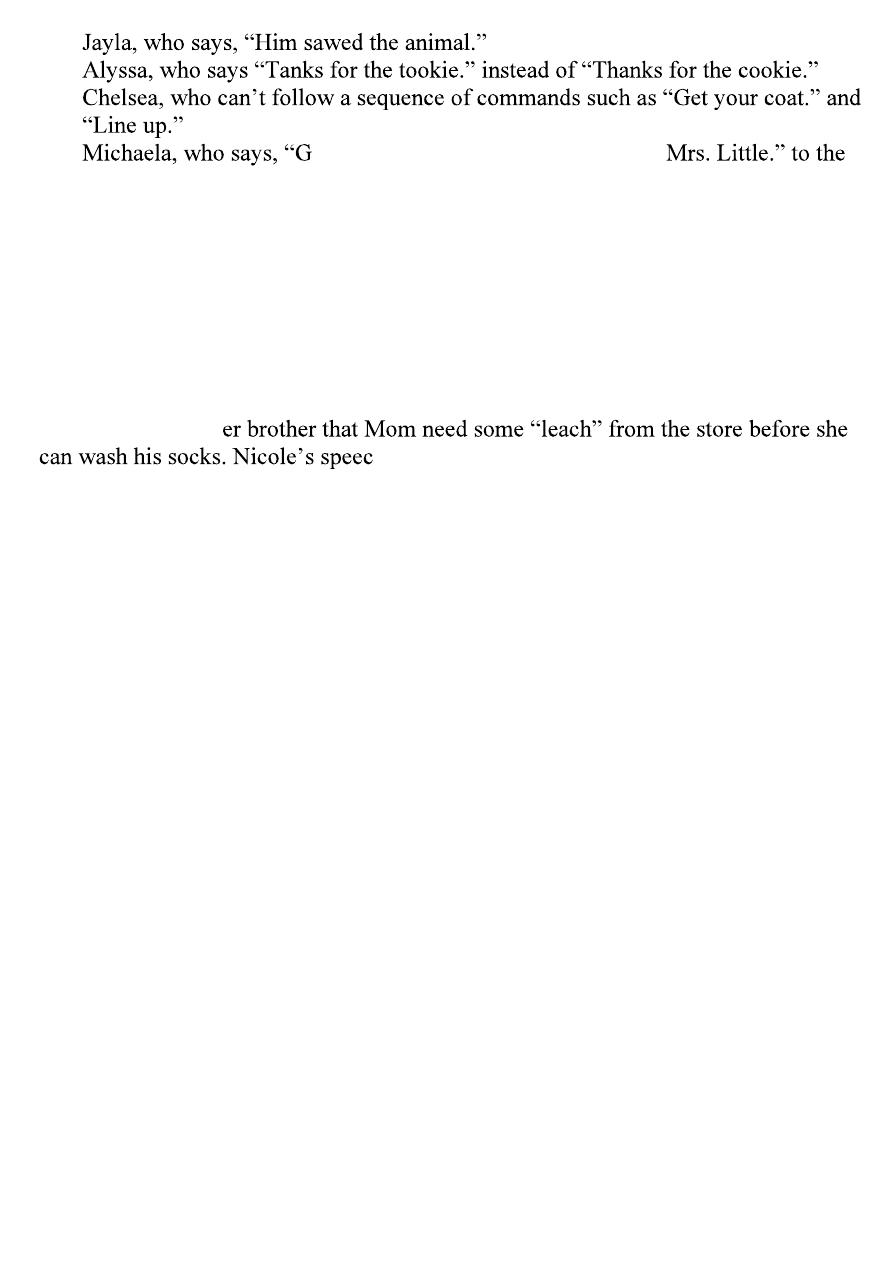
7) Which of the following children shows signs of a receptive language disorder?
A)
B)
C)
D) -G-Good m-m-m-morning, M-M-M-
principal.
8) Which of the following statements about dialects is most accurate?
A) Dialects are more common in English than in other languages.
B) Dialects are linguistically correct within the rules that govern them.
C) Dialects should usually be considered to be inferior to Standard English.
D) Dialects are severe forms of communication disorders that require intensive
intervention.
9) Nicole tells her old
h error is known as a/an _____.
A) addition
B) distortion
C) substitution
D) omission
10) Which of the following statements about speech-sound errors is true?
A) Treatments to address them are relatively simple.
B) Treatments must be implemented before the age of 7.
C) They result from a defect in the operation of the speech apparatus.
D) They result from problems recognizing or processing the sounds of language.
11) Which of the following students is most likely to have problems with reading?
A) Abe, a child with a phonological disorder
B) Charlene, a child with a fluency disorder
C) Demetrius, a child with a voice disorder
D) Francine, a child with an articulation disorder
12) A child with a communication disorder is eligible for special education services when
the disorder _____.
A) has an adverse effect on learning
B) has persisted for at least three years
C) is evident when the child enters school
D) has become worse despite the use of research-based interventions
13) Which of the following is NOT true about stuttering?
A) Stuttering is situational.
B) Stuttering affects more girls than boys.
C) Stuttering occurs more often in twins.
D) Stuttering is in some ways least understood.
121
14) Cherell is a 9th grader who is experiencing some difficulties at school. She has been
that she is tired of being teased by other students who claim that she sounds like a
m
_____.
A) cluttering
B) denasality
C) disnomia
D) dysphonia
15) Which of the following students is most likely to have a language disorder?
A) 2-year-old Brad who is just learning to talk.
B) 5-year-old Jasmine who cannot speak English.
C) 6-year-old Parker who has an extensive vocabulary, but cannot answer questions.
D) 7-year-old Rodney who speaks in sentences, but
16) Speech and language impairments constitute a secondary disability for approximately
_____.
A) 60% of students who receive special education services for another primary
disability
B) 50% of students who receive special education services for another primary
disability
C) 30% of students who receive special education services for another primary
disability
D) 20% of students who receive special education services for another primary
disability
17) A loss of the ability to process and use language is known as _____.
A) aphasia
B) apraxia
C) dysarthria
D) dyslexia
18) Mrs. Gonzales is evaluating Maria for a possible communication disorder. She asks
Maria a series of open-ended questions to evaluate her expressive speech. This type
of assessment is known as a _____.
A) case history
B) functional analysis
C) language application
D) language sample
122
19) Mrs. Crosby has been asked to evaluate Hector for a possible communication
Crosby has assessed Hector in both English and Spanish. What else can she do to be
sure that she has adequately measured his true communicative competence?
A) Interview his parents
B) Administer a third test in Spanish
C) Listen when Hector is involved in authentic conversational behavior
D) Interview his teachers
20) Which of the following is an example of BICS?
A) Writing a letter to a friend
B) Having a conversation about recess with a friend
C) Answering computer generated questions to prepare for a quiz
D) Participating in an online Discussion Board about the planets
21) Mrs. Robinson is a speech-language pathologist. She asks one of her students to look
_____.
A) discrimination
B) fluency
C) phonology
D) production
22) All of the following are true regarding therapy for phonological errors EXCEPT
_____.
A) sounds are not taught in isolation
B) the child is taught to recognize differences between minimally contrastive words
C) the therapist and child give and receive directions
D) it is incompatible with therapy for articulation errors
23) In the Lidcombe Program, children who stutter _____.
A) are praised for fluent speech
B) are praised for maintaining eye contact
C) are taught to speak to a rhythmic beat
D) are taught to prolong troublesome sounds
24) The three components of augmentative and alternative communication are _____.
A) pictures, sounds, words
B) aided, unaided, cooperative
C) representational set, means of selection, means of transmission
D) no-tech, low-tech, high-tech
123
25) Which of the following need NOT be considered when deciding what items to
A) What peers are saying
B) The words his/her parents can pronounce
C) The vocabulary that the student is currently using
D) The vocabulary that is needed in school and in the community
26) In which placement alternative, does the speech and language professional deliver
service through consultation?
A) In pull out
B) In community based
C) In collaboration
D) In self-contained classrooms
27) The most prevalent method of service delivery to students who receive
speech/language services is _____.
A) pull-out
B) classroom based
C) community based
D) collaborative consultation
28) Darius is 18 months of age. His mother, Mrs. Bluestone, has referred him for a speech
such as the str
A) She should have tried to assist Darius herself before referring him.
B) She is confusing typical development with articulation errors.
C) She did not listen to enough speech sounds before referring him.
D) She did not observe him in a variety of settings to see if he had similar problems.
29) All of the following tests are components of a comprehensive evaluation to identify
communication disorders EXCEPT _____.
A) aptitude
B) hearing
C) articulation
D) language function
30)
a problem with _____.
A) morphology
B) pragmatics
C) semantics
D) syntax
124
ESSAY
1) Discuss articulation and phonological disorders.
2) Using a fictitious case study, illustrate two strategies for increasing naturalistic
teaching of language.
3) As a first grade teacher, what process would you follow if you had concerns about
implement should a language impairment be diagnosed?
4) Explain why the pull-out model for special education service delivery might not be
the best option.
5) Suppose that a colleague approached you for advice concerning a student who
stuttered. What advice would you offer her/him?