Chapter 8: Free Appropriate Public Education
Test Questions
True or False
1. The courts have provided a precise and clear definition for schools to follow when
determining if a student’s special education program is conferring meaningful educational
benefit.
2. As long as a school offers appropriate programming to students in special education, the
choice of educational methodology is up to the school district.
3. Failure to provide with the procedural requirements of the IDEA will always constitute
sufficient grounds for ruling that a local education agency has failed to provide an
appropriate education.
4. One result of the Board of Education v. Rowley decision is that the U.S. Supreme Court
provided the lower courts with a two-part formula to assist them in determining if a FAPE
was appropriate.
5. Courts have consistently struck down policies limiting the length of the school year for
students with disabilities.
6. In enacting the IDEA, Congress allowed schools to use funding limitations as justification for
denying a FAPE.
7. In determining the content of a student’s special education, costs can never be a
consideration.
8. Under the IDEA, medical services are available as a related service to students qualifying for
special education.
9. A child must be receiving special education to be entitled to related services under the IDEA.
10. Case law indicates that psychotherapy provided by a psychotherapist or psychologist can be a
related service.
Multiple Choice
1. A child with disabilities who needs related services but does not require special education is
protected under which of the following?
a. The IDEA.
b. Section 504.
c. FERPA.
d. NCLB.
2. According to the Supreme Court in Rowley, IDEA established a “basic floor of opportunity.”
The court defined this as
a. an education equal to that provided to students without disabilities.
b. instruction that allows the handicapped child to reach his/her maximum potential.
c. a guarantee of meaningful access to special instruction & related services.
d. the “best” possible education.
3. The federal courts have determined which of the following can be related services if they are
necessary to assist a child to benefit from special education? (May be more than one)
a. Psychological services
b. Cochlear implants
c. Transportation
d. Health services provided by a school nurse
e. Counseling
f. Medical treatment performed by a physician
4. In addition to the federal standards that the local education agency must meet, the IDEA
includes a requirement concerning state educational agency standards. According to this
requirement, if state standards exceed the federal standards
a. the LEA must follow the federal standards.
b. the LEA may choose to follow either federal or state standard.
c. the LEA must follow the state standards.
d. None of the above.
5. In extended school year (ESY) cases, school districts have been ordered to provide ESY
services when
a. the student with disabilities could benefit from such services
b. b. the student with disabilities would be harmed an interruption of services
c. it is needed to provide an education in the least restrictive environment.
d. All of the above.
6. Assistive technology might be required in accordance with (may be more than one answer)
a. the least restrictive environment mandate of the IDEA.
b. the related services mandate of the IDEA.
c. the FAPE mandate of the IDEA.
d. Section 504.
7. When an IEP teams a placement decision, which the following factors may be considered in
deciding on a student’s placement? (May be more than one answer)
a. the student’s IEP
b. proximity of the proposed placement to the student’s home school.
c. the LRE mandate of the IDEA.
d. the availability of services in the proposed placement.
e. The cost of the proposed placement
8. Which of the following are/is not a related service that needs to be provided under the IDEA?
(May be more than one answer)
a. Transportation to a residential setting if needed to provide an appropriate
education.
b. Transportation to an out of district school if needed to provide an appropriate
education when the parents have unilaterally made the placement.
c. Vision therapy provided by an ophthalmologist to correct as visual-perceptual
problem.
d. Full time nursing care in school if needed to provide an appropriate education.
9. The case in which the U.S. Supreme Court first addressed the issue of related services and
the IDEA was
a. Board of Education v. Rowley
b. Irving ISD v. Tatro
c. Smith v. Robinson
d. Honig v. Doe
10. A bright-line test is
a. an IQ test to determine eligibility for special education
b. a legislative formula for assisting schools to deliver a FAPE
c. an eye sight screening
d. an clear test for developed by higher courts to assist lower courts in making
decisions.
Short Answer
1. In the Rowley decision the Supreme Court developed a twofold inquiry when determining if
a student with disabilities is provided an appropriate education. Explain the Rowley case and
both parts of this test. How can schools ensure that they meet each part
2. Explain the U.S. Supreme Court’s decision in Winkelman v. Parma City School District
(2007)
3. What is a related service? When must a school provide a related service? What are the
limitations on related services?
4. Briefly explain the litigation regarding delivering complex health services as related services
under the IDEA.
5. When is a student no longer eligible for services under the IDEA?
6. A critical decision in developing FAPE is a student’s placement. Discuss factors that IEP
teams should consider in determining placement.
7. Describe procedural and substantive violations of FAPE.
8. Briefly discuss the four components of FAPE.
9. List and define 4 criteria for scientifically based instruction
10. Discuss the IEP team’s responsibilities when a student with disabilities graduates
Essay
1. Examine the evolving standards of what constitutes a FAPE from the Rowley decision
through IDEA 1997 and IDEA 2004. How has the concept of FAPE changed since the
EAHCA was passed in 1975?
2. What is instruction based on peer-reviewed research? How can peer-reviewed research
instruction used to ensure a FAPE is delivered to students in special education?
3. Explain the controversy over FAPE and educational methodology.
4. Discuss school district responsibilities with respect to FAPE.
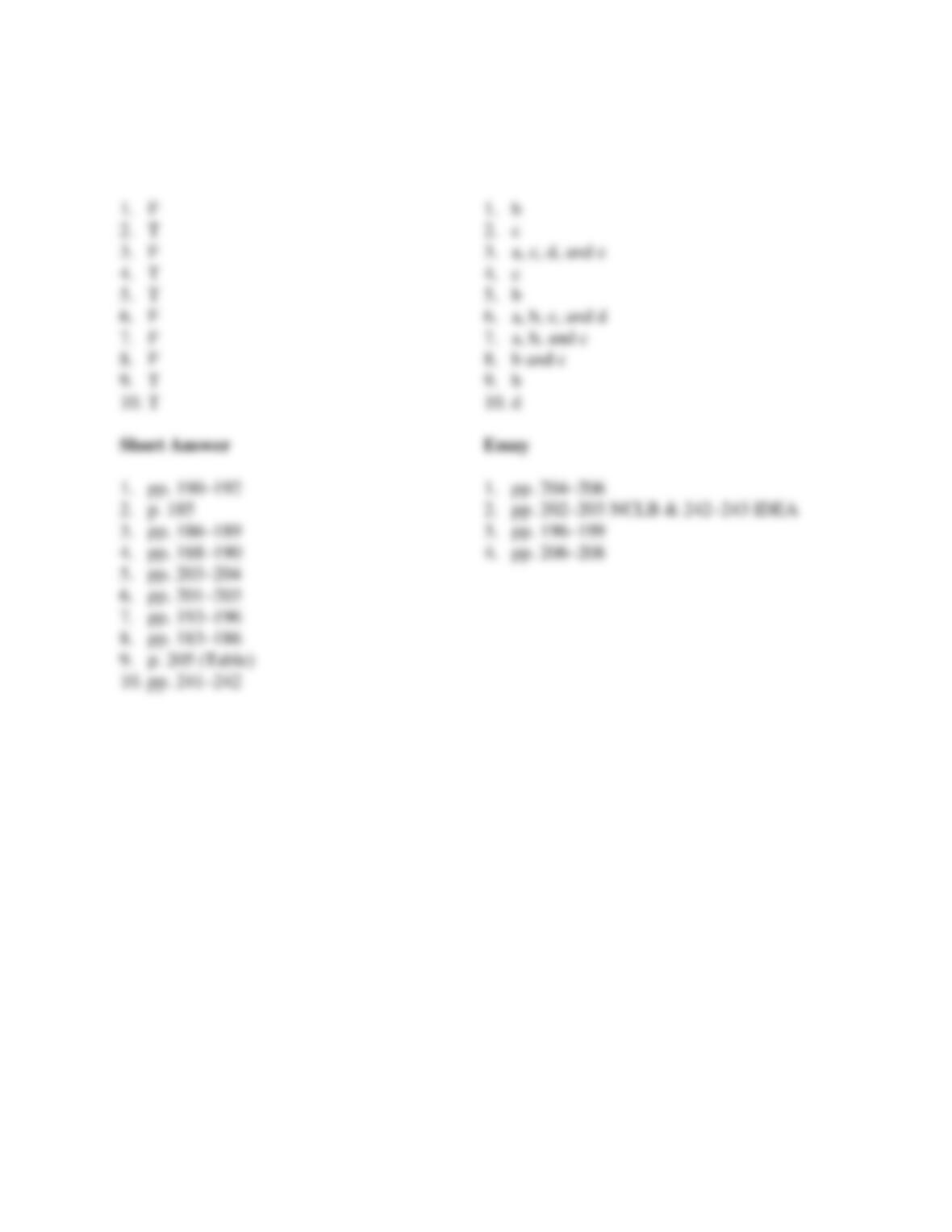
Chapter 8: Free Appropriate Public Education
True or False
Multiple Choice