
Chapter 7: Governance and Finance: Regulating and Funding Schools
CHAPTER SEVEN
GOVERNANCE AND FINANCE: REGULATING AND FUNDING SCHOOLS
Governance: How Are Schools Regulated and Run?
* 1. With respect to education, which of the following best describes the significance of the Tenth Amendment
to the Constitution?
a. It established the principle of separation of church and state.
b. It set land aside for the purposes of funding public education in the United States.
c. It assigned legal responsibility for the education of its citizens to the fifty states.
d. It mandated that all teachers must be licensed in order to teach students in public school classrooms.
* 2. Which of the following sta
governing education?
a. Most states have organizational structures that are unique to the geographical, economic, and
political characteristics of the state.
b. States in similar parts of the country, such as the northeast, the Midwest, and the deep South have
similar organizational structures, but differ significantly from the organizational structures in other
parts of the country.
c. States with large urban populations, such as New York and California, have similar organizational
structures, but they differ significantly from the organizational structures of rural states, such as
Wyoming and South Dakota.
d. In spite of their differences in geography, economy, and politics, each of the fifty states has a
surprisingly similar organizational structure.
* 3. State boards of education regulate and advise schools by doing which of the following?
1. Hiring and releasing teachers
2. Establishing the length of the school year
3. Issuing and revoking teaching licenses
4. Publishing standards for accrediting schools
5. Implementing a system for gathering educational data (such as standardized test scores)
a. 1, 2, 3, 4, 5 b. 2, 3, 4, 5 c. 1, 2, 3, 4 d. 1, 2, 4, 5 e. 1, 2, 3, 5
* 4. Which of the following best describes the relationship between state boards of education and state offices
of education?
a. State boards make policies, and state offices implement policies for individual states.
b. Both state boards and state offices make policies, which are then implemented by schools districts
in individual states.
c. State boards provide the philosophical foundations for policies, which are then made by state offices
for individual states.
d. State boards make policies, which are implemented by individual districts, and are evaluated by state
offices for individual states.
* 5. Which of the following best describes the staffing of state boards of education and state offices of
education?
a. State boards are staffed by professional educators, whereas state offices are staffed by lay people
(people who are not trained as professional educators).
b. Both state boards and state offices are staffed by professional educators.
c. Both state boards and state offices are staffed by lay people, who hire professional educators as
consultants.
d. State boards are staffed by lay people, whereas state offices are staffed by professional educators.

Chapter 7: Governance and Finance: Regulating and Funding Schools
* 6. As a new teacher, to which of the following will you apply for an initial teaching license?
a. The state board of education for your state
b. The state office of education for your state
c. The commissioner of education for your local state
d. The local district in which you hope to teach
** 7.
Which of the following statements best describes the parameters (if any) within which you must operate?
a. There are no parameters within which you must operate. Your committee can select the series you
believe is highest in quality.
b. You must select a textbook series that is on a state-approved list.
c. You are encouraged to select a textbook series that is on a state-approved list, but you may select a
d. You must select a series that is on both a state-approved list and a school-approved list.
* 8. A geographical area given the legal responsibility for education within its borders is best described as a:
a. school system.
b. school testing region.
c. school district.
d. state board of education.
* 9. Which of the following is given the responsibility for determining the curriculum that will be taught at an
individual school?
a. The state office of education for the state
b. The local school district in which the curriculum is taught
c. The local school in which the curriculum is taught
d. The individual teacher within the school in which the curriculum is taught
* 10. Which of the following exists in every school district?
1. A district superintendent
2. A district school board
3. A district central staff
4. A district curriculum council
5. A district school-community relations council
a. 1, 2, 3, 4, 5 b. 1, 2, 3, 4 c. 1, 2, 3, 5 d. 1, 2, 3 e. 2, 3, 4
* 11. Of the following, what is the best description of a local school board?
a. Groups of elected lay citizens responsible for setting school district policy
b. Groups of trained education professionals appointed by state committees
c. Groups of elected citizens who have earned at least bachelors degrees at an accredited college or
university
d. Groups of district teachers, elected by their individual schools, who advise the superintendent on
matters of district policy
* 12. Which of the following is not a function of local school boards?
a. Implementing curriculum guidelines specified at state levels
b. Specifying teaching techniques that increase student achievement
c. Raising and disbursing money to schools within the district
d. Hiring and firing individual teachers in schools
Chapter 7: Governance and Finance: Regulating and Funding Schools
* 13. Which of the following is responsible for defining the curriculum and implementing general
guidelines developed by states?
a. State level education boards
b. Local school boards
c. Individual schools (led by school principals)
d. Individual teachers
* 14. Which of the following best describes the composition of local school boards?
a. Male, cultural minority, lower SES, older (over 40)
b. Female, white, older, wealthy
c. Male, white, young, lower SES
d. Male, white, older, wealthy
* 15. istrative officer?
a. The state superintendent of education
b. The district superintendent
c. The chairperson of the local school board
d. A school principal elected by all the teachers in the district
* 16. Which of the following is responsible for overseeing the implementation of polic
school?
a.
b. The local school board
c.
d. The principals of each school in a district
* 17. The person or persons most responsible for establishing and maintaining high expectations for teachers and
students is:
a. the superintendent for the local school district.
b. the local school board for the district.
c. the principal of the individual school.
d. the teachers, themselves, in the individual school.
* 18. With respect to promoting student learning, which of the following is/are often considered to be the most
ve structure?
a. The members of the local school board
b. The district superintendent
c.
district)
d. The principal of each local school
** 19. You have just secured your first teaching job. If your district is consistent with historical trends in the
creation of school districts, which of the following is most likely?
a. You are likely to teach in a smaller district than in the past, since the trend is toward the creation of
smaller school districts that are more personalized for both teachers and students.
b.
istrict than in the past, since the
trend is toward larger school districts in rural areas (such as sparsely populated areas of Wyoming,
Montana, and Nevada) but toward smaller school districts in large cities (such as New York and
Chicago).
c. kely to teach in a larger district than in the past, since the trend is toward fewer and larger
school districts, in general, across the country.
d. n a larger district than in the past,
than in the past, since the population of the United States is moving South and West.
Chapter 7: Governance and Finance: Regulating and Funding Schools
** 20. red for your first teaching position. Which of the following best describes the
teaching?
a. Local school boards are composed of lay people (people who are not trained as professional
educators) appointed by superintendents of the districts in which they serve.
b. Local school boards are composed of professional educators selected by the city governments in
which they serve.
c. Local school boards are composed of professional educators who are elected by the citizens of the
districts in which they serve.
d. Local school boards are composed of lay people who are elected by the citizens of the districts in
which they serve.
** 21. our first teaching job and the issue of a student in one of your classes missing school to
participate in a foreign exchange program comes up. Which of the following is most responsible for
establishing the general policies for student attendance in this case?
a. The state office of education for your state
b. The local school board for your district
c. The school in which you teach
d. You
** 22.
they maintain a C average for all their courses. Of the following the group most responsible for setting this
policy is:
a. the local school board for the district in which you teach.
b. the administration for your school (the principal and vice-principal or assistant principals).
c. the administration for your school with input from the teachers in the school.
d.
** 23. ich will be most influential in determining whether or not
you get the job?
a. The local school board for the district in which you want to teach
b. The district superintendent for the district in which you want to teach
c. The school principal for the school in which you want to teach
d. A committee composed of teachers in the school (a search committee), in which you want to teach
Essay Items
** 24. Identify and explain one advantage and one disadvantage each of small and large school districts.
** 25. Describe five functions of local school boards, and provide an example that illustrates each.
** 26. Describe two important disparities between the composition of school boards and the people they serve.
Explain why these disparities are important.
School Finance: How Are Schools Funded?
* 27. According to Gallup polls examining public opinion, which of the following is the biggest problem facing
local schools?
a. Ineffectively prepared teachers
b. Inadequate school leadership (such as under-qualified school principals)
c. Inadequate district leadership (such as lack of effective leadership from the district superintendent)
d. Lack of financial support and funding for the schools
Chapter 7: Governance and Finance: Regulating and Funding Schools
* 28. s education budget is supplied by states?
a. 20%
b. 50%
c. 70%
d. 80%
* 29. Of the following, which best approximates the percentage of educational funding that comes from the
federal government?
a. Slightly less than 10%
b. Slightly less than 20%
c. Slightly more than 30%
d. About 50%
* 30. Of the following, which best describes the respective proportion of funding that schools receive from local,
state, and federal sources?
a. Local and state shares are about equal, and the federal share is much smaller.
b. State and federal shares are about equal, and local shares are much smaller.
c. Local sources provide about three fourths of all funding with the remaining fourth being about
evenly split between state and federal sources.
d. Each of the three sources provide about the same proportion of the funding for local districts.
* 31. The majority (about three fourths) of funding for schools at the local level comes from which of the
following?
a. Traffic fines
b. Federal and state grants
c. Fees for building permits
d. Property taxes
* 32. For most states in the United States, the largest source of state revenues is which of the following?
a. Sales taxes
b. State gasoline taxes
c. Property taxes
d. rettes and alcohol)
* 33. Funding for schools at the local, state, and federal level is controversial. Which of the following best
describes the controversies involved in educational funding?
a. sproportionately affect low income tax
payers.
b. Local funding is most controversial, because sales taxes unfairly target high income families.
c. State funding is most controversial, because money derived from lotteries reduces money that
education receives from other sources.
d. Federal funding is most controversial because proponents believe education is essential for the
progress of the country, whereas critics warn of too much federal control of education.
* 34. Which of the following best describes the source of funding for programs such as Title I, Head Start, and
the Bilingual Education Act of 1972?
a. The programs are funded by federal categorical grants and block grants.
b. The programs are funded by state categorical grants and block grants.
c. The programs are funded by federal categorical grants (but not block grants).
d. The programs are funded by federal block grants (but not categorical grants).
Chapter 7: Governance and Finance: Regulating and Funding Schools
* 35. Based on research examining educational expenditures and educational quality, which of the following is
the most accurate statement?
a. Little relationship exists between the amount of money spent on education per pupil and the amount
students learn.
b. Increased educational funding improves school physical facilities (such as school buildings), but
little evidence of improved learning exists.
c. Increased educational funding results in better qualified teachers and smaller class sizes, which
result in increased learning.
d. Increased educational funding increases the size of administrative staffs, but does little to improve
working conditions for teachers.
* 36. Of the following, which best approximates the percentage of the money allocated to education that is
actually spent on instruction?
a. 10%
b. 25%
c. 60%
d. 85%
* 37. Of the following, which best describes the comparison between the amount of education money that is
spent on administration and maintenance of schools compared to administration and the maintenance of
physical plants in industry?
a. Education spends a much higher percentage of its total budget (about 50% more) on administration
and the maintenance of schools than does industry for its administration and maintenance of physical
plants.
b. Education spends a slightly higher percentage of its total budget (about 5% more) on administration
and the maintenance of schools than does industry for its administration and maintenance of physical
plants.
c. Education and industry spend comparable percentages of their total budgets on administration and
the maintenance of schools and physical plants.
d. Education spends a significantly lower percentage of its total budget (about 20% less) on
administration and the maintenance of schools than does industry for its administration and
maintenance of physical plants.
* 38. Of the following, which is the closest approximate percentage of district funds that are spent on
administrative services?
a. 5%
b. 10%
c. 20%
d. 25%
* 39. Of the following, which is the most accurate estimate of yearly per-pupil spending in the United States?
a. $ 3,000
b. $ 6,000
c. $10,000
d. $15,000
* 40. Of the following, which is the best approximation of the range of yearly per-pupil spending in the United
States?
a. $2,000 to $11,000
b. $5,000 to $12,000
c. $6,000 to $17,000
d. $8,000 to $22,000
Chapter 7: Governance and Finance: Regulating and Funding Schools
Essay Items
** 41. Describe and explain the most important disadvantage of sales taxes as sources of revenue for states.
** 42. Describe and explain two important disadvantages in using property taxes as the basis for funding schools
in local districts.
** 43. Describe the difference between federal block grants and federal categorical grants. Which type has most
strongly influenced education at the local level? Explain your answer.
Emerging Issues in School Governance and Finance
* 44. Which of the following best describes the funding of urban school districts compared to their suburban
counterparts?
a. Since the needs are greater, urban districts are better funded than are suburban districts.
b. Since the majority of funds for districts come from states, the funding of urban and suburban
districts is about equal.
c. The funding of large urban districts, such as New York and Los Angeles is better than their suburban
counterparts, but the funding of medium-sized smaller urban districts is similar to their suburban
counterparts.
d. Since property taxes are higher, suburban districts are better funded than are urban districts.
** 45. ner city school. When you enter
the sc
school is not air conditioned, and textbooks in some of the curriculum areas are outdated.
because you recently visited a school in a different district only a few miles away, and the school was very
modern and well equipped. Which of the following is the most likely reason for the difference in the two
schools?
a. The administration of the first school is less effective than the administration of the second school.
b.
school board in the second district.
c. that is as clear and focused as is the mission for the second
school.
d. The property taxes in the first district are lower than the property taxes in the second district.
* 46. The concept of school choice most commonly brings to mind which of the following?
1. Charter schools
2. School vouchers
3. Comprehensive schools
4. Alternative schools
a. 1, 2, 3, 4 b. 1, 2, 3 c. 1, 3, 4 d. 1, 2
* 47. Which of the following best describes a charter school?
a. A private school that is partially funded by school vouchers
b. A religious school that receives public funding (such as money that comes from personal property
taxes) to help educate students with exceptionalities
c. A school that is publicly funded (such as money from property taxes) but is governed independent of
the structure of a local school district
d. A school that is publicly funded, but is governed by a local advisory council appointed by the local
school board of the district in which the school exists
Chapter 7: Governance and Finance: Regulating and Funding Schools
* 48. Which of the following is the best description of KIPP schools?
a. A state-regulated system of private schools with the stated goal of preparing all students to do
college level work.
b. A comprehensive system of public schools, funded by school vouchers and regulated and run by
local school boards
c. A national network of private, religious schools that receive federal funds for the purpose of
providing extra services for students who have learning disabilities.
d. A national network of free, open-enrollment, charter schools with a stated goal of preparing students
in underserved communities for success in college and in life
* 49. According to research, which is the most accurate assessment of for-profit (designed to make money for the
people managing the school) charter schools?
a. The educational experiences they provide for students are generally superior to the experiences
students have in public schools.
b. The educational experiences they provide for students are generally about equivalent to the
experiences students have in public schools.
c. The educational experiences they provide for students are generally superior to the experiences
students have in public schools and about equivalent to the experiences not-for-profit charter schools
provide.
d. The educational experiences they provide for students are generally inferior to the experiences
students have in public schools.
* 50. Which of the following best describes vouchers?
a. Written applications that people who want to open charter schools submit to local school boards
b. Financial support that parents can use to purchase educational services at schools other than the ones
their children are attending
c. Written descriptions of the governance structure for schools committed to site-based decision
making
d. Federal funding for private schools to support the education of students with learning disabilities
* 51. Which of the following best describes state tax credit plans?
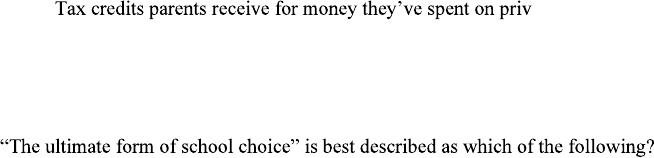
a. ate school tuition
b. Tax credits local school districts receive for implementing charter schools
c. Tax credits districts with low property tax bases receive to make funding between rich and poor
districts more equitable
d. Tax credits individual schools receive for implementing site-based decision making plans
* 52.
a. Charter schools
b. Vouchers
c. Home schooling
d. State tuition tax credits
Essay Item
** 53. Describe the controversy involved in the issue of school choice. Include and explain both sides of the
argument.
Chapter 7: Governance and Finance: Regulating and Funding Schools
CHAPTER SEVEN ANSWERS
Governance: How Are Schools Regulated and Run?
School Finance: How Are Schools Funded?
Chapter 7: Governance and Finance: Regulating and Funding Schools
Emerging Issues in School Governance and Finance