107
CHAPTER 6
MULTIPLE CHOICE
1) Why is it difficult to develop a clear definition of emotional disabilities?
A) Most children are well behaved.
B) Norms for appropriate behavior differ across cultures.
C) Emotional and behavior disorders usually occur in isolation.
D) There is a clear definition of what constitutes good mental health.
2) Which of the following student behaviors best fits the IDEA definition of emotional
disturbance?
A) Grace has been depressed and withdrawn for 7 months.
B) Maggie responds to teasing one day by throwing a chair through a window.
C) Page usually gets excellent grades but since starting fourth grade has been getting
D) Courtney tells the school nurse that she has been crying every day for a week
because her parents are divorced.
3) Which of the following is NOT a condition required to qualify for an emotional
disturbance?
A) Chronicity
B) Difficulty in school
C) Severity
D) Visibility
4) All of the following factors contribute to the vagueness of the definition of emotional
disturbance EXCEPT _____.
A) differing degrees of tolerance for misbehavior
B) varying expectations among parents and educators
C) inclusion of five different problems as qualifications
D) using terminology such as inappropriate and satisfactory
5) Which of the following conditions is excluded from the IDEA definition of emotional
disturbance?
A) Bipolar disorder
B) Depression
C) Schizophrenia
D) Social maladjustment
6) What is one advantage of the definition of emotional disturbance proposed by the
CCBD?
A) It identifies age-appropriate behavior.
B) It clarifies the social dimension of the disability.
C) It ignores cultural and ethnic influences on behavior.
D) It increases the chance of early identification and intervention.

108
7) Which of the following is NOT an example of a student displaying possible
internalizing behavior?
A) Twelve-year-old Ben daily fantasizes that he is a super hero. He refuses to
participate in any social or academic interactions but instead all day daydreams
about super heroes.
B) Seven-year-old Sophie is constantly out of her seat during all subjects, ignores
the teacher, and argues aggressively.
C) Nine–year–old Tameka asks to see the nurse every day, upon arrival to school from
home, complaining of a stomach ache.
D) Ten-year-old Steven is terrified of fish and each day becomes immobilized and
refuses to walk past the aquarium in the hall.
8) Which of the following statements is true regarding gender and emotional
disabilities?
A) Boys are more likely to have externalizing disorders than girls.
B) Boys are more likely to have internalizing disorders than girls.
C) Boys and girls are equally likely to have externalizing disorders.
D) Boys and girls are equally likely to have internalizing disorders.
9) Which of the following statements is true regarding students who display antisocial
behaviors at an early age?
A) They are likely to develop fears in adolescence.
B) They are likely to outgrow these behaviors by adulthood.
C) They are likely to engage in delinquent behavior in adolescence.
D) They are likely to pursue a college degree after graduation from high school.
10) What is the kingpin behavior around which other behavioral excesses revolve?
A) Fighting
B) Noncompliance
C) Tantrums
D) Vandalism
11) All of the following are causes of emotional disabilities EXCEPT _____.
A) brain dysfunction
B) differences in temperament
C) genetic factors
D) vitamin deficiencies
12) Children with emotional and behavior problems are more likely to come from homes
in which _____.
A) discipline is harsh
B) supervision is constant
C) spoiling is the norm
D) space is limited
109
13)
is unable to read grade-level text. He disrupts class during reading by cursing and
screaming when he is asked to read. Which of the following is an evidence-based
strategy most
A) Punishing Sammy when he disrupts reading.
B) Having Sammy to complete an easier task than other students during reading.
C) Sending Sammy to the principal when the behavior occurs.
D) Providing explicit and systematic instruction to improve his reading deficits.
14) Which of these statements about the identification of students with emotional and
behavior disorders is most accurate?
A) Young children are more difficult to identify.
B) Systematic assessment methods are used by all schools for identification.
C) Children with internalizing problems are the first to be identified.
D) Adolescents are more difficult to identify because they hide their problems.
15) Which of the following statements regarding risk factors and emotional and behavior
problems is true?
A) Behavior problems can often be a link to a specific risk factor.
B) Societal risk factors are more likely to produce negative outcomes than family factors.
C) Family risk factors are more likely to produce negative outcomes than school factors.
D) Behavioral problems are generally the result of the accumulation of several risk
factors.
16) Screening tests for emotional and behavior disorders _____.
A) are often unreliable with questionable validity
B) are usually rating scales or checklists
C) are usually completed by a school psychologist
D) are used to determine eligibility for special education
17) Behavior intervention plans are required for students with disabilities _____.
A) who require special education
B) who are placed in segregated settings
C) who have been suspended from school
D) who have behavior issues that adversely affect school performance
18) Mr. Shaffer is a high school history teacher. He is very concerned about Rafael, one of
his students. Rafael exhibits aggressive behavior in class, and episodes are becoming
more frequent. Mr. Shaffer has decided to conduct a functional behavior assessment to
s and two of his
teachers to determine which situations provoke aggressive behavior and solicit
suggestions for keeping Rafael calm. Mr. Shaffer is conducting a/an _____.
A) descriptive functional behavior assessment
B) functional analysis
C) indirect functional behavior assessment
D) integrated functional behavior assessment
110
19) Curriculum for students with emotional disabilities should focus on _____.
A) developing personal, academic, and social skills
B) developing vocational skills and treating maladaptive behaviors
C) treating maladaptive behaviors before developing academic skills
D) developing academic and vocational skills before treating maladaptive behaviors
20) Which of the following teachers is likely to have the fewest students with emotional
and behavior disorders in class?
A) Mr. Latta, an algebra teacher
B) Mrs. Dubois, a French teacher
C) Mr. Koslov, a history teacher
D) Mr. Tomko, a chemistry teacher
21) Mrs. Byrd is a middle school English teacher. She has just learned that Carla, a new
student in her class, has an emotional disability. She wants to keep confrontations and
classroom disruptions at a minimum. Mrs. Byrd should _____.
A) provide easy tasks to prevent frustration
B) provide explicit and systematic instruction
C) provide challenging tasks to prevent boredom
D) avoid calling on Carla unless she raises her hand
22) Which of the following social skills programs includes curriculum materials for
children and adolescents?
A) FAST Social Skills
B) Taking Part
C) The Prepare Curriculum
D) The Walker Social Skills Curriculum
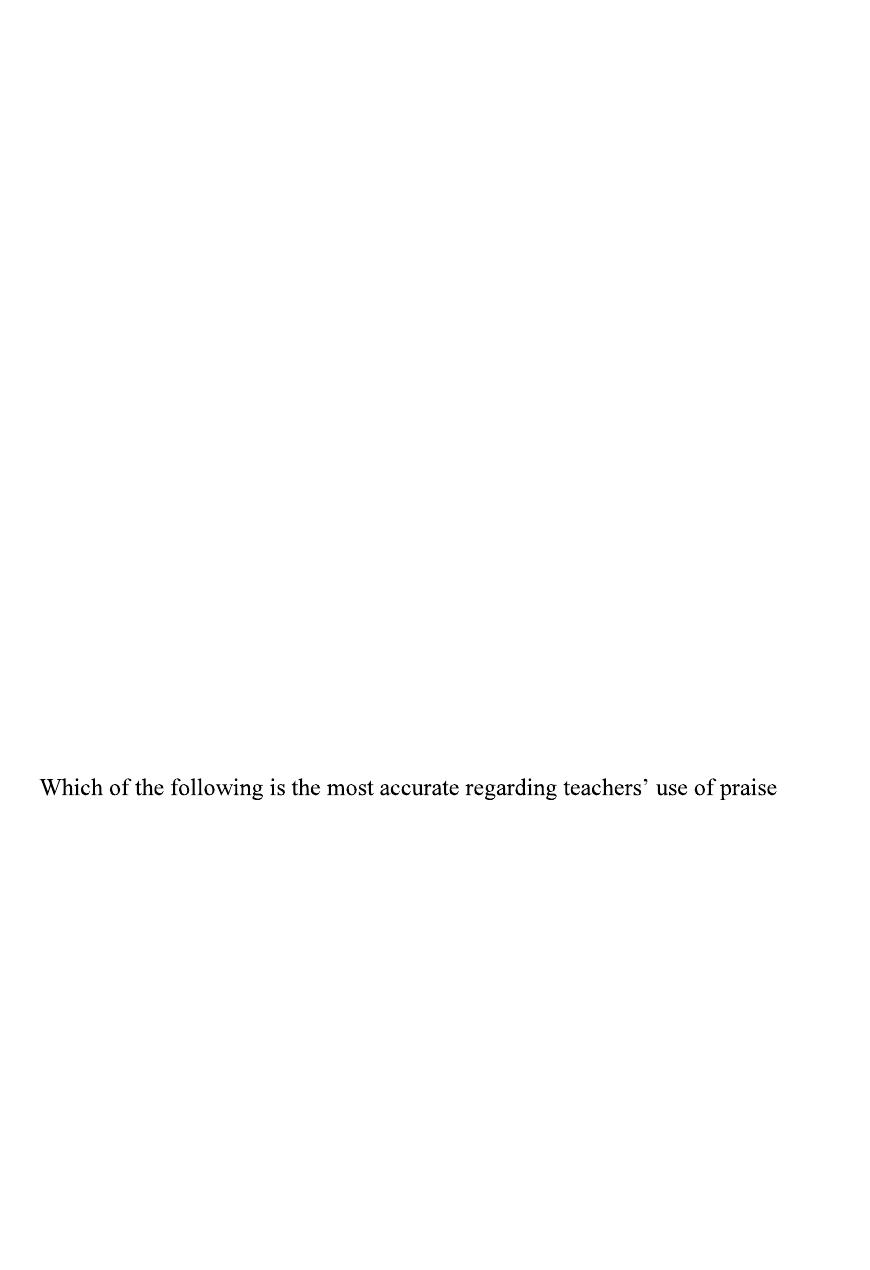
23) with
students who have emotional or behavioral disorders?
A) Teachers tend to praise students too frequently.
B) Teacher praise statements decline each year after second grade.
C) Teachers generally use less praise statements and more statements of disapproval
or reprimands.
D) Special education teachers use praise statements more frequently than general
education teachers.
24) Schoolwide Positive Behavioral Interventions and Supports _____.
A) is used only by administrators
B) is a new method for improving school safety
C) use research-based interventions to teach appropriate behaviors
D) is conceptualized from a punishment perspective
111
25) Which of the following statements about self-management is most accurate?
A) It is a tool for identification.
B) It has not been useful for students with emotional or behavioral disabilities.
C) It promotes maintenance and generalization of new behaviors.
D) It has mainly been used for students with health challenges.
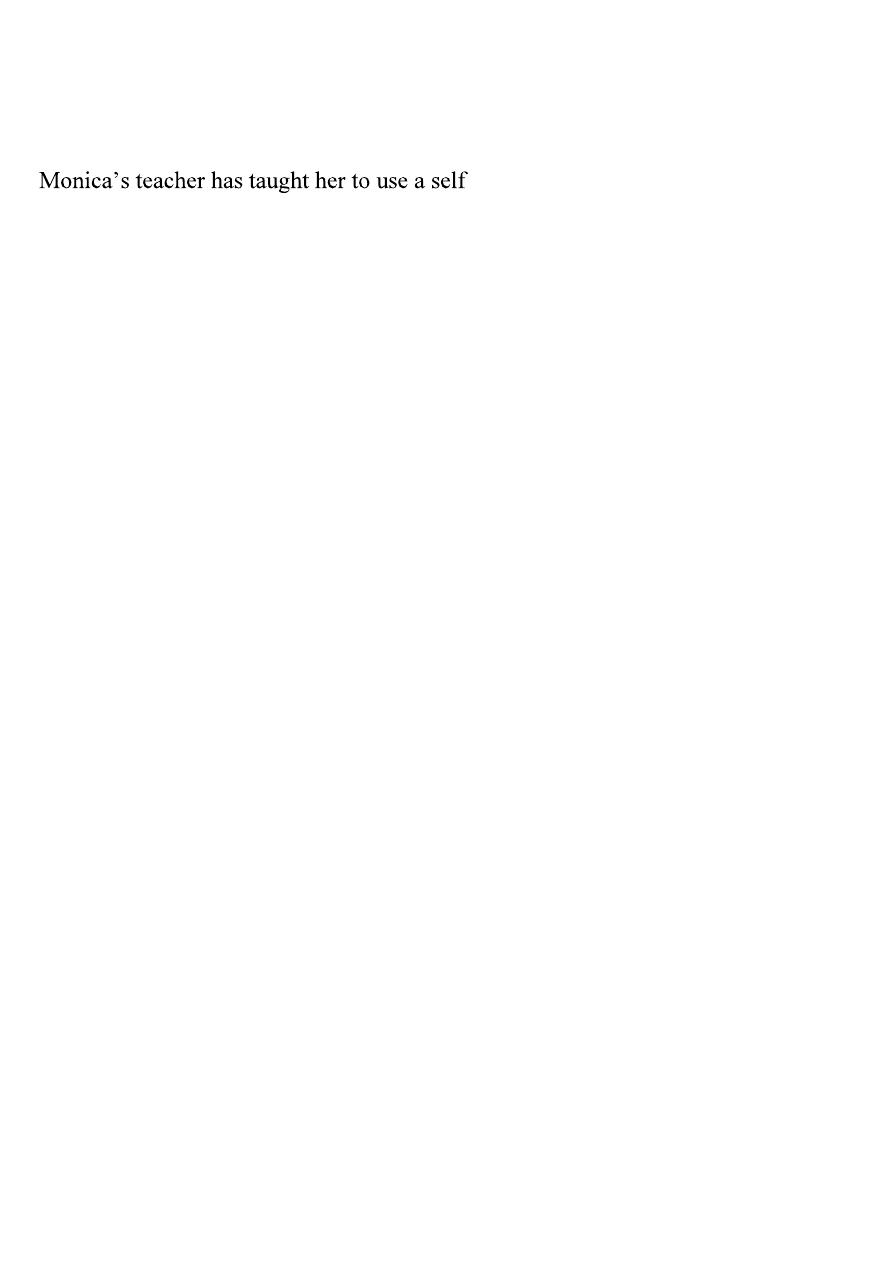
26) -management strategy to control her
blurting out in class. Her teacher has agreed to let her have extra time in the listening
center if she has fewer than 5 blurt outs during morning work. Monica has been
instructed to color the circle on her chart green if she has met the goal. On Thursday
after morning work, Monica holds up a green circle and smiles at her teacher. The
form of self-management described in this scenario is _____.
A) self-evaluation
B) self-monitoring
C) self-determination
D) self-reinforcement
27) Which of the following is a proactive management strategy?
A) Having unregulated transition times
B) Posting ambiguous rules and expectations
C) Allowing students opportunities to make choices
D) Seating difficult students in the back of the room
28) What is the first challenge that teachers of students with behavior disorders face when
they try to use a group process to modify behaviors?
A) Finding appropriate role models
B) Creating a sense of group solidarity
C) Getting students to follow directions
D) Teaching students to accept responsibility for their actions
29) Mrs. Gardner is using a peer support strategy to motivate her students to behave more
appropriately. Students have been asked to watch their classmates and catch them
being good. Mrs. Gardner praises students who have noticed and reported positive
behavior. Which of the following strategies is she using?
A) Peer monitoring
B) Positive peer reporting
C) Peer tutoring
D) Peer support and confrontation
30) Teachers who exhibit differential acceptance for students with emotional and
behavior problems _____.
A) like some students better than others
B) accept some inappropriate behaviors but not others
C) justify angry and aggressive student behavior as part of the disability
D) witness anger and aggression without becoming angry or aggressive

112
ESSAY
1) Discuss the advantages of the definition of emotional and behavioral disorders
proposed by the Council for Children with Behavioral Disorders.
2) Explain the difference between externalizing and internalizing behaviors and provide
at least four examples of each type of behavior.
3) There is some controversy surrounding the intelligence of students who are
emotionally or behaviorally disabled. Explain the reasons for this controversy.
4) Describe the three tiers of support in schoolwide positive behavioral interventions and
support (SWPBIS) and explain what happens at each tier.
5) What are the five dimensions by which behavior can be objectively measured?
Explain each.