Chapter 5: Educational Philosophy and Your Teaching
CHAPTER FIVE
EDUCATIONAL PHILOSOPHY AND YOUR TEACHING
Philosophy and Philosophy of Education
* 1. At a most basic level, philosophy is often described as:
a. a search for wisdom.
b. a set of fundamental principles.
c. a guide for action in our daily lives.
d. a system of beliefs about how the world works.
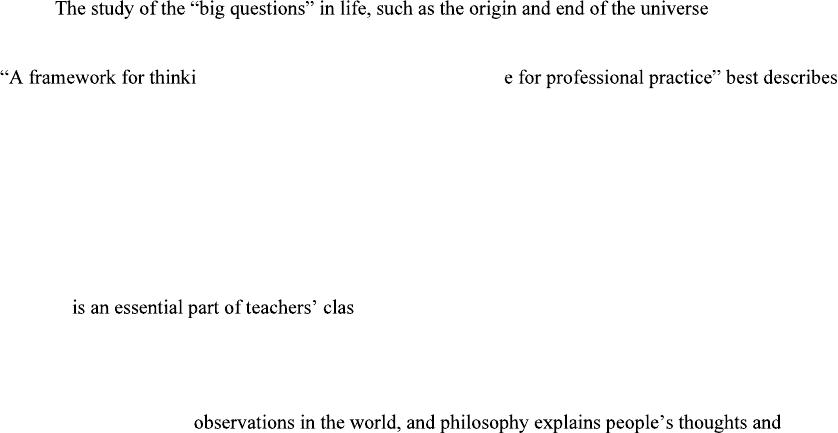
* 2. Which of the following best describes a formal description of philosophy?
a. The study of the universe and the place of humanity within it
b. The study of the moral principles of truth, justice, and honor
c.
d. The study of theories of knowledge, truth, existence, and good
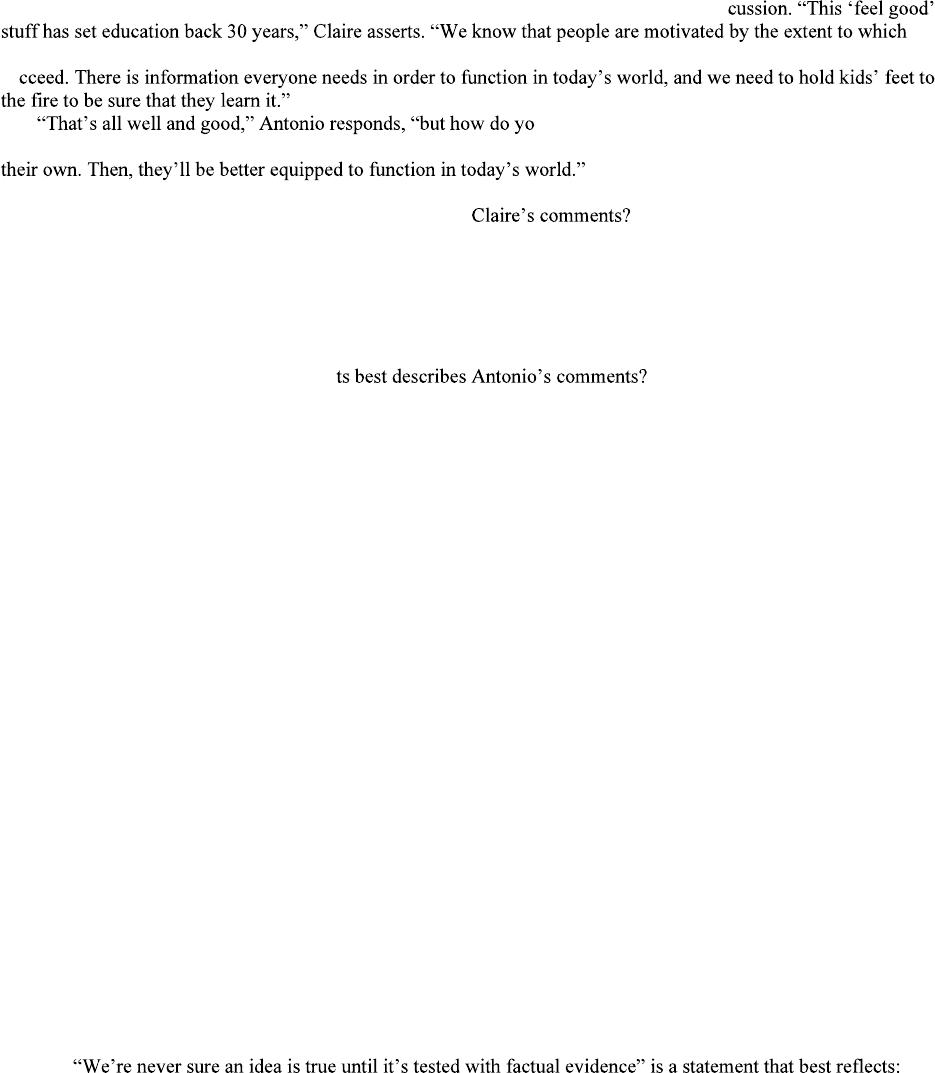
* 3. ng about educational issues and a guid
which of the following?
a. An epistemology of education
b. An ontology of education
c. An axiology of education
d. A philosophy of education
* 4. Which of the following best describes the role of philosophy in teacher professionalism?
a. It helps ensure that professional teachers will be ethical in their dealings with students.
b. It is an essential part of the knowledge base teachers use to make decisions.
c. It sroom strategies.
d. It ensures that students who are members of cultural minorities will be instructed without cultural
bias.
* 5. Which of the following statements best describes the relationship between theory and philosophy?
a. Theories explain
emotions.
b. Philosophy is used to analyze ideas, but theories go beyond philosophy to explain observations and
events.
c. Theories explain observations in the world, but philosophy goes beyond theory to describe how
things ought to be.
d. Theories are based on principles, and philosophy is used to form the principles.
* 6. A description of the way education, architecture, and any other profession ought to practice is called:
a. professional theory.
b. normative philosophy.
c. character education.
d. values clarification.
Chapter 5: Educational Philosophy and Your Teaching
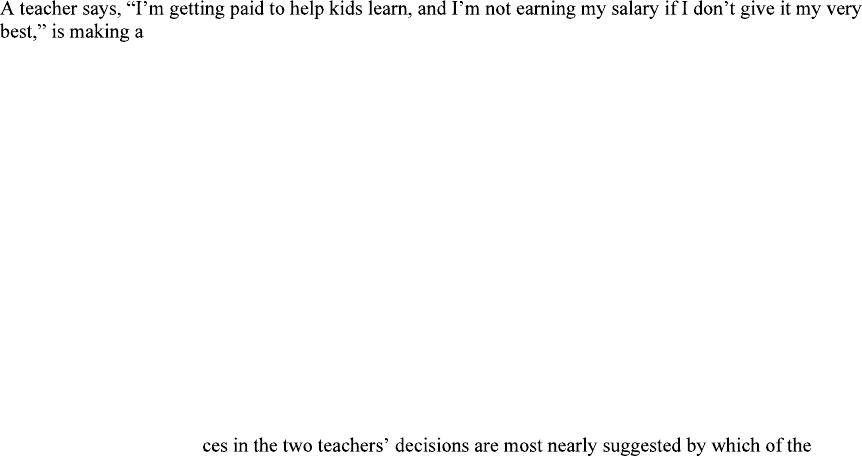
Use the following information for Items 7 and 8.
Vera Rodriguez and Antonio Rivera, two middle school teachers, are involved in a dis
they expect to succeed on challenging tasks. So, what we should be doing is challenging them and helping them to
su
u know what knowledge is the most important for
them to learn? Who is going to decide what is most important? I think kids need to learn how to get information on
** 7. Which of the following statements best describes
a. Her comments include explanations based on theory, but not statements that reflect philosophy.
b. Her comments include statements that reflect philosophy, but not explanations that are based on
theory.
c. Her statements include both explanations based on theory and statements that reflect philosophy.
d. Her statements reflect neither explanations based on theory nor statements that reflect philosophy.
** 8. Which of the following statemen
a. His comments include explanations based on theory, but not statements that reflect philosophy.
b. His comments include statements that reflect philosophy, but not explanations that are based on
theory.
c. His statements include both explanations based on theory and statements that reflect philosophy.
d. His statements reflect neither explanations based on theory nor statements that reflect philosophy.
Essay Items
** 9. Compare philosophy and theory including the essential difference between the two.
** 10. Explain how philosophy is related to teacher professionalism, and illustrate your explanation with an
example.
** 11. Explain the term normative philosophy, and illustrate your explanation with a classroom example.
Branches of Philosophy
* 12. Which of the following is not a branch of philosophy?
a. Paleontology
b. Epistemology
c. Ontology
d. Axiology
* 13. The branch of philosophy that deals with questions of how we come to know what we know is:
a. axiology.
b. ontology.
c. epistemology.
d. ethics.
** 14.
a. epistemology.
b. ontology.
c. axiology.
d. logic.
Chapter 5: Educational Philosophy and Your Teaching
* 15. The branch of philosophy that considers the nature of reality is:
a. epistemology.
b. ontology.
c. axiology.
d. logic.
* 16. The branch of philosophy that considers values and ethics is:
a. epistemology.
b. ontology.
c. psychology.
d. axiology.
** 17. Which of the following most closely relates to the conflict between one view of teaching morals, a view
suggesting that values, such as honesty should be emphasized, taught, and rewarded, and another view
suggesting that morals are most effectively developed with moral reasoning?
a. epistemology
b. ontology
c. axiology
d. logic
** 18. One person argues that reality is objective and observable, and another argues that reality is actually
perceived, since our behavior depends on our perceptions. This debate is most closely related to:
a. epistemology.
b. ontology.
c. axiology.
d. logic.
** 19.
statement most closely related to:
a. epistemology.
b. ontology.
c. axiology.
d. logic.
** 20. A person decides that Japanese built cars are more reliable than American built cars, saying he looked in a
consumer rating magazine that cited the average incidents of repair for Toyotas, Nissans, Hondas,
Chevrolets, Fords, and Chryslers. Which of the following best describes his decision?
a. It is primarily based on deductive reasoning.
b. It is primarily based on inductive reasoning.
c. It is primarily based on epistemological reasoning.
d. It is primarily based on metaphysical reasoning.
** 21. Brad Gilbert believes that learners construct their own understanding of the topics they study. He provides
a variety of experiences for learners and leads discussions intended to help them construct valid
understandings of the way the world works. Ann Wilson believes that authority is the most important way
of knowing, and she presents carefully organized lectures that cover the topics she wants her students to
understand. The differen
following?
a. Ethics
b. Ontology
c. Axiology
d. Epistemology
Chapter 5: Educational Philosophy and Your Teaching
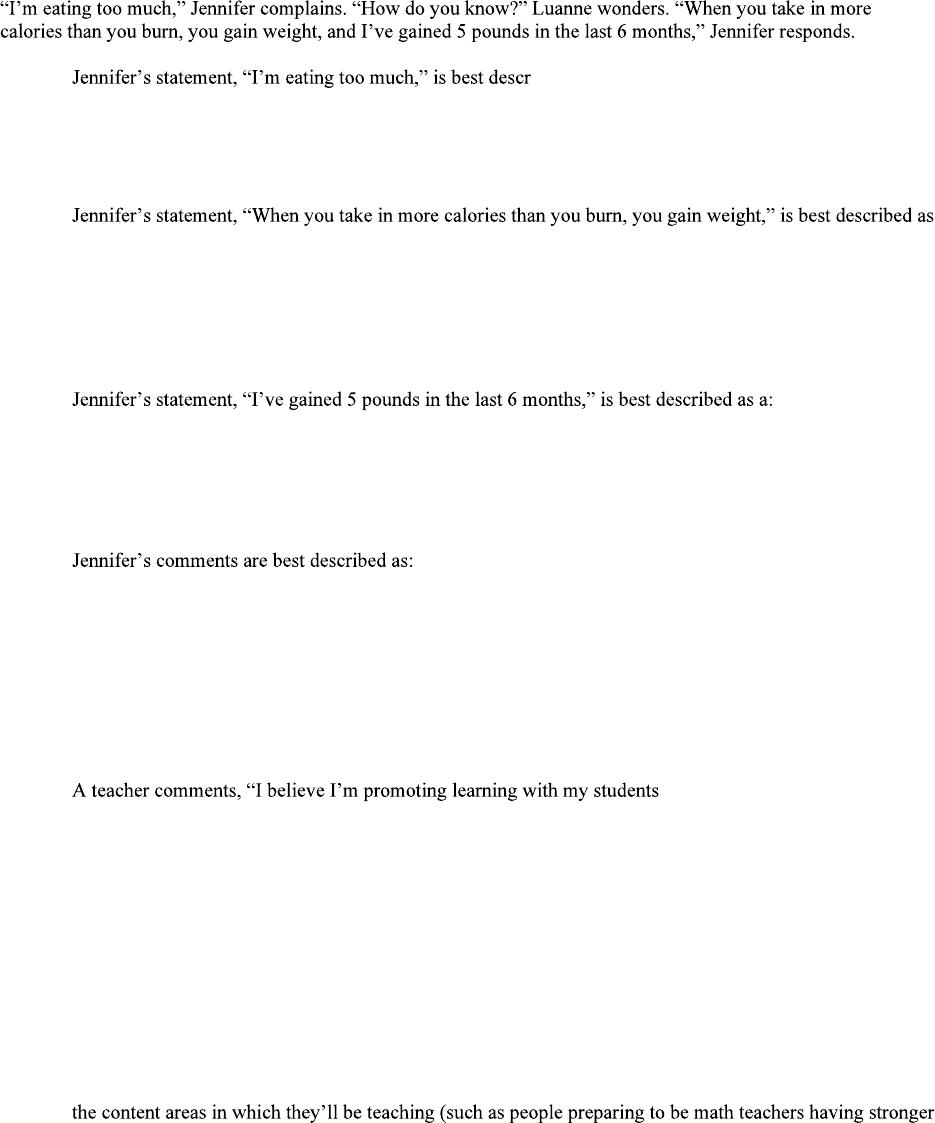
Use the following information for Items 22-25.
** 22. ibed as a:
a. major premise.
b. minor premise.
c. conclusion.
d. result of inductive reasoning.
** 23.
a:
a. major premise.
b. minor premise.
c. conclusion.
d. result of deductive reasoning.
e. result of inductive reasoning.
** 24.
a. major premise.
b. minor premise.
c. conclusion.
d. result of deductive reasoning.
e. result of inductive reasoning.
** 25.
a. deductive reasoning but not inductive reasoning.
b. inductive reasoning but not deductive reasoning.
c. both inductive and deductive reasoning.
d. both inductive and epistemological reasoning.
Essay Items
** 26. Describe the four branches of philosophy and provide a classroom example of each.
** 27. because I frequently assess my
students and give them detailed feedback, and I know that frequent assessment with feedback promotes
learning. Identify the major premise, the minor premise, and the conclusion in her statement.
Philosophies of Education
* 28. Some schools strongly emphasize basic skills, such as reading, writing, math, and now, even computer
literacy. The educational philosophy most closely associated with this emphasis is:
a. perennialism.
b. essentialism.
c. progressivism.
d. social reconstructionism.
* 29. Reforms aimed at improving teacher training have emphasized that teachers have stronger backgrounds in
backgrounds in math). This position is most strongly grounded in:
a. perennialism.
b. essentialism.
c. progressivism.
d. social reconstructionism.
Chapter 5: Educational Philosophy and Your Teaching
* 30. Which of the following statements best describes the primary difference between perennialism and
essentialism?
a. Essentialism is more strongly grounded in idealism and realism than is perennialism.
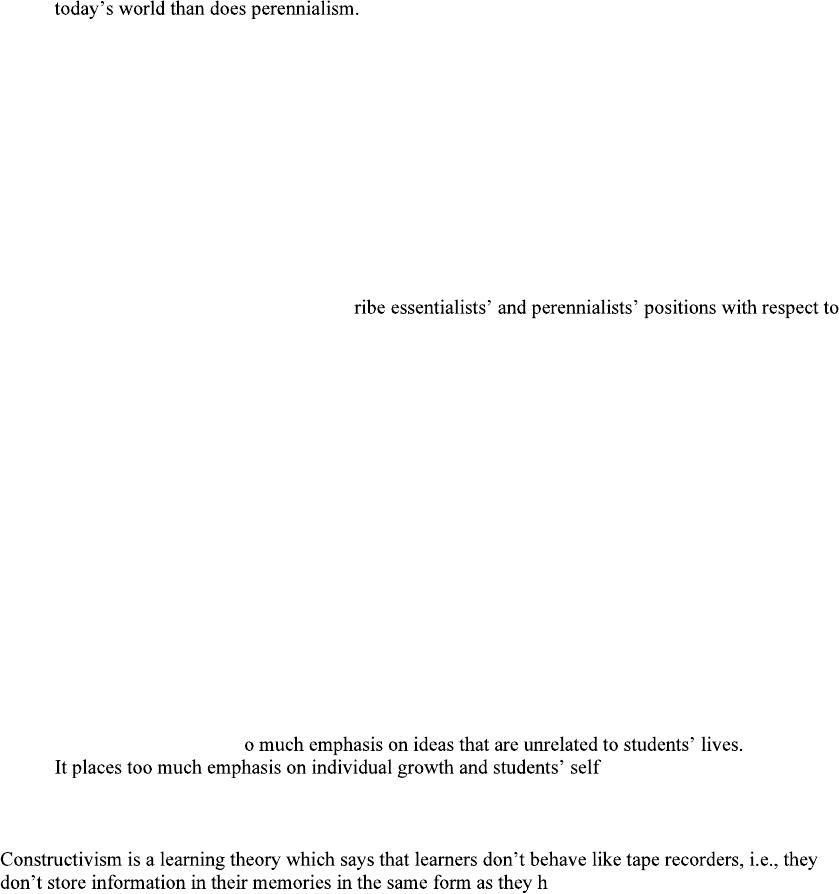
b. Essentialism more strongly emphasizes the importance of knowledge and skills that are useful in
c. Essentialism emphasizes learner-centered instruction, whereas perennialism emphasizes teacher-
centered instruction.
d. Essentialism emphasizes epistemology (how we know), whereas perennialism emphasizes ontology
(what we know).
* 31. A teacher believing that students are best educated when they study the ideas that have endured through
history, such as math, science, and great literature, is most strongly guided by:
a. perennialism.
b. essentialism.
c. progressivism.
d. social reconstructionism.
* 32. Which of the following statements best desc
learner-centered instruction and the development of learner self-esteem?
a. Both philosophies strongly emphasize learner-centered instruction, and the development of self-
esteem is a primary goal for both.
b. Essentialism strongly emphasizes learner-centered instruction and the development of self-esteem,
whereas perennialism does not.
c. Perennialism strongly emphasizes learner-centered instruction and the development of self-esteem,
whereas essentialism does not.
d. Both philosophies are very wary of learner-centered instruction, and the development of self-esteem
is not a goal for either.
* 33. The educational philosophy emphasizing curriculum that focuses on real-world problem solving and
individual development best describes:
a. perennialism.
b. essentialism.
c. progressivism.
d. social reconstructionism.
* 34. Of the following, what is the most commonly voiced criticism of perennialism?
a. It is elitist and places to
b. -esteem.
c. It is too strongly influenced by an emphasis on basic skills.
d. It is not appropriately grounded in one of the traditional philosophies.
** 35.
eard or read it. Rather, they create
understanding that makes sense to them by relating what they hear or read to what they already know, and
they store in memory the understanding they created for themselves.
This view of learning is most strongly grounded in:
a. perennialism.
b. essentialism.
c. progressivism.
d. social reconstructionism.
Chapter 5: Educational Philosophy and Your Teaching
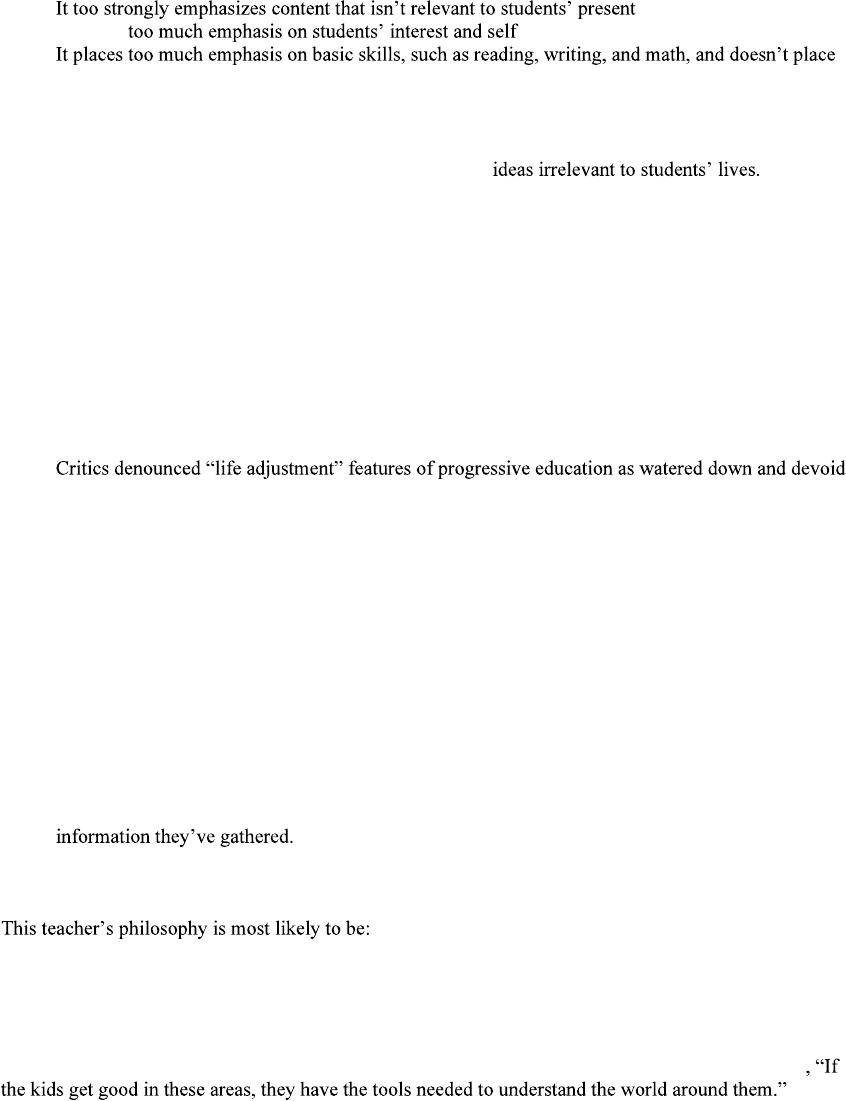
* 36. Which of the following is the most commonly voiced criticism of progressivism?
a. -day world.
b. It places -esteem at the expense of understanding.
c.
enough emphasis on other content areas, such as science and social studies.
d. It is too teacher-centered, and as a result, it detracts from student motivation.
* 37. Of the following, the most commonly voiced criticism of social reconstructionism is:
a. it is elitist and places too much emphasis on historical
b. it has abandoned schools as places for learning, instead using schools for political purposes.
c. it places too much emphasis on the individual and student self-esteem.
d. it places too much emphasis on basic skills at the expense of other parts of the curriculum.
* 38. Of the following, which is the most likely reason that progressive education declined after the middle of the
20th century?
a. The content of the progressive education curriculum was criticized as not being relevant to the lives
of students.
b. Progressive education was very costly to implement and maintain, and the excessive costs eventually
caused it to decline in prominence.
c. Teaching according to the progressive education philosophy required a great deal of professional
development for teachers, which school districts were unable to provide.
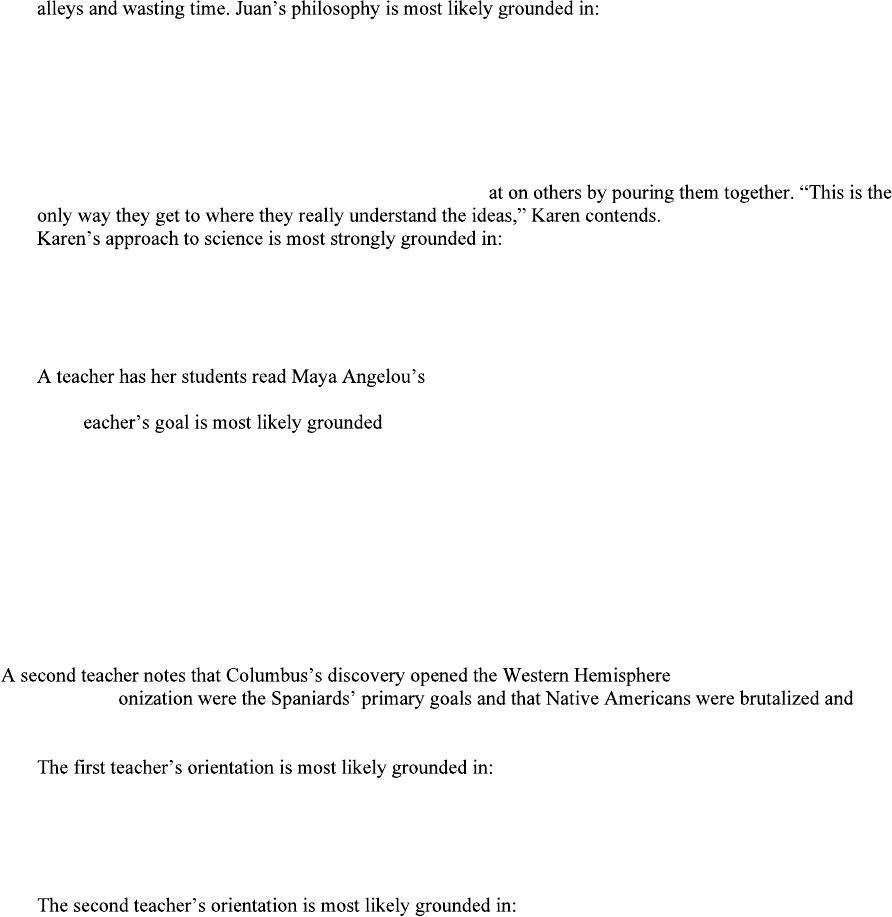
d.
of content and intellectual rigor.
** 39. Of the following, which example best illustrates a learning activity based on progressive education ideas?
a. Jackie Manning carefully explains the concept of camouflage. After explaining the concept she
shows the students colored slides of a snake camouflaged in some grass, and an insect camouflaged
on a leaf.
b. Molly Miller puts students into groups of three and each group reads a section of their textbook that
describes how animals protect themselves, with camouflage being one of the ways. The groups each
then report back to the whole class.
c. Ashley Wilson takes a box each of red, green, yellow, and blue toothpicks and randomly distributes
them on a section of the school grounds. She then takes the students outside and gives them 5
minutes to collect as many toothpicks as they can find. They discuss reasons why they found
different numbers of each color.
d. Ken Davis has his students search the Internet for information on camouflage. The students find
articles and research reports, print them, and then make oral reports to the class about the
** 40. A teacher has her seventh graders study the novel The Yearling because she believes students should
examine moral dilemmas, since moral dilemmas have existed throughout history.
a perennialism.
b. essentialism.
c. progressivism.
d. social reconstructionism.
** 41. Davis Elementary School places particular emphasis on reading, writing, math, and science, because
The
philosophy of Davis Elementary School is most likely grounded in:
a perennialism.
b. essentialism.
c. progressivism.
d. social reconstructionism.
Chapter 5: Educational Philosophy and Your Teaching
** 42. Juan Chaves is a strong proponent of problem-based learning, an approach to instruction in which students
are given an ill-defined, real world problem that requires an extended period of time to solve. As the
students work, Juan provides only enough guidance to keep the students from going too far down blind
a perennialism.
b. essentialism.
c. progressivism.
d. social reconstructionism.
** 43. Karen Ravitch has her fifth graders working on activities in which they determine the densities of different
liquids, such as water, alcohol, cooking oil, and glycerin, by putting equal volumes on balances and seeing
which ones are heavier. The also see which ones will flo
a perennialism.
b. essentialism.
c. progressivism.
d. social reconstructionism.
** 44. I Know Why the Caged Bird Sings because she wants
them to increase their sensitivity to literature written by cultural minorities.
This t in:
a. perennialism.
b. essentialism.
c. progressivism.
d. social reconstructionism.
Use the following information for Items 45 and 46.
One teacher presenting information about the New World emphasizes that Columbus’s discovery of the new
world was a critical point in European expansion and colonization, and it marked the beginning of modern history in
North and South America.
but emphasizes that
conquering and col
enslaved by the Spaniards.
** 45.
a. perennialism.
b. essentialism.
c. progressivism.
d. social reconstructionism.
** 46.
a. perennialism.
b. essentialism.
c. progressivism.
d. social reconstructionism.
Essay Items
** 47. Cite the most common criticisms of each of the educational philosophies. Explain in each case.
** 48. Native American, African, and Asian cultures have been described as having particular philosophical
perspectives. Outline these descriptions, and then cite the sharp criticisms that have been directed at this
approach to philosophy.

Chapter 5: Educational Philosophy and Your Teaching
** 49. Identify the educational goal, curriculum emphasis, and teaching methods that are most closely associated
with each of the educational philosophies perennialism, essentialism, progressivism, and postmodernism.
** 50. Describe four different perspectives, i.e., normative philosophies, with respect to the utilization of
technology in schools and the educational philosophy, or philosophies, to which each is most closely
related.
Developing Your Philosophy of Education
* 51. The explanation and rationale you provide for your educational goals what you want to accomplish in your
classroom will most strongly depend on:
a. your personal philosophy.
b. your personal needs.
c. your self-esteem.
d. your work ethic and sense of responsibility.
* 52. Of the following, the most important factor in critically examining your beliefs about learning and teaching
is likely to be:
a. epistemology.
b. ontology.
c. axiology.
d. logic.
* 53. Of the following, which is the decision most closely related to forming your own philosophy of education?
a. Deciding whether or not you want to be a teacher
b. Deciding if you want to remain in teaching as a career
c. Deciding if you are able to balance a career with a family
d. Deciding what kind of teacher you want to be
* 54. As you form your personal philosophy, which of the following statements best describes the personal
philosophy that you will form?
a. Your personal philosophy will closely parallel one of the educational philosophies that you studied
in the chapter.
b. Your personal philosophy will closely follow the general philosophical patterns characterized by the
ethnic group of which you are a member.
c. Your personal philosophy will be refined and change as you gather experience and learn.
d. Once your personal philosophy is formed, it will influence your thinking about teaching, but it will
have limited influence on your teaching practice.
* 55. As you begin the process of forming your own philosophy of education, which of the following best
describes the first step you will take?
a. Identifying your personal and professional goals
b. Identifying your professional needs
c. Identifying your professional beliefs
d. Summarizing your personal experiences
Essay Items
** 56. Explain why forming a personal philosophy is important for teachers. Provide a specific, concrete example
to illustrate your explanation.
* 57. As you begin to form your personal philosophy, you should keep three ideas in mind. Describe the three
ideas.
* 58. Describe the first two steps you should take as you begin to form your philosophy of education. Explain
why these steps are important.
Chapter 5: Educational Philosophy and Your Teaching
CHAPTER FIVE ANSWERS
Philosophy and Philosophy of Education
Branches of Philosophy
Chapter 5: Educational Philosophy and Your Teaching
Philosophies of Education
Chapter 5: Educational Philosophy and Your Teaching
Developing Your Philosophy of Education