95
CHAPTER 4
MULTIPLE CHOICE
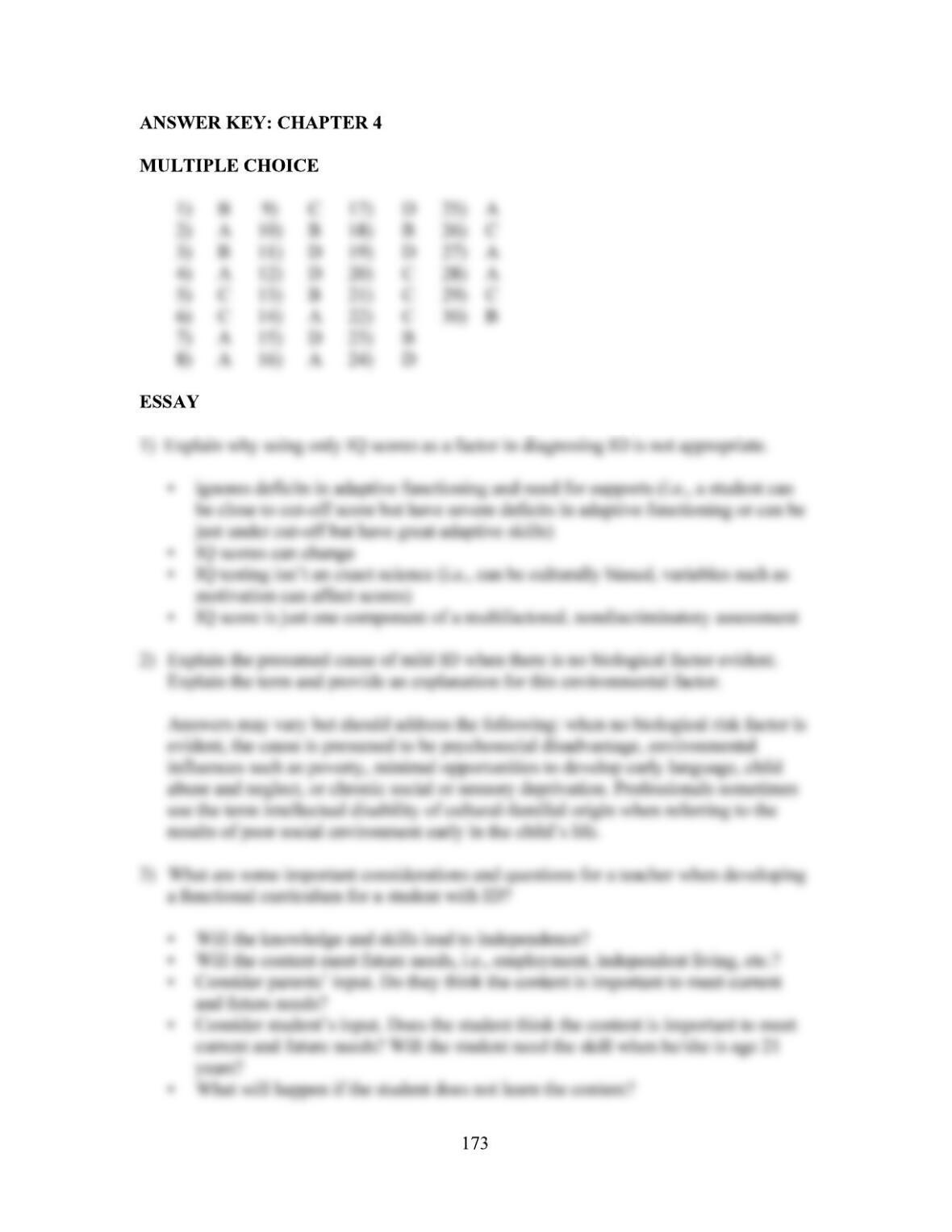
1) All of the following are criteria for a diagnosis of intellectual disability EXCEPT
_____.
A) deficits in adaptive behavior
B) concurrent sensory disabilities
C) significantly subaverage intelligence
D) manifestation during the developmental period
2) An intellectual disability is usually defined by an IQ that falls at or below _____.
A) 70
B) 80
C) 90
D) 100
3) The difference between the AAIDD and the IDEA definitions of intellectual
disabilities is _____.
A) the impact on adaptive behavior is considered only in the AAIDD definition
B) the AAIDD definition considers functioning within the context of the
environment
C) the effect on intellectual functioning is mentioned only in the IDEA definition
D) manifestation during the developmental period, or before age 18 years, is not a
part of the AAIDD definition
4) Which of the following statements about IQ tests is NOT true?
A) IQ test scores tend to be static.
B) Intelligence tests can be culturally biased.
C) Intelligence testing is not an exact science.
D) IQ tests measure performance at one point in time.
5) IQ tests are useful for all of the following purposes EXCEPT _____.
A) predicting school achievement
B) measuring a hypothetical construct
C) determining objectives for an IEP
D) identifying overall deficits in cognitive functioning
6) Which of the following best represents a deficit in adaptive behavior?
A) Three-year-old Joey is afraid of the dark.
B) Two-year old Darrell cannot tie his shoes.
C) Twelve-year-old Chandler cannot cross the street without assistance.
D) Fourteen-year-old Rodney calls his friend a sissy for wearing a hat in cold weather.

96
7) _____.
A) interviewing someone who knows the person well
B) administering a written test
C) watching a person perform specific tasks
D) interviewing the person
8) Early researchers suggested that students with intellectual disabilities have ability
about as well as people without disabilities in _____.
A) long-term memory retention
B) metacognition
C) short-term memory
D) working memory
9) Tony is a typically developing student in preschool. He learned to discriminate
between a circle and a triangle in 3 trials. His classmate, Jay, has an intellectual
disability. How many trials might Jay require to perform the same task?
A) 3
B) 10
C) 30
D) 50
10) Which of the following statements about attention and students with intellectual
disabilities is most accurate?
A) They have a great capacity for sustained attention.
B) They are typically slower to attend to relevant features of a task.
C) They are more likely to focus on complex tasks rather than simple ones.
D) They have little difficulty coming to attention and focus immediately when a
stimulus grabs their attention.
11) Which of the following exemplifies learned helplessness?
A) Ayden listens to the teacher as she gives directions.
B) Brenda asks for help when she does not understand how to solve a math problem.
C) Colleen counts on her fingers to multiply 4 × 9 because she does not know the
answer.
D) Darla has studied for a spelling test but she refuses to write any of the words the
teacher dictates as she fears making an error.
12) Which of the following is NOT true of learned helplessness and outer-directedness?
A) They may be caused by frequent failure.
B) They are often seen as a lack of motivation.
C) They often result from dependency on other people.
D) They are an inherent characteristic of intellectual disabilities.

97
13) Which of the following is the best example of self-determination?
A) Frances refuses to take a consumer math class because she hates math.
B) Gina asks to ride the bus to town with her cousin so she can learn to use public
transportation.
C)
at a restaurant.
D) Janelle decides to ride to school with her mother because her mother says the
students on the bus are too wild
14) Social deficits displayed by students with intellectual disabilities include all of the
following EXCEPT _____.
A) inability to recall names
B) poor communication skills
C) inability to recognize emotional states of others
D) unusual or inappropriate behavior during social interactions
15) Which of the following statements about challenging behaviors and students with
intellectual disabilities is true?
A) The challenging behaviors displayed are caused by mental illness.
B) Students with mild intellectual disabilities rarely display challenging behaviors.
C) Students with severe intellectual disabilities generally exhibit fewer challenging
behaviors.
D) Students with severe intellectual disabilities generally display a higher incidence
of challenging behaviors.
16) During the 2012 2013 school-year, what percentage of school-aged children received
special education services under the disability category of intellectual disabilities?
A) 6.7%
B) 7.8%
C) 10.1%
D) 12.4%
17) The difference in the prevalence rates of intellectual disabilities is largely due to
_____.
A) differences in poverty rates
B) differences in parental education
C) differences in availability of services
D) differences in criteria used for identification
18) The two most common genetic causes of intellectual disabilities are _____.
A) Down syndrome and fetal alcohol spectrum disorder
B) Down syndrome and fragile X syndrome
C) Fetal alcohol spectrum disorder and Tay-Sachs disease
D) Prader-Willi syndrome and PKU
98
19) Marvin is a second grade student with a moderate intellectual disability. His teachers
claim that his gnome costume for Halloween was perfect for him. They say that he is
always happy and that he never meets a stranger. Recently his teacher had to stop him
from leaving the classroom with a man who had come to fix the computer. Marvin
displays characteristics of a person with _____.
A) PKU
B) fragile X syndrome
C) Prader-Willi syndrome
D) Williams syndrome
20) All of the following are environmental causes of intellectual disabilities EXCEPT
_____.
A) poverty
B) child abuse
C) diseases or syndromes
D) chronic sensory deprivation
21) Which of the following is a maternal screening test, administered during weeks 8 to
10, that can identify pregnancies at risk for a disorder associated with intellectual
disabilities?
A) Amniocentesis
B) Maternal serum (AFP) alpha-fetoprotein
C) Chorionic villi sampling
D) Tandem mass spectrometry
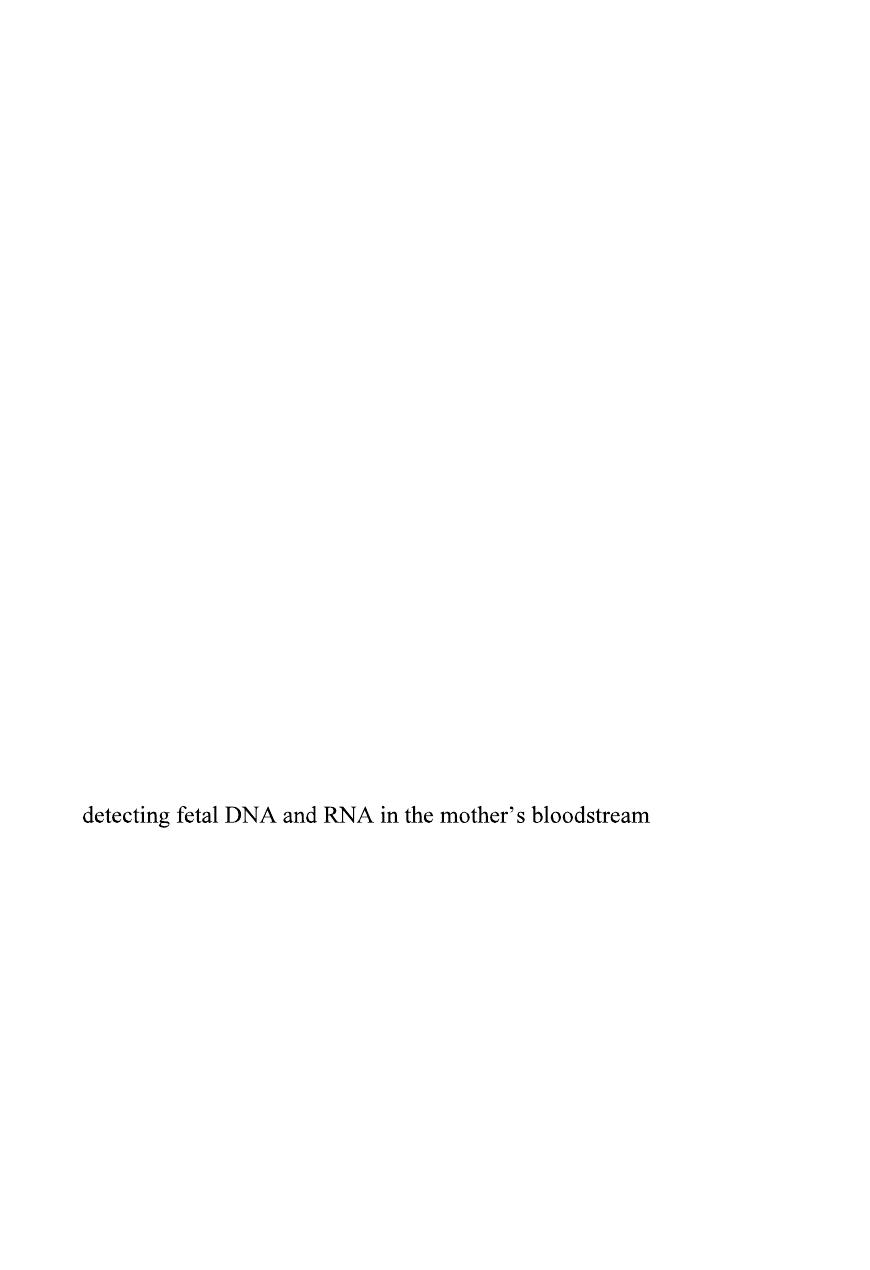
22) A new test for genetic abnormalities that can be done as early as 5 weeks into the
pregnancy is done by _____.
A) performing an ultrasound
B) examining maternal serum
C)
D) removing chorionic tissue
23) Who was the first person to develop methods for educating people with intellectual
disabilities?
A) Edgar Doll
B) Jean Itard
C) Bengt Nirje
D) Lewis Terman
24) Which question is critical for teachers in determining which skills to include in a
functional curriculum?
A) Will it be learned in the next grade?
B) Will learning this knowledge/skill be frustrating?
C) Will this skill make the student more acceptable to peers without disabilities?
D) Will failure to learn the knowledge or skill result in negative consequences?

99
25) Which of the following statements about self-determination is least accurate?
A) Self-determination cannot be taught to students in elementary or middle school.
B) Self-determination entails a complex set of skills.
C) Self-determination is a lofty goal.
D) Self-determination is both a goal and a means for achieving other goals.
26) Which of the following students would NOT need training in recruiting teacher
attention?
A) A shy student who rarely asks questions.
B) A student who rushes through the task before the teacher finishes explaining.
C) A student who asks appropriate subject-oriented questions.
D) A student who displays a disruptive manner.
27) Breaking down complex skills into smaller subskills or steps to make learning easier
is known as _____.
A) task analysis
B) applied learning
C) direct instruction
D) programmed instruction
28) Which of the following students would be identified as having difficulty with
generalization of learning?
A) Billy can tie his sneakers but not his dress shoes.
B) Keelee can add three-digit num
C) Jacob has learned how to read music but he refuses to help his brother learn it.
D) Melvin has learned to write his name in cursive at school, so he wants to write it
at home and at church.
29) During the practice stage of learning, feedback for students with intellectual
disabilities should _____.
A) be given after every response
B) be given after every correct response
C) emphasize the correct rate of skill performance
D) emphasize the accuracy and form of the student
30) Which of the following strategies is least likely to promote successful inclusion for
students with intellectual disabilities?
A) Peer tutoring
B) Common recess time
C) Collaborative learning
D) Direct training in social skills

100
ESSAY
1) Explain why using only IQ scores as a factor in diagnosing ID is not appropriate.
2) Explain the presumed cause of mild ID when there is no biological factor evident.
Explain the term and provide an explanation for this environmental factor.
3) What are some important considerations and questions for a teacher when developing
a functional curriculum for a student with ID?
4) Explain what skills are involved in self-determination training and give an example of
the importance of each as it relates to living independently.
5) Provide a task analysis for either tying a shoe or making a peanut butter sandwich.
Assume the shoe is already on the foot and that all the ingredients for the sandwich
are out. Assume the student has typical motor skills and knows right from left.
Number each step.