Chapter 4: Education in the United States: Its Historical Roots
CHAPTER FOUR
EDUCATION IN THE UNITED STATES: ITS HISTORICAL ROOTS
The Colonial Period (1607-1775)
* 1. `The historical period in American education that most contributed to the strong link between religion and
education (which remains to today) was the:
a. colonial period.
b. Early National Period.
c. common school movement.
d. Progressive Era.
* 2. Schooling during the colonial period was designed primarily for which of the following groups?
a. Wealthy males
b. Males of all socioeconomic classes
c. Wealthy males and wealthy females
d. Males of all socioeconomic classes and wealthy females
* 3. While religion was an important influence in all the colonies Northern, Middle, and Southern during the
colonial period, it was the most dominant influence in the:
a. Northern colonies.
b. Middle colonies.
c. Southern colonies.
d. Western colonies.
* 4. Which of the following is the most accurate description of the significance of the Massachusetts Act of
1647 (The “Old Deluder Satan Act”)?
a. It provided the precedent for the principle of separation of church and state.
b. It provided a legal foundation for the public support of education.
c. It provided a framework for differentiating American education from its European roots.
d. It made public education mandatory for all children aged 13 and under.
* 5. Which of the following is most significant about the Colonial Period in helping us understand American
education today?
a. ist.
b. It helps us understand why the federal government has turned much of the responsibility for
education over to the states.
c. It helps us understand how the present organization of elementary, middle, and high schools came to
exist.
d. It helps us understand why religion remains an important issue in American education.
** 6. Consider the schools in the Southern colonies Maryland, Virginia, the Carolinas and Georgia during the
colonial period. Which of the following statements is most valid?
a. The colonies were religiously diverse, so each colony created parochial schools for the children of
the colony.
b. Because many people lived on plantations that were long distances from each other, parents hired
tutors to educate their children.
c. Because many people lived and worked in agriculture, education was more egalitarian than in the
Middle and Northern colonies.
d. Education focused primarily on religious training, which was grounded in the belief that humanity
was evil, by its nature, having fallen in the sin of Adam and Eve.
Chapter 4: Education in the United States: Its Historical Roots
** 7. Consider the schools in the Middle colonies New York, New Jersey, Rhode Island, Delaware, and
Pennsylvania during the colonial period. Which of the following statements is most valid?
a. The colonies were religiously diverse, so each colony created parochial schools for the children of
the colony.
b. Because many people worked in towns that had industry and commerce, families collaborated to hire
c. Because many people came from working class instead of aristocratic backgrounds, education was
more egalitarian than in the Northern and Southern colonies.
d. Education focused primarily on religious training, which was grounded in the belief that humanity
was evil, by its nature, having fallen in the sin of Adam and Eve.
** 8. Consider the schools in the New England colonies Massachusetts, Connecticut, and New Hampshire
during the colonial period. Which of the following statements is most valid?
a. The colonies were religiously diverse, so each colony created parochial schools for the children of
the colony.
b. Because many people worked in towns that had industry and commerce, families collaborated to hire
c. Because many people came from working class, rather than aristocratic, backgrounds, education was
more egalitarian than in the Middle and Southern colonies.
d. Education focused primarily on religious training, which was grounded in the belief that humanity
was evil, by its nature, having fallen in the sin of Adam and Eve.
* 9.
Massachusetts Act of 1647), which was designed to create citizens that were literate with respect to the
Bible?
a. It established a link between education and religion in the Southern states, such as Alabama,
Mississippi, and Louisiana that remains today.
b. It set a precedent for controversies surrounding religion that led to the p
church and
c. It provided the legal foundation for public support of education.
d. It established a precedent that led to the widespread system of parochial schools that exist in the
United States today.
* 10. During the colonial period of American Education, the thinking of some European philosophers, such as
Locke, Rousseau, and Pestalozzi, began to influence education. Of the following, which is the most
accurate description of their influence?
a. These philosophers emphasized memorization and recit
b. These philosophers emphasized the importance of first-hand experiences for children as the
foundation for their education.
c. These philosophers emphasized education for all citizens instead of reserving education for the
wealthy elite.
d. These philosophers emphasized differences between religion and education that contributed to
establishing the principle of separation of church and state.
Essay Items
** 11. Describe the cultural and economic differences in the Southern, Middle, and Northern colonies during the
colonial period, and explain how the types of schools that were created were the result of these differences.
** 12. Describe the legacy of the Colonial Period (1607-1775) which remains in our count
today.
Chapter 4: Education in the United States: Its Historical Roots
The Early National Period (1775-1820)
* 13. The leaders that framed the U.S. Constitution refused to establish a national religion in the United States.
Which of the following is the best description of the reason fo
a. The leaders were afraid that a national religion might lead to a national system of schools and
churches.
b. The leaders adopted the principle of separation of church and state that had been established in
England during the 1600s.
c. The leaders recognized that a great deal of religious diversity existed in the colonies, making the
establishment of a national religion very difficult.
d. The leaders wanted to eliminate the influence of religion in America, and they believed that the
refusal to establish a national religion would help them reach that goal.
* 14. Which of the following statements best describes the contribution of the Land Ordinance of 1785 to
education in America?
a. It was the law the formally established the principle of separation of church and state.
b.
schools.
c. It was the law that established free public education for all students.
d. It was the law that set aside land that would be used to financially support public education.
* 15. Which of the following best describes the legal action that resulted in every state in the United States now
ice of education?
a. The First Amendment to the Constitution, which established the principle of separation of church
and state.
b. The Land Ordinance of 1785 which provided a basis for financial support of education.
c. The Tenth Amendment to the Constitution, which said that areas not assigned to the federal
government would be the responsibilities of the states.
d. The Old Deluder Satan Act which provided for public support of education.
** 16. Of the following, the two most significant contribution of the Early National Period (1775-1820) that
remain today were:
a. establishment of public support for education and the development of the comprehensive high
school.
b. the separation of church and state and the removal of the federal government from a central role in
running Amer
c. the establishment of the Department of Education as a federal cabinet post and the creation of
vouchers to support religion for all free members of society.
d. establishment of a widespread system of parochial schools.
** 17. Public school officials are not allowed to mandate prayer in their schools. Which of the following best
explains why officials are not allowed to mandate prayers?
a. The Land Ordinance of 1785, which called for a secular versus a religious orientation for public
education
b. The Old Deluder Satan Act, which established the principle of non-religious public education.
c. The First Amendment to the Constitution that established the principle of separation of church and
state
d. The 10th Amendment to the Constitution that mandated that education be largely governed by the
states instead of the federal government
Essay Items
** 18. The 1st and 10th Amendments to the Constitution, established during the Early National Period (1775-1820)
both continue to have a major impact on education in our country today. Describe the impact of each.
Chapter 4: Education in the United States: Its Historical Roots
** 19. Describe the legacy of the Early National Period (1775- ducational
system today.
The Common School Movement: The Rise of State Support for Public Education (1820-1865)
* 20. Which of the following is the best description of the Common School Movement?
a. A historical attempt to make education available to all children in the United States
b. An attempt to increase the quality of teachers by establishing normal schools.
c. The process of reserving public land specifically for the purpose of funding public education
d. The process of putting common people in leadership roles in education
* 21. Which of the following statements best describes the contribution Horace Mann made to American
education?
a. He spearheaded legislation that led to the principle of separation of church and state.
b. He spearheaded the idea that all citizens should have the right to attend a tax-supported elementary
school.
c. He was the leader of the movement to remove the federal government from direct involvement in
d. He was the person who wrote and spearheaded the passing of the Northwest Ordinance of 1785.
* 22. Which of the following contributed to the idea that free public education should be the right of all citizens?
1. The principle of separation of church and state.
2. The increasing industrialization of the United States during the approximate period between 1820
and 1865.
3. The large influx of immigrants from Europe and other parts of the world that began in about the
1830s.
4. The Land Ordinance of 1785 that established an economic basis for public education.
a. 1, 2, 3, 4 b. 1, 4 c. 1, 3, 4 d. 2, 3
* 23. Which of the following is the best description of normal schools?
a. Schools designed to educate all members of society, not just the elite
b. Schools designed to focus on secular more than religious education
c. Schools designed to prepare young men for careers in law or the ministry
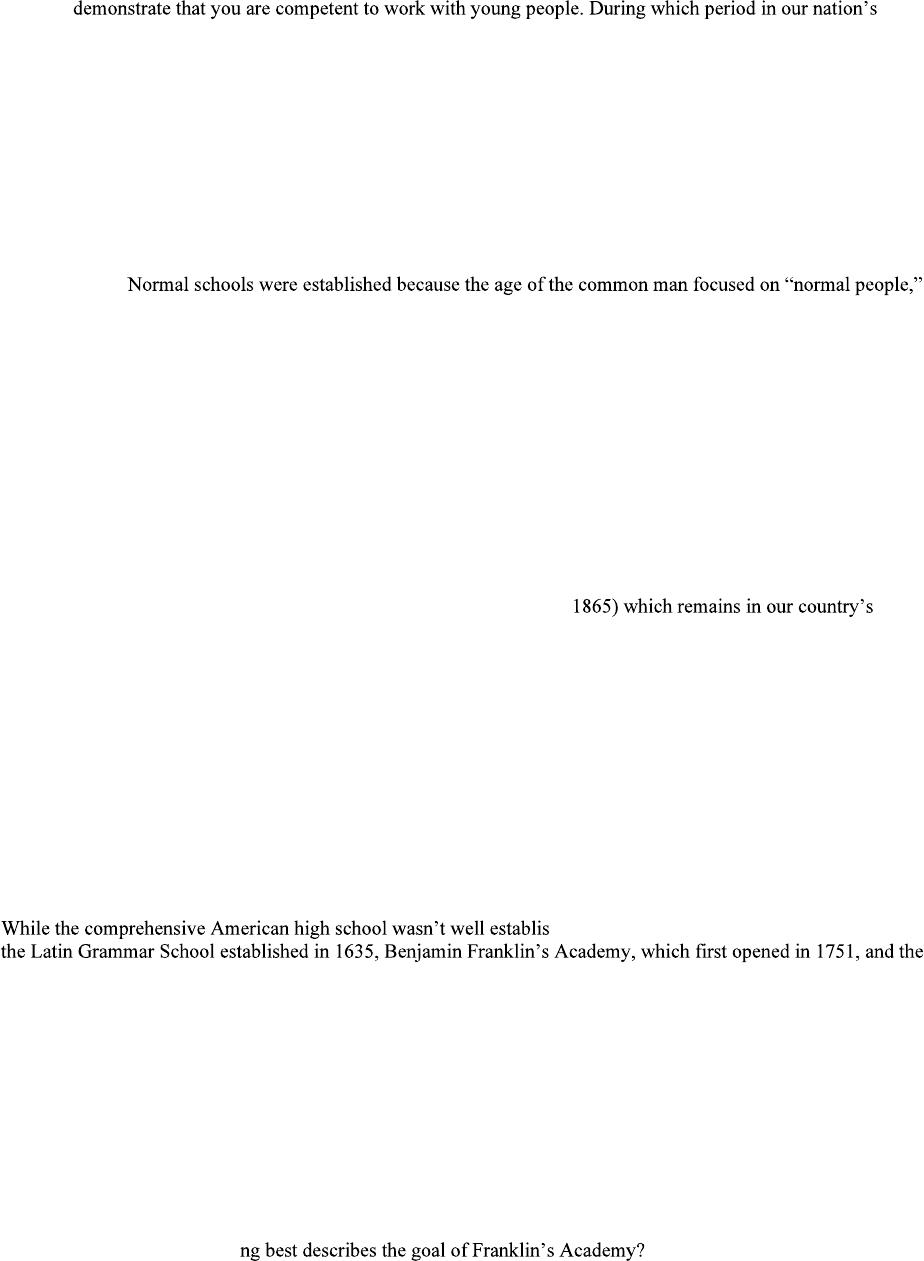
d.
* 24. Which of the following most contributed t schools during the period
from approximately 1820-1865?
a. Improvement in teacher preparation and the introduction of grade levels in elementary schools
b. The Land Ordinance of 1785 and the establishment of the comprehensive high school
c. The practice of using people preparing for the ministry as teachers and the establishment of middle
schools
d. Tax support for public schools and control of education being given to the states
* 25. Which of the following best describes an important problem with tax support for public schools?
a.
b. Funding is often inequitable, because some districts have high tax bases, whereas others have very
low tax bases.
c. Most of the taxes are paid by wealthy people who are unwilling to support education for all citizens.
d. Only a small portion of tax money goes to education, so education is consistently under-funded.
Chapter 4: Education in the United States: Its Historical Roots
** 26. In order to teach, you will be required to have a license, and you will likely have to pass a test to
educational history was this precedent established?
a. The Colonial Period (1607-1775)
b. The Early National Period (1775-1820)
c. The Period of the Common School Movement (1820-1865)
d. The 20th Century (1900-2000)
** 27. Universities in our country today, such as Eastern Michigan University, San Jose State University, and the
University of California at Los Angeles (UCLA) began as normal schools. Which of the following best
explains why these normal schools were originally established?
a. Competent teachers were seen as the key to improving schools, and normal schools were established
to improve teaching competence.
b.
people who made up mainstream America.
c. Normal schools were mandated by the Land Ordinance of 1785, which mandated that public
education should be supported with tax dollars.
d. Normal schools were established by the 10th amendment to the Constitution, which mandated that
education should be the responsibility of the states rather than the federal government.
Essay Items
** 28. Horace Mann is sometimes described as the father of public education in the United States. What is the
most important reason he is described this way?
** 29. Describe three reasons for the enormous growth of the common school movement during the middle 1800s.
** 30. Describe the legacy of the Common School Movement (1820-
educational system today.
The Evolution of the American High School
* 31. Approximately what percent of all high school-age students attended school at the beginning of the 20th
century?
a. Less than 10%
b. About 25%
c. About 50%
d. About 75%
Use the following information for items 32-34.
hed until the 20th century, its roots go back to
English Classical School (later changed to the English High School), which opened in 1821.
* 32. Which of the following best describes the goal of the Latin Grammar School?
a. To prepare students for law and the ministry
b. To help students develop practical skills, such as math, navigation, bookkeeping and logic
c. To help some students develop practical job skills and others prepare for college
d. To help students acquire basic skills, such as reading, writing, and math
e. To help students acquire basic skills, such as reading, writing, and math, as well as develop high
moral values and character
* 33. Which of the followi
Chapter 4: Education in the United States: Its Historical Roots
a. To prepare students for law and the ministry
b. To help students develop practical skills, such as math, navigation, bookkeeping and logic
c. To help some students develop practical job skills and others prepare for college.
d. To help students acquire basic skills, such as reading, writing, and math
e. To help students acquire basic skills, such as reading, writing, and math, as well as develop high
moral values and character
* 34. Of the Latin
school, which two are most alike?
a. The Latin Grammar School and the English High School
b. The Latin Grammar School and Fran
c. and the English High School
d. The English High School and the comprehensive high school
* 35. Which of the following best describes faculty psychology?
a. A view of learning that suggests that students learn best when taught by well-prepared teachers
b. A view of learning that emphasizes the role of experience and hands-on activities in learning
c. A view of learning suggesting that the best education involves mental discipline and training the
powers of the mind.
d. A view of learning that emphasizes a study of classic literature, such as Shakespeare, that has
endured throughout history
* 36. Of the following, what are reasons that the Committee of Ten recommended that all students both college
bound and non-college bound meet the same high school requirements?
1. The Committee was composed of college professors and administrators, who had a bias in favor of a
college preparatory curriculum.
2. The Committee believed in the need for basic skills reading, writing, and math that all students
should master.
3. The members of the Committee believed in faculty psychology, which emphasized mental training
for all students.
4. The members of the Committee believed that a different curriculum for college-bound and non-
college bound students might result in separation of social classes.
a. 1, 2, 3, 4 b. 1, 3, 4 c. 2, 3, 4 d. 2, 4
* 37. Of the following, which event most led to the development of the American high school as we know it
today?
a. The development of the English High School, whose curriculum included English, math, science,
history, and geography
b. The preparation of the report titled The Cardinal Principles of Education, which established goals for
high schools
c. The establishment of Normal Schools, which resulted in a teaching force able to work effectively in
modern high schools
d. The establishment of different grades in elementary schools, which better prepared students for the
rigorous content of high schools.

Chapter 4: Education in the United States: Its Historical Roots
** 38. Janet, a math teacher, Cal, who teaches American history, Lamont, an English teacher, and Karen, a science
teacher are meeting during their common planning period to discuss some students who appear to be
having problems in each of their classes. They also are working on integrating their curriculum. Lamont
Civil War, and the publication of the book was one of the factors that precipitated the war. Their discussion
then continues. Based on this information, it most likely that these teachers teach in a(n):
a. elementary school.
b. middle school.
c. junior high.
d. high school.
Essay Items
** 39. You likely graduated from a comprehensive high school. Explain how the idea of a comprehensive high
school evolved in our country.
** 40. Explain why junior high and middle schools were established in our country.
Searching for Equality: The Education of Cultural Minorities
* 41. The educational movement that attempted to bring cultural minorities into mainstream American life by
teaching basic skills and white middle class values is best described as:
a. separate but equal.
b. progressive education.
c. assimilation.
d. mainstreaming.
* 42. The assimilation movement in education was most strongly attempted with:
a. Native American students.
b. African American students.
c. Hispanic students.
d. Asian American students.
* 43. The policy separate but equal in education was most prominently implemented in:
a. Native American education.
b. African American education.
c. Hispanic education.
d. Asian American education.
* 44. The fastest growing cultural minority group in the United States is:
a. Native American students.
b. African American students.
c. Hispanic students.
d. Asian American students.
* 45. The cultural minorities who have experienced the greatest success in American schools are:
a. Native American students.
b. African American students.
c. Hispanic students.
d. Asian American students.
Chapter 4: Education in the United States: Its Historical Roots
* 46. Which of the following is most commonly cited as an important reason for the lack of success of Hispanic
students?
a. The lack of motivation of many Hispanic students
b. Language differences that symbolized the differences between Hispanics and the dominant culture
c. Differences between the learning styles of most Hispanic students and the patterns of instruction
found in most American schools
d. Antagonism between Hispanic students and other cultural minorities that resulted in Hispanic
students being isolated from the rest of the school population
Essay Items
** 47. Explain the assimilation movement in education in detail. Assess its success, and provide evidence for your
assessment.
** 48. Describe the differences between Booke
the education of African Americans. Describe differences in their personal backgrounds that could have
contributed to their views.
The Modern Era: Schools as Instruments for National Purpose and Social Change
* 49. The event of the Cold War period that had the most important implications for education was:
a. the Berlin airlift that resulted from the Communist blockade of Berlin.
b. the Korean War a
c. the Soviet launching of Sputnik.
d. the Cuban missile crisis that nearly caused World War III.
* 50.
a. It resulted in a dramatic increase in funding for math, science, and teacher training.
b. It precipitated the progressive education movement that made the school curriculum much more
c. It resulted in a standardized high school curriculum that raised the standards for the education of all
students.
d. It precipitated the modern reform movement that emphasized standards-based education and school
accountability.
* 51. -school education program designed to help three- and four-year-old
disadvantaged studen
a. Head Start.
b. Title I.
c. Progressive Education.
d. Individuals with Disabilities Education Act.
* 52. m targeting low income students in elementary and secondary
a. Head Start.
b. Title I.
c. National Defense Education Act.
d. Individuals with Disabilities Education Act.
* 53. The Supreme Court decision
a. the Civil Rights Act.
b. Brown vs. the Board of Education of Topeka .
c. Title IX.
d. the National Defense Education Act.
Chapter 4: Education in the United States: Its Historical Roots
* 54. The legislation intended to eliminate gender discrimination in schools was:
a. Title IX.
b. PL 94-142.
c. the Gender Equity Legislative Mandate.
d. the Civil Rights Act.
* 55. Schools that attempt to attract and integrate cultural minority and white students through quality instruction
or innovative programs are most accurately labeled:
a. progressive schools.
b. Title I schools.
c. integrated schools.
d. magnet schools.
Essay Items
** 56. Using research as a basis, write an assessment of the success of Head Start and Title I. Carefully explain the
success (or lack of success) in each case.
** 57. Describe the controversies that exist with respect to civil rights and equity for women. Cite arguments for
both sides of the issues in describing the controversies.
Chapter 4: Education in the United States: Its Historical Roots
CHAPTER FOUR ANSWERS
The Colonial Period (1607-1775)
The Early National Period (1775-1820)
The Common School Movement: The Rise of State Support for Public Education (1820-1865)
Chapter 4: Education in the United States: Its Historical Roots
The Evolution of the American High School
Searching for Equality: The Education of Cultural Minorities
Chapter 4: Education in the United States: Its Historical Roots
The Modern Era: Schools as Instruments for National Purpose and Social Change