Chapter 3: Student Diversity: Culture, Language, Gender, and Exceptionalities
CHAPTER THREE
STUDENT DIVERSITY: CULTURE, LANGUAGE, GENDER, AND EXCEPTIONALITIES
Cultural Diversity
* 1. The attitudes, values, customs, and behavior that characterize a social group is best described as:
a. culture.
b. ethnicity.
c. exceptionalities.
d. socioeconomic status.
* 2. on from which they or their
ancestors came is best described as:
a. culture.
b. ethnicity.
c. exceptionalities.
d. socioeconomic status.
** 3. Pedro is a boy living in a small Mexican village. Every day he rises early, for he must walk the two miles to
his school. He has breakfast of beans and bread made from ground corn, leaves the house and begins his
trek. He likes the walk for he can wave to his papa toiling daily in the cornfields that provide the food and
income for the family.
When Pedro comes home from school he often plays soccer with his friends in the village, and after
dinner his mother usually plays songs on a guitar while papa sings.
The activities Pedro is involved in, such as playing soccer and listening to his mother and father play
and sing best illustrate which of the following?
a. His culture
b. His ethnicity
c. Stereotype threat
d. Accommodation without assimilation
** 4. Rafael, a recent immigrant from Mallorca, an island in the Mediterranean off the coast of Spain, is very
proud of his Spanish heritage. He usually speaks Spanish at home and loves evenings and weekends where
he basks in the laid back, relaxed lifestyle and lack of concern about time that are characteristic of the way
he grew up. However, he never misses school, turns in all his assignments, and is always on time for school
a. culture.
b. ethnicity.
c. diversity.
d. assimilation.
* 5. Which of the following statements illustrates the relationship between culture and ethnicity?
a. Culture and ethnicity are unrelated.
b. Culture and ethnicity are the same thing.
c. Culture is a part of ethnicity.
d. Ethnicity is a part of culture.
* 6. Which of the following is not a component of ethnicity?
a. Customs and traditions
b. Language
c. Value systems
d. Socioeconomic status
Chapter 3: Student Diversity: Culture, Language, Gender, and Exceptionalities
* 7. Consider the following ethnic groups: Hispanics, African Americans, Asian/Pacific Islander, American
Indian/Alaskan Native and Non-Hispanic White. Experts estimate that by 2020 significant increases in
percentage of the school population will occur in each of these groups except one, and this one will
decrease in percentages. The group that will decrease in percentage is:
a. Hispanic.
b. African American.
c. Asian/Pacific Islander.
d. American Indian/Alaskan Native.
e. Non-Hispanic White.
* 8. non-
standard English dialects in favor of standard English?
a. Students quickly drop non-
b. Students quickly drop non-standard dialects because the school curriculum uses standard English.
c. Students are sometimes reluctant to drop non-standard dialects in favor of standard English, because
the non-standard dialect is the language they are comfortable with.
d. Students are sometimes reluctant to drop non-standard dialects in favor of standard English for fear
of alienating peers.
* 9.
a. ure
b. Ability differences that detr
c.
d. Learner exceptionalities that make acquiring certain skills, such as reading, difficult
* 10. According to research, which of the following is the most likely perception of cultural minorities who are
alienated from school?
a. They feel like they are not smart enough to succeed in school.
b. They feel like they are neither welcome nor do they belong in school.
c. They feel like school is only valuable for extracurricular activities.
d. They feel like they can succeed only if they have wealthy and influential parents.
* 11. Of the following, the most effective strategy for helping reduce or eliminate the effects of resistance
cultures is to:
a. remind students that to succeed in a global economy they must get a good education.
b. tity.
c. expose students to role models that have succeeded while retaining the characteristics of the
minority culture.
d. allow students to do written assignments on topics that are related to their cultural heritage.
* 12. Researchers have attempted to understand the high success rates of Southeast Asian students who have
been in the United States a relatively short period of time. Of the following, which is the most accurate
a. The researchers found that the families of these children placed heavy emphasis on the importance
of education and hard work.
b. The researchers found that these children were innately superior to American children as measured
by intelligence tests.
c. The researchers found tha come from war-torn areas, teachers
gave the children added support and attention.
d. The researchers found that the children had virtually no involvement in extracurricular activities, so
they devoted all their energies to academics.
Chapter 3: Student Diversity: Culture, Language, Gender, and Exceptionalities
* 13. Researchers have examined the effects of teachers changing their instruction so they ask more open-ended
questions requiring specific answers. Which of the following is the most accurate description of the effects
of this change in instruction?
a. The participation of African American students in the class increased compared to questions
requiring specific answers.
b. The participation of African American students in the class was not changed compared to questions
requiring specific answers.
c. The participation of African American students was not changed compared to questions requiring
specific answers, but the answers the students gave to the open-ended questions indicated less
thought on the part of the students.
d. The participation of African American students decreased compared to questions requiring specific
answers.
* 14. The process of socializing cultural minorities so that their behaviors fit the social patterns of the majority is
best described as:
a. cultural inversion.
b. assimilation.
c. multicultural education.
d. culturally responsive teaching.
** 15. Ann Henderson states to her 2nd graders,
white student, puts his math materials away, while Daron, an African American student, does not. If the
, according to research,
which of the following is the most likely explanation?
a. Daron is more likely to be disobedient than is Don, so he is more likely to disregard the directive.
b. nterpreting it as a command than
is Don.
c. Daron is less likely to be attentive than is Don, so his is more likely to not hear the directive.
d. Daron is more likely to socialize with his peers than is Don, so he is more likely to be off-task than
is Don.
** 16. Wayne Villegas is involved in a question and answer session with his 4th graders. During the lesson
Wayne attempts to call on all his students as equally as possible, and he wants to ask questions and have the
students answer at a quick pace t tention. In the process he directs a
question to Bill, a white student, and then another to Michael, one of his Native American students. If Bill
which of the following is the most
valid conclusion.
a. Both Bill and Michael are likely to be attentive and responsive in the lesson.
b.
c. Michael is more likely to be uncomfort Bill.
d.
* 17.
following statements provides the best evidence indicating that America never was a true and complete
a. Neighborhoods and groups continue to celebrate unique cultural festivals and maintain cultural
habits.
b. Many people came to the United States as non-native English speakers.
c.
d. The achievement of some minority groups tends to lag behind the achievement of white students.
Chapter 3: Student Diversity: Culture, Language, Gender, and Exceptionalities
* 18. If they fit general patterns identified by research, which of the following parents are most likely to provide
their children with supplementary science materials?
a. African Americans
b. Chinese Americans
c. Hispanic Americans
d. Native Americans
* 19. strategies schools use to accommodate cultural differences and provide educational
a. cultural inversion.
b. cultural assimilation.
c. cultural accommodation.
d. multicultural education.
* 20. Which of the following are considered to be characteristics of culturally responsive teaching?
1. Accepting and valuing differences among ethnic groups
2. Emphasizing that all ethnic groups are Americans
3. Accommodating different cultural learning styles
4. backgrounds
5. Individualizing instruction for different cultural minorities
a. 1, 2, 3, 4, 5 b. 2, 3, 4 c. 1, 3, 4 d. 1, 3, 4, 5
Essay Items
** 21. Describe the changes expected in the makeup of the student population during the next 20 years. What
implications do these changes have for you as a teacher?
** 22.
illustrate each characteristic.
** 23. Mrs. Bodin attended a workshop designed to improve her effectiveness in working with members of
cultural minorities. She attempted to implement the information in her class the following day.
She began a reading group by having the students read a story and then discussing it. She started by
reminding the students to remember who the story was about and what the people were doing. After the
s
these questions equally to both minority and non-minority students and giving them plenty of time to
answer.
Based on the information in the case study, describe three things Mrs. Bodin did that were effective for
working with cultural minorities.
Language Diversity
*
a. Students who have developed English language proficiency
b. Students whose first language is not English
c. Students who are native English speakers
d. Students who can read English, but cannot yet speak English

Chapter 3: Student Diversity: Culture, Language, Gender, and Exceptionalities
* 25. Which of the following best describes the primary criticism of maintenance bilingual programs?
a. They maintain the native language at the expense of English.
b. They require extensive supplementary learning materials.
c. They place unreasonable learning demands on students.
d. They maintain outmoded and ineffective ways of thinking about the world.
* 26. A program for EL students which focuses on learning English, and only English is spoken best describes
a(n):
a. maintenance program.
b. transition program.
c. immersion program.
d. English as a Second Language program.
* 27. Three of the programs listed below are types of EL programs. The one that is not an EL program is a(n):
a. immersion program.
b. assimilation EL program.
c. maintenance EL program.
d. ESL pullout program.
* 28. One type of EL program is called immersion. When using immersion:
a. teachers instruct learners only in their native tongue.
b. teachers instruct learners only in English.
c. teachers instruct learners in both languages.
d. teachers instruct learners in their native tongue and then transition to English.
** 29. David Nalbandian, a third grader, has recently come to the United States from Armenia. He is quickly
learning English on his own, since all of his instruction is in English and his school provides him with no
extra support with learning English. The EL program he is in is best described as:
a. an immersion program.
b. a transitional EL program.
c. a sheltered English program.
d. a maintenance EL program.
** 30. Andrei, whose native language is Russian, gets all of his instruction in English except for one period a day.
During that period he goes to another room and works with a teacher who helps him with pronunciation,
grammar, vocabulary, and oral comprehension in English. The ELL program he is in is best described as:
a. an immersion program.
b. an ESL pullout program.
c. a sheltered English program.
d. a maintenance EL program.
** 31. As you move into your teaching career, you are almost certain to have non-native English speakers in your
classroom. Which of the following is the most effective way to help your non-native English speakers as
their language skills are developing?
a. Explain everything you do slowly and clearly, so your non-native English speakers have time to try
and grasp the language.
b. Use as many concrete examples as possible to provide real and tangible reference points for new
concepts and vocabulary.
c. Have students explain topics to other students in their own words, because students often better
identify with oth
d. Avoid having a classroom that is too highly structured, since some cultural groups are not
comfortable in highly structured environments.
Chapter 3: Student Diversity: Culture, Language, Gender, and Exceptionalities
Essay Items
** 32. Describe and illustrate four guidelines that can help you as you work with culturally and linguistically
diverse students.
** 33. Cite the arguments for and against bilingual education.
Gender
* 34. Which of the following is not true of research on gender differences?
a. Males are more likely to be found in remedial and special education classes.
b. Males score lower on tests such as the SAT and ACT.
c. Males receive lower grades in school.
d. Males earn proportionally fewer bachelors and masters degrees.
* 35. Research suggests that three of the following are characteristics of girls. Which one is not a characteristic
of girls?
a. They develop faster than boys.
b. They have slightly higher self-esteem than boys.
c. They develop motor skills at an earlier age than boys.
d. They are more trusting than boys.
* 36. According to research on gender differences, which of the following are true?
1. Boys score higher than girls on standardized tests, such as the math sections of the SAT and ACT.
2. Boys get higher grades than girls, and they score higher on measures of writing ability.
3. Boys earn a higher percentage of both bachelors and masters degrees.
4. Boys have more behavior problems in school than do girls.
5. Boys are more likely to drop out of school than are girls.
a. 1, 2, 3, 4, 5 b. 1, 3, 5 c. 1, 4, 5 d. 1, 3, 4, 5
* 37. With respect to genetic differences between boys and girls that could impact their learning in various
subjects, which of the following is most accurate according to research?
a. Boys are innately superior in math but are innately inferior in reading.
b. Girls are innately superior in elementary school but fall behind later.
c. Girls are innately superior in most subjects but are discriminated against in school.
d. Innate differences between boys and girls are very small.
* 38. Which of the following is the most accurate description of a gender-related difference in achievement?
a. Girls generally score higher on the Scholastic Aptitude Test than do boys.
b. Women score higher on the Graduate Record Exam than do boys.
c. Girls score higher on measures of reading and writing ability than do boys.
d. Slightly more bachelors degrees are earned by men than by women.
** 39. Janet and Peter are in the second grade. If their reading achievement fits typical patterns for boys and girls,
which of the following is most likely?
a. Janet is slightly more likely to have problems with reading than is Peter.
b. Janet is much more likely to have problems with reading than is Peter.
c. Peter is much more likely to have problems with reading than is Janet.
d. They are equally likely to have problems with reading.
Chapter 3: Student Diversity: Culture, Language, Gender, and Exceptionalities
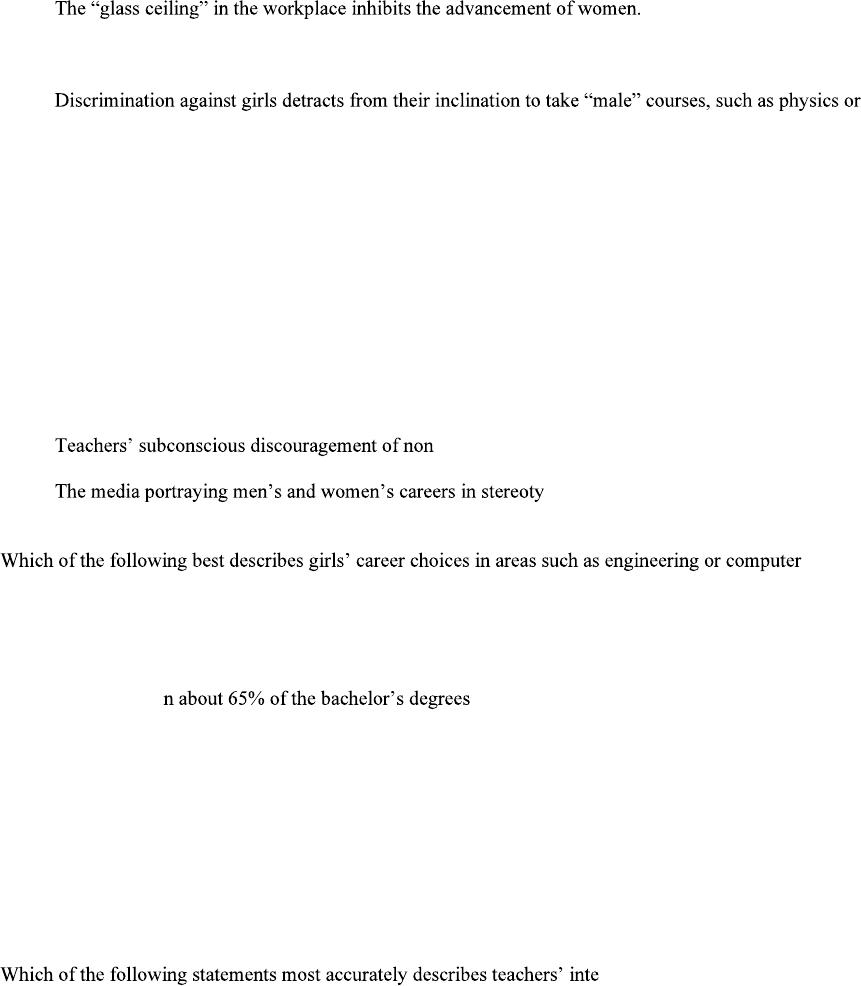
* 40 Which of the following statements is the best description of gender bias?
a.
b. Forces in schools and the larger society limit the growth and academic potential of either boys or
girls.
c. Reverse discrimination against boys detracts from their academic potential.
d.
computer science.
* 41. Of the following, what is the most likely cause of gender-role identity?
a. It is primarily determined by genetics, which determines not only physical characteristics but also
factors such as temperament and verbal ability.
b. It is primarily environment, resulting from different treatment by parents, peers, and teachers.
c. It is a combination of genetics and environment, with both contributing in varying degrees.
d. It is the result of gender-specific treatment during infancy, resulting in behavioral traits that endure
throughout life.
* 42. Of the following, which is the most likely cause of gender-stereotyped views of appropriate careers for
boys and girls (such as engineering or computer science being inappropriate careers for girls)?
a. Parental attitudes, and particular the attitudes of fathers
b. Parental attitudes, and particularly the attitudes of mothers
c. -stereotyped careers (such as a teachers subtly
discouraging a girl from majoring in engineering in college)
d. pic ways (such as computer scientists
in the media being usually portrayed as men)
* 43.
science?
a. Girls historically chose to not major in these areas, but the percentage of girls who now major in
them is rapidly increasing.
b. Girls remain less than half as likely as boys to pursue careers in these areas.
c. Girls now make up more than half of the college majors in these areas.
d. Girls now ear in these areas.
* 44. Which of the following is the most commonly cited criticism of single-gender schools?
a. Girls in single-gender schools take fewer science courses than they take in traditional school
settings.
b. Boys in single-gender schools have higher levels of character development than do boys in
traditional school settings.
c. Girls in single-gender schools are more apt to assume leadership roles that are often reserved for
boys in traditional school settings.
d. Both boys and girls in single-gender schools develop more gender-stereotyped attitudes of the
opposite sex than they develop in traditional school settings.
* 45. raction patterns with boys and
girls?
a. Teachers ask boys more questions than girls.
b. Teachers ask girls more questions than boys.
c. Girls initiate more questions than do boys, so teachers interact with them more often.
d. Teachers treat boys and girls nearly the same.
Chapter 3: Student Diversity: Culture, Language, Gender, and Exceptionalities
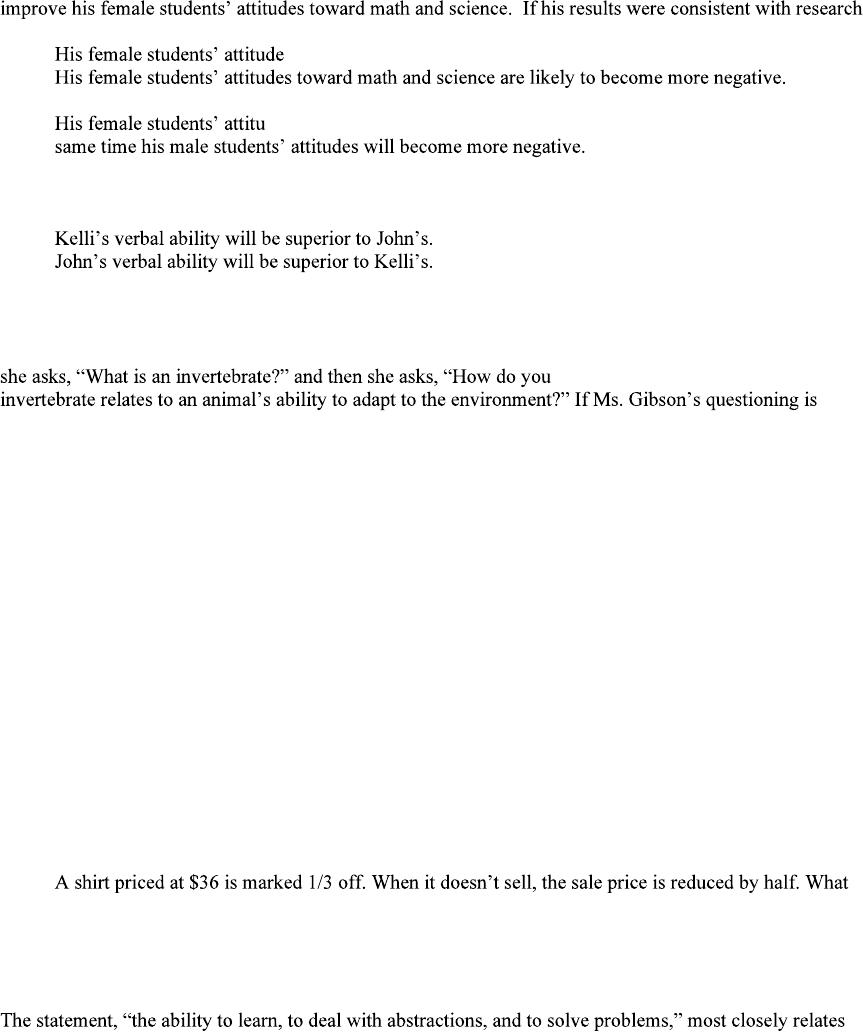
** 46. Darren James, a chemistry teacher, attended a series of workshops designed to make him aware of gender
stereotypes in secondary math and science. As a result, he made a conscious effort to eliminate the
stereotype of math and science as the domain of male students, and he consciously made an effort to
outcomes in the area, which of the following is most likely?
a. s toward math and science are likely to become more positive.
b.
c. No change in the attitudes of his female students is likely.
d. des toward math and science are likely to become more positive, but at the
** 47. Kelli and John are pre-kindergartners. If the children are consistent with patterns of development identified
by research, which of the following would be the most valid prediction?
a.
b.
c. Their verbal abilities will be about equal.
d. No prediction of verbal ability differences can be made as early as pre-kindergarten.
** 48. Ms. Gibson has 12 boys and 13 girls in her sixth-grade class. In a lesson on vertebrates and invertebrates
suppose being a vertebrate or being an
typical of the number of questions addressed to boys and girls, which of the following is most likely?
a. She will direct more questions to boys.
b. She will direct more questions to girls.
c. She will direct about the same number of questions to boys as to girls.
Essay Items
** 49. Describe five differences between boys and girls with respect to their classroom behavior and academic
achievement. (For example, boys outnumber girls in remedial English and math classes. Now, list five
more differences.)
** 50. Describe three guidelines that can help teachers as they attempt to eliminate gender bias and gender
stereotyping in their teaching, and provide an example of each.
Learners with Exceptionalities
* 51. Which of the following items, or items similar to them, would likely appear on an intelligence test?
1. On what continent is Chile?
2. Who was Isaac Newton?
3. How are a river and a plateau alike?
4.
is the price after the second reduction?
5. How far is it from Los Angeles to New York?
a. 1, 2, 3, 4, 5 b. 3, 4, 5 c. 3, 4 d. 1, 3, 4,
* 52.
to a description of:
a. intelligence.
b. learning style.
c. field dependence/independence.
d. impulsiveness and reflectiveness.
Chapter 3: Student Diversity: Culture, Language, Gender, and Exceptionalities
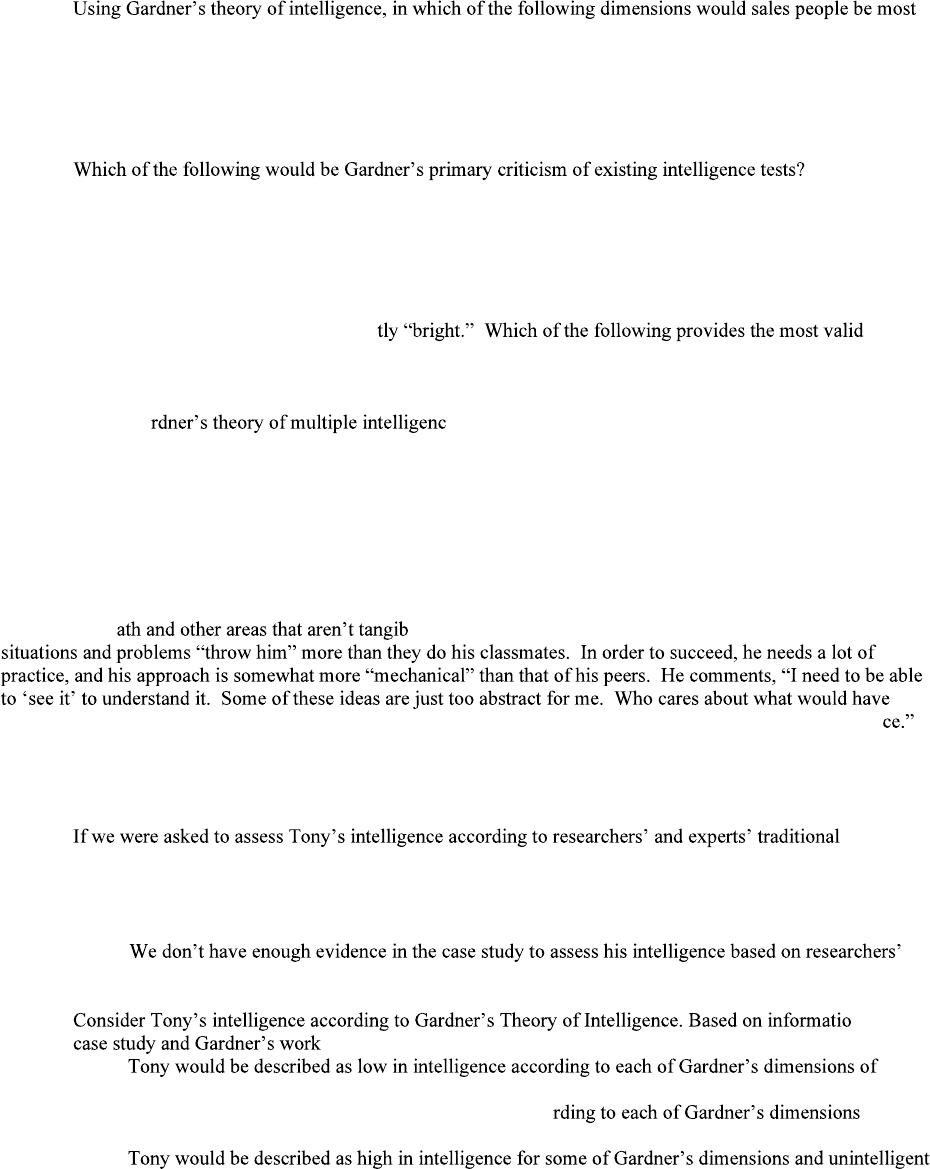
* 53.
likely to score highly?
a. Intrapersonal intelligence
b. Visual-spatial intelligence
c. Logical-mathematical intelligence
d. Interpersonal intelligence
* 54.
a. They are too difficult for most students.
b. They are culturally biased against certain minorities.
c. They are not developmentally appropriate.
d. They ignore certain important dimensions.
** 55. We have all met people who seem to be very adept at getting along with other people, even though our
perception is that they are only modes
explanation for this phenomenon?
a. Socioeconomic factors cause individuals to develop different dimensions of intelligence to different
degrees.
b. Ga es suggests that the eight different intelligences are relatively
independent.
c. Some people score high on the verbal component of intelligence tests, but low on performance
components.
d. Most theories of intelligence emphasize adaptive ability as an indicator of intelligent behavior.
Use the following information for Items 56 and 57.
Tony, a high school junior, has a somewhat difficult time in school compared to his peers, particularly with word
problems in m le. In spite of high motivation, he still struggles, and new
happened if the Crusades had been more successful for Christianity? I can get it though, if I get enough practi
When he gets frustrated, he retreats to his room where he plays his guitar; he has even done some of his own
arrangements. Tony is very skilled at working with people, and some of his peers turn to him as an arbitrator when
clashes occur in club and other organizational meetings.
** 56.
conceptions of intelligence, which of the following is the most valid prediction?
a. He will probably score lower on a test of intelligence than his typical peers.
b. He will probably get a score on an intelligence test that is similar to that of his typical peers.
c. He will probably score higher on an intelligence test than his typical peers.
d.
traditional conceptions of intelligence.
** 57. n in the
, which of the following statements is most valid?
a.
intelligence.
b. Tony would be described as high in intelligence acco of
intelligence.
c.
for the rest of the dimensions.
d. Tony would be described as low in intelligence for some dimensions, high in intelligence for oth
ers,
and information is lacking for the rest of the dimensions.
Chapter 3: Student Diversity: Culture, Language, Gender, and Exceptionalities
* 58. The ability to manage our feelings so we can cope with our world and accomplish goals, is best described
as:
a. personal development.
b. personal well being.
c. moral compass.
d. emotional intelligence.
* 59. Which of the following are considered to be characteristics of emotional intelligence?
1. Making and defending conclusions based on evidence.
2. Controlling impulses
3. Managing negative emotions
4. Behaving in socially acceptable ways
5. Demonstrating a strong work ethic
a. 1, 2, 3, 4, 5 b. 2, 3, 4, 5 c. 2, 3, 5 d. 2, 3, 4
* 60. Which of the following statements tend to be true of students with high levels of emotional intelligence?
1. They are happier and better adjusted than their peers with lower levels of emotional intelligence.
2. They are better able to make and keep friends than are their peers with lower levels of emotional
intelligence.
3. They are higher achievers than are their peers with lower levels of emotional intelligence.
4. They tend to use language as a tool to examine and monitor their emotions
a. 1, 2, 3, 4 b. 1, 2, 3 c. 1, 2 d. 2, 3
* 61. Your preferred way of learning, studying, or thinking about the world, best describes your:
a. emotional intelligence.
b. cultural values.
c. socioeconomic status.
d. learning style.
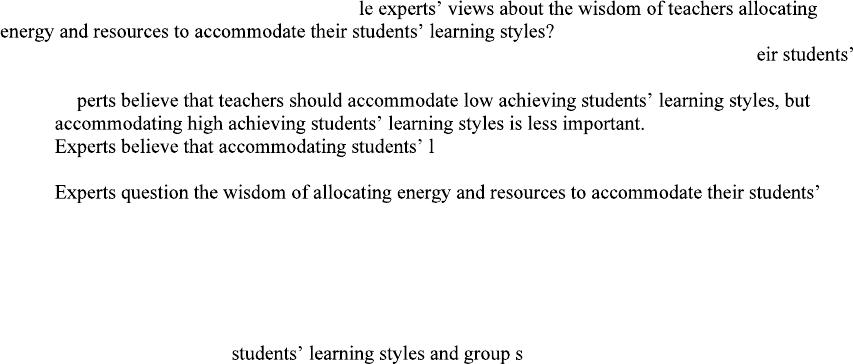
* 62. Which of the following best describes credib
a. Experts believe that effective teachers devote considerable energy to accommodating th
learning styles.
b. Ex
c. earning styles is one of the most important aspects of
their jobs.
d.
learning styles.
* 63. Of the following, based on research, which is the most valid implication of learning style research for the
way we teach?
a. We should be aware that students are different and vary the way we teach.
b. We should try to match our instruction to the individual learning styles of our students.
c. We should assess our tudents according to the assessment
results.
d. We should try to do as much cooperative learning as possible, because cooperative learning
capitalizes on learning style differences.

Chapter 3: Student Diversity: Culture, Language, Gender, and Exceptionalities
* 64. f the ways they learn most effectively, and their ability to control these factors is best
described as:
a. field independence.
b. cultural inversion.
c. learning style.
d. metacognition.
* 65. Functional limitations or an inability to perform a certain act, such as hear or walk are best described as:
a. disabilities.
b. exceptionalities.
c. behavior disorders.
d. cognitive deficits.
* 66. Instruction designed to meet the unique needs of students with exceptionalities is best described as:
a. mainstreaming.
b. inclusion.
c. ability grouping.
d. special education.
* 67. Which of the following is the most accurate description of Public Law 94-142?
a. Students with exceptionalities should be taught in as normal a school setting as possible that still
meets the students’ special academic, social, and physical needs.
b. Students with exceptionalities should be given as much extra academic assistance as necessary to
accommodate their special learning needs and help them compete acceptably with non-exceptional
students.
c. Students with exceptionalities should be provided with the extra counseling services needed to help
them maintain self-esteem and learn to cope with their physical, emotional, and academic
exceptionalities.
d. Students with exceptionalities must be taught by teachers with the special education and training
needed to help these students reach their maximum potential.
* 68. Which of the following are considered as students with exceptionalities?
1. Students who are mentally retarded
2. Students who are learning disabled
3. Students who are behaviorally disordered
4. Students who are gifted and talented
a. 1, 2, 3, 4 b. 1, 2, 3 c. 1, 2 d. 1, 2, 4
* 69. Of the following, the description that most closely relates to mainstreaming is:
a. parents are guaranteed involvement in all aspects of the evaluation of their children.
b. students with exceptionalities must be placed in environments as close to the regular classroom as
possible.
c. minorities must have a mainstream form of test, rather than an I.Q. test as the basis for placement.
d. all school age children with exceptionalities must be provided free public education.
* 70. The major difference between mainstreaming and inclusion is that:
a. inclusion addresses both cognitive and social adaptations, whereas mainstreaming does not.
b. mainstreaming is designed to help teachers accelerate learning for students with exceptionalities,
whereas inclusion is not.
c. mainstreaming is intended to provide support, within the classroom, for regular classroom teachers,
whereas inclusion does not provide these services.
d. inclusion provides a comprehensive web of services for learners with exceptionalities, whereas
mainstreaming does not.

Chapter 3: Student Diversity: Culture, Language, Gender, and Exceptionalities
* 71. A plan created
current level of performance, objectives, strategies to ensure that the student is making academic progress,
schedules for implementing the plan, and criteria for eval
a. individualized education program.
b. special needs outline.
c. exceptionalities development program.
d. program for academic success.
* 72. A team of educators will create a plan for every student having an exceptionality. Which of the following
most accurately describes the composition of the team?
a. You as the classroom teacher, a special education specialist, and parents
b. A special education specialist, a resource professional, and parents
c. You as the classroom teacher, a special education specialist, and a resource professional, but not
parents
d. You as the classroom teacher, a special education specialist, a resource professional, and parents
* 73. If you have students with exceptionalities in your classes, into which of the following categories are they
most likely to fall?
a. Students with visual impairments
b. Students with mental retardation
c. Students with learning disabilities
d. Students with behavioral disorders
* 74. A disability associated with difficulties in acquiring and using listening, speaking, reading, writing,
reasoning, or mathematical abilities is labeled a(n):
a. intellectual disability.
b. learning disability.
c. behavior disorder.
d. communication disorder.
* 75. A disability associated with the display of serious and persistent age-inappropriate behaviors that result in
social conflict, personal unhappiness, and school failure is labeled a(n):
a. intellectual disability.
b. learning disability.
c. behavior disorder.
d. communication disorder.
* 76. A disability associated with limitations in cognitive and social functioning, as indicated by difficulties in
learning, and problems with adaptive skills, such as communication, self-care, and social interaction is
labeled a(n):
a. intellectual disability.
b. learning disability.
c. behavior disorder.
d. communication disorder.
* 77. You as a regular classroom teacher have three important responsibilities in working with students who have
exceptionalities. Which one below is not one of those responsibilities?
a. Assisting in identifying students who may need additional help
b. Specifying the number of learners with exceptionalities who will be in their classes
c. Modifying their instruction to best meet the needs of students with exceptionalities in their classes
d. Encouraging acceptance of all students in their classes
Chapter 3: Student Diversity: Culture, Language, Gender, and Exceptionalities
* 78. Which of the following statements best describes effective instruction for students with exceptionalities?
a. With extra support such as one-on-one help, instruction that is effective with students in general is
also effective with students having exceptionalities.
b. Instruction that is effective with students in general is also effective with students having
exceptionalities if a special education specialist is in the room to supervise the instruction.
c. Instruction that is effective with students in general is also effective with students having
exceptionalities, and students are expected to adapt their learning strategies so they can succeed.
d. Effective instruction for learners with exceptionalities is different than effective instruction in
general, and teachers need special training to learn how to conduct this instruction.
Use the following information for items 79 and 80.
Four teachers each have learners with exceptionalities in their classrooms, and each is attempting to adapt
Mr. Robinson works hard to help his students learn study strategies, such as outlining, highlighting descriptions
of examples in the information his students read, summarizing, and self-questioning.
Mrs. Lake goes over each math homework assignment with her students and gives the students feedback on
problems that are frequently missed.
Mrs. Weber separates her students with exceptionalities from the rest of the class during learning activities and
gives them seatwork assignments to complete until she can work with them in a small group.
Mr. Edwards calls on his students with exceptionalities when he is conducting learning activities, but he avoids
** 79. The teacher who is most effective in adapting instruction to meet the needs of his or her students with
exceptionalities is:
a. Mr. Robinson.
b. Mrs. Lake.
c. Mrs. Weber.
d. Mr. Edwards.
** 80. The teacher who is least effective in adapting instruction to meet the needs of his or her students with
exceptionalities is:
a. Mr. Robinson.
b. Mrs. Lake.
c. Mrs. Weber.
d. Mr. Edwards.
Essay Items
** 81. views of
intelligence.
** 82. Describe three characteristics typically associated with high levels of emotional intelligence.
** 83. Describe differences in the way students who are high in emotional intelligence function in school
compared to students who are lower in emotional intelligence.
** 84. Describe two strategies that you, as a teacher, can use to help develop emotional intelligence and self-
regulation in your students.
** 85. What are the four most common types of exceptionalities foun
briefly.
** 86. Explain why it is important for you as a prospective teacher to understand learners with exceptionalities.
Chapter 3: Student Diversity: Culture, Language, Gender, and Exceptionalities
** 87. Describe the discrepancy model as a process for identifying students who may have exceptionalities,
criticisms of the model, and how the response to intervention model attempts to address the problems with
the discrepancy model as described by critics.
Chapter 3: Student Diversity: Culture, Language, Gender, and Exceptionalities
CHAPTER THREE ANSWERS
Linguistic Diversity
Chapter 3: Student Diversity: Culture, Language, Gender, and Exceptionalities
Gender
Learners With Exceptionalities
Chapter 3: Student Diversity: Culture, Language, Gender, and Exceptionalities
Chapter 3: Student Diversity: Culture, Language, Gender, and Exceptionalities