CHAPTER 3
ASSESSMENT OF INDIVIDUALS WITH INTELLECTUAL DISABILITIES
Chapter Outline
I. Assessment of Intelligence
A. Conceptual Bases
1. Definitions of Intelligence
2. Theories of Intelligence
3. Nature versus Nurture
4. Intelligence Quotient
B. Key Influences
1. Alfred Binet
2. David Wechsler
C. Major Instruments
1. Wechsler Preschool and Primary Scale of Intelligenc—Third
Edition
D. “Culture-Free” Tests
E. Issues Associated with Intelligence Testing
1. Underlying Constructs and Test Content
2. Test Selection and General Usage
3. Regulation of Access
II. Assessment of Adaptive Behavior
A. Conceptual Bases
1. Definitional Perspectives
2. Evolution of the Concept
3. Relationship to Intelligence
B. Key Influences
1. Edgar Doll
2. American Association on Mental Retardation
C. Major Instruments
1. Vineland Adaptive Behavior Scale
2. AAMR Adaptive Behavior Scale-School, Second Edition
D. Best and Recommended Practices
E. Issues Associated with the Measurement of Adaptive Behavior
1. Realities of Existing Instrumentation
2. Role of Intelligence
III. Other Types of Assessment
A. Educational Applications
1. Progress Monitoring
2. Transition Planning
3. High Stakes Testing
B. Adult and Community Applications
C. Legal Proceedings
1. Capacity/Diminished Capacity
2. Competence
3. Dissimulation/Malingering
IV. Summary
Key Terms
adaptive behavior
assessment
competence
deviation IQ
dissimulation
nature-nurture
Chapter Objectives
Upon completion of this chapter the student will be able to:
1. discuss different types of theories of intelligence and intellectual development.
2. identify and describe different instruments used in the practice of intelligence testing
today.
Suggested Activities
1. Have a psychologist or psychometrist demonstrate how to administer various
assessments, such as the WISC-III, Stanford-Binet IV, or VABS.
2. Interview a member of a multidisciplinary team about how individual tests of intelligence
are used to determine placement in programs for students who are mentally retarded.

Evaluation Questions
Multiple Choice
1. The collection of information for educational, psychological, and vocational decision
making is called
A. evaluation
B. assessment
C. functional analysis
D. examination
2. Psychoeducational evaluations for special education programs must include two
critical assessment areas: intelligence and _______
A. communication skills
B. problem solving skills
C. adaptive behavior
D. motor functioning
3. An essential activity for the purpose of making a diagnosis of mental retardation is the
A. assessment of communication skills
B. assessment of intelligence
C. assessment of ability to problem solve
D. assessment of motor ability
4. ______ defined intelligence as, “the aggregate or global capacity of the individual to act
purposefully, to think rationally, and to deal effectively with this environment.”
A. Gardner
B. Simon
C. Cattell
D. Wechsler
5. ______ have their roots in differential psychology, the study of group differences.
A. psychometric theories
B. genetic theories
C. biological theories
D. physiological theories
6. Psychometric theorists
A. study the methods by which an individual processes information.
B. propose that an individual’s underlying abilities account for variations in
intellect.
C. study the methods by which an individual applies information.
D. propose that there are different types of intellect.
7. Which of the following theories of intelligence represent an interdisciplinary approach?
A. differential.
B. multiple intelligences.
C. cognitive modifiability.
D. information processing.
8. Greenspan’s model of personal competence is a tripartite model of intelligence that
includes conceptual, practical, and
A. adaptive intelligence
B. social intelligence
C. motor intelligence
D. none of the above
9. Ben’s adoptive mother is interested in determining whether or not Ben’s IQ of 75 is
due to living in an impoverished neighborhood the first seven years of his life, or if it
is an issue of genetics. This phenomenon is related to the
A. environmental theory
B. theory of evolution
C. genetic controversy
D. nature-nurture controversy
10. The best research to date states that the heritability of intelligence is estimated to be
around
A. 80%
B. 70%
C. 60%
D. 50%
11. The earliest and least sophisticated term for describing a person’s level of
intellectual functioning is called
A. mental age
B. IQ
C. cognitive age
D. deviation IQ
12. Who coined the term intelligence quotient in 1916?
A. Wechsler
B. Cattell
C. Terman
D. Doll
13. Raw scores from subtests that have been converted to standard scores for the
examinee’s own age group are called
A. intelligence quotients.
B. deviation IQ.
C. mental ages.
D. Z-scores.
14. A series of three individually administered intelligence tests, modeled after one another in
which a person’s intellectual abilities are described using a verbal/motor framework is the
A. Wechsler scales.
B. Stanford-Binet IV.
C. Matrix Analogies.
D. Differential Ability Scales.
15. Elizabeth is a four year-old child who is in need of an evaluation for special
education services. The intelligence test which would be most appropriate
for her is the
A. WPPSI-III
B. WISC-IV
C. WAIS-III
D. VABS
16. Which of the following tests tends to be much more clinical rather than school–
based?
A. WPPSI-III
B. WISC-IV
C. WAIS-III
D. VABS
17. An individually administered intelligence test based on a three-level hierarchical model of
cognitive abilities is the
A. Wechsler scales.
B. Stanford-Binet IV.
C. Matrix Analogies.
D. Differential Ability Scales.
18. On the Stanford-Binet IV, which terms are used?
A. intelligence, IQ, and mental age.
B. block design and symbol search.
C. mazes and similarities.
D. verbal, abstract, quantitative reasoning, and SAS

19. The Matrix Analogies Test is a(n)
A. test for social competence
B. adaptive behavior test
C. test developed in 1915
D. “culture-free” test
20. Critics of intelligence testing find fault with the
A. tests
B. examinees
C. testing process
D. all of the above
21. IQ tests are intended to ______ the number of children qualifying for special
education.
A. reduce
B. increase
C. encourage
D. none of the above
22. The AAMR 2002 manual defines _______ as, “ the collection of conceptual, social,
and practical skills that have been learned by people in order to function in their
everyday lives.”
A. intelligence
B. cognitive development
C. adaptive behavior
D. social maturity
23. Adaptation has historically been considered a
A. psychological phenomenon.
B. biological phenomenon.
C. mental phenomenon.
D. emotional phenomenon.
24. Homeostasis occurs when an organism
A. functions over a normal range of biologically acceptable environments.
B. remains at equilibrium with itself.
C. migrates to other environments.
D. mutates into other, newer forms.
25. Homeokinesis occurs when an organism
A. functions over a normal range of biologically acceptable environments.
B. remains at equilibrium with itself.
C. migrates to other environments.
D. mutates into other newer forms.
26. The ______ is a popular measure of social competency and many now place it
among the best measures of adaptive behavior.
A. VABS
B. Leiter-R
C. Matrix Analogies Test
D. UNIT
27. Abdul is a thirty year-old male with an IQ of 70. He is currently living in supervised
housing due to his level of intellectual functioning; however, he is encountering a
great deal of difficulty adapting to situations, such as shopping and attending social
events with friends. The issue of concern is his
A. level of intelligence
B. level of mental retardation
C. adaptive behavior
D. all of the above
28. ______ is a norm-referenced, individually administered, comprehensive measure of
adaptive and maladaptive behavior intended for use with persons living in residential
and community settings.
A. VABS
B. ABS-RC:2
C. Stanford-Binet
D. Leiter-R
29. Julie is a forty year-old woman with an IQ of 60 who allegedly engaged in armed
robbery. The judicial system must determine whether or not Julie is fit to stand trial.
The judicial system is evaluating Julie’s
A. will
B. ability
C. readiness
D. competence
30. Alma murdered her husband of ten years and was afraid she would receive a harsh
penalty for her actions. Therefore, she intentionally scored low on all of the
assessments administered to her to appear as though she had an intellectual
disability. This phenomenon is termed
A. dissimulation
B. deception
C. maladaptive behavior
D. none of the above
True or False
Directions: If the statement is true, simply mark True. If the statement is false, mark
False and rewrite the statement so that it is true.
1. Theories of intelligence are useful to the extent that they provide educators with an
organizing structure for understanding and evaluating how children learn.
a. True
b. False
________________________________________________________________________
________________________________________________________________________
2. The Stanford-Binet and Wechsler scales have been and remain very popular with school
personnel and are the most widely used instruments.
a. True
b. False
________________________________________________________________________
________________________________________________________________________
3. In the Stanford-Binet IV, the term intelligence has been replaced by the term cognitive
development.
a. True
b. False
________________________________________________________________________
________________________________________________________________________
4. The Binet has a strong fine-motor component, while the WISC-IV does not.
a. True
b. False
________________________________________________________________________
________________________________________________________________________
5. Wechsler believed that motor skills were an important aspect of intelligence.
a. True
b. False
________________________________________________________________________
________________________________________________________________________
6. Wechsler only devised intelligence tests for adults.
a. True
b. False
________________________________________________________________________
________________________________________________________________________
7. A low IQ score is not a sufficient basis on which to identify a child as intellectual
disabilities.
a. True
b. False
________________________________________________________________________
________________________________________________________________________
8. IDEA mandates that transition services be provided to students beginning at age 10.
a. True
b. False
________________________________________________________________________
________________________________________________________________________
9. A narrow range of activities are used in the assessment of mental and special abilities.
a. True
b. False
________________________________________________________________________
________________________________________________________________________
10. Adaptive behavior measures are generally culture fair.
a. True
b. False
________________________________________________________________________
________________________________________________________________________
Discussion
1. Discuss the history of intellectual assessments.
2. Discuss the need for “culture–free” tests.
3. Discuss the key influences in developing tests for adaptive behavior.
4. Discuss the evolution of adaptive behavior assessments.
5. Discuss the most widely used instruments for determining intellectual functioning.
6. Compare and contrast the constructs of adaptive behavior and intelligence
7. Discuss legal proceedings involved in assessment.
8. Discuss Edgar Doll’s influence on assessments.
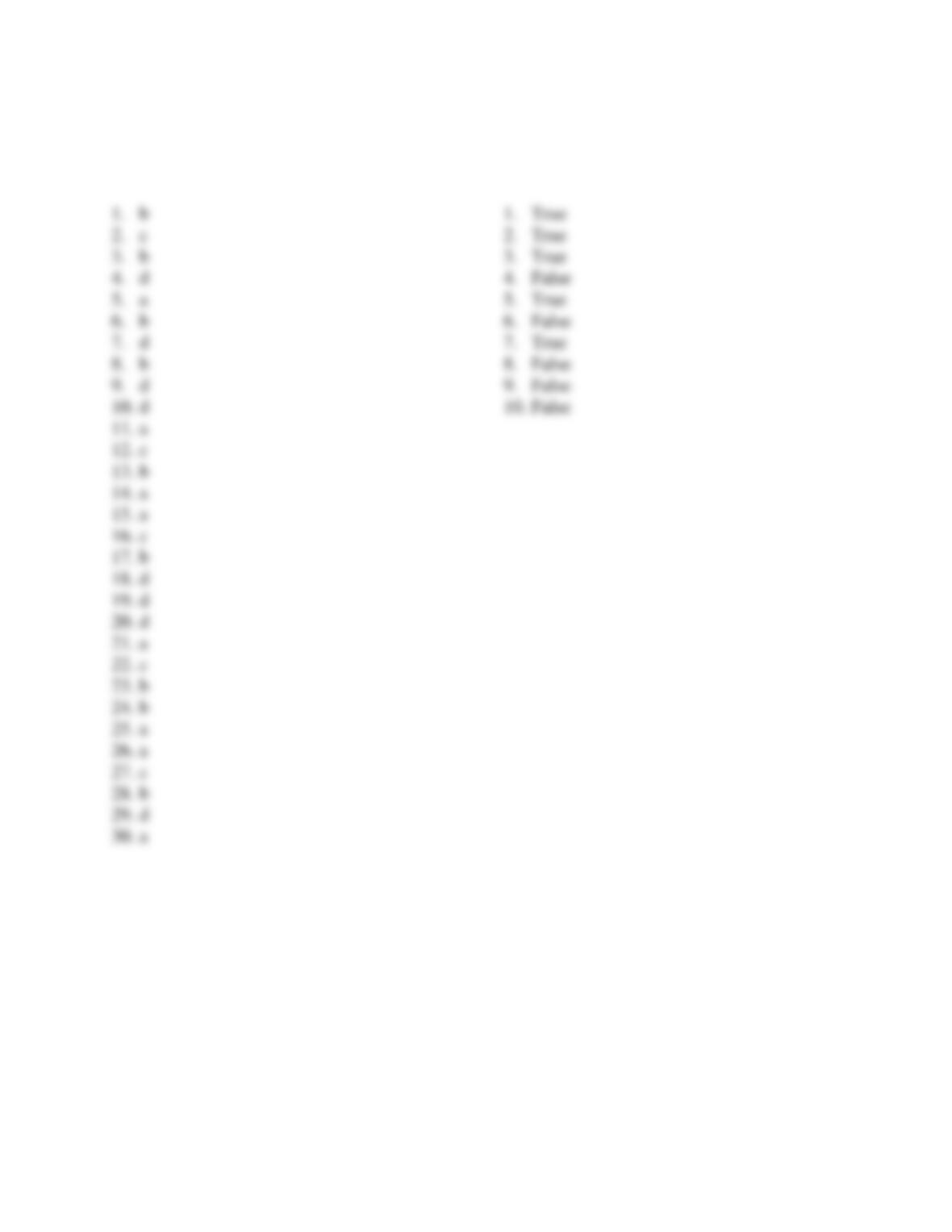
Answer Sheet
Multiple Choice True or False