159
CHAPTER 15
MULTIPLE CHOICE
1) What percentage of individuals with disabilities who are of working age are
employed?
A) 13%
B) 18%
C) 27%
D) 47%
2) According to the National Longitudinal Transition Study 2 (NLTS2), which adults
with disabilities were least likely to participate in social activities outside of work?
A) Adults with attention deficit disorder
B) Adults with emotional and behavioral disabilities
C) Adults with hearing impairments
D) Adults with intellectual disabilities
3) According to Halpern, what should the primary focus of transition services be?
A) Graduation
B) Adult employment
C) Access to adult services
D) Living successfully in the community
4) Which of the following is an example of an informal transition assessment?
A) An adaptive behavior inventory
B) A curriculum-based assessment
C) An independent living assessment
D) An academic skills assessment
5) Individualized transition plans (ITPs) specify postsecondary goals in the areas of
_____.
A) accessibility, community involvement, and family
B) functional behavior, academic performance, and socialization
C) employment, postsecondary education or training, and independent living skills
D) adaptive behavior, child rearing, and interpersonal skills
6) A summary of performance (SOP) is required for _____.
A) all high school students in special education
B) all students over the age of 16 in special education
C) all students who exit special education by dropping out of school
D) all students who exit special education by graduating or exceeding age
requirements

160
7) Which of the following statements regarding interagency collaboration and transition
is true?
A) Interagency collaboration is critical to the success of transition.
B) Interagency collaboration during transition is mandated under No Child Left
Behind.
C) Interagency collaboration during transition has been difficult in most states.
D) Interagency collaboration is required before transition goals and activities can be
implemented.
8) Which of the following represents the most appropriate way to develop career
awareness and vocational skills for students during the early elementary years?
A) Feeding the class pet
B) Developing a school-based business
C) Learning to count money and give change
D) Shadowing a cafeteria worker to learn about his/her job
9) Maria is a high school student with a disability. She is very interested in hair and
makeup and has expressed a desire to work in a beauty salon after she graduates.
Which of the following would be the least appropriate transition service for her?
A) Passing a beautician licensing exam
B) Attending art classes to learn to mix colors
C) Work-based experience with a local beautician
D) Attending classes in beauty culture at a vocational school
10) Which of the following meets the definition of competitive employment?
A) Ariel fills stockings in a sheltered workshop. She earns $.50 for each one she
fills.
B) Brad stocks shelves at a local grocery store without assistance. He earns $3 an hour.
C) Sarah wipes and clears tables at a local restaurant without supervision. She earns
minimum wage.
D) Tanya provides day care during a library program and no longer needs
supervision but works to gain experience rather than money.
11) Mr. Tozzi teaches job skills to high school students with disabilities. However, his
students are able to go to work in a community restaurant only one day a week. Mr.
Tozzi does not want his students to forget what they learned. How can he maximize
the effectiveness of their on-the-job training?
A) He can discuss their work experiences in class.
B) He can simulate work experiences in the classroom.
C) He can take the students on a field trip to Pizza Hut.
D) He can invite a restaurant manager to speak to the students.

161
12) All of the following are models of supported employment EXCEPT _____.
A) clustered placement
B) mobile work crews
C) small business enterprise
D) sheltered work environments
13) Which of the following statements about enclaves is true?
A) Enclaves are organized as not-for-profit corporations.
B) Enclave workers do not need job supports.
C) Enclave workers receive wages based on their level of productivity.
D) Enclave workers work in a sheltered employment environment.
14) Which of the following is NOT a drawback to providing a job coach for people with
disabilities?
A) They can disrupt the natural work setting.
B) They gradually reduce the level of direct onsite training and support.
C) The supported employee may behave differently with the job coach.
D) The supported employee may interact mainly with the job coach rather than other
employees.
15) Which of the following best describes a natural cue in a work environment?
A) Gina wears a uniform to her job at McDonalds.
B) Jason looks at a poster to make sure he set a table correctly.
C) Madeline hears a beeping sound and removes sandwich buns from the oven.
D) Nicholas cleans the bird cages after the store manager requests that he do so.
16) The most common type of vocational activity for people with severe disabilities is
_____.
A) competitive employment
B) home employment
C) sheltered employment
D) supported employment
17) Which of the following statements about sheltered employment is true?
A) Many people in sheltered workshops eventually obtain jobs in the community.
B) People from sheltered workshops who obtain community employment retain
their jobs over time.
C) Most special educations consider placement in sheltered workshops as an
appropriate transition outcome for students with disabilities.
D) The theoretical purpose of sheltered workshops is to provide employment
training for people with disabilities

162
18) Work activity centers provide all of the following EXCEPT _____.
A) training in recreation
B) training in independent living skills
C) training n social skills and self-help skills
D) training in task persistence and concentration
19) In 2005, what percentage of students who received special services in high school
enrolled in college?
A) 19%
B) 26%
C) 37%
D) 46%
20) An approach that helps people with disabilities live in the community as
independently as possible is known as _____.
A) assisted living
B) embedded living
C) supported living
D) transitional living
21) Shelly and Sabrina are adults with disabilities. They live together in an apartment and
are able to take care of themselves. They also perform routine household tasks. Once
or twice a week Mrs. Nelson stops by to check on them and help as needed. Once, a
neighbor was disturbing them by playing loud music, and Mrs. Nelson helped them
contact the landlord. This type of living arrangement is known as a/an _____.
A) apartment cluster
B) co-residence apartment
C) group home
D) maximum independence apartment
22) Group homes are the most common living arrangement for _____.
A) adults with intellectual disabilities
B) adults with severe physical disabilities
C) adults with emotional and behavioral disabilities
D) adolescents with emotional and behavioral disabilities
23) Seth works for a large landscaping service along with coworkers who also have
disabilities. They have support on the job from a supported employment specialist.
This is known as _____.
A) competitive employment
B) customized employment
C) a mobile work crew
D) a small business enterprise

163
24) All of the following are strategies that help students with disabilities succeed in
postsecondary environments EXCEPT _____.
A) providing an IEP for college
B) training students to use learning strategies to solve new content
C) providing exposure to increasingly rigorous content at the secondary level
D) training students to use assistive technology to access and manipulate content
25) Which of the following most accurately reflects beliefs about residential treatment
facilities for people with disabilities?
A) Residential treatment facilities for people with disabilities should be outlawed.
B) Residential treatment facilities are the best service option for people with disabilities.
C) Residential treatment facilities do not provide a normal lifestyle for people with
disabilities.
D) Residential treatment facilities do not provide the kind of 24-hour support needed
by people with disabilities.
26) What percentage of adults with disabilities are very satisfied with their quality of life?
A) 25%
B) 34%
C) 54%
D) 76%
27) Which of the following words has a meaning most like ableism?
A) Idealism
B) Individualism
C) Racism
D) Realism
28) Self-advocacy in adults with intellectual disabilities _____.
A) is impossible
B) is hindered by a lack of motivation
C) has been enhanced by Internet resources and tools
D) has increased sharply in the last decade
29) Which statement best represents the quality of life for people with disabilities?
A) For most people, it is better now than it was in the past.
B) For most people, it is worse now than it was in the past.
C) Most of the problems are due to physical barriers such as inaccessible buildings.
D) People with disabilities have more rights and privileges than those without
disabilities.
164
30) Benefits of active recreation for adults with disabilities include all of the following
EXCEPT _____.
A) increasing satisfaction with life
B) increasing ability to maintain a job
C) improvements in academic ability
D) improvements in overall health and vitality
ESSAY
1) Describe and give examples of three characteristics of good secondary programs for
individuals with disabilities.
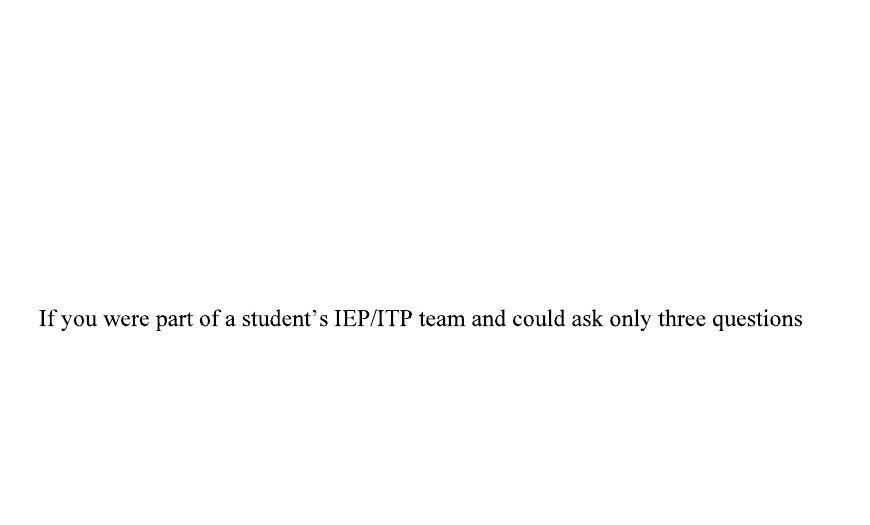
2)
before planning transition services, what would those questions be? Explain the
rationale for each of your question selections.
3) Why are transition services necessary?
4) Describe an example of competitive employment.
5) Define and give an example of self-advocacy.