Chapter 13: Developing as a Professional
CHAPTER THIRTEEN
DEVELOPING AS A PROFESSIONAL
Entering the Profession
* 1.
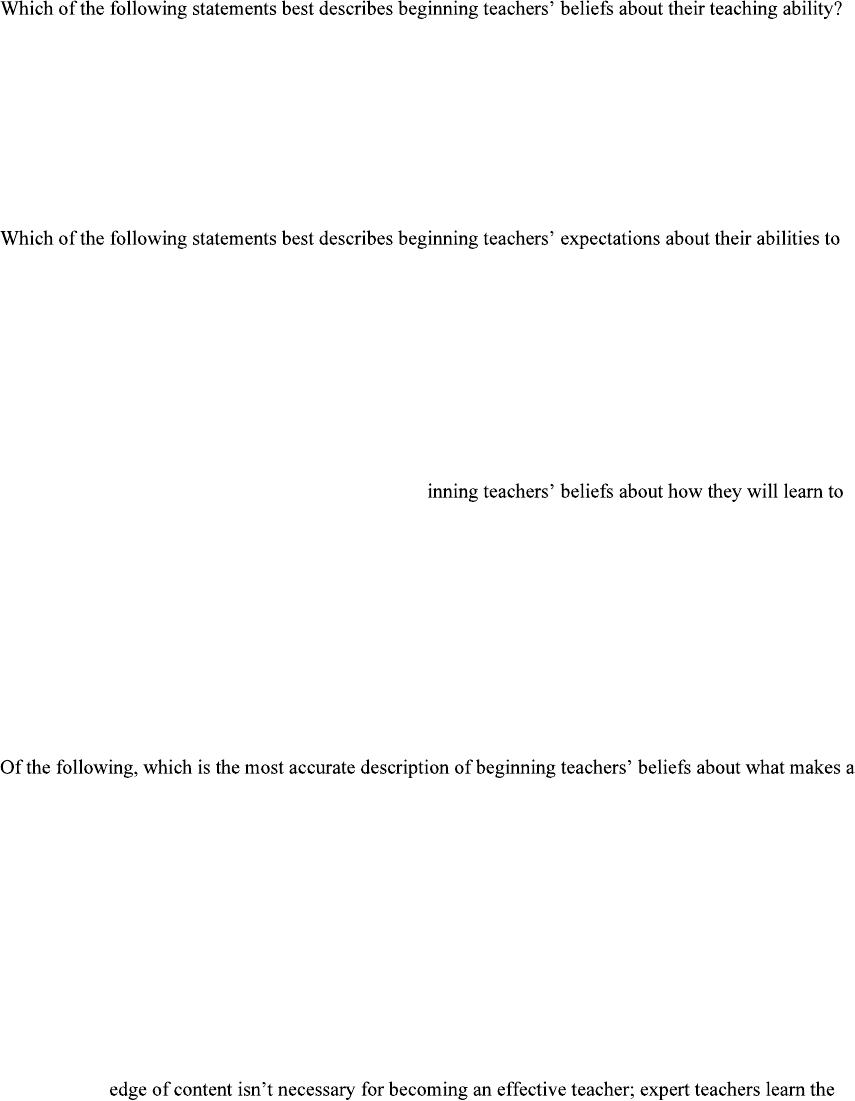
a. Beginning teachers are uncertain about their teaching ability when they begin, but they are more
self-assured by the end of their first year.
b. Beginning teachers are confident about their teaching ability when they begin, but their confidence
decreases when they encounter the realities of classroom life.
c. Beginning teachers are uncertain about their teaching ability when they begin, and their uncertainty
remains until about their third year of experience.
d. Beginning teachers are confident about their teaching ability when they begin, and their confidence
remains high at the end of their first year.
* 2.
help children learn?
a. Beginning teachers expect their confidence in their abilities to help children learn to increase as they
gain experience.
b. Beginning teachers expect their confidence in their abilities to help children learn to decrease as they
gain experience.
c. Beginning teachers expect their confidence in their abilities to help children learn to remain high and
steady as they gather experience.
d. Beginning teachers expect their confidence in their abilities to help children learn to decrease during
the first few months, but then to increase as they settle into their jobs.
* 3. Which of the following statements best describes beg
be effective teachers?
a. Beginning teachers believe that they will learn most of what they need to know about becoming an
effective teacher in their university classes.
b. Beginning teachers believe that they will learn most of what they need to know about becoming an
effective teacher in their university classes combined with pre-internships.
c. Beginning teachers believe that they will learn most of what they need to know about becoming an
effective teacher when they get into full-time experiences in classrooms.
d. Beginning teachers believe that they will learn most of what they need to know about becoming an
effective teacher in their university classes combined with their internships (student teaching
experiences).
* 4.
teacher effective?
a. The most effective teachers are those who are able to establish close relationships with their
students.
b. The most effective teachers are those who genuinely care about their students.
c. The most effective teachers are those who are enthusiastic about the topics they teach.
d. The most effective teachers are those able to most clearly explain the content they teach to their
students.
* 5. Which of the following statements best describes the importance of knowledge of content (such as
knowledge of history) in being an effective teacher?
a. If teachers understand content well enough, they will be able to figure out how to teach it effectively.
b. Knowledge of content is one of the essential kinds of knowledge that effective teachers possess.
c. Knowledge of content is valuable but not essential for being an effective teacher.
d. Knowl
content they want to teach when they prepare their lessons.
Chapter 13: Developing as a Professional
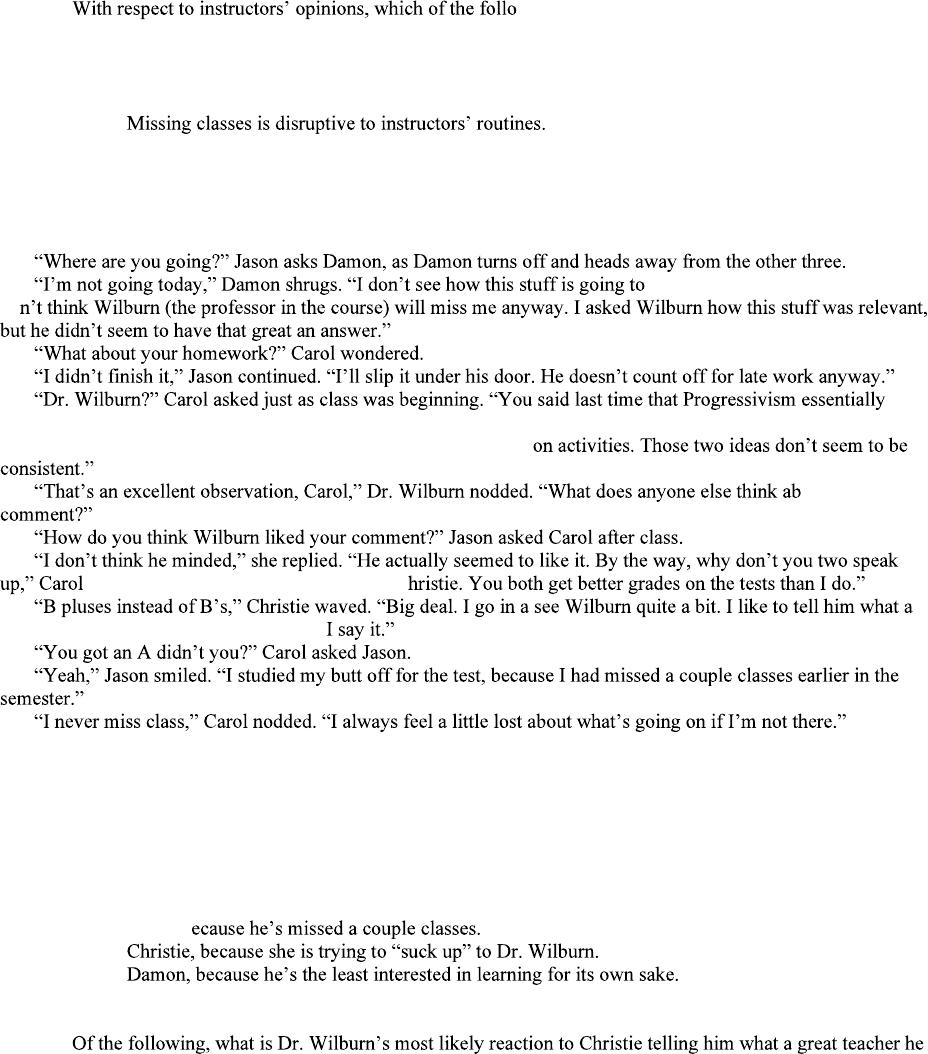
* 6. wing is the most important reason for students
attending all classes and being on time?
a. Instructors view missing classes as unprofessional behavior by students.
b. Instructors worry that the students will miss some important content if they miss classes.
c. Instructors take it as a personal reflection on their teaching if students miss classes.
d.
Use the following vignette for Items 7-9.
Jason, Christie, Damon, and Carol are walking across the campus as they head toward one of their teacher-
preparation courses.
help me be a better teacher, and I
do
disappeared by the mid 20th century, but awhile back we learned that hands-on activities are one characteristic of
Progressivism, and most of our other instructors emphasize hands-
out her
encouraged looking at both Jason and C
great teacher his is. He just smiles when
** 7. The student most likely to develop the best professional reputation is likely to be:
a. Jason, because he gets the best grades of the four students.
b. Christie, because she seems to have to best personal relationship with Dr. Wilburn.
c. Damon, because he thinks the most critically about the worth of the class.
d. Carol, because she is the most conscientious and involved in the class.
** 8. The student who is least likely to develop a positive professional reputation is:
a. Jason, b
b.
c.
d. Carol, because she asks questions that seem critical of the course content.
** 9.
is?
a. He will take the comments at face value; flattery is difficult to see through.
b. He will react very positively and view Christie very positively as a student.
c. He will react negatively to Christie repeatedly coming in for help, but he will react positively to the
compliment.
d. He is likely to react positively to Christie asking for help, but he will be skeptical of her repeated
compliments.

Chapter 13: Developing as a Professional
* 10. A collection of work samples from your teacher preparation program that you can submit to document your
skills and abilities when you apply for a teaching position is best described as a:
a. portfolio.
b. résumé.
c. credentials file.
d. license.
* 11. Which of the following best describes the primary purpose for creating a professional portfolio?
a. To collect work products (such as written papers and videotapes of their teaching) during the course
of your teacher-preparation program
b. To gather experiences that extend beyond taking paper-and-pencil tests
c. To document your knowledge and skills as a prospective teacher
d. To help clarify your teaching goals
** 12. Juan, a preservice teacher, is in the process of collecting evidence of his work in schools. He has a box into
which he has put a lesson plan that he used when he taught a lesson in math, the examples he used to
illustrate the topic he taught, a videotape of the lesson, and written feedback about the lesson from his
directing teacher. He is now in the process of doing the same thing in language arts and science. Of the
a. He is preparing pedagogical content knowledge.
b. He is demonstrating accountability.
c. He is responding to a high-stakes test.
d. He is preparing a professional portfolio.
* 13. escribes
which of the following?
a. A professional portfolio
b. A professional résumé
c. A professional certification
d. A professional syllabus
* 14. For which of the following areas are job opportunities likely to be the greatest?
a. Secondary social studies
b. Middle school English
c. High school history
d. Middle school math
* 15. For which of the following are job opportunities likely to be the greatest?
a. Teaching math in a suburban school
b. Teaching chemistry in an inner-city school
c. Teaching physics in a suburban school
d. Teaching Spanish in a suburban school
* 16. A new teacher is attempting to maximize the likelihood of finding a job. Based on population growth
patterns in the U.S., where will the opportunities be the greatest?
a. In the Northeast
b. In the Midwest
c. In the Great Lakes area
d. In the South
Chapter 13: Developing as a Professional
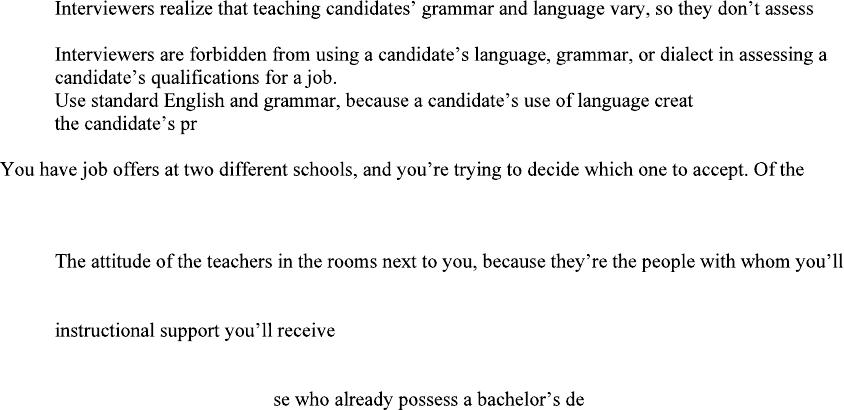
* 17. Consider the relationship between the use of standard English and interviewing effectively. Which of the
following is the most accurate statement?
a. Be yourself and use the language and grammar that is natural for you. Interviewers react most
positively to a candidate that is genuine.
b.
candidates on the basis of the grammar they use.
c.
d. es an impression of
ofessional ability.
** 18.
following, which is the most important factor to consider in making your decision?
a. The commitment and leadership of the school principal, because the principal sets the tone for the
school climate and working conditions
b.
most interact
c. The amount of technology you have available in the school, because it indicates the amount of
d. Your salary, because it will determine how satisfied you are on the job
* 19. A shorter route to teaching for tho gree best describes which of the
following?
a. Alternative licensure
b. INTASC standards
c. Formative evaluation
d. Mentoring programs
* 20. Which of the following percentages best describes the number of new teachers who enter the profession
through alternative licensure?
a. 10%
b. 25%
c. 50%
d. 75%
Essay Items
** 21. Describe the beliefs of beginning teachers with respect to effective instruction, that is, what beginning
teachers believe effective teachers do when they want to help students understand a particular topic?
Explain why they are likely to have this belief.
** 22. Describe the beliefs of beginning teachers with respect to how effective they will be when they begin
teaching. Why is examining this belief important?
** 23. Alternative licensure has become an important topic in the preparation of teachers. Explain the arguments
supporting and criticizing alternative licensure.
** 24. Describe the steps involved in creating a professional portfolio and then include a specific example of each
step.
** 25. Identify one advantage and one disadvantage of electronic portfolios compared to traditional portfolios.
Explain each.
Chapter 13: Developing as a Professional
Your First Year of Teaching
* 26. Which of the following statements best describes the number of new teachers who leave the profession by
the end of their second year of teaching?
a. About two thirds of new teachers leave the profession by their second year.
b. About half of new teachers leave the profession by their second year.
c. About a fourth of new teachers leave the profession by their second year.
d. About one of 10 new teachers leave the profession by their second year.
* 27. Which of the following statements best describes the number of new teachers who leave the profession
within their first five years?
a. About 2 of 3 new teachers leave the profession within the first five years.
b. About four of 10 new teachers leave the profession within the first five years.
c. About 1 of 4 new teachers leave the profession within the first five years.
d. About 1 of 10 new teachers leave the profession within the first five years.
* 28. Which of the following are helpful suggestions for surviving in your first year of teaching?
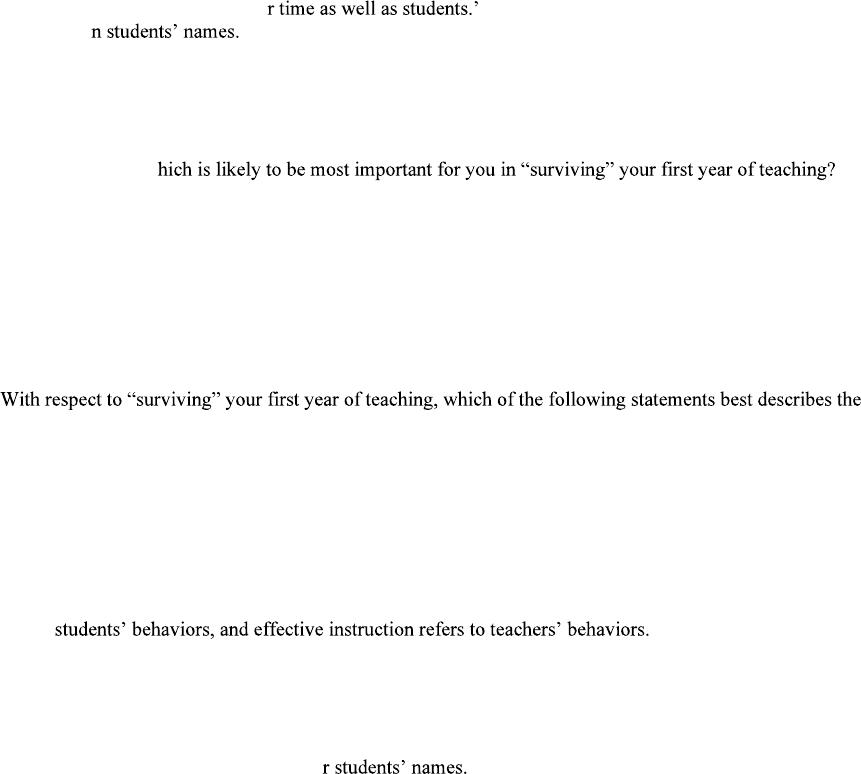
1. Organize to maximize you
2. Lear
3. Use as much cooperative learning as possible.
4. Learn effective classroom management skills.
a. 1, 2, 3, 4 b. 1, 2, 4 c. 1, 3 d. 2, 3, 4 e. 1, 2, 3
** 29. Of the following, w
a. Your ability to use sophisticated forms of instruction, such as guided discovery, because they
strongly influence student motivation
b. Your ability to do group work and cooperative learning, because they are powerful strategies for
getting students involved
c. Your communication with your colleagues, because they will be able to give you helpful
encouragement.
d. Your organizational skills, because they will save you time, and lack of time is an important problem
for first-year teachers
** 30.
relationship between classroom management and effective instruction?
a. Classroom management is a prerequisite to effective instruction; order must first be established
before teachers can instruct effectively.
b. Orderly classrooms are a result or an outcome of effective instruction; if instruction is effective,
classroom management takes care of itself.
c. Classroom management and effective instruction are interdependent; it is virtually impossible to
effectively teach in a chaotic classroom, and orderly classrooms are virtually impossible if
instruction is ineffective.
d. Classroom management and effective instruction are not related; classroom management refers to
* 31. Which of the following are suggestions that will help you get your first day of teaching off to a good start?
1. Carefully plan, and be over-organized.
2. Present your classroom rules and procedures.
3. Conduct an academic lesson, i.e., teach your students some content.
4. Begin the process of learning you
a. 1, 2, 3, 4 b. 1, 4 c. 1, 2, 4 c. 1, 2, 3
Chapter 13: Developing as a Professional
* 32. Of the following, which is the most important suggestion for thriving in your first year of teaching?
a. Spend all of your planning time preparing motivating and meaningful lessons for your students.
b. Focus your efforts primarily on the most unruly students in your classes, and develop a system to
ensure that you are able to manage their behavior.
c. To recharge your batteries, take some personal time for yourself, including taking a day off from
school now and then.
d.
staff, and attempt to work collegially with them.
* 33. The process of gathe
about retention and promotion is best described as:
a. formative evaluation.
b. professional evaluation.
c. high-stakes evaluation.
d. summative evaluation.
* 34. Which of the following is the best description of formative evaluation?
a. The process of providing professional experiences for beginning teachers that help them make the
transition to classroom work
b. The process of gathering materials, such as lesson plans, worksheets, and videotaped lessons, that
c.
decisions about retention and promotion
d. The process of gathering information and providing feedback that teachers can use to improve their
instruction
* 35. Professional experiences designed to help beginning teachers make the transition into teaching are called:
a. professional development programs.
b. induction programs.
c. new-teacher support programs.
d. professional-transition programs.
* 36. Experienced teachers who provide guidance and support for beginning teachers are most commonly called:
a. supervisors.
b. support staff.
c. mentors.
d. peer teachers.
* 37. Which of the following statements most accurately describes the percentage of newborn infants on our
a. Nearly a third of newborn infants in the United States are members of cultural minorities.
b. About 4 of 10 newborn infants in the United States are members of cultural minorities.
c. Nearly half of newborn infants in the United States are members of cultural minorities.
d. Nearly two thirds of newborn infants in the United States are members of cultural minorities and the
percentage is rapidly increasing.
* 38. Which of the following percentages most accurately describes the proportion of students who are members
of cultural minorities in the 25 largest cities in our country?
a. 10%
b. 25%
c. 50%
d. 70%

Chapter 13: Developing as a Professional
* 39. The small percentage of cultural minorities in the teaching force has some school leaders concerned. Which
of the following is the most commonly cited reason for this concern?
a. Research indicates that cultural minorities are generally more flexible in dealing with students than
are non-minorities.
b.
teaching than do non-minorities.
c. Research indicates that cultural minorities better manage classrooms (maintain acceptable student
behavior) than do non-minorities.
d. Research indicates that the minority student population is rapidly increasing, and leaders believe
they need minority teachers as role models.
* 40. A number of school leaders encourage the active recruitment of cultural minorities for the teaching force.
Which of the following are reasons given for encouraging this active recruitment?
1. The need for minority role models
2. The need for effective instructors of minority students
3. The need for teachers who are knowledgeable in particular content areas
4. The need for alternative perspectives
a. 1, 2, 3, 4 b. 2, 3, 4 c. 1, 3, 4 d. 1, 2, 4 e. 1, 2, 3
Essay Items
** 41. Describe four common challenges -year teacher.
** 42. Describe three stages of teacher development, including the focus and concerns of each stage.
** 43. Effective induction and mentoring programs significantly reduce the failure rate for beginning teachers, and
they include several elements. Describe those elements.
** 44. Many induction programs provide little more than perfunctory experiences for new teachers. Describe the
two primary reasons for this problem.
** 45. Many school leaders are encouraging the recruitment of cultural minorities into the teaching force. Cite
three reasons that they give for encouraging these efforts. Explain each reason.
Career-Long Professional Development
* 46. The process designed to give teachers the tools they need to improve their teaching, is best described as:
a. professional development.
b. formative evaluation.
c. summative assessment.
d. teacher advancement.
* 47. Which of the following is the best descrip derstands how children
learn and develop and can provide learning opportunities that support their intellectual, social and personal
a. It is a statement taken from the NEA Code of Ethics.
b. It is a description of one of the INTASC principles.
c. It is a statement taken from the description of the No Child Left Behind Act.
d. It is a statement taken from the description of teachers as advanced professionals.
Chapter 13: Developing as a Professional
** 48. Which of the following statements best describe the following qu
variety of instructional strategies to encourage students’ development of critical thinking, problem solving,
a. It is a description of one of the propositions of the National Board for Professional Teaching
Standards, which describes certification for advanced professionals.
b. It is a description of one of the principles of the Interstate New Teacher Assessment and Support
Consortium (INTASC), which describes what advanced professionals (veteran teachers) should
know and be able to do.
c. It is a description of one of the principles of the Interstate New Teacher Assessment and Support
Consortium (INTASC), which describes what beginning teachers should know and be able to do.
d.
working with students of all ability levels.
* 49. g that an individual has met certain
a. Teacher licensure
b. Teacher certification
c. Teacher tenure
d. Teacher professionalism
* 50. Which of the following best describes the concept certification?
a.
decisions about retention and promotion
b. The process states use to ensure that teachers meet professional standards
c. Recognition by a professional organization indicating that an individual has met requirements
specified by the organization
d. The process of gathering information and providing feedback that teachers can use to improve their
instruction
* 51. Which of the following best describes the goals of the National Board for Professional Teaching Standards?
a. To strengthen teaching as a profession and improve the quality of education
b. needed to deliver the
content
c. To improve the quality of alternative licensure programs and reduce the attrition rate of new teachers
d.
* 52. Which of the following statements best describes the relationship between the propositions of the National
Board for Professional Teaching Standards (NBPTS) and the four types of knowledge knowledge of
content, pedagogical content knowledge, general pedagogical knowledge, and knowledge of learners and
learning that research indicates effective teachers possess?
a. The NBPTS propositions place strong emphasis on knowledge of content and less emphasis on the
other forms of knowledge.
b. The NBPTS propositions place strong and approximately equal emphasis on each of the four types
of knowledge research indicates that effective teachers possess.
c. The NBPTS propositions place primary emphasis on learner motivation and learner diversity.
d. The NBPTS propositions place primary emphasis on the importance of self-
overall development.
* 53. The process of identifying a specific, school-related question and gathering information to try to answer it
is best described as:
a. action research.
b. alternative certification.
c. formative evaluation.
d. summative evaluation.
Chapter 13: Developing as a Professional
* 54. When conducting action research, after identifying and diagnosing a problem that is important to you, the
next step is to:
a. use the results of the study to generate additional research.
b. implement the findings to solve or improve a local problem.
c. systematically plan and conduct a research study.
d. generalize the findings to other action research settings.
** 55. Marcella is an action researcher concerned with the effects of feedback on science concept learning. She
has identified a problem important to her, that is, whether feedback hinders inquiry, and she has
systematically planned a study to address the problem. The next step for Marcella is to:
a. diagnose the problem.
b. conduct the study.
c. implement the findings.
d. generate additional questions.
Essay Item
** 56. Professional development for teachers has historically been problematic. Explain what the problems have
been and how educational leaders hope to address the problems using technology.
** 57 Describe action research. Then, identify and illustrate four steps that teachers should take in planning and
conducting action research activities.
** 58. Explain each of the five elements of National Board Certification.
Chapter 13: Developing as a Professional
CHAPTER THIRTEEN ANSWERS
Entering the Profession

Chapter 13: Developing as a Professional
Chapter 13: Developing as a Professional
v