147
CHAPTER 13
MULTIPLE CHOICE
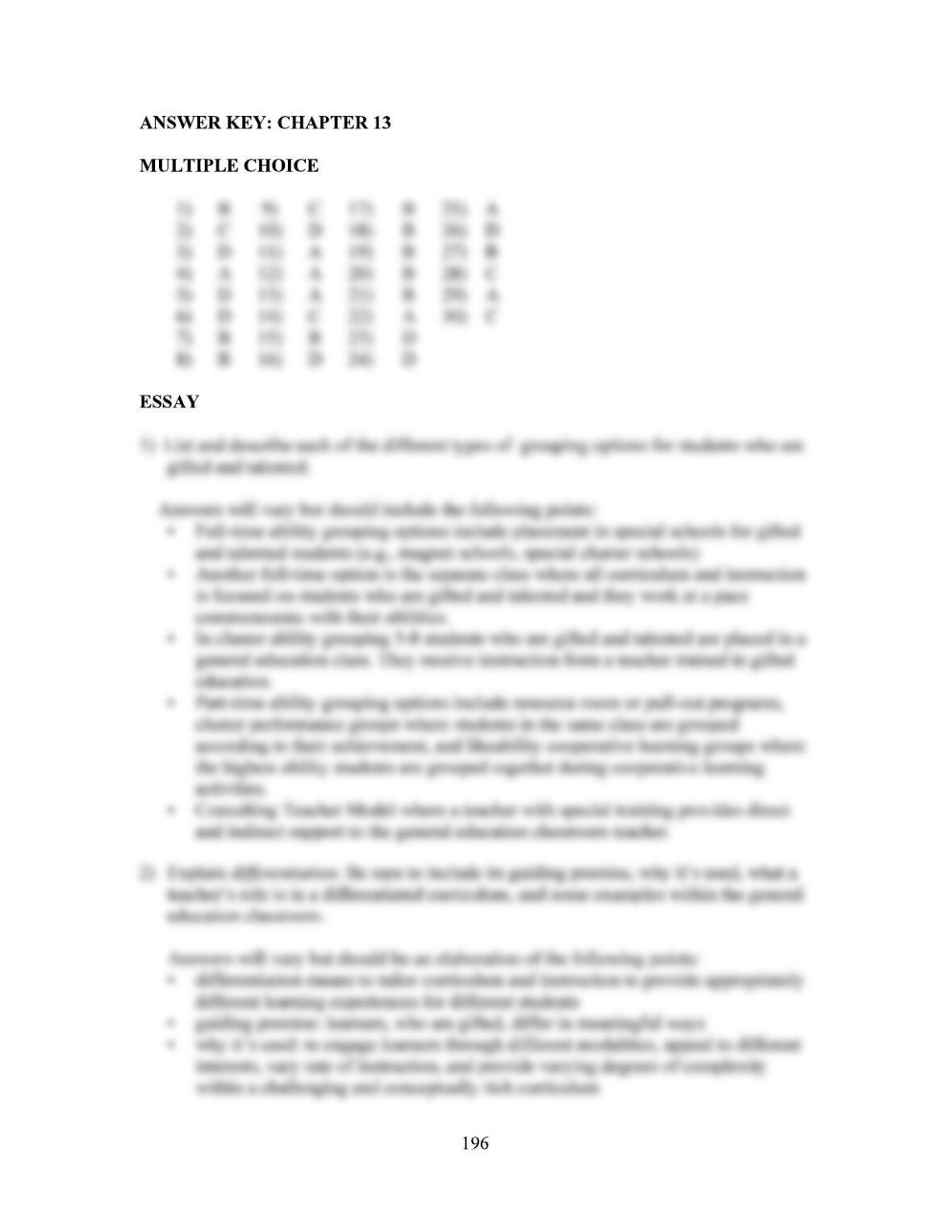
1) Which best describes early federal attempts to define giftedness?
A) The focus was exclusively on academic aptitude.
B) Multiple forms of giftedness were included in the definition.
C) Multiple talents and creativity were included in the definition.
D) The focus was exclusively on students who scored in the top 2% on standardized
intelligence tests.
2) Which best characterizes the 1993 federal definition of gifted and talented presented
A) Its primary criterion is intellectual ability.
B) It added psychomotor talent as a criterion for eligibility.
C) It required demonstrated high performance capability.
D) It eliminated the term creative as it did not indicate developing ability.
3) All of the following are characteristics that may be exhibited by students who are
gifted EXCEPT _____.
A) early moral and existential concerns
B) perfectionism and the need for precision
C) fascination with basic words and simple ideas
D) resistance to multiple or opposing points of view
4)
three basic clusters of human traits?
A) High intellect, creativity, and task commitment
B) Creativity, academic aptitude, and athletic aptitude
C) High intellect, task commitment, and academic aptitude
D) Situated problem-solving ability, academic aptitude, and leadership
5)
A) Creativity, cultural identity, motivation
B) Genetics, personality, environmental influences
C) Superior productivity, home/school collaboration, intelligence
D) Superior memory, observational powers, curiosity, creativity and rapid learning

148
6) Which is an example of intraindividual differences?
A) Belle has higher scores in math than Tony, but Tony has higher writing and
reading scores.
B) Brenna and Deanna take the same analytical abilities test and have vastly
different scores.
C) Mia has grade level scores in math, but after receiving tutoring is scoring well
above grade level.
D) Jamie has grade level scores in reading and in mathematics scores typical of
children four years older.
7) Disparate rates of social, emotional, intellectual, and physical growth and
development experienced by some children who are gifted is called _____.
A) acceleration
B) asynchrony
C) developmental lag
D) precocity
8) Using intelligence test scores and including students regarded as highly talented as
well as those with the potential for superior performance, the prevalence for
giftedness is estimated as high as _____.
A) l%
B) 3 5%
C) 25%
D) 10 15%
9) An approach toward identification of children who are gifted and talented that is
recommended by equity minded educators in gifted education is best described as
_____.
A) a nomination system
B) group analysis
C) progressive filtering approach
D) standardized test administration
10) Which is NOT edure?
A)
B) It involves increasingly more complex problem-solving tasks.
C) It includes tasks which require both convergent and divergent thinking.
D) It has been found to be inequitable when used with girls.
11) Identification and placement of children who are gifted and talented from diverse
racial, ethnic, and cultural groups _____.
A) is a persistent and pervasive problem in education
B) is addressed in the federal legislation for the gifted
C) is addressed in local and state mandates
D) was an issue resolved in the last decade, as these groups are served in proportion
similar to that of other population groups

149
12) Which is NOT a type of qualitative assessment tool used for identification of students
who are gifted and talented?
A) IQ test
B) Interview
C) Observation
D) Portfolio
13) What is primarily to blame for the underrepresentation of students from culturally
diverse groups in programs for the gifted and talented?
A) Biases inherent in the identification process
B) The increasing numbers of culturally diverse students in the school population
C) Reduced numbers of minority students entering fields requiring math and science
skills
D) Students in culturally diverse groups lack the qualities of students who are gifted
and talented
14) Which of the following is a variable, identified by the authors of the textbook, as a
concern for girls who are gifted and talented?
A) Lack of female geniuses as role models
B) Lack of parental and community role models
C) Poor academic choices and poor self-concept
D) General encouragement for careers in math and science curriculum
15) Which of the following is NOT true regarding the problems that boys, who are gifted
and talented, encounter?
A) Many boys intentionally underachieve
B) Creative behavior in boys, and careers in the arts, is encouraged.
C) Many boys act in inappropriate ways to avoid bullying.
D) Many boys feign interest in sports letting their desires go unfulfilled.
16) For students who are twice exceptional, which of the following is NOT
recommended for supporting their social and emotional needs?
A) Encourage students to succeed
B) Teach strategies for coping with frustrations
C) Provide support in establishing and maintaining friendships
D) Use conventional or nontraditional measurement tools as well as nonverbal
measurement
17) Twice exceptional means _____.
A) being gifted academically and also talented
B) being gifted and talented and having a disability
C) being in the top 1% on the bell curve of IQ and achievement test scores
D) being gifted and talented but unidentified because of gender

150
18) Appropriate curricular approaches for educating students who are gifted and talented
include all of the following EXCEPT _____.
A) acceleration
B) progressive filtering
C) differentiation
D) enrichment
19) Maker characterizes a person who is gifted as _____.
A) highly talented
B) a problem solver
C) extremely creative
D) an individual with an IQ score two standard deviations above the mean
20) Which is the best example of enrichment?
A) Jewel is 14 years old, but is allowed to enroll in college courses.
B) ot.
C) Tosha is given extra reading and math problems because she always finishes early.
D) Since Lynn already knows the algebra content covered in the first 8 weeks in
class, she is allowed to begin with content usually introduced later.
21) Which step in curriculum compacting is usually the most difficult for teachers?
A) Assessing the target content areas
B) Substituting more appropriate content
C) Determining the content to be eliminated
D) Determining which students qualify for compacting
22) Which best exemplifies acceleration?
A) Rose, a six-year-old, is in a third grade class because she has mastered first and
second grade subject content.
B) Carter is given more difficult reading material than her classmates in fourth
grade.
C) Coralee, who has mastered the third grade science curriculum, teaches it to others
in her class who have not.
D) Desmond studies subject areas not offered at his school, such as comparative
religion and quantum physics.
23) Mrs. Stewart provides a basic lesson on figurative language. All students are expected
to identify examples of similes and metaphors. Some students are expected to
generate examples of similes and metaphors and others are expected to identify and
generate more complex examples of figurative language. This approach to
differentiation is known as _____.
A) advanced placement
B) curriculum compacting
C) response to intervention
D) tiered lessons
151
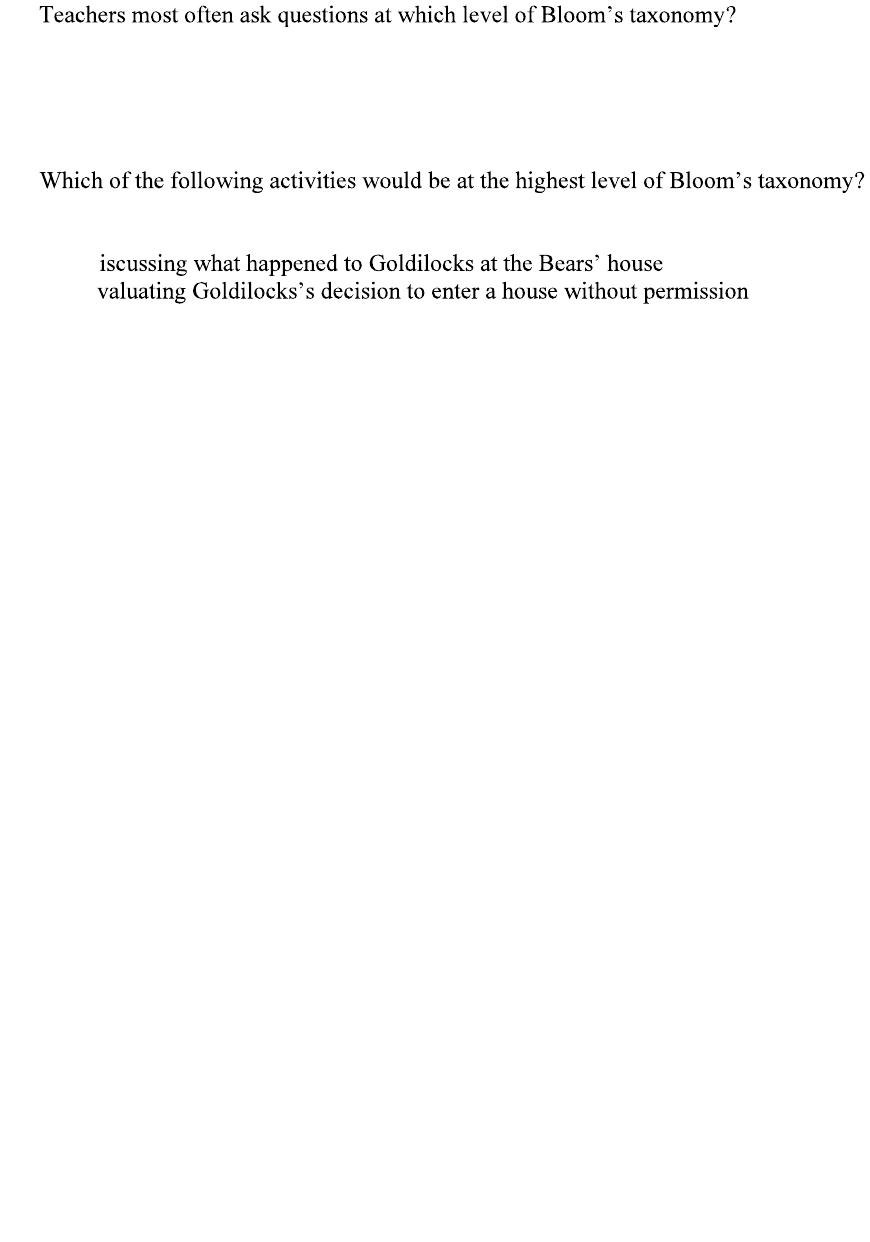
24)
A) Remember and create
B) Understand and create
C) Remember and apply
D) Remember and understand
25)
A) Designing a new chair for Baby Bear that is unbreakable.
B) Acting out what happened when the bears found Goldilocks.
C) D .
D) E .
26) Danielle is not identified as a student who is gifted or talented but has opportunities to
participate in some challenging activities for which she shows serious interest. Which
model is being used?
A) Ability grouping
B) Active problem solving
C) Problem-based learning
D) Schoolwide enrichment
27) Which best characterizes the position of the National Association for Gifted and
Talented Children on ability grouping for students who are gifted?
A) It is undemocratic and racist.
B) It is necessary to achieve the least restrictive environment.
C) It damages the self-esteem of struggling students.
D) It creates an elitist group of students with inflated egos.
28) Which of the following is the most recent type of special school, in some states, for
students who are gifted and talented?
A) High schools for gifted girls
B) Magnet schools in urban areas
C) Charter schools for the gifted and talented
D) High schools for the visual and performing arts
29) Mrs. Sawyer is a general education teacher with a class of 26 students. Six of those
students have been identified as gifted and talented. Mr. Lucas, a teacher who is
certified in teaching students who are gifted and talented, spends one fourth of his
time providing differentiated instruction to these students in the general education
classroom. This arrangement is known as _____.
A) cluster ability grouping
B) cluster performance grouping
C) dual differentiation
D) like ability cooperative learning groups
152
30) All of the following are advantages to using the DISCOVER model to identify
giftedness in culturally diverse children EXCEPT _____.
A) the process is equally effective for boys and girls
B) equitable percentages of children from all cultures are identified
C) the children identified closely resemble the cultural characteristics of the
dominant culture
D) children identified make gains that are the same as or greater than those children
identified using traditional tests
ESSAY
1) List and describe each of the different types of grouping options for students who are
gifted and talented.
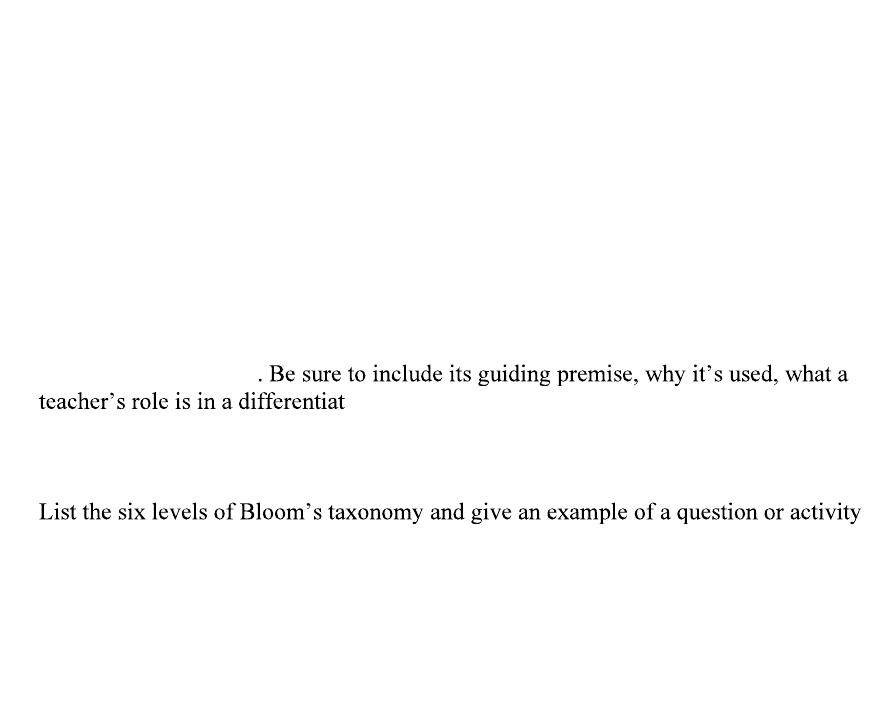
2) Explain differentiation
ed curriculum, and some examples within the general
education classroom.
3) Compare and contrast the advantages and disadvantages of two placement
alternatives for students who are gifted and talented.
4)
at each level.
5) List and explain four methods of differentiation within the general education
classroom.