141
CHAPTER 12
MULTIPLE CHOICE
1) Which of the following would qualify as a student with severe disability?
A) Karin, a student who is deaf and blind.
B) Liam, a student with an IQ of 35.
C) Melanie, a student with severe emotional disturbance.
D) Nathan, a student with traumatic brain injury.
2) Which of the following statements about students with profound disabilities is
accurate?
A) Most of them are ambulatory.
B) They need minimal support with daily living skills.
C) They function no higher than a typically developing two-year-old in many areas.
D) Sophisticated IQ tests are needed to plan educational programs for this
population.
3) Charlie is a student with muscular dystrophy and an intellectual disability. He would
be classified as a child with multiple disabilities _____.
A) automatically
B) if both disabilities were diagnosed in infancy
C) if more than two areas of functioning were affected
D) if his educational needs could not be met in a program for one of the disabilities
4) Which of the following is NOT a characteristic of a student with dual sensory
impairments?
A) displaying characteristics of emotional disturbance
B) Failing to initiate interactions
C) Engaging in self-stimulatory behaviors
D) Appearing to be passive or noncompliant
5) What percentage of students with dual sensory impairments do NOT have other
disabilities?
A) About 10%
B) About 20%
C) About 25%
D) About 30%
6) Which of the following has NOT been identified as a cause of severe disabilities?
A) Refractive errors
B) Infectious diseases
C) Premature births
D) Rh incompatibility

142
7) Which statement about the causes of many cases of severe disabilities is true?
A) The cause of most severe disabilities is delayed speech.
B) Severe disabilities are rarely acquired later in life.
C) The cause of a severe disability in almost every case is a brain disorder.
D) Most severe disabilities are caused by a lack of adequate prenatal care.
8) Which of the following students would most likely be classified as a student with
traumatic brain injury?
A) Kelsey, who has hydrocephalus.
B) Anna, who has a closed head injury.
C) Isaac, who was born with cerebral palsy.
D) Jerome, who has Charge syndrome.
9) All of the following are reasons for the gap in the number of students with traumatic
brain injury and the number of students receiving services in this category EXCEPT
_____.
A) public awareness is low about the disability
B) many students with brain injury recover
C) many students are receiving services in other categories of disability
D) brain injury does not always have an adverse effect on educational performance
10) Recent statistics on traumatic brain injury indicate that _____.
A) traumatic brain injuries are decreasing
B) most traumatic brain injuries occur in adults
C) incidence of traumatic brain injury is lower in rural areas
D) traumatic brain injury is the leading cause of death in children
11) Which of the following is NOT an example of a social or behavioral impairment
caused by a brain injury?
A) Mood swings
B) Self-centeredness
C) Lack of motivation
D) Difficulty maintaining attention
12) Which of the following would be the least functional activity for a sixteen-year-old
with severe or multiple disabilities?
A) Sorting M & or
B) Fastening a pair of shoes
C) Operating a vending machine
D) Reading words such as stop, walk, men and women

143
13) Which of the following would be the most age-appropriate recreation and leisure
activity for a teenage girl with severe or multiple disabilities?
A) Watching Dora on TV
B) Going to a school football game
C) Listening to Baby Einstein music alone in her bedroom
D) Playing a game of clap your hands
14) Teaching recreation and leisure skills to students with severe or multiple disabilities is
important for all of the following reasons EXCEPT _____.
A) accessing the general curriculum
B) helping students interact socially
C) maintaining their physical health and motor skills
D) becoming more involved in community activities
15) Determining what should be taught to students with severe or multiple disabilities
focuses on _____.
A) standardized scores
B) developmental levels
C) alignment with curriculum standards
D) functionality and age appropriateness
16) Mr. Santos is trying to teach Carl, a student with a severe disability, how to get lunch
from the cafeteria independently. To see the learning that is occurring, he should
measure progress _____.
A) each time a skill is taught
B) twice a week
C) at least once a week
D) prior to beginning instruction and after it has ended
17) Mrs. Keller wants Tony to participate in making a snack with other children in a
kindergarten class. He is able to pour things but his movements are jerky. She does
not want him to spill the cereal and waste it. She has him point to the cereal to
indicate that it needs to go in the bowl next. Which misuse of partial participation
does this exemplify?
A) Missed participation
B) Myopic participation
C) Passive participation
D) Piecemeal participation

144
18) Which of the following is an example of embedding core content into a functional
skills activity for a student with a severe or multiple disability?
A) Teaching a high school student to use a graphing calculator.
B) Teaching an elementary student to use pictures and a graphic organizer to make
comparisons.
C) Teaching an elementary student the scientific method.
D) Teaching a middle school student to read vocabulary words necessary to
understand Huckleberry Finn.
19) A term used to describe multiple disabilities, deaf-blindness and traumatic brain
injury is _____.
A) autosomal disabilities
B) comorbid disabilities
C) high impact disabilities
D) low incidence disabilities
20) Contemporary curriculum for students with severe or multiple disabilities _____.
A) focuses only on current needs
B) focuses on functional skills needed in immediate and future environments
C) is based on general education curricula but done at a slower pace with
adaptations
D) is based on developmental age and emphasizes skills that are prerequisites for
approaching milestones
21) Which of the following is NOT an element of positive behavioral support?
A) Teaching a student a desirable alternative behavior
B) Understanding the function of the behavior for a student
C) Using natural aversive consequences when the inappropriate behavior occurs
D) Arranging the environment so that the inappropriate behavior is less likely to
occur
22) Which of the following reasons for educating students with severe disabilities in
neighborhood schools has the most empirical support?
A) Parents and families have greater access to school activities.
B) Inclusion has beneficial effects on social skills and relationships.
C) Integrated schools are more meaningful instructional environments.
D) Students without disabilities learn to accept diversity and they function better as
adults.
23) Serving as a peer buddy for a student with a severe or multiple disability has all of the
following benefits for students without disabilities EXCEPT _____.
A) helps develop empathy
B) helps develop responsibility
C) provides a source of paid income
D) fosters friendships
145
24) Shelby, a student with a severe disability, is based in a general education class.
Brown and colleagues suggest this means that _____.
A) she spends 100% of her time there
B) she spends at least 70% of her day there
C) she is included in homeroom and then goes elsewhere
D) she is regarded as a class member rather than a visitor
25) Which of the following is true regarding small-group instruction and students with
severe or multiple disabilities?
A) Partial participation is the primary goal.
B) In some instances, it is the least cost effective instructional arrangement.
C) Skills learned are less likely to generalize to other settings.
D) It provides opportunities for incidental learning from others.
26) Which of the following best illustrates building communication skills?
A) Jason plays quietly with the blocks. He is praised for attending to the task.
B) Kyle rarely demonstrates eye contact. His teacher does not notice when he does.
C) Madison is learning to do laundry. Her teacher creates a washing machine from a
large box.
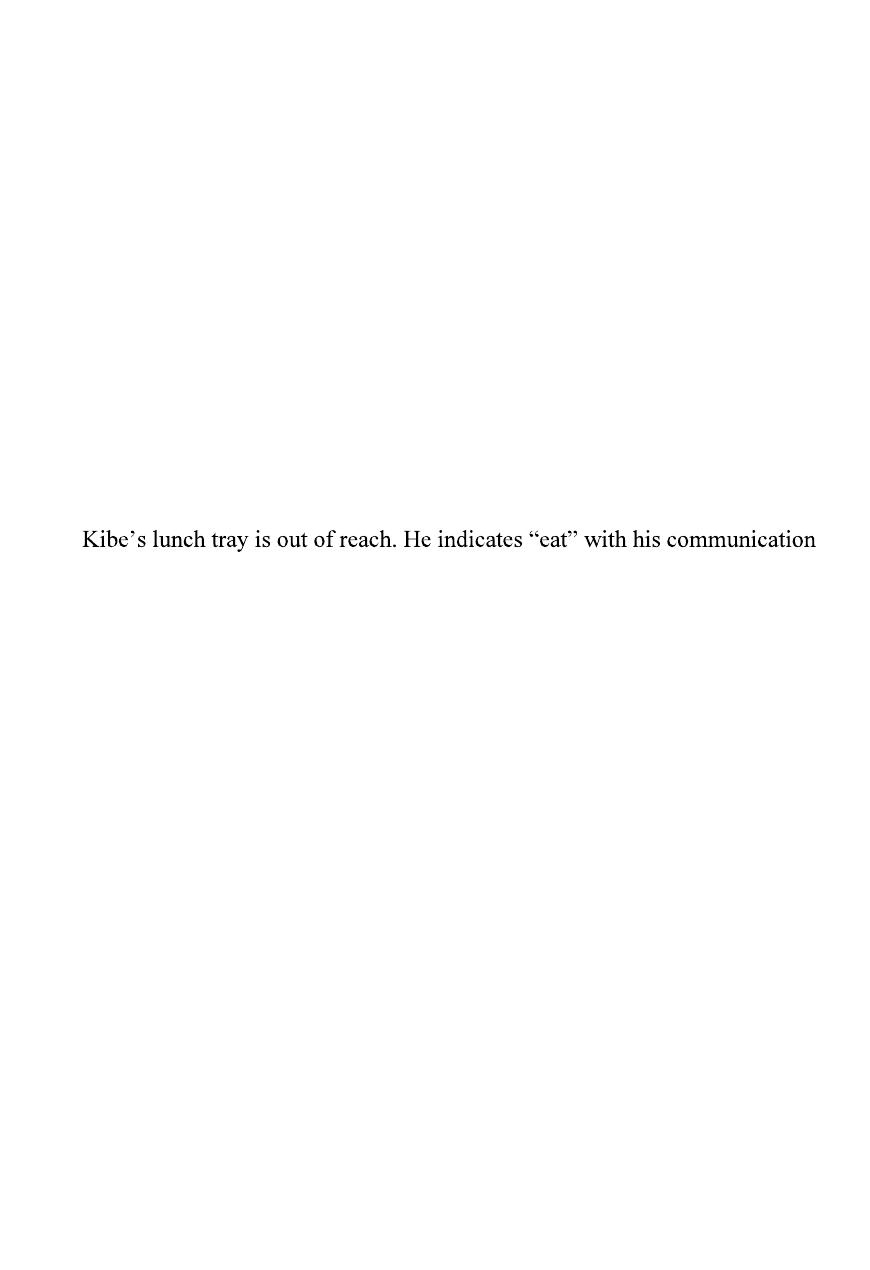
D)
device, so his teacher moves the tray where he can reach it.
27) When developing an IEP for a student with severe or multiple disabilities, one of the
greatest responsibilities of a special educator as an IEP team member is _____.
A) providing appropriate assistive technology
B) providing appropriate positive behavior supports
C) selecting and prioritizing instructional objectives
D) ensuring that the student is included with nondisabled peers
28) Which of the following is true regarding shared meaning?
A) The less skilled partner will eventually develop speech.
B) Shared communication is dependent on the form or mode used.
C) The more skilled partner should take more responsibility for communication.
D) The more skilled partner should follow the lead of the less skilled partner to
initiate communication.
29) Which of the following is NOT a component of an instructional program that is
recommended by authors of leading texts on teaching students with severe
disabilities?
A) Problem, inquiry, and project based learning
B) generalization and maintenance learning
C) Response prompts and repeated practice
D) Task analysis and time delay
146
30) Why is choice making important for students with severe disabilities?
A) It increases compliance during instruction.
B) It improves instructional control for educators.
C) It removes some of the burden from the community.
D) It improves the quality of life for students with severe disabilities.
ESSAY
1) Imagine you are a special educator with a student, Maya, who has severe/multiple
disabilities. Your supervisor wants to recommend that Maya be sent to a special
residential school because he (the supervisor) sees no significant change in her
academic levels of performance. Draft a response letter that supports your reasons for
keeping Maya in her neighborhood school.
2) Explain the importance of choice making for students with severe disabilities.
3) Explain the important components for an instructional program for Tess, a fourth
grader with severe disabilities.
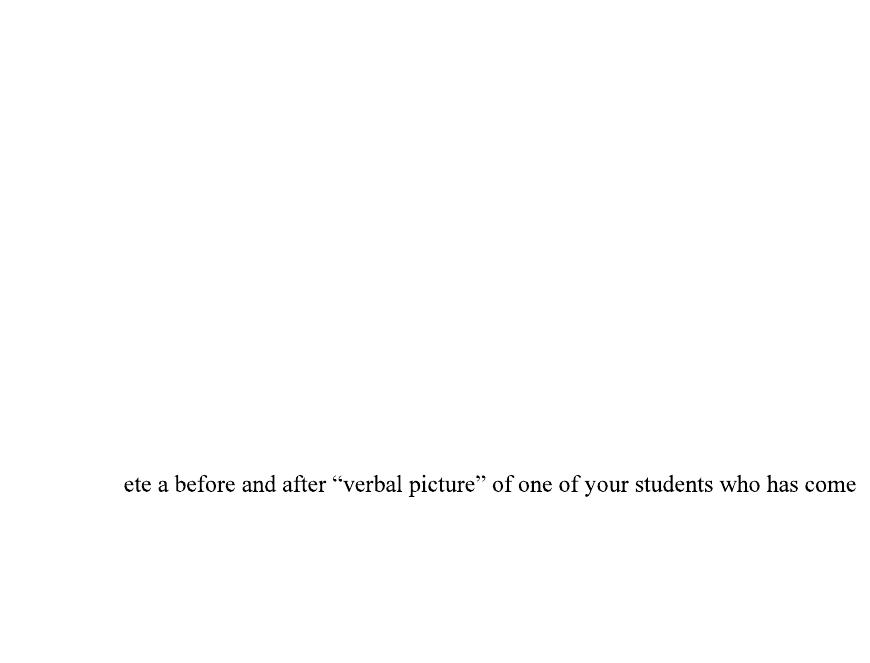
4) Imagine you are a teacher and the IAT (Intervention Assistance Team) has asked you
to compl
to school reporting he has been in a bicycle accident. The description should make it
apparent that the child has suffered a traumatic brain injury that is adversely affecting
his educational performance. Be sure to include descriptions from all three domains:
physical and sensory, cognitive/academic, and social, emotional, and behavioral.
5) Defend the position that all children are educable.