Chapter 12: Educational Reform and You
CHAPTER TWELVE
EDUCATIONAL REFORM AND YOU
Understanding Reform
* 1. Changes to schools, classrooms, students, and te
them better places for promoting student learning best describes which of the following?
a. Standards
b. No Child Left Behind
c. Accountability
d. Reform
* 2. Which of the following are types of reform?
1. Changes in the way teachers will be screened as they enter the profession
2. Changes in the way teaching is evaluated
3. Changes in the ways teachers will be rewarded for quality work
4. Changes in the ways student learning is assessed
a. 1, 2, 3, 4 b. 2, 3, 4 c. 1, 2, 3 d. 1, 2, 4
* 3. The reform movement in our country is most commonly traced to which of the following events in
American history?
a. The Vietnam War
b. The Civil Rights movement
c. The publication of A Nation at Risk
d. The election of George W. Bush as president
* 4. Statements that describe what students should know or be able to do at the end of a period of study are best
described as:
a. assessments.
b. performances.
c. rubrics.
d. standards.
* 5. Which of the following best describes the underlying theme of each of the reform efforts made in our
country since the publication of A Nation At Risk?
a. Philosophy, with the goal of providing a quality education for all students in our nation
b. Religion, with the goal of returning our country to its roots grounded in religious freedom
c.
d. Economics, with the nomy more globally competitive
* 6. Which of the following is the best description of the No Child Left Behind Act?
a. It is an amendment to the National Education Association Code of Ethics.
b. It is one of the INTASC principles.
c. It is an attempt by several states to increase the professionalism of teaching.
d. It is an accountability reform sponsored by the federal government.
Chapter 12: Educational Reform and You
* 7. Which of the following are accountability provisions of the No Child Left Behind Act?
1. All states are required to create standards for what every child should know at all grades.
2. Independent agencies (agencies outside school districts) sponsored by the federal government will
determine the extent to which standards are being met.
3. Students attending schools that fail to make adequate yearly progress for two years in a row can
transfer to another school.
4. Students are required to take standardized tests to determine the extent to which standards are being
met.
a. 1, 2, 3, 4 b. 1, 3, 4 c. 1, 2, 4 d. 1, 4
Essay Items
** 8. Outline the history of reform in our country, emphasizing current reform movements.
** 9. Describe four different types of reform that you might experience when you begin teaching.
** 10. Explain
Reform: Focus on the Curriculum
* 11. Statements describing what students should know or be able to do at the end of a prescribed period of study
are called:
a. specifications.
b. benchmarks.
c. criteria.
d. standards.
** 12. Look at the two following descriptions.
Number, operation, and quantitative reasoning. The student describes and compares fractional parts of
whole objects or sets of objects
The student is expected to:
use concrete objects and pictorial models to generate equivalent fractions.
Understand that objects in the solar system are for the most part in regular and predictable motion. Know
that those motions explain such phenomena as the day, the year, the phases of the moon, and eclipses.
Which of the following is the best description of the two statements?
a. They are statements describing two different content areas.
b. They r two different content areas.
c. They are standards written for two different curriculum areas.
d. They are guidelines for learning activities written in two different content areas.
** 13. When you begin teaching, you will be required to work with standards in the content areas you teach.
When working with standards, what will be your first task?
a. Interpreting the meaning of the standard
b. Designing learning activities to help your students meet the mandates of the standard
c. Designing assessments to help determine whether or not your students have met the standard
d. Deciding how to integrate the standard with other content areas
Chapter 12: Educational Reform and You
* 14. The process of requiring students to demonstrate that they have met specified standards and holding
a. standardization.
b. criterion referencing.
c. accountability.
d. high-stakes testing.
* 15. The mechanism used to ensure that students have met standards is:
a. effective instruction.
b. instructional supervision.
c. effective leadership.
d. standardized testing.
* 16. Of the following, which is the best description of high-stakes tests?
a. Standardized tests, such as the National Assessment of Educational Progress (sometimes called the
b. Standardized tests that are used to make important decisions affecting schools, teachers, and
students, such as promoting students from one grade level to another
c. Teacher-made tests that teachers use to measure the extent to which their students are reaching the
standards prescribed by their state
d. Tests in reading, math, and science that our country uses to compare the achievement of our students
to the achievement of students in other countries around the world.
* 17. Of the following, which is likely to be the most direct impact of high-stakes testing on you as a teacher?
a. Your school may be graded A, B, C, D, or F, and a stigma is attached to teaching in a school given a
low grade.
b. -stakes tests, so you will be confronted with negative student attitudes when
preparing them for the tests.
c. School principals are under a great deal of pressure to improve student performance, so your
principal is likely to supervise you more closely than he or she otherwise would.
d.
tests.
* 18. Of the following, which statement best describes the reason for reform effort titled the Common Core State
Standards Initiative (CCSSI)?
a.
reading and math.)
b. Educators in different states in our country have expressed strong disagreements about how
standards should be written.
c.
d. The standards created by the states in our country vary significantly in quality and rigor.
* 19. Of the following, which statement best describes the relationship between national standards (standards that
exist as a result of the Common Core State Standards Initiative) and different state standards.
a. The national standards are very similar to most existing state standards in content and format.
b. The national standards are similar to state standards in reading, but they differ from most state
standards in math and other content areas.
c. The national standards are a summary of standards gathered from different states.
d. The national standards are very different from most state standards and will make state standards
obsolete.
Chapter 12: Educational Reform and You
* 20. Of the following, which statement most accurately describes research results that have examined the
influence of high-stakes testing on student learning?
a. A consistent body of research indicates that high-stakes testing significantly increases student
learning in all of the content areas tested.
b. A consistent body of research indicates that high-stakes testing significantly increases learning in
reading and math, but results are inconclusive in other content areas.
c. Comprehensive research reviews of the effects of high-stakes testing on student achievement have
found that this approach to reform has had little or no positive effect on student learning.
d. Comprehensive research reviews of the effects of high-stakes testing on achievement have found that
this approach to reform has sharply reduced student learning.
Essay Items
* 21. Explain how the terms standards, accountability, and high-stakes tests are related.
** 22. From state to state in our country, standards and test items used to measure the extent to which students
have reached the standards are sim
implications these similarities have for you as a teacher.
** 23. Describe the controversies in the standards movement, including three of the most common criticisms, and
two arguments made by advocates of the movement.
Reform: Focus on Schools
* 24. Of the following, which is the best description of Race to the Top?
a. A reform initiative designed to increase the rigor of the standards created by
each of the states in our country for the most important content areas
b. A United States Department of Education competition, open to the states in our country, designed to
spur innovation and reforms in state and local district K-12 education
c. A revision of the Common Core State Standards Initiative (CCSSI) designed to more nearly align
national standards with standards written by the different states
d. A reform effort designed to identify the most capable students in high schools and
encourage them to consider teaching as a career.
* 25. Race to the Top rewards points to states for satisfying certain educational policies. Three of the following
are examples of those policies. Which one is not an example of those policies?
a. Improving the strategies teachers use to increase student learning
b. Designing performance-based standards for teachers and principals
c. Promoting charter schools in local school districts
d. Applying technology in classrooms
* 26. Which of the following terms best describes a variety of programs designed to let families send their
children to schools other than the school the children are assigned to attend based on the neighborhoods in
which they live?
a. Charter schools
b. Race to the Top
c. KIPP (Knowledge is Power Program) schools
d. School choice

Chapter 12: Educational Reform and You
* 27. Advocates of school choice make arguments supporting their position. Which of the following are
examples of these arguments?
1. Freedom to choose is a central American value, and school choice is consistent with that value.
2. The states in our country are unique with distinctive histories and subcultures, and our schools ought
to reflect this diversity.
3. Poor parents and parents who are members of cultural minorities are unable to move to
neighborhoods that have the best schools.
4. Our existing public-
needs.
a. 1, 2, 3, 4 b. 2, 3, 4 c. 1, 2, 4 d. 4
* 28. Opponents of school choice make arguments supporting their position. Which of the following are examples
of those arguments?
1. Parents already have choices, such as moving to neighborhoods with better schools.
2. School choice is not responsive to the needs of students with special needs or students who are
members of cultural minorities.
3. Districts now allow parents whose incomes are below the poverty line to send their children to
private schools of their choice.
4. Districts now allow parents to send their children with open enrollments and magnet programs.
a. 1, 2, 3, 4 b. 1, 2, 4 c. 3, 4 d. 1, 4
* 29. Which of the following is the best description of charter schools?
a. Schools that are financed with vouchers
b. Scho
c. Schools that are publicly funded but independently operated
d. All types of private schools except those that are religiously based
* 30. Which of the following is the best description of KIPP (Knowledge is Power Program) schools?
a. A national network of charter schools whose goal is helping students in underserved communities
b. A national network of private, non-religiously based schools that are financed by school vouchers
c. Schools created by the Race-to-the-Top reform movement and financed by federal grants
d. A network of schools financed by grants from local businesses and staffed by members of Teach for
America
* 31. Of the following, which statement best describes the way charter schools are organized and run compared
to the way regular public schools are organized and run?
a. Because charter schools are designed to be alternatives to regular public scho
organized and run is very different from the way regular public schools are organized and run.
b. The way charter schools are organized and run depends on their funding sources, because this
sources decide how they want the schools to operate.
c. The way charter schools are organized is very different from the way regular public schools are
schools.
d. The way charter schools are organized and run is very similar to the way regular public schools are
organized and run.
* 32. Which of the following is the best description of school vouchers?
a. A form of school reform that provides policies used to govern charter schools
b. A form of school choice reform that exists as checks or written documents that parents can use to
purchase educational services
c. A form of school reform that exists as grants received from the federal government and given
directly to schools to provide services for underachieving students
d. A form of school reform that provides federal monies to schools which allow the schools to provide
public transportation for students attending magnet schools

Chapter 12: Educational Reform and You
* 33. Of the following, which statement best describe d vouchers?
a. The American public overwhelmingly supports vouchers, with approximately 9 of 10 favoring using
public dollars to allow parents to send their children to private schools.
b. The American public supports vouchers for parents of disadvantaged students, such as students of
poverty and members of cultural minorities, but does not support vouchers for parents of other
students.
c. The American public supports vouchers for parents of high achievers to allow these students to
attend the best schools in local school districts.
d. The American public does not support vouchers, with only 1 of 3 Americans supporting using public
dollars to allow parents to send their children to private schools.
* 34. Of the following, which is the most common reason parents choose to home-school their children?
a. Parents believe that schools provide their children with an inadequate education.
b. Parents believe that home schooling will allow their children to better develop socially and
personally than they would in schools
c. Parents are concerned about the existing moral climate in most schools.
d. Parents home-school their children primarily for financial reasons
* 35. Which of the following most accurately describes the performance of home-schooled students on
standardized tests compared to students in public schools?
a. Home-schooled students typically score significantly higher than public school students on
standardized tests.
b. Home-schooled students typically score significantly higher than public school students on
standardized tests in reading, but they score lower on standardized tests in math.
c. Home-schooled students typically score significantly higher than public school students on
standardized tests in basic skill areas, such as reading and math, but they score lower on standardized
tests in other content areas.
d. Home-schooled students typically score significantly lower than public school students on
standardized tests.
Essay Items
** 36. Identify the four major goals of Race to the Top.
** 37. Describe three reasons why the Race to the Top program is significant with respect to educational reform in
our country.
** 38. A considerable amount of research has examined student achievement in charter schools compared to
comparable public schools. Describe what the most significant of this research has found.
** 39. Describe what research examining the academic benefits of vouchers has found.
Reform: Focus on the Teacher
* 40. Of the following, which is the most important factor determining how much students learn?
a. The quality of the teacher: How effectively the teacher teaches
b. The curriculum: What students study
c. School leadership: The quality of school principals and other administrators
d. School facilities: The physical plant and access to technology and other support services
Chapter 12: Educational Reform and You
* 41. Of the following, which statement most accurately describes the influence of expert teachers on students?
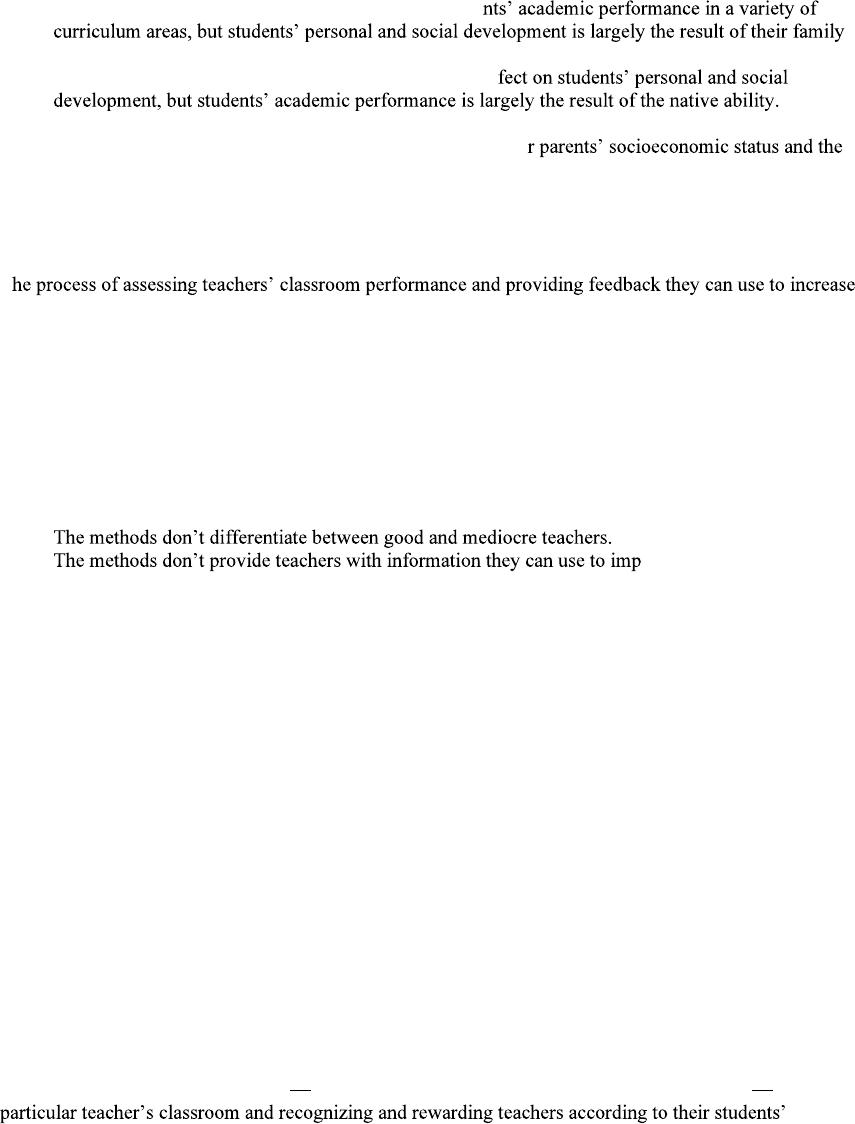
a. Expert teachers have a lasting positive effect on stude
background.
b. Expert teachers have a wide-ranging, lasting positive ef
c. The effect of expert teaching on students is somewhat limited, because student achievement, as well
as personal and social development largely depends on thei
involvement of parent with their children during the school years.
d. Expert teachers have a wide-ranging, lasting positive effect on students, including increased
academic achievement, improved personal and social development, increased enrollment in college,
and higher adult earnings.
* 42. T
their expertise is best described as:
a. teacher professional development.
b. a school improvement model.
c. teacher evaluation.
d. in-service teacher training.
* 43. Present methods of teacher evaluation are commonly criticized. These criticisms include which of the
following?
1. The methods are not grounded in research examining the relationships between teaching and
learning.
2.
3. rove their teaching.
4. The methods are not cost effective, so schools districts spend money unnecessarily.
a. 1, 2, 3, 4 b. 2, 3, 4 c. 1, 2 d. 2, 3
* 44. As reformers realized that teachers are central in the process of improving schools, they began to look for
ways to examine and improve the teaching force. Which of the following have been included in this
examination?
1. Teacher tenure
2. The way teachers are evaluated and whether or not current evaluation systems identify excellent
teachers the eliminate those who are not competent
3. The teaching strategies teachers use in their classrooms
4. The role of teacher professional organizations
5. How good teachers should be rewarded
a. 1, 2, 3, 4, 5 b. 1, 2, 4, 5 c. 3, 4, 5 d. 2, 3, 5
* 45. Current reforms in teacher evaluation have three goals. Which of the following is not one of those goals?
a. Certifying that teachers are adequately utilizing modern technology in their classrooms
b. Verifying that veterans are doing a competent job in their classrooms
c. Certifying that a beginning teacher has the skills needed to manage a classroom and promote student
learning.
d. Identifying and rewarding exemplary performance
* 46. Assessing the amount students learn as measured by their performance on standardized tests while in a
performance best describes which of the following?
a. Application of the No Child Left Behind Act models of teacher evaluation
b. Value-added models of teacher evaluation
c. Student performance models of teacher evaluation
d. Professional assessment models of teacher evaluation
Chapter 12: Educational Reform and You
** 47.Emma Harrison, a first year teacher, learns that her
be taken into account when she is evaluated, and these scores may be considered in determining whether or
not she is awarded tenure in her district. Of the following, this process would be best described as an
application of:
a. observational models of teacher evaluation.
b. No Child Left Behind models of teacher evaluation.
c. professional development models of teacher evaluation.
d. value-added models of teacher evaluation.
* 48. The process of offering teachers higher salaries and bonuses for taking on extra responsibility, working in
high-need areas, or performing in an exemplary way, is best described as:
a. a pay for-performance system.
b. a reward based on a value-added model of teacher evaluation.
c. a professional reward system.
d. a professional development system.
** 49. Nancy Evans, a third-grade teacher in a large, urban elementary school, has agreed to be the third-grade,
grade-level chair for the upcoming school year, and she will receive a salary supplement for doing so. This
process is an application of which of the following?
a. A value-added model of teacher evaluation
b. A professional development system
c. A collective bargaining application
d. A pay-for-performance system
* 50. Status granted to teachers after a probationary period (typically three years), indicating that employment is
essentially permanent, is best described as:
a. teacher tenure.
b. pay-for-performance.
c. professional status.
d. value-added reward.
* 51. Of the following, which statement most accurately describes research results that have examined the
influence on student learning of providing merit pay for teachers?
a. A consistent body of research indicates that merit pay for teachers has resulted in significantly
increased student learning in all content areas.
b. A consistent body of research indicates that merit pay for teachers has resulted in significantly
increased learning in reading and math, but results are inconclusive in other content areas.
c. Comprehensive research reviews of the effects of merit pay for teachers on student achievement
have found that this approach to reform has had little or no positive effect on student learning.
d. Comprehensive research reviews of the effects of merit pay for teachers on student achievement
have found that this approach to reform has sharply reduced student learning.
Essay Items
** 52. Describe current forms of teacher evaluation that you are experiencing, and will experience, as you go
through your teacher preparation program and begin teaching. Include when (such as during your pre-
service program, or during your first year of teaching) the evaluation will occur, and what the purpose of
the evaluation is.
** 53. Identify three common criticisms directed at value-added models of teacher evaluation.
** 54. Merit pay differs from other pay-for-performance plans in two ways. Describe the two ways in which it is
different.
** 55. Merit pay is highly controversial. Describe three arguments supporting merit pay, and then provide three
criticisms of merit pay.
Chapter 12: Educational Reform and You
** 56. Describe the primary reasons teacher tenure was originally implemented in the late 1800s.
** 57. With respect to the process of educational reform, describe the relationship between professional
organizations, such as the National Education Association (NEA) and the American Federation of Teachers
(AFT) and educational reformers. Explain how this relationship has evolved over the last five or more
years.
Chapter 12: Educational Reform and You
CHAPTER TWELVE ANSWERS
Reform: Focus on the Curriculum
Chapter 12: Educational Reform and You
Reform: Focus on Schools
Reform: Focus on the Teacher
Chapter 12: Educational Reform and You
Chapter 12: Educational Reform and You