1
Chapter 10: Students with Attention-Deficit Hyperactivity Disorder
Multiple Choice
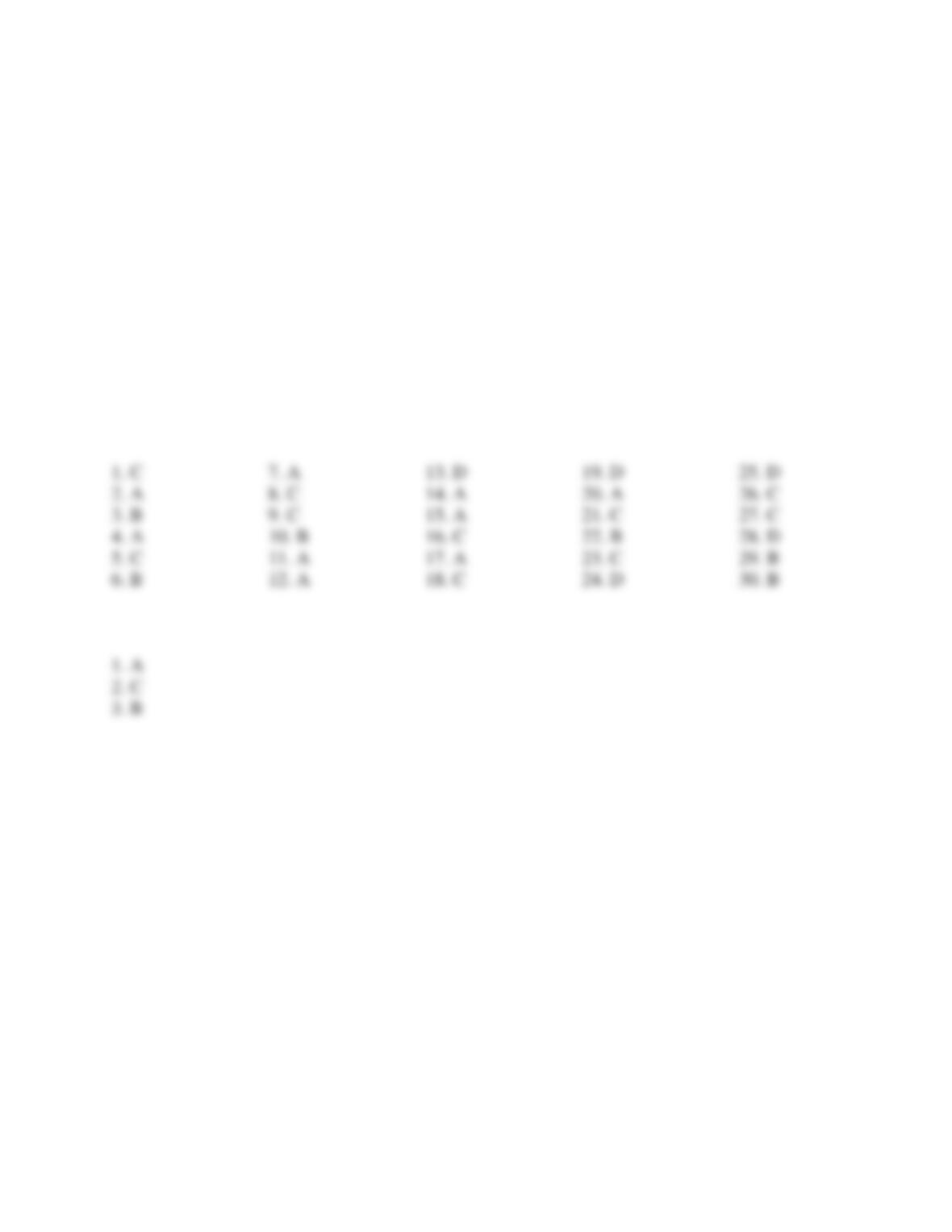
1. Which IDEA category includes ADHD?
A. Emotional disturbance
B. Learning disabilities
C. Other health impairments
D. Attention deficit disorder
2. What fraction of students served under the category that includes ADHD actually have
ADHD?
A. Greater than 2/3
B. Less than 1/2
C. Almost 3/4
D. About 1/4
3. Fidgeting, leaving the seat in the classroom, running or climbing excessively, difficulty
playing or engaging in leisure activities, blurting out answers, difficulty waiting to take turns,
and talking excessively are characteristics of:
A. ADHD inattentive type
B. ADHD hyperactive/impulsive type
C. ADHD with learning disability
D. ADHD combined type
4. According to the American Psychiatric Association, symptoms of ADHD must persist for at
least how long?
A. 6 months
B. 3 years
C. 6 years
D. 3 months
5. Which of the following is not criteria for ADHD under APA definition?
A. Be present in at least two settings
B. Occur before age 12
C. Attributed to another disability
D. Persist for greater than six months
2
6. What is the prevalence of ADHD in boys vs. girls?
A. Approximately 6 times as many boys have ADHD than girls
B. Approximately 2 times as many boys have ADHD than girls
C. Approximately 10 times as many girls have ADHD than boys
D. Approximately 3 times as many girls have ADHD than boys
7. Students with which type of ADHD are usually identified earliest?
A. Predominantly hyperactive-impulsive type
B. Predominantly inattentive type
C. Combined type
D. Predominantly inattentive-hyperactive type
8. For students who have inattentive type of ADHD, teachers should make sure students have
enough time to shift from one activity to another, allow flexible limits for finishing work,
simplify tasks that have multiple steps, and:
A. Take medication
B. Receive special education services
C. Teach organization skills
D. Have a peer tutor
9. The majority of children with ADHD have:
A. Predominantly hyperactive-impulsive type
B. Predominantly inattentive type
C. Combined type
D. Predominantly inattentive-hyperactive type
10. Most students with ADHD have IQ scores in what range?
A. Low average
B. Average
C. High average
D. Above average
11. 66% of students with ADHD exhibit:
A. Internal and externalizing behaviors
B. Oppositional defiant disorders
C. Conduct disorders
D. Depression
3
12. Which of the following is a known cause of ADHD in children?
A. Structural differences in the brain
B. Dietary issues such as too much sugar
C. Prenatal exposure to cigarette smoke, lead, and alcohol
D. Watching too much television
13. There is research to support braid differences in children with ADHD. Which of the
following is not a brain difference noted in children with ADHD?
A. Cerebellar volume differences
B. Less activation in networks related to cognition
C. Neurochemical differences
D. More activation in the frontal cortex
14. Exposure to cigarette smoke, lead, and alcohol are which of the following environmental
causes/factors of ADHD?
A. Prenatal
B. Perinatal
C. Genetic
D. Biological
15. The name of a plan written for a student who does NOT require special education services
but needs some accommodations in the general education classroom is:
A. 504 plan
B. Behavior Management plan
C. IEP
D. IFSP
16. Nondiscriminatory evaluation plans seek to answer each of the following EXCEPT:
A. Does the student have ADHD and can other disabilities be ruled out?
B. Do other disabilities exist simultaneously with ADHD?
C. What should the student’s IEP contain?
D. Can the student be served by an existing program, like EBD, even if he has ADHD?
17. Many school psychologists use which measure to determine the presence of ADHD?
A. Attention Deficit Disorders Evaluation Scales
B. Conner’s Rating Scales
C. Peterson’s Rating Scales
D. ADHD Assessment Tool
4
18. Accommodations like reassuring the student gently, meeting with the parents to find out how
the child likes to communicate, and being on the alert for frustration or anger and modifying
expectations during those times are particularly good for students who:
A. Display inattention
B. Are impulsive
C. Have mood characteristics
D. Have difficulty complying
19. A critical predictor of success in adulthood for students with ADHD is:
A. Note taking
B. Self-instruction
C. Organizational skills
D. Goal setting
20. With regards to medications for ADHD teachers are expected to:
A. Help monitor the impact on the child
B. Help the parents learn behavioral interventions to avoid using drugs
C. Discourage parents from resorting to using medications
D. Recommend drugs that have proven to be successful in their experience
21. Common components of multimodal treatment include each of the following except:
A. Medication
B. Parent training
C. Behavior management in the home
D. Behaviorally oriented treatment
22. An instructional strategy that minimizes mistakes students make when learning a new task is:
A. Multimodal instruction
B. Errorless learning
C. Mastery learning
D. Goal attainment instruction
23. Anything a teacher does after asking a question to increase the chances a student will provide
the correct response is called a:
A. An SD
B. Reinforcer
C. Prompt
D. Intrusion
5
24. What percentage of children and youth who visit a doctor, pediatrician, or psychiatrist to
address ADHD issues receive prescriptions for mediation?
A. 20%
B. 40%
C. 60%
D. 80%
25. ________ medication is the most frequently prescribed ADHD medication.
A. Non-stimulant
B. Anti-inflammatory
C. Psychoactive
D. Stimulant
26. What percent of students with OHI and ADHD spend 0-40% of their time in the general
education setting?
A. 80%
B. 50%
C. 9%
D. 1%
27. Why doesn’t the U. S. Department of Education provide data on the number of students with
ADHD who are educated in the general education classroom?
A. Because all students with ADHD receive their education in the general education
classroom.
B. Because ADHD is a complex disability that often also includes students with learning
and language disabilities.
C. Because ADHD is not a separate category under IDEA.
D. Because some parents do not want their child labeled ADHD.
28. When a student with ADHD does not qualify for services under IDEA, often a ________ is
developed.
A. 911 plan
B. 401 plan
C. 508 plan
D. 504 plan
29. Under IDEA, ADHD falls under the larger category of
A. Emotional Disturbance
B. Other Health Impairment
C. Specific Learning Disability
6
D. Intellectual Disability
30. A recommended assessment accommodation for students with ADHD is:
A. Provide them with a shortened test
B. Allow the student to take extra breaks
C. Allow them to take the test with a partner
D. Allow them to take the test as an open-book test
Praxis style questions
1. Shane has difficulty finishing assignments, often loses things, is easily distracted, and has
poor attention to detail. Which of the following best identifies Shane?
A. ADHD predominantly inattentive type
B. ADHD predominantly hyperactive type
C. ADHD predominantly hyperactive-impulsive type
D. ADHD combined type
2. José is a student with ADHD combined type. He is inattentive, withdrawn, restless, and
impulsive. Which would be the most appropriate intervention to help José with his behavior?
A. Send him to the principal’s office where there are less distractions.
B. Offer José reading materials below his reading level to decrease frustration.
C. Teach José organizational and goal-setting skills.
D. Help José’s parents seek medication to control his behavior.
3. Casey lacks motivation to complete her work and participate in class. What motivational
strategy might help Casey?
A. Send frequent notes to Casey’s parents so they can talk to her.
B. Use goal attainment scaling as a way for Casey to see her progress.
C. Give Casey good grades to motivate her to work in class.
D. Develop a behavior plan for Casey with consequences for not completing work.
Short Answer
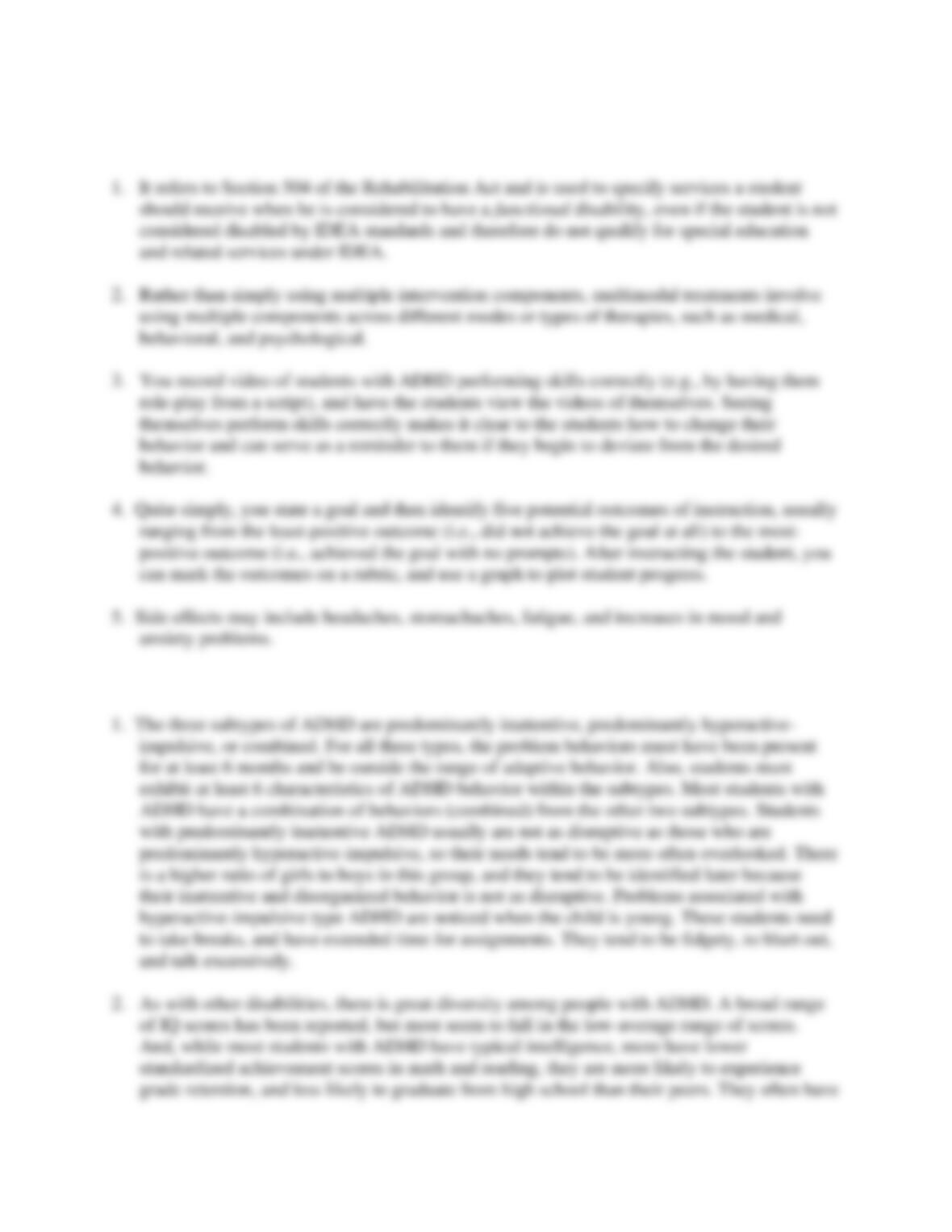
1. Explain the purpose of a 504 plan.
2. Describe multimodal treatments for students with ADHD.
3. Discuss the usefulness of video self-monitoring for students with ADHD.
4. Describe the goal attainment scaling process for determining student progress.
5. Discuss potential side effects of stimulant medication.
7
Essay
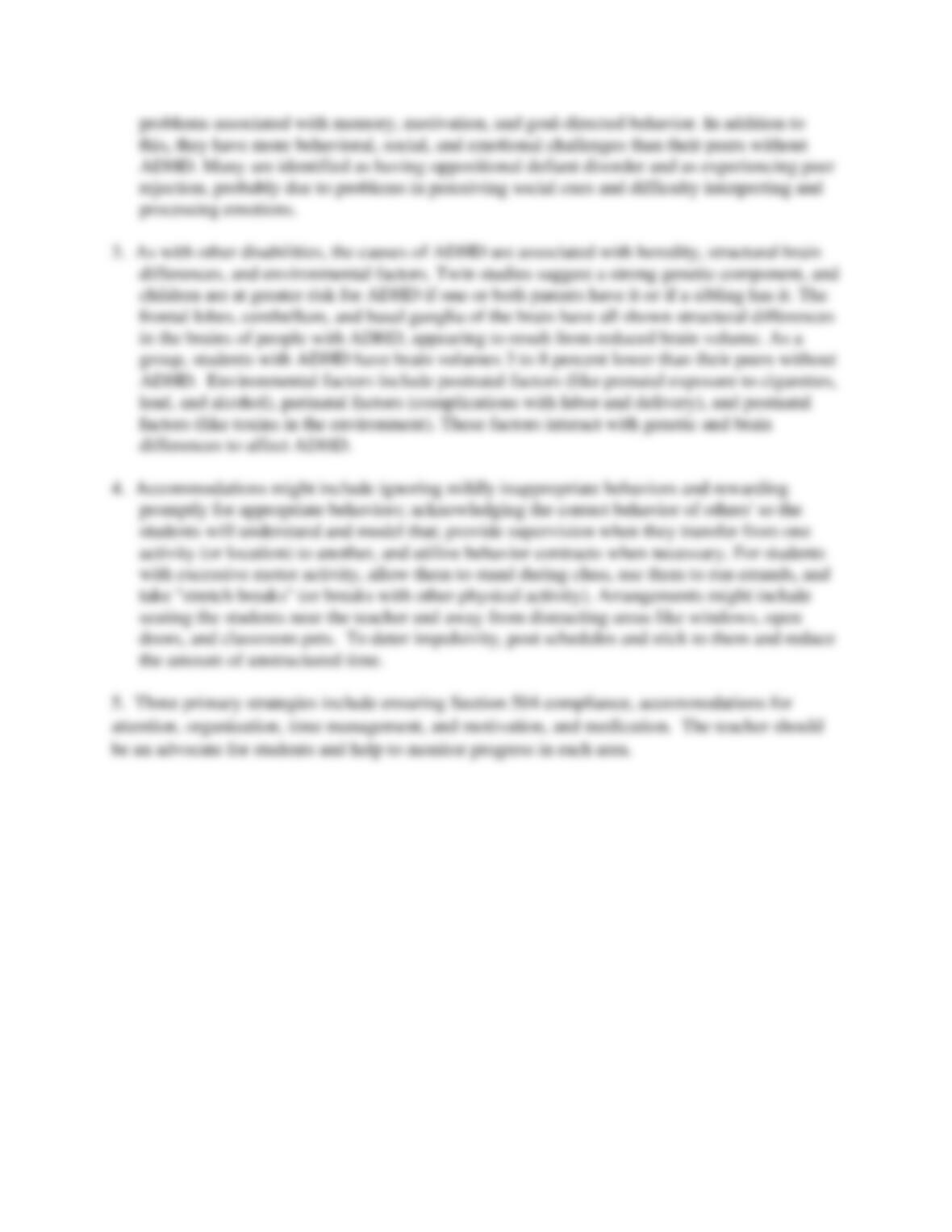
1. Compare and contrast the three types of ADHD.
2. Describe the intellectual, academic, and behavioral/emotional characteristics of students with
ADHD.
3. Summarize the possible causes of ADHD.
4. Describe accommodations for students with hyperactivity impulsivity and suggest classroom
arrangement features to minimize distractions related to hyperactive impulsivity.
5. Discuss three educational strategies used to support students with ADHD.
Chapter 10: Students with Attention-Deficit Hyperactivity Disorder
Multiple Choice
Praxis
8
Short Answer
Essay
9