Chapter 10: Classroom Management: Creating Productive Learning Environments
CHAPTER TEN
CLASSROOM MANAGEMENT: CREATING PRODUCTIVE LEARNING ENVIRONMENTS
What is a Productive Learning Environment?
* 1. Which of the following best describes a productive learning environment?
a. A classroom environment in which learners understand and obey well-established rules.
b. A classroom environment that involves collaboration and cooperation between the teacher and
students.
c. A classroom environment that involves order and well-established routines.
d. A classroom environment that is orderly and focuses on learning.
* 2. Three of the following statements are reasons why effective classroom management is so important. Which
one is not a reason?
a. Public and professional concerns about classroom management
b.
c. The complexities of classroom life
d. The influence of orderly classrooms on learning and motivation
* 3. Of the following, which is typica rn?
a. Their knowledge of the content they teach
b. Their skills, such as questioning
c. Their ability to manage their classrooms
d. Their repertoire of teaching strategies
* 4. Which of the following is not an outcome of effective management?
a. Greater obedience and conformity
b. Increased achievement
c. Decreased disruptive behaviors
d. Improved motivation
* tates both academic
and social-emotion
a. classroom discipline.
b. classroom management.
c. teacher organization.
d. teacher withitness.
* 6. Based on research examining classroom management, which of the following is the best advice for
beginning teachers with respect to classroom management?
a. Try to prevent management problems before they occur.
b. Develop a series of techniques that will stop misbehavior immediately.
c. Show students you really care about them.
d. Structure lessons so that students are required to actively participate.
* 7. Of the following, which best describes the relationship between learning, motivation, and well-managed
classrooms compared to classrooms where students are less orderly?
a. Students learn more and are more motivated to learn in well-managed classrooms.
b. Students learn more in well-managed classrooms, but their motivation is slightly decreased.
c. -managed classrooms, but they learn slightly less.
d. Low-achieving students learn more in well-managed classrooms, but high-achieving students learn
slightly less.
Chapter 10: Classroom Management: Creating Productive Learning Environments
* 8.
a. classroom management.
b. classroom discipline.
c. behavioral approaches to management.
d. teacher organization.
* 9. A classroom environment in which learners feel physically and emotionally safe and they feel personally
connected to their teacher and peers is:
a. a productive learning environment.
b. a well-disciplined classroom.
c. a classroom with well-established routines.
d. a positive classroom climate
** 10. Jan Amos strongly emphasizes the need for her students to feel emotionally safe enough to offer their ideas
and say what they think without fear of ridicule or embarrassment. She has a rule requiring that students
treat each other with courtesy and respect, and she explains why it is important. Of the following Jan is
most nearly attempting to:
a. develop well-disciplined students.
b. create a system of automatic rules and procedures.
c. create a positive classroom climate.
d. -concepts and self-esteem.
* 11. Which of the following statements best describes the relationship between classroom management and the
development of learner responsibility?
a. Development of learner responsibility is an important goal for well-managed classrooms.
b. Development of learner responsibility is possible with high achievers but not with low achievers.
c. Development of learner responsibility is part of classroom discipline but not classroom management.
d. Development of learner responsibility is not related to classroom management.
** 12. Wanda Fisher wants her stu ll their classmates nasty names, for
Wanda most nearly attempting to develop?
a. A withit learning community
b. Time available for learning
c. Learner responsibility
d. Well-disciplined students
* 13. Of the following, which most nearly describes how learner responsibility can be developed?
a. Create an orderly classroom with rules and procedures that make sense to students.
b. Create an orderly classroom by consistently enforcing rules.
c. Create an orderly classroom by using reinforcers rather than punishers.
d.
* 14. The amount of time a teacher or school designates for a topic or subject matter area is called:
a. allocated time.
b. instructional time.
c. engaged time.
d. academic learning time.
* 15. The amount of time left after routine management and administrative tasks are completed is called:
a. allocated time.
b. instructional time.
c. engaged time.
d. academic learning time.
Chapter 10: Classroom Management: Creating Productive Learning Environments
** 16. Students in your class appear to have difficulty in understanding the concept of probability. An increase in
which of the following will most increase student achievement?
a. Engaged time
b. Instructional time
c. Allocated time
d. Class time
* 17. The amount of time students are engaged and successful is called:
a. allocated time.
b. instructional time.
c. engaged time.
d. academic learning time.
* 18. Consider the concept academic learning time. Of the following, the one most closely related to the concept
is:
a. success.
b. structure.
c. specific praise.
d. skills.
* 19. Of the following, t
a. teacher organization.
b. student attentiveness.
c. student success.
d. teacher expectations.
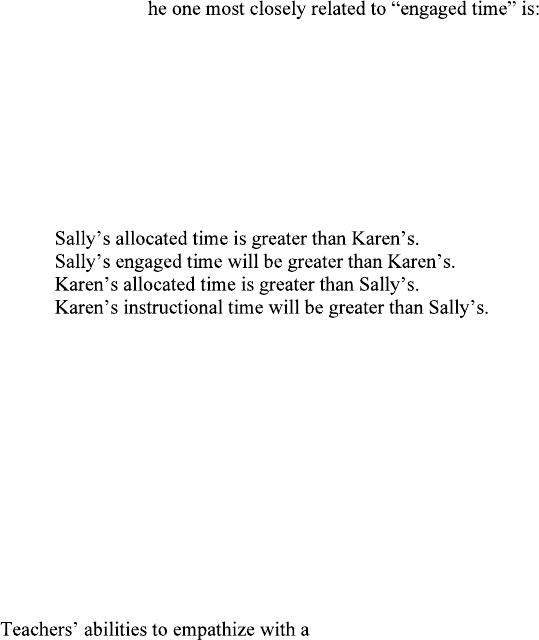
** 20. Sally Harvey, an eighth-grade math teacher, typically spends about 7 minutes after the bell rings taking roll,
handing out papers, and writing assignments on the board. Karen Walters, who teaches in the room next to
Sally, writes her assignments on the board during the time the students are moving from one class to
another. Based on this information, which of the following conclusions is most valid?
a.
b.
c.
d.
Essay Items
** 21. What are the major differences between classroom management and discipline?
** 22. What are the goals of an effective classroom management system? How do they contribute to a productive
learning environment?
** 23. What are the differences between the following dimensions of classroom time: allocated time, instructional
time, engaged time, and academic learning time?
Creating a Productive Learning Environment
* 24. nd invest in the protection and development of young people best
describes which of the following?
a. Withitness
b. Overlapping
c. Caring
d. Artistry
Chapter 10: Classroom Management: Creating Productive Learning Environments
* 25. Of the following, which is the best indicator of teacher caring?
a. Avoiding communications and learning activities that might
b. Demonstrating that you respect students by holding them to high standards
c. Designing learning activities to ensure that students are successful virtually all of the time
d. Telling the students that you value each of them as an individual
* 26. Of the following the most effective way to communicate caring to students is to:
a. smile at them frequently.
b. compliment them on personal characteristics.
c. spend time with them.
d. be enthusiastic in class.
* 27. Which of the following is not considered to be a characteristic of a caring teacher?
a. Shows respect and politeness to all students
b. Praises students whether or not they try
c. Helps with personal problems
d. Values individuality
* 28. Which of the following statements best describes the relationship between classroom management and
effective instruction?
a. Classroom management is a prerequisite to effective instruction; order must first be established
before teachers can instruct effectively.
b. Orderly classrooms are a result or an outcome of effective instruction; if instruction is effective,
classroom management takes care of itself.
c. Classroom management and effective instruction are interdependent; it is virtually impossible to
effectively teach in a chaotic classroom, and orderly classrooms are virtually impossible if
instruction is ineffective.
d. Classroom management and effective instruction are not related; classroom management refers to
studen
** 29. Sam Good, a new fourth-grade teacher, wants to prevent classroom problems before they occur, so he is
planning carefully. As he plans his management system, which of the following is the best advice?
a. Be sure to consider the characteristics of students when you plan.
b.
c. Design a token reward system and have a catalog of rewards.
d. Be stern, d few months.
* 30. Which of the following are the cornerstones of an effective classroom management system?
a. The combination of a cognitive and a behavioral approach to management
b. A well defined set of logical consequences and desists
c. A caring and democratic teacher
d. A clear system of rules and procedures
* 31. The routines students follow in their daily learning activities, such as how they turn in papers, sharpen
pencils, and make transitions from one activity to another are best described as:
a. rules.
b. procedures.
c. patterns.
d. strategies.
* 32. Guidelines that provide standards for acceptable classroom behavior are best described as:
a. rules.
b. procedures.
c. reinforcers.
d. strategies.
Chapter 10: Classroom Management: Creating Productive Learning Environments
* 33. Which of the following statements best describes the difference between classroom procedures and
classroom rules?
a.
classroom procedures.
b. Classroom procedures describe acceptable behaviors, whereas classroom rules describe unacceptable
behaviors.
c. Classroom procedures describe routines to be followed, whereas classroom rules describe standards
for acceptable behavior.
d. Classroom procedures focus on a management approach to developing an orderly classroom,
whereas classroom rules focus on a discipline approach to developing an orderly classroom.
** 34. Without any announcement from the teacher, students come into class, take their seats, take out their
workbooks, and begin working exercises written on the chalkboard. The aspect of classroom management
illustrated in this description is best described as:
a. effective use of classroom rules.
b. effective use of classroom procedures.
c. ineffective use of a structured environment.
d. an application of classical conditioning.
* 35. Which of the following is the most accurate description of the need for monitoring classroom rules?
a. to be monitored if they are carefully taught at the beginning of the year.
b.
less important.
c. Rules need to be monitored in classes of low-achieving nitored
in classes of high-achieving students.
d. Rules must be carefully monitored and discussed throughout the school year for all students.
Use the following vignette for items 36 and 37.
Four first-year teachers are planning for the beginning of the school year.
Justin McCall, nervous about classroom management carefully plans a system of rules and procedures that he
will use to begin his class.
Julia Winters, confident in her knowledge of content, believes that she will be an effective enough teacher that
Joe Weiss is a veteran of the business world who has just gotten into teaching. Because he has considerable
experience working with people, he spends his time learning the school policies and setting up his computer to make
his grading and reporting as efficient as possible.
Angela Boyer eagerly anticipates her first day, but being new, she is somewhat uneasy, so she carefully
prepares both her rules and procedure
** 36. The teacher who is least likely to have classroom management problems is:
a. Justin.
b. Julia.
c. Joe.
d. Angela.
** 37. The teacher who is most likely to have classroom management problems is:
a. Justin.
b. Julia.
c. Joe.
d. Angela.
Essay Items
** 38. Describe planning for classroom management, including each factor you should consider as you plan.
Chapter 10: Classroom Management: Creating Productive Learning Environments
** 39. What are the primary similarities and differences between rules and procedures?
** 40. Describe four guidelines for creating and monitoring rules. Explain why the guidelines are important.
Involving Parents
* 41. According to research examining the benefits of home-school cooperation, which of the following are ways
in which stu
1. Higher academic achievement
2. More positive attitudes toward school
3. More acceptable student behavior
4. Better attendance rates
5. Greater willingness to do homework
a. 1, 2, 3, 4, 5 b. 2, 3, 4, 5 c. 1, 2, 3, 4 d. 1, 3, 4, 5
* 42. Research examining home-school cooperation has identified several barriers to parental involvement in
school activities. Which of the following are most commonly identified as these barriers?
1. Economic barriers, such as parents holding more than one job, and lacking resources such as child
care or transportation to and from school
2. Attitude barriers, such as parents feeling home-school cooperation is unnecessary, since it is the
3. Cultural barriers, such as parents having attended schools that were very different from the ones
their children are now attending.
4. Language barriers, such as children coming from homes where the first language is not English.
a. 1, 2, 3, 4 b. 2, 3, 4 c. 1, 3, 4 d. 1, 2, 4 e. 1, 2, 3
* 43. Which of the following statements best describes standards describing paren
learning?
a.
in activities directly related to what students learn in their classes.
b. Parents should regularly communicate with the school, and they should play an integral role in
c.
learning, but decisions that directly affect their children chool
professionals.
d. Parents are welcome in schools to promote communication and support for their students, but
learning decisions are left in the hands of school leaders, such as principals and guidance counselors.
* 44. Parents with which of the following characteristics are most likely to participate in school activities?
a. Member of cultural minority
b. Has a child enrolled in an English-as-a-second-language program
c. High socioeconomic status
d. Has a child enrolled in a special education program
* 45. Which of the following describes the most desirable time to send a letter of introduction home to your
a. The second day of the school year, to establish early communication links between the school, you,
and the parents
b. The second week of the school year, to allow the students a chance to get settled into the routine of
school
c. After the first set of grades on homework and quizzes have been given, to provide parents with
tial work
d. Together with interim progress reports, which are given during the middle of the grading period in
most schools

Chapter 10: Classroom Management: Creating Productive Learning Environments
Use the following vignette for items 46 and 47.
Four teachers are planning for their communication with parents. The school in which they all teach has a
beginning-of-year open house and all parents are invited. The attendance at the open house is typical for most
schools. Some parents attend; others do not. Interim progress reports are also sent to parents midway in each grading
period.
Ryan Hurst prepares a letter to the parents that expresses his optimism about the coming school year, and in it,
he describes his rules and procedures. He has a friend read the letter to be sure there are no spelling or grammatical
errors i
He periodically calls parents to tell them when their son or daughter has done exemplary work.
Monica Winters sends home a letter of introduction to parents and expresses her enthusiasm about the coming
with the problem.
Denise Nixon gives each of the parents that attend the open house a handout that describes her rules and
procedures, and she verbally expresses her optimism about the school year and how much she believes her students
are going to learn.
Jerry Conway sends a letter of introduction home to parents in which he describes his rules and procedures for
the year. He also calls or emails parents in cases where problems with misbehavior occur, and he follows up with an
additional call to let parents know about the progress their son or daughter has made.
** 46. Based on research examining home-school communication, the teacher who communicated most effectively
with the parents of his students was:
a. Ryan.
b. Monica.
c. Denise.
d. Jerry.
** 47. Based on research examining home-school communication, the teacher who communicated least effectively
with the parents of his students was:
a. Ryan.
b. Monica.
c. Denise.
d. Jerry.
Essay Items
** 48. Describe four of the benefits of home-school communication.
** 49. Describe three strategies for establishing and maintaining communication with parents.
Intervening When Misbehavior Occurs
* 50. Which of the following are guidelines for intervening effectively in cases of misbehavior?
1. Demonstrate withitness and overlapping.
2. Preserve student dignity.
3. Reinforce behaviors appropriately.
4. Keep communication congruent.
a. 1, 2, 3, 4 b. 1, 2, 4 c. 1, 3, 4 d. 2, 3, 4
Chapter 10: Classroom Management: Creating Productive Learning Environments
* 51. assroom all the time and communicating this
awareness to students best describes:
a. reflection.
b. withitness.
c. decision making.
d. caring.
* 52. Demonstrating that you know what is going on in all parts of the classroom all of the time best describes:
a. a cognitive approach to management.
b. self-regulation.
c. overlapping.
d. withitness.
** 53.
trated in this description is:
a. classroom management.
b. teacher discipline.
c. teacher organization.
d. teacher withitness.
Use the following information for items 54 and 55.
You are leading a question-and-answer session with your students, and you notice that Jeremy is not paying
attention, and that Jacinta is whispering to Gail. You call on Jeremy as you walk over and stand by Jacinta.
** 54.
a. self-regulation.
b. organization.
c. active listening.
d. withitness.
** 55. Moving near Jacinta to stop her whispering as you continue the progress of the lesson best describes which
of the following?
a. Using a logical consequence
b. Using a desist
c. Using active listening
d. Using overlapping
* 56. Which of the following statements most accurately describes the relationship between verbal and nonverbal
behavior?
a. The credibility of a message is communicated more strongly through the nonverbal than through the
verbal channel of communication.
b. Verbal and nonverbal behavior are two different channels of communication and one has little effect
on the other.
c. Warmth, empathy, and caring are communicated verbally, whereas assertiveness and management
are communicated nonverbally.
d. Affective factors are primarily communicated verbally, while cognitive factors are primarily
communicated nonverbally.
* 57. Research indicates that classroom management is most effective when interventions are as brief and
unobtrusive as possible. Based on this research, which is the least intrusive intervention for a minor
infraction, such as a student briefly whispering to another student?
a. Ignore the behavior.
b. Use an indirect cue, such a moving near the student.
c. Use a desist, such as a brief reminder that students speak only when given permission.
d. Apply a consequence, such as time out, to maintain consistency in interventions.

Chapter 10: Classroom Management: Creating Productive Learning Environments
* 58. In the case of a serious management problem, such as two students fighting, which of the following should
be your immediate reaction?
a. Stop the fight, if possible.
b. Send a student to the main office for help.
c. Go to the main office for help yourself.
d. Wait for a moment to see if the students stop tudent to the main
office for help.
** 59.
following, which is your most effective immediate intervention?
a. Send a student to the main office for help.
b. Shout as loudly as you can, to see if the students will be surprised enough to stop.
c. Rush to the main office yourself for help.
d. Ask two of the biggest boys in your class to step in and stop the fight.
** 60. Two students are fighting on the playground, but neither is in any of your classes. Of the following, which
is the best description of your responsibility in this case?
a. You are required by law to intervene, such as attempting to stop the fight, or sending a student for
help.
b. You are required by law to physically break up the fight, since the continued fighting could result in
student injury.
c. You are required by law to report the fight to the school administration, but you are not required to
intervene, since they are not your students.
d. You have no legal responsibilities, since they are not your students.
Essay Items
** 61. Describe three goals of successful classroom interventions.
** 62. Describe four guidelines for intervening effectively. Explain why each is important.
Chapter 10: Classroom Management: Creating Productive Learning Environments
CHAPTER TEN ANSWERS
What is a Productive Learning Environment?
Creating a Productive Learning Environment
Chapter 10: Classroom Management: Creating Productive Learning Environments
Involving Parents
Intervening When Misbehavior Occurs