130
CHAPTER 10
MULTIPLE CHOICE
1) Collin has 20/200 vision. This means that _____.
A) he has perfect vision
B) he sees as well as or better than 20% of his classmates
C) he can identify only 20 letters on the Snellen Eye Chart correctly
D) he is legally blind
2) What is emphasized in the definition of visual impairments in IDEA?
A) The degree of limitations in visual field
B) The degree of limitations in visual acuity
C) The relationship between vision and learning
D) The cause of the impairment and the age of onset
3) Mrs. Torrez has been informed that Victoria, a new student with low vision, is being
placed in her class. Which of the following is probably true about Victoria?
A) She will wear thick glasses.
B) She will need to use braille to learn.
C) She will mainly use her vision to learn.
D) She will use her vision mainly to help her get around in the classroom.
4) One drawback for students with adventitious visual impairments is that _____.
A) they retain a memory of things they saw
B) they have a greater need for emotional support
C) their visual memories can help with learning
D) they have a large background of visual experiences on which to draw
5) The ability to clearly distinguish forms or discriminate details at a specified distance
is called _____.
A) field of vision
B) focal center
C) functional vision
D) visual acuity
6) Which term best describes a person with vision of 20/220 in the better eye that is
improved to 20/70 with glasses?
A) Functionally blind
B) Low vision
C) Partially sighted
D) Tunnel vision

131
7) Which of the following is NOT a problem experienced by a person with a limited
field of vision?
A)
B) Gracie has 20/40 vision yet she is considered legally blind because of her 20-
degree field of vision.
C) Kinsey can see things directly in front of her but lacks peripheral vision.
D) 20/20 vision allows him to read the smallest print from 20 feet away.
8) Which of the following is true about cognition and children with limited vision?
A) They have difficulty connecting their experiences.
B) Their potential to learn is extremely limited.
C) They perform more poorly on tasks that require recall.
D) They cannot be taught the meaning of abstract concepts.
9) Jasmine is a kindergarten child with low vision. Which of the following is NOT a
realistic expectation regarding motor skills?
A) She will be less careful with space.
B) She will lose her balance and fall easily.
C) She will be less likely to imitate actions of others.
D) She will have poorer overall motor skills than normally sighted peers.
10) One reason that the number of students with visual impairments is larger than the
number reported in IDEA is _____.
A) some students refuse services
B) some students are counted in other categories
C) some students receive services outside of school
D) some people become visually impaired in adulthood
11) As light passes through the eye, what does it hit first?
A) The cornea
B) The lens
C) The pupil
D) The retina
12) The ability to fuse the single images from each eye into a single three-dimensional
shape is called _____.
A) accommodation
B) binocular vision
C) ocular motility
D) depth perception
13) All of the following statements about refractive errors are true EXCEPT _____.
A) they include conditions such as myopia
B) they include conditions such hyperopia
C) they include conditions restricting circulation in the eye
D) they affect approximately half of the general population

132
14) Which disease is marked by abnormal pressure in the eye caused by disturbances or
blockages of fluids that normally circulate?
A) Cataracts
B) Glaucoma
C) Nystagmus
D) Strabismus
15) Which condition is caused by an imbalance of the eye muscles that results in the
inability to focus on an object with both eyes?
A) Cataracts
B) Glaucoma
C) Nystagmus
D) Strabismus
16) Which of the following is NOT a cause of cortical vision impairments?
A) Anoxia
B) Hydrocephalus
C) Head injuries
D) An immature integumentary system
17) Nigel states that he does not like social studies class because they spend most of the
time reading. He claims that the text is blurry when he holds the book close to his
face. He often complains of headaches. His teacher says that he is seeking attention
because there are days that his vision is fine. Nigel is exhibiting symptoms of _____.
A) astigmatism
B) farsightedness
C) nearsightedness
D) nystagmus
18) Chelsea is a child with strabismus. She does not require special education but her
teacher wants to be sure to help her succeed in class. She has some ideas for helping
Chelsea. Which is least likely to be helpful?
A) Preferential seating
B) Rest periods during close work
C) Extra time on unfamiliar tasks
D) High illumination with no glare
19) Which statement about braille for students who are blind is most accurate?
A) It is introduced in middle school.
B) It makes reading and writing slower.
C) Students write words as contractions rather than letter by letter.
D) It is a visual system.
133
20) Which of the following mathematical tools is most likely to be helpful in teaching
students who are blind to add and subtract?
A) Cranmers abacus
B) Cuisenaire rods
C) Digi-blocks
D) Finger counting
21) What is the Kurweil 1000?
A) A talking clock for people who are blind.
B) A computer-based reading system that scans and reads printed text.
C) A talking calculator that is capable of performing advanced math functions.
D) An electronic device that creates embossed relief maps and scientific diagrams.
22) Which of the following statements about keyboarding for students who are blind is
most accurate?
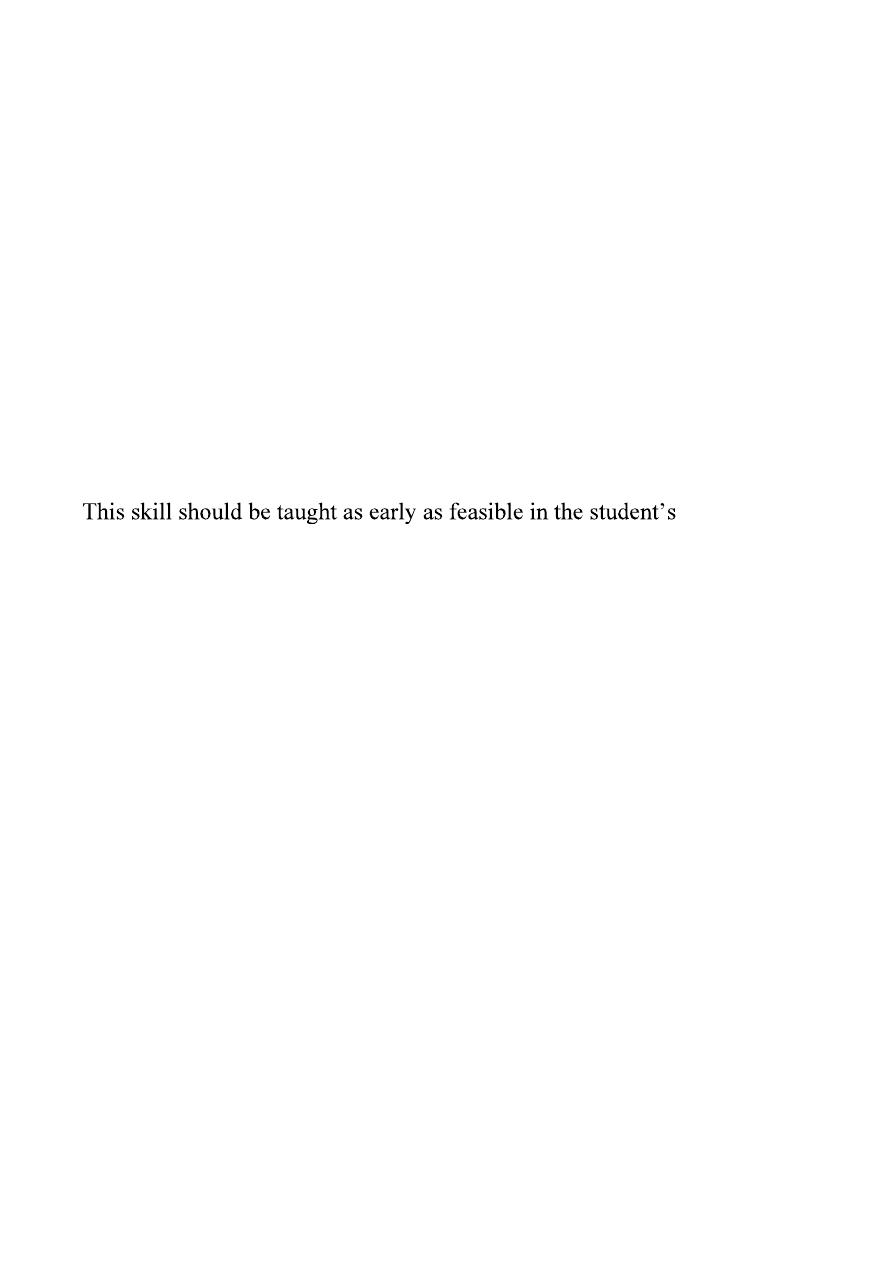
A) This skill should be taught using braille typewriters.
B) This skill should be taught after handwriting has been mastered.
C) This skill should be taught to high school students seeking employment.
D) school program.
23) Teachers can help children with low vision develop visual efficiency by _____.
A) making their classrooms very attractive
B) providing individual visual stimulation sessions
C) providing visual instruction in the context of daily activities
D) conducting frequent assessments of visual acuity and visual field
24) All of the following are true about closed circuit television EXCEPT _____.
A) it can be easily moved from class to class
B) it enables students with low vision to read regular sized print materials
C) students with low vision can adjust the brightness and contrast of materials
D) students with low vision can use them to create negative white-on-black images
25) Mrs. Gandy wants to be sure that her classroom has appropriate lighting for her
students with low vision. Which adaptation would NOT be helpful?
A) Adjustable lamps
B) Desks with tilting tops
C) Writing paper with a dull finish
D) Worksheets printed on colored paper
26) Which of the following statements about orientation and mobility (O & M) is most
accurate?
A) The terms are synonyms.
B) O & M skills must be taught at an early age.
C) More time is spent on specific mobility skills than orientation.
D) O & M instruction is not required as a related service.

134
27) A long cane serves as all of the following EXCEPT _____.
A) a tool for independent travel
B) a probe for detecting changes in travel surfaces
C) a bumper for protection from obstacles such as doors
D) a bumper for protection from high tree branches.
28) Guide dogs _____.
A) are used by 25% of people who are blind
B) are most useful for independent travel in large cities
C) are most useful to blind people with multiple disabilities
D) are considered pets for their owners
29) Which of the following devices can read street signs and announce traffic signals for
people with visual impairments?
A) A Connecticut Cane
B) A Global Positioning System
C) The Mowat Sensor
D) The Sonic Guide
30) Accelerated and compressed speech enable students with visual impairments to listen
at speeds of _____.
A) up to 275 words per minute
B) up to 300 words per minute
C) up to 350 words per minute
D) up to 375 words per minute
ESSAY
1) Name and define the educational classifications of students with visual impairments.
2) Provide four examples of tactile, technological, and/or optical aids you would expect
to see available across the curriculum to a fourth grade student who is functionally
blind and describe how it provides access to the general education curriculum.
3) Explain how you could teach a student who is totally blind and without braille skills
to cook a simple dish. Include at least two benefits to the student.
4) Explain how a teacher could help a child who is blind learn about small mammals.
5) Briefly explain the social interaction of children with visual impairments compared to
children who are typically sighted.