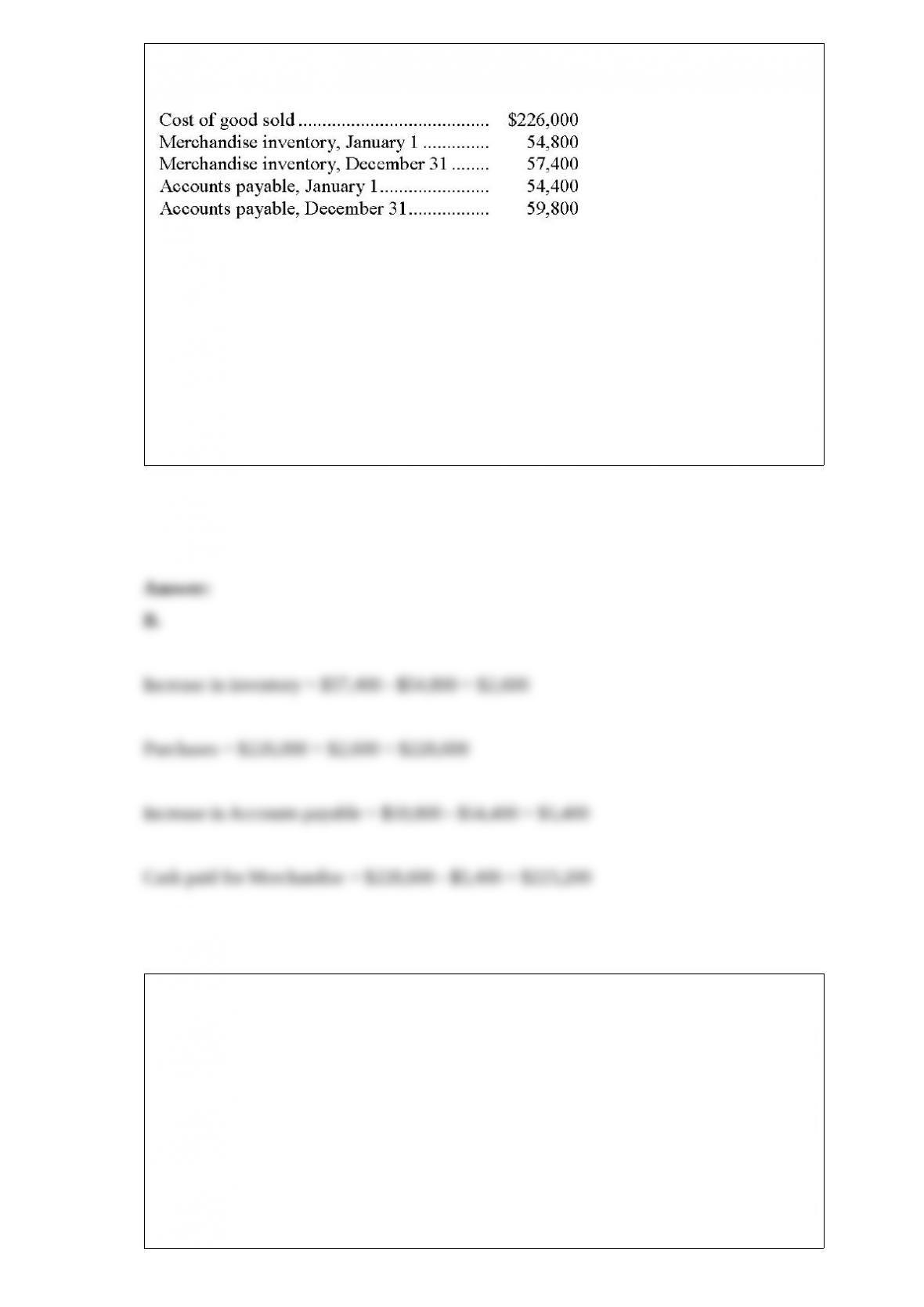
Use the following information about the current year’s operations of a company to
calculate the cash paid for merchandise.
A.$218,000.
B.$223,200.
C.$220,000.
D.$228,800.
E.$234,000.
Which of the following is not a benefit of following a well-designed budgeting process?
A.Improved decision-making processes.
B.Improved performance evaluations.
C.Improved coordination of business activities.
D.Assurance of future profits.
E.All of these are benefits of effective budgeting.

A broad principle that requires identifying the activities of a business with specific time
periods such as months, quarters, or years is the:
A.Operating cycle of a business.
B.Time period principle.
C.Going-concern principle.
D.Matching principle.
E.Accrual basis of accounting.
Uncertainties such as natural disasters:
A.Are not contingent liabilities because they are future events not arising from past
transactions or events.
B.Are contingent liabilities because they are future events arising from past transactions
or events.
C.Should be disclosed because of their usefulness to financial statements.
D.Are estimated liabilities because the amounts are uncertain.
E.Arise out of transactions such as debt guarantees.
A company uses the weighted average method for inventory costing. During a period,
Department A finished and transferred 50,000 units to Department B. Also, during the
period, 10,000 units were started but brought only to a stage of being 3/5 completed.
The number of equivalent units produced by Department A during the period was:
A.44,000 units.
B.50,000 units.
C.54,000 units.
D.56,000 units.
E.60,000 units.
Which one of the following methods considers the time value of money in evaluating
alternative capital expenditures?
A.Accounting rate of return.
B.Net present value.
C.Payback period.
D.Cash flow method.
E.Return on average investment.

Regarding overhead costs, as volume increases:
A.Unit fixed cost increases, unit variable cost decreases.
B.Unit fixed cost decreases, unit variable cost increases.
C.Unit variable cost decreases, unit fixed cost remains constant.
D.Unit fixed cost decreases, unit variable cost remains constant.
E.Both unit fixed cost and unit variable cost remain constant.
Closing entries are required:
A.if management has decided to cease operating the business.
B.only if the company adheres to the accrual method of accounting.
C.if a company’s bookkeeper forgets to prepare reversing entries.
D.if the temporary accounts are to reflect correct amounts for each accounting period.
E.in order to satisfy the Internal Revenue Service.

The statement of cash flows reports:
A.Assets, liabilities, and equity.
B.Revenues, gains, expenses, and losses.
C.Cash inflows and cash outflows for an accounting period.
D.Equity, net income, and dividends.
E.Changes in equity.
A corporation:
A.Is a business legally separate from its owners.
B.Is controlled by the FASB.
C.Has shareholders who have unlimited liability for the acts of the corporation.
D.Is the same as a limited liability partnership.
E.All of these.
An income statement account that is used to record cash overages and cash shortages
arising from petty cash transactions or from errors in making change is titled:
A.Cash Lost.
B.Bank Reconciliation.

C.Petty Cash.
D.Cash Over and Short.
E.Cash Receivable.
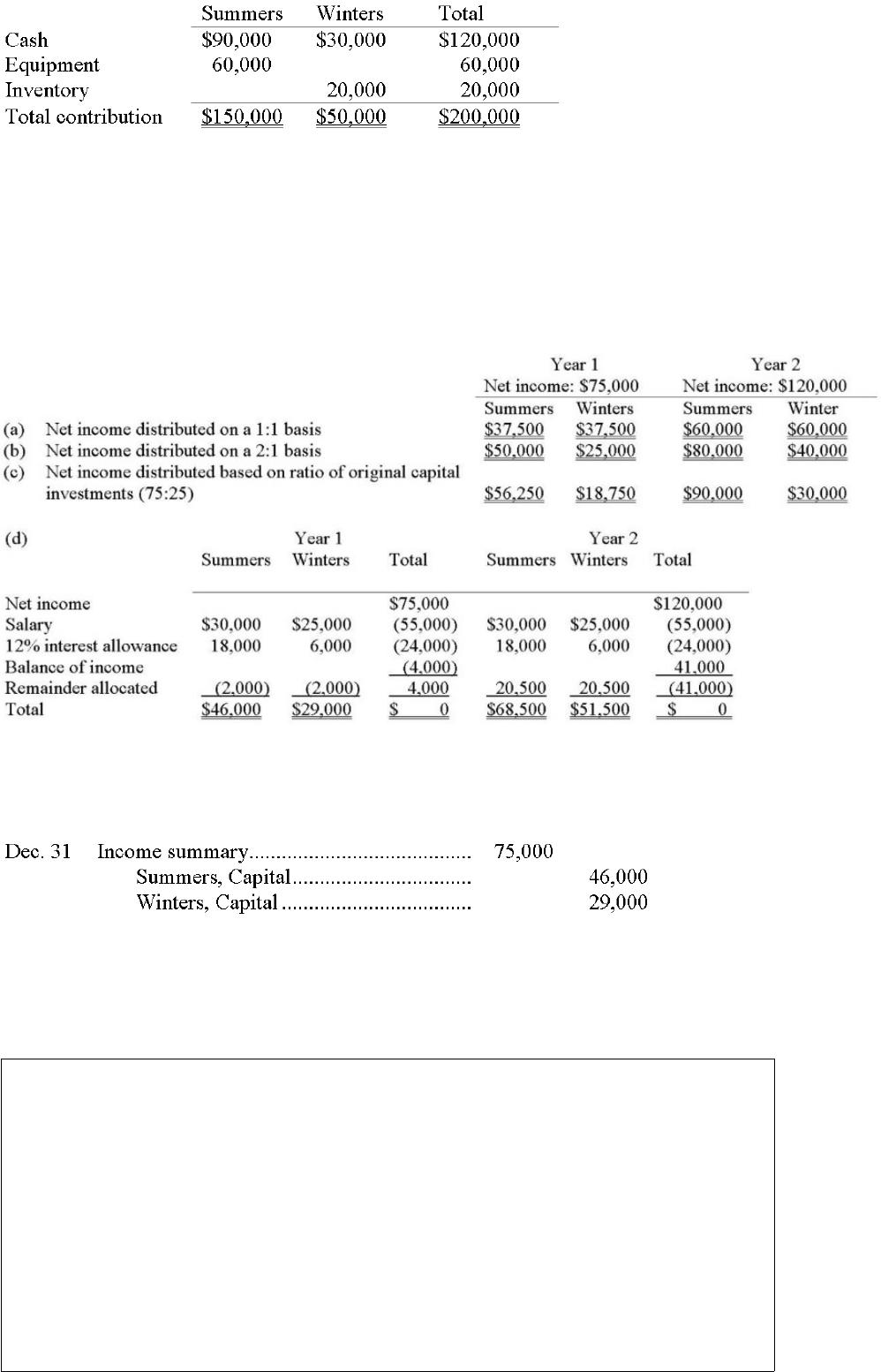
Summers and Winters formed a partnership on January 1. Summers contributed
$90,000 cash and equipment with a market value of $60,000. Winters’ investment
consisted of: cash, $30,000; inventory, $20,000; all at market values. Partnership net
income for year 1 and year 2 was $75,000 and $120,000, respectively.
1) Determine each partner’s share of the net income for each year, assuming each of the
following independent situations:
(a) Income is divided based on the partners’ failure to sign an agreement.
(b) Income is divided based on a 2:1 ratio (Summers: Winters).
(c) Income is divided based on the ratio of the partners’ original capital investments.
(d) Income is divided based on interest allowance of 12% on the original capital
investments; salary allowance to Summers of $30,000 and Winters of $25,000; and the
remainder to be divided equally.
2) Prepare the journal entry to record the allocation of the Year 1 income under
alternative (d) above.
The price of one currency stated in terms of another currency is referred to as the:
A.Historical exchange rate.
B.Foreign exchange rate.
C.Consolidated exchange rate.
D.General exchange rate.
E.Multinational exchange rate.
Analysis reveals that a company had a net decrease in cash of $4,000 for the current
year. Net cash provided by operating activities was $18,000; net cash used in investing
activities was $10,000 and net cash used in financing activities was $12,000. If the
year-end cash balance is $21,000, the beginning cash balance was:
A.$ 3,000.
B.$ 7,000.
C.$17,000.
D.$25,000.
E.$39,000.
Presented below are terms preceded by letters a through g and followed by a list of
definitions 1 through 7. Match the letter of the term with the definition. Use the space
provided preceding each definition.
(a) Net Present Value
(b) Capital Budgeting
(c) Accounting Rate of Return
(d) Net Cash Flow
(e) Internal Rate of Return
(f) Payback Period
(g) Hurdle Rate
Presented below are the year-end balances at December 31 of Laura’s Laundry Service.
(All accounts have normal balances.)
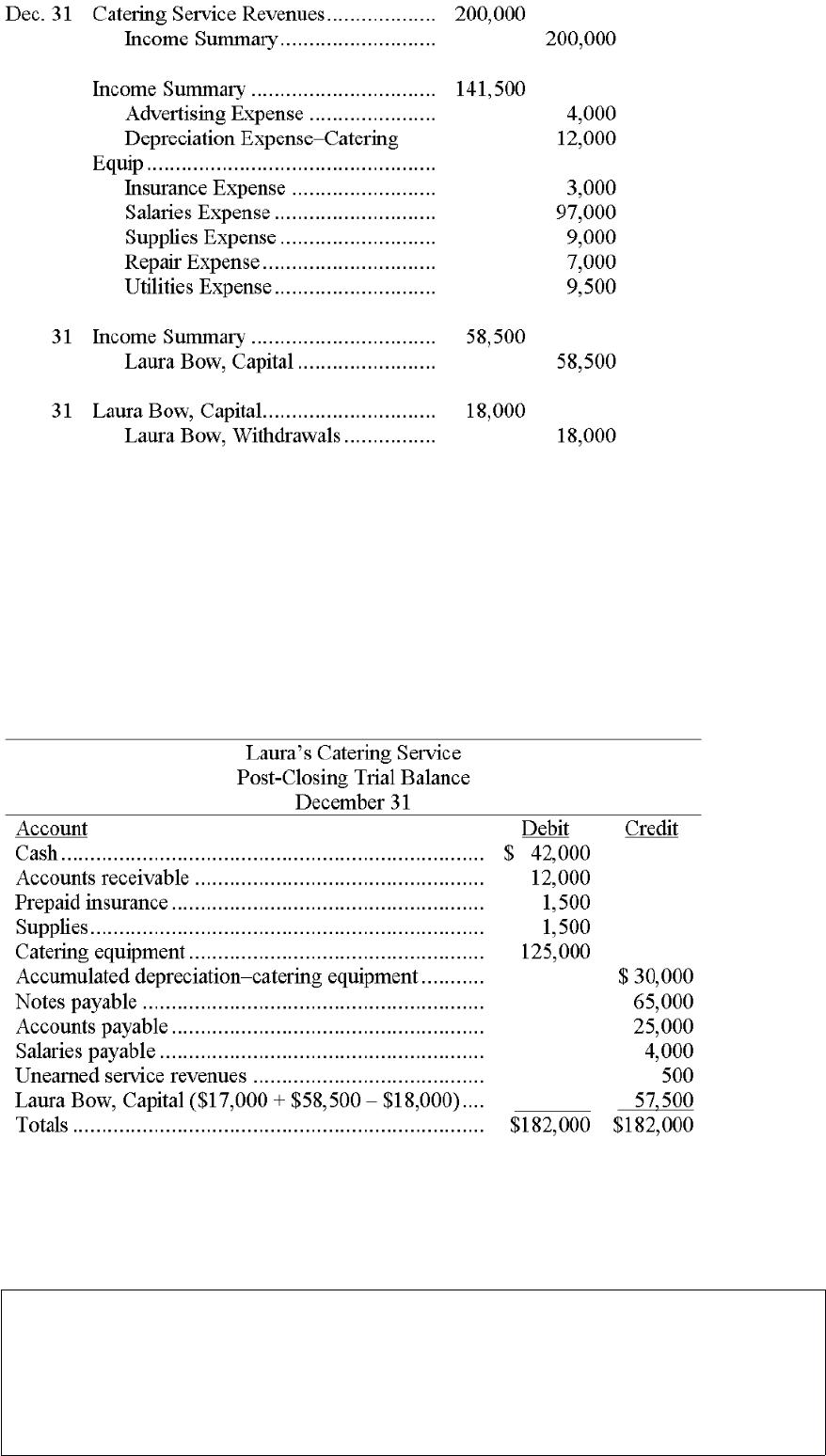
(a) Prepare the necessary closing entries at December 31.
(b) Prepare a post-closing trial balance at December 31.

The major activities of a business include:
A.Operating.
B.Financing.
C.Investing.
D.All of these.
An organizational unit of a factory that has the responsibility for partially
manufacturing or producing a product is called a:
A.Production department.
B.Service department.
C.Primary department.
D.Responsibility department.
E.Control department.

The Accounts Payable account in the general ledger is:
A.A controlling account for the subsidiary accounts payable ledger.
B.The account that controls the purchases journal.
C.The subsidiary account to the purchases journal.
D.Part of a special journal.
E.Part of a subsidiary ledger.
If a firm uses activity-based costing to allocate costs, it must:
A.Combine costs in appropriate pools.
B.Select appropriate cost drivers.
C.Calculate an appropriate rate for each pool.
D.Assign overhead based on predetermined rates for cost pools.
E.Perform All of these steps.

Current assets divided by current liabilities is the:
A.Current ratio.
B.Quick ratio.
C.Debt ratio.
D.Liquidity ratio.
E.Solvency ratio.
Net sales divided by average total assets is the:
A.Profit margin.
B.Total asset turnover.
C.Current ratio.
D.Sales return ratio.
E.Return on total assets.
Promissory notes that require the issuer to make a series of payments consisting of both
interest and principal are:

A.Debentures.
B.Discounted notes.
C.Installment notes.
D.Indentures.
E.Investment notes.
Investments in debt and equity securities that the company actively manages and trades
for profit are referred to as short-term investments in:
A.Available-for-sale securities.
B.Held-to-maturity securities.
C.Trading securities.
D.Realizable securities.
E.Liquid securities.
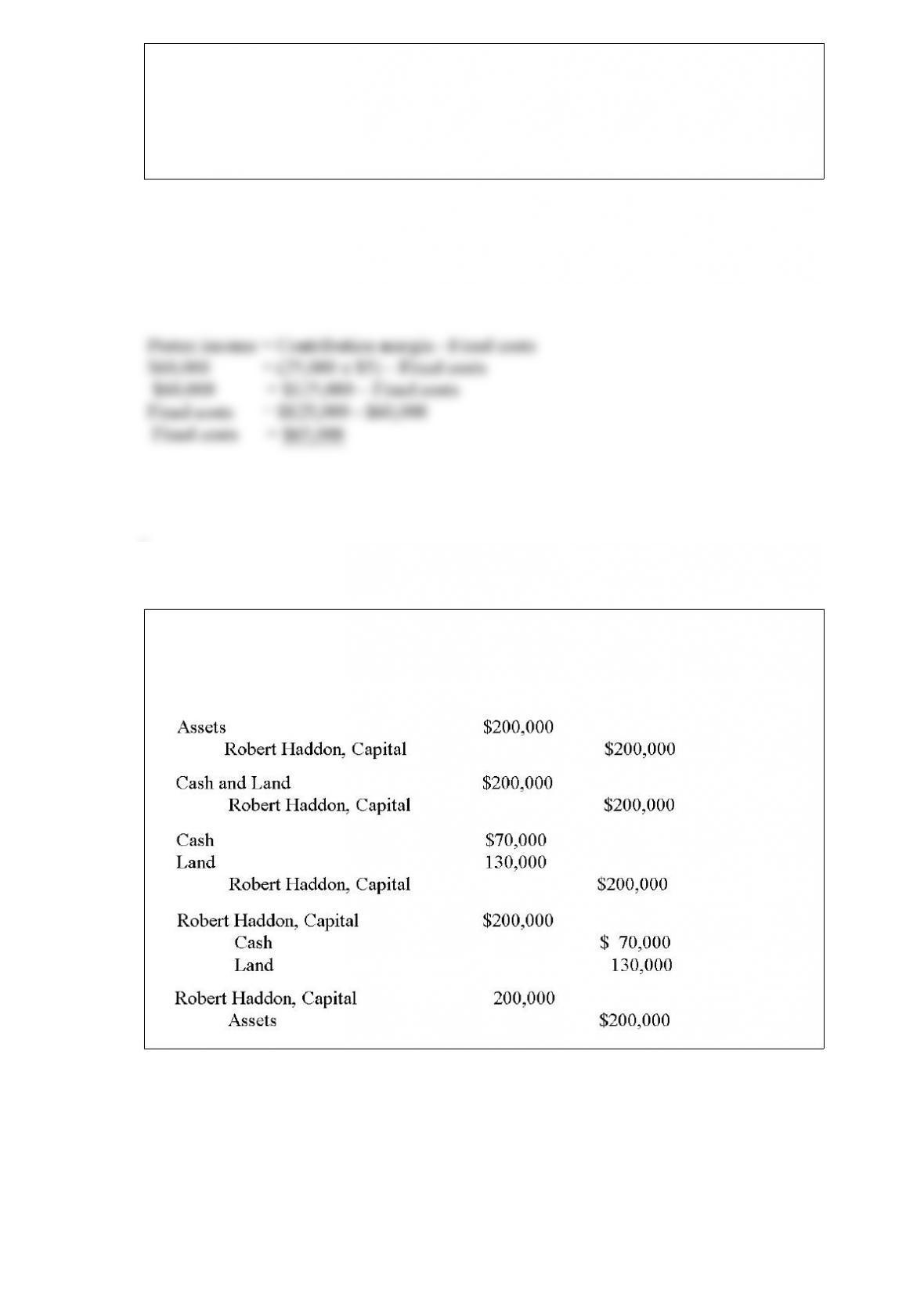
A firm expects to sell 25,000 units of its product at $11 per unit. Pretax income is
predicted to be $60,000. If the variable costs per unit are $5, total fixed costs must be:
A.$ 65,000.
B.$ 90,000.
C.$125,000.
D.$215,000.
E.$275,000.
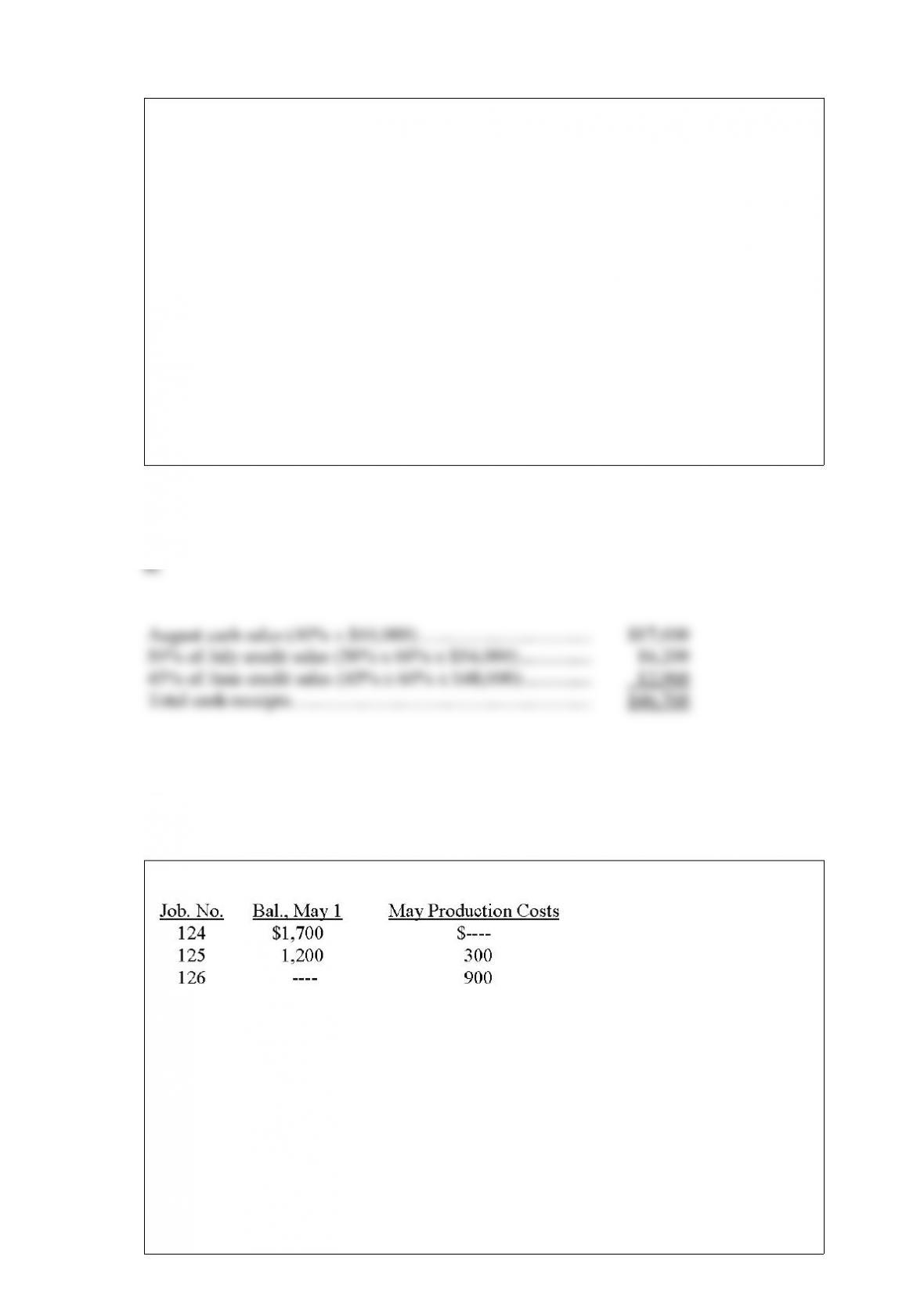
Robert Haddon contributed $70,000 in cash and land worth $130,000 to open a new
business, RH Consulting. Which of the following general journal entries will RH
Consulting make to record this transaction?
A.
B.
C.
D.
E.
The Palos Company expects sales for June, July, and August of $48,000, $54,000, and
$44,000, respectively. Experience suggests that 40% of sales are for cash and 60% are
on credit. The company collects 50% of its credit sales in the month following sale,
45% in the second month following sale, and 5% are not collected. What are the
company’s expected cash receipts for August from its current and past sales?
A.$29,160.
B.$46,760.
C.$61,160.
D.$66,200.
E.$78,800.
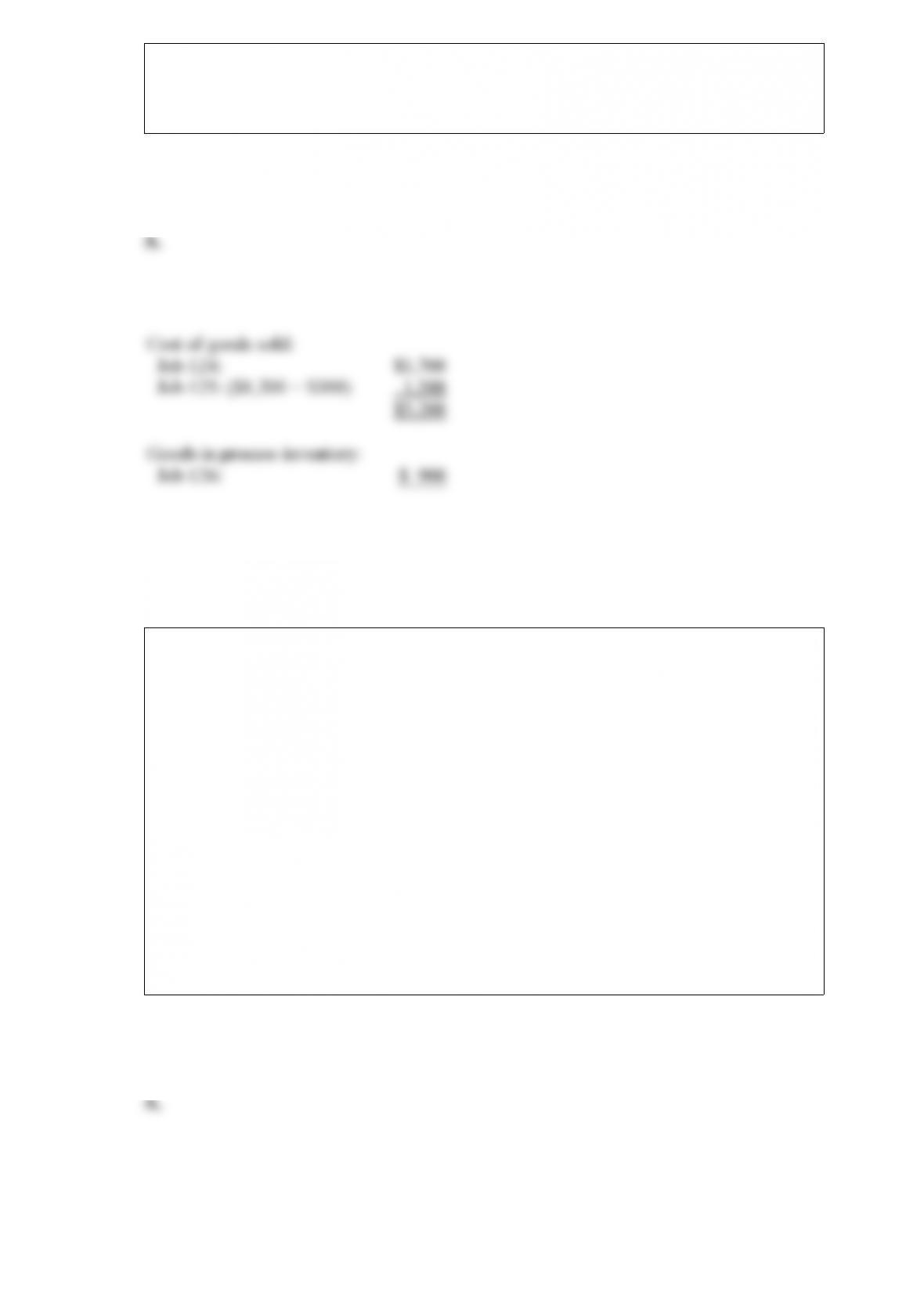
The job order cost sheets used by Garza Company revealed the following:
Job No. 125 was completed during May and Jobs No. 124 and 125 were shipped to
customers in May. What were the company’s cost of goods sold for May and the goods
in process inventory on May 31?
A.$3,200; $ 900.
B.$2,900; $1,200.
C.$1,200; $2,900.
D.$1,700; $1,200.
E.$4,100; $ 0.
In a process operation, the direct labor of a production department includes:
A.All labor used exclusively by that department, even if the labor is not applied to the
product itself.
B.All labor used exclusively by that department, but only if the labor is applied to the
product itself.
C.All labor for that department, including labor for services that help more than one
production department, such as clerical, repair, and computer technicians.
D.Only labor that helps more than one production department, such as clerical, repair,
and computer technicians.
E.Only that labor that is recorded in the Factory Payroll account.
Explain how the cash flows from operating activities section of the statement of cash
flows is prepared using the direct method.
What is interest?
List the steps in recording transactions.
What are the five basic components of accounting information systems?
Briefly describe a master budget and the sequence in which the individual budgets
within the master budget are prepared.
A manufacturing company uses an overhead allocation rate based on direct labor cost.
The company’s Goods in Process Inventory account has a $15,000 debit balance after
all posting is completed, and the cost sheet of the one job still in process shows direct
material costs of $6,600 and direct labor costs of $3,000. What is the company’s
overhead application rate?
Describe how a cost-volume-profit analysis would be performed for a company that
sells more than one product. (Assume that the sales mix is known.)
Define an investment center. How are investment centers evaluated?
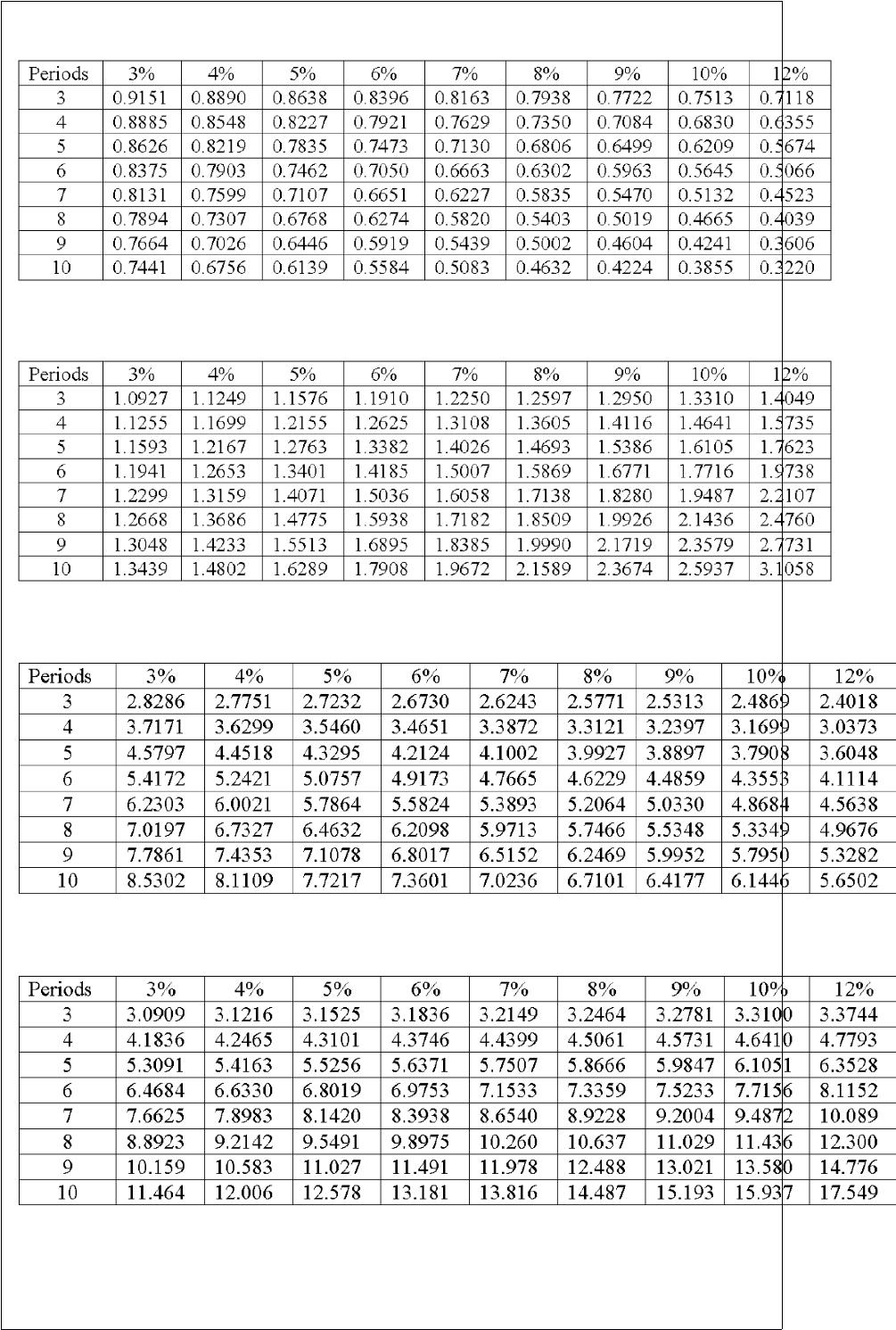
Present Value of 1
Future Value of 1
Present Value of an Annuity of 1
Future Value of an Annuity of 1
A company is setting up a sinking fund to pay off $8,654,000 in bonds that are due in 7
years. The fund will earn 7% interest, and the company intends to put away a series of
equal year-end amounts for 7 years. What is the amount of the annual deposits that the
company must make?
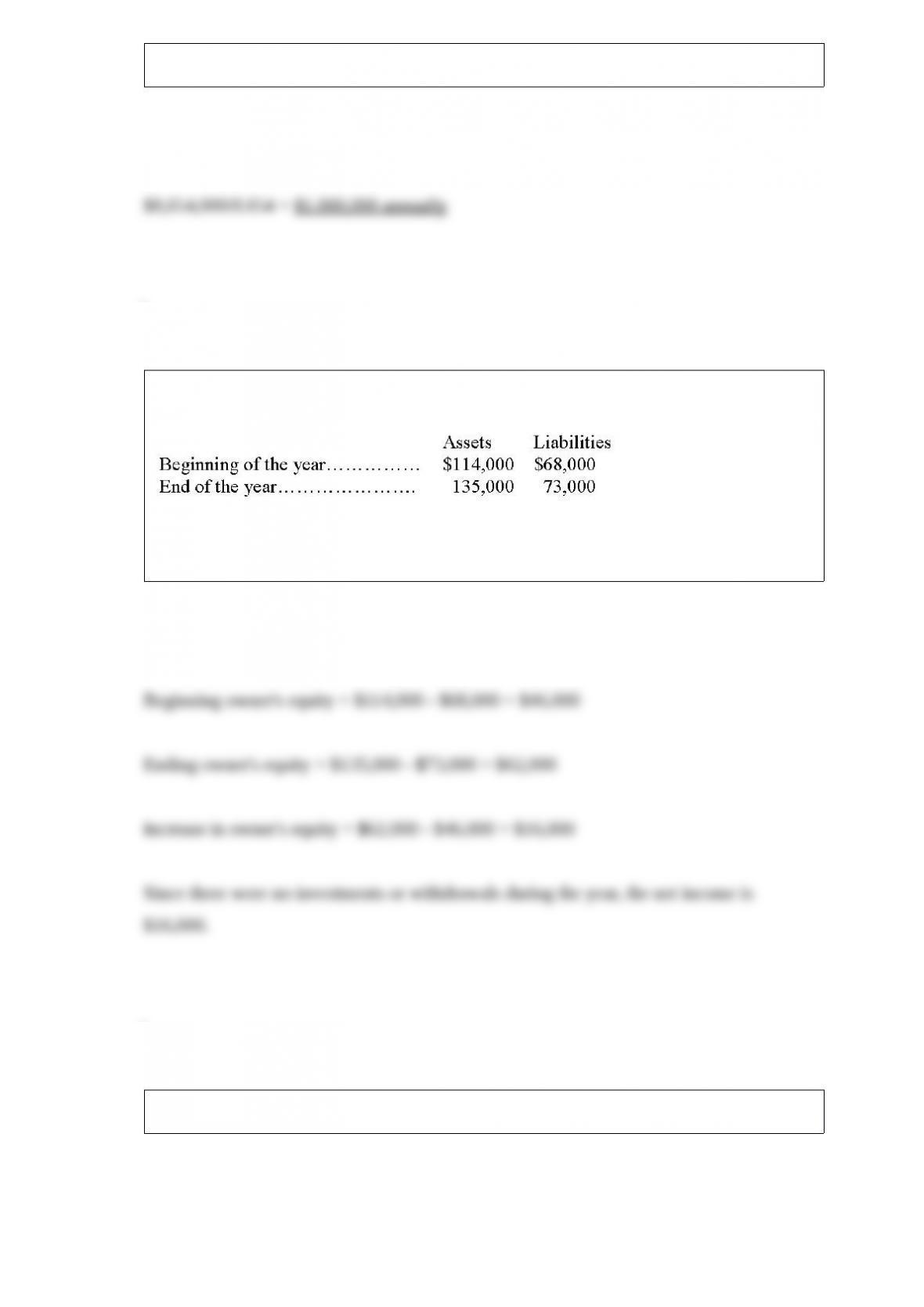
Josephine’s Bakery had the following assets and liabilities at the beginning and end of
the current year:
If Josephine made no investments in the business and withdrew no assets during the
year, what was the amount of net income earned by Josephine’s Bakery?
Briefly describe the procedure of management by exception.
___________________________ are investments in securities that management
intends to convert to cash within the longer of one year or the operating cycle, and are
readily convertible to cash.
Hess Co. manufactures a product that sells for $12 per unit. Total fixed costs are
$96,000 and variable costs are $7 per unit. Hess can buy a newer production machine
that will increase total fixed costs by $22,800 but variable costs will be decreased by
$0.40 per unit. What effect would the purchase of the new machine have on Hess’s
break-even point in units?
The standards for comparisons in financial statement analysis include (1)

_______________, (2) ________________, (3) _________________, and (4)
_______________.