When borrowing money, the most important objective of the borrower should be to:
A. minimize monthly payments.
B. minimize the APR.
C. avoid borrowing on a discount basis.
D. make the maturity date as far in the future as possible.
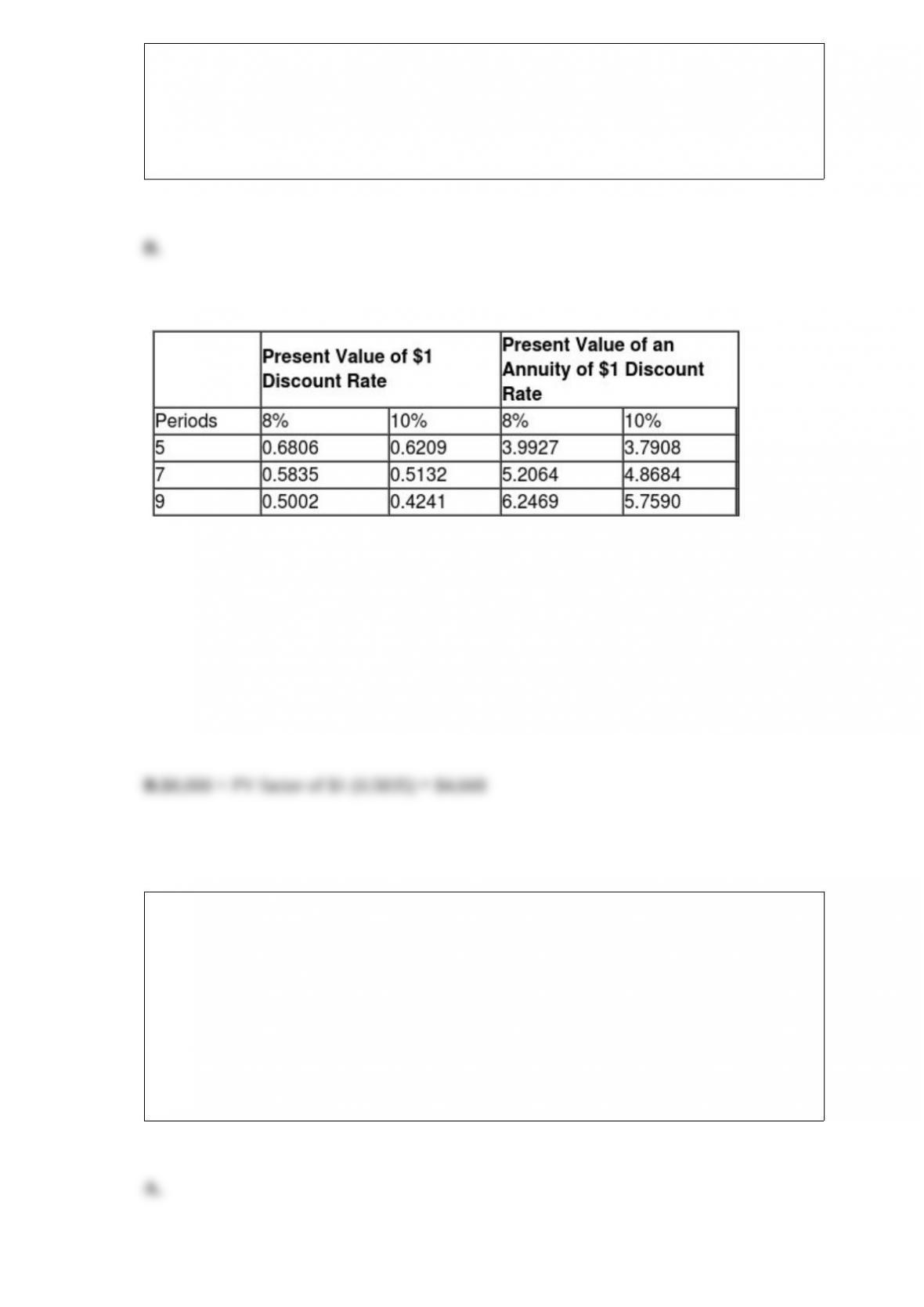
The present value of an obligation of $8,000 payable in 7 years at 8% is:
A. $3,520
B. $4,668
C. $6,412
D. $7,360
Which of the following is not usually a right or attribute of preferred stock?
A. Having a claim to dividends in excess of the annual dividend requirement if
dividends on common stock exceed dividends on preferred stock.
B. Having a priority claim to dividends relative to the common stock’s claim to
dividends.
C. Having a priority claim in liquidation relative to the common stock’s claim in
liquidation.
D. Having a claim to dividends that is cumulative over time if the annual dividend
requirement is not satisfied.

Which of the following would not appear in the operating expense budget?
A. sales commissions.
B. delivery expense.
C. advertising.
D. depreciation on the production equipment.
_____________ is a cost management technique in which the firm determines the
required cost for a product or service in order to earn a desired profit when the
marketplace establishes the product’s selling price.
A. Relevant costing
B. Product costing
C. Differential costing
D. Target costing
A standard cost or production standard that is achievable under actual operating
conditions is called a(n):
A. attainable standard.
B. ideal standard.
C. past experience standard.
D. average standard.
Assume that on September 1, 2016, a 6-month rent payment for $12,000 per month (for
a total of $72,000) was made with respect to a commercial lease that the company
entered into on that date as a tenant. The company took occupancy of the rented space
immediately. The lease term will expire on February 28, 2017. The $72,000 payment
was recorded as a debit to Prepaid Rent on September 1, 2016. The adjusting entry on
December 31, 2016, is as follows:
A. Dr. Prepaid Rent 24,000 Cr. Rent Expense 24,000
B. Dr. Prepaid Rent 48,000 Cr. Rent Expense 48,000
C. Dr. Rent Expense 24,000 Cr. Prepaid Rent 24,000

D. Dr. Rent Expense 48,000 Cr. Prepaid Rent 48,000
Prepaid expenses classified as current assets represent:
A. current year expenses that have been accrued.
B. current year cash payments that will be matched against revenues of the next year or
for several future years.
C. cash that has been segregated to pay for future expenses.
D. expenses of the current year that have been paid in advance.
Operating expenses are best budgeted on the basis of knowledge about:
A. cost behavior patterns.
B. relevant range.
C. prior period actual expenses.
D. current period budget amounts.
An advantage of the net present value method for evaluating investment proposals over
the internal rate of return method is that:
A. only one set of present value calculations using a required discount rate is made.
B. the actual rate of return on the project is calculated.
C. projects can be ranked in order of profitability using the net present value amount.
D. estimates of future cash flows do not have to be made.
Standards are most appropriately used to:
A. reward workers and managers who meet them.
B. penalize workers and managers who do not meet them.
C. calculate the unit cost of a product or service.
D. support the planning and control processes of the firm.
The most powerful corporate governance legislation to date has been:
A. the Sarbanes-Oxley Act (SOX) of 2002.
B. the creation of the American Institute of Certified Public Accountants.
C. Corporate Ethics Code of 2007.
D. the regulation of inventory management practices by the SEC.
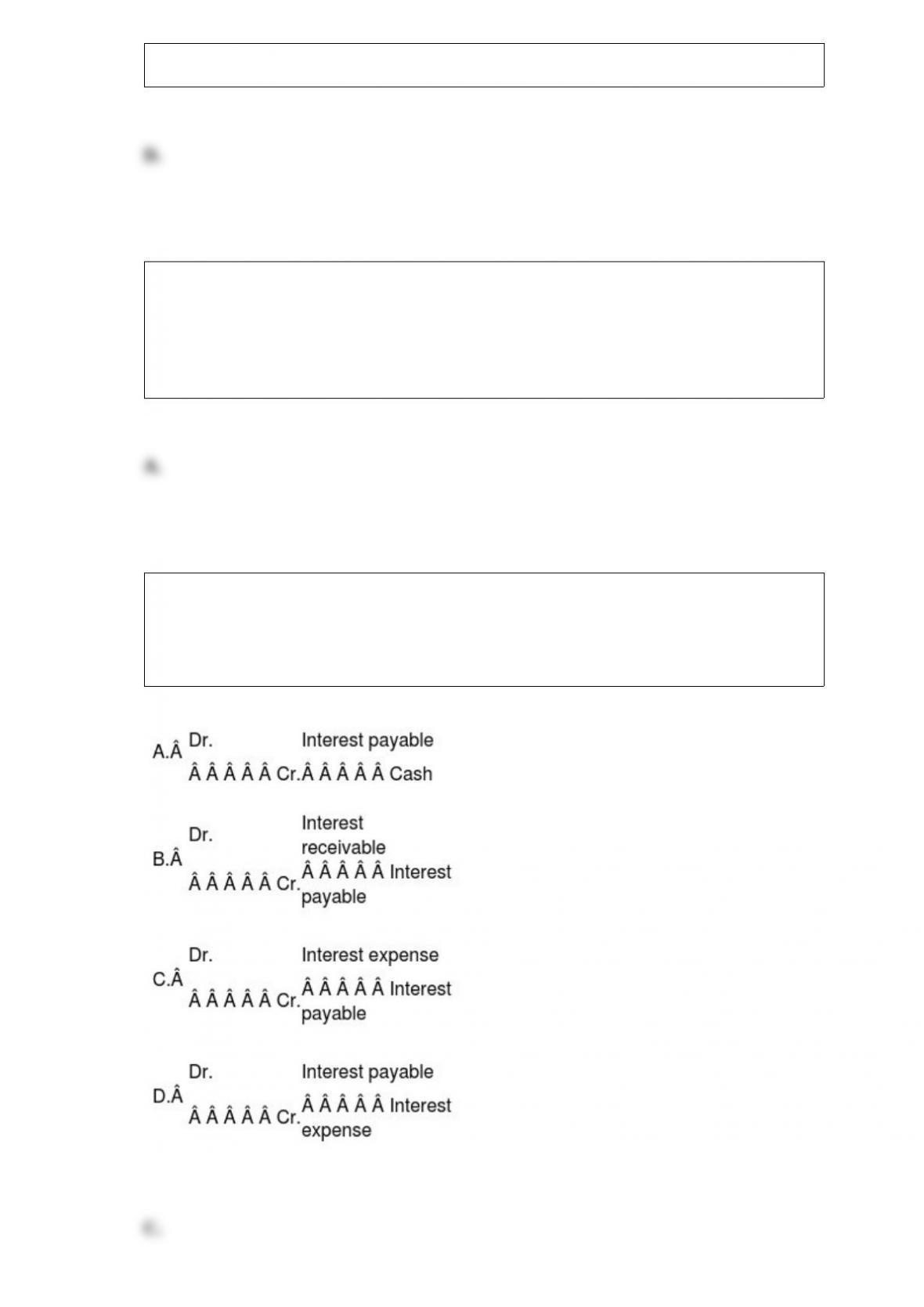
Martin & Associates borrowed $15,000 on April 1, 2016 at 8% interest with both
principal and interest due on March 31, 2017.
Which of the following journal entries should the firm use to accrue interest at the end
of each month?

Which of the following costs are not relevant in a decision to continue or discontinue a
segment of the organization?
A. avoidable costs.
B. unavoidable costs.
C. opportunity costs.
D. differential costs.
Which classification of accounting is most concerned with the use of economic and
financial information to plan and control many of the activities of the entity?
A. Financial accounting.
B. Auditing-Public accounting.
C. Managerial accounting.
D. Income tax accounting.
On March 15, 2017, Birkshire Energy obtained a nine-month working capital loan from
the First National Bank of Oglesby. The face amount of the note signed by the treasurer
was $900,000. The interest rate charged by the bank was 10 percent. The bank made the
loan on a discount basis. (Round your final answers to the nearest dollar).
(a.) Calculate the loan proceeds made available to Birkshire.
(b.) Calculate the amount of interest expense related to this loan during the six months
ended June 30, 2017.
(c.) What is the amount of the current liability related to this loan to be shown in the
June 30, 2017, balance sheet?

The shift in the amount of manufacturing overhead costs applied to the mix of products
produced that occurs when using a single cost driver rate as compared to using
activity-based costing rates is known as:
A. underapplied overhead.
B. overapplied overhead.
C. cost absorption.
D. cost distortion.
Which of the following is another term for mixed costs?
A. semifixed costs.
B. semivariable costs.
C. component costs.
D. none of the above.
A credit entry will:
A. increase an asset account.
B. increase a liability account.
C. decrease paid-in capital.
D. increase an expense account.
For the partial value chain functions given below, which sequence is correct?
A. design, production, marketing.
B. marketing, production, distribution.
C. research and development, production, distribution.
D. customer service, marketing, distribution.

The notes to the financial statements:
A. are not an integral part of the financial statements.
B. explain the significant accounting policies of the company.
C. usually disclose the amount of the company’s bad debts expense.
D. describe management’s product development plans for the coming year.
In a make or buy decision, which of the following costs would be considered relevant?
A. avoidable costs.
B. unavoidable costs.
C. sunk costs.
D. allocated costs.
Gains differ from revenues because gains:
A. are not a result of the entity’s ongoing, central operations.
B. do not have to be realized.
C. are reported as income from operating activities.
D. do not involve any offsetting costs or expenses.
The valuation of short-term marketable securities on the balance sheet is likely to be for
an amount that is approximately equal to the cost of these investments because:
A. the market value of short-term marketable securities does not fluctuate from cost.
B. the high quality and close maturity date of the securities cause their market values to
be relatively stable.
C. generally accepted accounting principles require that short-term marketable
securities be reported at cost.
D. the question statement is false; the valuation of short-term marketable securities on
the balance sheet is not likely to be for an amount that is approximately equal to the
cost of these investments.

Which of the following best describes cost accounting?
A. cost accounting serves the needs of both financial and managerial accounting.
B. managerial accounting is a subset of cost accounting.
C. financial accounting is a subset of cost accounting.
D. cost accounting is an alternative to both financial and managerial accounting.
Which of the following was not one of the reasons for the FASB’s decision to undertake
the Conceptual Framework project?
A. To provide a structure or framework of financial accounting concepts.
B. To describe concepts that will underlie guidance on future accounting practices and
in due course serve as a basis for evaluating existing guidance and practices.
C. To provide detailed, industry-specific authoritative guidance for the accounting and
financial reporting of complex business transactions.
D. To facilitate the FASB’s efforts in developing accounting and reporting guidance by
providing a common foundation and basic reasoning on which to consider merits of
alternatives.
Ariana Co. issued $6,000,000 face amount of 15%, 20-year bonds on April 1, 2017. The
bonds pay interest on a semi-annual basis on June 30 and December 31 each year.
(a.) Assume that market interest rates were slightly lower than 15% when the bonds
were sold. Would the proceeds from the bond issue have been more than, less than, or
equal to the face amount?
(b.) Independent of part (a), assume that the proceeds were $5,940,000. Write the
journal entry or use the horizontal model to show the effects of issuing the bonds.
(c.) Assume that the bonds were issued for $5,940,000 as in part (b). Calculate the
interest expense that Ariana Co. will show with respect to these bonds in its income
statement for the year ended December 31, 2017, assuming that the discount of $60,000
is amortized on a straight-line basis.
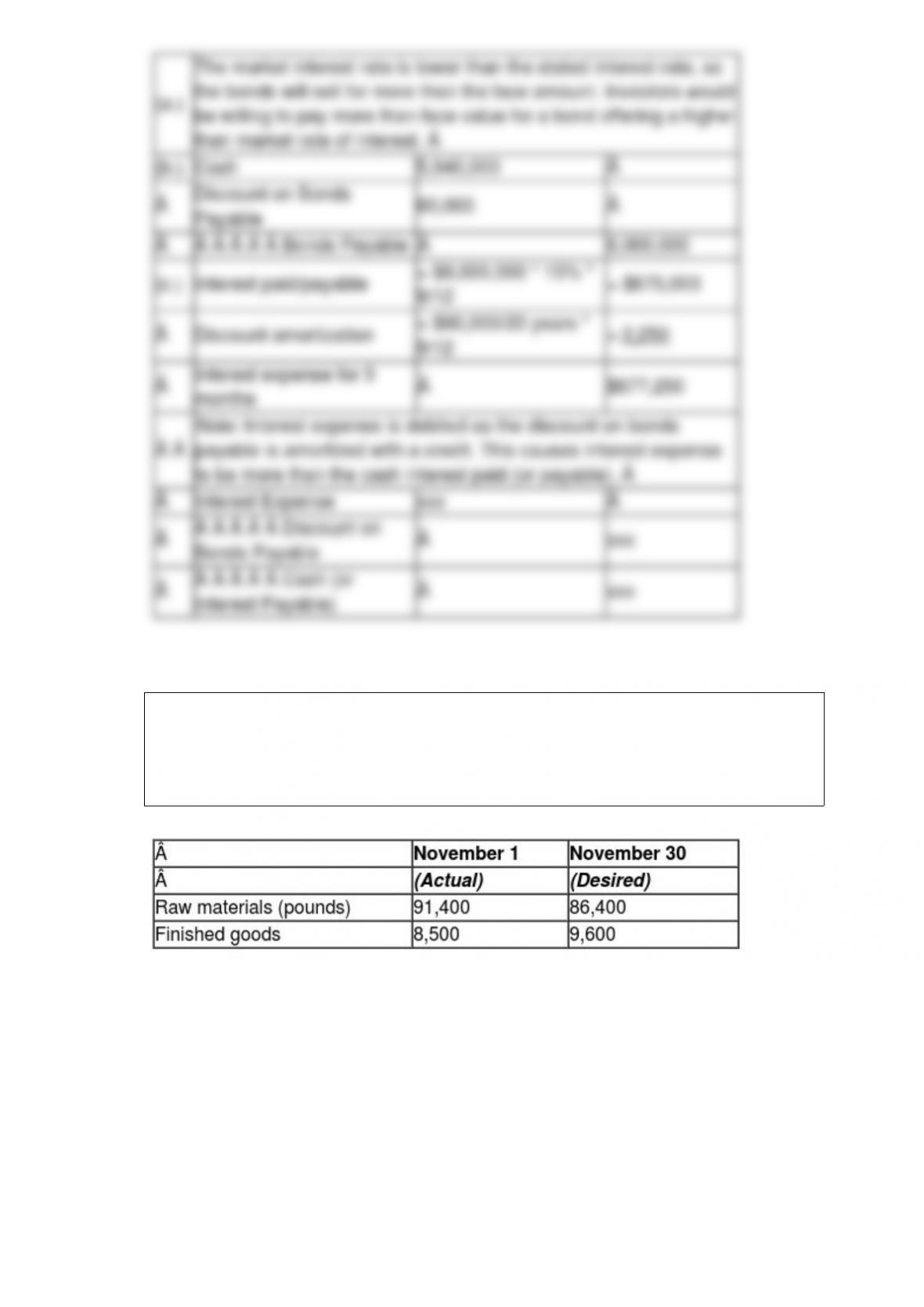
Aborkian Co. is forecasting sales of 75,000 units of product for November. To make
one unit of finished product, seven pounds of raw materials are required. Actual
beginning and desired ending inventories of raw materials and finished goods are:
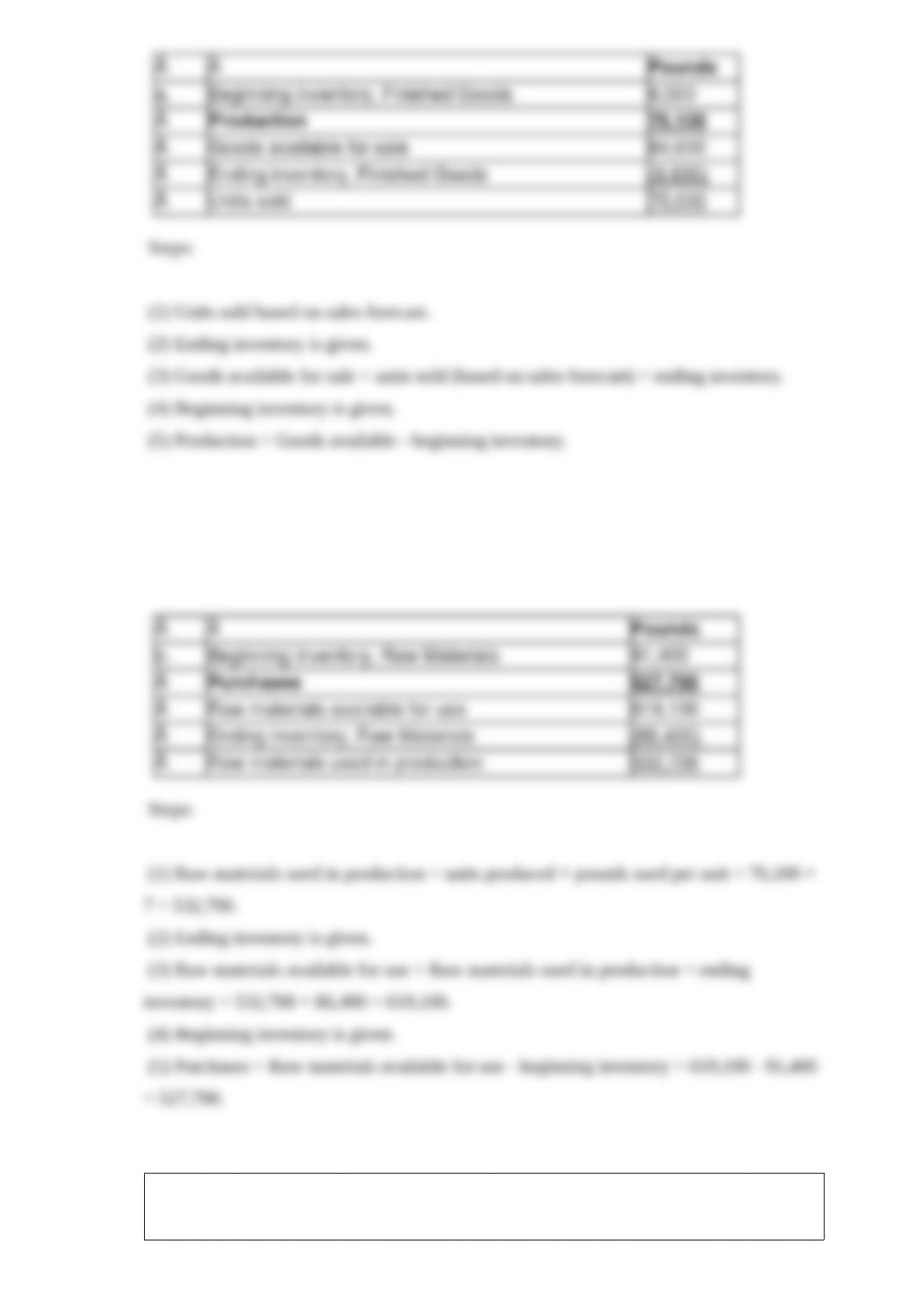
(a.) Calculate the number of units of product to be produced during November.
(b.) Calculate the number of pounds of raw materials to be purchased during November.
The noncurrent liability, Noncontrolling Interest, arises if:
A. A firm owns less than 50% of another entity.

B. A firm owns more than 50%, but less than 100%, of another entity.
C. A firm owns 100% of another entity.
D. Noncontrolling Interest is accounted for as an equity item.
The principle of full disclosure pertains to:
A. The entity fully discloses all client data.
B. The entity fully discloses all proprietary information.
C. The entity fully discloses all necessary information to prevent a reasonably astute
user of financial statements from being misled.
D. The entity fully discloses all necessary information to prevent all users of financial
statements from being misled.
E. All of the above.
Which of the following is the last budgeted financial statement to be prepared?
A. budgeted income statement.
B. budgeted balance sheet.
C. cash budget.
D. it doesn’t matter which one is prepared last.
The effect of an error resulting in an understatement of ending inventory is to:
A. overstate the next period’s beginning inventory.
B. understate cost of goods sold of the current period.
C. overstate cost of goods sold of the current period.
D. overstate operating expenses of the current period.
Most entities satisfy the accounting criteria for recognizing an expense when:

A. a commitment is made to purchase a product or service.
B. cash is paid to a supplier.
C. a cost is incurred in the revenue generating process.
D. a dividend is paid to stockholders.
Sometimes when management decisions are reached, the investment project with the
highest NPV or IRR is not selected. This occurs because:
A. a lower IRR is a less risky investment.
B. the highest NPV is not necessarily the highest IRR.
C. qualitative factors override quantitative analysis techniques.
D. sometimes management makes the wrong decision.
In most states, par value of issued shares represents:
A. legal capital.
B. no par capital.
C. noncontrolling capital.
D. corporate capital.