
1) the practice of maintaining budgets for the same number of future periods, revising
those budgets as each period is completed and adding a new budget each period, is
called:
a.master budgeting
b.cyclical budgeting
c.zero-based budgeting (zbb)
d.rolling budgets (or, rolling financial forecasts)
e.kaizen (or continuous-improvement) budgeting
2) a manager uses regression to express sales as a function of advertising expenditures
(x1), and per capita income (x2) in your sales area. the following multiple linear
regression equation is developed:
y = 10 + .51×1 + .45×2
the coefficient of determination is .96
this coefficient of determination explains that:
a.96% of sales variations are due to an error term
b.the dependent variable is not related to advertising expenditures and per capita
income
c.96% of sales variations are explained by the equation
d.only 4% of the sales variations are explained by advertising expenditures and per
capital income
3) which one of the following is a plan that will allow a manufacturing firm to satisfy
its sales goals and have on hand the desired amount of inventory at the end of the
budget period?
a.direct materials usage budget
b.sales budget
c.selling and administrative expense budget
d.production budget
e.sales forecast
4) which of the following is not a reason why global companies choose to report on
corporate responsibility?
a.ethical considerations
b.innovation and learning
c.risk management
d.market share
e.saves time
5) the objective of the fourth step in cost estimation, graphing the data, is intended to:
a.identify unusual patterns
b.show data in two dimensions
c.enhance the cost estimation process
d.allow for subjectivity in cost estimation
6) which one of the following is not a unit-level cost driver?
a.direct labor hours
b.direct material dollars
c.machine hours
d.production orders
e.none of the above
7) the cvp profit-planning model assumes that over the relevant range of activity:
a.only revenues are linear
b.only revenues and fixed costs are linear
c.only revenues and variable costs are linear
d.variable cost per unit decreases because of increases in productivity
e.both revenues and total costs are linear
8) the following cost information pertained to the violin division of stringing music co.
and was based on monthly demand and sales of 100 units:
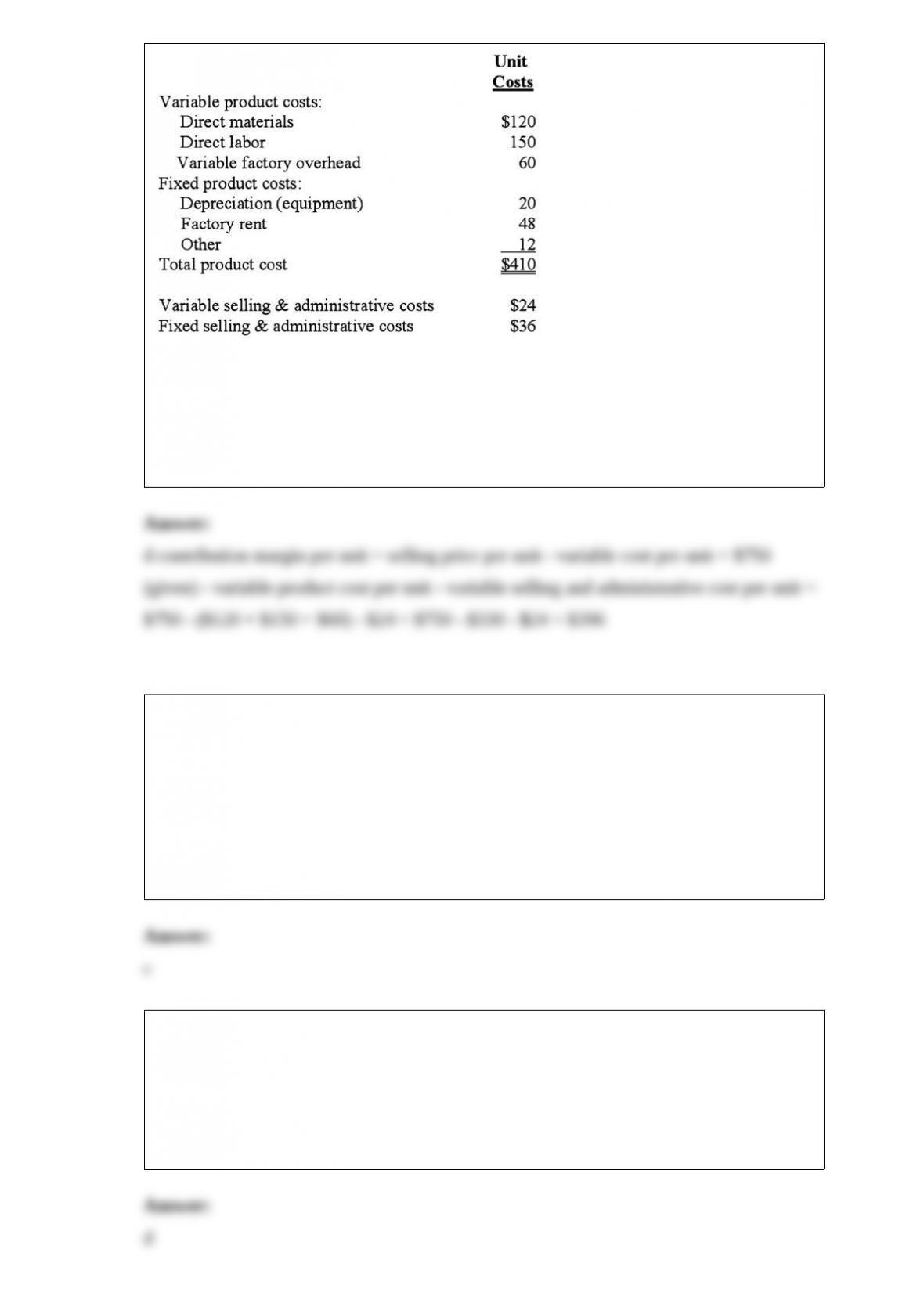
given a selling price per unit of $750, what is the contribution margin per unit sold?
a.$336
b.$316
c.$276
d.$396
e.$630
9) over the past several years it has become increasingly important for firms to improve
achievement towards their social and environmental responsibilities. what is the best
way the management accountant can help the firm improve on sustainability?
a.participate in programs of environmental organizations
b.develop and implement a legal staff and public relations staff for dealing with
sustainability issues that may affect the firm
c.develop and implement a sustainability scorecard
d.risk management
10) activity-based costing systems:
a.accumulate overhead costs by departments
b.are less complex and therefore less costly than volume-based systems
c.can be used in manufacturing firms only
d.have separate overhead rates for each activity
e.eliminate multiple-stage cost allocation