A company pays its workforce on Fridays for a five-day workweek ending on that day.
The payroll for a week is $100,000. If the accounting year-end falls on a Tuesday, the
adjusting journal entry to record this will include a
A) debit to Salaries and Wages Expense $100,000.
B) debit to Salaries and Wages Expense $40,000.
C) credit to Salaries and Wages Payable $60,000.
D) credit to Salaries and Wages Payable $100,000.
Which of the following items would be reported on a statement of cash flows using the
indirect method, but not on a statement prepared using the direct method?
A) Cash paid for dividends
B) Cash received from stock issuances
C) Depreciation
D) Cash paid for purchase of treasury stock
A company’s quarterly income statements show that in the last three quarters both Sales
Revenue and net income have been falling. Given this information, which of the
following conclusions drawn by users are valid?
A) Creditors are likely to conclude that the risk of lending to the company is declining
and might be willing to accept a lower interest rate on loans.
B) Investors are likely to conclude that the stock price is likely to rise, making the
company more attractive as a potential investment.
C) Customers are likely to conclude that the company is struggling; therefore it is
permissible to take longer to pay amounts they owe to the company.
D) Owners may conclude that the company will be less likely to distribute dividends.
Extending credit to customers will introduce all of the following additional costs
except:
A) increased wage costs will be incurred to hire people to evaluate whether each
customer is creditworthy, track how much each customer owes, and follow up to collect
the receivable from each customer.
B) bad debt costs will result when amounts cannot be collected from customers.
C) delayed receipt of cash may result in requiring the company to take out short-term
loans and incur interest costs.
D) decreased gross profit from reduced sales.
When a company has a contingent liability that is remote in likelihood, the company
should:
A) include a description in the notes to the financial statements.
B) record the amount of the liability times the probability of its occurrence.
C) record the amount of the liability as a long-term liability on the balance sheet.
D) exclude the information about the contingent liability from its financial statements
and notes.
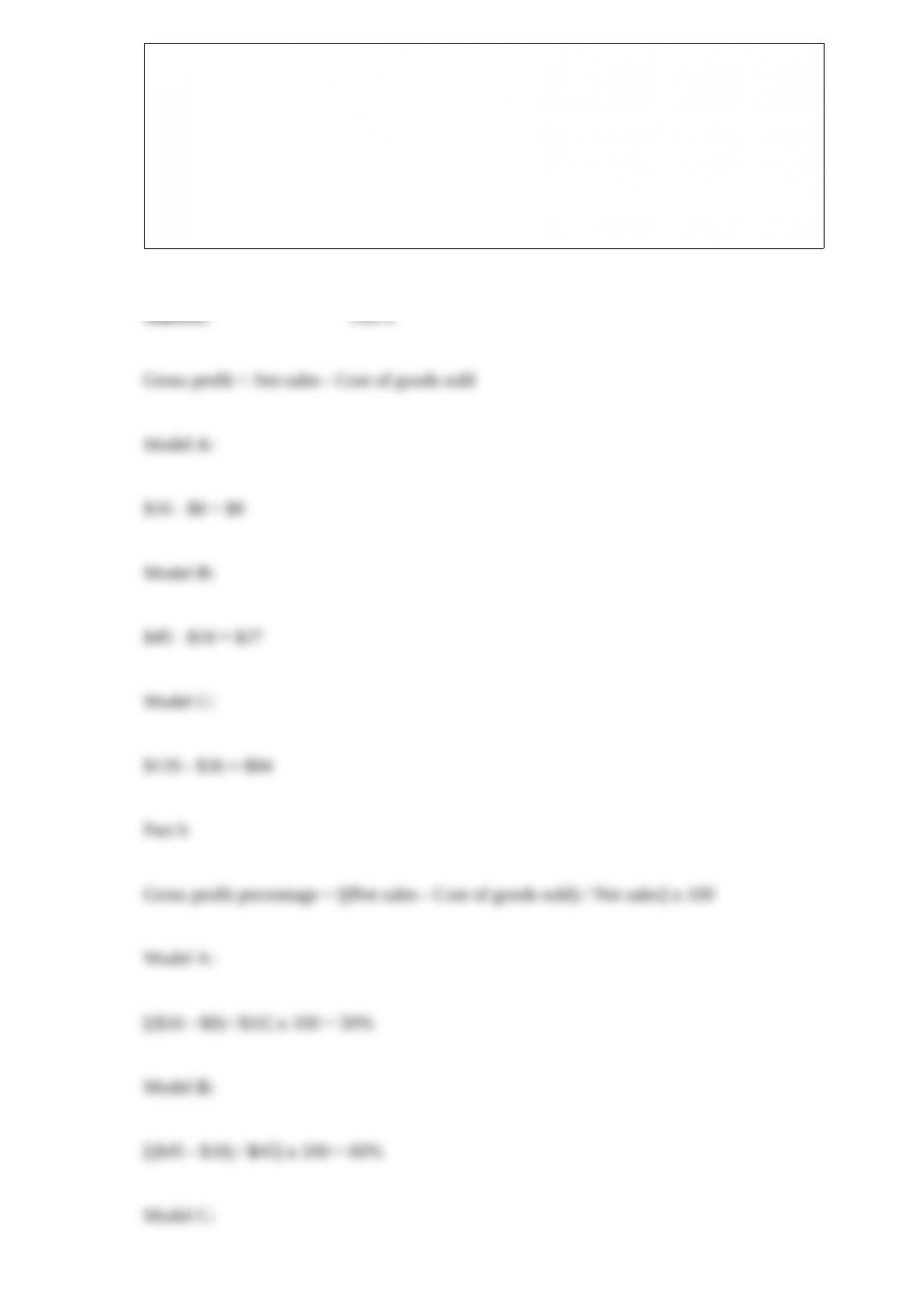
A company sells three different products. Model A costs $8 and sells for $16, Model B
costs $18 and sells for $45, and Model C costs $36 and sells for $120.
Required:
Part a. Calculate the gross profit per unit for each of the three products.
Part b. Calculate the gross profit percentage for each of the three products.
The evaluation of the internal control system to determine whether it is working as
intended is referred to as:
A) the control environment.
B) information and communication.
C) risk assessment.
D) monitoring activities.
Your company uses the again of accounts receivable method. Net credit sales are
unchanged from last year, the year-end balance in Accounts Receivable is unchanged
from the previous year’s ending balance, and there were no write-offs during the current
year. The company previously averaged about 20% of its total accounts receivable in
the “over 90 days past due” category and now has 35% in this category at the end of the
current year. The dollar amount of the adjustment to record Bad Debt Expense in the
current year:
A) decline, thus increasing the ending balance of the Allowance for Doubtful Accounts
account.
B) increase, thus increasing the ending balance of the Allowance for Doubtful Accounts
account.
C) decline, thus reducing the ending balance of the Allowance for Doubtful Accounts
account.
D) increase, thus reducing the ending balance of the Allowance for Doubtful Accounts
account.
Which of the following is the usual last step in the accounting cycle?
A) Preparing the adjusted trial balance.
B) Preparing the financial statements.
C) Preparing a post-closing trial balance.
D) Preparing an unadjusted trial balance.
Assume that accrual basis accounting is used. Which of the following errors would
most likely lead to an overstatement of net income in the current year?
A) Recording revenue when the cash is collected next year although it is earned in the
current year.
B) Recording an expense when paid next year although it is incurred this year.
C) Failing to adjust the Unearned Revenue account for the portion of rent earned this
year.
D) Recording revenue earned in the current year when cash is collected this year.
A new Chief Executive Officer (CEO) was hired by a company on December 10, 2015.
The CEO has been promised a significant bonus if 2016 net income is 10% more than
2015 net income. The CEO is considering taking the following actions:
A) Overstating the cost of machinery purchased in 2016
B) Prepaying 2016 expenses in 2015
C) Deferring 2016 expenses to 2017 and accruing revenues in 2016 that do not exist
D) Recording revenues earned in 2016 as unearned revenues
Required:
Explain how each of these actions would impact the 2016 net income amount and
decide if the action is ethical.
BetterBuy uses a perpetual inventory system. BetterBuy sells a computer from
inventory for $599 on credit. BetterBuy originally bought the computer from IBM for
$395. What journal entry (entries) will BetterBuy prepare to record the sale?
A) Debit Cash and credit Sales Revenue for $599; debit Cost of Goods Sold and credit
Inventory for $395
B) Debit Accounts Receivable for $599, credit Inventory for $395, and credit Gross
Profit for $204
C) Debit Accounts Receivable and credit Sales Revenue for $599; debit Cost of Goods
Sold and credit Inventory for $395
D) Debit Inventory for $395, debit Cost of Goods Sold for $204, and credit Accounts
Receivable for $599

A company began the year with assets of $100,000, liabilities of $20,000, and
stockholders’ equity of $80,000. During the year assets increased $55,000 and
stockholders’ equity increased $20,000. What was the change in liabilities for the year?
A) Increase of $75,000
B) Increase of $35,000
C) Decrease of $75,000
D) Decrease of $35,000
When the amount of a contingent liability can be reasonably estimated and its
likelihood is probable, the company should:
A) include a description in the notes to the financial statements.
B) record the estimated amount of the liability times the probability of its occurrence.
C) record the estimated amount of the liability on the balance sheet.
D) exclude the information about the contingent liability from its financial statements
and notes.
Assume a company only entered into financing and investing activities and has
prepared its journal entries and posted them to T-accounts. How would the related
account balances be listed on its trial balance?
A) Credits first, followed by debits
B) Debits first, followed by credits
C) Alphabetically
D) In descending order by dollar amount