1) The human resources model of motivation is strongly influenced by Japanese
management practices.
2) If the organization’s code of ethics is more stringent than an individual’s code of
ethics, conflicts may arise.
3) Customer lifetime value is the discounted net cash flows from the customer for all of
the years that it remains a customer compared to the initial acquisition cost to obtain the
lifetime relationship with the customer.
4) In markets where the organization faces a market-determined price, the organization
can set its price using cost plus pricing.
5) Cost-volume-profit analysis may be used for single-product and multiproduct
analysis but not in a service environment.
6) Budgets can play both planning and control roles for management.
7) Negotiated transfer prices, and therefore production decisions, may reflect the
negotiating skills of the parties rather than economic considerations.
8) The focus of the learning and growth perspective of the Balanced Scorecard includes
employee capabilities that continually improve customer relationships.
9) Customer loyalty may be low regardless of the customer’s attitude toward the product
or the company in highly competitive industries, characterized by low differentiation
among products, with many substitutes and a low cost of switching.
10) An example of a situation in which process costing might be used would be a
consulting engagement.
11) Strategy creates a competitive advantage by positioning the company in its external
environment where its internal resources and capabilities deliver something to its
customers better than or different from its competitors.
12) Budgeting slack is most likely to occur when a firm uses the budget only as a
planning device and not for control.
13) The financial measure, economic value added, evaluates income relative to the level
of investment required.
14) When an organization moves to decentralized decision making, control moves from
results control to task control.
15) Overhead costs such as factory rent and supervisory salaries are allocated to cost
objects in a multi-product facility.
16) Experience shows that it is more expensive to prevent defects than to detect and
repair them.
17) Outcome-based incentive compensation systems can only be used to motivate
appropriate decision-making behavior when employees are empowered to understand
the compensation system.
18) The customer perspective of the Balanced Scorecard focuses on excellence in
processes which satisfy customers.
19) Kaizen costing requires relevant financial results to be shared with front-line
employees.
20) More cost pools:
A) always result in better estimates of overhead costs
B) seldom result in better estimates of overhead costs
C) are usually beneficial if the pattern of demand varies across resources
D) result in lower estimates of total overhead costs
21) The two major categories of technical considerations for a management accounting
and control system are:
A) design and accuracy of information
B) relevance of information and scope of system
C) service and timely information
D) development and flexibility
22) Financial budgets are prepared:
A) to specify expectations for selling, purchasing, and production
B) to evaluate the financial results of the proposed decisions
C) so that financial statements can be prepared for shareholders
D) to plan for production capacity
23) Empowering employees in management accounting and control system design
requires all of the following EXCEPT:
A) allowing employees to participate in decision making
B) having highly-motivated employees in every position
C) ensuring that employees understand the information they are using and generating
D) enabling employees’ comprehension of performance measure computations
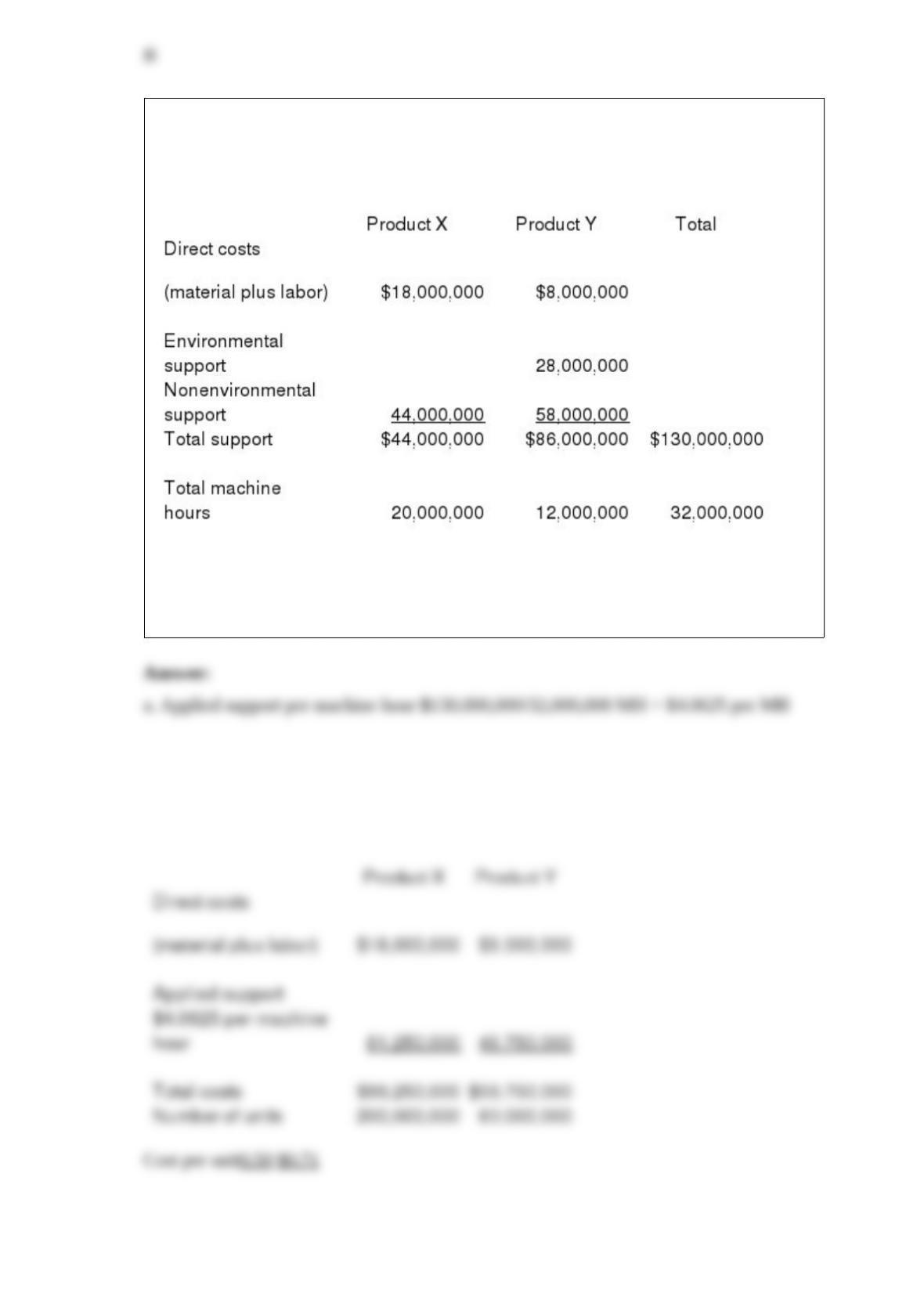
24) Environmental costing and ABC:
Abbot Corporation produces 200,000,000 units of product X and 80,000,000 of product
Y with the following costs and machine hours.
a.Determine total product cost per unit for each product using a traditional costing
system with machine hours as the cost driver.
b.Determine total product cost per unit for each product using an activity based costing
system. Use the number of units as the cost driver for each activity.
25) Pressures on managers to act unethically include all of the following EXCEPT:
A) pressures to act in the long-run best interest of the shareholders
B) solicitations for confidential information
C) requests to falsify reports
D) requests to bias information in favor of certain stakeholders
26) It is important that the product costs reflect as much of the diversity and complexity
of the manufacturing process so that:
A) product costs will reflect their relative consumption of resources
B) better information related to resource constraints can be captured and communicated
C) there is more likelihood of cost distortions
D) All of the above are correct
27) The variances that should be investigated by management include:
A) only unfavorable variances
B) only favorable variances
C) all variances, both favorable and unfavorable
D) both favorable and unfavorable variances that are considered significant in amount
for the company
28) A favorable price variance for direct materials indicates that:
A) a lower price than expected was paid for materials
B) a higher price than expected was paid for materials
C) less material was used during production than planned for actual output
D) more material was used during production than planned for actual output
29) If products are alike, then for costing purposes:
A) a simple costing system will yield accurate cost numbers
B) an activity-based costing system should be used
C) multiple unit-level cost rates should be used
D) varying demands will be placed on resources
30) All of the following are true of cost-based transfer prices EXCEPT that they:
A) provide no incentive to the supplying division to control costs when actual costs are
used
B) may use standard costs to help maintain operating efficiency
C) promote the optimal level of transactions for the overall organization
D) don’t give proper guidance when operating capacity is constrained
31) The variance that LEAST affects cost control is the ________ variance.
A) flexible budget
B) direct material price
C) planning
D) direct labor efficiency
32) Wood Manufacturing is a small textile manufacturer using machine-hours as the
single, plant-wide predetermined cost driver rate to allocate manufacturing overhead
costs to the various jobs contracted during the year. The following estimates are
provided for the coming year for the company and for the Winfield High School band
jacket job:
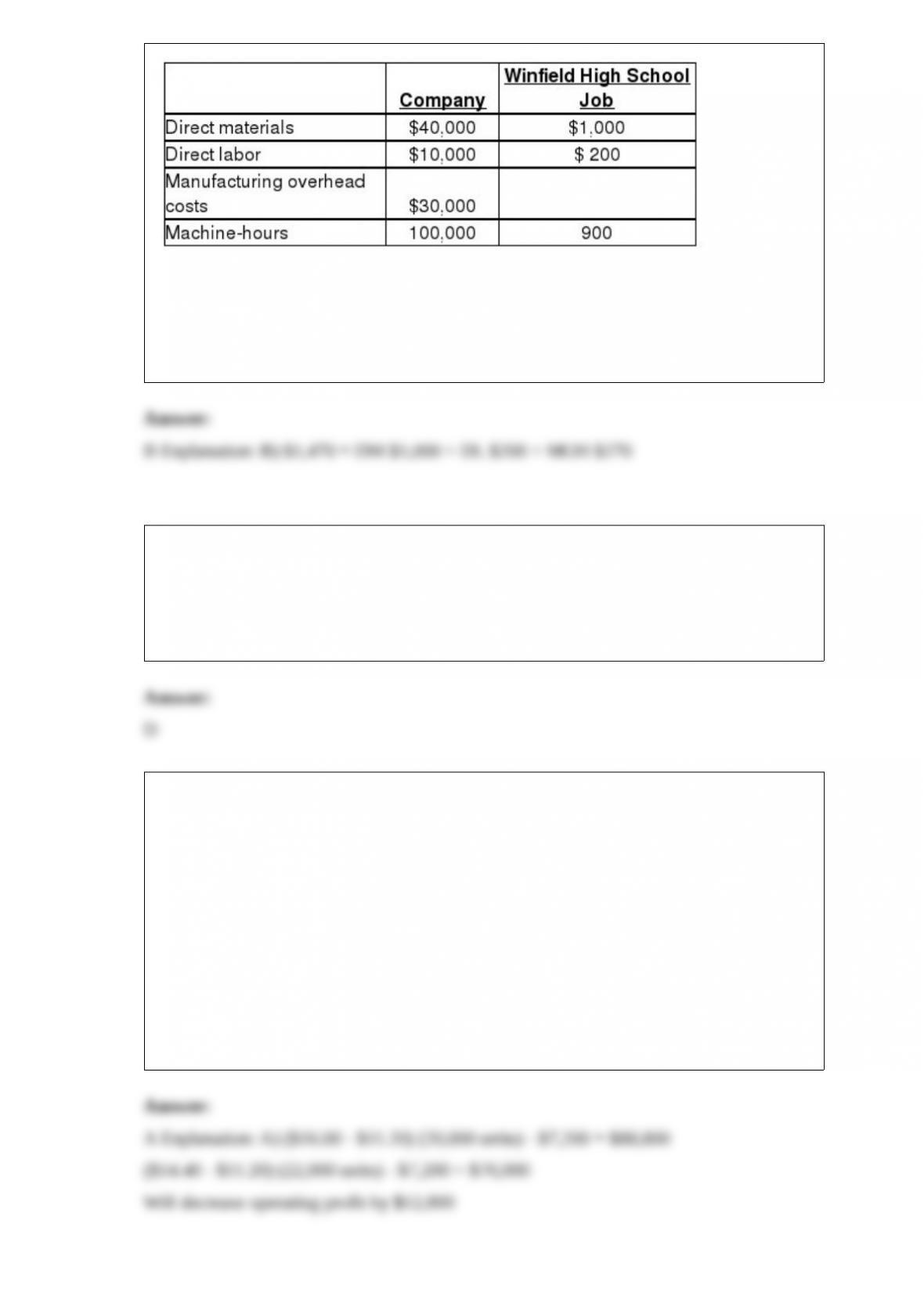
What are the total manufacturing costs of this job?
A) $1,200
B) $1,470
C) $1,650
D) $1,920
33) Sunk costs:
A) are relevant
B) are differential
C) have future implications
D) are ignored when evaluating alternatives
34) L&M Manufacturing produces a single product that sells for $16. Variable (flexible)
costs per unit equal $11.20. The company expects the total fixed (capacity-related) costs
to be $7,200 for the next month at the projected sales level of 20,000 units. In an
attempt to improve performance, management is considering a number of alternative
actions. Each situation is to be evaluated separately.
Suppose that L&M Manufacturing’s management believes that a 10% reduction in the
selling price will result in a 30% increase in sales. If this proposed reduction in selling
price is implemented, then:
A) profit will decrease by $12,800 in a month
B) profit will increase by $12,800 in a month
C) profit will decrease by $32,000 in a month
D) profit will increase by $32,000 in a month
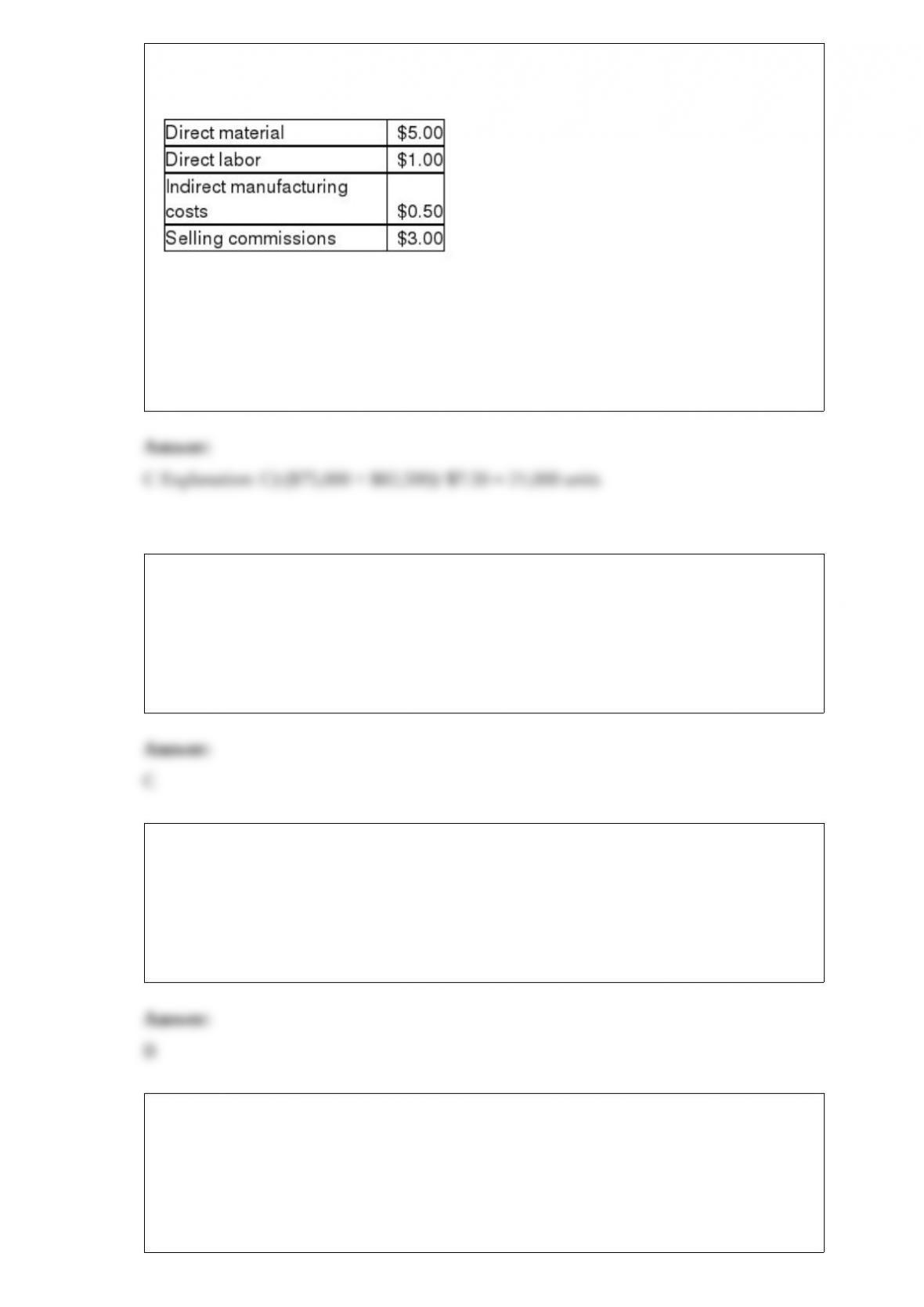
35) EJL Herbal Remedies sells several products for an average price of $17 per unit.
Average variable costs per unit are as follows:
EJL’s annual fixed costs total $82,500.
The number of units that EJL must sell annually to make a profit of $75,000 is:
A) 7,500 units
B) 18,000 units
C) 21,000 units
D) 30,000 units
36) The underlying philosophy of the scientific management school developed at the
turn of the century was:
A) to foster a work environment that encouraged creativity
B) to use multiple performance measures
C) that people find work objectionable and money is a primary motivator
D) that employees want to feel they contributed value to their organization
37) Group performance should be rewarded with compensation:
A) when an individual’s work must be coordinated with others
B) when employees must coordinate their decision making and other activities with
other employees
C) in addition to individual performance when working in teams
D) never
38) It is useful to think of the process perspective of the Balanced Scorecard within four
groupings that include all of the following EXCEPT:
A) operating management processes
B) customer management processes
C) innovation processes
D) regulatory and social processes
39) Characteristics of just-in-time manufacturing include all of the following EXCEPT:
A) the ability to process items in large batches
B) making a product only when the customer requires it
C) no work-in-process inventories
D) a problem anywhere can stop production
40) The regulatory authority responsible for formulating rules of United States GAAP
is:
A) the Financial Accounting Standards Board
B) the Cost Accounting Standards Board
C) the Federal Accounting Standards Advisory Board
D) the International Accounting Standards Board
41) Jackie Company’s CFO provided the following information on last year’s sales for
two customers that purchased a variety of products from the company.
Scarborough Schultz
Sales $900,000 $800,000
Cost of Goods Sold 360,000 160,000
MSDA expenses, excluding sale commissions 640,000 130,000
a. Which customer is more profitable for the company?
b. Compare a sales incentive scheme that pays 3% of sales revenue to an incentive
scheme that pays 5% of customer profit. How will each scheme affect salespersons’
desire to increase sales to each customer?
42) Staley company has 30 order operators with associated costs of $1,000,000 per
year. Staley calculated that each operator worked about 2,000 hours per year. Allowing
for time off, each operator provided about 1,600 or productive work per year. What is
the rate per hour for each order entry employee?
A) $20.83
B) $28.83
C) $500.00
D) $625.00
43) Currently, most companies consider annual salary costs as:
A) a fixed cost
B) a variable cost
C) an opportunity cost
D) a period cost
44) Jeffrey’s, Inc., sells a single product. The company’s most recent income statement
is given below.
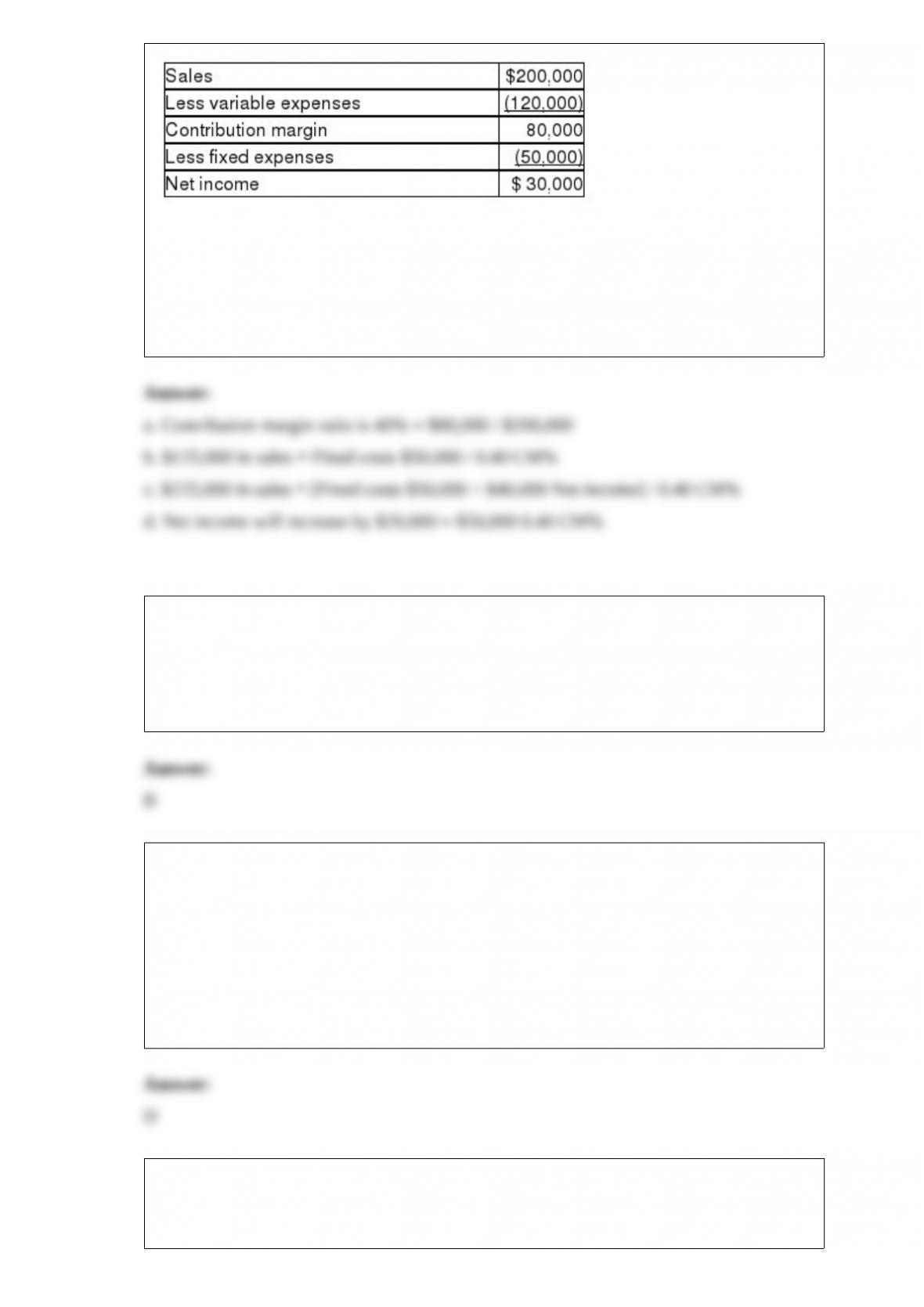
Required:
a. Contribution margin ratio is _______________
b. Break-even point in total sales dollars is _______________
c. To achieve $40,000 in net income, sales must total _______________
d. If sales increase by $50,000 from a $200,000 level,
net income will increase by _______________
45) Customers are price sensitive with few special demands are:
A) high cost to serve and low margin
B) low cost to serve and low margin
C) high cost to serve and high margin
D) low cost to serve and high margin
46) All of the following encourage ethical behavior among employees EXCEPT:
A) having a system for employees to point out violations of the organization’s code of
ethics without fear of retribution
B) dealing promptly and consistently with persons who violate the organization’s code
of ethics
C) exemplary behavior demonstrated by senior management
D) protecting whistle blowers who report unethical behavior who have also acted
unethically
47) Vander Belt Manufacturing, Inc., is considering reorganizing its plant into
manufacturing cells. The following estimates have been prepared to evaluate the
benefits from the reorganization:
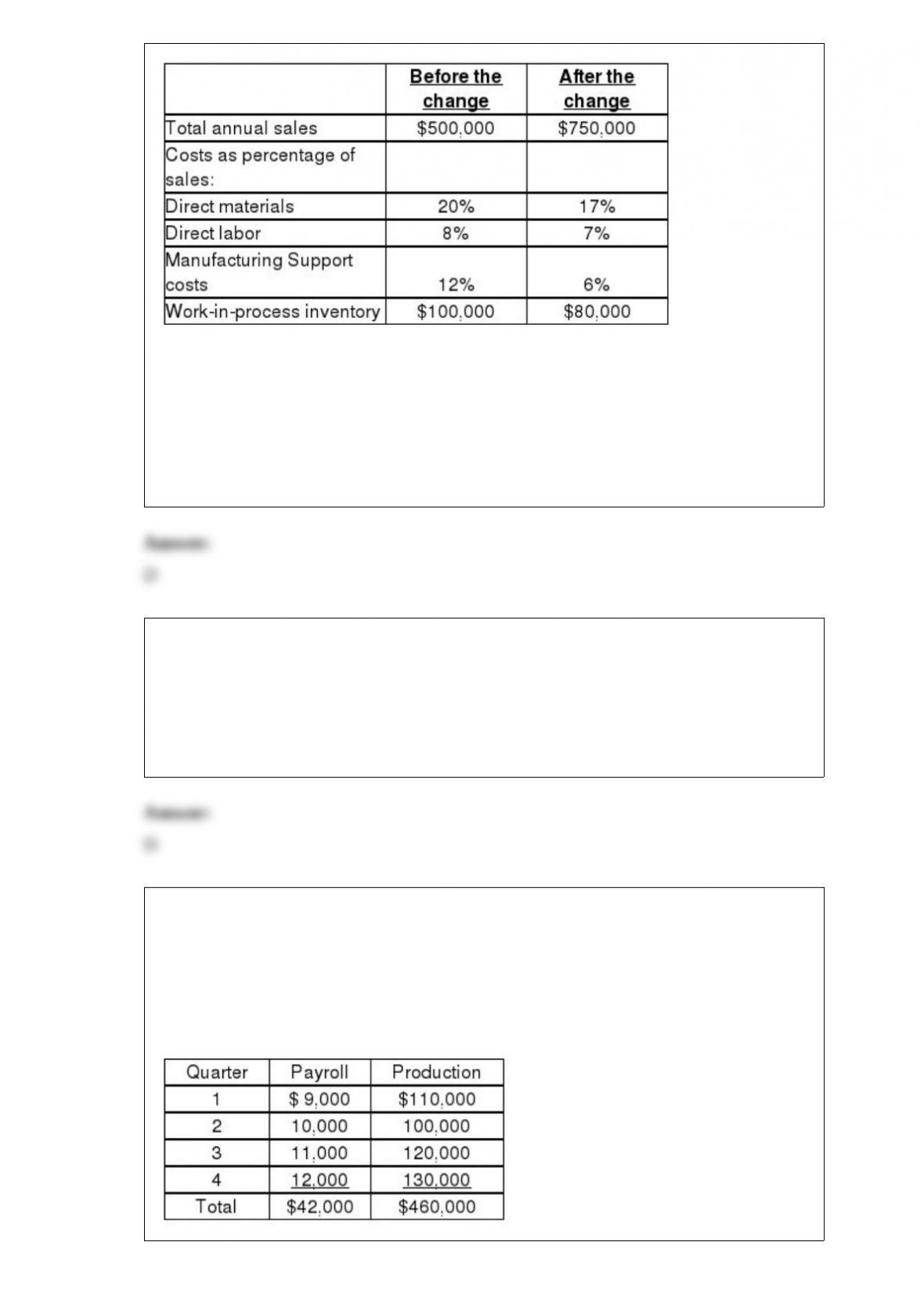
Inventory carrying costs are estimated to be 11% per year.
After the change, work-in-process inventory carrying costs are projected to decrease
because of:
A) reduced costs in materials handling
B) lower financing costs
C) the decreased need for inventory storage
D) All of the above are correct
48) Financial analysts use the expected cash flow statement to do all of the following
EXCEPT:
A) plan for when excess cash is generated
B) plan for short-term cash investments
C) project cash shortages and plan a strategy to deal with the shortages
D) project sales
49) Aero Company has implemented a gain sharing compensation plan for its
production employees. The plan is a Scanlon plan and the base period payroll costs are
$10,000. The value of production in the base period was $100,000. The plan calls for
labor savings to be added to, or excess labor costs to be deducted from, the bonus pool
each quarter. The payroll costs and value of production in each quarter of the current
year were:
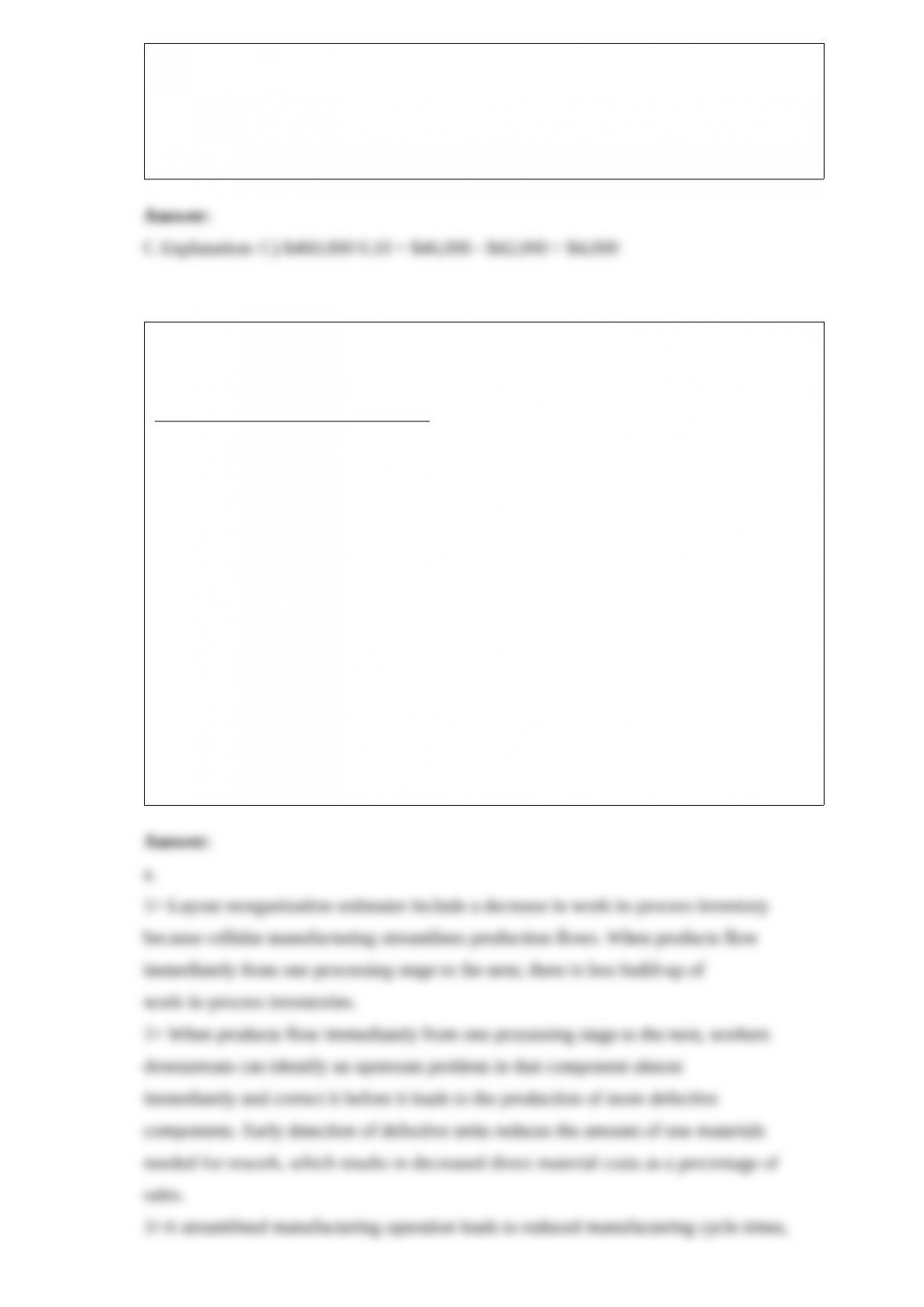
The bonus pool at the end of the year totals:
A) ($4,000)
B) -0-
C) $4,000
D) None of the above is correct
50) Carey Manufacturing, Inc., is considering reorganizing its plant into manufacturing
cells. The following estimates have been prepared to evaluate the benefits from the
reorganization:
Before the changeAfter the change
Total annual sales$700,000$850,000
Costs as percentage of sales:
Direct materials10%9%
Direct labor6%4%
Support costs9%7%
Work-in-process inventory$200,000$120,000
Inventory carrying costs are estimated to be 12% per year.
Required:
a.Why do the layout reorganization estimates include
1> a decrease in work-in-process inventory?
2> a decrease in direct material costs as a percentage of sales?
3> an increase in sales?
b.As a result of the layout reorganization, what amount of annual change is projected
1> from carrying reduced levels of work-in-process inventory?
2> for incremental manufacturing costs?
3> in total benefits?
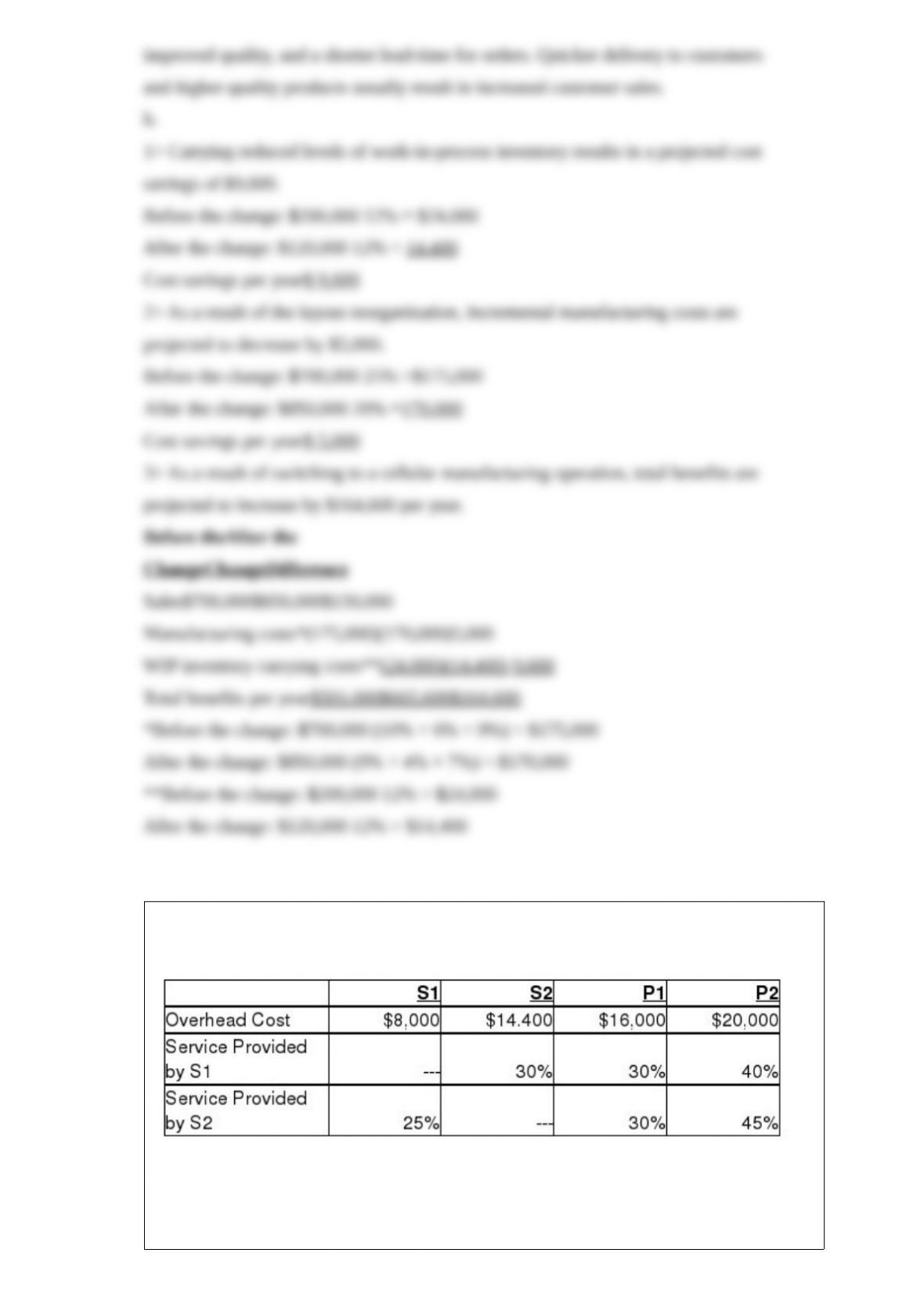
51) Long Island Manufacturing Company developed the following information for its
service departments, S1 and S2, and its production departments, P1 and P2:
Using the direct method of service department cost allocation, how much is to be
allocated from S2 to P2 if calculations are rounded to the nearest dollar?
A) $5,720
B) $6,480
C) $8,640
D) $4,430
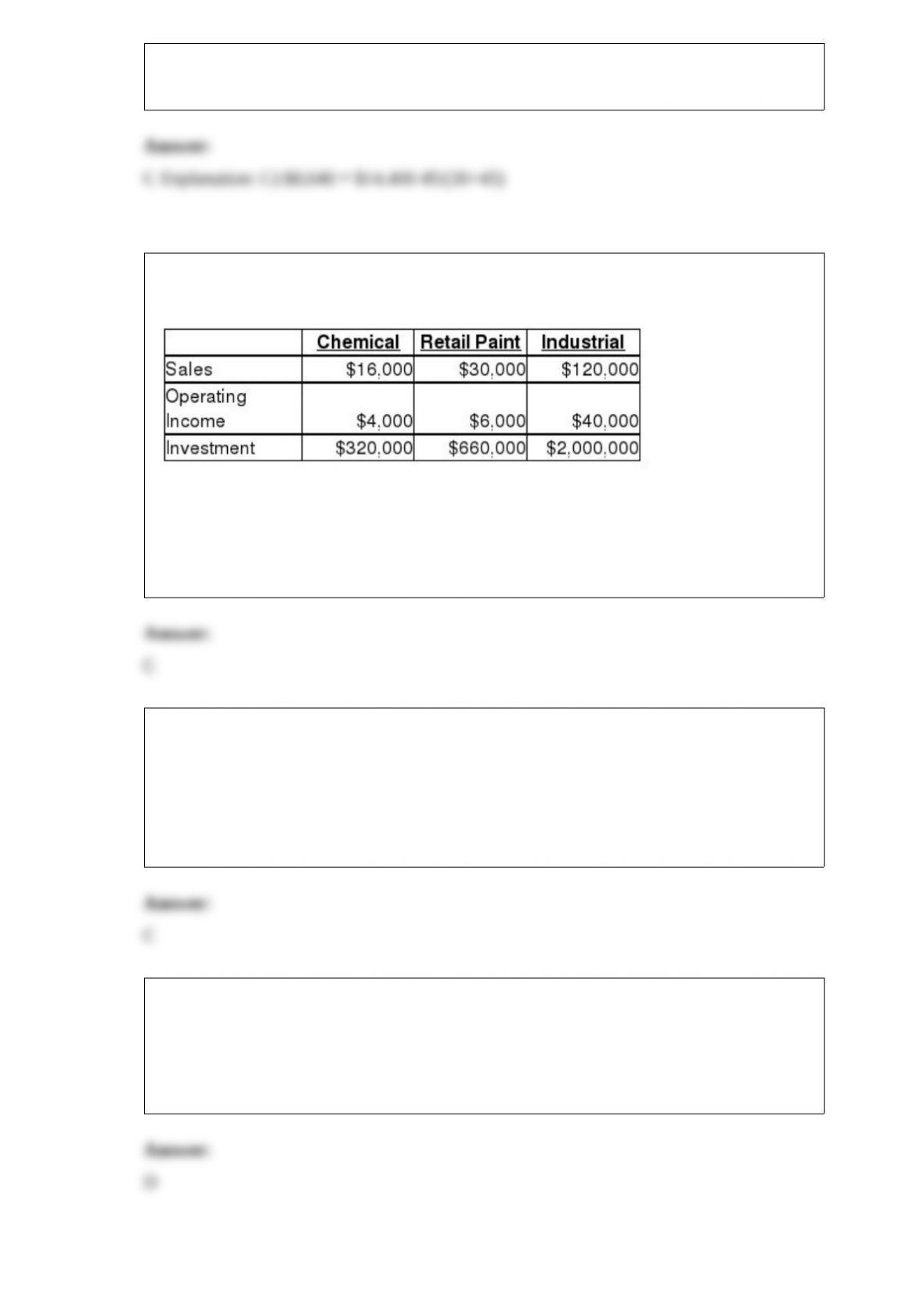
52) The following information pertains to three divisions of Marine Industrial Coatings,
Inc. (amounts in millions):
Which division is more profitable based on ROI?
A) Chemical
B) Retail paint
C) Industrial
D) Both Chemical and Retail paint are more profitable than Industrial.
53) ________ occur(s) when subordinates ask for excess resources above and beyond
what they need to accomplish budget objectives.
A) Pseudo participation
B) Effective budgeting
C) Budget slack
D) Participative budgeting
54) Translating a company’s strategy to operational terms:
A) is an analytical exercise
B) results in the benefit of having the end product of the balanced scorecard
C) often results in team building and employees’ commitment to the new strategy
D) All of the above are correct
55) Assume only the specified parameters change in a sensitivity analysis. If the
contribution margin increases by $10 per unit then operating profits will:
A) also increase by $10 per unit
B) increase by less than $10 per unit
C) decrease by $10 per unit
D) be indeterminable
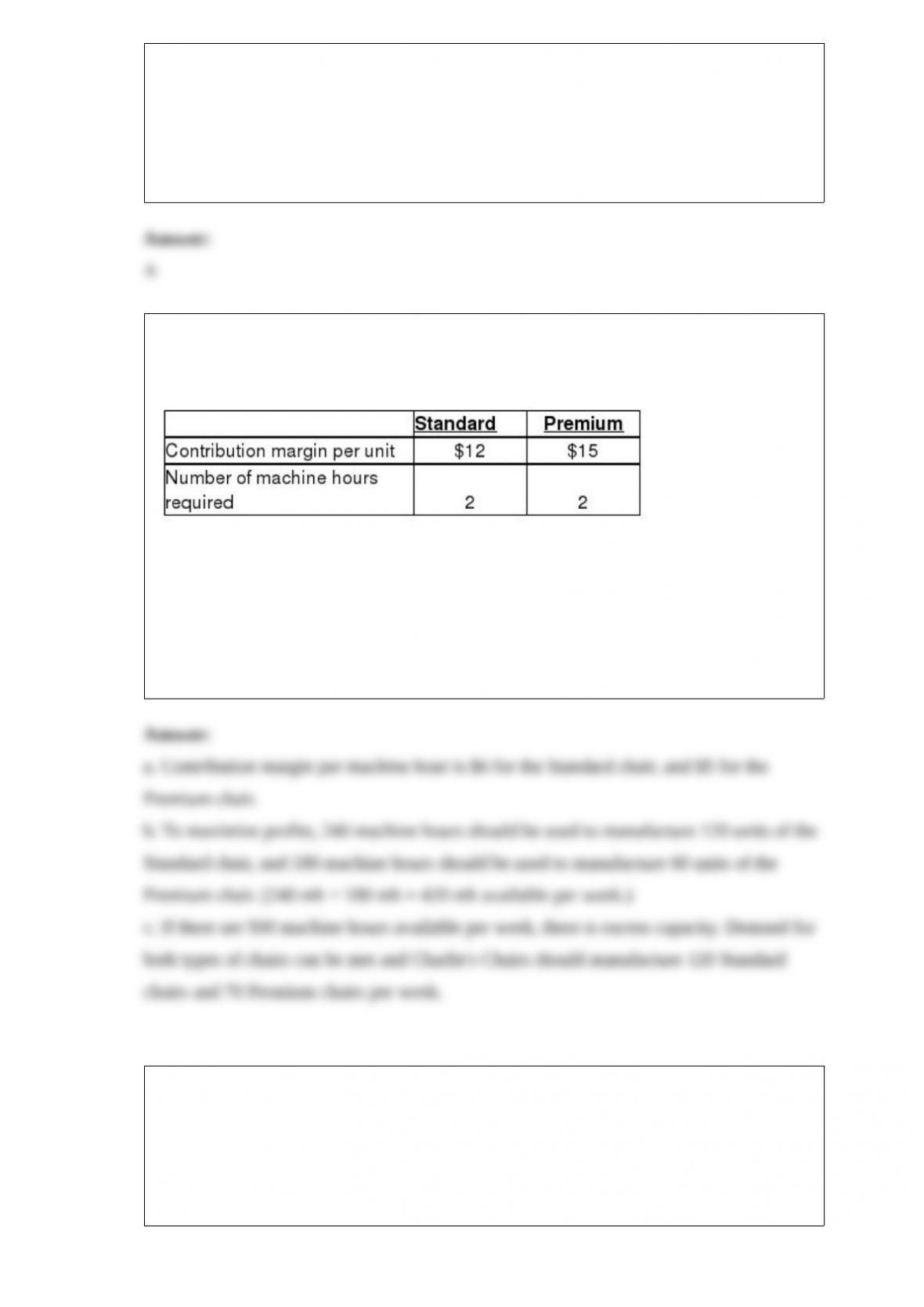
56) Charlie’s Chairs manufactures two models, Standard and Premium. Weekly demand
is estimated to be 120 units of the Standard Model and 70 units of the Premium Model.
Only 420 machine hours are available per week. The following per unit data apply:
Required:
a. For each model, compute the contribution margin per machine hour.
b. To maximize weekly production profits, how many machine hours would you
recommend of each model? How many units of each model?
c. If there are 500 machine hours available per week (instead of only 420 machine
hours per week), how many chairs of each model should Charlie’s produce to maximize
profits?
57) Different products consume different proportions of manufacturing overhead costs
because of differences in all of the following EXCEPT:
A) product design
B) product size
C) setup time
D) sales prices
58) Identify and explain each of the three major cycles of the total-life-cycle costing
approach.
59) What are some nonfinancial measures that a company might use in order to
motivate achieving the objective of anticipating future customer needs?
60) Explain how an activity cost driver rate is determined.
61) Discuss the issues related to excessive focus on nonfinancial customer metrics such
as customer loyalty and satisfaction.
62) Describe the benefits to an organization of preparing an operating budget.
63) What is the key ingredient to successful Balanced Scorecard implementation?
Explain.
64) How do customer costs differ in service companies when compared to
manufacturing companies? Discuss customer independent and customer specific costs.
65) What is benchmarking and why is it used?