
Auditors test the assertion of completeness by determining if any restrictions on the use
of commercial paper by an entity are disclosed in the footnotes.
Audit firms should NOT customize the audit programs based on the assessment of the
risk of material misstatement when auditing long-lived assets.
Auditors are responsible for obtaining reasonable assurance that the financial
statements are free from material misstatements, including material misstatements
related to noncompliance with laws and regulations.
It is never efficient to rely on the internal controls of an organization.

If an auditor discovers evidence of fraud, the planned audit procedures should be
adjusted accordingly.
Current auditing standards do not require the confirmation of receivables if accounts
receivable are not material.
Analytical procedures may indicate that new controls need to be designed before
completing the audit.

A component of the reporting standards is the requirement that an opinion always be
rendered on the subject matter.
Prenumbered receiving documents establish the completeness of the population and are
useful in determining that all goods are recorded in the correct period.
Kiting fraudulently places the company’s marketable securities in the name of the
officers.
An unqualified audit opinion with an explanatory paragraph often makes reference to
the footnotes of the financial statements

A red flag that may alert the auditor to fraud in the revenue cycle is a trend of revenue
growth that is consistent with industry results.
External auditors frequently serve on the audit committees of their clients.
The risk of the company issuing checks near year-end and mailing them subsequently is
not important to the auditor because the action does not affect cash balances.

Effective control not only identifies risk but also responds to these risks appropriately.
When the auditor is unable to obtain sufficient, appropriate evidence concerning the
beginning inventory, which is material, the report is modified by adding an explanatory
paragraph prior to the opinion paragraph and appropriate modification to the scope
paragraph.
The auditor has determined that the control risk for the existence assertion is low;
therefore the auditor may reduce the number of items tested on a substantive basis.
An auditor must obtain an adequate amount of evidence and the evidence must be of the
appropriate quality.

Internal controls are considered to be part of corporate governance.
The Public Company Accounting Oversight Board (PCAOB) does not set specific
standards for audits of public companies.
Reconciliation of vendor statements to recorded payables provides assurance related to
the completeness assertion.

Materiality relates to the significance or importance of an item.
The auditor’s preliminary assessment of internal control effectiveness is based on an
understanding of the control system as it has operated in the past and is designed to
operate.
The five major components of an organization’s internal control are: the control
environment, risk assessment, control activities, information and communication, and
monitoring.
One of the components of internal control, monitoring, refers to the process of
identifying, capturing, and exchanging information in a timely fashion to enable
accomplishment of the organization’s objectives.

The Sarbanes Oxley Act requires management to pre-approve any non-audit service by
the auditor, including tax services not specifically prohibited.
The SEC requires publicly owned corporations to have their quarterly financial
information reviewed by their independent auditors before it is issued.
Type I subsequent events indicate conditions that did not exist at the balance sheet date,
but that may require disclosure.

Vouching is a process that helps establish that recorded transactions are valid.
Auditors are required to evaluate the likelihood of each client continuing as a going
concern for a reasonable period into the foreseeable future.
Multiple internal control deficiencies in the same cycle may actually decrease the
likelihood of misstatement in that cycle.
Internal controls are the responsibility of management.

A misstatement that is intentional is not assessed any differently by the auditor than a
misstatement that is unintentional.
Inherent risk refers to the susceptibility of an assertion about a class of transaction,
account balance, or disclosure to a misstatement that could be immaterial, either
individually or when aggregated with other misstatements, before consideration of any
related controls.
If tolerable misstatement for accounts payable is $1,000, the auditor would need to
obtain more audit evidence for that account than if tolerable misstatement were
$100,000.

Misstatements that are detected, but individually are not material, should be ignored
when determining the appropriate audit report.
Which of the following is the most common type of fraudulent financial reporting?
A.Capitalizing major overhauls to operating equipment.
B.Deferring service revenue until it is delivered to customers.
C.Including as sales inventory sold with the right to return.
D.Excluding a contingent liability that has been settled.
An auditor may best test commissions expense for salespeople when control risk is low
by performing which of the following procedures?
A.Analytical procedures.
B.Tagging and tracing.
C.Alternative procedures.
D.Subsequent proof of cash.

When an auditor uses MUS and analyzes misstatements in the lower stratum, which of
the following will be multiplied by the sampling interval to calculate the projected
misstatement for each misstated item?
A.Audit value.
B.Tolerable misstatement.
C.Sampling interval.
D.Tainting percentage.
Which of the following is a cash management arrangement with a bank whereby the
organization’s customers send payments directly to the client’s bank, which deposits the
remittance to the client’s account?
A.Lockbox.
B.Bank transfer.
C.Imprest bank account.
D.Imprest Account.

Which of the following is not a type of audit procedure?
A.Analytical procedures.
B.Scanning.
C.Reviewing.
D.Observation.
Internal control is a process designed to achieve objectives in which one of the
following categories?
A.Reliability of financial reporting.
B.Compliance with applicable laws.
C.Ineffectiveness of operations.
D.Both A and B.
When a subsequent event provides evidence about conditions that existed at the balance
sheet date, what is the best course of action for the auditor to follow?
A.Assign a specialist.
B.Ensure that the financial statements are adjusted to reflect the information, including

any necessary footnote disclosures.
C.Shop for an opinion that fits the desired type of event.
D.Provide management with a new engagement letter to document the terms of the
revised arrangement.
Almost every asset and liability account requires significant judgments. Which of the
following judgments is subject to allowance for noncollectibility?
A.Inventories.
B.Marketable securities.
C.Other receivables.
D.Deferred revenue.
Which one of the following is not a type of unqualified audit opinion issued by
auditors?
A.Standard with three paragraphs.
B.Includes explanatory paragraph.
C.Includes modifications.
D.Does not include the opinion paragraph.

The primary difference between positive and negative confirmations used in the audit of
accounts receivable is which of the following?
A.The mode of response.
B.The amount of information included.
C.The control of the confirmation process by the auditor.
D.The level of assurance provided.
Which one of the following would the auditor consider to be an indication of a potential
going-concern problem?
A.Loss of the controller to a competitor.
B.Improper reporting of internal controls by management.
C.Adverse key financial ratios.
D.Large increase to sales in the month previous to year-end.

Which one of the following is not a key condition indicating doubt about a client’s
ability to continue as a going-concern?
A.Adverse key financial ratios.
B.Employee strike that halts operations for several months.
C.Company has not paid dividends to date.
D.Default on bank debt.
The extent of procedures is affected mostly by which of the following factors?
A.The sheer volume of procedures to be applied by the auditor.
B.The time of year in which the client takes a physical inventory in the warehouse.
C.The auditor’s judgment that misstatements are probable in certain balances.
D.The availability of the client’s staff at or near the balance sheet date.
When planning a test of details using MUS sampling, tolerable misstatement is usually
set at what level?
A.Higher than planning materiality.
B.Lower than planning materiality.
C.Either higher or lower than planning materiality.

D.The same as materiality.
What is the typical outcome when an auditor discovers a material weakness in the
design or operation of controls?
A.An adverse opinion unless management corrects the defect before year-end.
B.An adverse opinion even if management corrects the defect before year-end.
C.The firing of the auditors.
D.Adjusting audit journal entries.
When a subsequent event provides evidence about conditions that did not exist at the
balance sheet date, what is the best course of action for the auditor to follow?
A.Ensure that any necessary footnote disclosures be included with the statements.
B.Ensure that the financial statements are adjusted to reflect the information, including
any necessary footnote disclosures.
C.Give an inappropriate opinion.
D.Provide management with a new engagement letter to document the terms of the
revised arrangement.

Which of the following is not considered to be non-sampling risk?
A.Misinterpretation of information.
B.Use of improper audit procedure.
C.Improper projection of results to the population.
D.Carelessness of the auditor.
In testing account balances, haphazard sampling is an acceptable method of sampling
provided the auditor believes the sample tobe which of the following?
A.Statistically sound.
B.Representative of the population.
C.Representative of the sample.
D.In the upper stratum.
Which of the following correctly states the period for which the auditor is responsible
for subsequent events?

A.The balance sheet date to the date the audit report is issued.
B.The balance sheet date to the end of field work.
C.The balance sheet date to the date of subsequent discovery of omitted procedures.
D.All of the above.
According to the AICPA, the auditor needs to form an opinion on the financial
statements based on an evaluation of the audit evidence obtained. This is stated in
which AICPA principle governing an audit conducted in accordance with GAAS?
A.Principle 1
B.Principle 4
C.Principle 5
D.Principle 7
Which of the following is not one of the components of the fraud risk model?
A.Incentive.
B.Rationalization.
C.Susceptibility.
D.Auditors do not use a fraud risk model.

How must an auditor address fraud in the planning stage?
A.The auditor must test for fraud in the planning stage by sampling accounts.
B.The auditor must consider the likelihood of fraud existing in the company in the
planning stage.
C.The auditor must realize that most people are honest and not automatically assume
that fraud exists when planning the audit.
D.The auditor must not be aggressive in its initial approach to fraud as trust may be lost
by the client.
Which of the following descriptions best explains triple bottom line reporting?
A.It is reporting on assets, liabilities, and stockholders’ equity.
B.It is reporting on financial, environmental and social performance.
C.It is reporting on auditing, accounting, and ethics.
D.It is reporting with respect to laws, norms, and performance standards.

Pro forma financial information is often used to illustrate the effects of various types of
transactions. Pro forma financial information would be least likely to be used with
which of the following transactions?
A.Setting up a bond sinking fund.
B.Disposing of a significant segment of a business.
C.Proposing the sale of securities and applying the proceeds to a project.
D.Business combinations.
In selecting a sample for attribute testing, block sampling involves which of the
following approaches?
A.Each item in the population having an equal chance of selection.
B.Every nth item being selected after a random start.
C.An arbitrary selection with no conscious bias.
D.Selecting all items on a day or week.
Which of the following might an auditor do in testing for the existence of accounts
payable?
A.Review client’s financial statement disclosure.

B.Review long-term purchase commitments.
C.Perform a cutoff test of purchases and cash disbursements.
D.Perform analytical review of related expense accounts.
Protection Transparency, Inc. is being audited by Messer and Bromely, LLP. During the
assessment of fraud, Messer and Bromely discover that the controller has been creating
fictional sales and posting them to the general ledger. Who should the auditors make
aware of this issue?
A.Protection Transparency’s legal counsel.
B.The police.
C.The chairman of Protection Transparency’s audit committee.
D.The predecessor auditor of Protection Transparency.
According to the AICPA, which of the following is not a safeguards to the auditing
profession?
A.Education.
B.Professional standards.
C.External reviews.
D.Legislation concerning competency requirements.
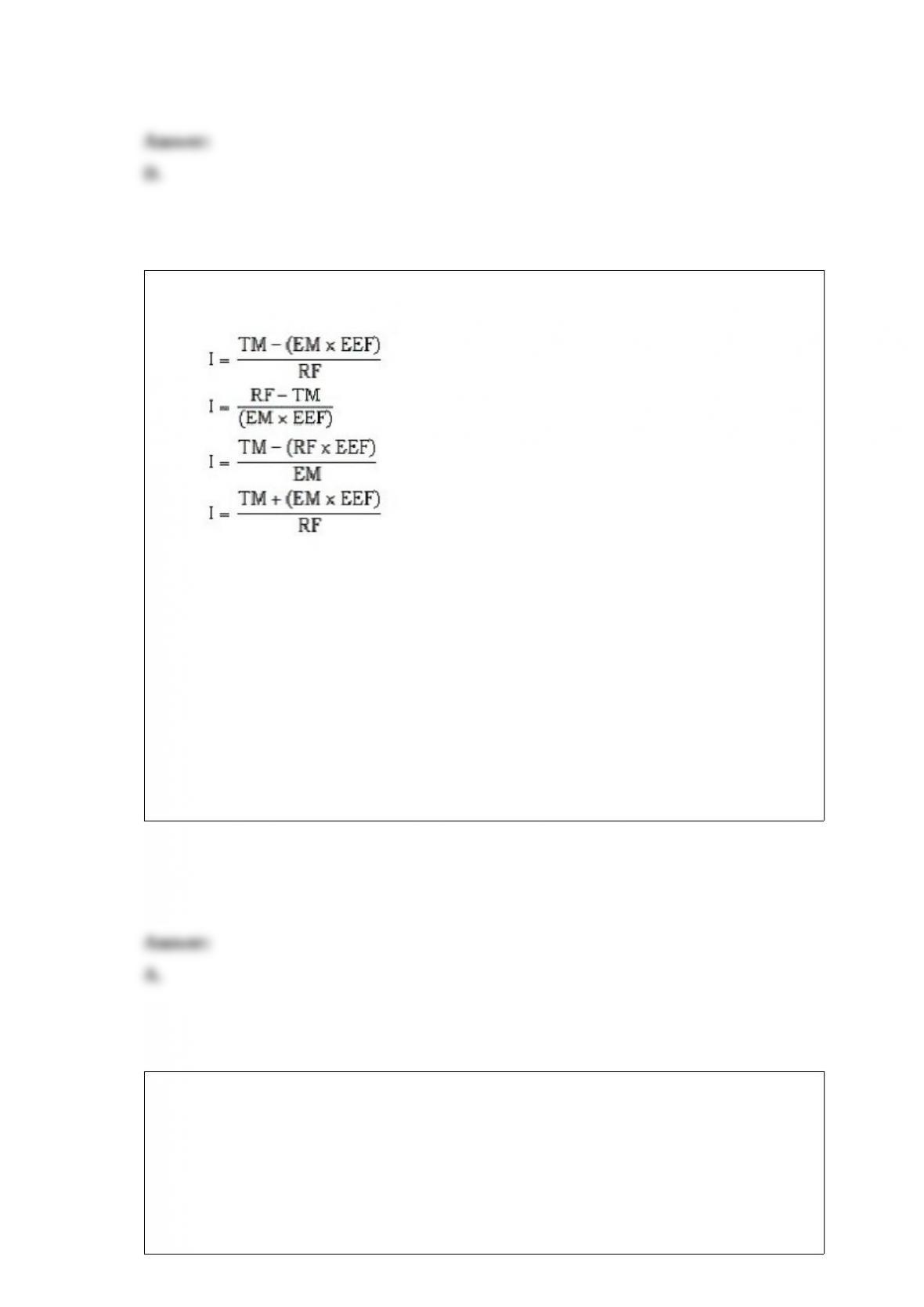
In MUS, what is meant by a sampling interval of 900?
A.Every 900th item will be selected.
B.Every 900th dollar will be selected.
C.Expected misstatement is 900.
D.Tolerable misstatement is 900.
Which of the following statistical sampling methods is most commonly used to test
control procedures?
A.Variable sampling.
B.Ratio estimation sampling.

C.Attribute sampling.
D.Dollar unit sampling.
What organization continues to set auditing standards for firms auditing private
companies?
A.FASB.
B.GAO.
C.SEC.
D.AICPA.
Which of the following individuals should sign the management representation letter?
A.The members of the audit committee and board of directors.
B.The chief executive officer and the chief financial officer.
C.The chief financial officer and the treasurer.
D.The controller and the auditor.

What does utilitarian theory hold?
A.There is a decision that exists that is optimal for all people.
B.What is ethical is the action that achieves the least bad for the greatest number of
people.
C.What is ethical is the action that achieves the greatest good for the greatest number of
people.
D.What is ethical is the action that achieves the greatest good for all people.
The auditor should perform review procedures (a) on the quarterly information
contained in the annual report to shareholders and (b) when engaged to review the
quarterly information issued at the end of each of the first three quarters of the fiscal
year.