The process of creating a formal plan and translating goals into a quantitative format is
(CMA adapted)
A. budgeting.
B. benchmarking.
C. cost-benefit analysis.
D. value-added analysis.
E. activity-based costing.
Answer:
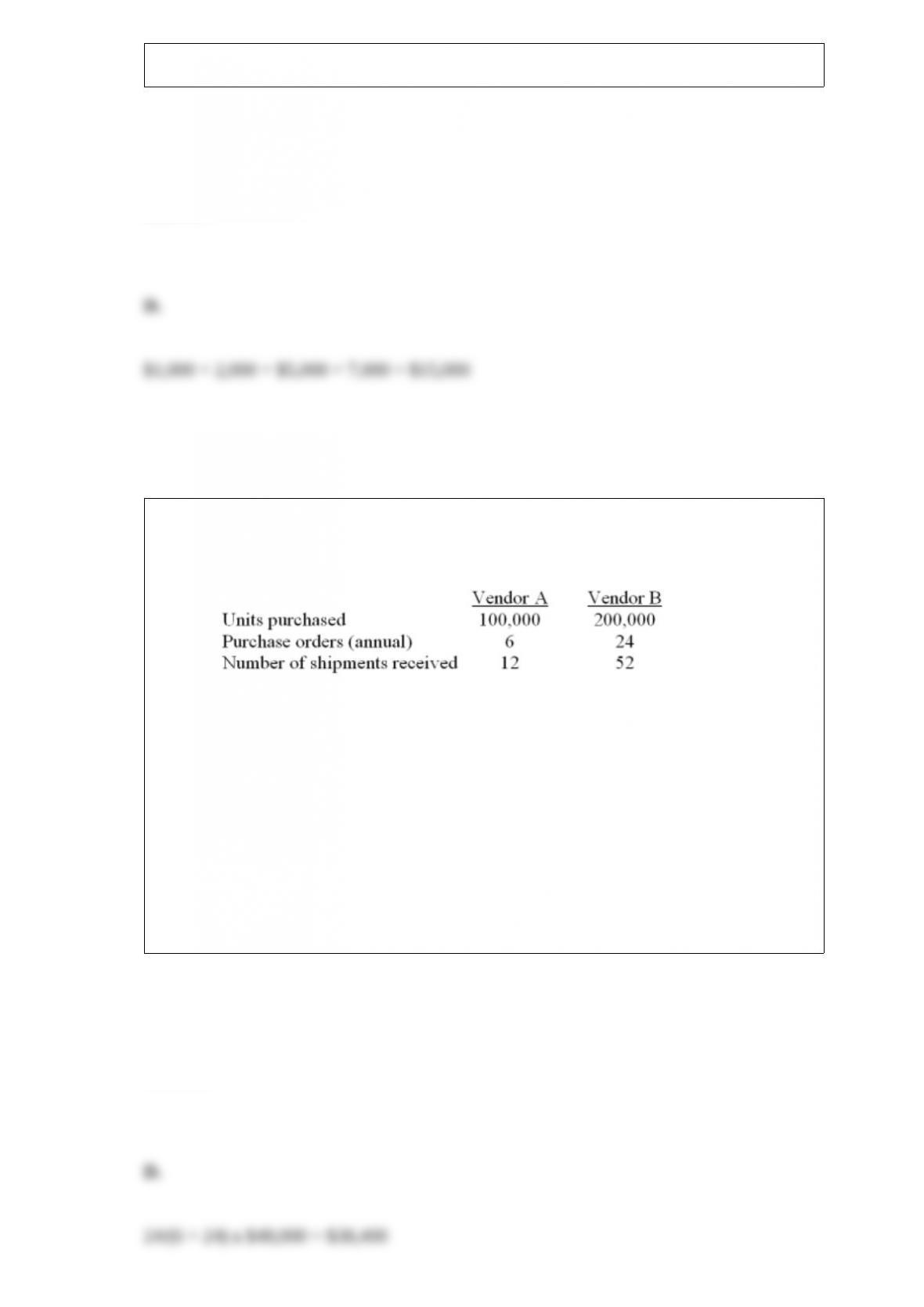
BC Enterprises’ quality control report for August contains the following items.
What would be the total of the prevention costs on the August quality control report for
BC Enterprises?
A. $5,000
B. $7,000
C. $11,000
D. $15,000
Answer:
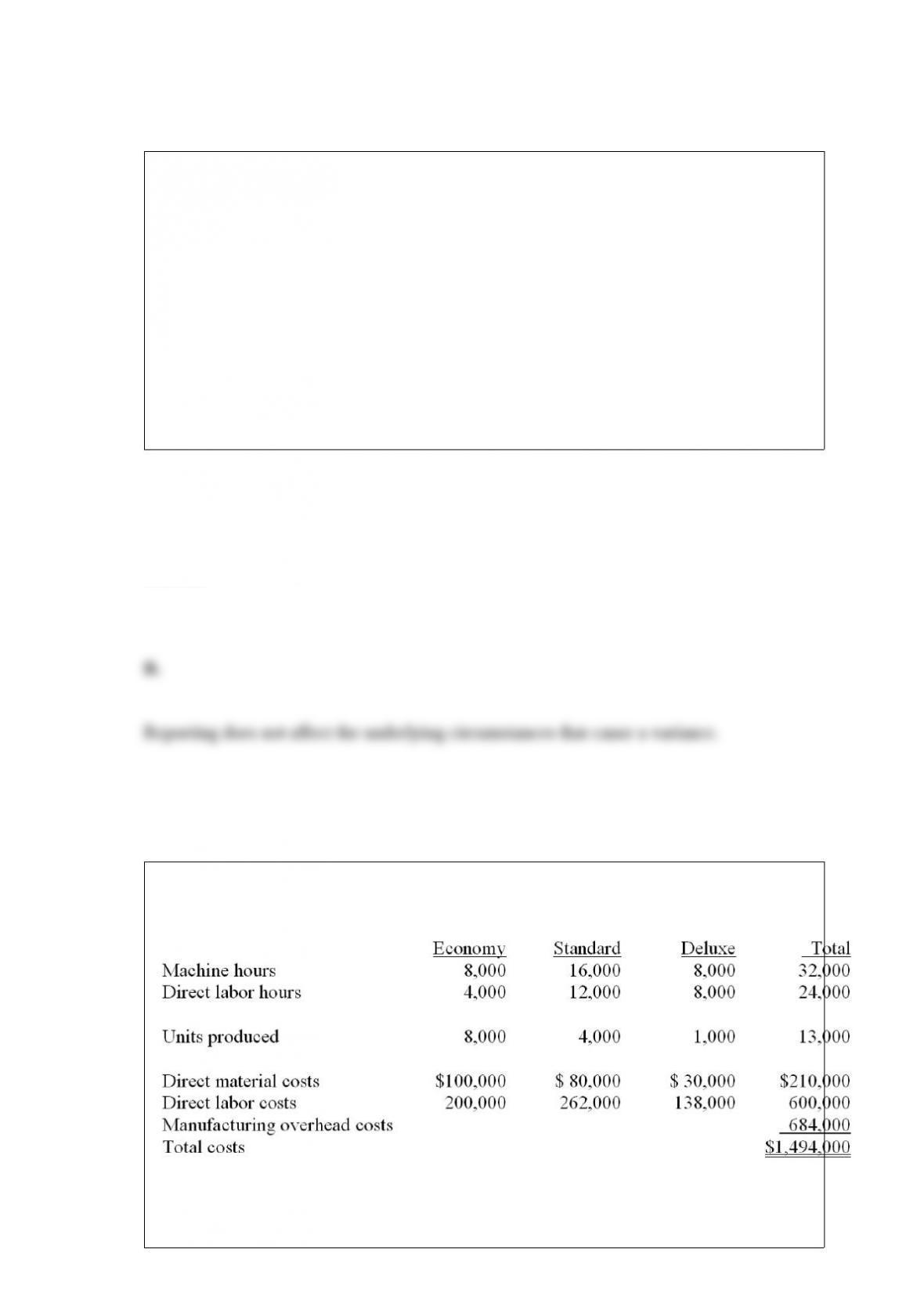
Rogers Company is preparing its annual profit plan. As part of its analysis of the cost
of its purchasing activity, management estimates that the $48,000 for purchasing
support should be assigned to the individual vendors from the information given as
follows:
What is the amount of the purchasing costs that should be allocated to Vendor B
assuming Rogers uses purchases orders to compute activity-based costs?
A. $9,600
B. $16,000
C. $32,000
D. $38,400
Answer:
There are several reasons why actual results differ from standards. Which of the
following does not represent a reason why a variance might occur?
A. Inaccurate information from the accounting system
B. Increasing the accuracy of a variance report by decreasing its timeliness
C. Standards which do not reflect the current economic conditions
D. Operating conditions that are consistently inefficient
E. Event or transaction that is unexpected and infrequent
Answer:
Cameron Carts produces three models of push carts, the Economy, the Standard and
the Deluxe. Data on operations and costs for the month are:
Required: Compute the total cost for each model, assuming Cameron Carts uses:
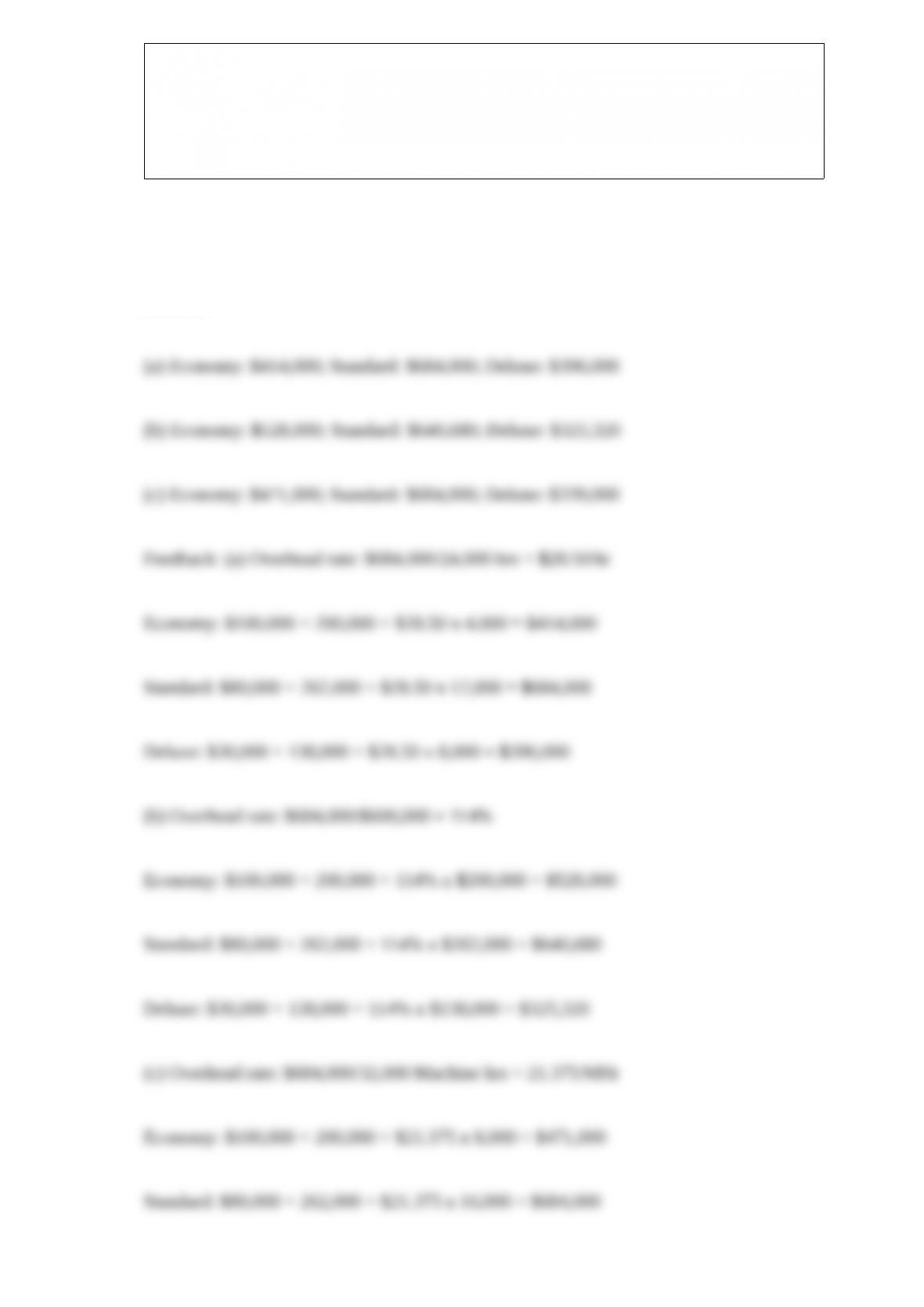
(a) Direct labor hours to allocate overhead costs.
(b) Direct labor costs to allocate overhead costs.
(c) Machine hours to allocate overhead costs.
Answer:
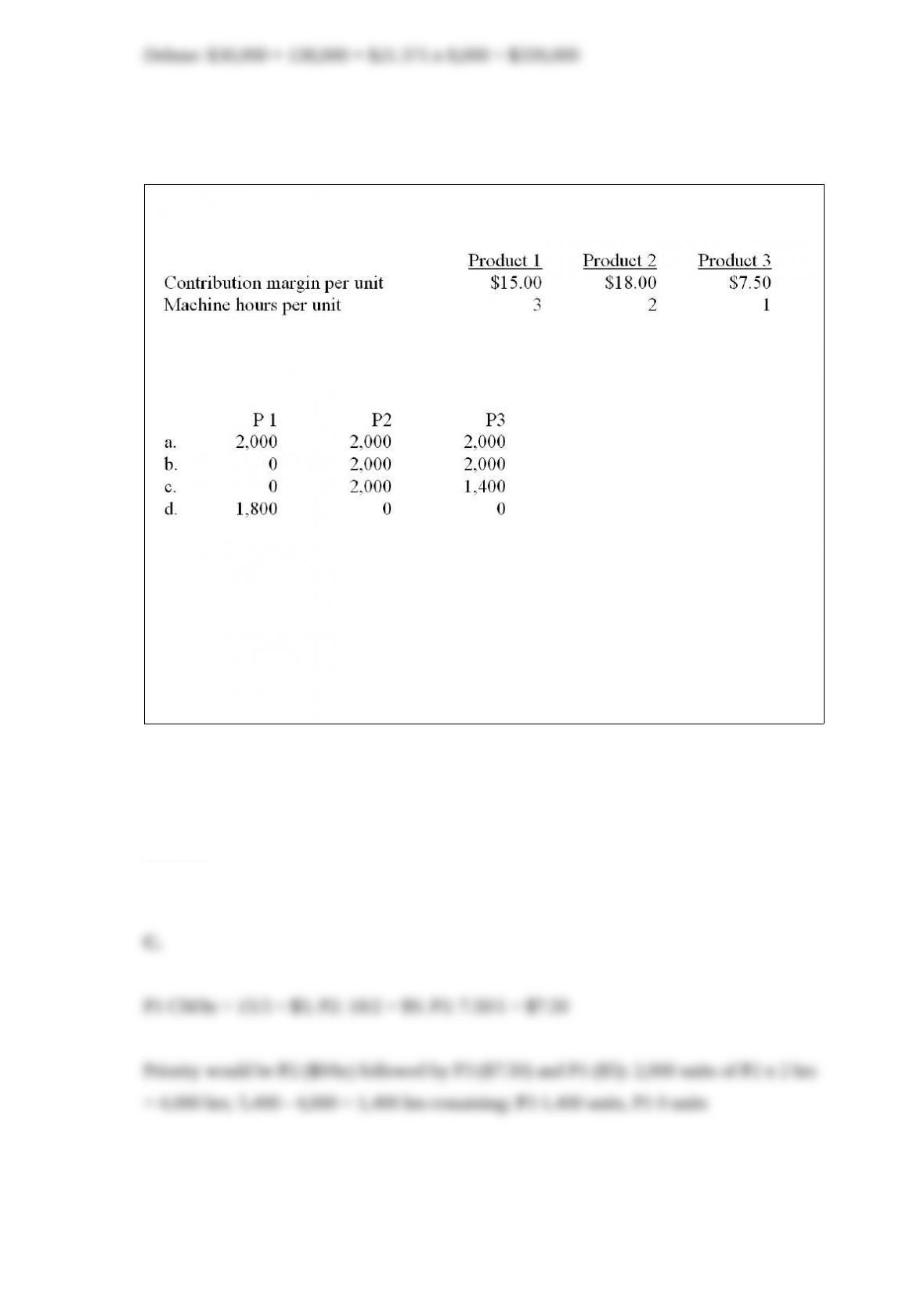
Zurek Inc has 5,400 machine hours available each month. The following information
on the company’s three products is available:
The market demand is limited to 2,000 units of each of the three products. How many
units of each should Zurek produce and sell?
A. a
B. b
C. c
D. d
Answer:
Which of the following statements is (are) true?
(1). The term full cost refers to the cost of manufacturing and selling a unit of product
and includes both fixed and variable costs.
(2). The fixed cost per unit is considered constant despite changes in volume of activity
within the relevant range.
A. Only (1) is true.
B. Only (2) is true.
C. Both (1) and (2) are true.
D. Neither (1) nor (2) are true.
Answer:
Which of the following activities is most likely to be classified as value-added for a
merchandise company?
A. Purchasing
B. Waiting
C. Receiving
D. Setting up
Answer:
Assume that the following events occurred at a division of General Enterprises for the
current year.
(1) Purchased $450,000 in direct materials.
(2) Incurred direct labor costs of $260,000.
(3) Determined that manufacturing overhead was $410,000.
(4) Transferred 70% of the materials purchased to Work-in-Process Inventory.
(5) Completed work on 65% of the work in process. Costs assigned equally across all
work-in-process.
(6) The inventory accounts have no beginning balances.
Required: Compute the following amounts in the Work-in-Process Inventory account:
(a) Transfers-in (TI).
(b) Transfers-out (TO).
(c) Ending balance (EB).
Answer:
Operations costing systems are used when the products have
A. used a standardized method that is repeatedly performed.
B. common characteristics and no individual characteristics.
C. individual characteristics and no common characteristics.
D. been mass produced in a continuous production process.
E. some common characteristics and some individual characteristics.
Answer:
Which of the following statements is (are) false regarding the direct method of
allocating service department costs?
(A) The selection of an allocation base in the direct method is easier than the selection
of an allocation base in the step method.
(B) Once an allocation is made from a service department using the direct method, no
further allocations are made back to that department.
A. Only A is false.
B. Only B is false.
C. Neither A nor B is false.
D. Both A and B are false.
Answer:
In a labor intensive company in which more overhead is used by the more highly
skilled and paid employees, which activity base would be most appropriate for applying
overhead to production?
A. Direct labor cost.
B. Direct material cost.
C. Direct labor hours.
D. Machine hours.
E. Sales value of the product produced.
Answer:
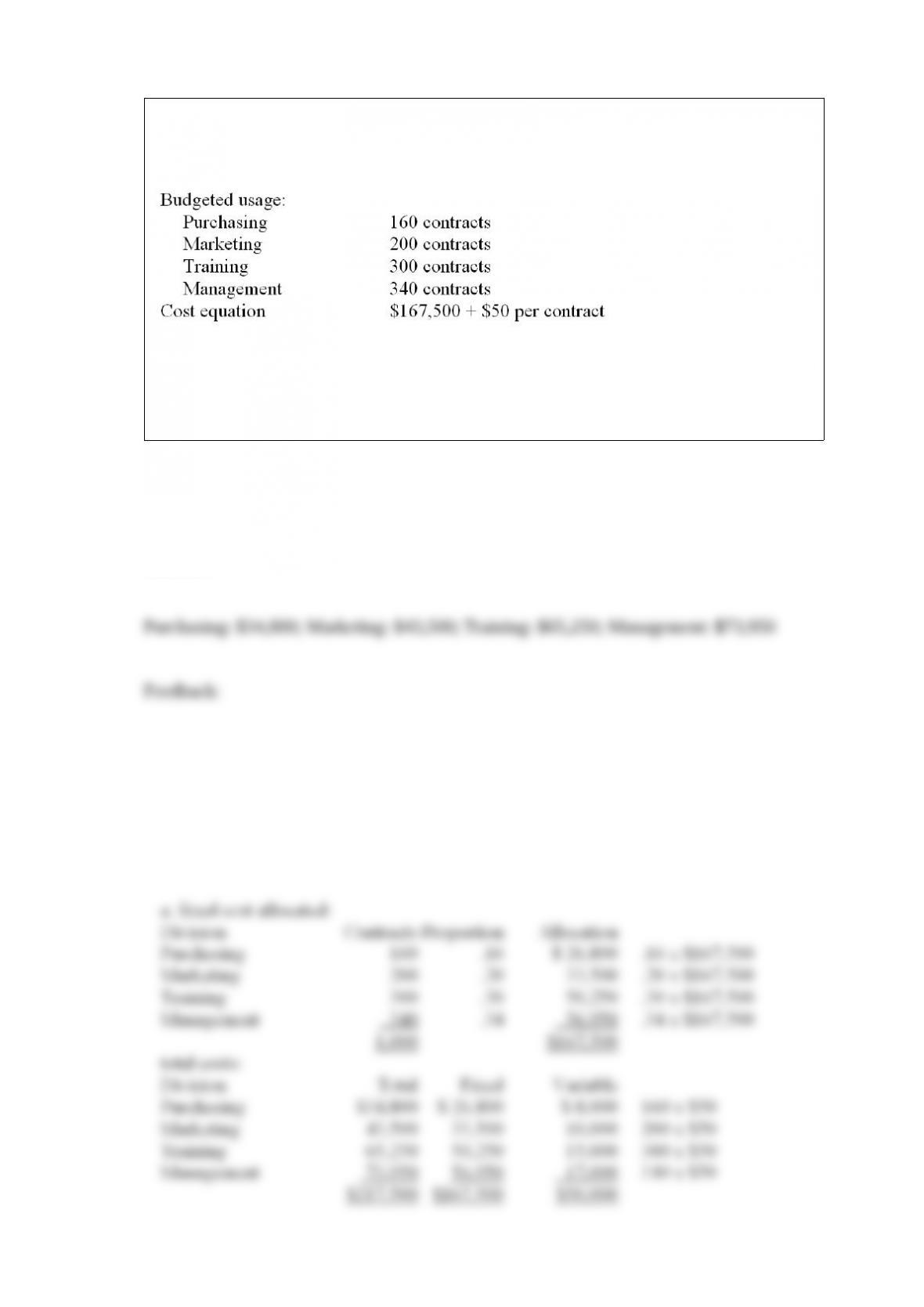
The legal department for Buffet Corp. provides legal services for four departments in
the Omaha office. The following budget has been prepared for the month.
Required (use three decimal places in your calculations):
a) If Buffet uses a dual rate for allocating its costs based on usage, how much cost will
be allocated to the four user departments?
Answer:

The production volume variance is computed by the difference between the
A. actual fixed overhead and applied fixed overhead.
B. actual fixed overhead and budget at actual level of activity reached.
C. actual fixed overhead and budget at denominator level of activity planned.
D. budget at actual levels of activity reached and fixed overhead applied.
Answer:
Which of the following statements is (are) true regarding product costing?
(A) Individual product costs are relevant for managerial decision-making but irrelevant
for preparing the financial statements.
(B) A common decision facing managers is determining the price at which to sell their
product or provide their services.
A. Only A is true.
B. Only B is true.
C. Both A and B are true.
D. Neither A nor B is true.
Answer:
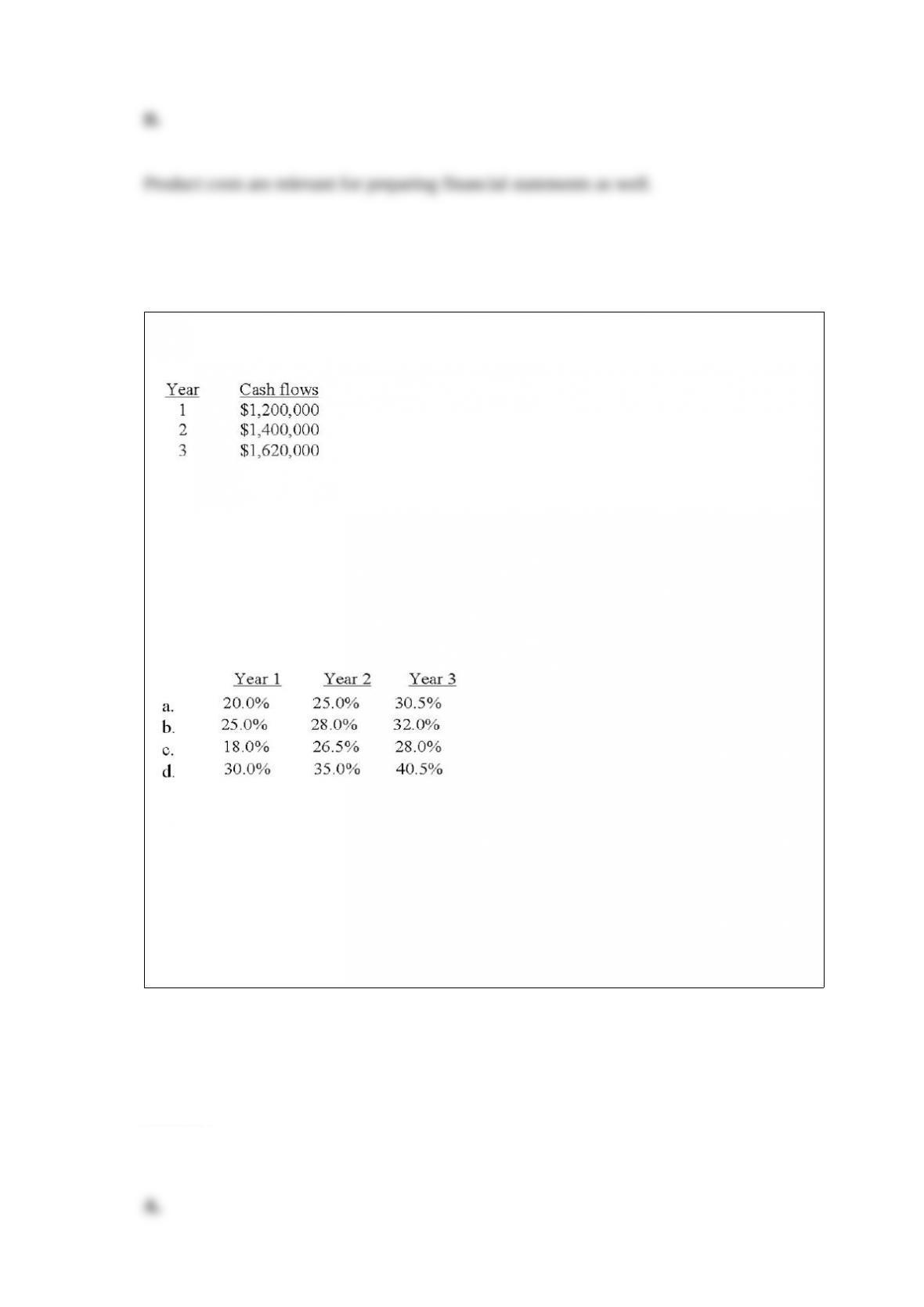
One division of the RST Enterprise Company has depreciable assets costing
$4,000,000. The cash flows from these assets for the past three years have been:
The current (i.e., replacement) costs of these assets were expected to increase 25% each
year. RST used the straight-line depreciation method; the estimated useful life is
10-years with no salvage value. For return on investment (ROI) calculations, RST uses
end-of-year balances.
What is the ROI using historical cost and gross book value?
A. a
B. b
C. c
D. d
Answer:
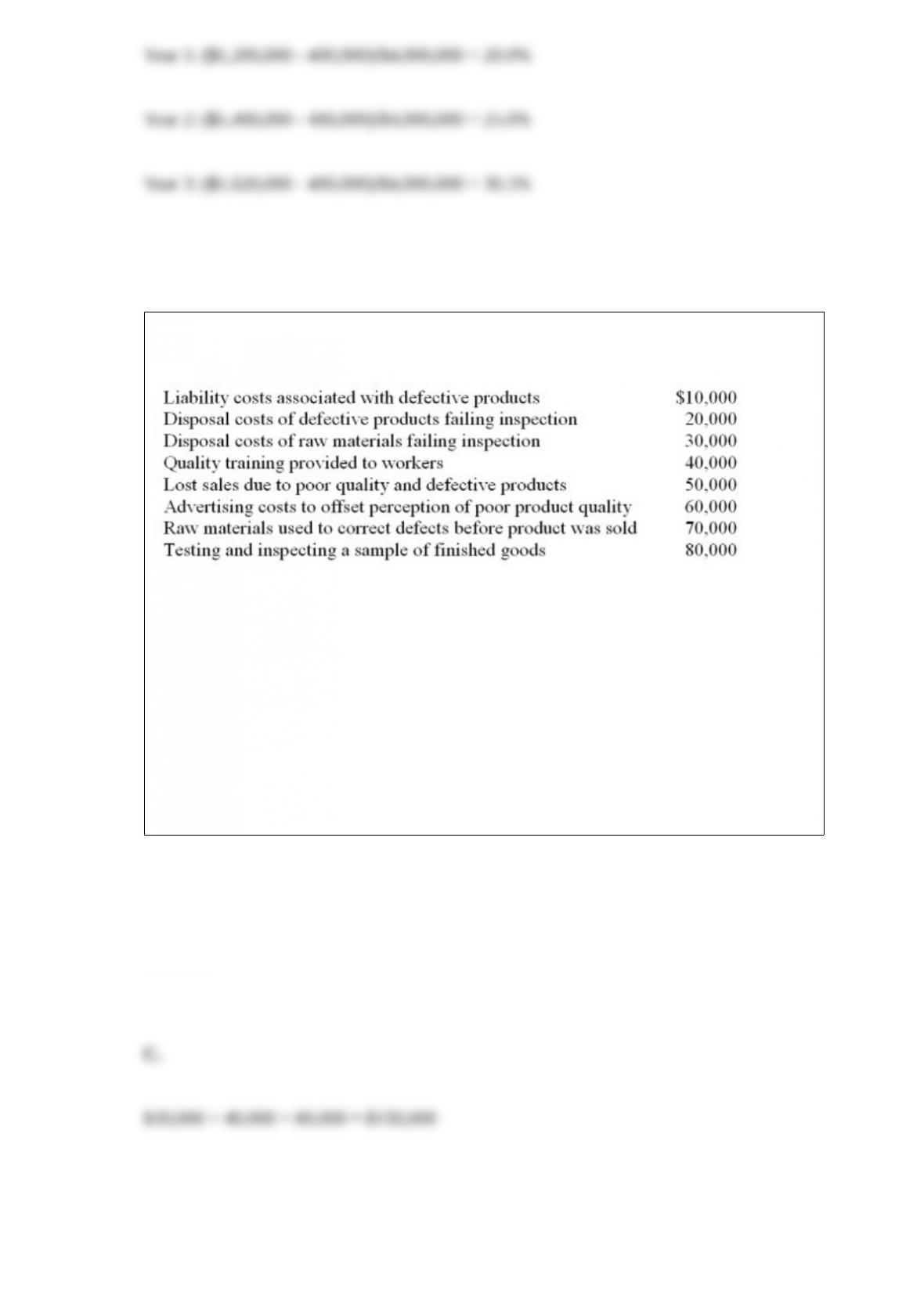
QC Enterprises quality control report for August contains the following items.
What would be the total of the conformance costs on the August quality control report
for QC Enterprises?
A. $200,000
B. $170,000
C. $150,000
D. $90,000
Answer:
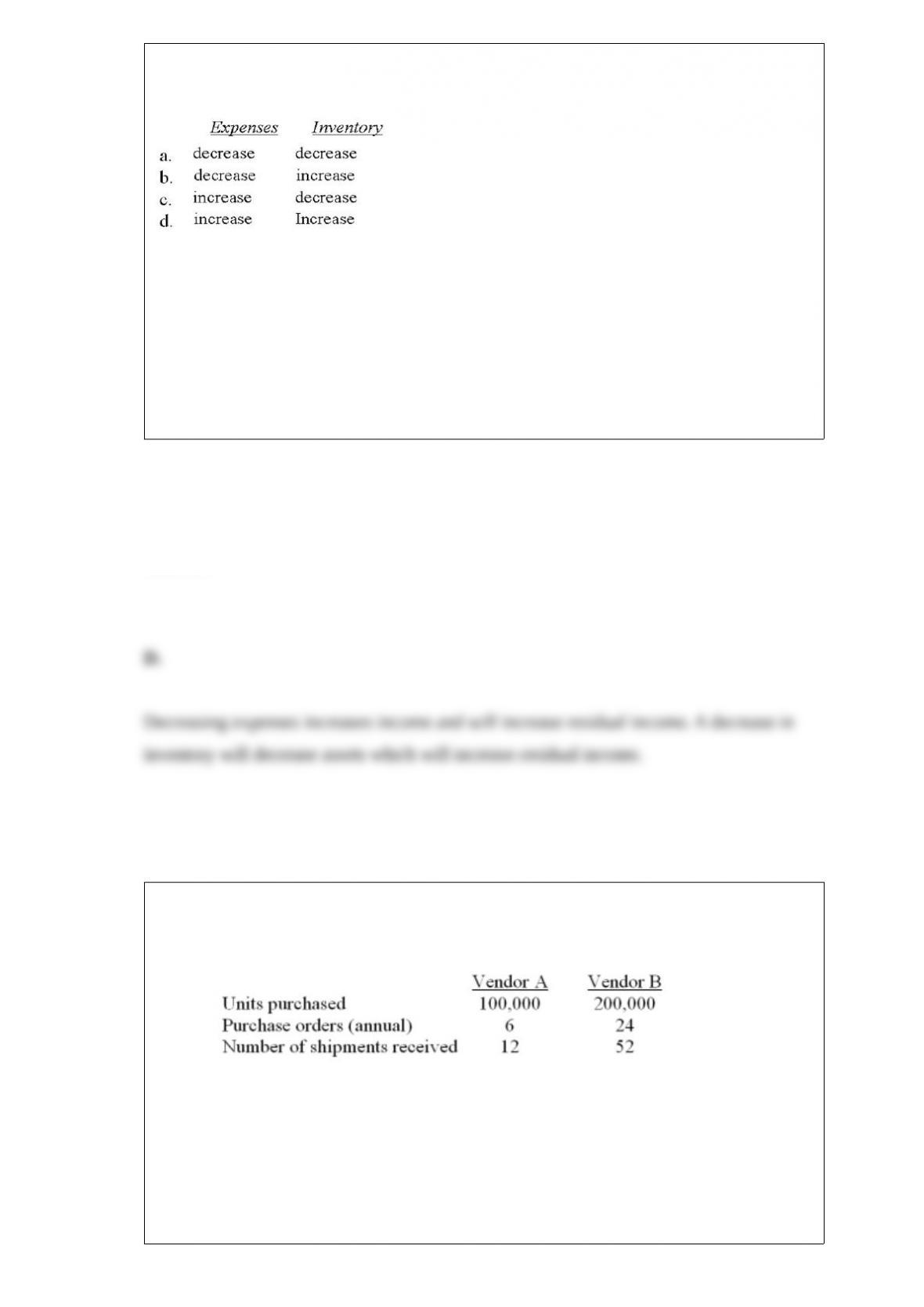
How will decreases in the following items affect residual income?
A. a
B. b
C. c
D. d
Answer:
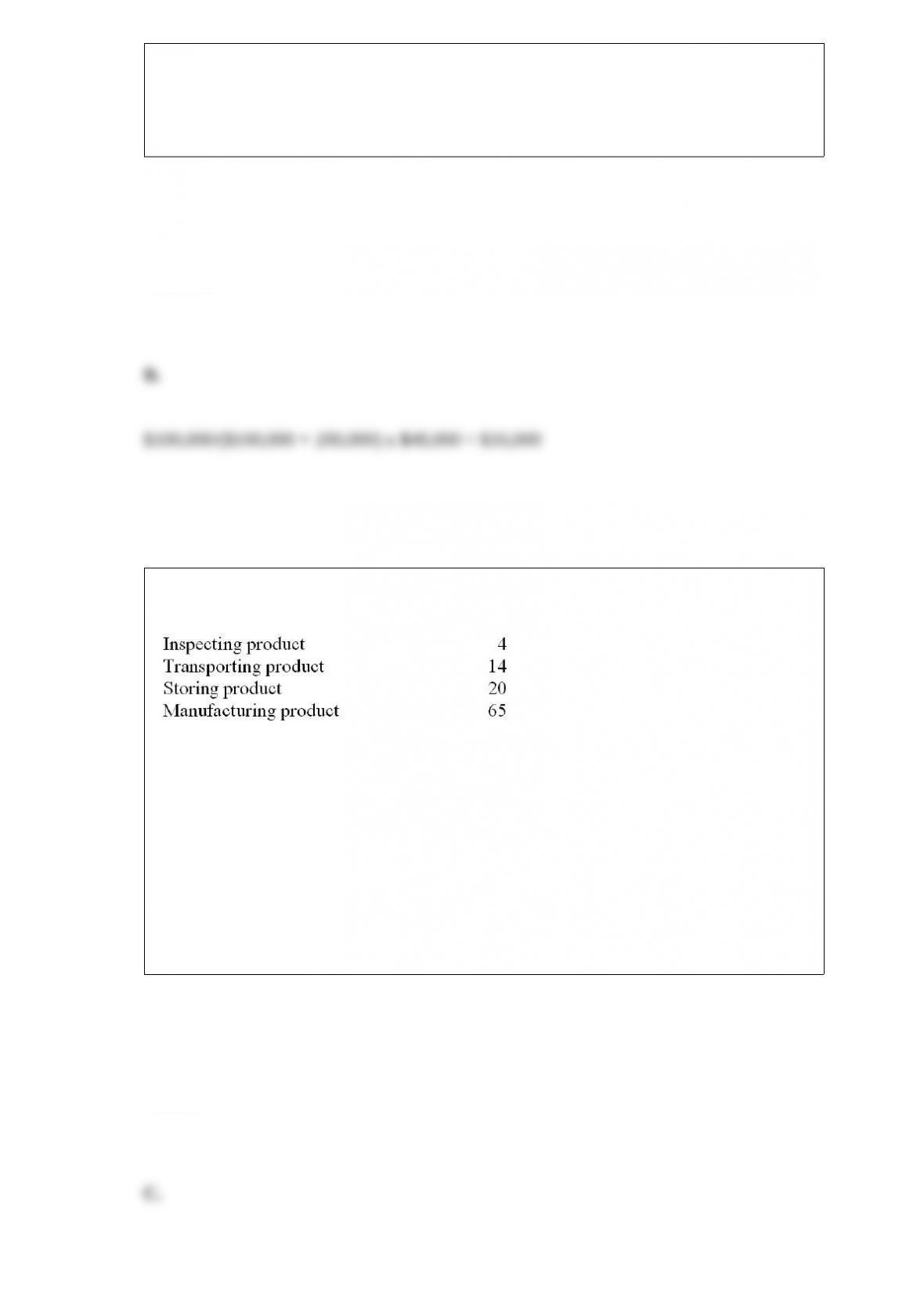
Rogers Company is preparing its annual profit plan. As part of its analysis of the cost
of its purchasing activity, management estimates that the $48,000 for purchasing
support should be assigned to the individual vendors from the information given as
follows:
What is the amount of the purchasing costs that should be allocated to Vendor A
assuming Rogers uses units purchased to compute activity-based costs?
A. $9,600
B. $16,000
C. $32,000
D. $38,400
Answer:
The Nelson Company collected the following information (in days):
What is the manufacturing cycle time?
A. 65 days
B. 34 days
C. 103 days
D. 85 days
Answer:
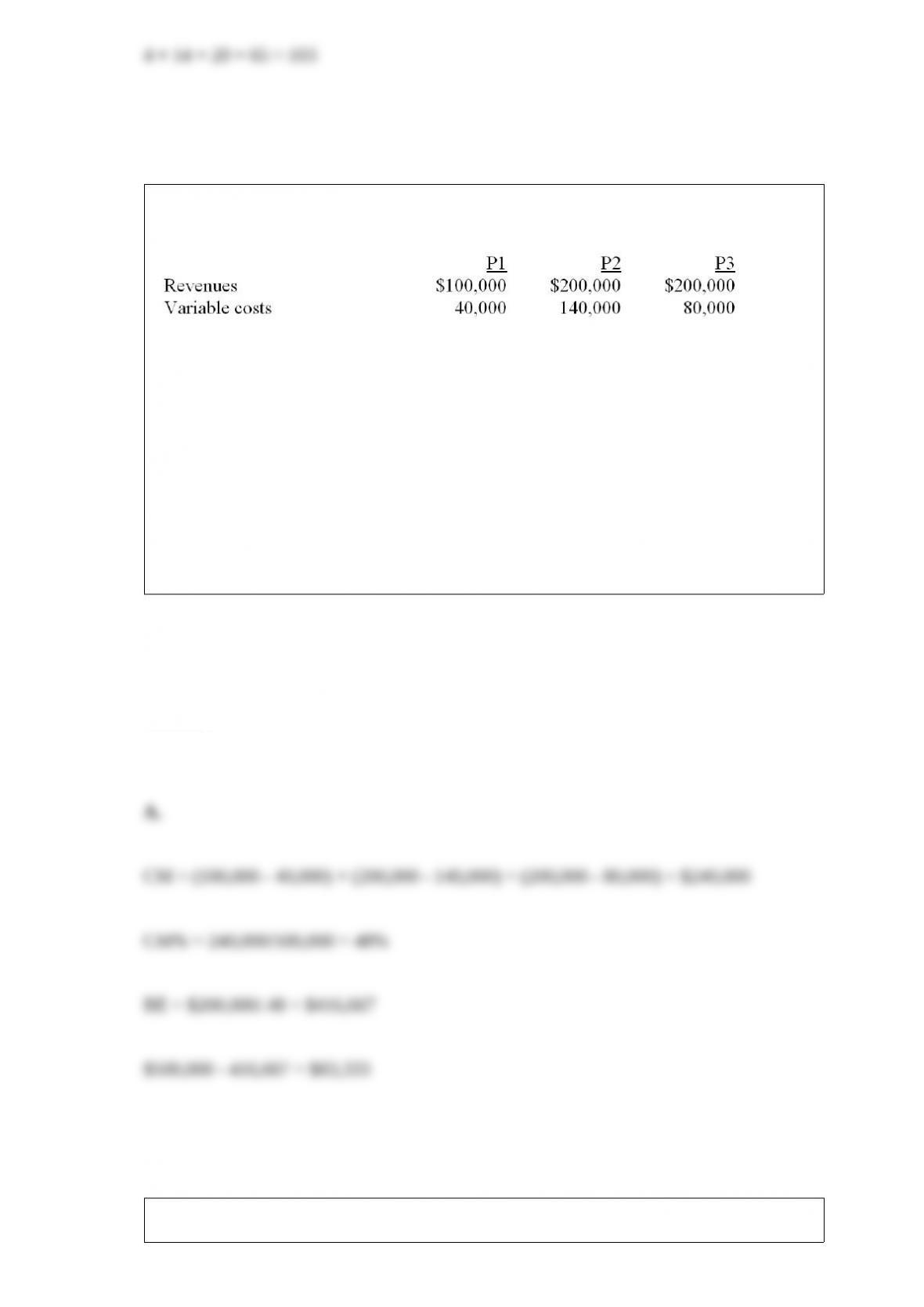
Kanmore produces and sells three products. Last month’s results are as follows:
Fixed costs total $200,000. What is Kanmore’s margin of safety? (Assume the current
product mix)
A. $83,333
B. $40,000
C. $460,000
D. $115,385
Answer:
The XYZ Company uses a standard cost accounting system and estimates production
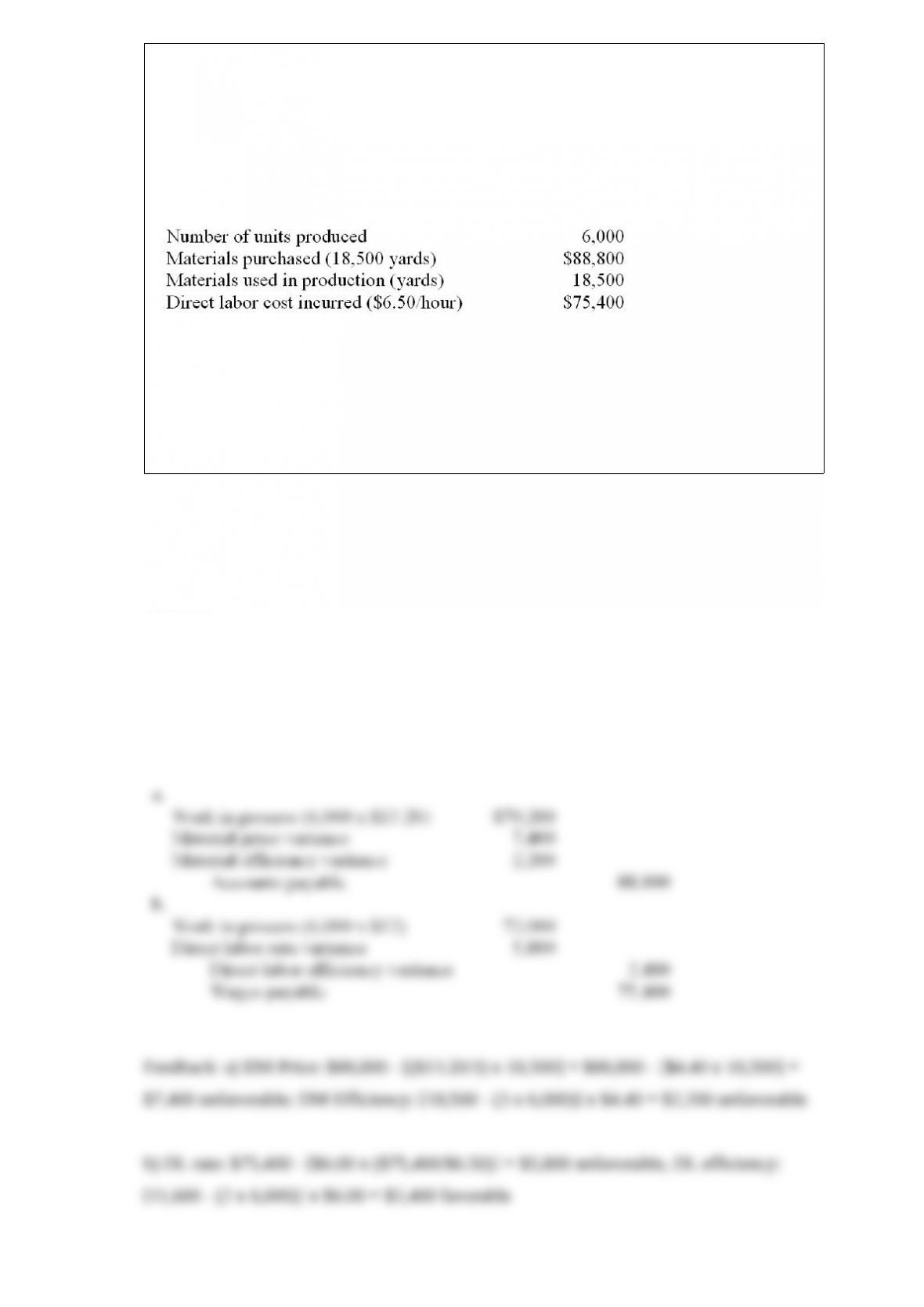
for the year to be 60,000 units. At this volume, the company’s variable overhead costs
are $.50 per direct labor hour.
The company’s single product has a standard cost of $30.00 per unit. Included in the
$30.00 is $13.20 for direct materials (3 yards) and $12.00 of direct labor (2 hours).
Production information for the month of March follows:
Required: Prepare the journal entries to record the following:
a) Purchase and use of direct materials (Assume materials are used as purchased and no
inventory is maintained).
b) Recognition of direct labor.
Answer:
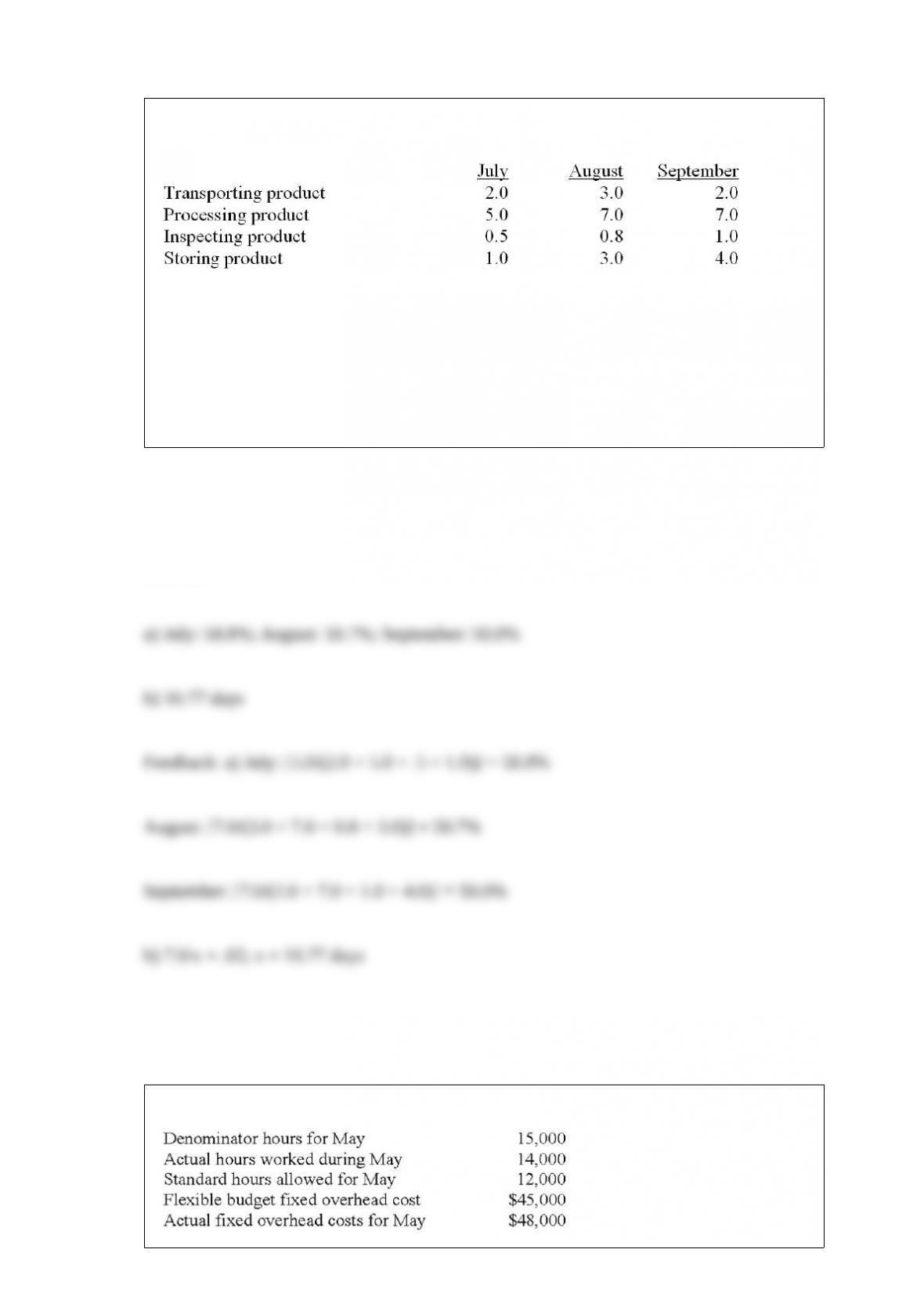
The XYZ Manufacturing Company collected the following information (in days) for
July and August.
Required:
a) Calculate the manufacturing cycle efficiency for July, August, and September.
b) Assume October’s processing time will be the same as September’s. If XYZ’s target
for manufacturing cycle efficiency is 65%, what will October’s target for manufacturing
cycle time be?
Answer:
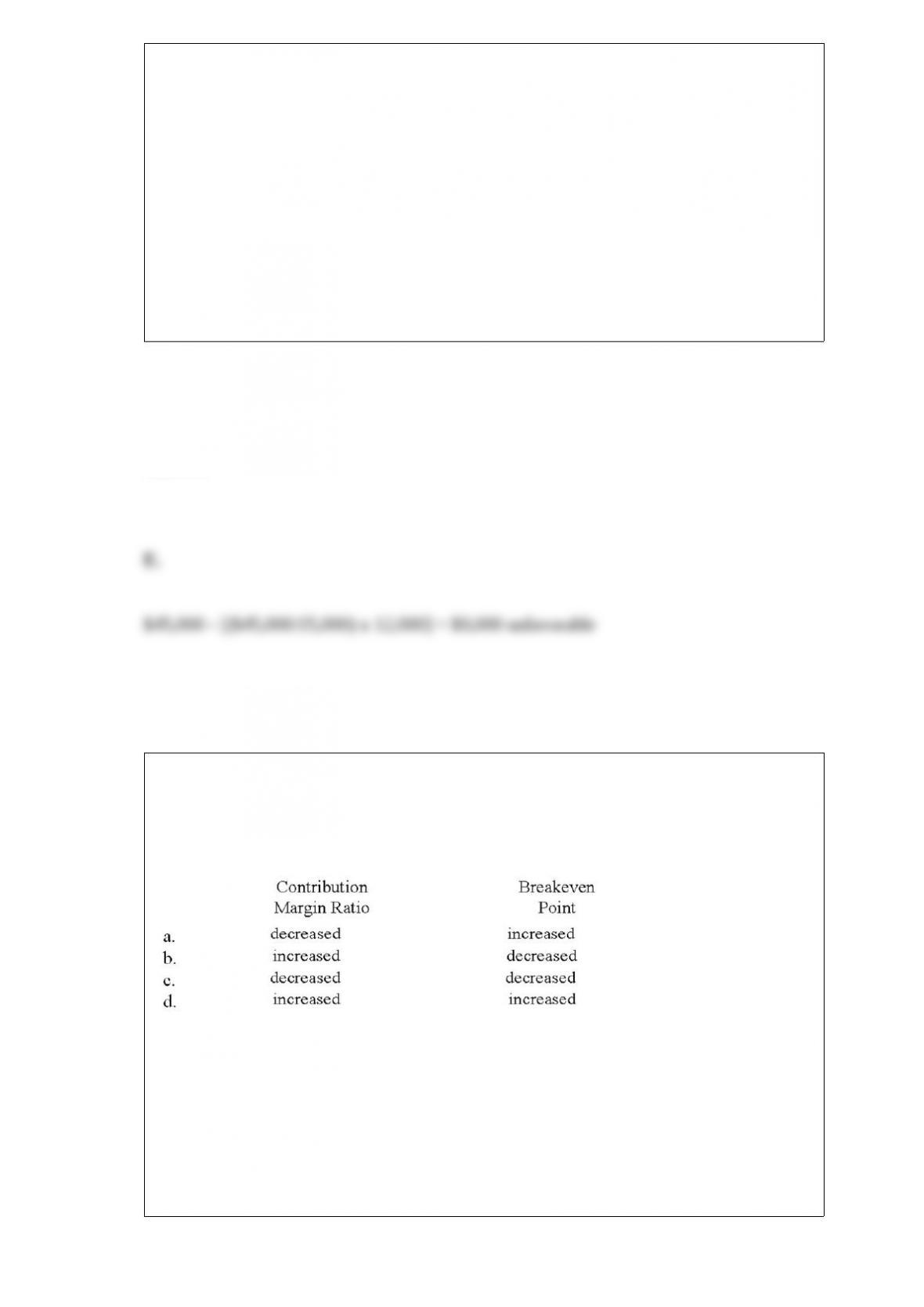
What is the production volume variance for May?
A. $2,000
B. $3,000
C. $6,000
D. $8,000
E. $9,000
Answer:
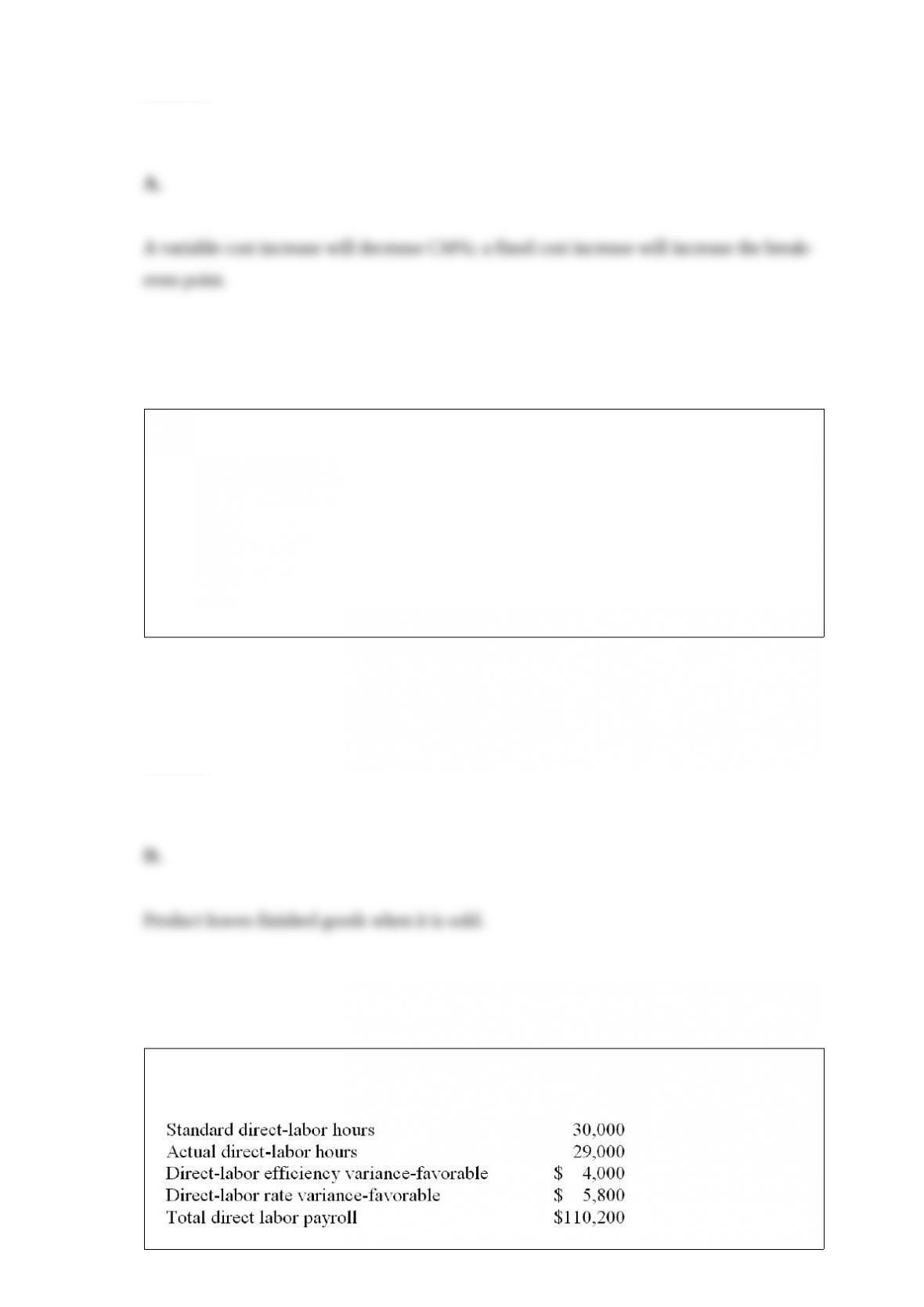
If the fixed costs for a product increase and the variable costs (as a percentage of sales
dollars) increase, what will be the effect on the contribution margin ratio and the
break-even point respectively?
A. a
B. b
C. c
D. d
Answer:
What are the transfers-out from the Finished Goods Inventory called?
A. Cost of Goods Manufactured
B. Cost of Goods Available
C. Cost of Goods Completed
D. Cost of Goods Sold
Answer:
Data on Goodman Company’s direct-labor costs are given below:
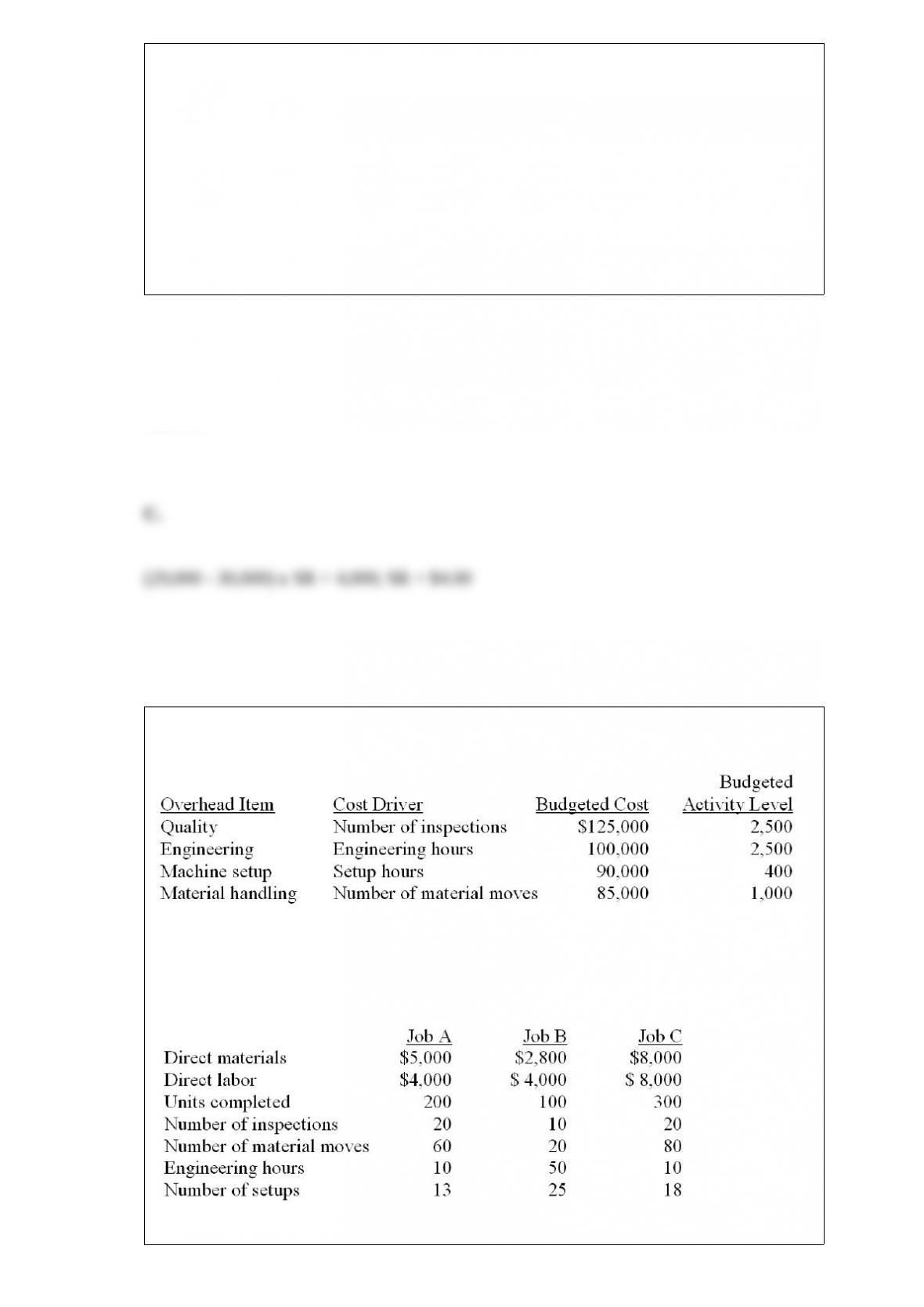
What was Goodman’s standard direct-labor rate?
A. $3.54
B. $3.80
C. $4.00
D. $5.80
Answer:
Acme Enterprises has identified the following overhead costs and cost drivers for the
coming year:
Budgeted direct labor cost was $200,000 and budgeted direct material cost was
$300,000. The following information was collected on three jobs that were completed
during the month:
Required:
a) If the company uses traditional costing and allocates overhead using direct labor cost,
how much overhead cost should be assigned to Job A, B and C?
b) If the company uses activity-based costing (ABC), how much overhead cost should
be assigned to Job A, B, and C?
Answer:
Prepare the necessary journal entries from the following information for Beaulieu
Company.
a) Purchased materials on account, $56,700.
b) Requisitioned materials for production as follows: direct materials – 80 percent of
purchases, indirect materials – 15 percent of purchases
c) Direct labor for production is $33,100, indirect labor is $12,500.
d) Overhead incurred (not including materials or overhead): $52,900.
e) Overhead is applied to production based on direct labor cost at the rate of 220
percent.
f) Goods costing $97,600 were completed during the period.
g) Goods costing $51,320 were sold on account for $77,600.
h) Close the overhead control account to Cost of Goods Sold.
Answer:
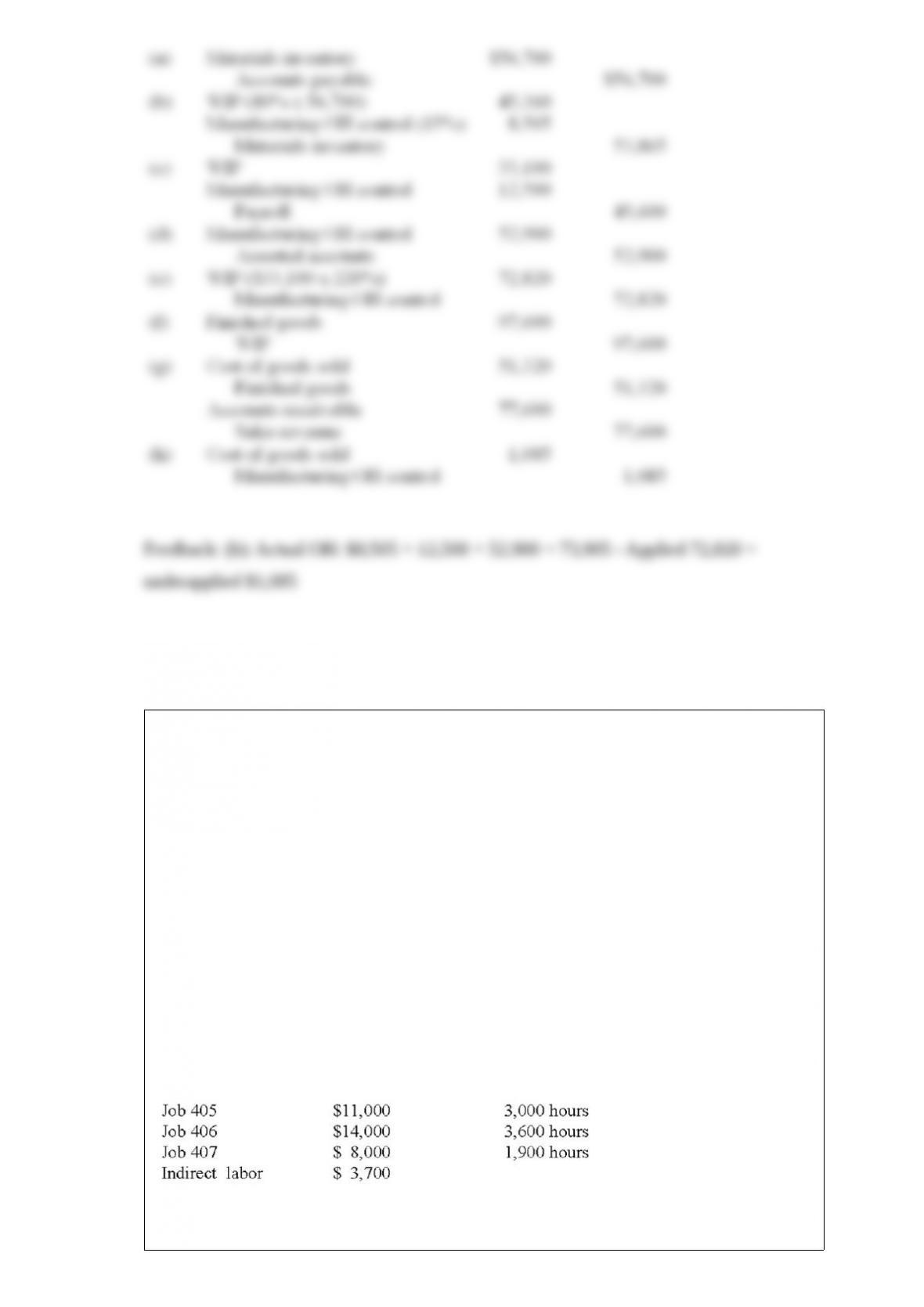
The following selected data were taken from the books of the Bixby Box Company.
The company uses job costing to account for manufacturing costs. The data relate to
June operations.
A) Materials and supplies were requisitioned from the stores clerk as follows:
Job 405, material X, $7,000.
Job 406, material X, $3,000; material Y, $6,000.
Job 407, material X, $7,000; material Y, $3,200.
For general factory use: materials A, B, and C, $2,300.
B) Time tickets for the month were chargeable as follows:
C) Other information:

Factory paychecks for $36,700 were issued during the month.
Various factory overhead charges of $19,400 were incurred on account.
Depreciation of factory equipment for the month was $5,400.
Factory overhead was applied to jobs at the rate of $3.50 per direct labor hour.
Job orders completed during the month: Job 405 and Job 406.
Selling and administrative costs were $2,100.
Factory overhead is closed out only at the end of the year.
If Job 406 were sold on account for $41,500 how much gross profit would be
recognized for the job?
A. $3,800
B. $5,900
C. $18,500
D. $35,600
Answer:
What was the amount of manufacturing overhead applied to Job A-101?
A. $16,000
B. $18,000
C. $24,000
D. $44,000
Answer:
Which of the following is not a XOAXOA in implementing nonfinancial performance
measurement systems?
A. Fixation on financial measures.
B. Reliability of the nonfinancial measures.
C. Nonfinancial measures decrease goal congruence.
D. Lack of correlation between nonfinancial measures and financial results.
Answer:
Which of the following activities is most likely to be classified as value-added for a
manufacturing company?
A. Storing
B. Ordering
C. Inspecting
D. Assembling
Answer:
For which of the following businesses would the job order cost system be appropriate?
A. law office
B. crude oil refinery
C. baby formula manufacturer
D. soft drink producer
Answer: