1) Environmental costing computes the cost effects an organization has on the
environment.
2) Activity based pricing prices products, not orders.
3) When demand for a product is low, a higher markup should be used since a larger
share of the fixed costs needs to be allocated to each product.
4) The selection of activity cost drivers requires making choices related to the usage of
transaction drivers, duration drivers, and intensity drivers.
5) When the ABC system has a good model design, ABC can still overcome the barriers
to implementation and provide an effective system.
6) The first step in developing a budget is for the accounting department to prepare the
sales forecast.
7) A major problem faced by cost centers is assigning jointly earned revenues.
8) In determining whether to keep or drop a product line, avoidable fixed costs are
relevant to the decision.
9) The time over which a decision maker can adjust capacity is referred to as the short
run.
10) The raw material used in a product that can be easily traced to the product is
generally classified as an indirect cost.
11) For activity-based cost systems, activity costs are assigned to products in the
proportion of the demand they place on activity resources.
12) One option to transform breakeven or loss customers into profitable customers is to
use more discipline in granting discounts and allowances.
13) A major goal of transfer pricing is to motivate the decision maker to act in the
organization’s best interests.
14) Properly chosen nonfinancial measures anticipate and explain financial results.
15) Customer loyalty is characterized by a customer’s attitude toward a product or
company.
16) MSDA expenses as a percentage of sales is an effective way to measure customer
profitability.
17) Traditional cost systems are likely to overcost simple products with higher
production volume.
18) Currently, most personnel costs are classified as fixed costs.
19) A product can have an initial life-cycle cost that is relatively high, but a
manufacturing cost that is relatively low.
20) Baker company has 40 order operators with associated costs of $2,000,000 per year.
Baker calculated that each operator worked about 2,000 hours per year. Allowing for
time off, each operator provided about 1,600 or productive work per year. On average,
it takes an order entry employee about 0.2 hour to enter the basic customer information
for a manual customer order. In addition, manual orders require an operator to spend an
additional 0.04 hour to enter each line item on the order.
a. What is the rate per hour for each order entry employee?
b. What is the order entry cost associated with a manual order with 10 line items?
21) Which of the following is a sign that an ABC system may be useful?
A) There are small amounts of overhead costs
B) Products make diverse demands on resources because of differences in volume,
process steps, batch size, or complexity
C) Products a company all show large profits
D) Operations throughout the plant are fairly similar
22) Traditional cost systems distort product costs because:
A) they do not know how to identify the appropriate units
B) excess capacity costs are ignored
C) they emphasize financial accounting requirements
D) they use unit-level cost drivers to allocate overhead costs to products
23) Management accounting information can be used for all of the following except:
A) calculate the cost of a product or service
B) evaluate the performance of a company
C) project materials needs
D) evaluate the market price of the stock
24) Aggressive customers who demand low prices and customized services:
A) require high costs to serve
B) are most profitable to serve
C) are customers to eliminate
D) require high costs and are most profitable to serve
25) ________ can be a cost beneficial way to gather information because the company
can avoid mistakes other companies have made.
A) QFD
B) TLCC
C) Benchmarking
D) Kaizen
26) Elfie Enterprises uses three cost pools to allocate manufacturing overhead costs.
The following estimates were provided for the coming year.
Manufacturing
Cost Pool Overhead CostsCost driverActivity level
Supervision of direct labor$320,000Direct labor hours800,000
Machine maintenance$120,000Machine hours960,000
Facility rent$200,000Square feet of area100,000
Total overhead costs$640,000
The accounting records show the Lacio Job consumed the following resources.
Cost driverActual level
Direct labor hours200
Machine hours1,600
Square feet of area50
Required:
a. If direct labor hours are considered the only manufacturing overhead cost driver,
compute:
1> the single cost driver rate for Elfie Enterprises; and
2> the amount of manufacturing overhead costs allocated to the Lacio job.
b. If Elfie Enterprises uses the three cost pools to allocate manufacturing overhead
costs, compute:
1> the cost driver rate for each of the three overhead activities above; and
2> the amount of manufacturing overhead costs allocated to the Lacio job.
c. Review the amount of manufacturing overhead costs allocated in (a2) and (b2). Why
do the two estimates differ? Which method of allocation probably best estimates the
actual manufacturing overhead costs used? Why?.
27) Product costs estimated using the direct method of cost allocation
A) the first step is to develop a reciprocal cost equation
B) the first step is to allocate the service department costs to the production departments
C) one service department is chosen to allocate costs first
D) service department costs are allocated directly to the production departments
28) Tony’s Skate Corporation manufactures two models of skate boards: a standard and
a deluxe model. The following activity and cost information has been compiled.
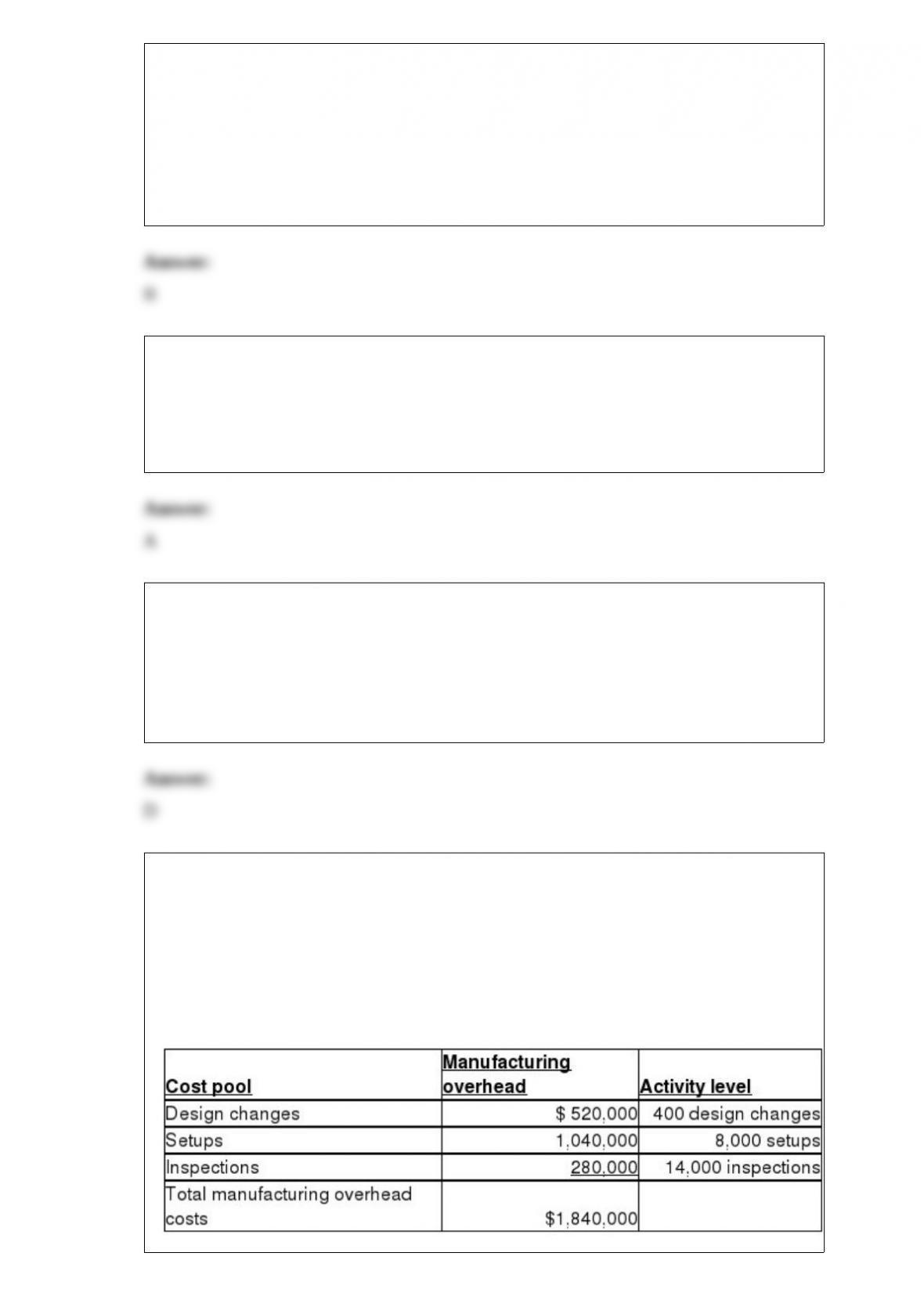
Assume a traditional costing system applies the $120,000 of overhead costs based on
direct labor hours. What is the total amount of overhead costs assigned to the standard
model?
A) $40,000
B) $75,000
C) $50,000
D) $70,500
29) Measures of the Balanced Scorecard’s learning and growth perspective include:
A) number of environmental and safety incidents
B) number of on-time deliveries
C) number of process improvements
D) revenue growth
30) Product lines that produce different variations (models, styles, or colors) often
require specialized activities that translate into:
A) lower overhead costs for each product line
B) decisions to drop product variations
C) more favorable direct labor cost ratios
D) more overhead costs for each product line
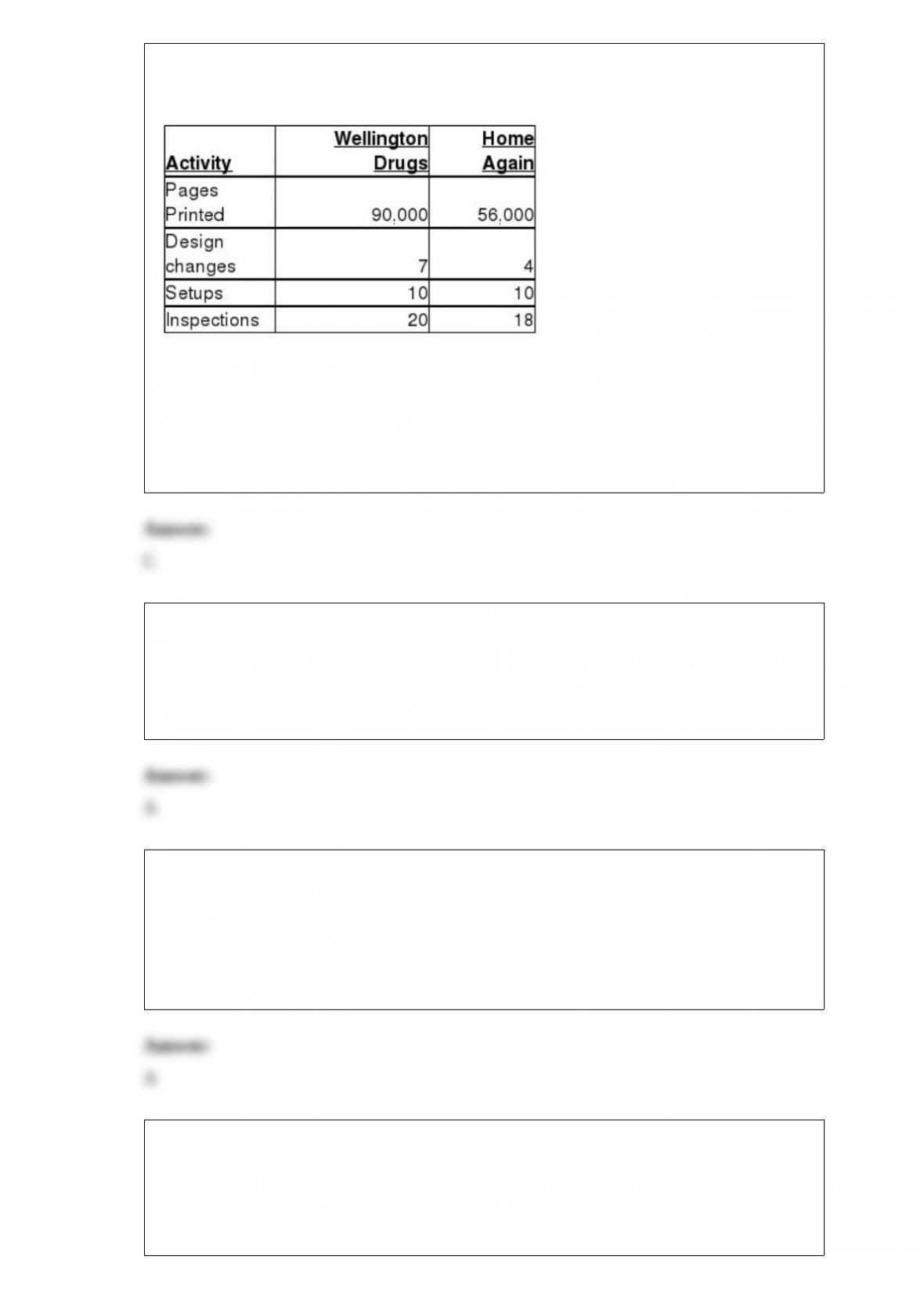
31) Baldwin Printers has contracts to complete weekly supplements required by
forty-two customers. For the year 2011, manufacturing overhead cost estimates total
$1,840,000 for an annual production capacity of 20 million pages.
For 2011 Baldwin Printers has decided to evaluate the use of additional cost pools.
After analyzing manufacturing overhead costs, it was determined that number of design
changes, setups, and inspections are the primary manufacturing overhead cost drivers.
The following information was gathered during the analysis:
During 2011, two customers, Wellington Drugs and Home Again, are expected to use
the following printing services:
What is the cost driver rate if manufacturing overhead costs are considered one large
cost pool and are assigned based on 20 million pages of production capacity?
A) $0.10 per page
B) $0.07 per page
C) $0.092 per page
D) $1.84 per page
32) Aggressive customers who demand low prices and customized services:
A) require high costs to serve
B) are most profitable to serve
C) are customers to eliminate
D) require high costs and are most profitable to serve
33) Manufacturing cycle efficiency is an example of a Balanced Scorecard’s measure of
the:
A) process perspective
B) customer perspective
C) learning and growth perspective
D) financial perspective
34) Baldwin Printers has contracts to complete weekly supplements required by
forty-two customers. For the year 2011, manufacturing overhead cost estimates total
$1,840,000 for an annual production capacity of 20 million pages.
For 2011 Baldwin Printers has decided to evaluate the use of additional cost pools.
After analyzing manufacturing overhead costs, it was determined that number of design
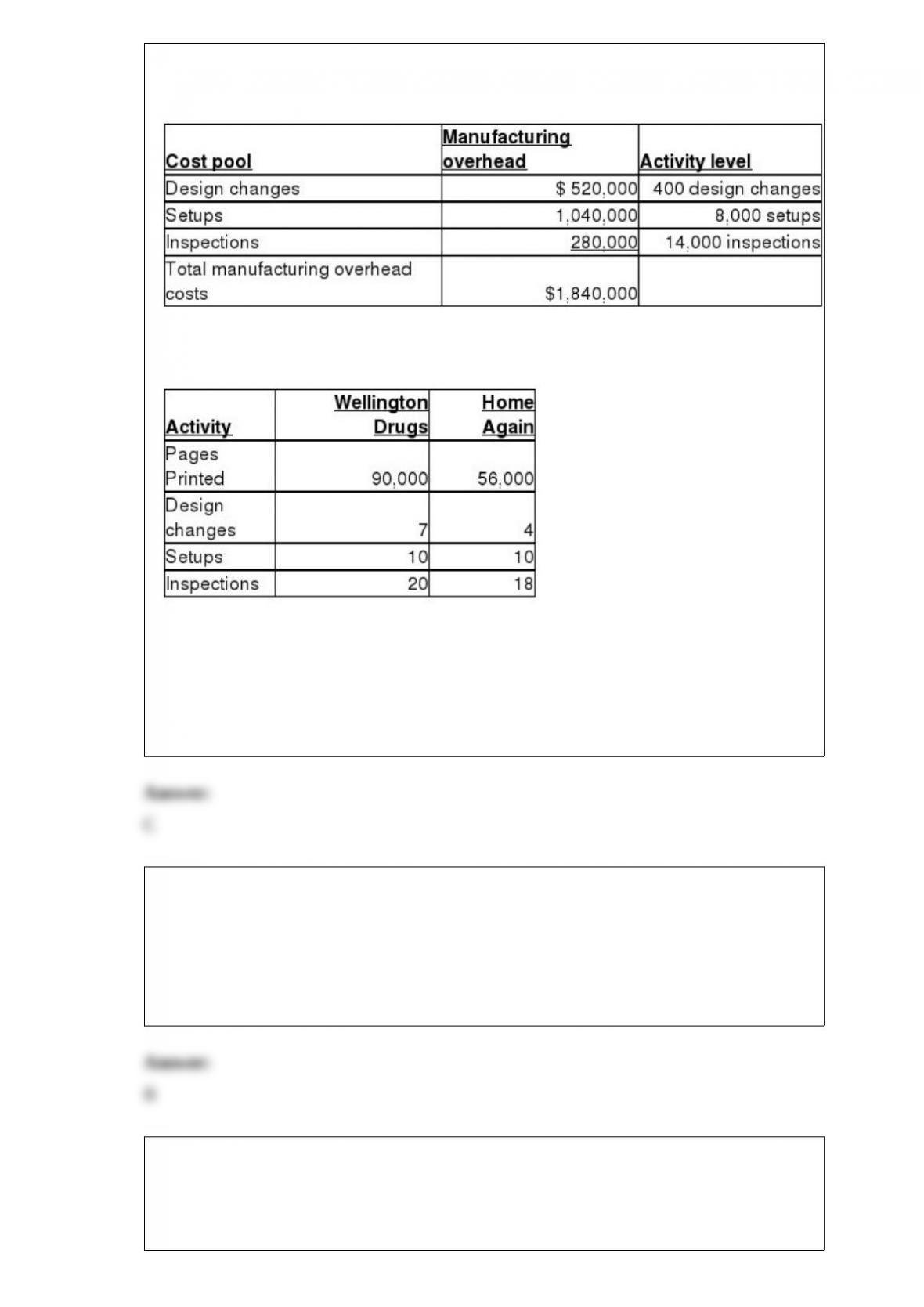
changes, setups, and inspections are the primary manufacturing overhead cost drivers.
The following information was gathered during the analysis:
During 2011, two customers, Wellington Drugs and Home Again, are expected to use
the following printing services:
Using the three cost pools to allocate overhead costs, what is the total manufacturing
overhead cost estimate for Wellington Drugs during 2011?
A) $5,400
B) $9,100
C) $10,800
D) $10,192
35) Management accounting can play a critical role in the service industry because of
all the following reasons EXCEPT:
A) firms must be especially sensitive to the timeliness and quality of customer service
B) many employees have very little contact with customers
C) customers immediately notice defects and a delay in service
D) dissatisfied customers may never return
36) ________ is where participants meet openly to discuss their methods, visit each
other’s sites, and generally have a long-run association.
A) Group benchmarking
B) Cooperative benchmarking
C) Unilateral (covert) benchmarking
D) Indirect/third party benchmarking
37) ABC systems:
A) reveal activities that can be eliminated
B) help control nonfinancial items such as number of setup hours
C) help identify new designs to reduce costs
D) All of the above are correct
38) The MAJOR criticism of using return on investment (ROI) for financial control is
that it:
A) gives managers an incentive to reject projects with an ROI greater than the
company’s required rate of return but less than the department’s current ROI
B) usually uses the blended rate of capital as the required rate of return
C) encourages competition among segment managers
D) is a measure of overall performance
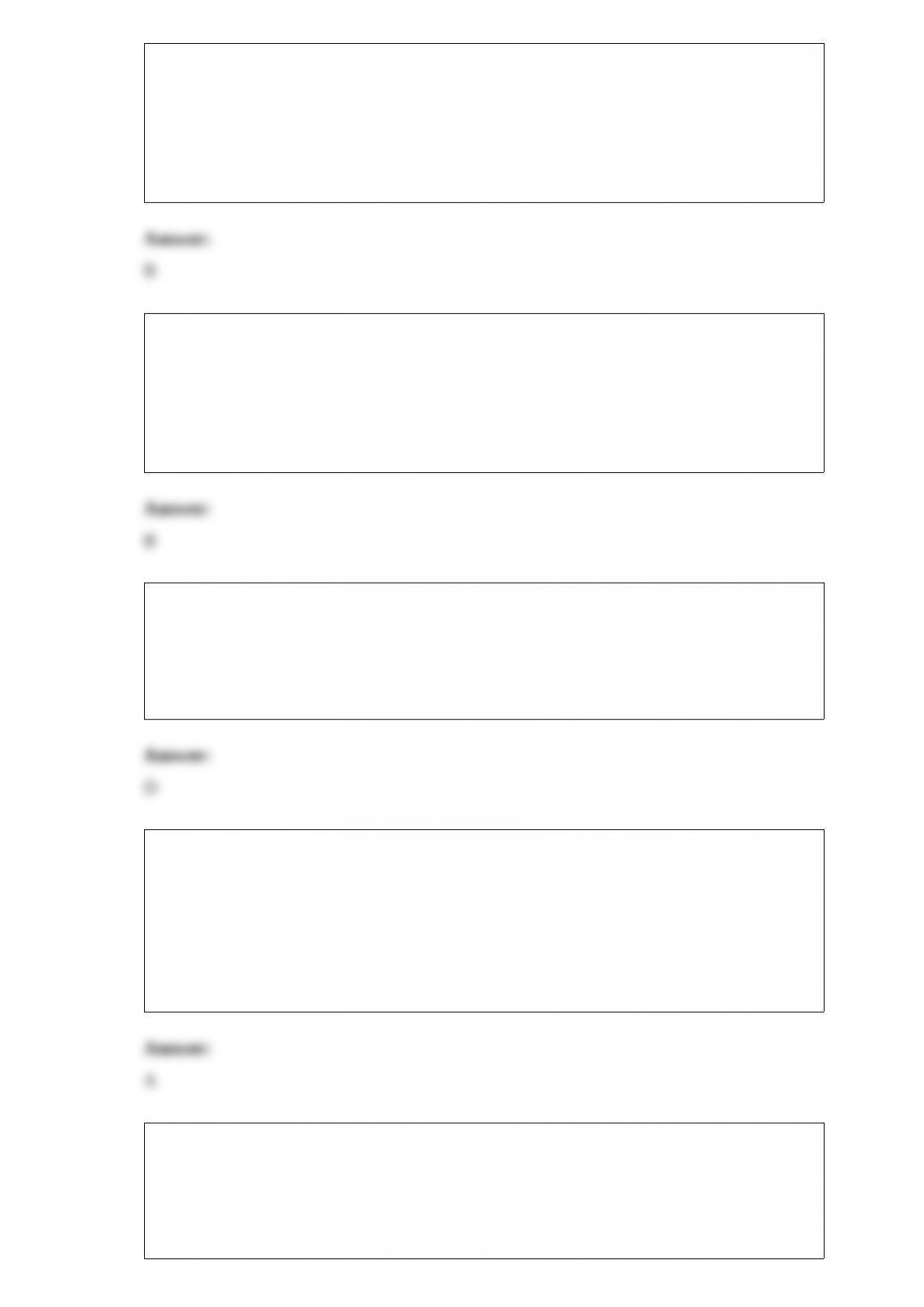
39) For 2011, Steve’s Plastics Manufacturing uses a normal job order costing system.
The accounting records contain the following information:
The only cost driver is machine hours.
Using normal job order costing, the 2011 predetermined manufacturing overhead cost
driver rate is:
A) $4.00 per machine hour
B) $4.80 per machine hour
C) $5.00 per machine hour
D) $6.00 per machine hour
40) When discussing the roles of budgets, a planning role in the budgeting process
includes:
A) measuring outcomes against planned amounts
B) developing the master budget
C) assessing performance
D) reporting actual amounts at the end of the budgeting period
41) The characteristic of a management accounting and control system that allows
employees to customize applications for local decisions is referred to as being:
A) timely
B) flexible
C) accurate
D) in control
42) Typical sales person’s compensation:
A) is paid in the form of salary
B) encourages sales only to profitable customers
C) is usually based on customer profit
D) is usually based on sales revenue
43) When there is excess capacity, it makes sense to accept a one-time-only special
order for less than the current selling price when:
A) incremental revenues exceed incremental costs
B) additional fixed costs must be incurred to accommodate the order
C) the company placing the order is in the same market segment as your current
customers
D) None of the above is correct
44) The purpose of the Balanced Scorecard is BEST described as helping an
organization:
A) develop customer relations
B) mobilize employee skills for continuous improvements in processing capabilities,
quality, and response times
C) introduce innovative products and services desired by target customers
D) translate an organization’s mission, vision, and strategy into a set of performance
measures that help to implement the strategy
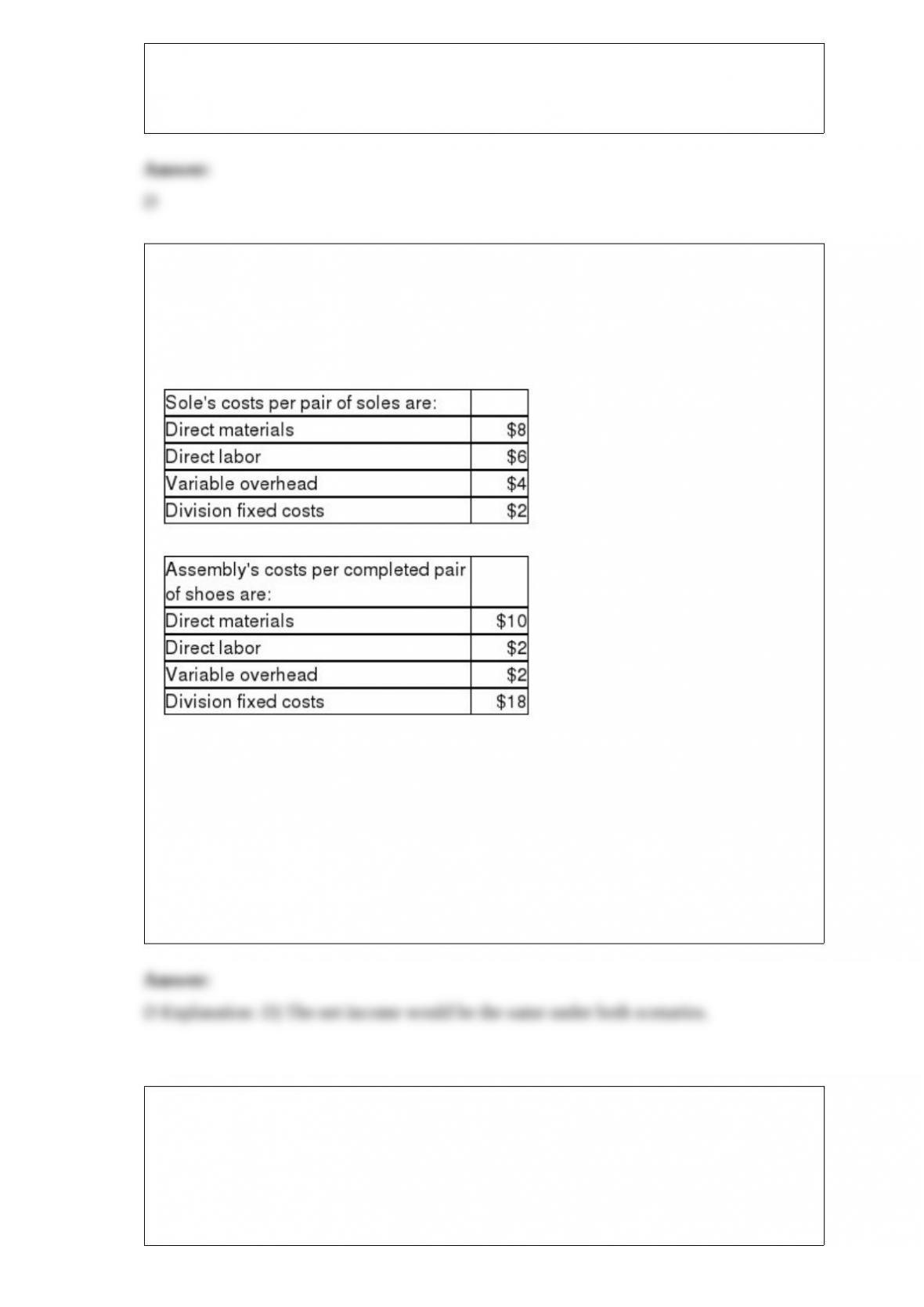
45) The Jordan Company manufacturers only one type of shoe and has two divisions,
the Sole Division and the Assembly Division. The Sole Division manufactures soles
and then ‘sells” them to the Assembly Division, which completes the shoes and sells
them to retailers. The market price for the Assembly Division to purchase a pair of soles
is $40. Fixed costs are per pair at 100,000 units.
Calculate and compare the difference in overall corporate net income between Scenario
A and Scenario B if the Assembly Division sells 100,000 pairs of shoes for $120 per
pair to customers.
Scenario A: Negotiated transfer price of $30 per pair of soles
Scenario B: Market-based transfer price
A) $1,000,000 more net income under Scenario A
B) $1,000,000 of net income using Scenario B
C) $200,000 of net income using Scenario A
D) None of the above is correct.
46) Surveys of employees’ satisfaction is an example of a Balanced Scorecard’s measure
of the:
A) process perspective
B) customer perspective
C) learning and growth perspective
D) financial perspective
47) Deciding how to allocate resources over a product’s life cycle usually is:
A) decided once at the beginning of the product design phase
B) not known until the beginning of the manufacturing cycle
C) part of product development
D) an iterative process over the life of the product
48) Which of the following statements regarding aligning the organization to strategic
objectives is true?
A) Measures of individual business units must add up to the corporate measure, just like
aggregating financial measures
B) Support functions and shared units are exempt from the Balanced Scorecard’s
process perspective since they have no external customer
C) High-level strategic objectives on the corporate balanced scorecard guide the
development of Balanced Scorecards for the decentralized operating units
D) All of the above are correct
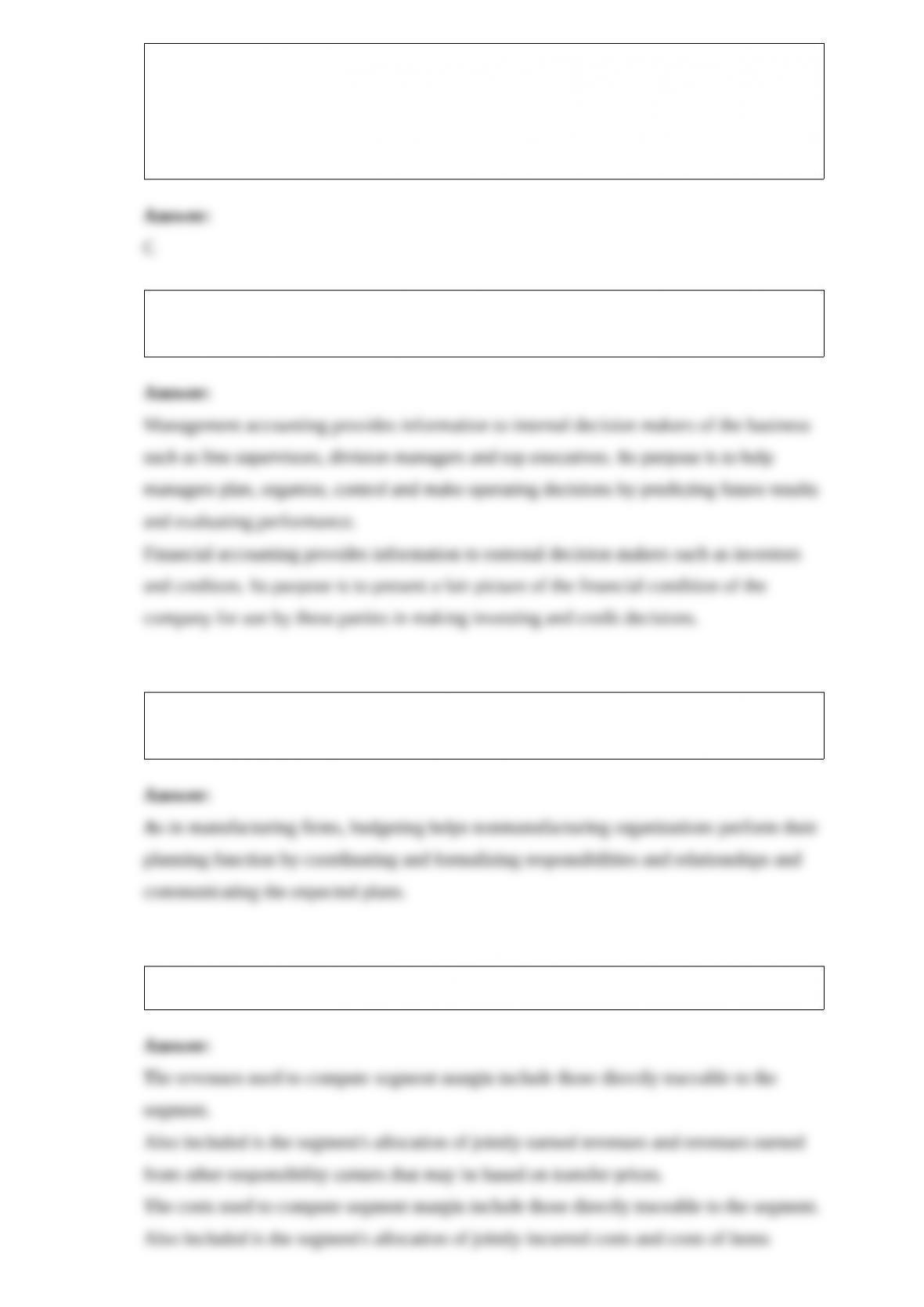
49) The following annual information is for Bressler Corporation:
Total fixed costs: $100,000
If the sales mix consists of two units of Product X and one unit of Product Y, what is the
break-even point in units for a year?
A) 2,000 units of Y and 4,000 units of X
B) 2,025 units of Y and 4,050 units of X
C) 4,025 units of Y and 8,050 units of X
D) 4,000 units of Y and 8,000 units of X
50) The budgeting process is MOST strongly influenced by the:
A) capital spending plan
B) statement of expected cash flows
C) demand forecasts
D) production plan
51) Compare and contrast the users and uses of management accounting and financial
accounting.
52) How is the role of budgeting similar for a manufacturing firm and a not-for-profit
organization?
53) What types of revenues and costs are used to calculate segment margin?
54) Is financial accounting or management accounting more useful to an operations
manager? Why?
55) Is segment margin an appropriate measure of financial performance for segment
management? Why?
Yes, it is an appropriate measure because all of the revenues and costs used to compute
segment margin are directly traceable to the segment and are essentially under the
control of the segment manager. Segment income is also a valuable measure of
performance because it considers all costs that could be avoided without the segment.
56) Draw a strategy map that identifies the cause-and-effect linkages of the following
objectives:
Market share
Strategic technology availability
Grow revenues
Design and develop new products