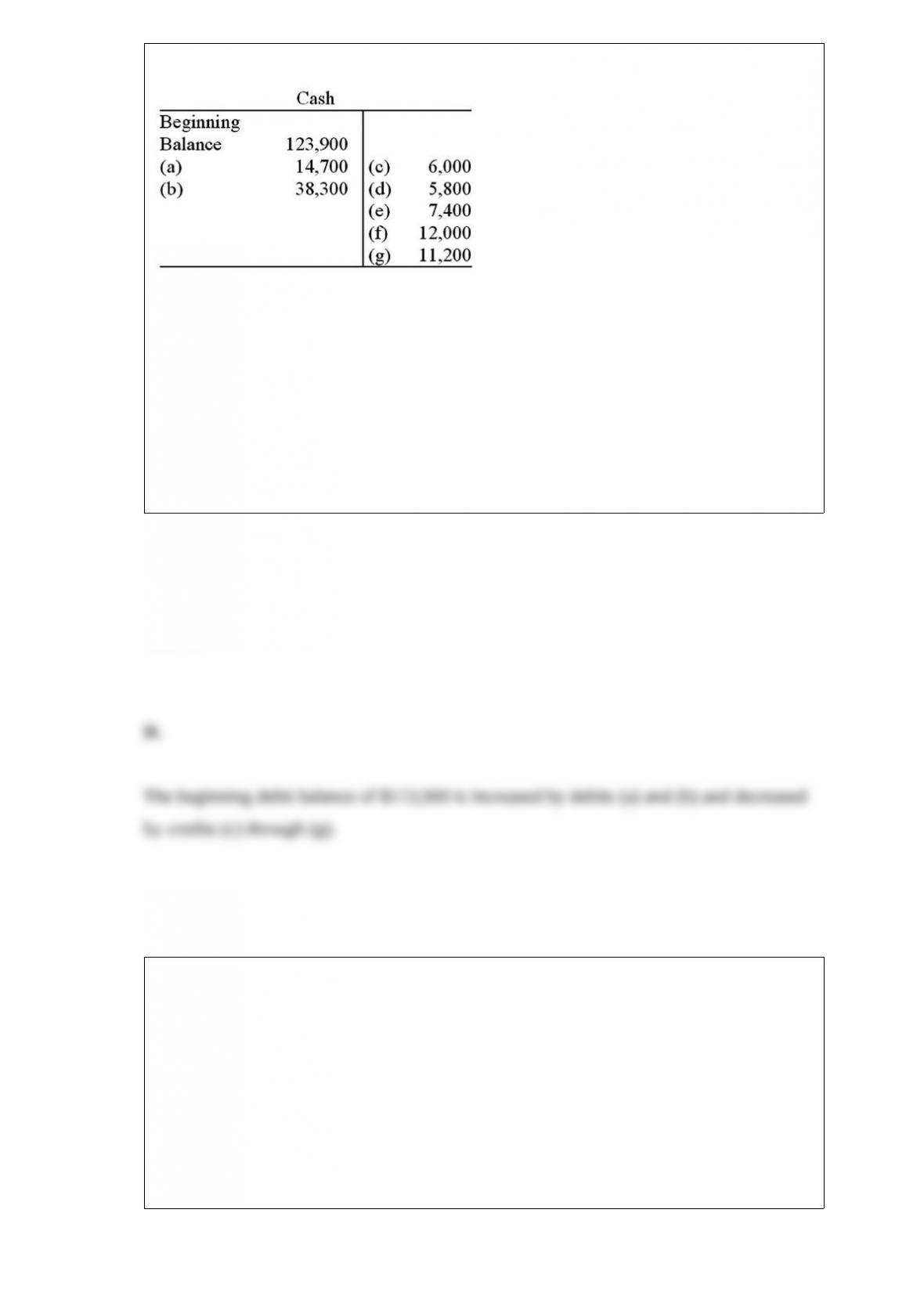
The final balance of the Cash account would be:
A. $219,300.
B. $113,300.
C. $28,500.
D. $134,500.
Answer:
Which of the following would be acceptable as an alternative term used for the income
statement?
A. Statement of Operations.
B. Statement of Financial Position.
C. Statement of Retained Earnings.
D. Statement of Revenues and Expenses.
Answer:
Which of the following is not an amount that is needed to calculate straight-line
depreciation?
A. The cost of the asset.
B. An estimate of the asset’s useful economic life to the company.
C. The estimated amount that the company will receive when it disposes of the asset.
D. The cost the company will be required to incur to replace the asset.
Answer:
The purchase of $100,000 of equipment by issuing a note would be reported:
A. as a $100,000 investing inflow, and a $100,000 financing outflow.
B. as a $100,000 investing outflow, and a $100,000 financing inflow.
C. as a $100,000 operating inflow, and a $100,000 financing outflow.
D. in a supplementary schedule.
Answer:
If a company’s sales revenue was $171,356 and cash collected from customers was
$167,803, which of the following would be consistent with this difference?
A. Accounts receivable could have decreased.
B. Cash payments could have been larger than the expense accounts.
C. Accounts receivable could have increased.
D. Cash payments could have been smaller than the expense accounts.
Answer:
The financial results for a public company are generally first reported in a:
A. press release issued one day after the accounting period ends.
B. press release issued on the same day as the quarterly or annual report.
C. quarterly or annual report issued a week or two after the accounting period ends.
D. press release issued a few weeks after the accounting period ends.
Answer:
Use the information above to answer the following question. If the units-of-production
method is used, the depreciation expense for this period is:
A. $80,000.
B. $400,000.
C. $76,000.
D. $380,000.
Answer:
JC Corporation had 20,000 shares of $4 par value common stock outstanding on
January 1, 2014. On January 20, 2014, the company purchased 2,000 of the outstanding
shares for $16 per share. On July 3, 2014, the company reissued 1,000 of the shares at
$20 per share.
Use the information above to answer the following question. Assume the company paid
a dividend of $5 per share on August 3. What is the total amount of the dividends that
would be paid to the common stockholders?
A. $95,000
B. $100,000
C. $90,000
D. $76,000
Answer:
A machine had an estimated useful life of 5 years, but after 3 years, it was decided that
the original estimate of useful life should have been 10 years. At that point, the
remaining cost to be depreciated should be allocated over the remaining:
A. 2 years.
B. 5 years.
C. 7 years.
D. 10 years.
Answer:
Which of the following statements is FALSE about the current ratio?
A. Instead of using the dollar amounts, the current ratio makes it easier to compare
several companies.
B. The current ratio is used to evaluate a company’s ability to pay current obligations.
C. Having more current assets than current liabilities will yield a current ratio less than
1.
D. A high current ratio suggests good liquidity.
Answer:
In a period of rising prices, the inventory costing method that will cause the company to
have the lowest cost of goods sold is
A. LIFO.
B. FIFO.
C. Weighted average.
D. Specific identification.
Answer:
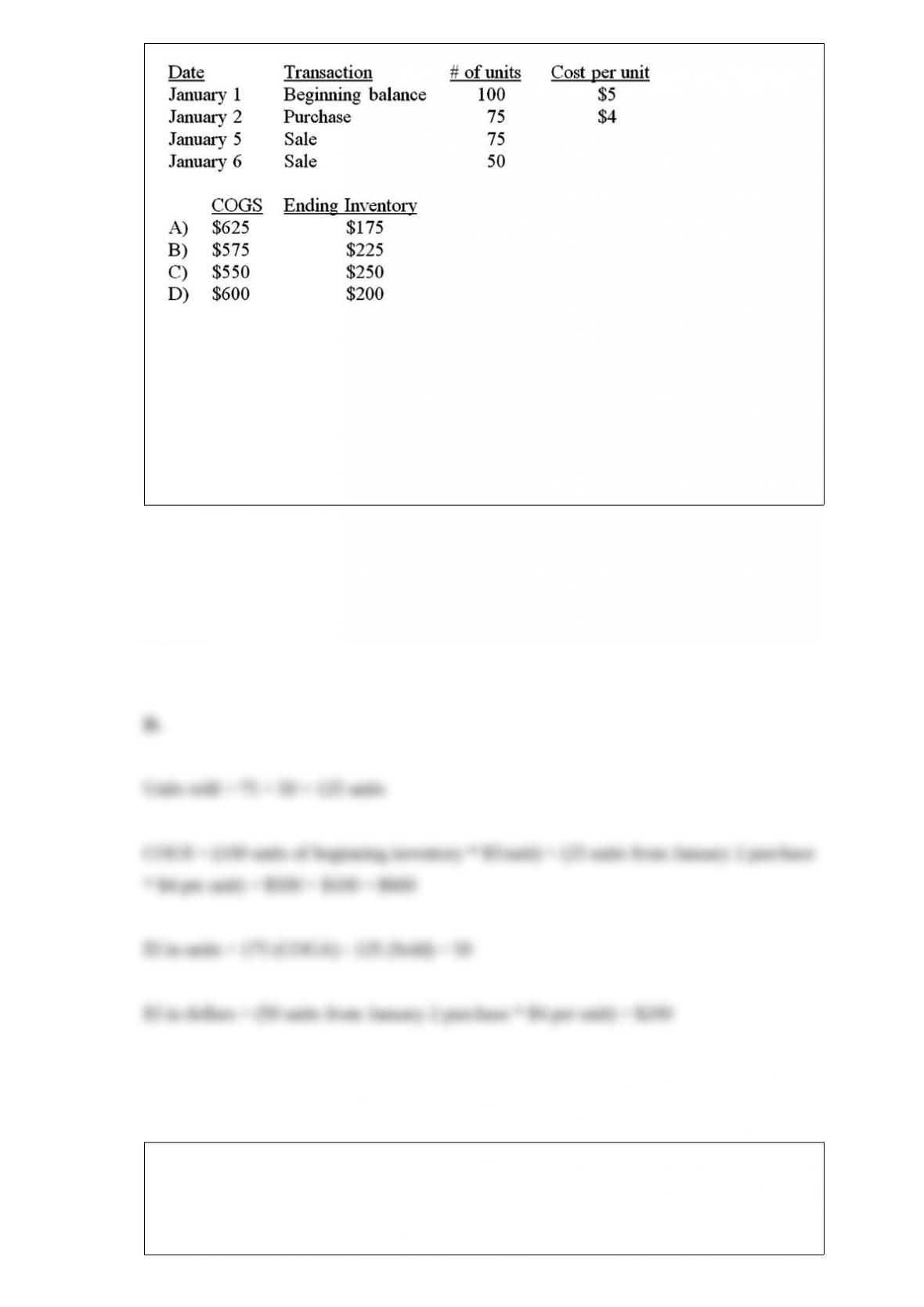
Maxell Company uses the periodic FIFO method to assign costs to inventory and cost
of goods sold. Given the following information, what would be reported as the cost of
goods sold (COGS) and ending inventory balances for the period?
A. Option A
B. Option B
C. Option C
D. Option D
Answer:
The characteristic shared by all liabilities is that they:
A. provide a future economic benefit.
B. result in an inflow of resources to the company.
C. always end in the word “payable.”
D. obligate the company to do something in the future.
Answer:
Choose the appropriate letter to match the term and the definition. Not all definitions
will be used.
Term
_______ 1/ Full disclosure principle
_______ 2/ Ratio analysis
_______ 3/ Liquidity
_______ 4/ Going-concern assumption
_______ 5/ Profitability
_______ 6/ Solvency
_______ 7/ Trend analysis
_______ 8/ Vertical analysis
Definition
A) The ability of a company to meet its short-run financial obligations.
B) A type of analysis that focuses on relationships within a single financial statement.

C) Also known as time-series analysis.
D) The standard that companies should present all relevant information needed to
interpret a company’s financial position and performance.
E) The standard that expenses should be recognized when incurred.
F) A measure of current earnings performance.
G) A result from comparing a company’s results to other companies in the industry.
H) A measure of long-run survivability.
I) The standard that revenue should be recorded when earned, provided payment is
reasonably expected.
J) Measures that relate financial variables reported in one or more of the financial
statements from the same year.
K) The characteristic that financial information needs to be valuable to decision makers.
L) The standard that takes for granted a company’s near term financial survival.
Answer:
Solvency ratio data are primarily concerned with the ability of a company to:
A. produce profits.
B. handle its debt.
C. manage its cash flow.
D. provide income for stockholders.
Answer:
On the date of record for a dividend, the company:
A. debits Dividends Declared and credits Dividends Payable for the amount of the
dividend.
B. debits Dividend Expense and credits Cash for the dividend amount.
C. debits Dividends Payable and credits Cash for the dividend amount.
D. establishes who will receive the dividend payment.
Answer:
Dry Corporation cannot pay off its account with Bone Corporation on a timely basis.
Bone Corporation issues a $2,000, 3-month, 12% promissory note to Dry Corporation
in settlement of an open accounts receivable. What entry will Bone Corporation make
upon issuance?
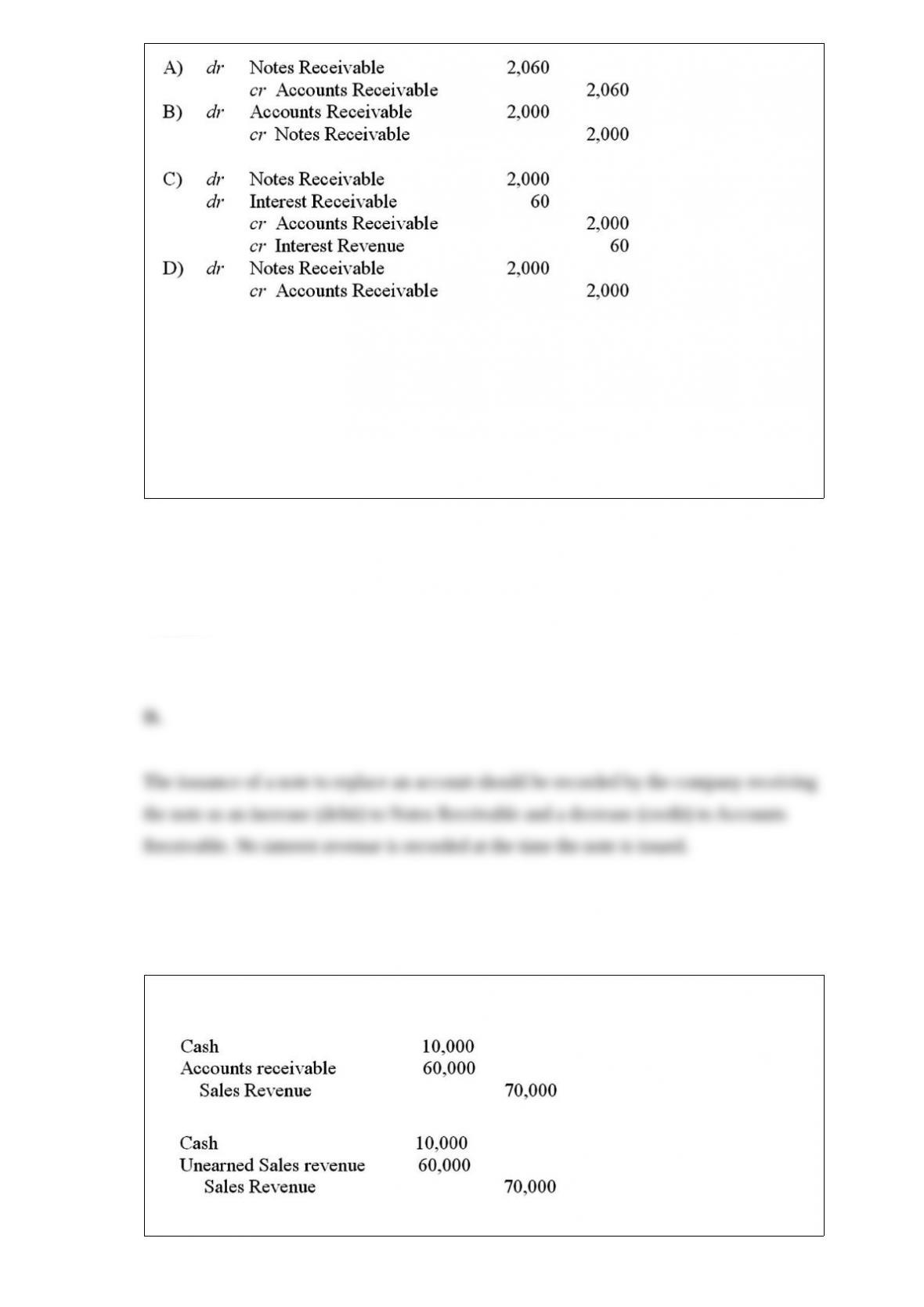
A. Option A
B. Option B
C. Option C
D. Option D
Answer:
The correct entry by Seconds Best to record the sale in the previous month is:
A.
B.
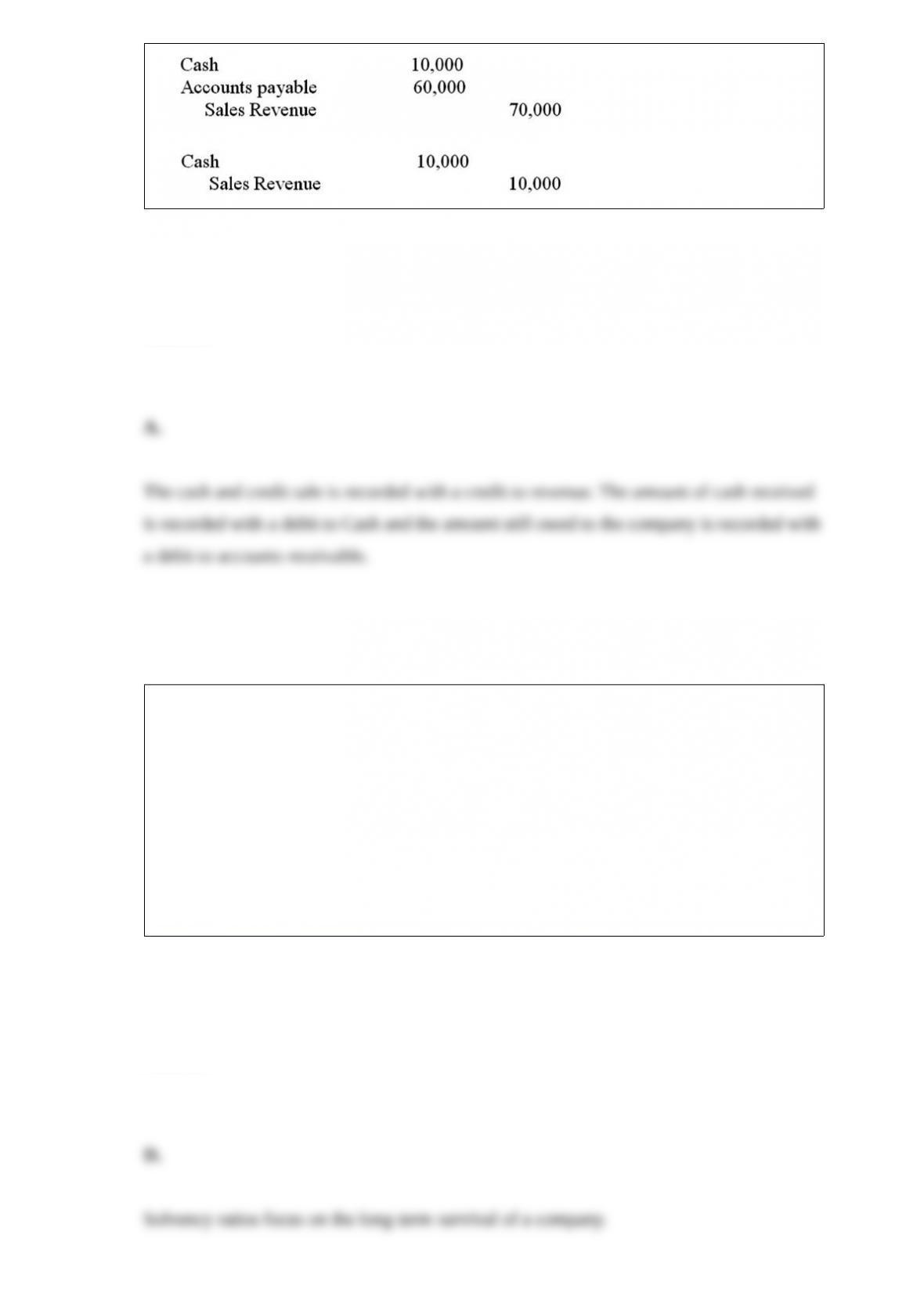
C.
D.
Answer:
If an analyst wanted to examine a company’s long-run ability to survive, which of the
following would best be considered?
A. Liquidity.
B. Market share.
C. Profitability.
D. Solvency.
Answer:
If a company purchased 200 units of inventory at $9 per unit and 300 units at $10 per
unit, its weighted average unit cost for this inventory would be:
A. $9.00.
B. $9.50.
C. $9.60.
D. $10.00.
Answer:
Which of the following would be classified as an operating activity on the statement of
cash flows using the direct method?
A. Cash dividends paid to stockholders.
B. Cash received from selling equipment.
C. Cash paid to retire bonds payable at maturity.
D. Cash received from accounts receivable collections.
Answer:
Earnings per share can be affected by all of the following except:
A. how the company chose to finance its operations.
B. the method of depreciation.
C. the inventory cost method.
D. classification of debt as current or long-term.
Answer:
The following activities occurred during the current year, 2013, for the Maverick Law
Firm.
– On February 1, 2013, received cash of $5,000 from clients in payment of their
accounts from 2012.
– In 2013, received cash of $13,000 for law services rendered in 2013.
– At the end of 2013, billed customers $4,000 for services rendered in 2013. This
amount was unpaid as of the end of the year.
– In November of 2013, received cash of $2,000 from clients as a deposit on law
services to be performed in 2014.
What is the amount of Law Services Revenue to be reported on the Income Statement
for the year 2013?
A. $19,000
B. $22,000
C. $24,000
D. $17,000
Answer:
A store holding a “25% off” sale will probably experience ______________ gross profit
than usual and _______________ sales volume.
A. higher; higher
B. lower; lower
C. higher; lower
D. lower; higher
Answer:
Although the inventory turnover ratio is an important analytical tool for many
companies, it would be most crucial for a company that:
A. provides legal services.
B. sells cell phones and notebook computers.
C. manufactures steel.
D. sells paint.
Answer:
The allocation method used for natural resources is similar to which of the following
depreciation methods?
A. Straight-line.
B. Units-of-production.
C. Double-declining balance.
D. MACRS.
Answer:
Which of the following effects would occur as a result of a purchase of merchandise for
cash in a perpetual inventory system?
A. Total assets increase.
B. Total assets are unchanged.
C. Total liabilities increase.
D. Total stockholders’ equity decreases.
Answer:
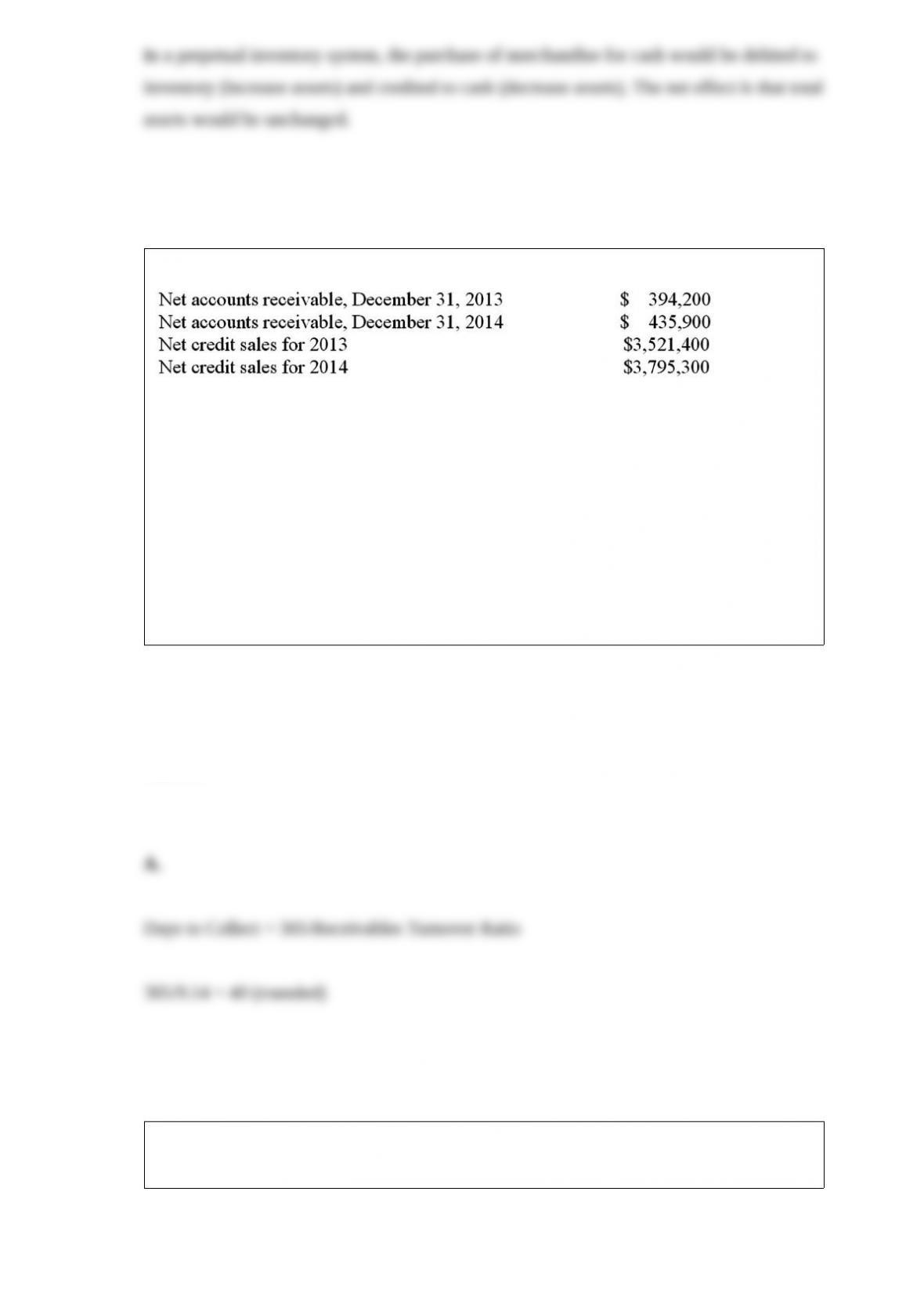
Use the information above to answer the following question. The days to collect for
2014 is closest to:
A. 40
B. 41
C. 43
D. 42
Answer:
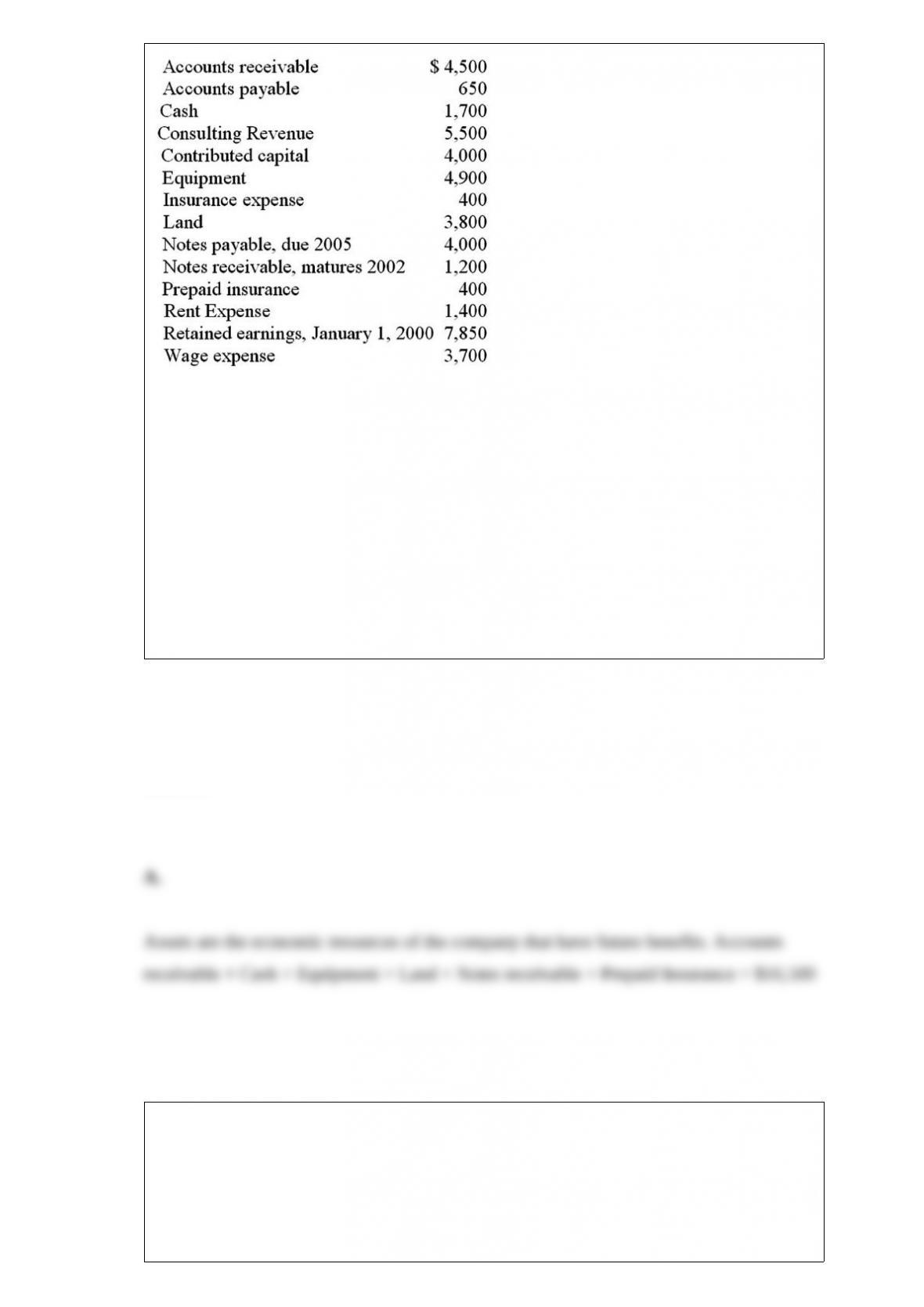
All accounts have normal balances.
What is the amount of Total Assets at December 31?
A. $16,500
B. $22,000
C. $17,350
D. $13,500
Answer:
Which of the following is NOT an incentive to provide fair and reliable financial
information?
A. Management would be taking a large legal risk if they interfere with the independent
auditors who are examining the financial statements.
B. External auditors would be taking a large legal risk if they allow their independence
to be compromised.
C. External auditors have a reputation for integrity to protect.
D. The company could attract business partners by making their financial information
appear more favorable.
Answer:
B. Darin Company purchased a truck and trailer for $54,000. The appraised values of
the truck and trailer are $38,000 and $19,000, respectively. What is the amount of the
cost that should be assigned to the trailer?
A. $19,000.
B. $18,000.
C. $16,000.
D. $22,000.
Answer:
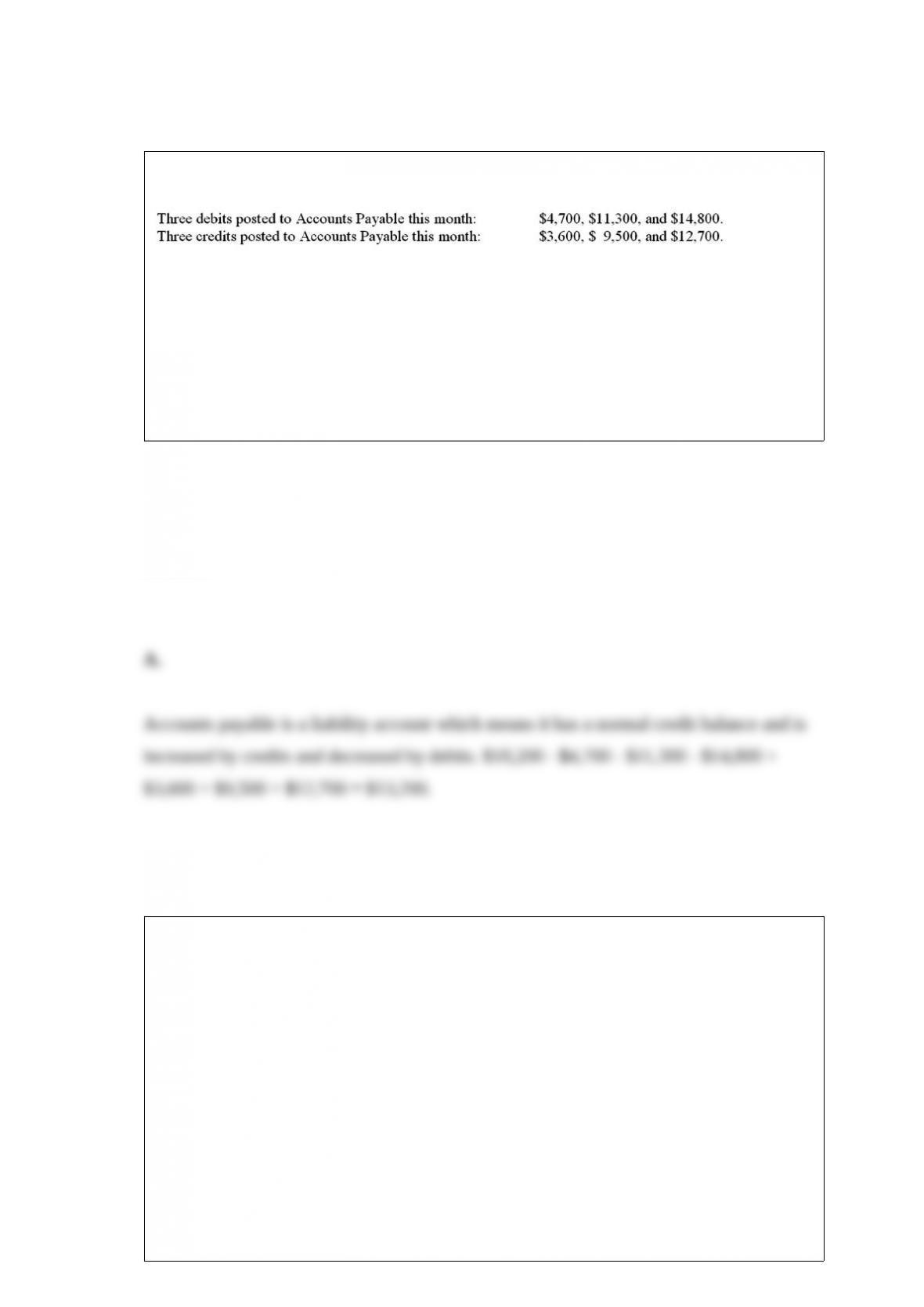
If Accounts Payable had a balance of $18,200 at the beginning of the month, and the six
amounts shown below were posted to this account, what should be the ending balance?
A. $13,200
B. $5,000
C. $23,200
D. $49,000
Answer:
Alphabet Company, which uses the periodic inventory method, buys different letters for
resale. It buys A thru G in January at $4 per letter. In February, it buys H thru L at $6
per letter. It buys M thru R in March at $7 per letter. It sells A, D, E, H, J and N in
April.
Use the information above to answer the following question. If the company uses the
LIFO method, what is the cost of its ending inventory?
A. $24
B. $42
C. $58
D. $76
Answer: