When the amount of a contingent liability can be reasonably estimated and its
likelihood is probable, the company should:
A. include a description in the notes to the financial statements.
B. record the estimated amount of the liability times the probability of its occurrence.
C. record the estimated amount of the liability on the balance sheet.
D. exclude the information about the contingent liability from its financial statements
and notes.
Answer:
Patel Inc. issued 5-year, 10% bonds with a face value of $10,000 on January 1, 2013.
The market rate of interest was 8% and the proceeds from the bond issuance was
$10,800.
Use the information above to answer the following question. If the effective interest
method of amortization is used, how much total interest expense would be recorded in
2013?
A. $1,000
B. $1,080
C. $800
D. $864
Answer:

A corporation had a net increase in retained earnings of $65,000 for the year. The
corporation also paid $20,000 of cash dividends that had been declared in the previous
year. This year, the corporation declared $18,000 of dividends but has not paid them as
of year-end. Given this information, the net income for the current year must have been:
A. $63,000
B. $85,000
C. $65,000
D. $83,000
Answer:
What would happen to the debt-to-assets ratio, if at the end of 2015, the company
borrowed $1,000 from the bank by signing a promissory note and received $2,000 from
the issuance of stock?
A. This transaction would cause the debt-to-assets ratio to increase.
B. This ratio would increase indicating a less risky financing strategy.
C. The debt-to-assets ratio would not change.
D. This ratio would decrease because assets would increase by more than liabilities.
Answer:
Which of the following items is not a specific account in a company’s chart of
accounts?
A. Income Tax Expense.
B. Sales Revenue.
C. Unearned Revenue.
D. Net Income.
Answer:
Fonthouse Corp. issues 10,000 shares of $2, no-par value preferred stock for cash at
$60 per share.
Use the information above to answer the following question. The journal entry to record
the transaction will consist of a debit to Cash for $600,000 and a credit (or credits) to:
A. Preferred Stock for $600,000.
B. Preferred Stock for $20,000 and Additional Paid-In Capital for $580,000.
C. Preferred Stock for $20,000 and Retained Earnings for $580,000.
D. Retained Earnings for $600,000.
Answer:
A company’s total assets and total liabilities at the end of the year are as follows:
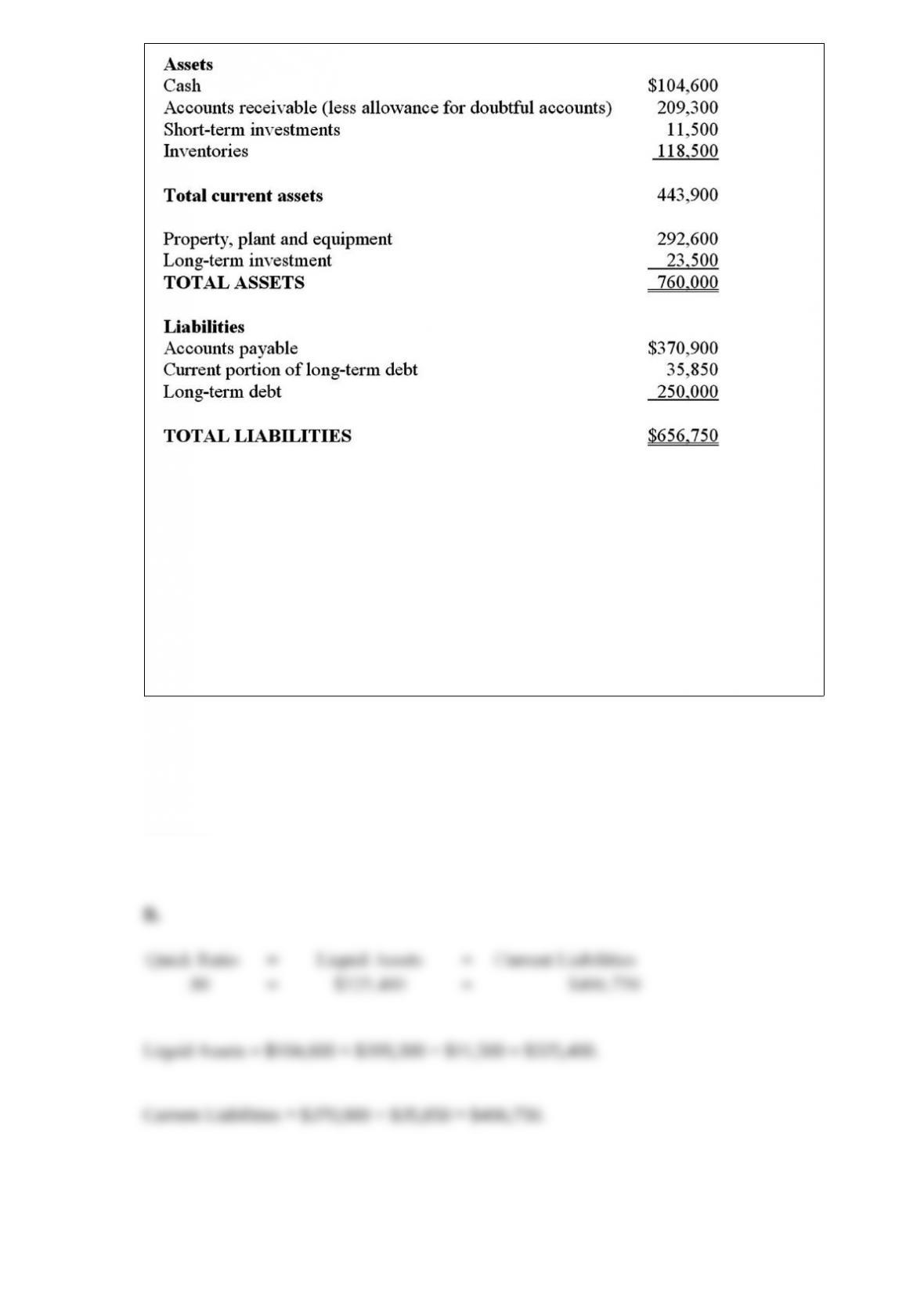
The quick ratio for this company is approximately:
A. 1.09.
B. 0.80.
C. 1.16.
D. 0.50.
Answer:
E. Flynn Company uses a perpetual inventory system and reported $500,000 of
inventory at the beginning of the month based on a physical count of inventory. During
the month, the company bought $45,000 of inventory and sold inventory that had cost
$30,000. At the end of the month, the physical count of inventory shows $510,000 on
hand. How much shrinkage occurred during the month?
A. $35,000
B. $25,000
C. $5,000
D. $10,000
Answer:
When a company sells stock to the public for the first time, the sale is called a(n):
A. initial public offering (IPO).
B. first time issue (FTI).
C. seasoned new issue (SNI).
D. initial stock offering (ISO).
Answer:
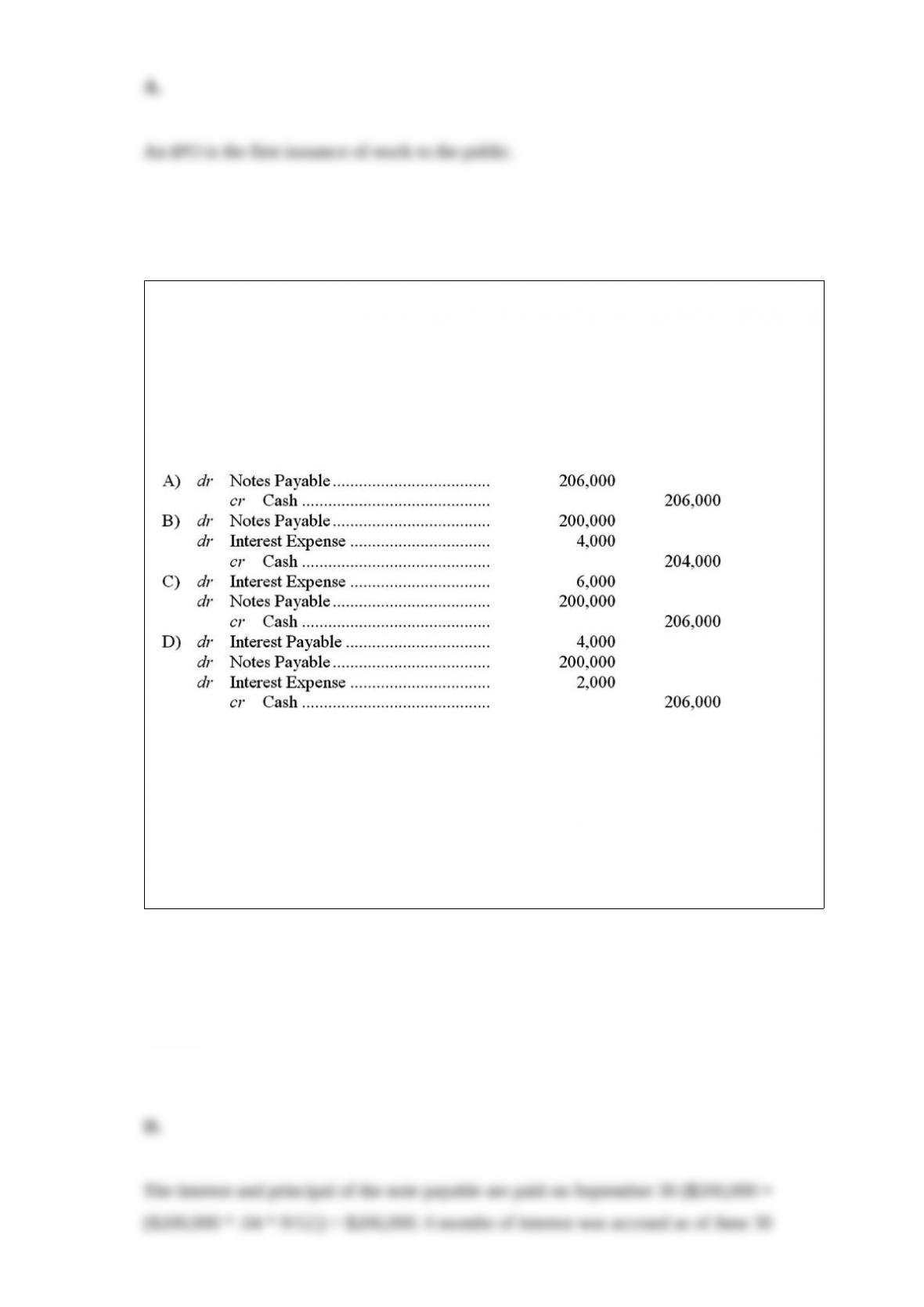
Travis County Bank agrees to lend Backyard Corporation $200,000 on January 1.
Backyard signs a $200,000, 4%, 9-month note. Interest is due at maturity on September
30. The fiscal year ends June 30.
Use the information above to answer the following question. What journal entry will
Backyard make when paying off the note and interest at maturity if the company’s
year-end is June 30? (Hint: Backyard’s records were adjusted on June 30).
A. Option A
B. Option B
C. Option C
D. Option D
Answer:
Before adjustment, the allowance for doubtful accounts has a credit balance of $2,700.
The company had $140,000 of net credit sales during the period and historically fails to
collect 4% of credit sales. The company uses the percentage of credit sales method of
estimating doubtful accounts. After adjusting for estimated bad debts, the ending
balance in the allowance for doubtful accounts account will be:
A. $8,300.
B. $5,400.
C. $2,900.
D. $5,600.
Answer:

Match the term with the explanation. (There are more explanations than terms.)
_____ 1/ investors
_____ 2/ audit
_____ 3/ balance sheet
_____ 4/ operating activity
_____ 5/ unit of measure concept
_____ 6/ retained earnings
_____ 7/ investing activity
_____ 8/ income statement
A. An example of an internal user of financial statements.
B. A financial statement showing a company’s assets, liabilities and stockholders’
equity.
C. When a company acquires money from investors.
D. A financial statement that summarizes a company’s past and current cash situation.
E. An example of external users of financial statements.
F. The idea that the financial statements of a company include the results of only that
company’s business activities.

G. Day to day events involved in the production and sales of a company’s goods or
services.
H. A financial statement that shows a company’s revenues and expenses.
I. Borrowing money from lenders.
J. The total amount of profits that are kept by the company.
K. The idea that a company should report its financial data in the relevant currency.
L. A procedure by which independent evaluators assess the accounting procedures and
financial reports of a company.
M. Events involving the purchase or sale of long-term assets, like property and
equipment.
Answer:
If a company declares and pays a dividend during the year, this will:
A. decrease the company’s net profit margin.
B. increase the company’s debt-to-assets ratio.
C. decrease the company’s debt-to-assets ratio.
D. increase the company’s net profit margin.
Answer:
Purrfect Pets, Inc., makes a $10,000 payment on account. This would result in a:
A. $10,000 credit to Cash and a $10,000 credit to Accounts Payable.
B. $10,000 debit to Cash and a $10,000 debit to Accounts Payable.
C. $10,000 debit to Accounts Payable and a $10,000 credit to Cash.
D. $10,000 debit to Cash and a $10,000 credit to Accounts Payable.
Answer:
A one-time error in the application of the lower of cost or market (LCM) rule in the
current period distorts financial results for the current accounting period
A. only.
B. and the period before.
C. and the period after.
D. and all periods after.
Answer:
Many lending agreements require the borrowing company to maintain certain financial
standards as demonstrated by its financial statements. This feature is known as:
A. a bond certificate.
B. a loan covenant.
C. a renegotiation.
D. a contingent liability.
Answer:
On the balance sheet, accumulated depreciation is:
A. added to property and equipment.
B. subtracted from property and equipment.
C. added to total liabilities.
D. subtracted from total liabilities.
Answer:
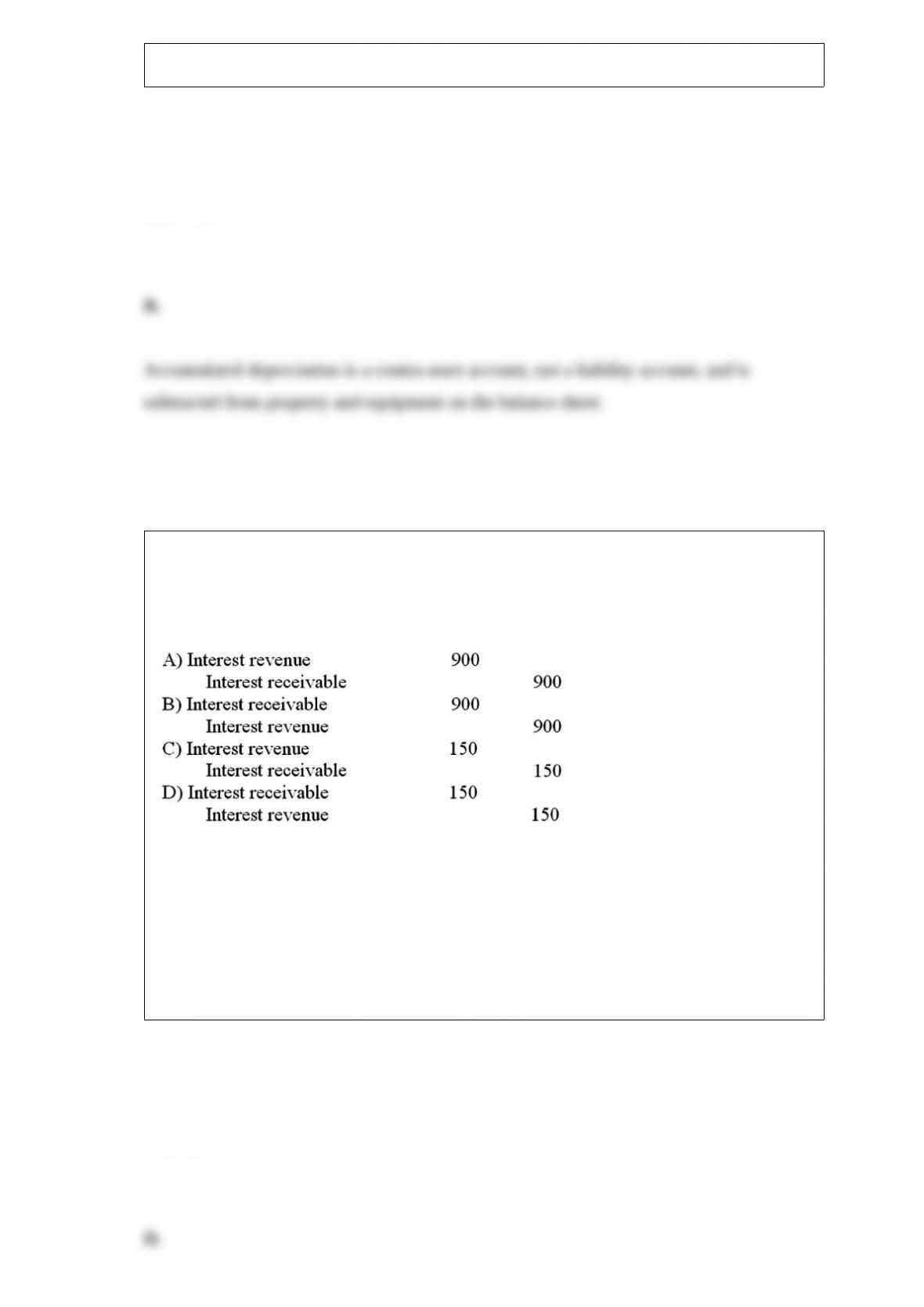
On December 1, 2013, a company loaned a new employee $20,000 to assist with her
relocation expenses. The employee signed a 6-month note, with interest of 9%. The
company prepares year-end financial statements at December 31. What is the required
adjusting entry at December 31 as a result of this note transaction?
A. Option A
B. Option B
C. Option C
D. Option D
Answer:
An increasing inventory turnover ratio indicates:
A. a longer time span between the ordering and receiving of inventory.
B. a shorter time span between the ordering and receiving of inventory.
C. a shorter time span between the purchase and sale of inventory.
D. a longer time span between the purchase and sale of inventory.
Answer:
A company issued 8% preferred stock with a $100 par value. This means:
A. Preferred stockholders are entitled to 8% of the annual net income.
B. Only 8% of total contributed capital can be preferred stock.
C. Preferred stockholders are guaranteed a dividend.
D. The potential dividend to preferred stockholders is $8 per share per year.
Answer:
Contra-accounts:
A. are used to increase the original value of the account they offset.
B. always appear in the same column of the trial balance as the account they offset.
C. are used to decrease the original value of the account they offset.
D. reduce the asset to its fair value.
Answer:
The Acme Corporation uses a periodic inventory system and buys 300 units of
merchandise in January at $5 each. Acme buys 500 units at $4 each in February and 200
units at $6 each in March. The company had no beginning inventory.
Use the information above to answer the following question. Acme sells 150 units

during the quarter. If Acme uses the weighted average method, what is its cost of goods
sold for the quarter?
A. $600
B. $705
C. $750
D. $900
Answer:
Which of the following is an advantage of debt financing?
A. It does not have to be repaid.
B. Interest is discretionary.
C. Interest is tax deductible.
D. It reduces stockholder control.
Answer:
Deposits in transit:
A. have been recorded by the company but not yet by the bank.
B. have been recorded by the bank but not yet by the company.
C. have not been recorded by the bank or the company.
D. have been recorded by both the bank and the company.
Answer:
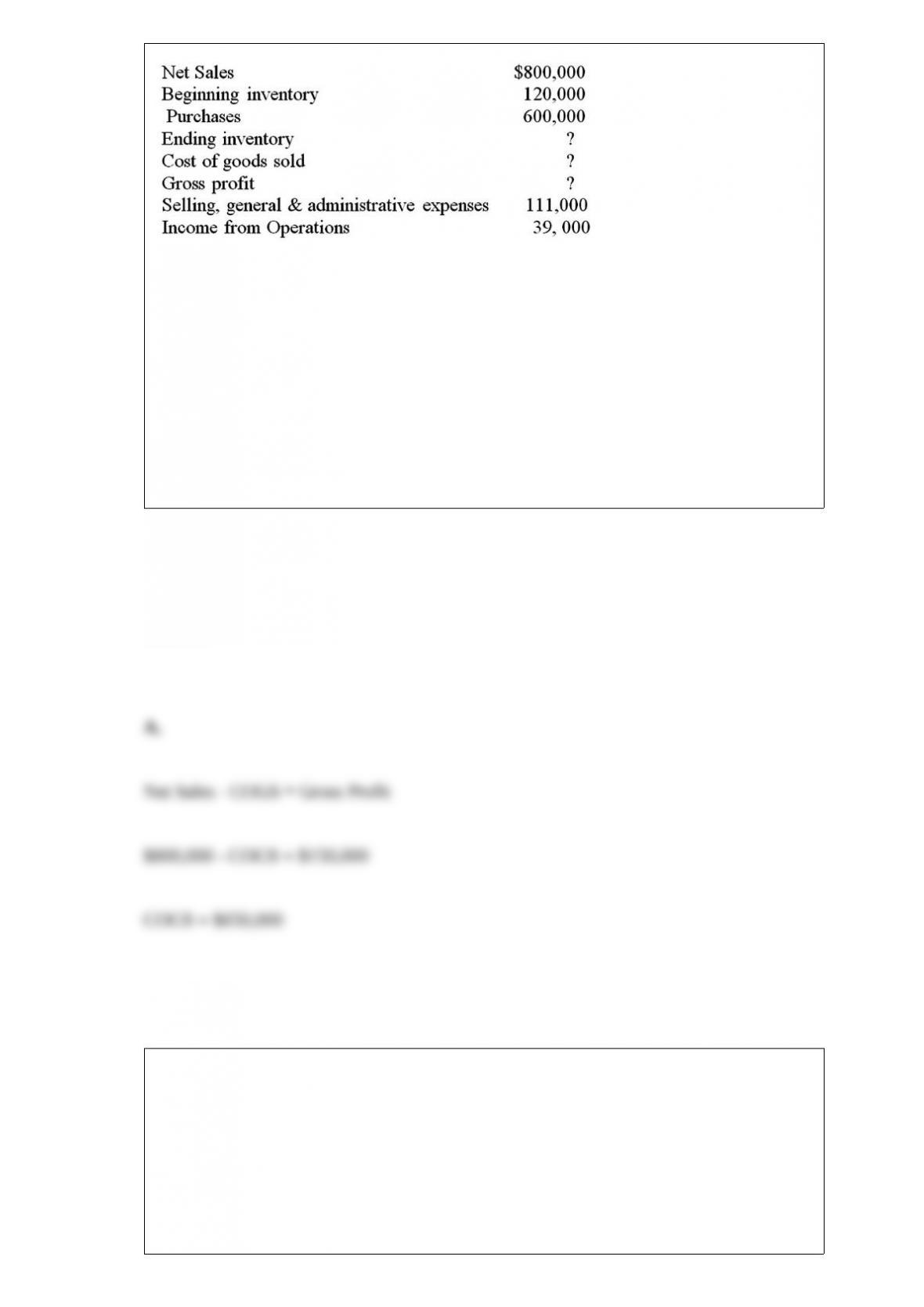
Use the information above to answer the following question. What is the amount of
Cost of Goods Sold?
A. $650,000
B. $720,000
C. $150,000
D. $70,000
Answer:
Receivables might be sold (“factored”) to:
A. lengthen the time to collect from customers.
B. reduce the receivables turnover ratio.
C. generate cash quickly.
D. generate a gain on sale.
Answer:
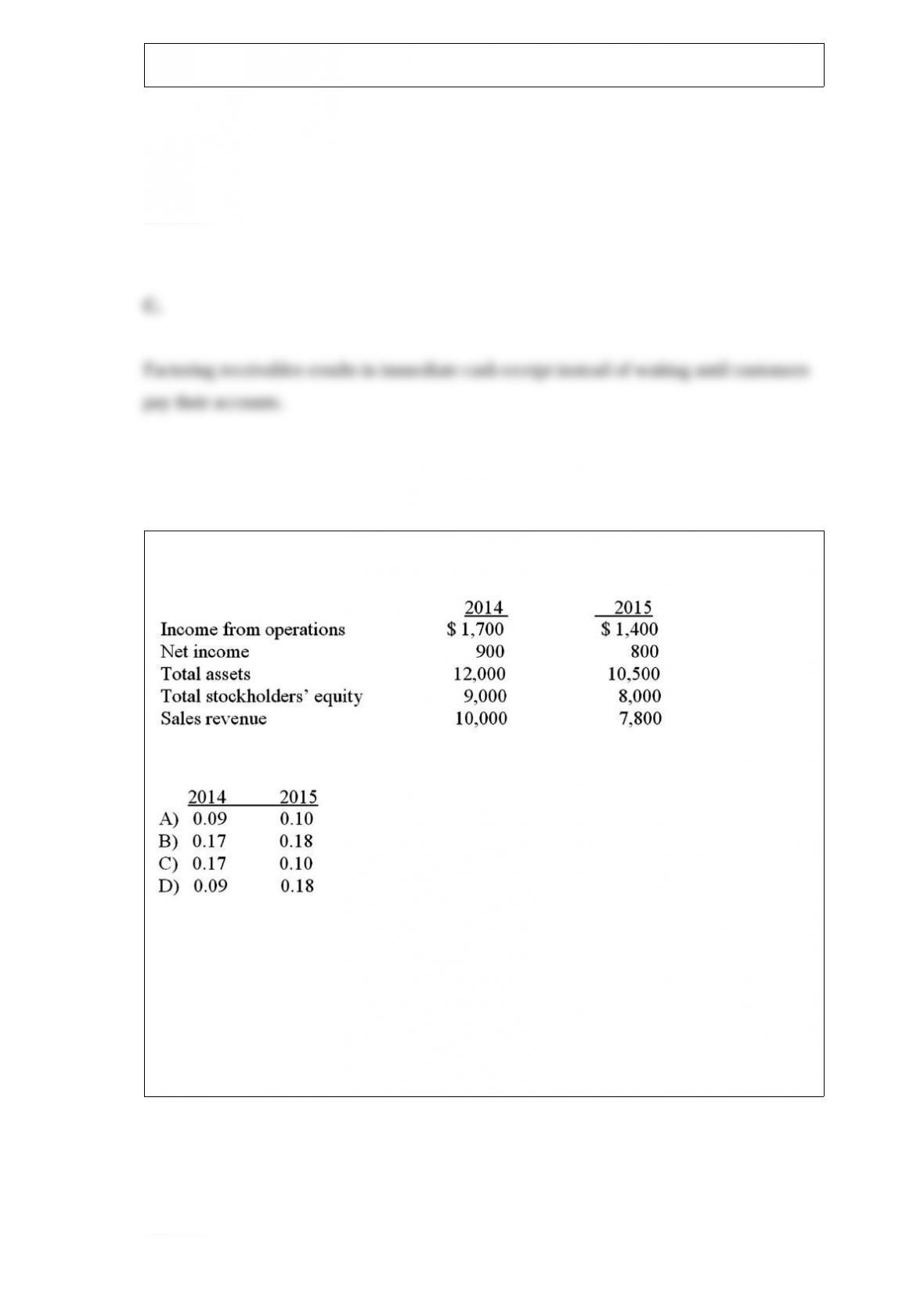
A company had total assets of $10,900 at the start of the year 2014. The following
additional information has been taken from the records:
What is the net profit margin ratio for each year?
A. Option A
B. Option B
C. Option C
D. Option D
Answer:
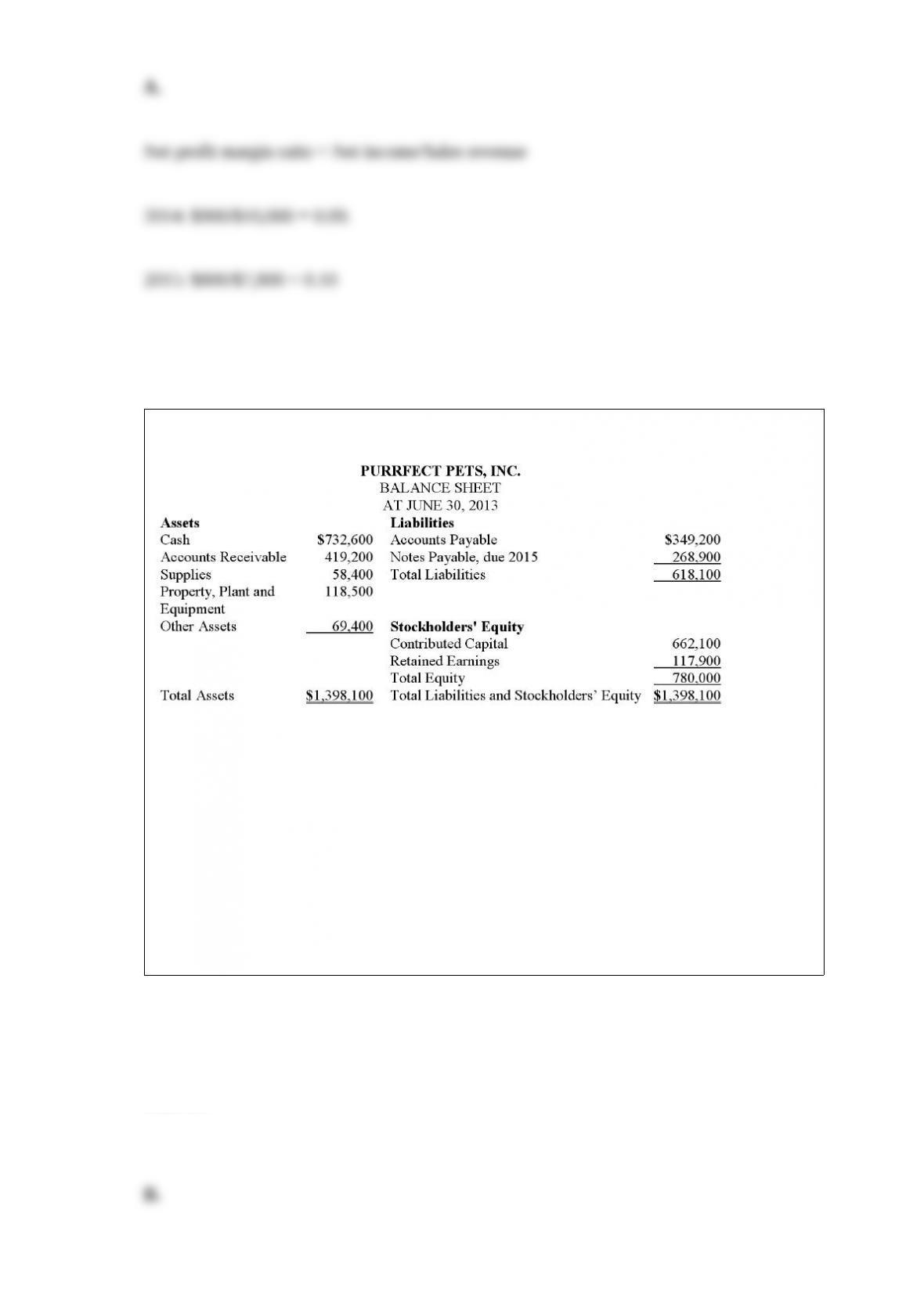
How much financing did the stockholders of Purrfect Pets, Inc., directly contribute to
the company?
A. $117,900
B. $662,100
C. $780,000
D. $1,398,100
Answer:
This month, Grass is Greener Lawn Service pays cash for $4,000 of grass fertilizer to
be used two months from now. What journal entry will Grass is Greener record this
month?
A. Debit cash for $4,000 and credit supplies expense for $4,000.
B. Debit supplies expense for $4,000 and credit accounts payable for $4,000.
C. Debit supplies for $4,000 and credit cash for $4,000.
D. Debit retained earnings for $4,000 and credit accounts payable for $4,000.
Answer:
Under what circumstances should a company record an asset impairment loss?
A. When residual value is greater than the repairs and maintenance expenses needed to
keep up the asset.
B. When net book value is less than the residual value of the asset.
C. When accumulated depreciation equals the purchase cost of the asset.
D. When net book value is greater than expected future cash flows for the asset.
Answer: