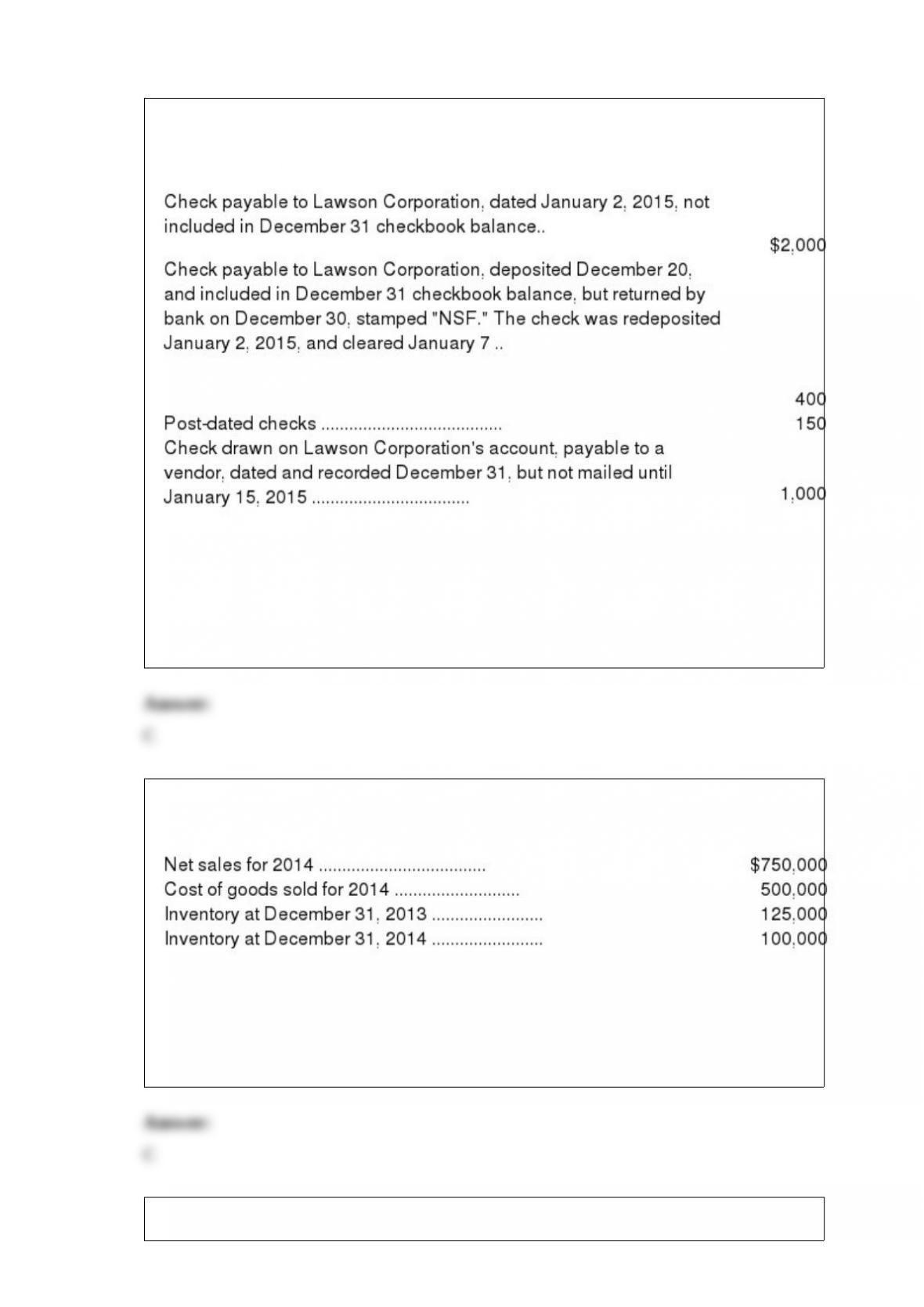
1) Lawson Corporation’s checkbook balance on December 31, 2014, was $8,000. In
addition, Lawson held the following items in its safe on December 31:
The proper amount to be shown as cash on Lawsons balance sheet at December 31,
2014, is
a. $7,600
b. $8,000
c. $8,600
d. $9,750
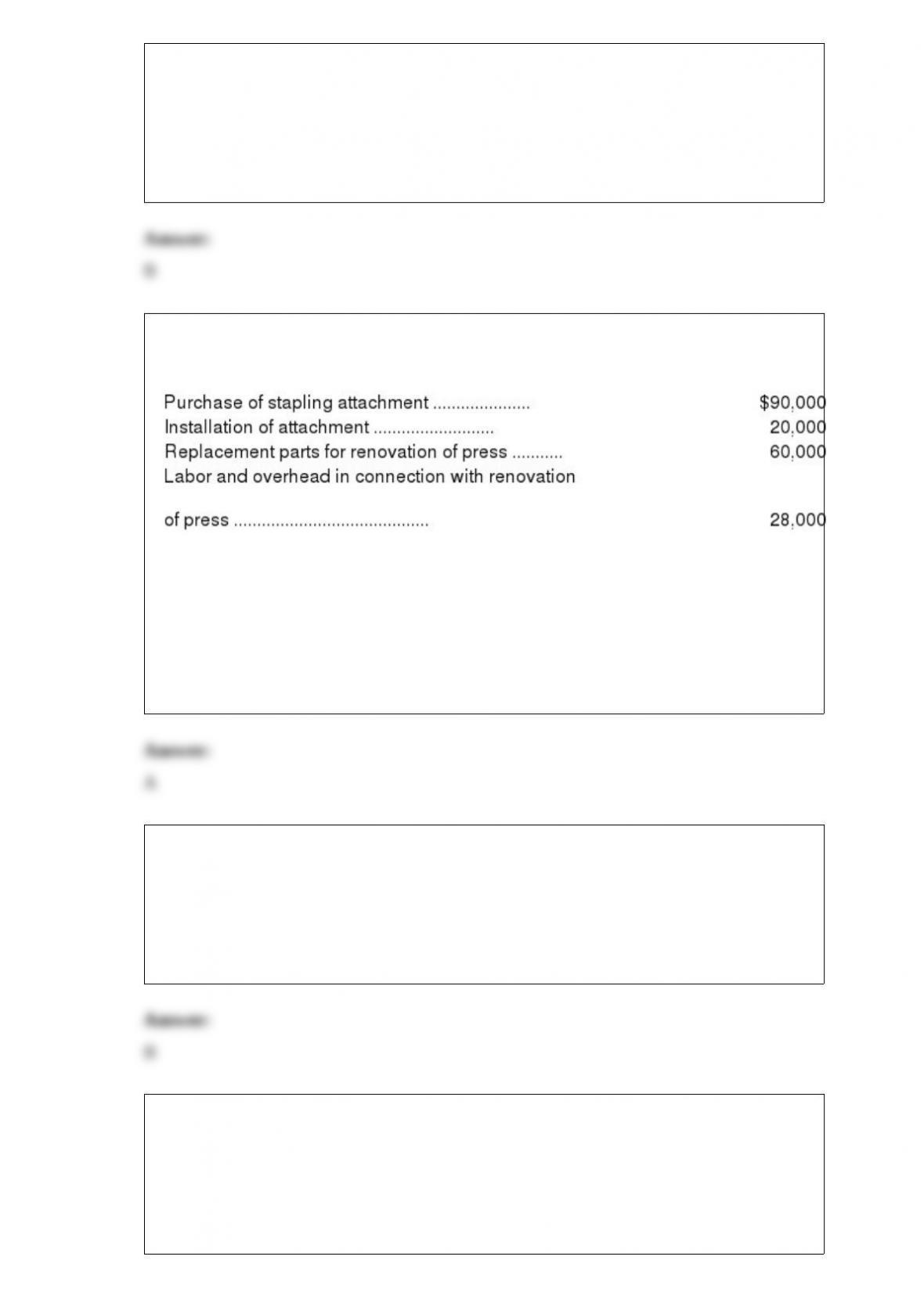
2) Selected information from the accounting records of Thackary Company is as
follows:
Thackary’s inventory turnover for 2014 is
a. 7.50 times
b. 6.665 times
c. 4.44times
d. 2.22 times
3) A donated plant asset for which the fair value has been determined, and for which
incidental costs were incurred in acceptance of the asset, should be recorded at an
amount equal to its
a. incidental costs incurred
b. fair value and incidental costs incurred
c. book value on books of donor and incidental costs incurred
d. book value on books of donor
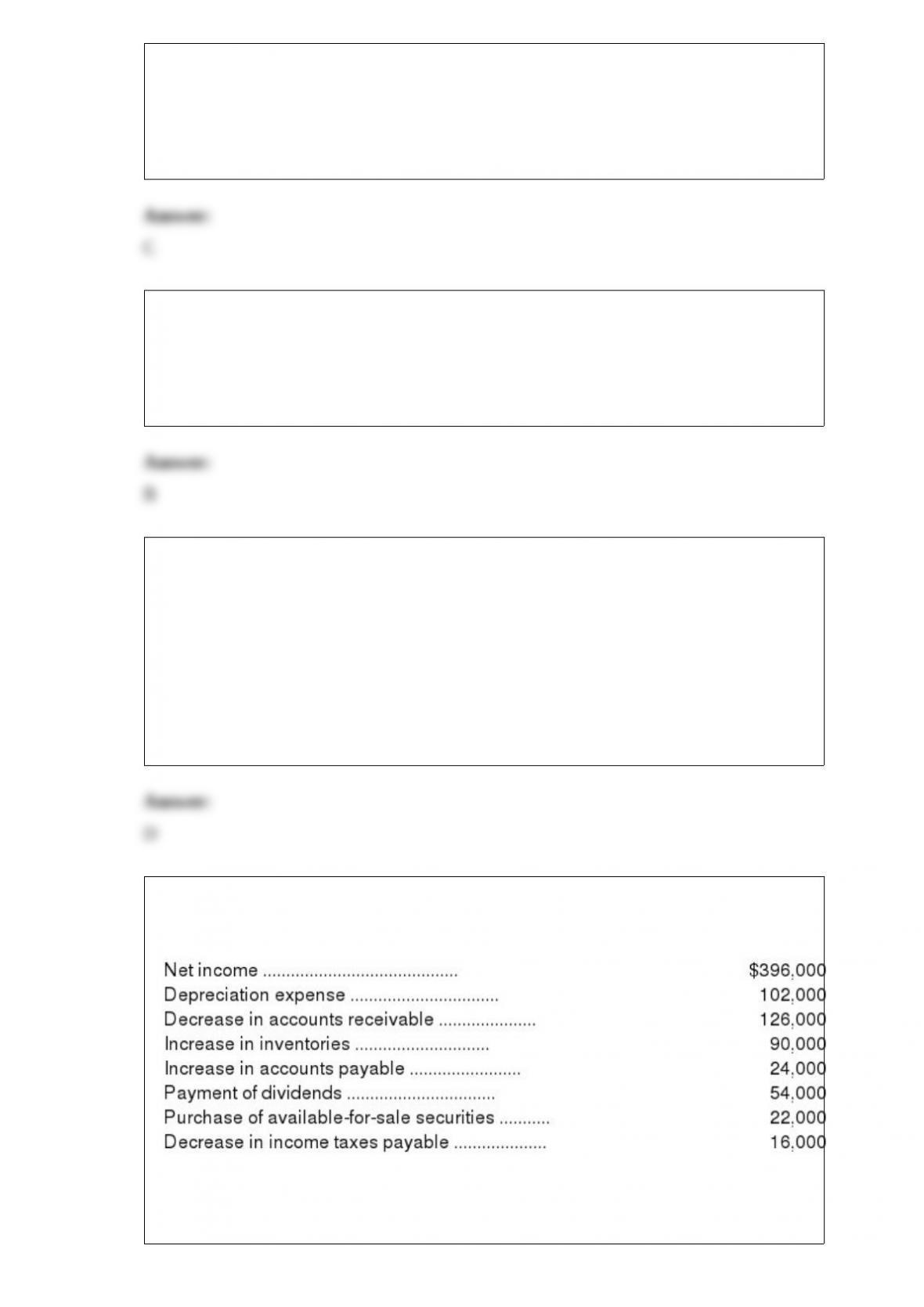
4) On September 10, Gravelly Company incurred the following costs for one of its
printing presses:
Neither the attachment nor the renovation increased the estimated useful life of the
press. However, the renovation resulted in significantly increased productivity. What
amount of the costs should be capitalized?
a. $198,000
b. $110,000
c. $90,000
d. $88,000
5) If the bonds were issued at 97 on April 1, 2014, the amount of the discount amortized
on July 1 (using the straight-line method) would be approximately
a. $25
b. $76
c. $67
d. $152
6) On March 2, 2014, Burton Corporation issued 4,000 shares of 6 percent cumulative
$100 par value preferred stock for $434,000. Each preferred share carried one
nondetachable stock warrant which entitled the holder to acquire, at $17, one share of
Burton $10 par common stock. On March 2, 2014, the market price of the preferred
stock (without warrants) was $90 per share and the market price of the stock warrants
was $15 per warrant. The amount credited to Paid-In Capital in Excess of Par-Preferred
by Burton on the issuance of the stock was
a. $0
b. $8,000
c. $34,000
d. $62,000
7) Which of the following will occur when inventory costs are decreasing?
a. LIFO will result in lower net income and lower ending inventory than will FIFO
b. FIFO will result in lower net income and lower ending inventory than will LIFO
c. LIFO will result in a lower net income, but a higher ending inventory, than will FIFO
d. FIFO will result in a lower net income, but a higher ending inventory, than will LIFO
8) What is measured by the accumulated benefit obligation?
a. The pension expense, computed by the plan formula applied to years of service to
date, assuming future salary levels
b. The pension expense, computed by the plan formula applied to years of service to
date, using existing salary levels
c. The pension obligation, computed by the plan formula applied to years of service to
date, assuming future salary levels
d. The pension obligation, computed by the plan formula applied to years of service to
date, using existing salary levels
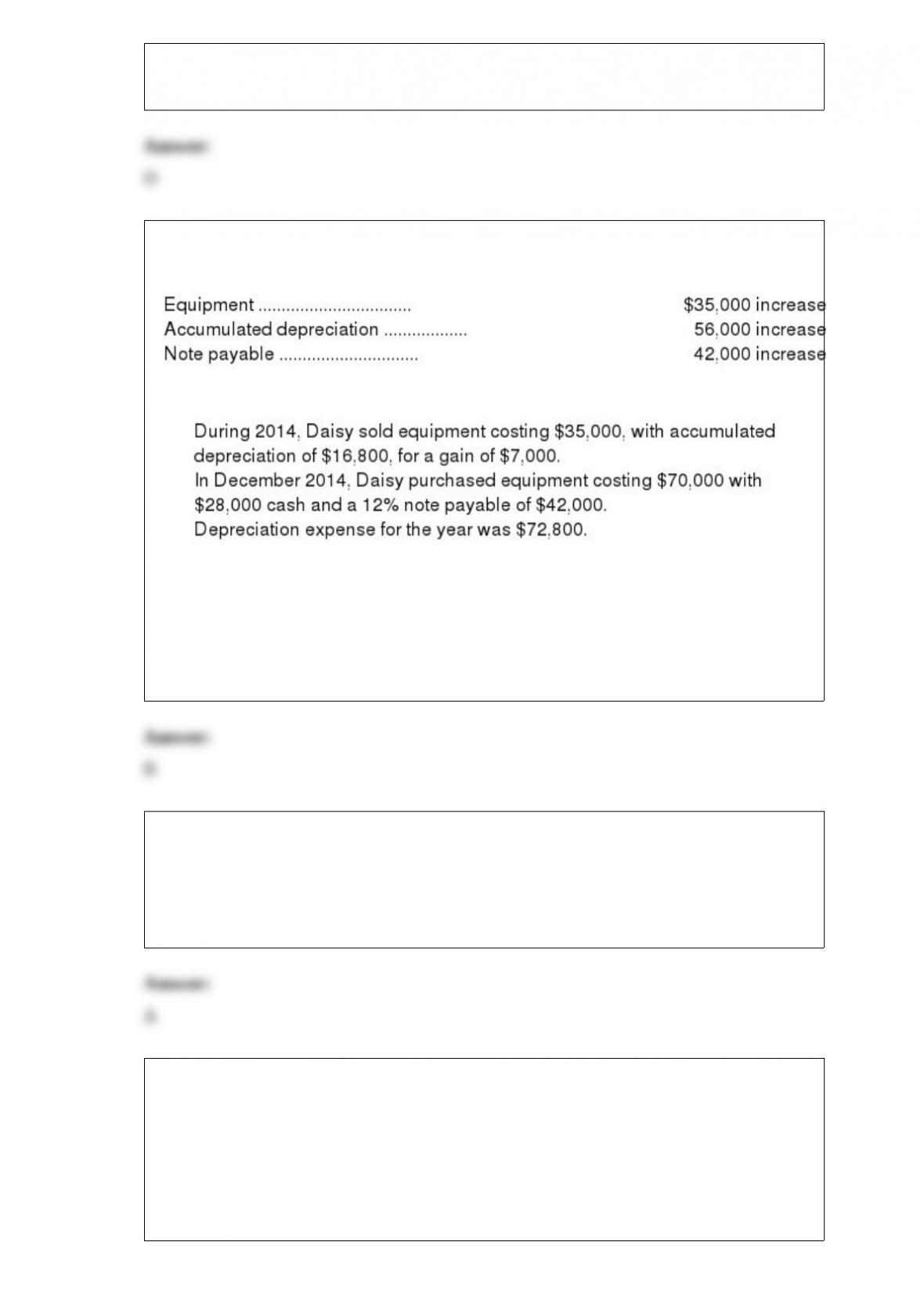
9) The following information is available from the financial statements of Barrington
Corporation for the year ended December 31, 2014:
What is Barrington Corporation’s net cash flow from operating activities?
a. $440,000
b. $466,000
c. $520,000
d. $542,000
10) Daisy Corporation reported net income of $420,000 for 2014. Changes occurred in
several balance sheet accounts as follows:
Additional information:
In Daisy’s 2014 statement of cash flows, net cash provided by operating activities
should be
a. $476,000
b. $485,800
c. $492,800
d. $499,800
11) Which of the following ratios measures short-term solvency?
a. Current ratio
b. Creditors’ equity to total assets
c. Return on investment
d. Total asset turnover
12) At the beginning of the year a company had a debit balance in the account Market
Adjustment–Trading Securities. During the year the company did not buy or sell any
trading securities, but at the end of the year the related market adjustment account had a
credit balance. This change indicates that
a. a loss on the income statement was recognized
b. a gain on the income statement was recognized
c. the value of the investment account increased

d. the value of the investment account decreased
13) On January 1, 2014, $50,000 of 20-year, 6 percent debentures were issued for
$56,275.20. Interest payment dates on the bonds are January 1 and July 1. The amount
of premium to be amortized on July 1, 2014, when using the straight-line method is
a. $313.76
b. $156.88
c. $776.50
d. $93.11
14) The inventory turnover ratio
a. measures managements ability to productively employ all of its resources
b. measures the efficient use of assets held for resale
c. is a stringent measure of liquidity
d. provides a measure of the strength of the sales mix the company currently employs
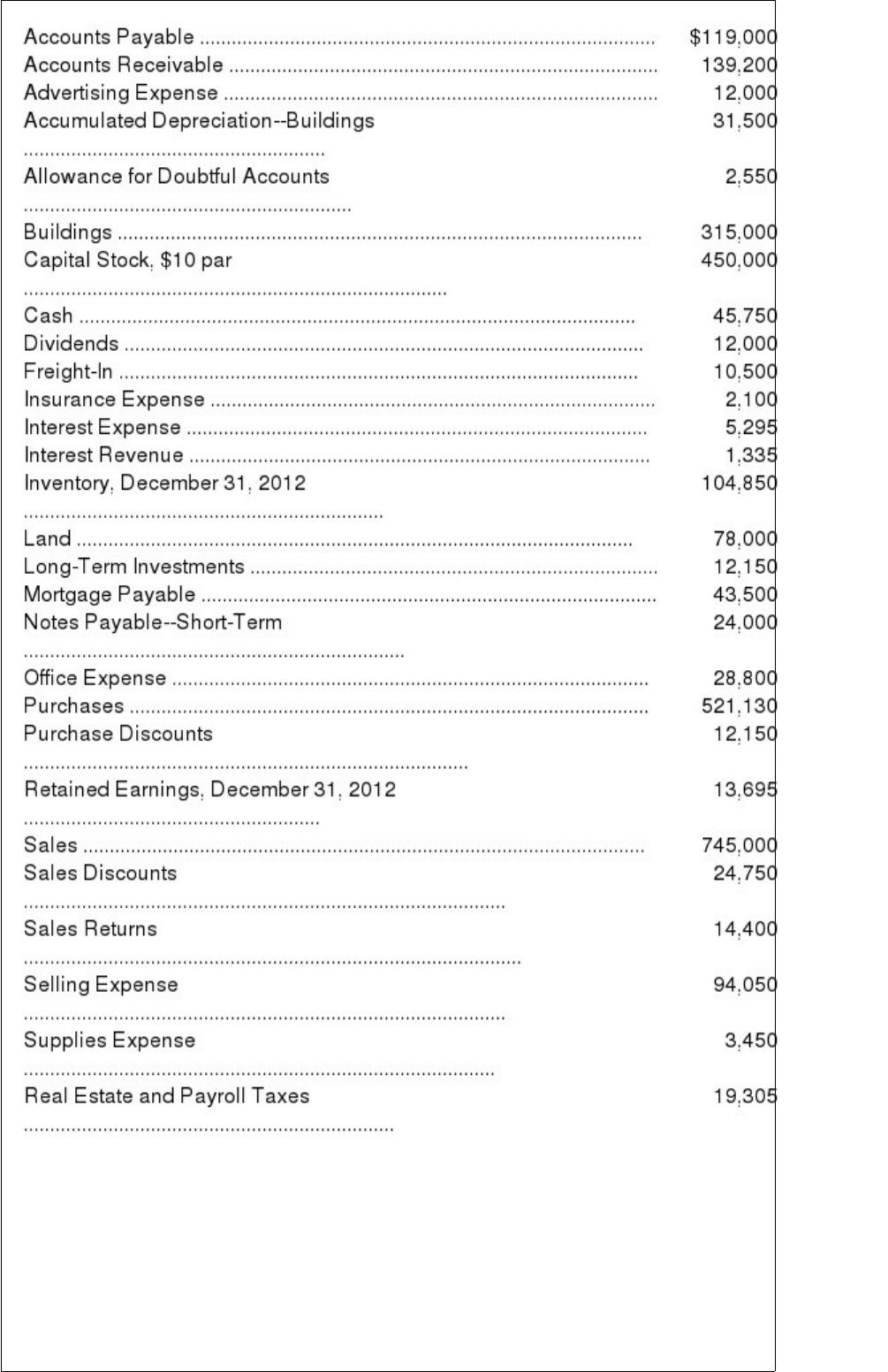
15) Account balances taken from the ledger of Middler Company on December 31,
2013, are as follows:
Adjustments on December 31, 2013, are required as follows:
(a) The inventory on hand is $135,915.
(b) The allowance for doubtful accounts is to be increased to a balance of $6,250.
(c) Buildings are depreciated at the rate of 5 percent per year.
(d) Accrued selling expenses are $6,075.
(e) There are supplies of $1,050 on hand.
(f) Prepaid insurance at December 31, 2013, totals $1,290.
(g) Accrued interest on long-term investments is $360.
(h) Accrued real estate and payroll taxes are $1,170.
(i) Accrued interest on the mortgage is $240.
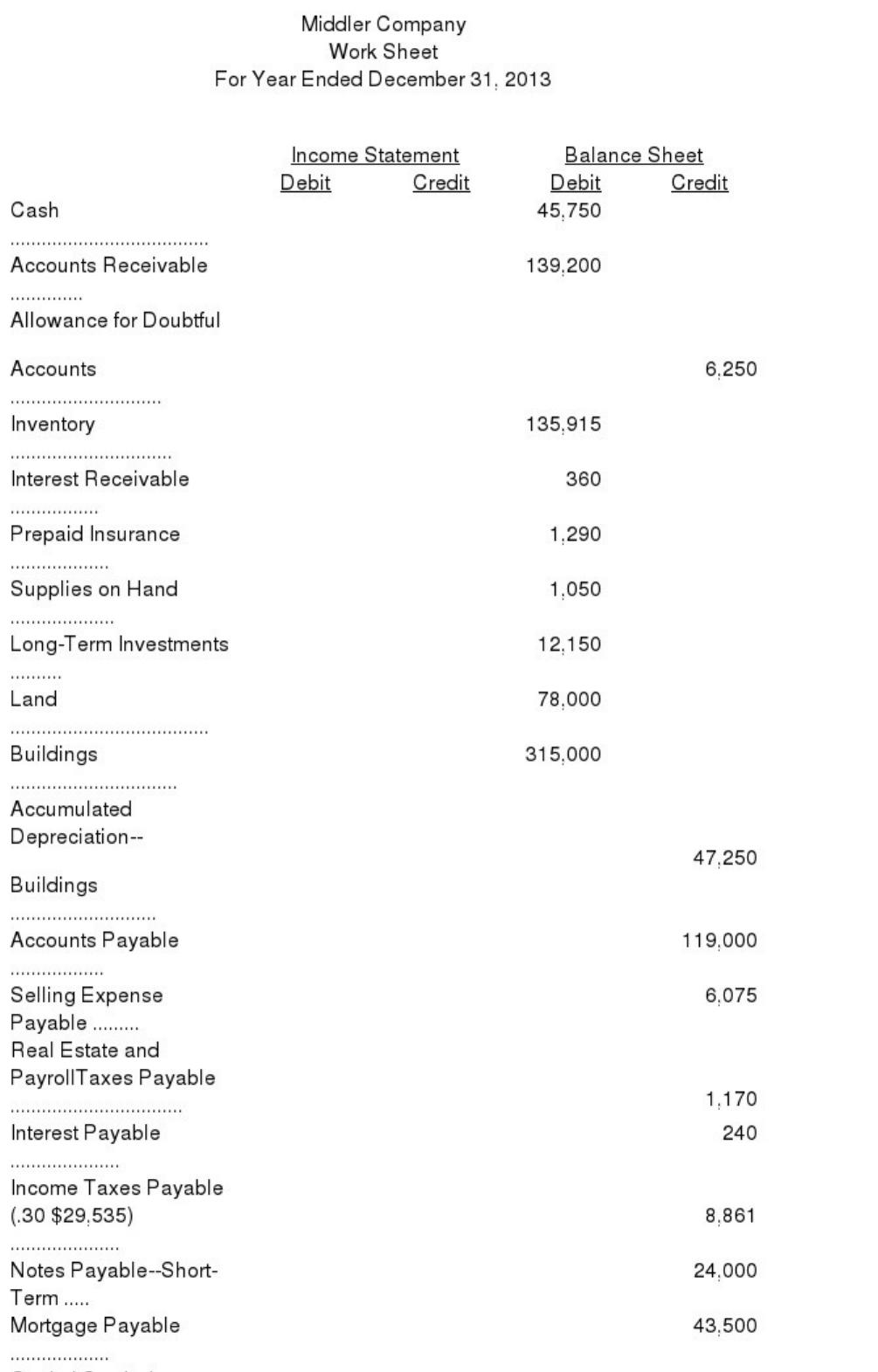
(j) Income tax is estimated to be 30 percent of the income before income tax (round to
nearest dollar).


16) Which of the following is a noncash transaction that should be disclosed in a
schedule accompanying the statement of cash flows?
a. Sale of an investment for cash
b. Purchase of a machine for cash
c. Issuance of common stock in exchange for land
d. Declaration and payment of a cash dividend on common stock
17) Which of the following is true regarding International Accounting Standard No. 23
(IAS 23), Borrowing Costs, and FASB Statement of Financial Accounting Standards
No. 34 (SFAS No. 34), Capitalization of Interest Cost?
a. IAS 23 requires the capitalization of borrowing costs less the amount of investment
income generated by borrowed construction funds temporarily invested
b. SFAS No.34 requires the capitalization of borrowing costs less the amount of
investment income generated by borrowed construction funds temporarily invested
c. IAS 23 requires that all interest should be expensed
d. Both IAS 23 and SFAS No. 34 require the capitalization of borrowing costs with no
adjustment for the amount of investment income generated by borrowed

18) The following information is available for Closer Company relative to 2014
operations:
What is Closer Companys accounts receivable balance at December 31, 2014?
a. $82,000
b. $62,000
c. $20,000
d. $146,000
19) Kurtain Corp. leased a new building and land from Harlow Leasing Inc. for 20
years. At the inception of the lease the building and land have fair market values of
$150,000 and $20,000, respectively. The building has an expected economic life of 25
years. Which of the following statements is correct regarding Kurtain’s treatment of the
lease?
a. Kurtain should treat the lease as a capital lease provided that the land and building
are recorded in separate asset accounts and accounted for separately
b. Kurtain should treat the lease as a capital lease only if there is either a bargain
purchase option or an automatic transfer of ownership at the termination of the lease
c. Kurtain should treat the lease as a capital lease even though there is no bargain
purchase option and no automatic transfer of ownership at the termination of the lease
d. Kurtain should treat the lease as a capital lease only if Harlow treats the transaction
as a leveraged lease
20) International accounting standards currently are moving toward the
a. comprehensive recognition approach
b. partial recognition approach
c. no-deferral approach
d. discounted comprehensive recognition approach

21) Which of the following would NOT be reported for capital stock in the contributed
capital section of a classified balance sheet?
a. Dividends per share
b. Shares authorized
c. Shares issued
d. Shares outstanding
22) For the current year, Eastern Atlantic Company reported income tax expense of
$21,000. Income taxes payable at the end of the prior year were $19,000 and at the end
of the current year were $20,000. The deferred tax liability classified as noncurrent that
resulted from the use of MACRS for tax purposes and straight-line depreciation for
financial reporting purposes increased from $21,000 at the beginning of the current year
to $23,000 at the end of the current year. How much cash was paid for income taxes
during the year?
a. $18,000
b. $20,000
c. $21,000
d. $19,000
23) The effective interest rate on bonds is higher than the stated rate when bonds sell
a. at face value
b. above face value
c. below face value
d. at maturity value
24) Financial disclosure statements are strictest in
a. the United Kingdom
b. Germany
c. the United States
d. France

25) The statement of cash flows and related disclosures would be of the least assistance
in helping a potential investor assess
a. a firms ability to generate cash
b. a firms ability to make good use of cash reserves to earn interest or other return
c. a firms ability to meet its obligations
d. the reasons for differences between income and associated cash flows
26) On July 1, 2014, Stagger Company sold some limited edition art prints to
Wakaramas Company for 38,500,000 to be paid on September 30 of that year. The
current exchange rate on July 1, 2014, was 110=$1, so the total payment at the current
exchange rate would be equal to $350,000. Stagger entered into a forward contract with
a large bank to guarantee the number of dollars to be received. According to the terms
of the contract, if 38,500,000 is worth less than $350,000, the bank will pay Stagger the
difference in cash. Likewise, if 38,500,000 is worth more than $350,000, Stagger must
pay the bank the difference in cash.
Using the information above and assuming the exchange rate on September 30 is
115=$1, what amount will Stagger pay to, or receive from, the bank (rounded to the
nearest dollar)?
a. $15,217 payment
b. $15,217 receipt
c. $16,667 payment
d. $16,667 receipt
27) Brawn Co. has a $20,000, two-year note payable to Gassaway City Bank that
matures June 30, 2014. Brawn’s management intends to refinance the note for an
additional three years and is negotiating a financing agreement with Gassaway City. In
order to exclude this note from current liabilities on its December 31, 2013, balance
sheet, Brawn Co. must
a. pay off the note and complete the refinancing before the 2013 financial statements
are issued
b. complete the refinancing before the note’s maturity date
c. complete the refinancing before the balance sheet date
d. demonstrate an ability to refinance the obligation before the 2013 financial
statements are issued
28) Cash equivalents would not include short-term investments in
a. money market funds

b. available-for-sale securities
c. commercial paper
d. certificates of deposit
29) Assume the Abokair Corporation sold $30,000 worth of merchandise on the
installment basis. The cost of the merchandise was $24,000, and collectibility of the
receivable is uncertain. Collection in the current year on the account is $8,000. How
much gross profit should be reported as realized?
a. $1,600
b. $2,000
c. $6,000
d. $8,000
30) A firms accumulated depreciation account increased $30,000 for the year and total
plant assets at cost increased $200,000. During the year, the firm purchased $350,000 of
new equipment for cash, and sold equipment for $50,000 cash. This equipment had
been depreciated $30,000 at the time of the sale. What is the complete disclosure of
these events in the statement of cash flows prepared under the direct method?
a. $300,000 investing cash outflow; $130,000 addition reconciling adjustment
b. $350,000 investing cash outflow; $50,000 investing cash inflow; $60,000 addition
reconciling adjustment
c. $350,000 investing cash outflow; $50,000 investing cash inflow; $60,000 addition
reconciling adjustment; $70,000 addition reconciling adjustment
d. $350,000 investing cash outflow; $50,000 investing cash inflow; $70,000 addition
reconciling adjustment
31) Any gains or losses from the early extinguishment of debt should be
a. recognized in income of the period of extinguishment
b. treated as an increase or decrease in Paid-In Capital
c. allocated between a portion that is an increase (decrease) in Paid-In Capital and a
portion that is recognized in current income
d. amortized over the remaining original life of the extinguished debt

32) Strong Company’s December 31 year-end financial statements contained the
following errors:
An insurance premium of $3,600 was prepaid in 2013 covering the years 2013, 2014,
and 2015. The entire amount was charged to expense in 2013. In addition, on December
31, 2014, fully depreciated machinery was sold for $6,400 cash, but the sale was not
recorded until 2015. There were no other errors during 2013 or 2014, and no corrections
have been made for any of the errors. Ignore income tax considerations. What is the
total effect of the errors on 2014 net income?
a. Net income is understated by $12,800
b. Net income is overstated by $3,600
c. Net income is understated by $1,600
d. Net income is overstated by $2,400
33) Which of the following is correct regarding the provisions of IAS No. 8 on
accounting changes and error corrections?
a. IAS No. 8 requires that correction of an error be made only by restatement of all prior
periods presented
b. IAS No. 8 requires correction of an error to be made only by reflecting the effect of
the correction in income of the period in which the error was discovered without
restating previously reported results
c. IAS No. 8 allows correction of an error to be made either through restatement of all
period periods presented or by reflecting the effect of the correction in income of the
period in which the error was discovered without restating previously reported results
d. IAS No. 8 reflects a preference for not restating prior results in reporting accounting
changes and error corrections
34) An example of a “deductible temporary difference” occurs when
a. the installment sales method is used for tax purposes, but the accrual method of
recognizing sales revenue is used for financial reporting purposes
b. warranty expenses are recognized on the accrual basis for financial reporting
purposes but recognized as the warranty conditions are met for tax purposes
c. accelerated depreciation is used for tax purposes but straight-line depreciation is used
for accounting purposes
d. the completed-contract method of recognizing construction revenue is used for tax
purposes, but the percentage-of-completion method is used for financial reporting
purposes
35) When the current year’s ending inventory amount is overstated, the
a. current year’s cost of goods sold is overstated
b. current year’s total assets are understated
c. current year’s net income is overstated
d. next year’s income is overstated
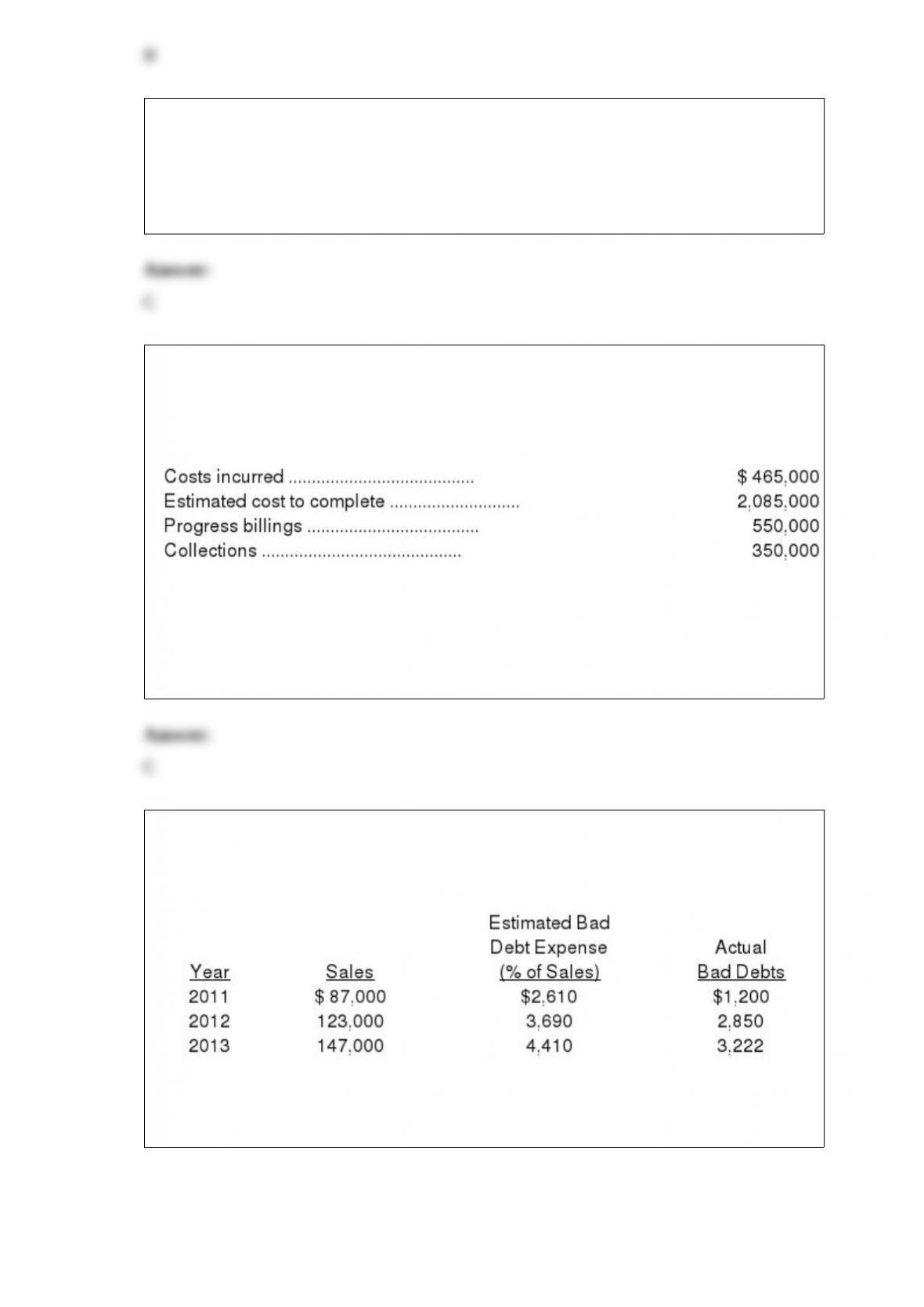
36) Gunner Construction, Inc. has consistently used the percentage-of-completion
method of recognizing revenue. During 2014, Gunner started work on a $2,500,000
fixed-price construction contract. The accounting records disclosed the following data
for the year ended December 31, 2014:
How much loss should Gunner have recognized in 2014?
a. $15,000
b. $35,000
c. $50,000
d. $315,000
37) Improved Technologies has estimated bad debts using the percentage-of-sales
method since their business began operations in 2011. Information relating to bad debts
and sales is as follows:
At the beginning of 2014, Improved proposes changing their estimation of bad debt
expense from 3 percent of sales to 2.5 percent. Sales for the year totaled $186,000 and
actual bad debts amounted to $3,910.
38) Algon Company owns a machine that cost $560,000, has a book value of $240,000,
and an estimated fair value of $480,000. Nogal Company has a machine that cost
$720,000, has accumulated depreciation of $400,000, and an estimated fair value of
$640,000. Algon pays Nogal cash of $160,000. Assume the trade has commercial
substance.
39) On January 1, 2014, the Bombay Corp. amended its defined benefit pension plan to
provide increased retirement benefits for its 150 employees covered by the plan on that
date. As a result of the plan amendment, the projected benefit obligation as of January
1, 2014, increased by $1,275,000. Management decided to amortize this amount on a
straight-line basis over the average remaining service life of the 150 employees. It is
assumed that employees will retire at the rate of six employees per year over the next
25 years. The prior service cost is to be funded with equal annual contributions over a
ten-year period. The first contribution is due at the end of 2014 and the assumed interest
rate for funding purposes is 12 percent. The present value factor for an ordinary annuity
for ten periods at 12 percent is 5.6502.
40) Wastenot is a waste disposal company. Explain the effect the following actions of
the management of Wastenot Company might have in managing earnings:
41) The percentage-of-completion method is a generally accepted accounting procedure
that allows revenue to be recognized prior to the completion of a project or product.
Revenues and gross profit are recognized each period based upon the progress of the
construction. Construction costs plus gross profit earned to date are accumulated in an
inventory account (Construction in Progress) and progress billings are accumulated in a
contra-inventory account (Billings on Construction in Progress).
Required:
Explain the effect on shareholders and managers if an enterprise did not use the
percentage-of-completion method to account for long-term contracts and projects.