1) The Form W-2 must be given to employees before January 31 following the year
covered by the Form W-2.
2) Within the same flexible budget performance report, it is impossible to have both
favorable and unfavorable variances.
3) The management concept of customer orientation motivates a company to spend
large amounts on advertising to convince customers to buy the company’s standard
products.
4) A variable cost changes in proportion to changes in the volume in activity.
5) Profitability is the ability to generate positive market expectations.
6) The number of hours that a department uses equipment and machinery is a
reasonable basis for allocating depreciation.
7) On January 1, a company issued a $500,000, 10%, 8-year bond payable, and received
proceeds of $473,845. Interest is payable each June 30 and December 31. The total
interest expense on the bond over its eight-year life is $400,000.
8) Sales taxes payable is debited and cash is credited when companies send sales taxes
collected from customers to the government.
9) The statement of cash flows reports and proves the net change in cash for a reporting
period.
10) Managerial accounting reports and information are used by external users and
financial accounting by internal users.
11) The cost of an inventory item includes its invoice cost plus any added or incidental
costs necessary to put it in a place and condition for sale, and minus any discount.
12) Paxton Company can produce a component of its product that incurs the following
costs per unit: direct materials, $10; direct labor, $14, variable overhead, $3 and fixed
overhead, $8. An outside supplier has offered to sell the product to Axle for $32.
Compute the net incremental cost or savings of buying the component.
A.$5.00 savings per unit.
B.$3.00 cost per unit.
C.$0 cost or savings per unit.
D.$5.00 cost per unit.
E.$3.00 savings per unit.
13) Honoring a note receivable indicates that the maker has:
A.Signed.
B.Paid in full.
C.Guaranteed.
D.Notarized.
E.Cosigned.
14) McVeigh Corp. owns 40% of Gondor Company’s common stock. McVeigh received
$41,200 in cash dividends from Gondor. The entry to record this transaction should
include a:
A.Debit to Dividends for $103,000.
B.Credit to Long-Term Investments for $41,200.
C.Debit to Dividend Revenue for $41,200.
D.Credit to Long-Term Investments for $103,000.
E.Credit to Cash for $41,200.
15) The two business entities involved in an investment in securities with controlling
influence, for which consolidated financial statements are prepared, are known as:
A.Parent and Investor
B.Subsidiary and Investee
C.Consolidator and Parent
D.Parent and Subsidiary
E.Both are referred to as partners.
16) If a company purchases equipment costing $4,500 on credit, the effect on the
accounting equation would be:
A.Assets increase $4,500 and liabilities decrease $4,500.
B.Equity decreases $4,500 and liabilities increase $4,500.
C.Liabilities decrease $4,500 and assets increase $4,500.
D.Assets increase $4,500 and liabilities increase $4,500.
E.Equity increases $4,500 and liabilities decrease $4,500.
17) The following information relating to a company’s overhead costs is available.
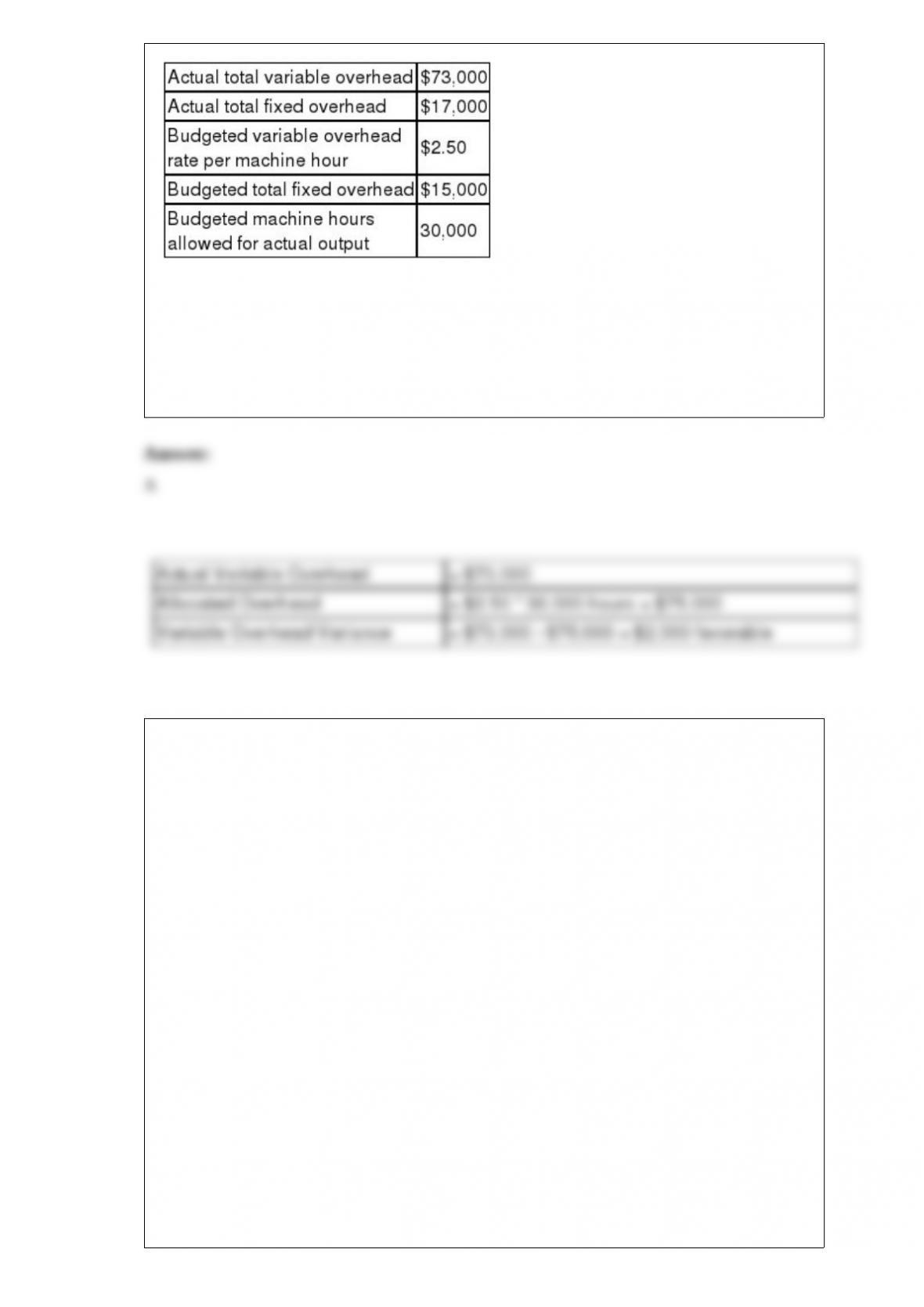
Based on this information, the total variable overhead variance is:
A.$2,000 favorable.
B.$6,000 favorable.
C.$2,000 unfavorable.
D.$6,000 unfavorable.
E.$1,000 favorable.
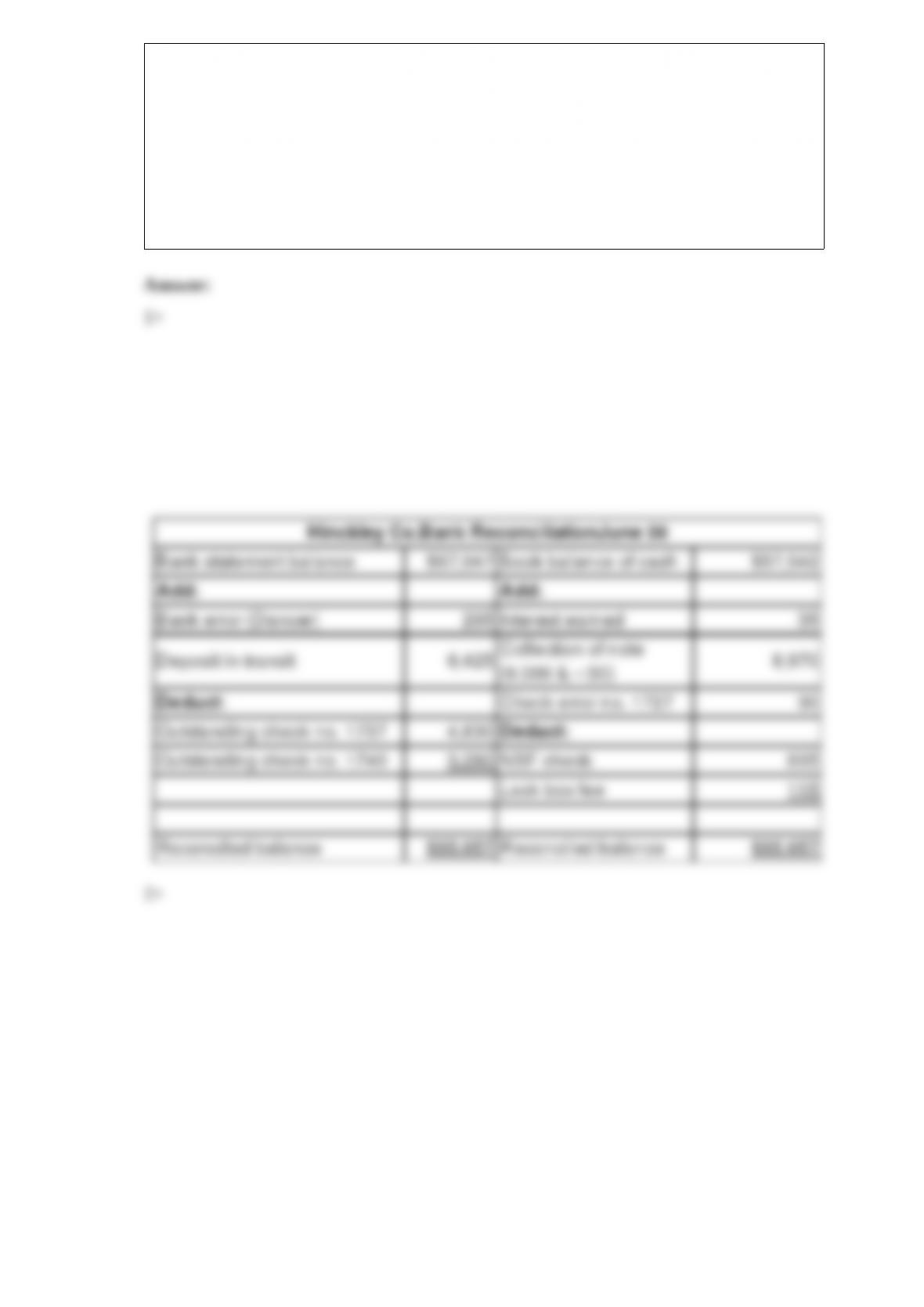
18) The following information is available to reconcile Hinckley Company’s book
balance of cash with its bank statement cash balance as of June 30. The June 30 cash
balance according to the accounting records is $57,542, and the bank statement cash
balance for that date is $67,047.
a. The bank erroneously cleared a $295 check against the account in June that was not
issued by Hinckley. The check documentation included with the bank statement
indicates the check was actually issued by Dancer Co.
b. On June 30, the bank issued a credit memorandum for $35 interest earned on
Hinckley’s account.
c. When the June checks are compared with entries in the accounting records, it is
found that Check No. 1727 had been correctly drawn for $1,450 to pay for advertising
but was erroneously entered in the accounting records as $1,540.
d. A credit memorandum indicates that the bank collected $9,000 cash on a note
receivable for Hinckley, deducted a $30 collection fee, and credited the balance to the
company’s Cash account. Hinckley did not record this transaction before receiving the
statement.
e. A debit memorandum of $865 is enclosed with the bank statement for an NSF check
for $840 received from a customer. The bank assessed a $25 fee for processing it.
f. Hinckley’s June 30 daily cash receipts of $6,425 were placed in the bank’s night
depository on that date, but do not appear on the June 30 bank statement.
g. Hinckley’s June 30 cash disbursements journal indicates that Check No. 1737 for
$4,830 and Check No. 1740 for $3,280 were both written and entered in the accounting
records, but are not among the canceled checks.
h. A debit memorandum for $115.00 indicates the bank deducted the annual lock box
fee for the company.
1> Prepare the bank reconciliation for this company as of June 30.
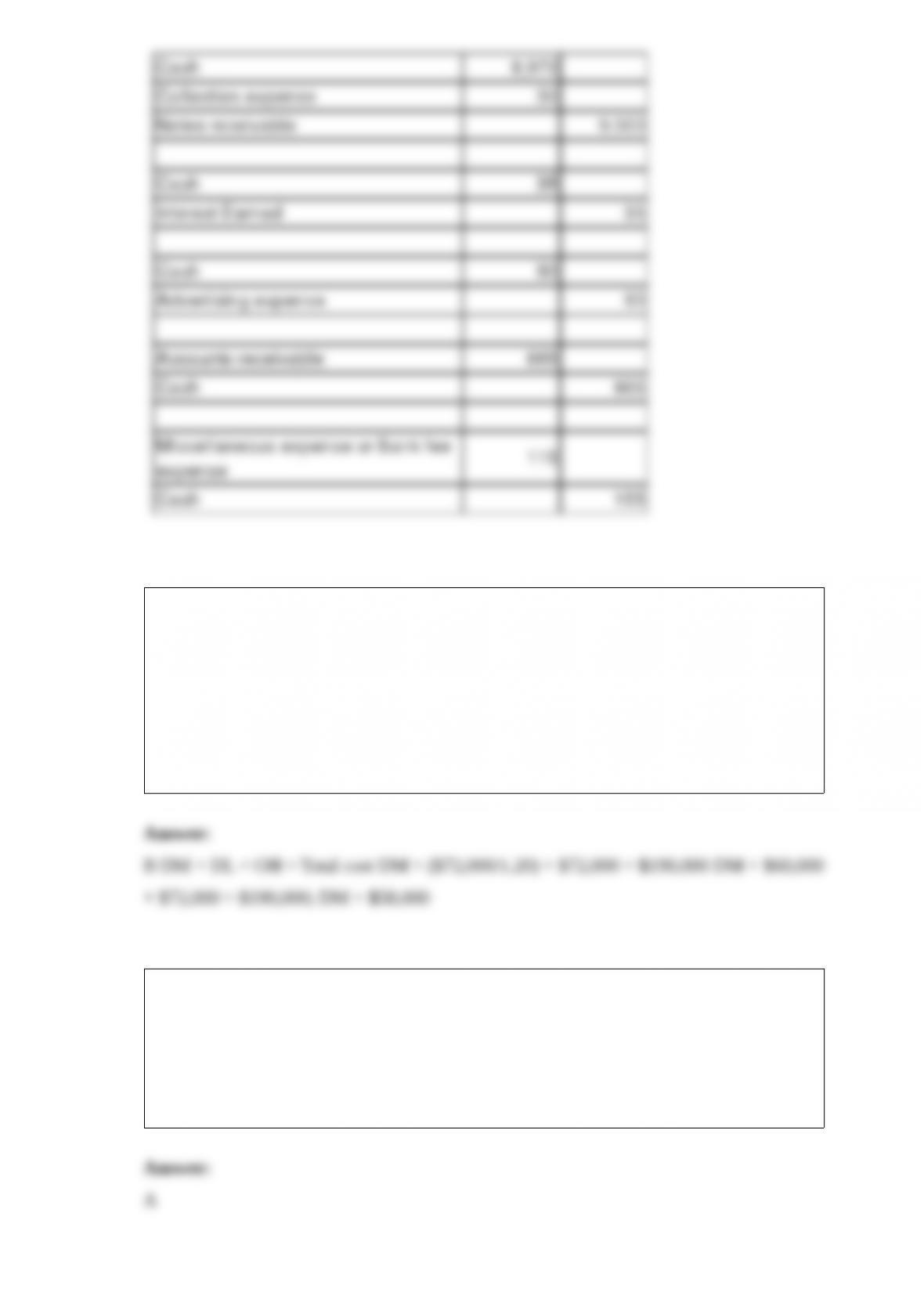
2> Prepare the journal entries necessary to bring the company’s book balance of cash
into conformity with the reconciled cash balance as of June 30.
19) Finished goods inventory is $190,000. If overhead applied to these goods is
$72,000, and the overhead rate is 120% of direct labor, how much direct materials cost
was incurred in producing the inventory?
A.$31,600.
B.$58,000.
C.$56,000.
D.$60,000.
E.$86,400.
20) When a bond sells at a premium:
A.The contract rate is above the market rate.
B.The contract rate is equal to the market rate.
C.The contract rate is below the market rate.
D.It means that the bond is a zero coupon bond.
E.The bond pays no interest.
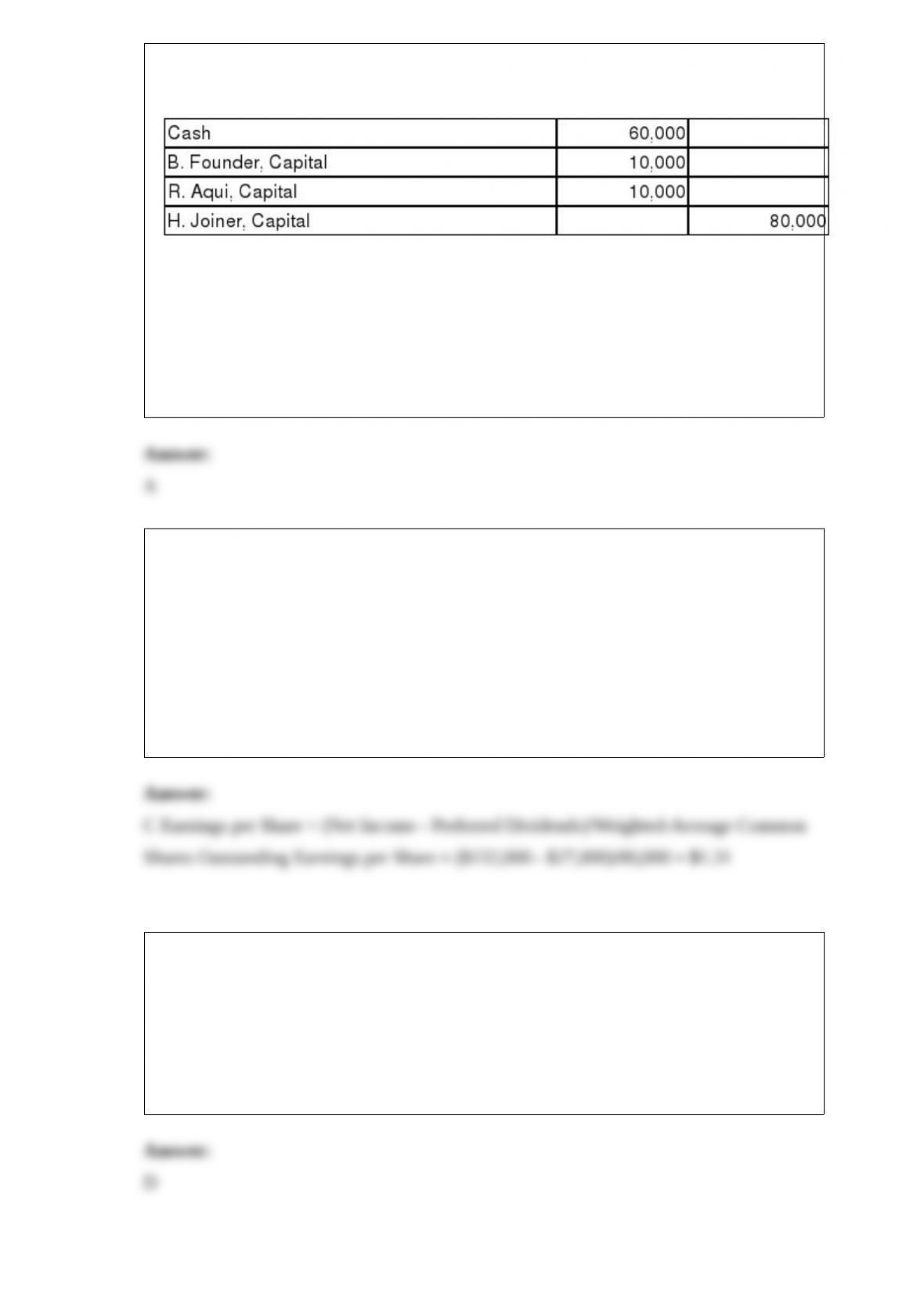
21) A partnership recorded the following journal entry:
This entry reflects:
A.Acceptance of a new partner who invests $60,000 and receives a $20,000 bonus.
B.Withdrawal of a partner who pays a $10,000 bonus to each of the other partners.
C.Addition of a partner who pays a bonus to each of the other partners.
D.Additional investment into the partnership by Founder and Aqui.
E.Withdrawal of $10,000 each by Founder and Aqui upon the admission of a new
partner.
22) Mayan Company had net income of $132,000. The weighted-average common
shares outstanding were 80,000. The company declared a $27,000 dividend on its
noncumulative, nonparticipating preferred stock. There were no other stock
transactions. The company’s earnings per share is:
A.$1.65.
B.$1.99.
C.$1.31.
D.$0.34.
E.$4.89.
23) The first line item in the operating activities section of a spreadsheet for a statement
of cash flows prepared using the indirect method is:
A.Cash.
B.Cash received from customers.
C.Increase (decrease) in accounts receivable.
D.Net income.
E.Adjustments to net income.

24) A credit is used to record an increase in all of the following accounts except:
A.Accounts Payable
B.Service Revenue
C.Unearned Revenue
D.Wages Expense
E.Owner’s Capital
25) Portside Watercraft uses a job order costing system. During one month Portside
purchased $153,000 of raw materials on credit; issued materials to production of
$164,000 of which $24,000 were indirect. Portside incurred a factory payroll of
$95,000, paid in cash, of which $25,000 was indirect labor. Portside uses a
predetermined overhead rate of 170% of direct labor cost. The journal entry to record
the issuance of materials to production is:
A.Debit Raw Materials Inventory $153,000; credit Accounts Payable $153,000.
B.Debit Work in Process Inventory $140,000; debit Factory Overhead $24,000; credit
Raw Materials Inventory $164,000.
C.Debit Raw Materials Inventory $195,000; credit Work in Process Inventory
$195,000.
D.Debit Work in Process Inventory $140,000; debit Raw Materials Inventory $24,000;
credit Materials Inventory $164,000.
E.Debit Finished Goods Inventory $140,000; credit Raw Materials Inventory $140,000.
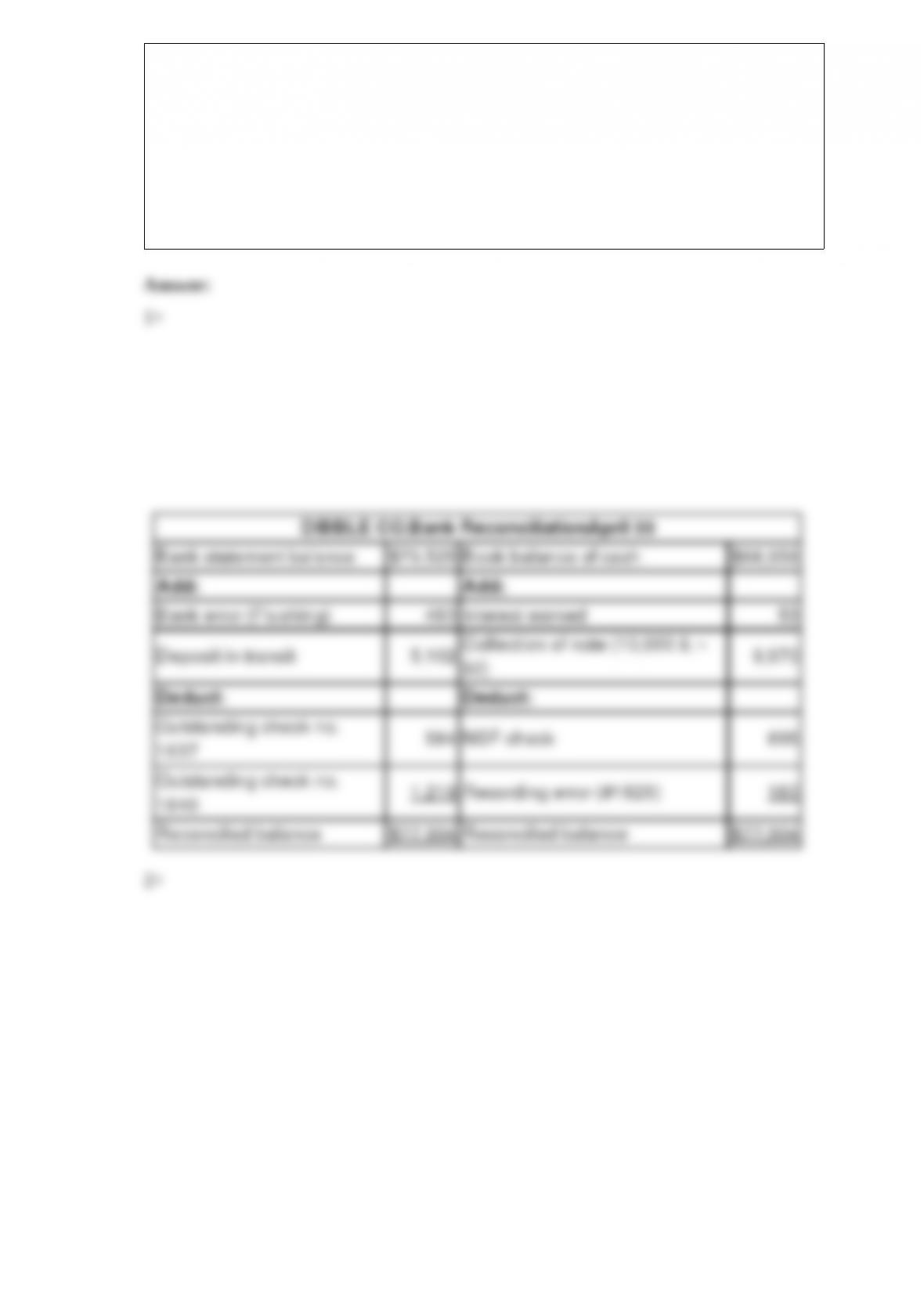
26) The following information is available to reconcile Dibble Co.’s book balance of
cash with its bank statement cash balance as of April 30. The April 30 cash balance
according to the accounting records is $68,356, and the bank statement cash balance for
that date is $73,525.
a. The bank erroneously cleared a $480 check against the account in April that was not
issued by Dibble. The check documentation included with the bank statement indicates
the check was actually issued by Flushing Co.
b. On April 30, the bank issued a credit memorandum for $53 interest earned on
Dibble’s account.
c. When the April checks are compared with entries in the accounting records, it is
found that Check No. 1828 had been correctly drawn for $1,530 to pay for advertising
but was erroneously entered in the accounting records as $1,350.
d. A credit memorandum indicates that the bank collected $10,000 cash on a note
receivable for Dibble, deducted a $30 collection fee, and credited the balance to the
company’s Cash account. Dibble did not record this transaction before receiving the
statement.
e. A debit memorandum of $895 is enclosed with the bank statement for an NSF check
for $870 received from a customer. The bank assessed a $25 fee for processing it.
f. Dibble’s April 30 daily cash receipts of $5,102 were placed in the bank’s night
depository on that date, but do not appear on the April 30 bank statement.
g. Dibble’s April 30 cash disbursements journal indicates that Check No. 1837 for $584
and Check No. 1840 for $1,219 were both written and entered in the accounting
records, but are not among the canceled checks.
1> Prepare the bank reconciliation for this company as of April 30.
2> Prepare the journal entries necessary to bring the company’s book balance of cash
into conformity with the reconciled cash balance as of April 30.
27) Define the cash flow on total assets ratio and explain how it is used to evaluate cash
flows and to assess company performance.
28) Job #411 was budgeted to require 3.5 hours of labor at $11.00 per hour. However, it
was completed in 3 hours by a person who worked for $14.00 per hour. What is the
total labor cost variance for Job #4115?
29) A company’s job order costing system applies overhead based on direct labor cost.
The company’s estimated production costs for were: direct labor, $57,600; direct
materials, $76,800; and factory overhead, $9,600. Calculate the company’s overhead
rate.
30) The budget that lists the dollar amounts to be both received from plant asset
disposals and spent to purchase additional plant assets to carry out the budgeted
business activities is the __________________________.
31) In producing 700 units of product last period, Azure Company used 5,000 pounds
of Material K, costing $34,250. The company has established the standard of using 7.2
pounds of Material K per unit of product, at a price of $7.50 per pound. Calculate the
materials price and quantity variances associated with producing the 700 units, and
indicate whether they are favorable or unfavorable:
32) A corporation is responsible for its own acts and debts because it is considered a
____________________________________.
33) A ________ accounting system records production activities using a perpetual
inventory system.
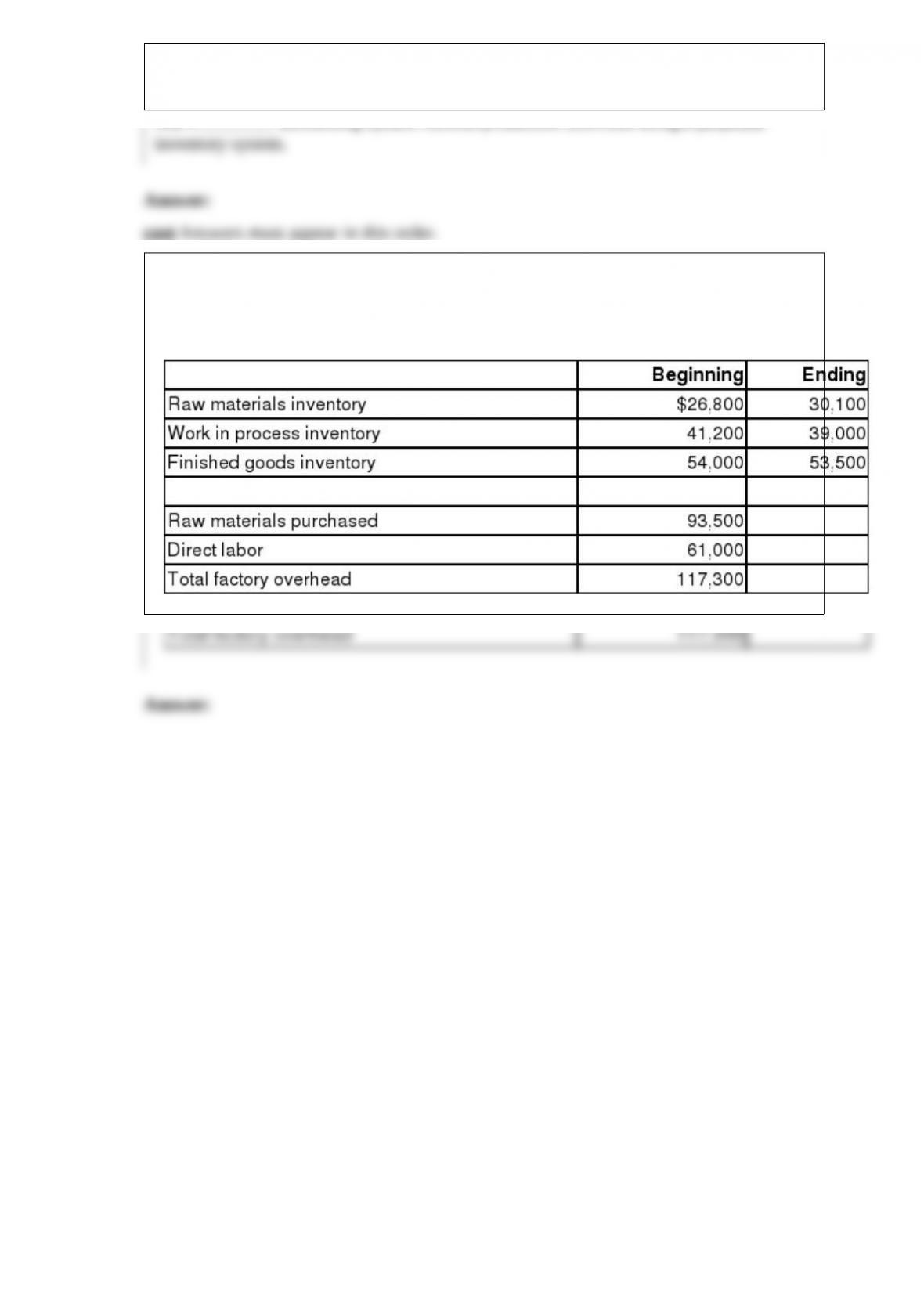
34) Information for Underwood Industries is presented below. Compute the cost of
goods manufactured.
35) On a process cost summary, the total costs to account for (the processing costs for
the period plus the Work in Process at the end of the period) should equal
___________________ (____________________ plus _____________________).