
Examples of internal transactions include all of the following except: A. Writing off an
uncollectible account.
B. Recording the expiration of prepaid insurance.
C. Recording unpaid wages.
D. Paying wages to company employees.
Answer:
Listed below are five terms followed by a list of phrases that describe or characterize
each of the terms. Match each phrase with the correct term. 1) 1.Indefinite life
2) 2.Group method
3) 3.Sum-of-the-years’-digits method
4) 4.Depreciation
5) 5.Time-based method
A. The reason for not amortizing goodwill
B. Aggregates assets that are simila
C. Cost allocation for plant and equipment
D. Estimates service life in years
E. Results in depreciation declining by the same amount in subsequent years
Answer:
What is the effect of the error on Berkshire’s 2013 income statement? A. Net income is
understated by $420,000.
B. Cost of goods sold is understated by $420,000.
C. There are no errors in the 2013 income statement.
D. None of the above is correct.
Answer:
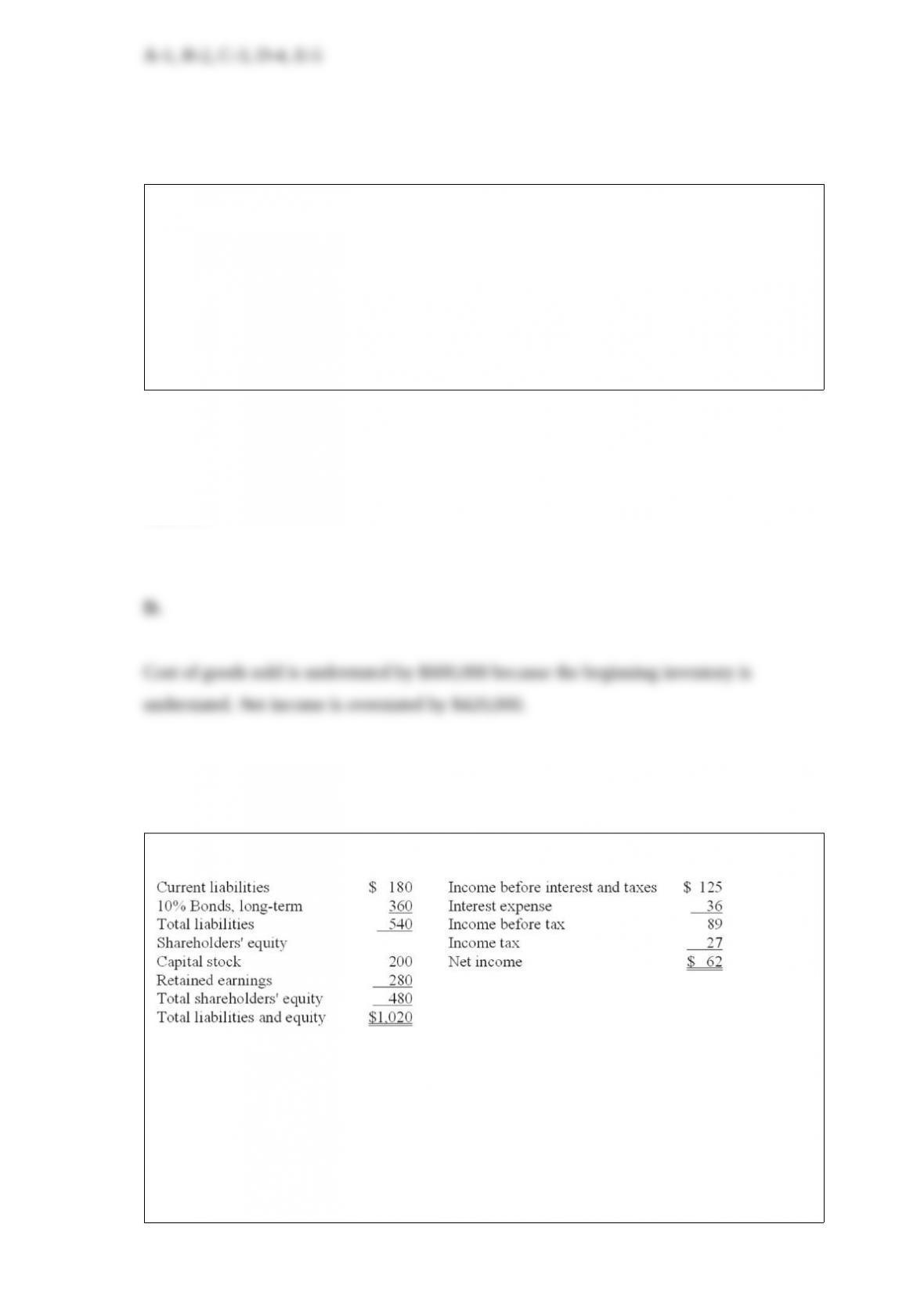
Recent financial statement data for Harmony Health Foods (HHF) Inc. is shown below.
HHF’s times interest earned ratio is (rounded): A. 3.47.
B. 1.73.
C. 2.47.
D. 10.0.

Answer:
Z Co. filed suit against W Inc. in 2013 seeking damages for patent infringement. At
December 31, 2013, legal counsel for Z believed that it was probable that Z would be
successful against W for an estimated amount in the range of $30 million to $60
million, with each amount in that range considered equally likely. Z was awarded $40
million in April 2014. Z should report this award in its 2013 financial statements, issued
in March 2014 as: A. A receivable and unearned revenue of $40 million.
B. A receivable and revenue of $40 million.
C. A disclosure of a gain contingency of $40 million.
D. A disclosure of a gain contingency of an undetermined amount in the range of $30
million to $60 million.
Answer:

Ford Motor Company purchases services from suppliers on account and sells its
products to distributors on short-term credit. As a result, do each of these events affect
net income faster than they affect net operating cash flows?
A.Option a
B.Option b
C.Option c
D.Option d
Answer:
The transferor is considered to have surrendered control over its receivables if: A. The
transferred assets have been isolated from the transferor.
B. Each transferee has the right to pledge or exchange the assets it received.
C. The transferor does not maintain effective control over the transferred assets through
either repurchase or redemption agreements before maturity or the ability to cause the
transferee to return the assets.
D. All of the above must occur.
Answer:

Oregon Co.’s employees are eligible for retirement with benefits at the end of the year
in which both age 60 is attained and they have completed 35 years of service. The
benefits provide 15 years reimbursement for health care services of $20,000 annually,
beginning one year from the date of retirement.
Ralph Young was hired at the beginning of 1977 by Oregon after turning age 22 and is
expected to retire at the end of 2015 (age 60). The discount rate is 4%. The plan is
unfunded.
The PV of an ordinary annuity of $1 where n = 15 and i = 4% is 11.11839.
The PV of $1 where n = 2 and i = 4% is 0.92456
With respect to Ralph, what is the interest cost to be included in Oregon’s 2014
postretirement benefit expense, rounded to the nearest dollar? A. $7,802.
B. $7,877.
C. $8,766.
D. None of the above is correct.
Answer:
Cromartie Ltd. prepares its financial statements according to International Financial
Reporting Standards. During 2013 the company incurred $1,245,000 in research
expenditures to develop a new product. An additional $756,000 in development
expenditures were incurred after technological and commercial feasibility was

established and after the future economic benefits were deemed probable. The project
was successfully completed and the new product was patented before the end of the
2013 fiscal year. Sale of the product began in 2012. What amount of the above
expenditures would Cromartie expense in its 2013 income statement? A. $2,001,000.
B. $756,000.
C. $1,245,000.
D. $0.
Answer:
In terms of business volume, the dominant form of business organization is the: A.
Partnership.
B. Corporation.
C. Limited liability company.
D. Proprietorship.
Answer:

Oregon Co.’s employees are eligible for retirement with benefits at the end of the year
in which both age 60 is attained and they have completed 35 years of service. The
benefits provide 15 years reimbursement for health care services of $20,000 annually,
beginning one year from the date of retirement.
Ralph Young was hired at the beginning of 1977 by Oregon after turning age 22 and is
expected to retire at the end of 2015 (age 60). The discount rate is 4%. The plan is
unfunded.
The PV of an ordinary annuity of $1 where n = 15 and i = 4% is 11.11839.
The PV of $1 where n = 2 and i = 4% is 0.92456
With respect to Ralph, what is the service cost to be included in Oregon’s 2013
postretirement benefit expense, rounded to the nearest dollar? A. $3,544.
B. $6,365.
C. $20,000.
D. $5,272.
Answer:
With pensions, service cost reflects additional benefits employees earn from an
additional year’s service. The service cost for retiree health care plans is: A. An
allocation to the current year of a portion of an estimated fixed total cost.

B. An allocation to the current year of a portion of an existing liability.
C. An amount earned by a defined benefit formula.
D. The amount paid to retired employees.
Answer:
Jack Corporation purchased a 20% interest in Jill Corporation for $1,500,000 on
January 1, 2013. Jack can significantly influence Jill. On December 10, 2013, Jill
declared and paid $1 million in dividends. Jill reported a net loss of $6 million for the
year. What amount of loss should Jack report in its income statement for 2013 relative
to its investment in Jill? A. $1,000,000.
B. $1,200,000.
C. $1,400,000.
D. $1,500,000.
Answer:

The attribution period for postretirement benefits spans each year of service from the
employee’s date of hire to the employee’s date of: A. Full eligibility.
B. Death.
C. Retirement.
D. Termination.
Answer:
Waldman Associates received a written, approved contract to deliver economic
consulting services, with service commencing in one month. The contract specifies the
services that Waldman is to perform, and the payment terms. Waldman and the
customer both can cancel the contract without penalty prior to commencing service.
Does Waldman have a contract for purposes of revenue recognition on the day the
contract is received? A. Yes, because Waldman has a written approved contract.
B. No, because Waldman can cancel without penalty.
C. Maybe, depending on whether Waldman can estimate collectability of the receivable.
D. Insufficient data on which to base an answer.
Answer:

Jane’s Donut Co. borrowed $200,000 on January 1, 2013, and signed a two-year note
bearing interest at 12%. Interest is payable in full at maturity on January 1, 2015. In
connection with this note, Jane’s should report interest expense at December 31, 2013,
in the amount of: A. $0.
B. $24,000.
C. $48,000.
D. $50,880.
Answer:
According to the conceptual framework, verifiability implies: A.Legal evidence.
B.Logic.
C.Consensus.
D.Legal verdict.
Answer:
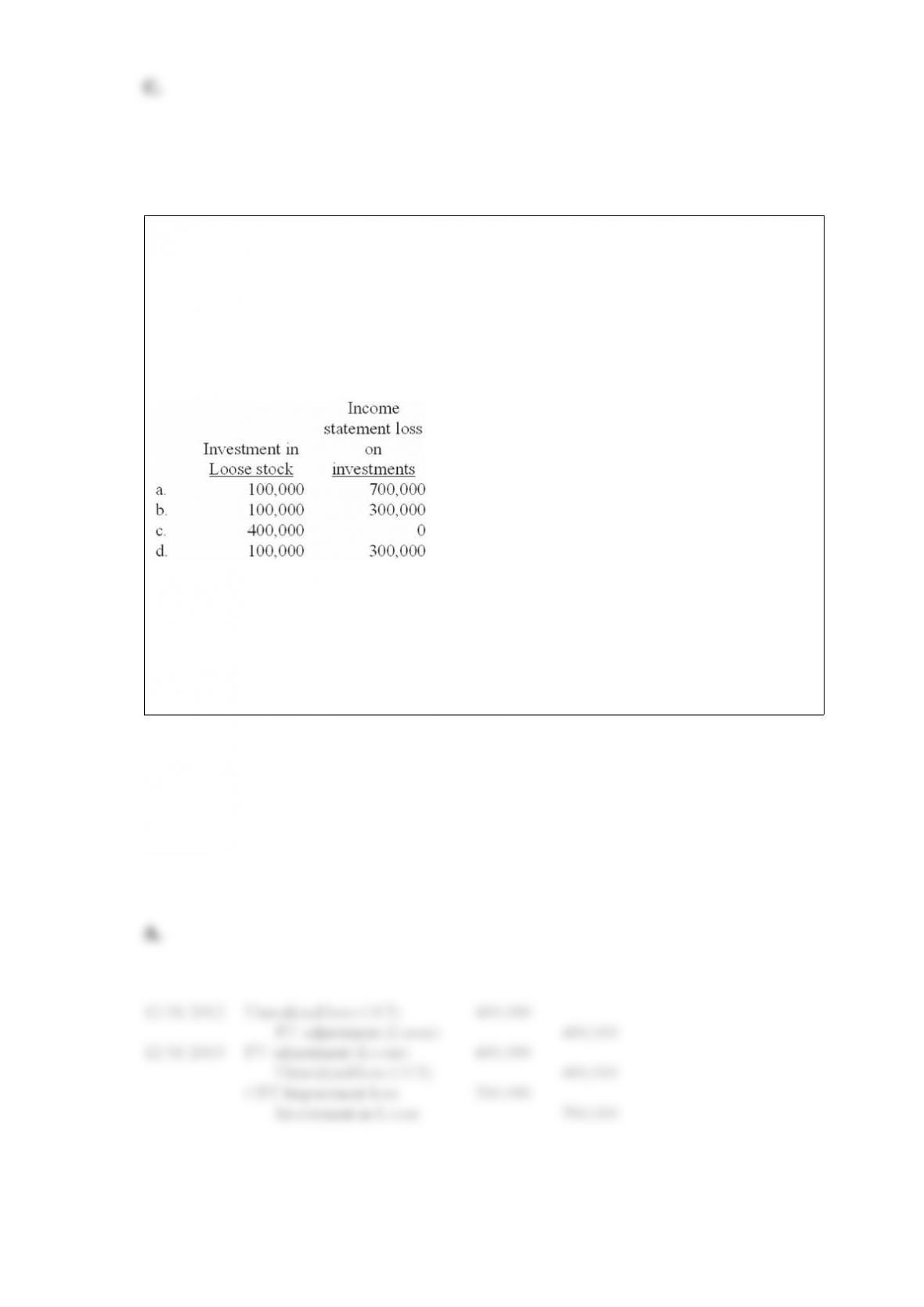
Dicker Furriers purchased 1,000 shares of Loose Corporation stock on January 10,
2012, for $800 per share and classified the investment as securities available for sale.
Loose’s market value was $400 per share on December 31, 2012, and the decline in
value was viewed as temporary. As of December 31, 2013, Dicker still owned the Loose
stock whose market value had declined to $100 per share. The decline is due to a reason
that’s judged to be other than temporary. Dicker’s December 31, 2013, balance sheet and
the 2013 income statement would show the following:
A. Option a
B. Option b
C. Option c
D. Option d
Answer:

Listed below are 5 terms followed by a list of phrases that describe or characterize each
of the terms. Match each phrase with the correct term. 1)Raw materials
2)Cost index
3)Specific identification
4)LIFO
5)Consumer Price Index
A. Used to convert ending inventory at year-end cost to base year cost.
B. Could be used instead of an internally generated index in dollar-value LIFO
computations
C. Method not feasible for most inventories
D. The cost of components purchased from other manufacturers
E. Most recent purchases will be included in cost of goods sold.
Answer:
Sullivan Corporation has determined its year-end inventory on a FIFO basis to be
$500,000. Information pertaining to that inventory is as follows:
What should be the carrying value of Sullivan’s inventory? A. $500,000.
B. $440,000.
C. $430,000.
D. $490,000.

Answer:
Short-term obligations can be reported as long-term liabilities if: A. The firm has a
long-term line of credit.
B. The firm has tentative plans to issue long-term bonds.
C. The firm intends to and has the ability to refinance as long-term.
D. The firm has the ability to refinance on a long-term basis.
Answer:
Lake Power Sports sells jet skis and other powered recreational equipment. Customers
pay one-third of the sales price of a jet ski when they initially purchase the ski, and then
pay another one-third each year for the next two years. Because Lake has little
information about the ability to collect these receivables, it uses the cost recovery
method to recognize revenue on these installment sales. In 2012, Lake began operations

and sold jet skis with a total price of $900,000 that cost Lake $450,000. Lake collected
$300,000 in 2012, $300,000 in 2013, and $300,000 in 2014 associated with those sales.
In 2013, Lake sold jet skis with a total price of $1,500,000 that cost Lake $900,000.
Lake collected $500,000 in 2013, $400,000 in 2014, and $400,000 in 2015 associated
with those sales. In 2015, Lake also repossessed $200,000 of jet skis that were sold in
2013. Those jet skis had a fair value of $75,000 at the time they were repossessed.
In 2012, Lake would recognize realized gross profit of: A. $150,000.
B. $0.
C. $300,000.
D. $450,000.
Answer:
The most likely important flaw leading to the demise of the APB was the perceived lack
of: A.Confidence.
B.Competence.
C.Independence.
D.Importance.
Answer:
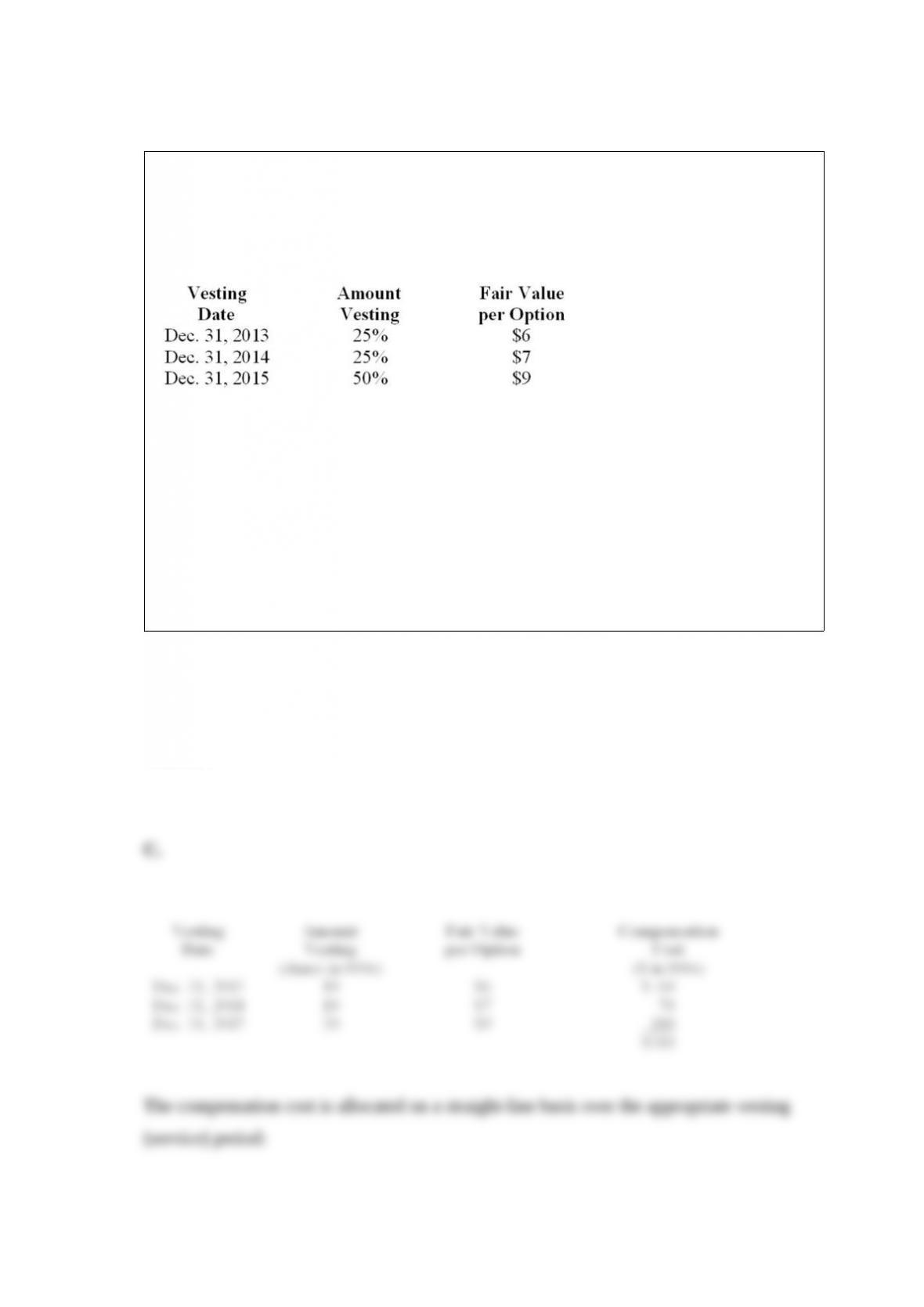
Yellow Company is a calendar-year firm with operations in several countries. At
January 1, 2013, the company had issued 40,000 executive stock options permitting
executives to buy 40,000 shares of stock for $30. The vesting schedule is 20% the first
year, 30% the second year, and 50% the third year (graded-vesting). The fair value of
the options is estimated as follows:
Assuming Yellow prepares its financial statements in accordance with International
Financial Reporting Standards, what is the compensation expense related to the options
to be recorded in 2014? A. $40,000.
B. $60,000.
C. $95,000.
D. $130,000.
Answer:
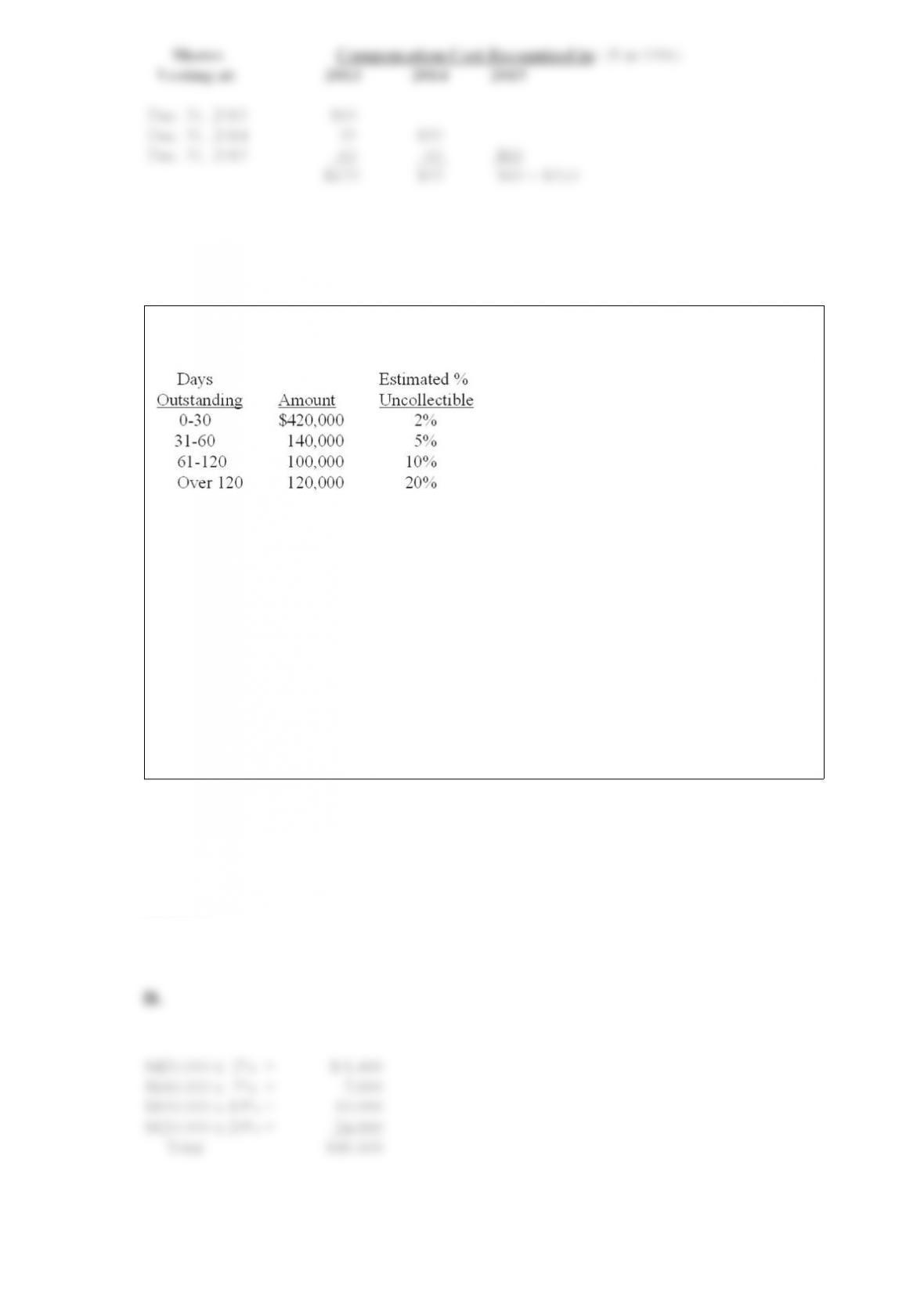
The following information pertains to Jacobsen Co.’s accounts receivable at December
31, 2013:
During 2013, Jacobsen wrote off $18,000 in receivables and recovered $6,000 that had
been written off in prior years. Jacobsen’s December 31, 2012, allowance for
uncollectible accounts was $40,000. Under the aging method, what amount of
allowance for uncollectible accounts should Jacobsen report at December 31, 2013? A.
$28,000.
B. $31,400.
C. $55,400.
D. $49,400.
Answer:

California Inc., through no fault of its own, lost an entire plant due to an earthquake on
May 1, 2013. In preparing its insurance claim on the inventory loss, the company
developed the following data: Inventory January 1, 2013, $300,000; sales and purchases
from January 1, 2013, to May 1, 2013, $1,300,000 and $875,000, respectively.
California consistently reports a 40% gross profit. The estimated inventory on May 1,
2013, is: A. $302,500.
B. $360,000.
C. $395,000.
D. $455,000.
Answer:
Accruals occur when cash flows: A. Occur before expense recognition.
B. Occur after revenue or expense recognition.
C. Are uncertain.
D. May be substituted for goods or services.
Answer:

On August 1, 2014, United Corporation issued $10 million of 8% convertible bonds at
105. The bonds mature in 20 years. Each $1,000 bond was issued with 20 detachable
stock warrants, each of which entitled the bondholder to purchase, for $50, one share of
United $5 par common stock. World Company purchased 10% of the bond issue. On
August 1, 2014, the market value per share for United stock was $56 and the market
value of each warrant was $6. In March 2020, when United common stock had a market
price of $70 per share and the unamortized premium balance was $300,000, World
exercised the warrants it held.
Required:
1) Prepare the journal entries on August 1, 2014, to record (A) the issuance of the bonds
by United and (B) the investment by World.
2) Prepare the journal entries for both companies in March 2020 to record the exercise
of the warrants.
Answer:

Constraints on qualitative characteristics of accounting information include:
A.Timeliness.
B.Going concern.
C.Neutrality.
D.Cost-effectiveness.
Answer:
Which of the following accounts has a debit balance? A. Accounts payable.
B. Accrued taxes.
C. Accumulated depreciation.
D. Advertising expense.
Answer:
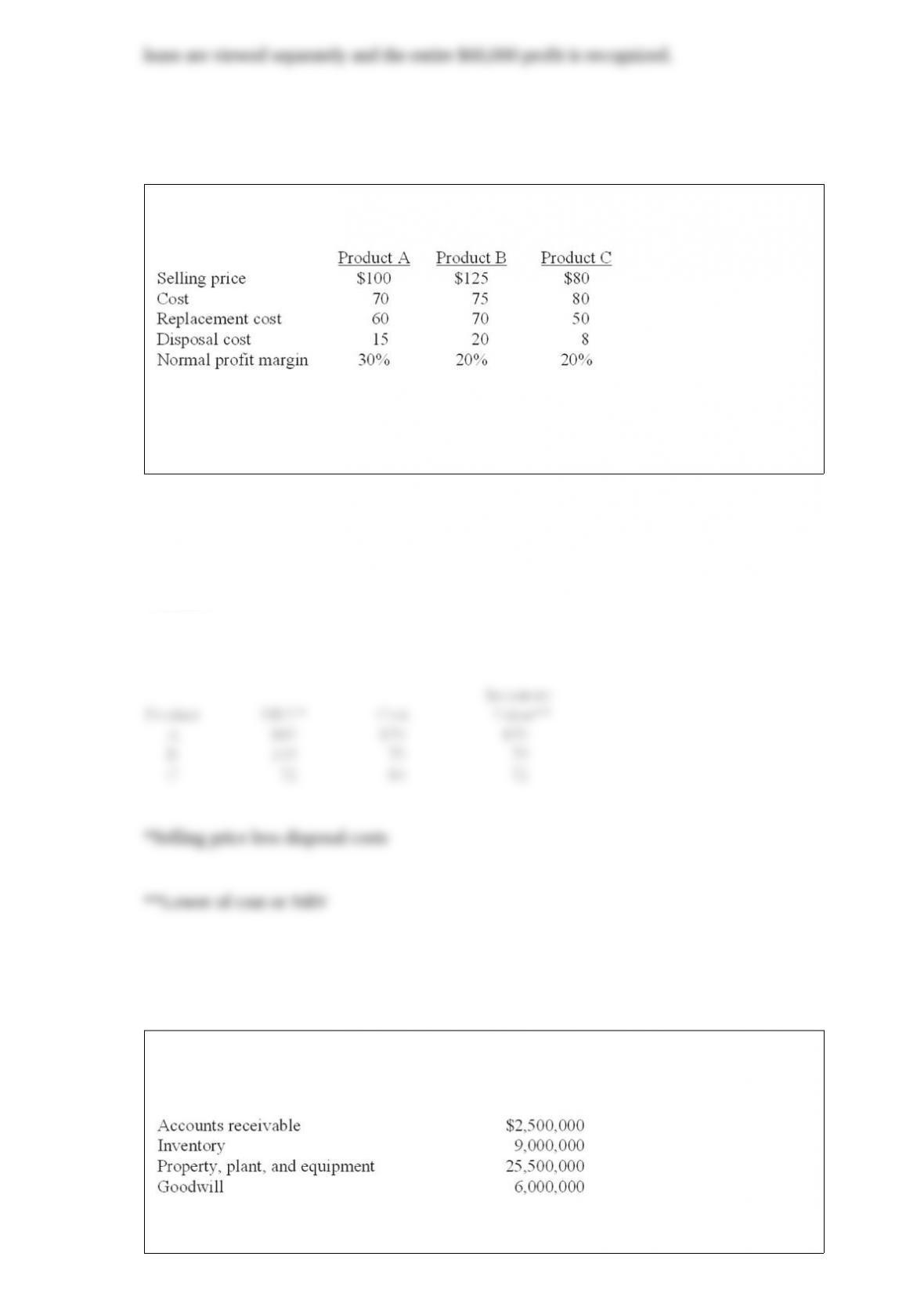
On December 31, 2013, B Corp. sold a machine to Royal and simultaneously leased it
back for one year. Pertinent information at this date follows:
In B’s December 31, 2013, balance sheet, the deferred revenue from the sale of this
machine should be: A. $0.
B. $8,200.
C. $60,000.
D. $68,200.
Answer:
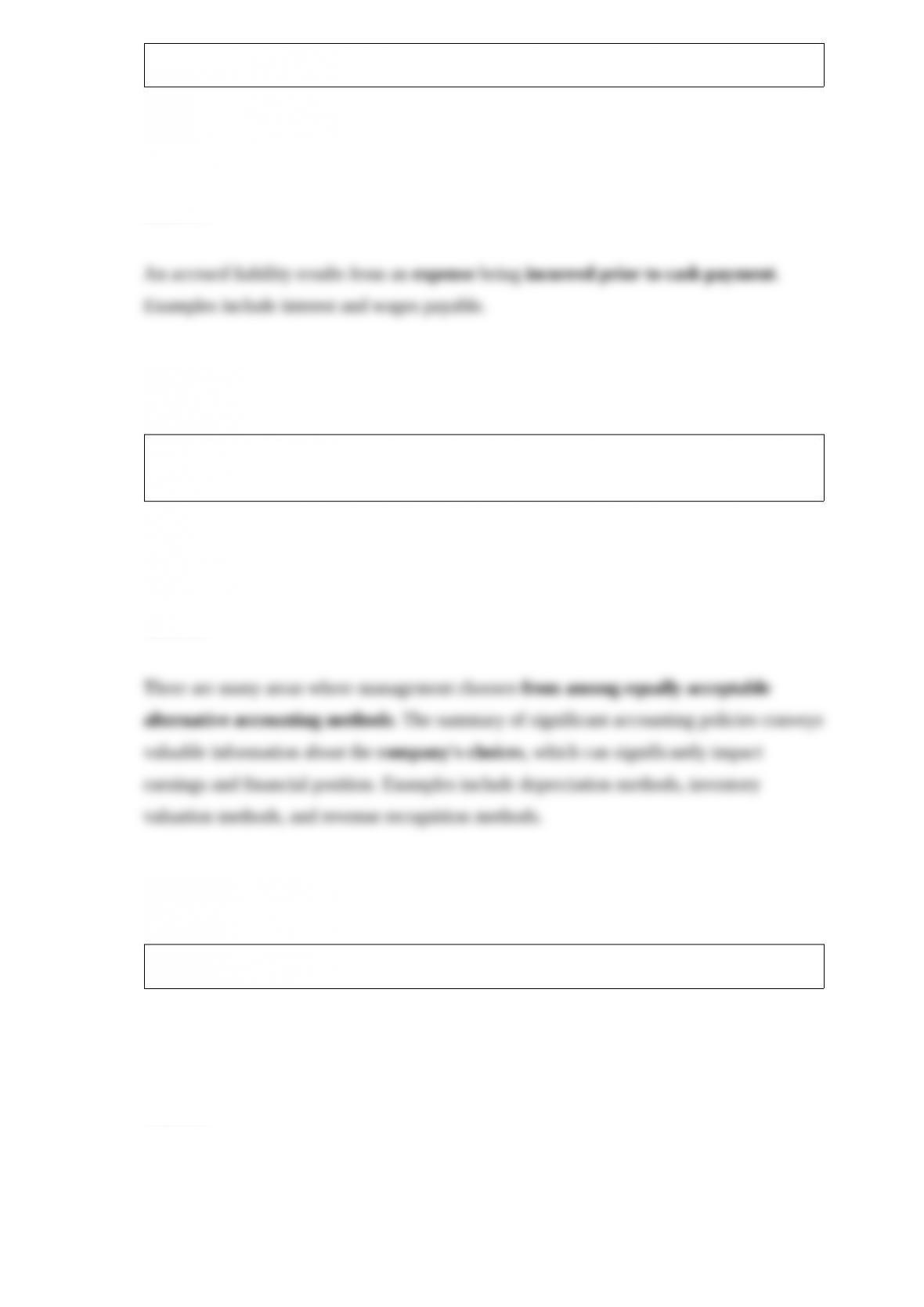
Memphis Wholesale Market applies lower-of-cost-or-market valuation to individual
products and has collected the following data:
Determine the balance sheet inventory carrying value for Products A, B, and C
assuming that Memphis Wholesale Market prepares its financial statements according
to International Financial Reporting Standards.
Answer:
During the current year, Peterson Data Corporation purchased all of the outstanding
common stock of Junior Jackson Inc. (JJI), paying $36 million in cash. Peterson
recorded the assets acquired as follows:
The book value of JJI’s assets and owners’ equity before the acquisition were $22

million and $18 million, respectively.
Required:
Compute the fair value of JJI’s liabilities that Peterson assumed in the acquisition.
Answer:
On January 1, 2013, American Corporation purchased 25% of the outstanding voting
shares of Short Supplies common stock for $210,000 cash. On that date, Short’s book
value and fair value were both $840,000. The equity method is deemed appropriate for
this investment. Short’s net income reported on December 31, 2013, was $80,000.
During 2013, Short also paid cash dividends in the amount of $24,000.
Required:
Prepare the journal entries necessary to record the above information on American
Corporation’s books during 2013.
Answer:

The following information comes from the 2013 Annual Report to stockholders of
Composition Inc. (in thousands):
From the Statement of Changes in Stockholders’ Equity:
From the Statement of Cash Flows: In Cash flows from financing activities:
Assuming that Composition had Dividends Payable of $17,450 thousand at December
31, 2011, compute the balance in that account at December 31, 2013. The balance
would be $20,129 thousand, computed as follows:
Answer:
How may accounting changes detract from accounting information?
Answer:
What is an accrued liability?
Answer:
Briefly explain the purpose of the disclosure note on significant accounting policies.
Provide two examples of what might be found in this note?
Answer:
Answer:
What is the “if converted method”?
Answer:
How should bond issue costs be accounted for on the books of the issuing corporation?
Answer:
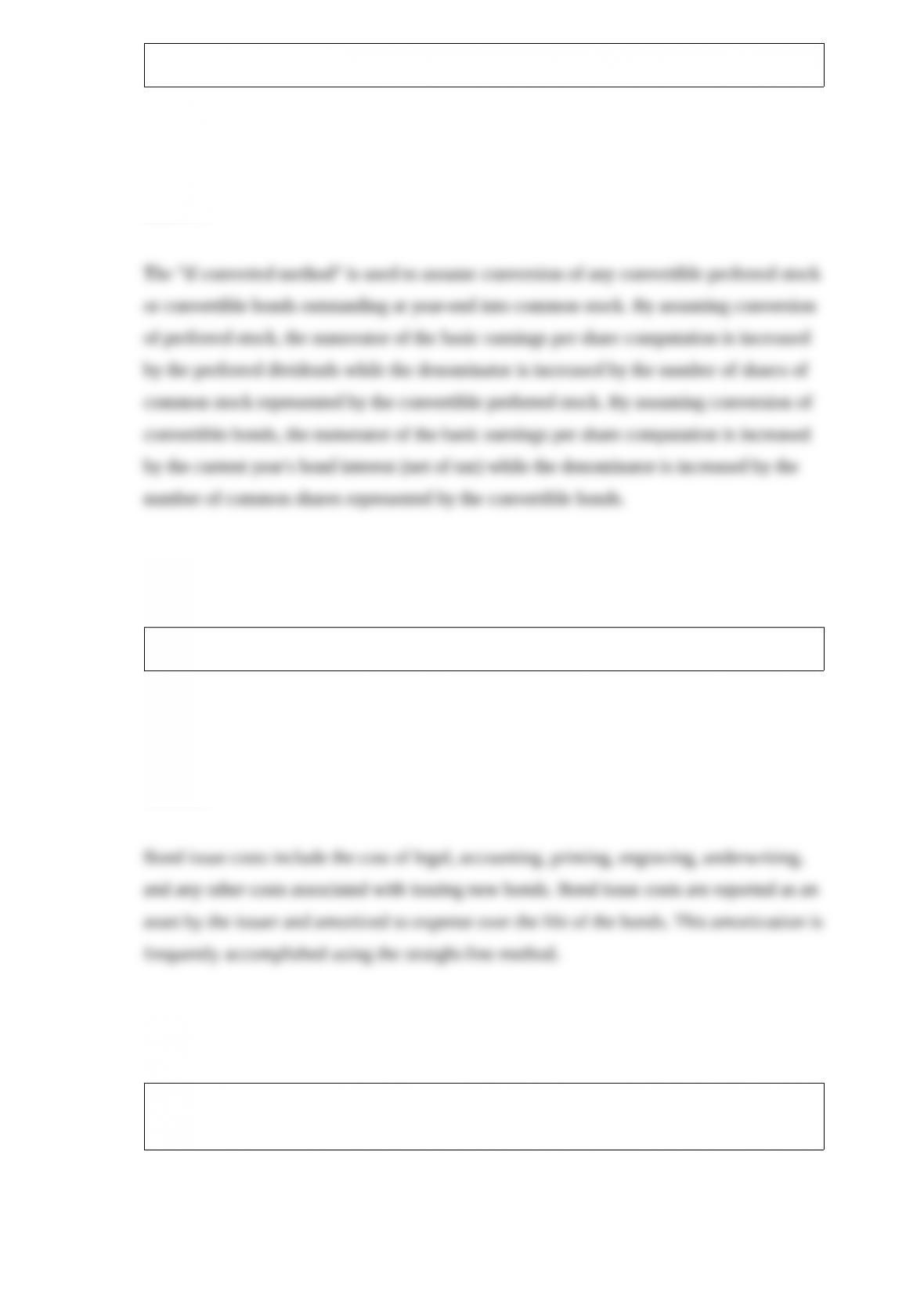
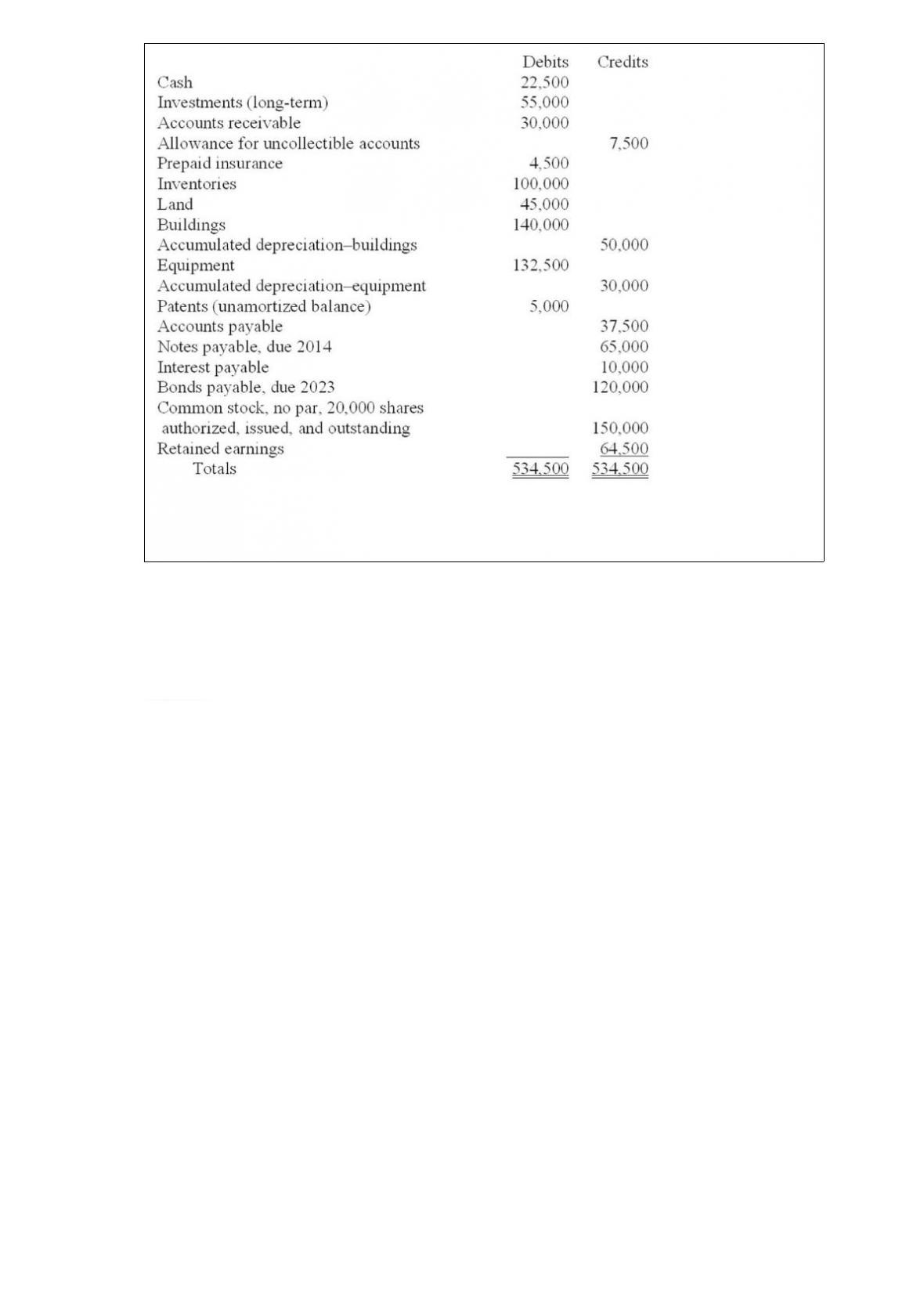
The December 31, 2013, post-closing trial balance ($ in thousands) for Libby
Corporation is presented below:
Required:
Prepare a classified balance sheet for Libby Corporation at December 31,
Answer:
Concept 1 Office Products sells office electronics that carry a 60-day manufacturer’s
warranty. At the time of purchase, customers are offered the opportunity to also buy a
1-year or 2-year extended warranty for an additional charge.
Required:
1) Does the sale of the extended warranty represent a loss contingency?
2) Provide journal entries for the extended warranty sales and revenue recognition.
Answer:
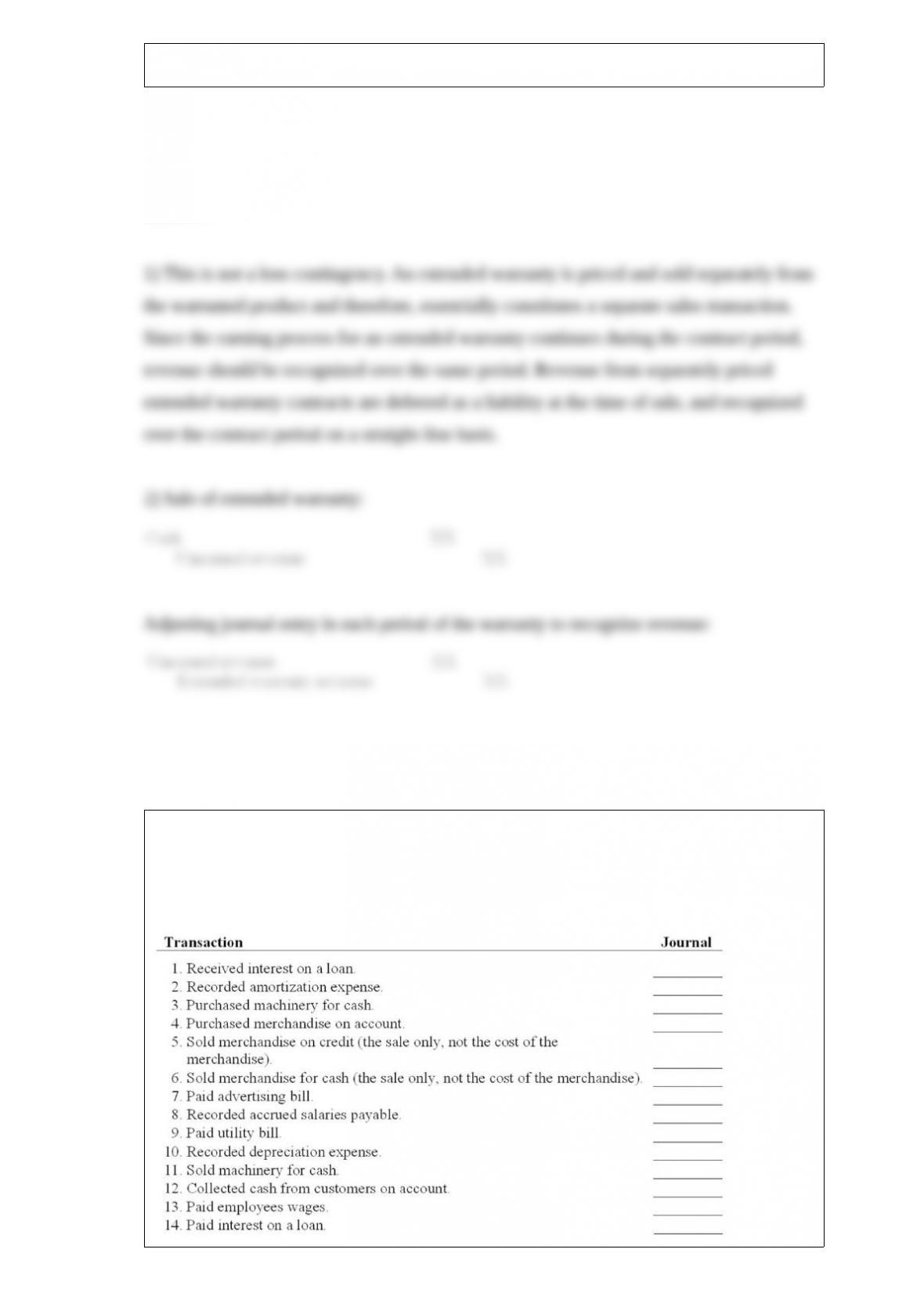
The accounting system of Carlton and Sons consists of a general journal (GJ), a cash
receipts journal (CR), a cash disbursements journal (CD), a sales journal (SJ), and a
purchases journal (PJ). For each of the following, indicate which journal should be used
to record the transaction.

Answer:
Patterson Development sometimes sells property on an installment basis. In those cases,
Patterson reports income in its income statement in the year of the sale but reports
installment income by the installment method on the tax return. Installment income in
2013 was $120 million, which Patterson expects to collect equally over the next four
years. The tax rate is 30%, but based on an enacted law, is scheduled to become 40% in
2015.
Patterson’s pretax accounting income for the 2013 income statement was $530 million.
Of this amount, $30 million is non-taxable revenue from proceeds of a life insurance
policy. There were no differences between accounting income and taxable income other
than those described above and no cumulative temporary differences existed at the
beginning of the year.
Required:
1) Prepare the appropriate journal entry to record Patterson’s 2013 income taxes. Show
calculations.
2)What is Patterson’s 2013 net income?
Answer:
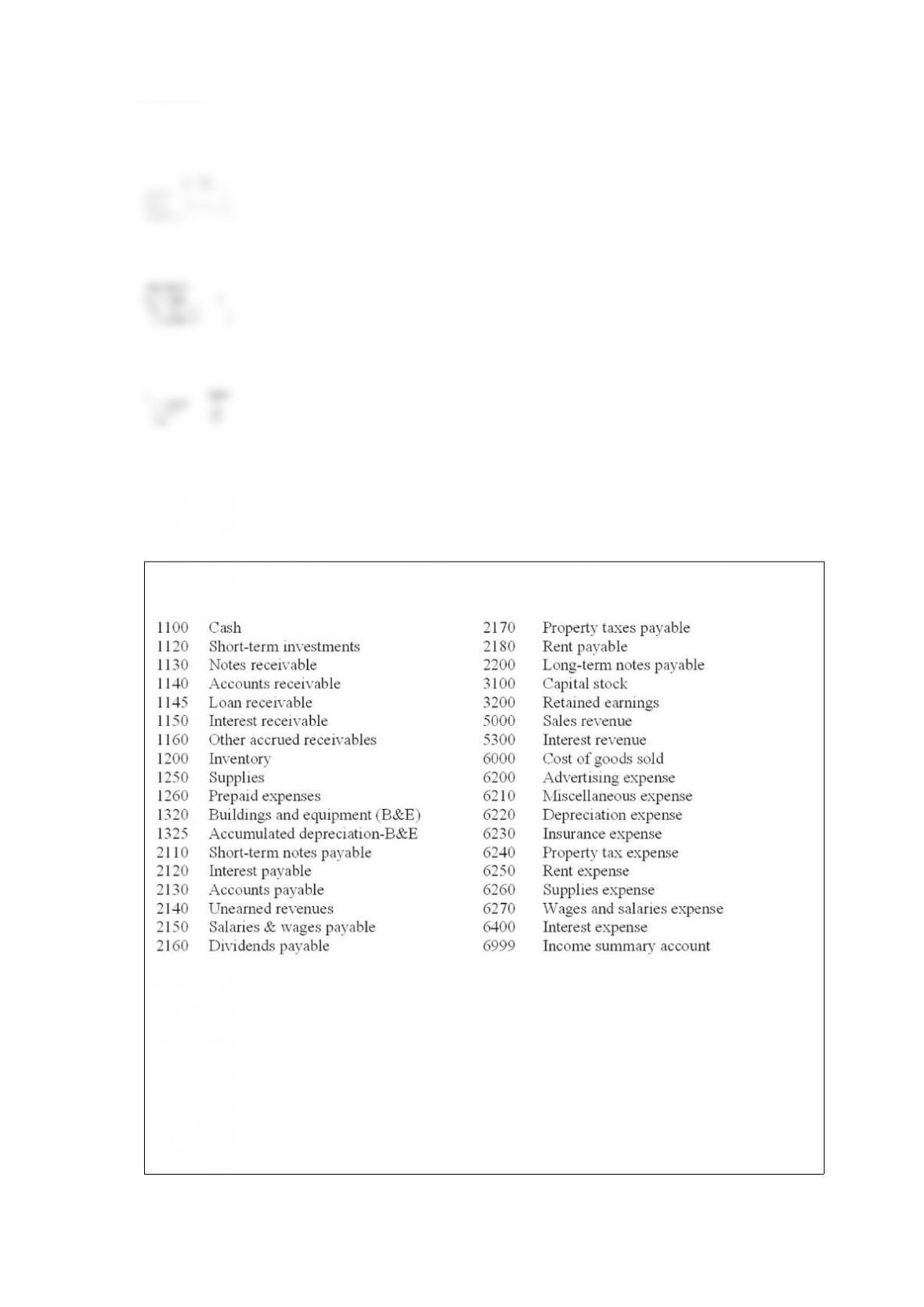
Using the chart of accounts provided, indicate by account number the account or
accounts that would be debited and credited in the following transactions and indicate
the type of transaction as: (1) an external transaction, (2) an internal transaction
recorded as an adjusting journal entry, or (3) a closing entry. The company uses a
perpetual inventory system. All prepayments are initially recorded in permanent
accounts.
Sold merchandise to a customer in exchange for a promissory note.

Answer: