1) Throughput costing considers only direct materials and direct manufacturing labor to
be truly variable costs.
2) Appraisal costs are costs incurred to preclude the production of products that do not
conform to specifications.
3) Multicollinearity exists in multiple regression when two or more independent
variables are highly correlated with each other.
4) A standard price is the minimum price a company will have to pay for a unit of input.
5) Economics suggests that a decrease in the selling price of a product will decrease
revenue.
6) Work-in-Process Control will be decreased (credited) for the amount of direct-labor
costs incurred.
7) A homogeneous relationship exists when each activity whose costs are included in
the dependent variable has the same cost driver.
8) Which of the following statements is true of ABC systems?
A) ABC system will always result in higher product costs.
B) ABC system employs multiple activity-cost drivers.
C) ABC system is least suited for service companies.
D) ABC system is simpler compared to traditional systems.
9) Which of the following journal entries is used to record actual variable overhead
costs incurred?
A) Accounts Payable
Variable Overhead Control
B) Variable Overhead Control
Accounts Receivable
C) Work-in-Process Control
Variable Overhead Control
D) Variable Overhead Control
Accounts Payable
10) Which of the following is true of ISO 9000?
A) It is a quality management system comprising different process improvement such
as six sigma and lean manufacturing.
B) It is mandatory for all listed companies in US to get ISO certified.
C) It helps companies monitor, document, and certify the elements of their production

processes that lead to quality.
D) It is a disciplined, data-driven, and statistical approach to improve the quality of
products or services by identifying and removing the causes of defects.
11) The static-budget variance will be favorable, when ________.
A) budgeted unit sales are more than actual unit sales
B) the actual contribution margin is less than the static-budget contribution margin
C) the actual sales mix shifts toward the less profitable units
D) the flexible-budget and the sales-volume variance are favorable
12) Post-investment audits ________.
A) result in managers to overstate the expected cash inflows from projects and accept
projects they should reject
B) provide management with feedback about the performance of a project
C) include obtaining appropriation requests so that the funding will be authorized to
purchase the equipment
D) are usually not feasible in a large project because the cost accounting system does
not collect actual costs at the same level of detail as the initial plans had
13) Cause-and-effect diagrams are used in quality management systems to ________.
A) identify and respond to potential reasons of failure
B) indicate how frequently each type of failure occurs
C) distinguish random from nonrandom variations in an operating process
D) evaluate the tradeoffs among prevention costs, appraisal costs, and failure costs
14) When 20,000 units are produced, variable costs are $8 per unit. Therefore, when
10,000 units are produced ________.
A) variable costs will remain at $8 per unit
B) variable costs will total $60,000
C) variable unit costs will increase to $12 per unit
D) variable unit costs will decrease to $3 per unit
15) Products S5 and CP8 each are assigned $100.00 in indirect costs by a traditional
costing system. An activity analysis revealed that although production requirements are
identical, S5 requires 45 minutes less setup time than CP8.
According to an ABC system, S5 uses a disproportionately ________.
A) smaller amount of unit-level costs
B) larger amount of unit-level costs
C) smaller amount of batch-level costs
D) larger amount of batch-level costs
16) Discounted cash flow methods for capital budgeting focus on ________.
A) cash inflows and required rate of return
B) operating income and required rate of return
C) operating income and cost of capital
D) working capital and cost of capital
17) A company reported revenues of $375,000, cost of goods sold of $118,000, selling
expenses of $11,000, and total operating costs of $70,000. Gross margin for the year is
________.
A) $257,000
B) $246,000
C) $176,000
D) $252,000
18) Animent Industries, Inc. (AII), developed standard costs for direct material and
direct labor. In 2015, AII estimated the following standard costs for one of their major
products, the 10-gallon plastic container.
During June, AII produced and sold 20,000 containers using 1,900 pounds of direct
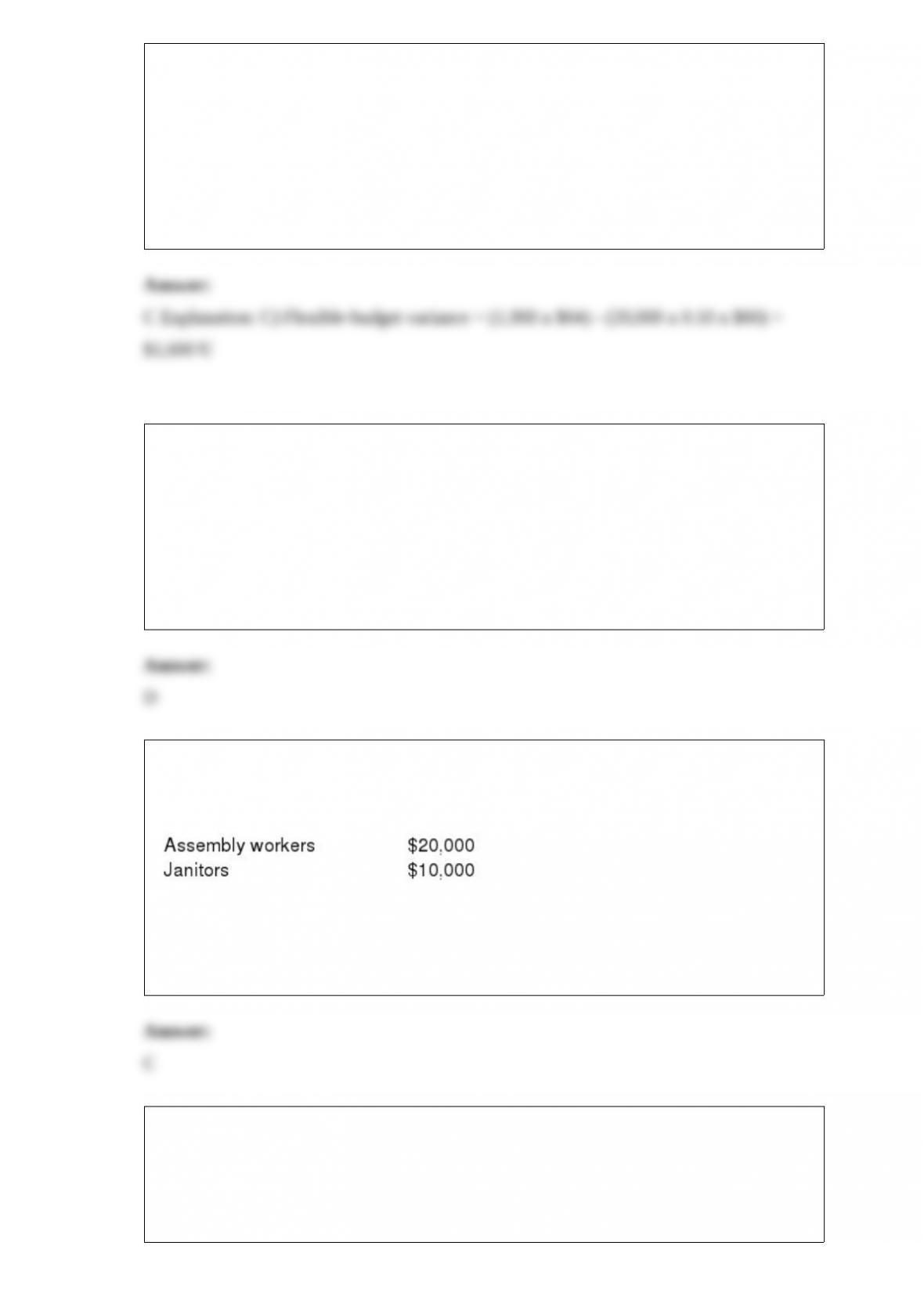
materials at an average cost per pound of $64 and 1,000 direct manufacturing
labor-hours at an average wage of $30.50 per hour.
June’s direct material flexible-budget variance is ________.
A) $7,200 unfavorable
B) $600 favorable
C) $1,600 unfavorable
D) $500 favorable
19) Which of the following statements best defines a trigger point in a
sequential-tracking costing system?
A) the inventory level at which a new purchase order is generated
B) the point at which the sum of annual relevant stockout and ordering costs is minimal
C) the production level at which the costing system becomes incapable of tracking the
production costs
D) a stage in the production cycle at which journal entries are made in the accounting
system
20) Which account would be credited if the following labor wages were incurred in a
furniture manufacturing company?
A) Work-in-Process Control, 30,000
B) Manufacturing Overhead Control, 30,000
C) Wages Payable Control, 30,000
D) Accounts Payable Control, 30,000
21) The cost-allocation method that allocates each support-department’s costs to
operating departments only is the ________.
A) direct method
B) single-rate cost allocation method
C) step-down method
D) reciprocal method
22) Which of the following statements is a benefit of measuring environmental and
social performance?
A) It limits the number of performance measures, identifying only the most critical
ones.
B) It helps to communicate the strategy to all members of the organization.
C) It enhances the identification of cause-and-effect relationships to evaluate benefits.
D) It uses financial measures to serve as leading indicators of future nonfinancial
performance.
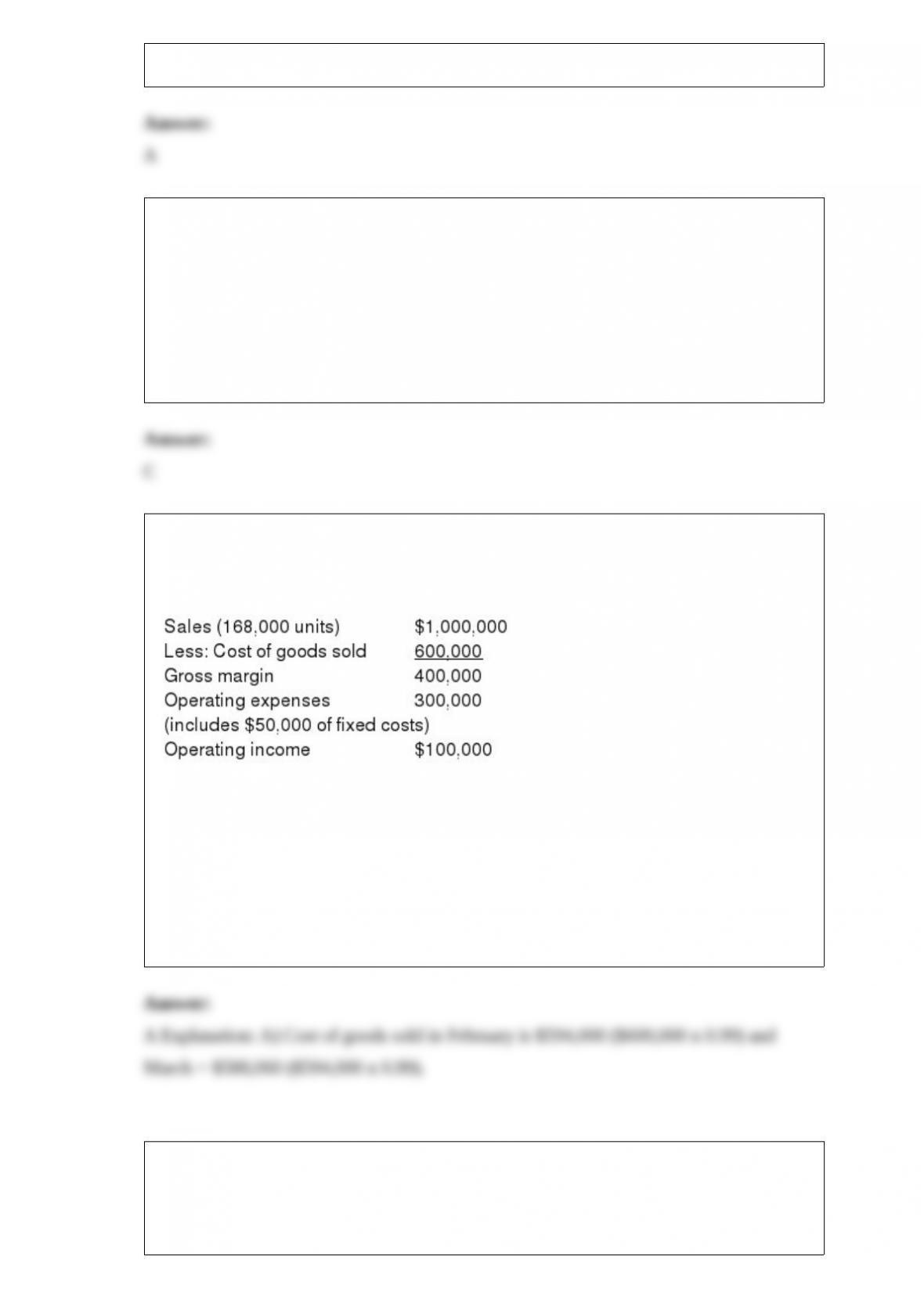
23) Sherry and John Enterprises are using the kaizen approach to budgeting for 2015.
The budgeted income statement for January 2015 is as follows:
Under the kaizen approach, cost of goods sold and variable operating expenses are
budgeted to decline by 1% per month.
What is budgeted cost of goods sold for March 2015?
A) $588,060
B) $592,000
C) $600,000
D) $594,000
24) The time from which a machine setup begins for an order until the product is
delivered to the customer is the ________.
A) delivery time only
B) manufacturing time plus the waiting time

C) manufacturing time plus the delivery time
D) customer-response time minus the receipt time
25) Which of the following is a cost driver for a company’s human resource costs?
A) the number of employees in the company
B) the number of job applications processed
C) the number of units sold
D) the square footage of the office space used by the human resource department