1) An example of direct matching of an expense with revenues would be
a. depreciation expense
b. office salaries expense
c. direct labor costs incurred to produce inventory sold during a period
d. advertising expense
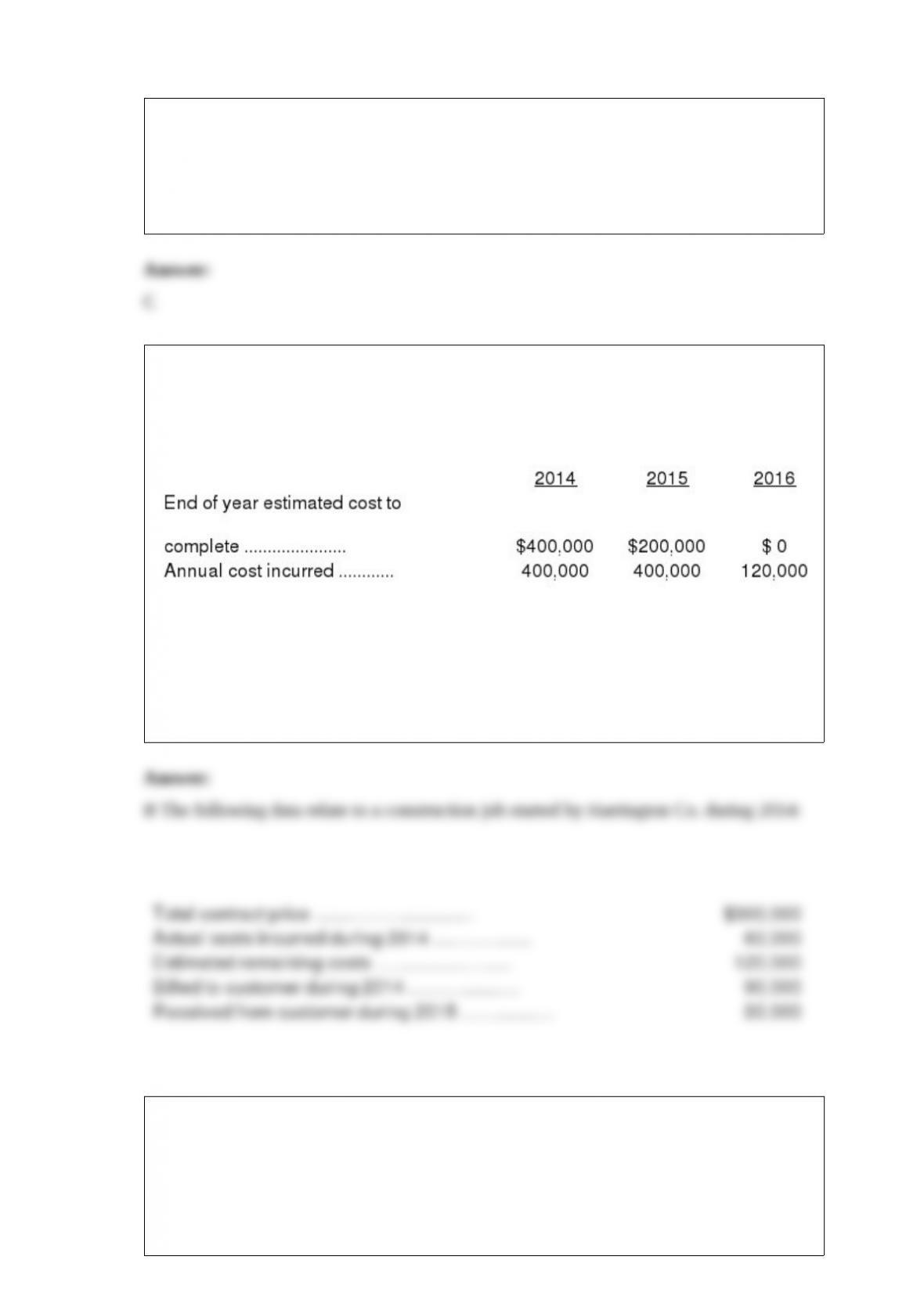
2) Astor Construction Company uses the percentage-of-completion method for
long-term construction contracts. A specific job was begun in 2014 and completed in
2016. The contract price was $1,400,000 and cost information as of each year-end is
given below:
Assuming Astor correctly recorded gross profit in 2014, how much gross profit should
the company record in 2015?
a. $0
b. $20,000
c. $300,000
d. $320,000
3) If a company uses the completed-contract method of accounting for long-term
construction contracts, then during the period of construction, financial information
related to a long-term contract will
a. appear on both the income statement and balance sheet during the construction period
b. appear only on the income statement during the period of construction
c. appear only on the balance sheet during the period of construction
d. not appear on the financial statements
4) In 2014, a company changed from the LIFO method of accounting for inventory to
FIFO. The companys 2013 and 2014 comparative financial statements will reflect
which method or methods?
2013 2014
a. LIFO LIFO
b. FIFO FIFO
c. LIFO FIFO
d. LIFO either LIFO or FIFO
5) When treasury stock is purchased for more than its par value, Treasury Stock is
debited for the purchase price under which of the following methods?
Cost Method Par Value Method
a. No No
b. No Yes
c. Yes No
d. Yes Yes
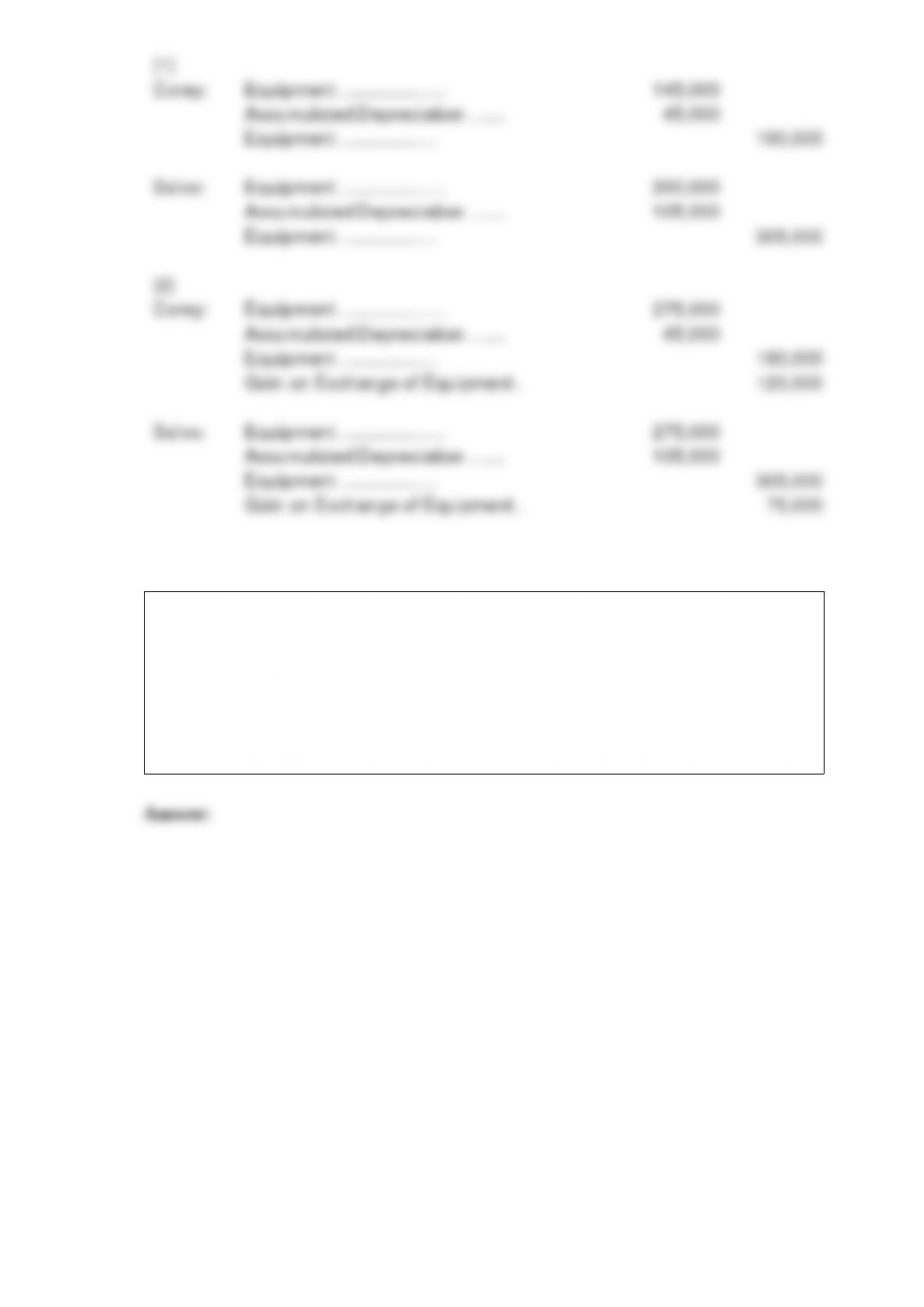
6) In preparing a monthly bank reconciliation, which of the following items would be
added to the balance reported on the bank statement to arrive at the correct cash
balance?
a. Outstanding checks
b. Bank service charge
c. Deposits in transit
d. A customer’s note collected by the bank on behalf of the depositor
7) A significant industry segment (for segment reporting purposes) is one which meets
any of the three criteria relating to
a. Revenue
b. Earnings
c. Identifiable assets.
The percent that is used to measure each of these criteria is the same.

Which of the following is the percent used to measure each of these criteria?
a. 1 percent
b. 5 percent
c. 10 percent
d. 15 percent
8) Under international accounting standards, the derecognition of receivables requires
that
a. the risks and rewards associated with the cash flows from the financial asset pass
from the transferor to the transferee
b. a binding legal agreement must exist between the transferor and the transferee
c. economic ownership of the asset passes from the transferor to the transferee
d. the receivable is determined to be fully collectible
9) On November 1, 2014, Balloon Company sold some limited edition art prints to
Sitake Company for 47,850,000 to be paid on January 1, 2015. The current exchange
rate on November 1, 2014, was 110=$1, so the total payment at the current exchange
rate would be equal to $435,000. Balloon entered into a forward contract with a large
bank to guarantee the number of dollars to be received. According to the terms of the
contract, if 47,850,000 is worth less than $435,000, the bank will pay Balloon the
difference in cash. Likewise, if 47,850,000 is worth more than $435,000, Balloon must
pay the bank the difference in cash. Assuming the exchange rate on December 31, 2014
is 115=$1, what amount will Balloon disclose as the fair value of the forward contract
on December 31, 2014 (answers rounded to the nearest dollar)?
a. $0
b. $18,913
c. $20,714
d. $416,087
10) In January 2014, Albert Corporation acquired 20 percent of the outstanding
common stock of Peter Company for $1,120,000. This investment gave Albert the
ability to exercise significant influence over Peter. The book value of the acquired
shares was $840,000. The excess of cost over book value was attributed to an
identifiable intangible asset that was undervalued on Peter’s balance sheet and that had a
remaining useful life of ten years. For the year ended December 31, 2014, Peter
reported net income of $252,000 and paid cash dividends of $56,000 on its common
stock. What is the proper carrying value of Albert’s investment in Peter at December 31,
2014?
a. $1,080,800
b. $1,092,000
c. $1,131,200
d. $1,181,600
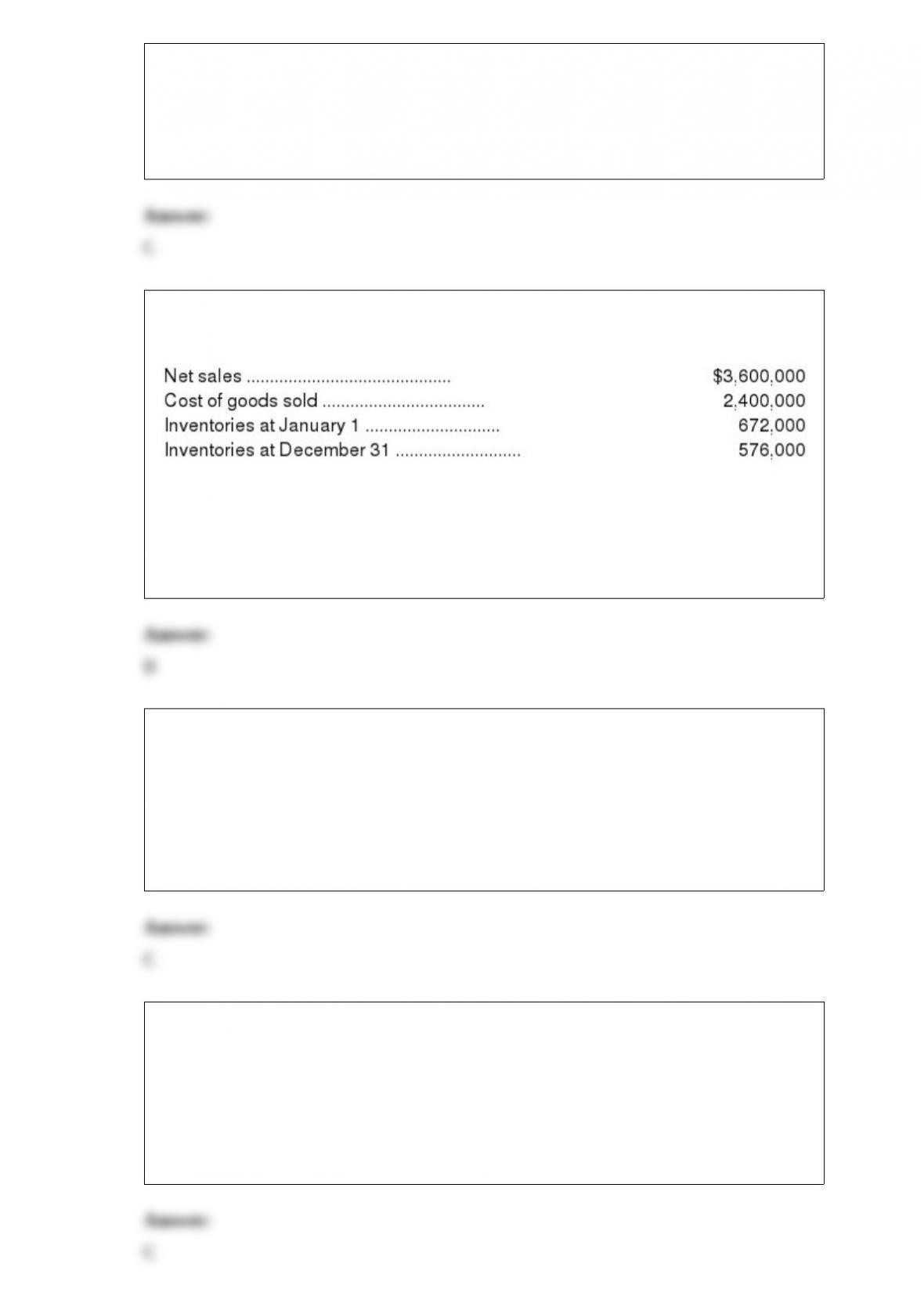
11) Selected information from the accounting records of Monroe Manufacturing
Company follows:
What is the number of days’ sales in average inventories for the year?
a. 102.2
b. 94.9
c. 87.6
d. 68.1
12) Cirrus Inc. purchased certain plant assets under a deferred payment contract. The
agreement was to pay $40,000 per year for ten years. The plant assets should be valued
at
a. $400,000
b. $400,000 plus imputed interest
c. present value of $40,000 annuity for ten years at an imputed interest rate
d. future value of $40,000 annuity for ten years at an imputed interest rate
13) Which of the following is true regarding the accounting process?
a. Preparation of the trial balance ensures that all amounts have been posted to the
correct accounts
b. Preparation of the trial balance is a step in the recording process
c. Preparation of the trial balance determines that total debits equal total credits
d. Preparation of the trial balance determines both that total debits equal total credits
and that all amounts have been posted to the correct accounts

14) On December 31, 2014, Value Corporation’s current liabilities total $50,000 and
long-term liabilities total $150,000. Working capital at December 31, 2014, is equal to
$80,000. If Value Corporation’s debt-to-equity ratio is .32 to 1, total long-term assets
must equal
a. $625,000
b. $745,000
c. $825,000
d. $695,000
15) Pending litigation would generally be considered a(n)
a. nonmonetary liability
b. contingent liability
c. estimated liability
d. current liability
16) Cash flows from investing activities would be decreased by which of the following?
a. Issuance of bonds
b. Issuance of common stock
c. Purchase of long-term investments
d. Payment of dividends
17) See information for Pastel Corporation above. Pastel Corporation’s working capital
is
a. $77,700
b. $73,100
c. $62,500
d. $125,700
18) In a basket or lump-sum purchase of assets, which of the following best describes
the process by which the historical cost of the various assets acquired should be
determined?
a. Allocation of the total cost to the individual assets on the basis of the historical cost
of the individual assets to their original owner

b. Allocation of the total cost to the individual assets on the basis of the fair market
value of the individual assets at the time of the basket purchase
c. Recording of the individual assets at their current value with recognition of a gain or
loss for the difference between the price paid for the assets and the current value of the
individual assets
d. Recording of the individual assets at their original historical cost to the seller with a
gain or loss recognized as the difference between the total of the original historical cost
figures and the price paid in the basket purchase
19) Form 10-K is submitted to the
a. FASB
b. GASB
c. IRS
d. SEC
20) A useful tool in financial statement analysis is the common-size financial statement.
What does this tool enable the financial analyst to do?
a. Evaluate financial statements of companies within a given industry of approximately
the same value
b. Determine which companies in the same industry are at approximately the same
stage of development
c. Ascertain the relative potential of companies of similar size in different industries
d. Compare the mix of assets, liabilities, capital, revenue, and expenses within a
company over time or between companies within a given industry without respect to
relative size
21) Which of the following factors are used to compute the number of days’ sales in
accounts receivable?
a. Inventory turnover and 365 days
b. Accounts receivable turnover and 365 days
c. Net sales and average inventory
d. Average accounts receivable and cost of goods sold
22) The entry to record the issuance of common stock for fully paid stock subscriptions
is
a. a memorandum entry
b. Common Stock Subscribed, Common Stock Additional Paid-In Capital
c. Common Stock Subscribed, Subscriptions Receivable
d. Common Stock Subscribed, Common Stock
23) Which of the following would be an addition to net income when using the indirect
method to derive net cash flows from operating activities?
a. Payment of cash dividends
b. Decrease in accounts payable
c. Increase in merchandise inventory
d. Loss on sale of machinery and equipment
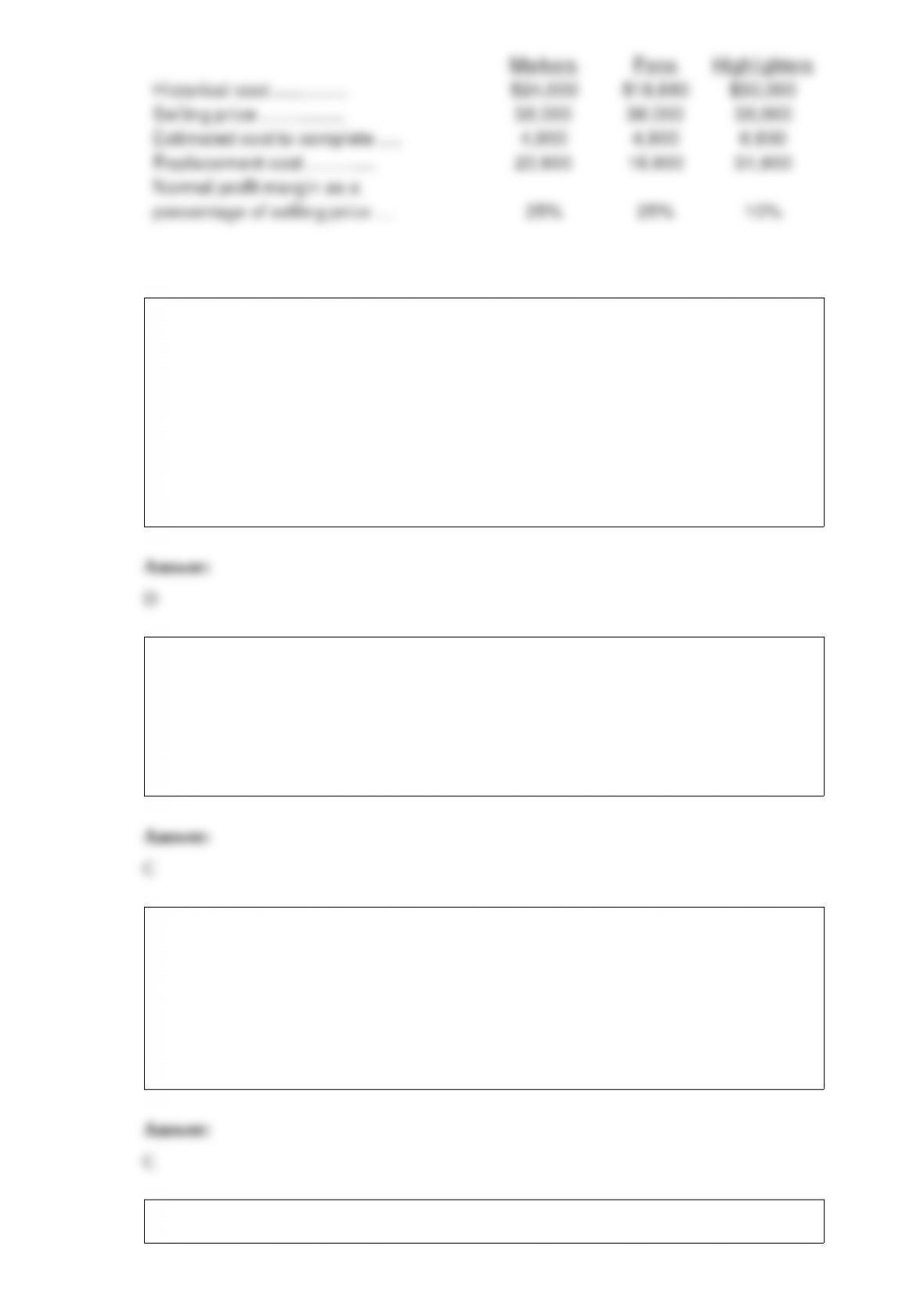
24) The Kidde Corporation uses the lower-of-cost-or-market method to value inventory.
Data regarding the items in work-in-process inventory are presented below.
The value for cost to be used in the lower-of-cost-or-market comparison for the markers
is
a. $20,800
b. $23,400
c. $24,000
d. $31,200
25) Which of the following is NOT correct regarding a change in reporting entity?
a. Financial statements of the year in which the change in reporting entity is made
should disclose the nature of the change and the reason for the change
b. The effect of the change on income before extraordinary items, net income, and
earnings per share amounts should be reported for all periods presented
c. Financial statements presented for all prior periods must be restated
d. The effect of the change on income before extraordinary items, net income, and
earnings per share amounts should be reported for all periods presented and must be
repeated in all periods subsequent to the period of the change
26) The financial statements that are prepared for the business are separate and distinct
from the owners according to the
a. going-concern assumption
b. matching principle
c. economic entity assumption
d. full disclosure principle
27) During the year, The Core Company purchased $1,700,000 of inventory. The cost
of goods sold for the year was $1,600,000 and the ending inventory at December 31
was $330,000. What was the inventory turnover for the year?
a. 2.9
b. 3.3
c. 5.7
d. 6.1
28) Earnings per share information should be reported for all of the following except
a. continuing operations
b. extraordinary gain
c. net income
d. cash flows from operating activities
29) Aboard Company began the current year with the following:
During the current year, the following events occurred:
At the end of the current year, Aboard showed a balance in gross accounts receivable
(before the allowance for doubtful accounts) of $16,800.
What amount would be shown as an operating cash inflow in the statement of cash
flows under the indirect method?
a. $21,000
b. $22,000
c. $30,000
d. $28,200
30) In a statement of cash flows, proceeds from the sale of a company’s own bonds or
mortgages should be classified as cash inflows from
a. leveraging activities
b. operating activities
c. investing activities
d. financing activities
31) In preparing the bank reconciliation of Yardley Company for the month of July, the
following information is available:
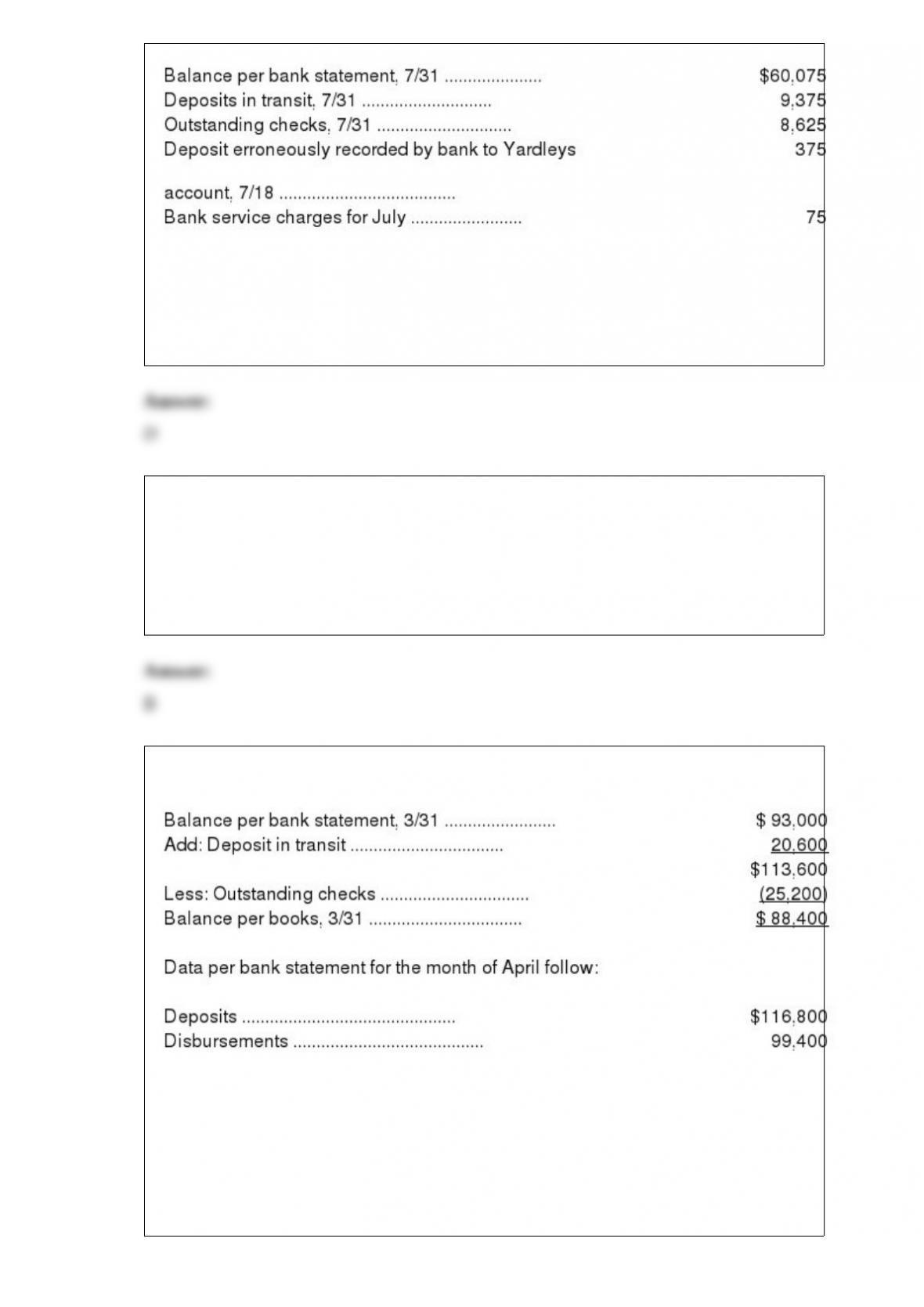
What is the correct cash balance at July 31?
a. $52,875
b. $54,375
c. $54,825
d. $60,450
32) According to the FASB’s conceptual framework, the process of reporting an item in
the financial statements of an entity is
a. realization
b. recognition
c. matching
d. allocation
33) Alonso Company had the following bank reconciliation at March 31:
All reconciling items at March 31 cleared through the bank in April. Outstanding
checks at April 30 totaled $15,000. What is the amount of cash disbursements per books
in April?
a. $89,200
b. $99,400
c. $109,600
d. $114,400

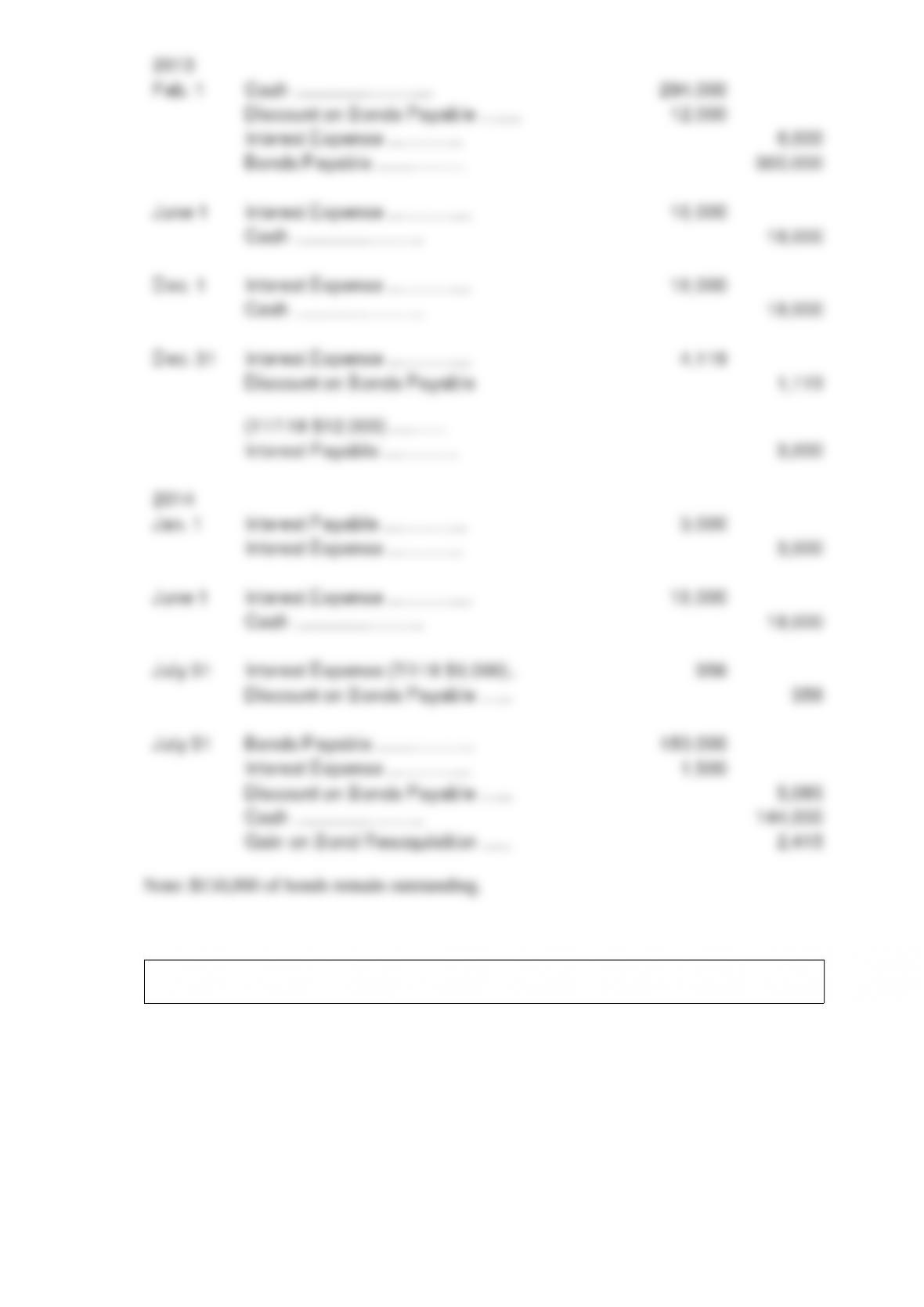
34) On February 1, 2013, SouthernGas sold $300,000, 12 percent, ten-year bonds at 96
plus accrued interest. Interest is payable semiannually on June 1 and December 1. The
bond issue was dated December 1, 2009. On July 31, 2014, $150,000 of the issue was
reacquired at 95 plus accrued interest.
Make the entries on the issuer’s books for the sale of the bonds, the payment of interest,
amortization of premium or discount, and accrual of interest, and reacquisition as
needed for 2013 and 2014. Straight-line amortization is recorded at the end of the
calendar year and accruals are reversed. (Round all calculations.)
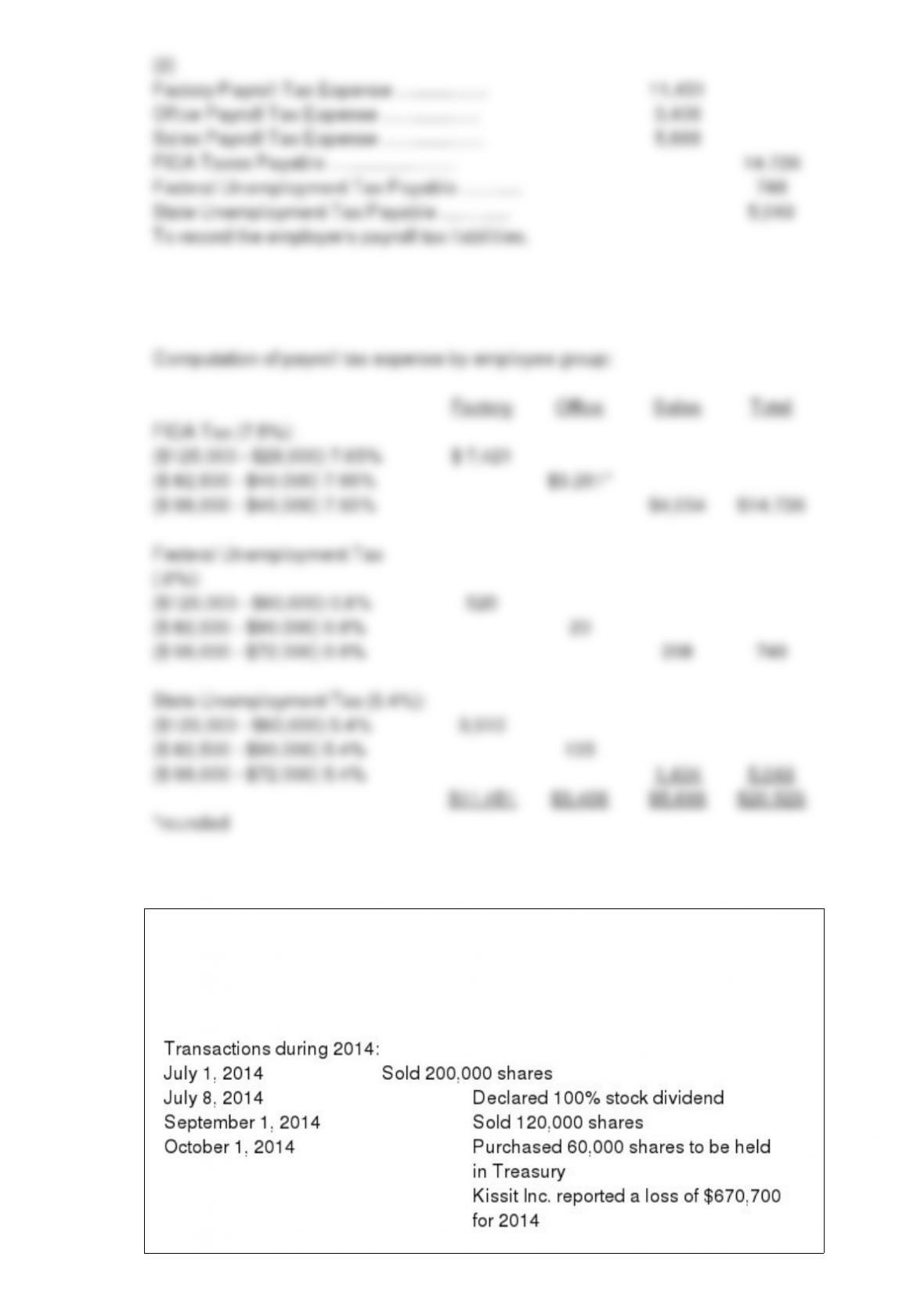
35) On August 31, 2014, payroll data from the records of Astroland Enterprises showed:
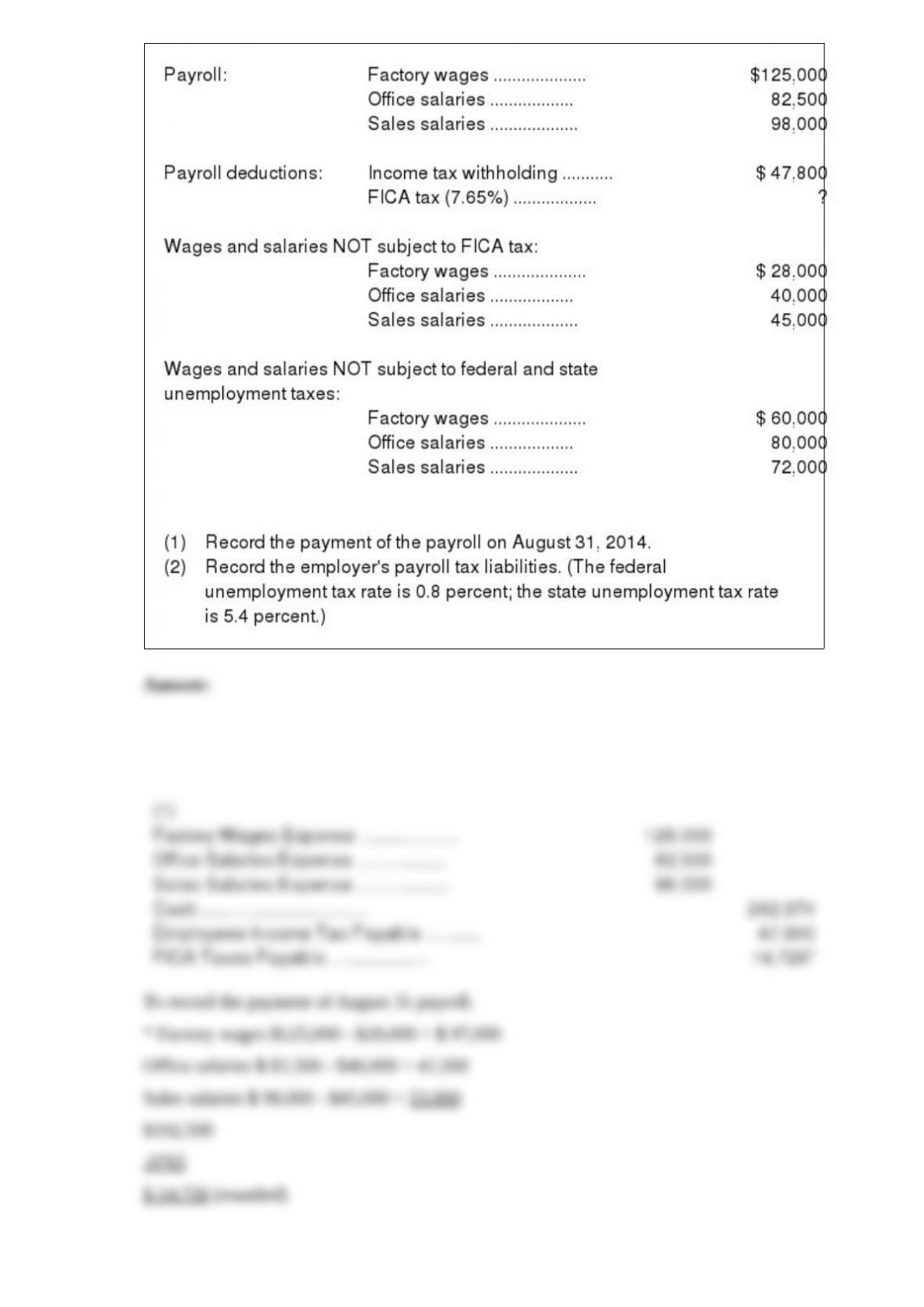
Provide the entries necessary to:
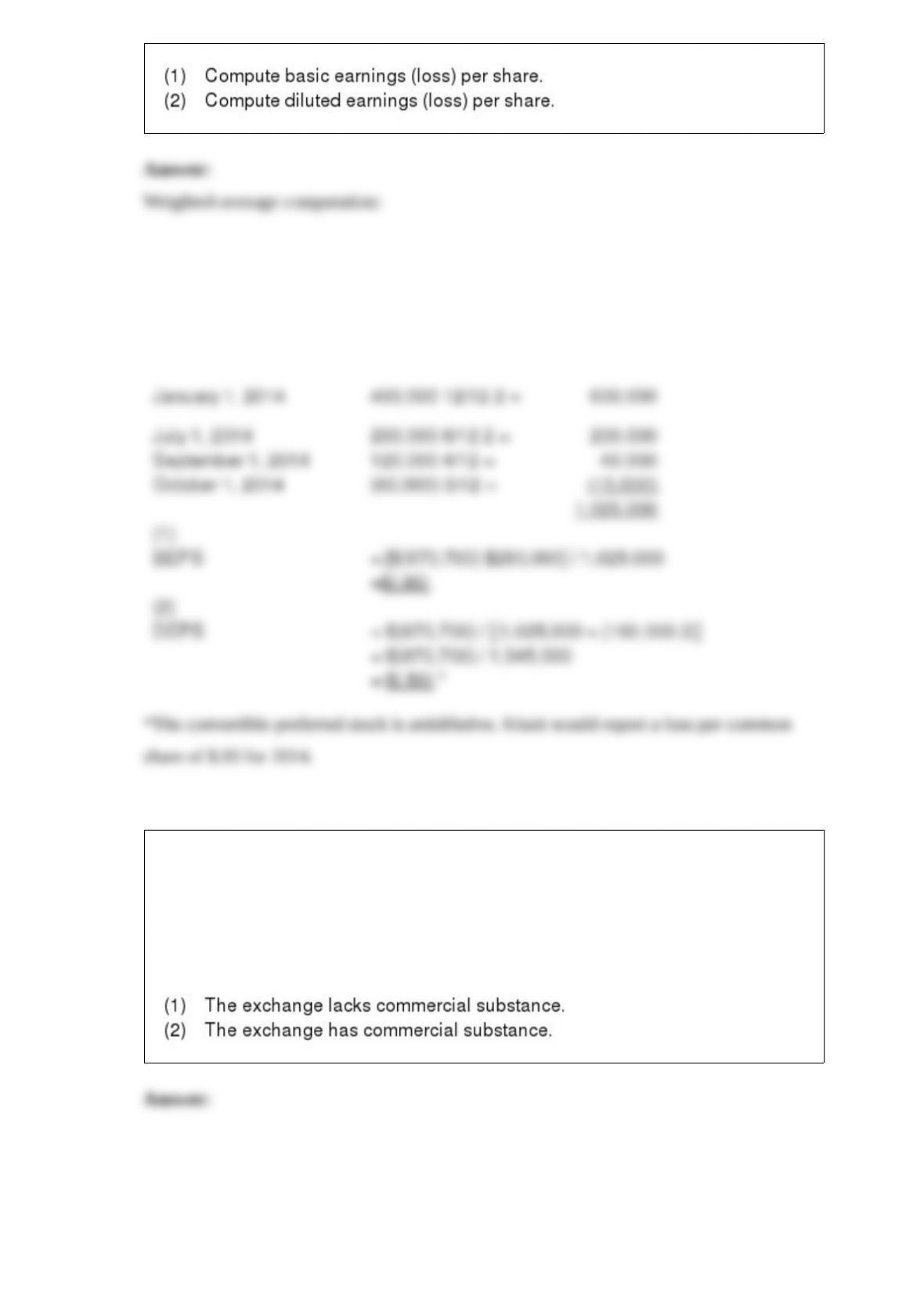
36) At December 31, 2013, Kissit Inc. had 400,000 shares of common stock
outstanding. The company also had 40,000 shares of $7 convertible preferred stock.
Each share is convertible into 4 shares of common stock. (Dividends were declared and
paid.)
37) The Corey Company exchanged equipment costing $190,000 with accumulated
depreciation of $45,000 for equipment owned by Salvo Corporation. The Salvo
equipment cost $305,000 with accumulated depreciation of $105,000. The fair value of
both pieces of equipment was $275,000.
Provide the necessary entries to record the transaction on both companies’ books
assuming:
38) Ideally, managers should make accounting changes only as a result of new
experience or information, or due to changes in economic conditions that demand
methods of accounting that more accurately reflect such changing conditions. Managers
should be attempting to achieve the closest match between reporting and economic
reality.
Identify motivations for managers to make accounting changes other than the goal of
achieving congruence between reporting and economic reality.
39) D. C. System Services provides its customers with computer-based services over an
extended period. Customers are required to prepay the entire fee for the extended
service. D. C. performs initial setup activities to enter a customer into its system. The
initial setup allows the customer to receive automated services from D. C. from that
point forward in the service agreement.
The management of D. C. plans to recognize the revenue over the life of the service
contract, but plans to recognize a disproportionate amount of revenue at the beginning
of the contract as a result of the completion of the setup activities and the cost incurred
in connection with the completion of the setup activities.
Required:
Do you agree with the proposal by the management of D. C. regarding revenue
recognition related to the setup activities? How should revenue be recognized for an
agreement such as this?
40) On January 1, 2011, Shine Services Inc. purchased a new machine for $600,000.
The machine had an estimated useful life of eight years and a salvage value of
$150,000. Shine elected to depreciate the machine using the double-declining-balance
method. On January 1, 2014, the company decided to change to straight-line
depreciation.
Ignoring income tax considerations, prepare the entries to record