Which of the following statements about dividends is notTRUE?
A. Dividends represent a sharing of corporate profits with owners.
B. Both stock dividends and cash dividends reduce retained earnings.
C. Cash dividends paid to stockholders reduce net income.
D. Dividends are declared at the discretion of the board of directors.
Answer:
Net Income would be understated by a failure to record collection of accounts
receivable.
Answer:
Transactions are analyzed from the point of view of the company, not the company’s
owners.
Answer:
Your company issued bonds at a discount. Which of the following statements is
notTRUE?
A. The contra liability account, Discount on Bonds Payable, is amortized each year by
shifting part of its balance to interest expense.
B. As the current date approaches the maturity date, the carrying value of the bond
approaches the face value of the bond.
C. At the date of issuance, the market interest rate was higher than the stated interest
rate.
D. The account used to record the discount is a normal credit balance account.
Answer:
Which one of the following statements regarding sales discounts isTRUE?
A. If a company offers a discount to encourage prompt payment and the discount is
taken, the discount reduces the amount of Net Sales.
B. Credit terms of “2/10, n/30” mean that if payment is made in two days, a 10%
discount may be taken; if not paid within two days, the full invoice price will be due in
thirty days.
C. The terms ‘sales discounts” and ‘sales credits” are used interchangeably by a
company.
D. Sales discounts is an expense account.
Answer:
Inventory shrinkage is the difference between inventory recorded and inventory
counted.
Answer:
A stock dividend decreases the market price of the company’s stock.
Answer:
Which of the following statements regarding dividends isTRUE?
A. Some companies do not pay dividends even when the company is profitable.
B. Stock dividends immediately increase the total value of the stockholders’ investment.
C. Cash dividends and stock dividends both decrease total stockholders’ equity.
D. A corporation has a legal obligation to pay dividends each year.
Answer:
At the end of the year, a company issued stock for cash and then used the cash to
acquire a piece of land for future development. Which of the following isTRUE?
A. Net profit margin ratio will decrease and debt-to assets ratio will decrease.
B. Net profit margin ratio will not change and debt-to-assets ratio will increase.
C. Net profit margin ratio will increase and debt-to-assets ratio will decrease.
D. Net profit margin ratio will not change and debt-to-assets ratio will decrease.
Answer:
Which of the following statements regarding payroll liabilities isTRUE?
A. Accrued payroll includes such liabilities as retirement and health benefits that are not
yet paid.
B. Only employees are required to pay FICA taxes.
C. Both employers and employees are required to pay unemployment taxes.
D. Accrued payroll liabilities do not include any voluntary deductions by employees for
charitable contributions or union dues.
Answer:
If merchandise is purchased on terms 1/10, n/30 and paid for in 7 days, the purchase
discounts account would be credited at date of payment when a perpetual inventory
system is used.
Answer:
The gross profit percentage is computed by dividing operating income by net sales.
Answer:
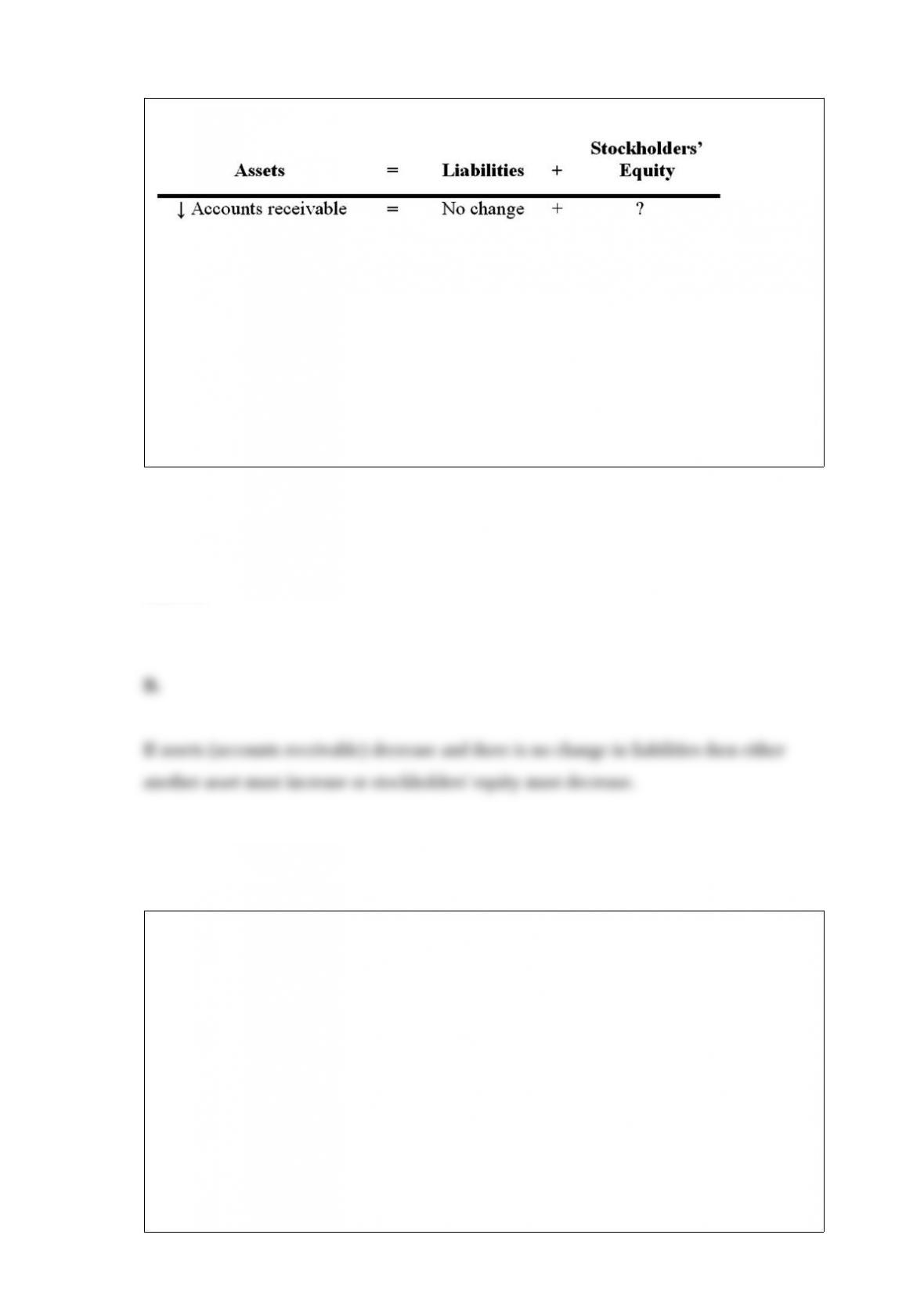
In part, a transaction affects the accounting equation as follows:
Which of the following must beTRUE for this transaction?
A. If other assets are unchanged, stockholders’ equity must be increasing.
B. If other assets are unchanged, stockholders’ equity must be decreasing.
C. If stockholders’ equity is unchanged, another asset must be decreasing.
D. If stockholders’ equity is unchanged, other assets must be unchanged.
Answer:
Which of the following statements is notTRUE regarding net profit margin?
A. If a company’s net profit margin increases from 15% to 20% this would be
considered an improvement in profitability.
B. A company with a net profit margin of 10% may be evaluated differently depending
upon which industry it is in.
C. A company with a net profit margin of 10% is using 90% of each dollar of revenue to
cover costs and expenses.
D. Net profit margin indicates how much revenue is earned for every dollar of net
income.
Answer:
A stock that does not pay a dividend is an undesirable investment.
Answer:
A post-closing trial balance should include only permanent accounts.
Answer:
Contributed Capital is an asset on the balance sheet.
Answer:
Treasury stock purchases made with cash are cash outflows in the financing activities
section of the statement of cash flows.
Answer:
A debit may increase or decrease an account, depending on the type of account.
Answer:
Which of the following statements regarding bonds payable net of a discount or
premium is notTRUE?
A. If a company records a discount or premium with the bonds payable in a single
account called Bonds Payable, Net, it is using the simplified effective interest method
of amortization.
B. When bonds payable are accounted for net of a discount, the initial amount recorded
in the Bonds Payable, Net account is the issue price of the bond.
C. When the Simplified Approach (Effective-interest Method) of amortization is used,
the balance in the Bonds Payable, Net account will increase as the bond approaches the
maturity date.
D. If a company issued bonds at their face value, the balance of Bonds Payable, Net
account will always be equal to the face value of the bonds as long as the bonds are
outstanding.
Answer:
Which of the following statements regarding the concepts underlying the balance sheet
areTRUE?
A. A company buys land for $5 million dollars in 1983. The land is now worth $15
million. The company should increase the book value of this asset on its balance sheet
to reflect its current value.
B. All events affecting the current value of a company are reported on the balance sheet.
C. According to the cost principle, assets are valued at their replacement cost.
D. Under Generally Accepted Accounting Principles, assets are generally written down
if the market value declines, but are not written up if the market value increases.
Answer:
In applying the lower of cost or market rule to report inventory, “market” is defined as
the current selling price.
Answer:
An entertainment company received $6 million in cash for advance season ticket sales.
Prior to the beginning of the season, these sales should be recorded as a liability.
Answer:
Corporations are governed by federal law.
Answer:
Which of the following statements regarding types of adjusting entries isTRUE?
A. An accrual adjustment that increases an asset will include an increase in an expense.
B. A deferral adjustment that decreases an asset will include an increase in an expense.
C. An accrual adjustment that increases an expense will include an increase in assets.
D. A deferral adjustment that increases a contra account will include an increase in an
asset.
Answer:
Net Income on the Income Statement is equal to the amount of cash generated by the
business.
Answer:
When preparing the operating activities section of the statement of cash flows using the
indirect method, a decrease in accounts receivable is subtracted from net income.
Answer:
Which of the following statements is notTRUE about when cash dividends can be paid?
A. The retained earnings account must have an accumulated balance sufficient to cover
the amount of the dividends to be paid.
B. The cash account must have a balance sufficient to pay the dividends.
C. The board of directors must have declared the dividend before it can be paid.
D. Loan covenants do not restrict the payment of dividends.
Answer:
The allowance method for uncollectible accounts is required by GAAP because it
conforms to the matching principle.
Answer:
Trend analysis is a form of horizontal analysis.
Answer:
Gains or losses from discontinued operations are reported on a separate line on the
income statement net of income tax effects.
Answer:
A retailer is a company that buys products from manufacturers and sells them to
wholesalers.
Answer:
Operating cycles are generally longer than a year.
Answer:
A company had average total assets of $600,000 and an asset turnover ratio of 4.
Which of the following is notTRUE?
A. Sales revenue was $2,400,000.
B. The asset turnover ratio indicates $4 of sales were generated for every $1 invested in
assets.
C. The asset turnover ratio is an indication of the efficiency in the use of assets to
generate revenues.
D. The asset turnover ratio indicates the success of efforts to control expenses.
Answer:
Which one of the following statements regarding the balance sheet for Anonymous Inc.
isTRUE?
A. The $207,100 shown on the balance sheet has been distributed to stockholders as
dividends.
B. Retained Earnings is misclassified. It should be reported as an Asset.
C. Anonymous, Inc., is owed $310,500 from customers who have purchased goods or
services from the company, but have not yet paid for them.
D. The retained earnings reported represents the retained earnings at the beginning of
the year.
Answer:
Unearned Revenue is reported on the Balance Sheet as a liability.
Answer:
What is the first step in calculating cash flows from operations when the indirect
method is used?
A. Find net income on the income statement.
B. Calculate the net change in the cash account.
C. Add the change in accounts receivable to sales revenue.
D. Identify the balance sheet accounts that relate to operating activities.
Answer:
A company had current assets of $550,000 and a current ratio of 2.0. The current assets
consist of Cash of $50,000, Short-term investments of $150,000, Accounts receivable of
$50,000, and Inventory of $300,000. Which of the following is closest to the company’s
quick ratio?
A. 2.0
B. 1.82
C. 0.53
D. 0.91
Answer:
In the U.S., generally accepted accounting principles are established:
A. directly by the 1933 Securities Act.
B. by the Public Company Accounting Oversight Board (PCAOB).
C. by the Financial Accounting Standards Board (FASB).
D. by the American Institute of Certified Public Accountants (AICPA).
Answer:
If a company capitalizes costs that should be expensed, how is its income statement for
the current period impacted?
A. Net income will be lower than it should be.
B. Revenues will be lower than they should be.
C. Expenses will be lower than they should be.
D. Assets will be lower than they should be.
Answer:
Current liabilities are due:
A. but not receivable for more than one year or the current operating cycle, whichever
is longer.
B. but not payable for more than one year or the current operating cycle, whichever is
longer.
C. and receivable within the current operating cycle or one year, whichever is longer.
D. and payable within the current operating cycle or one year, whichever is longer.
Answer:
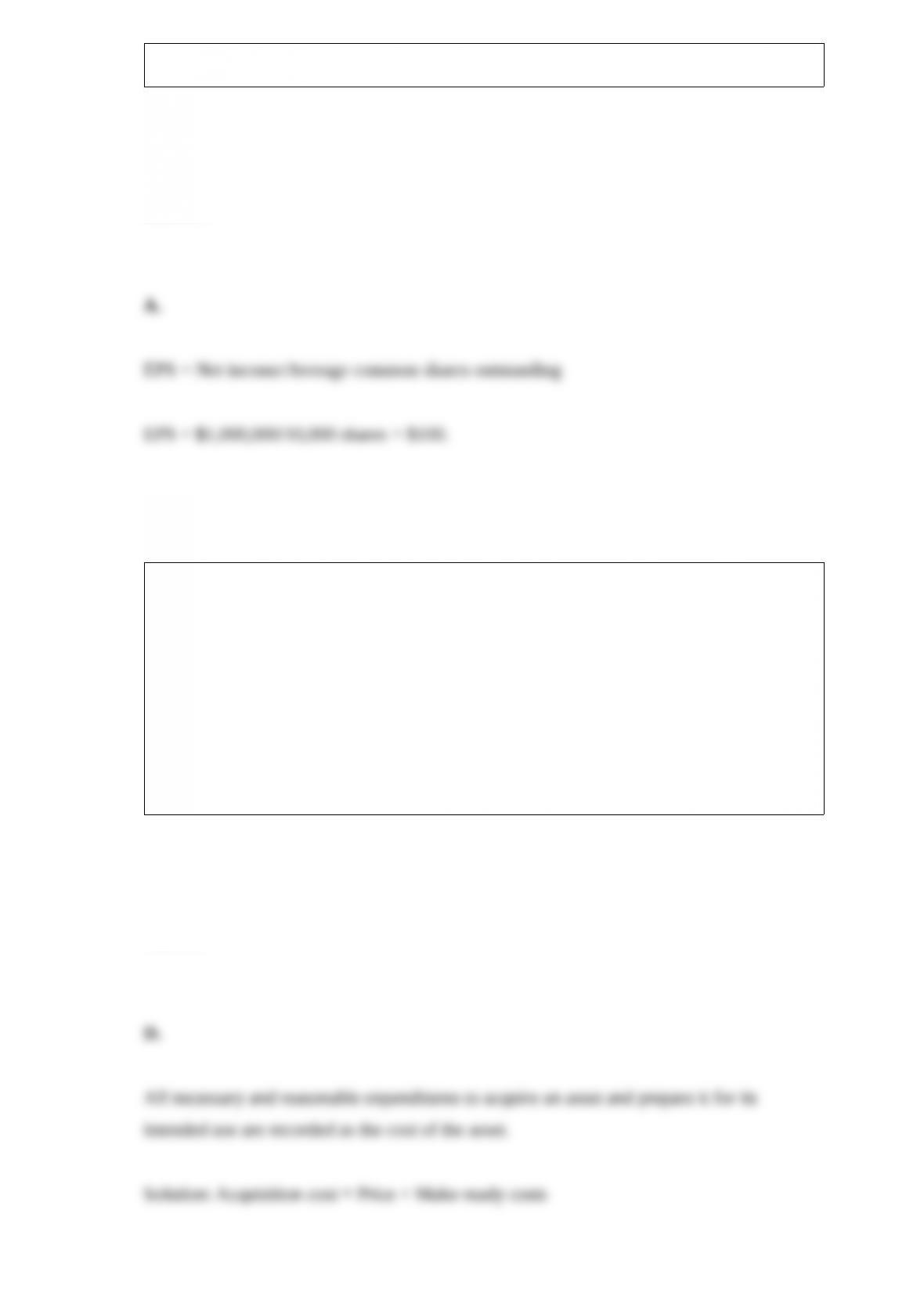
On December 31, 2014 and 2015, a company had 10,000 shares of common stock
outstanding. The following information is also available:
Use the information above to answer the following question. The earnings per share at
December 31, 2015 is closest to:
A. $100.
B. $400.
C. $40.
D. $500.
Answer:
Your company buys a computer system from IBM for $3 million and pays IBM
$200,000 to install the computer system. Your company should record:
A. $3 million in equipment, and $200,000 in expenses.
B. $3.2 million in expenses.
C. $2.8 million in equipment and the rest in expenses.
D. $3.2 million in equipment.
Answer:
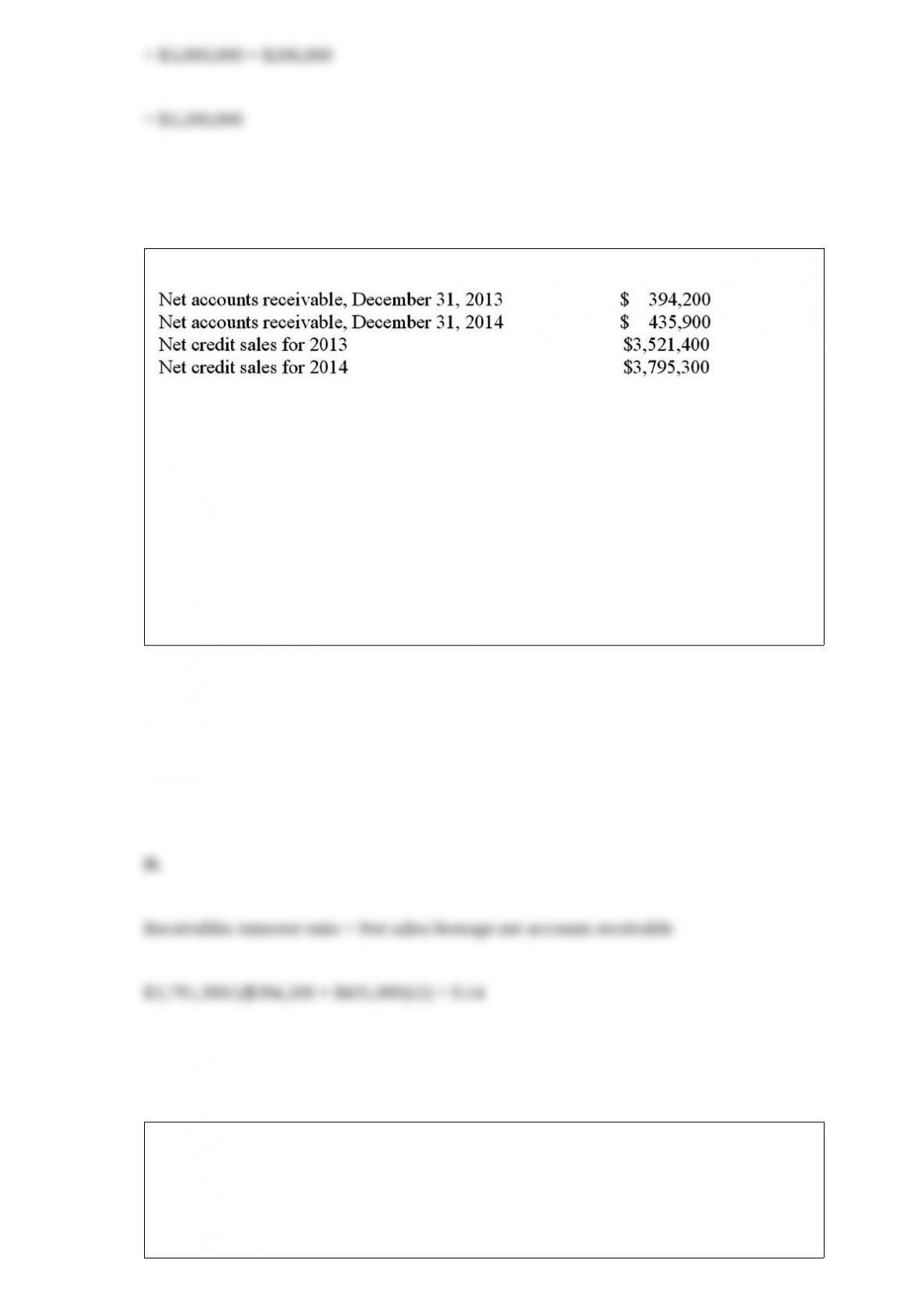
Use the information above to answer the following question. The receivables turnover
ratio for 2014 is closest to:
A. 8.93
B. 8.48
C. 8.71
D. 9.14
Answer:
Which of the following statements regarding capitalization is correct?
A. Capitalizing costs refers to the process of converting assets to expenses.
B. All costs incurred to acquire an asset may be capitalized.
C. Capitalizing a cost means to record it as an asset.
D. Capitalization results in an immediate decrease in net income.
Answer:
Brighton, Inc., uses the indirect method to determine its net cash flows from operating
activities. During the course of the year, the company’s accounts receivable increased
by $10,000 and its accounts payable decreased by $5,000. As a result of these two
items, the calculation to determine cash flows from operating activities will be:
A. increased by $5,000.
B. decreased by $5,000.
C. increased by $15,000.
D. decreased by $15,000.
Answer:
Sparkling Pools provides $1,000 of pool maintenance services during July and collects
payment in August. The company performs $1,600 of pool maintenance services during
July that were paid for in June. The company accepts an order to perform $500 of pool
maintenance services in August and will be paid in the same month. Revenue should be
credited for:
A. $1,600 in June, $1,000 in July, and $500 in August.
B. $1,600 in June, $0 in July, and $1,500 in August.
C. $0 in June, $1,600 in July, and $1,500 in August.
D. $0 in June, $2,600 in July, and $500 in August.
Answer:
A company’s income statement for the year shows a net loss of $90,000. Additional
information for the year follows:
What is the net cash provided by (used in) operating activities?
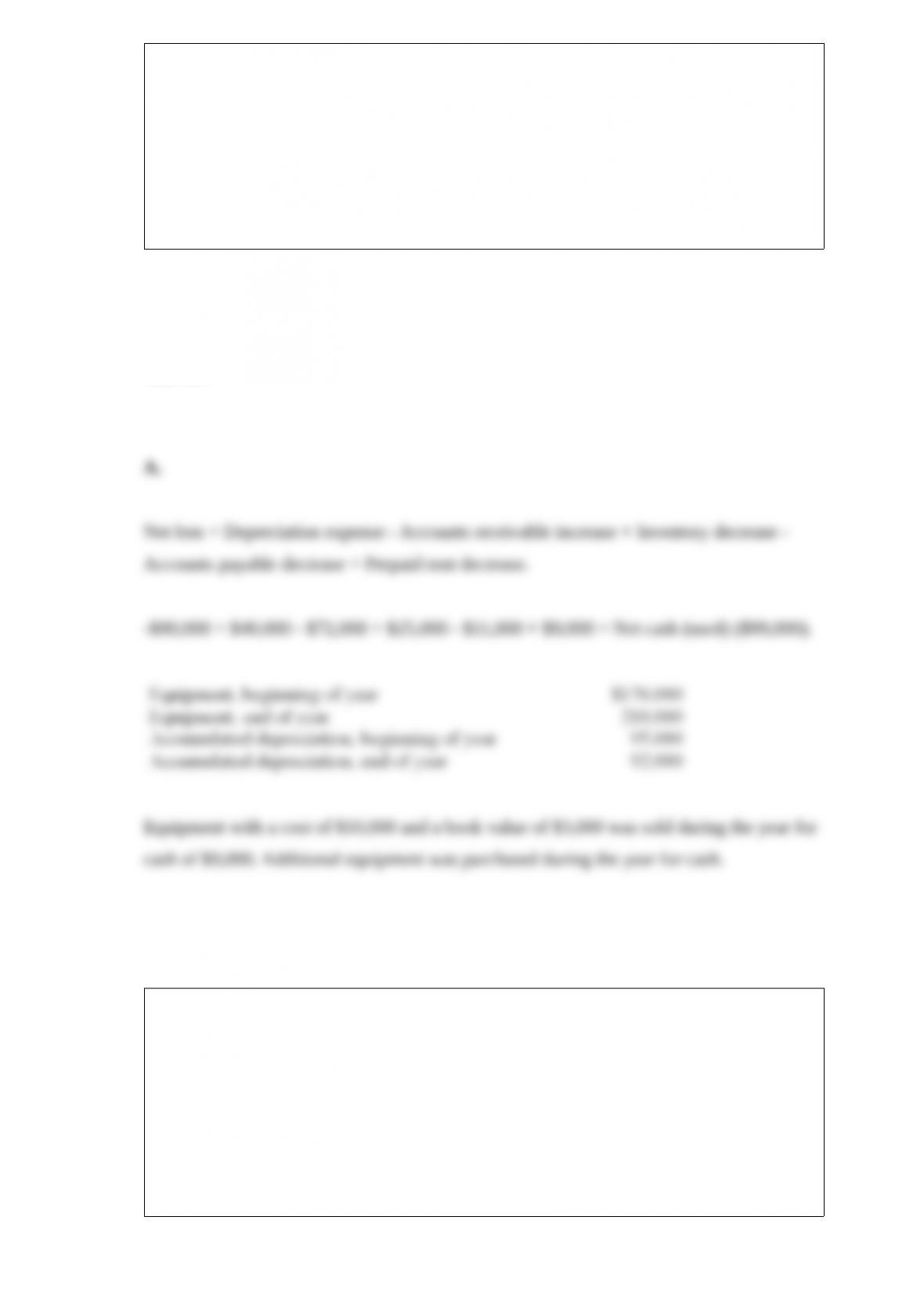
A. ($99,000)
B. $27,000
C. $13,000
D. ($45,000)
Answer:
The entry to record a bond retirement at maturity usually involves:
A. no gain or loss.
B. a credit to Gain on Bond Retirement.
C. a debit to Loss on Bond Retirement.
D. a credit to Bonds Payable.
Answer:
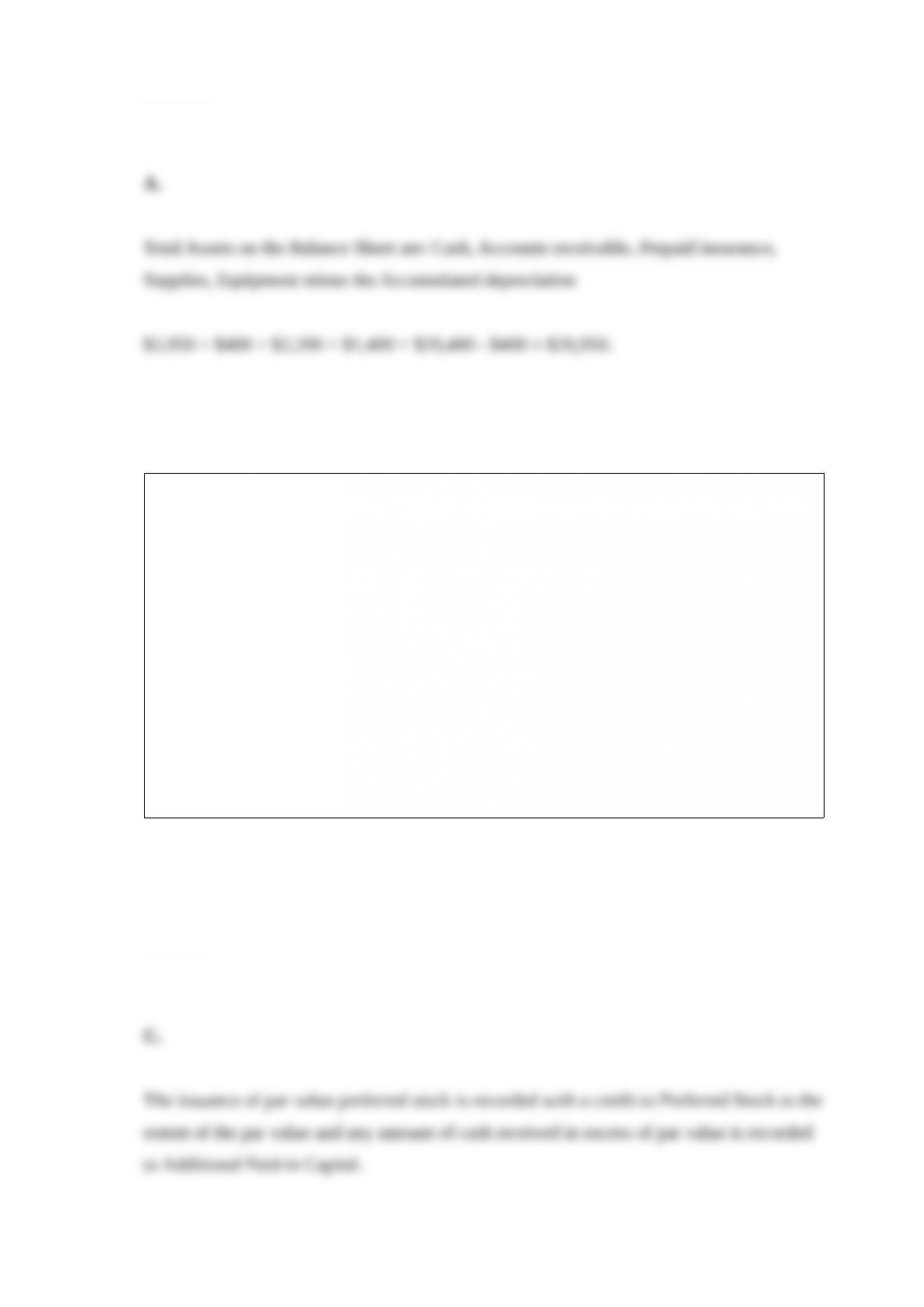
The following items are taken from the adjusted trial balance prepared as of December
31, 2013. All accounts have normal balances.
What is the amount of Total Assets to be reported on the Balance Sheet at December 31,
2013?
A. $26,950
B. $27,100
C. $27,250
D. $26,550
Answer:
A company issues 100,000 shares of preferred stock for $40 a share. The stock has a
fixed dividend rate of 5% and a par value of $3 per share. The company records the
issuance with a:
A. debit of $4 million to Cash and a credit of $4 million to Preferred Stock.
B. debit of $300,000 to Cash and a credit of $300,000 to Preferred Stock.
C. debit of $4 million to Cash, a credit of $300,000 to Preferred Stock, and a credit of
$3.7 million to Additional Paid-in Capital.
D. debit of $300,000 to Cash, a debit of $3.7 million to Long-term Investments, a credit
of $300,000 to Preferred Stock, and a credit of $3.7 million to Additional Paid-in
Capital.
Answer:
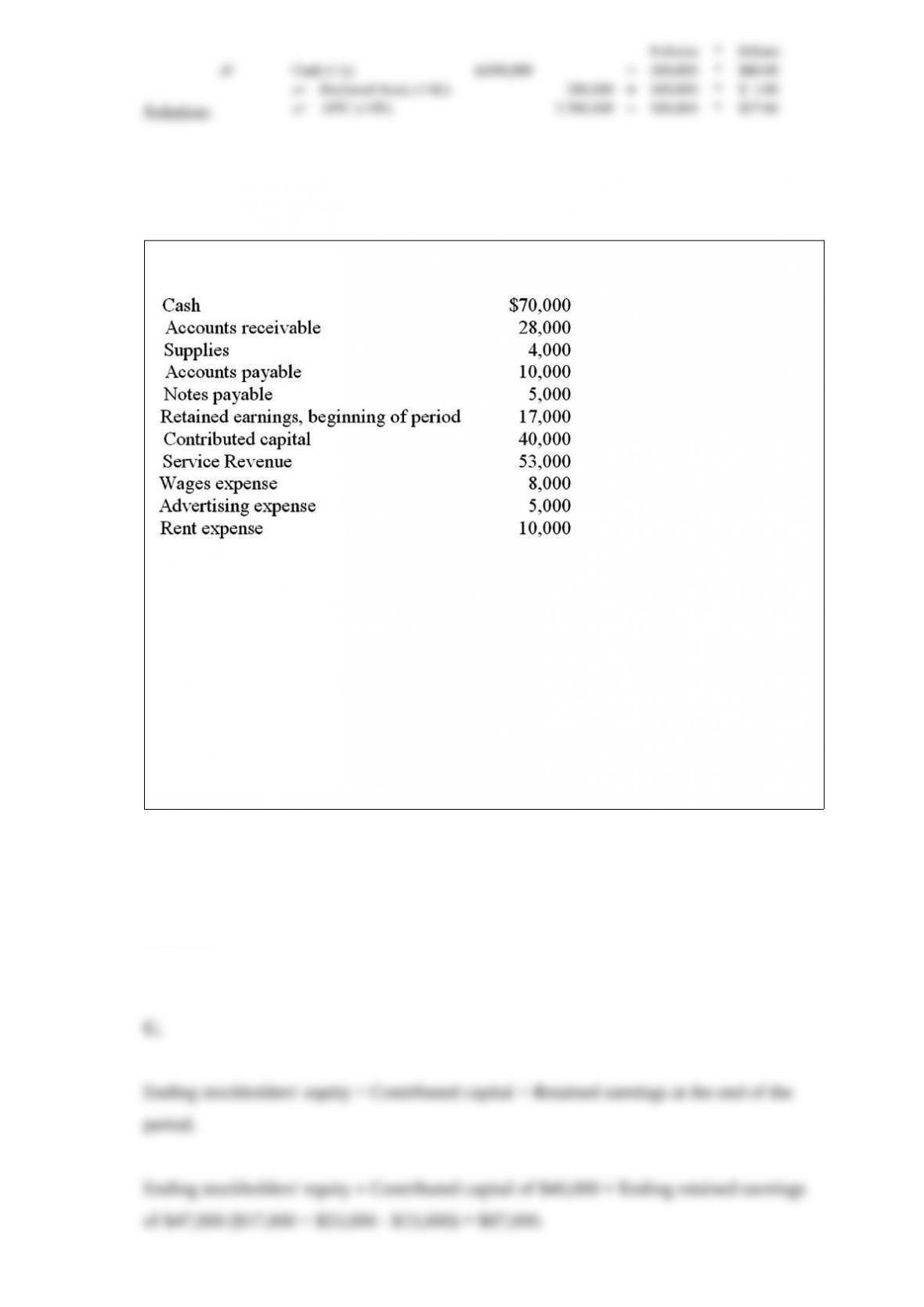
A company’s financial records at the end of the year were as follows:
What is the amount of total stockholders’ equity that would be reported on the Balance
Sheet at the end of the year?
A. $30,000
B. $57,000
C. $87,000
D. $102,000
Answer:
Sales tax collected by a company is normally reported as:
A. a current liability.
B. income tax expense.
C. an asset.
D. an operating expense.
Answer:
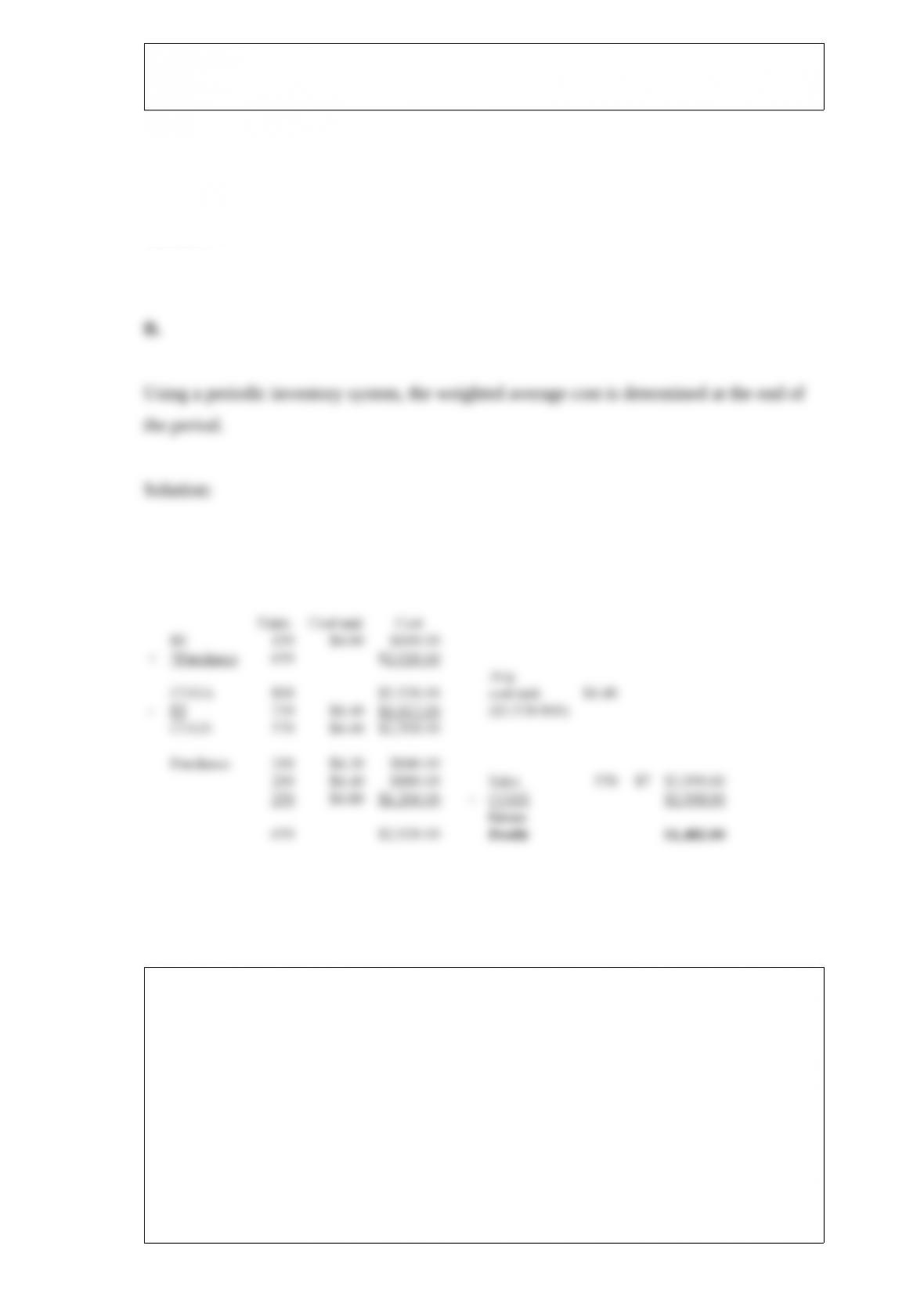
Meanmocha Hardware has a periodic inventory system and uses the weighted average
method. The company began the month of November with 150 large brass switch plates
on hand at a cost of $4.00 each. These switch plates sell for $7.00 each. The following
schedule sets forth the purchases of switch plates during November:
If Meanmocha sells 570 switch plates for $7.00 each during November, the company’s
gross profit for November is closest to:
A. $1,046.
B. $1,482.
C. $1,516.
D. $1,528.
Answer:
A company has $72,500 in inventory at the beginning of the accounting period and
$65,500 at the end of the accounting period. Sales revenue is $986,400, cost of goods
sold is $572,700, and net income is $124,200 for the accounting period. On average,
this company has inventory on hand for approximately:
A. 203 days.
B. 44 days.
C. 61 days.
D. 26 days.
Answer:
Assets are listed on a classified balance sheet in which of the following ways?
A. In alphabetical order.
B. From the largest dollar amount to the lowest dollar amount.
C. Beginning with noncurrent assets and ending with current assets.
D. Starting with cash.
Answer:
The normal balance of any account is the
A. left side.
B. right side.
C. side which increases that account.
D. side which decreases that account.
Answer:
The E. Flynn Company started business by obtaining financing through debt financing
and equity financing. Which of the following statements is FALSE?
A. Equity financing refers to the money obtained through owners’ contributions and
reinvestments of profit.
B. Debt financing refers to the money obtained through loans.
C. The business is obligated to repay debt financing.
D. The business is obligated to repay equity financing.
Answer:
The following accounts are taken from the December 31, 2014 financial statements of a
company.
What is the amount of total assets at the end of 2014?
A. $16,800.
B. $16,500.
C. $21,600.
D. $23,500.

Answer:
At the end of the first year, the Treadwell Tire Company had net accounts receivable of
$67,900 and at the end of the second year the company had net accounts receivable of
$72,400. If the company’s net sales revenue during the second year was $876,875, the
receivables turnover ratio for the second year was:
A. 12.5.
B. 29.2.
C. 0.08.
D. 0.034.
Answer:
A company has net income of $5.6 million. Stockholders’ equity at the beginning of the
year is $32.55 million and, at the end of the year, it is $38.15 million. The only change
to stockholders’ equity came from net income. The Return on Equity ratio is
approximately:
A. 0.15.
B. 0.16.
C. 0.87.
D. 6.64.
Answer:
Which one of the following accounts would not necessarily be classified as a current
liability?
A. Accounts payable
B. Accrued liabilities
C. Contingent liabilities
D. Current portion of long-term debt

Answer:
Alphabet Company, which uses the periodic inventory method, buys different letters for
resale. It buys A thru G in January at $4 per letter. In February, it buys H thru L at $6
per letter. It buys M thru R in March at $7 per letter. It sells A, D, E, H, J and N in
April.
Use the information above to answer the following question. If the company uses the
weighted average method, the cost of its ending inventory is closest to:
A. $38.
B. $48.
C. $67.
D. $75.
Answer:
If selling, general and administrative expenses are $53,600, of which $12,200 is
depreciation expense, and beginning prepaid expenses are $3,000, ending prepaid
expenses are $5,000, beginning accrued expenses are $17,000, and ending accrued
expenses are $20,000, how much cash was paid to employees and service providers?
A. $52,600
B. $40,400
C. $42,400
D. $64,800
Answer:
Fonthouse Corp. issues 10,000 shares of $2, no-par value preferred stock for cash at
$60 per share.
Use the information above to answer the following question. If the company pays the
fixed dividend on the preferred stock, the transaction will:
A. decrease Preferred stock by $20,000.
B. decrease Retained earnings by $600,000.
C. decrease Cash by $20,000.
D. increase Liabilities by $20,000.
Answer:
A current asset is one that:
A. the company has owned for over one year.
B. the company has owned for over five years.
C. the company will use up or convert into cash in less than one year.
D. the company has updated to reflect its current value.
Answer:
Under the periodic inventory system:
A. inventory records are updated immediately after each purchase.
B. inventory must be counted at the end of each accounting period.
C. inventory does not have to be counted. (It can be taken from the accounting records.)
D. inventory levels must be counted every day.
Answer:
Use the information above to answer the following question. What is the amount of
cash collected from customers?
A. $130,000
B. $134,000
C. $126,000
D. $116,000
Answer:
A machine is purchased on January 1, 2014, for $90,000. It is expected to have a useful
life of five years and a residual value of $5,000. The company closes its books on
December 31. Under the double-declining balance method, what is the total amount of
depreciation to be expensed during the 2015 fiscal year (year 2 of 5)?
A. $21,600
B. $22,000
C. $22,400
D. $34,000
Answer:
Using the indirect method, which of the following would be added to net income?
A. A decrease in supplies.
B. An increase in prepaid insurance.
C. A decrease in wages payable.
D. An increase in property, plant and equipment.
Answer:
Which of the following would not be recorded as an identifiable accounting
transaction?
A. Putting a deposit down on a new vehicle.
B. Hiring a new employee.
C. Obtaining a bank loan.
D. Receiving a deposit from a customer.
Answer: