In contribution margin analysis, the unit price or unit cost factor is computed as:
a. the difference between the actual unit price or unit cost and the planned unit price or
cost, multiplied by the planned quantity sold
b. the difference between the actual unit price or unit cost and the planned unit price or
cost, multiplied by the actual quantity sold
c. the difference between the actual quantity sold and the planned quantity sold,
multiplied by the planned unit sales price or unit cost
d. the difference between the actual quantity sold and the planned quantity sold,
multiplied by the actual unit sales price or unit cost
The amount of income that would result from an alternative use of cash is called
opportunity cost.
a. True
b. False
A company’s history indicates that 20% of its sales are for cash and the rest are on
credit. Collections on credit sales are 20% in the month of the sale, 50% in the next
month, 25% the following month, and 5% is uncollectible. Projected sales for
December, January, and February are $60,000, $85,000, and $95,000, respectively. The
February expected cash receipts from all current and prior credit sales is
a. $61,200
b. $57,000
c. $66,400
d. $90,250
Standards are performance goals used to evaluate and control operations.
a. True
b. False
The following data relate to direct labor costs for March:
Rate: standard, $12.00; actual, $12.25
Hours: standard, 18,500; actual, 17,955
Units of production: 9,450
Calculate the total direct labor variance.
a. $2,051.25 favorable
b. $2,051.25 unfavorable
c. $2,362.50 unfavorable
d. $2,362.50 favorable
Production estimates for August are as follows:
Estimated inventory (units), August 1 12,000
Desired inventory (units), August 31 9,000
Expected sales volume (units), August 75,000
For each unit produced, the direct materials requirements are as follows:
Material A ($5 per lb.) 3 lbs.
Material B ($18 per lb.) 1/2 lb.
The total direct materials purchases (assuming no beginning or ending inventory of
material) of Materials A and B required for August production is
a. $1,080,000 for A; $1,296,000 for B
b. $1,080,000 for A; $648,000 for B
c. $1,125,000 for A; $675,000 for B
d. $1,170,000 for A; $702,000 for B
Selected accounts with amounts omitted are as follows
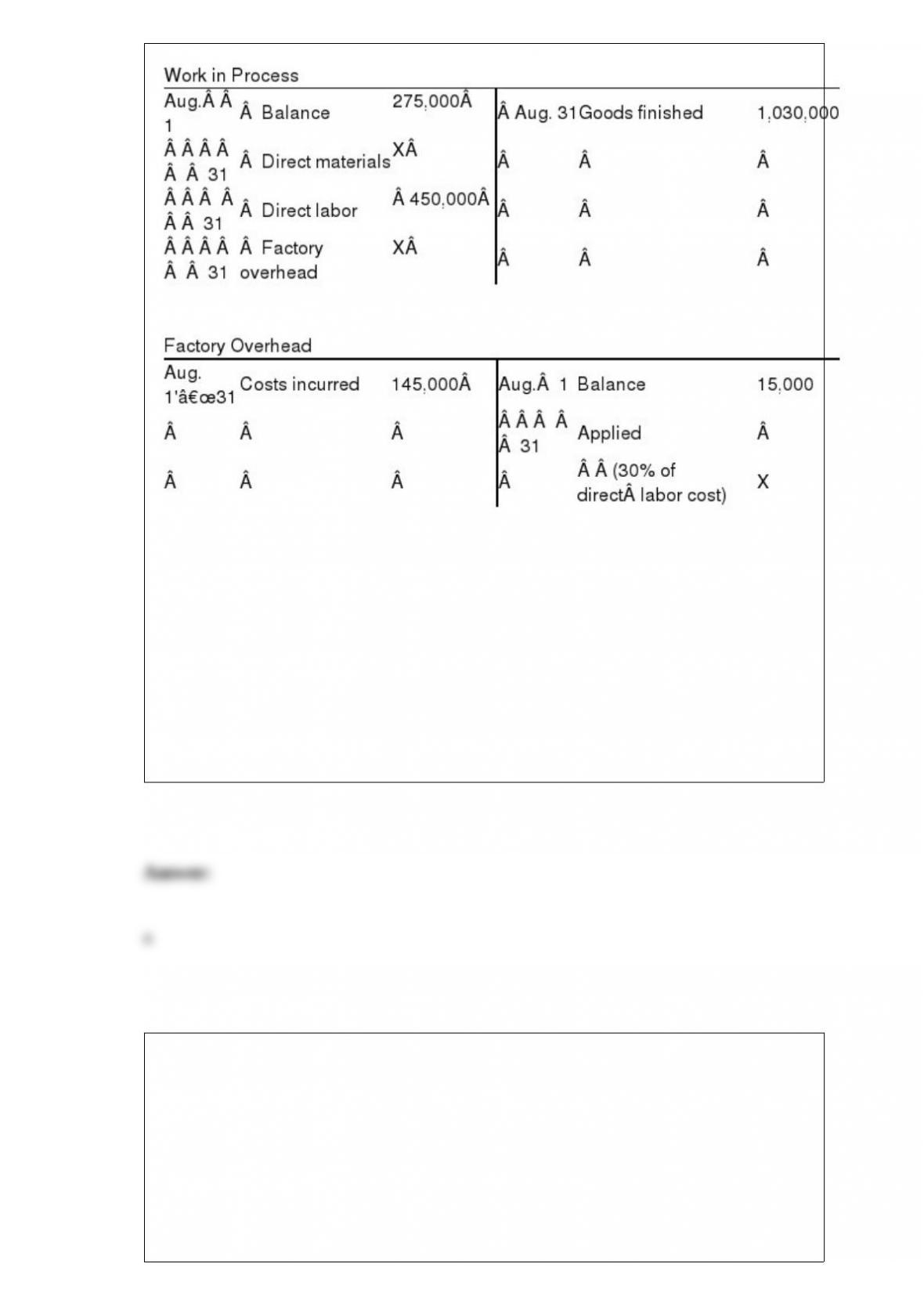
If the balance of Work in Process at August 31 is $220,000, what was the amount
debited to Work in Process for direct materials in August?
a. $390,000
b. $170,000
c. $525,000
d. $580,000
The budgeted finished goods inventory and cost of goods sold for a manufacturing
company for the year are as follows: January 1 finished goods, $765,000; December 31
finished goods, $640,000; and cost of goods sold, $2,560,000. The budgeted costs of
goods manufactured is
a. $1,405,000
b. $2,560,000
c. $2,435,000
d. $3,965,000
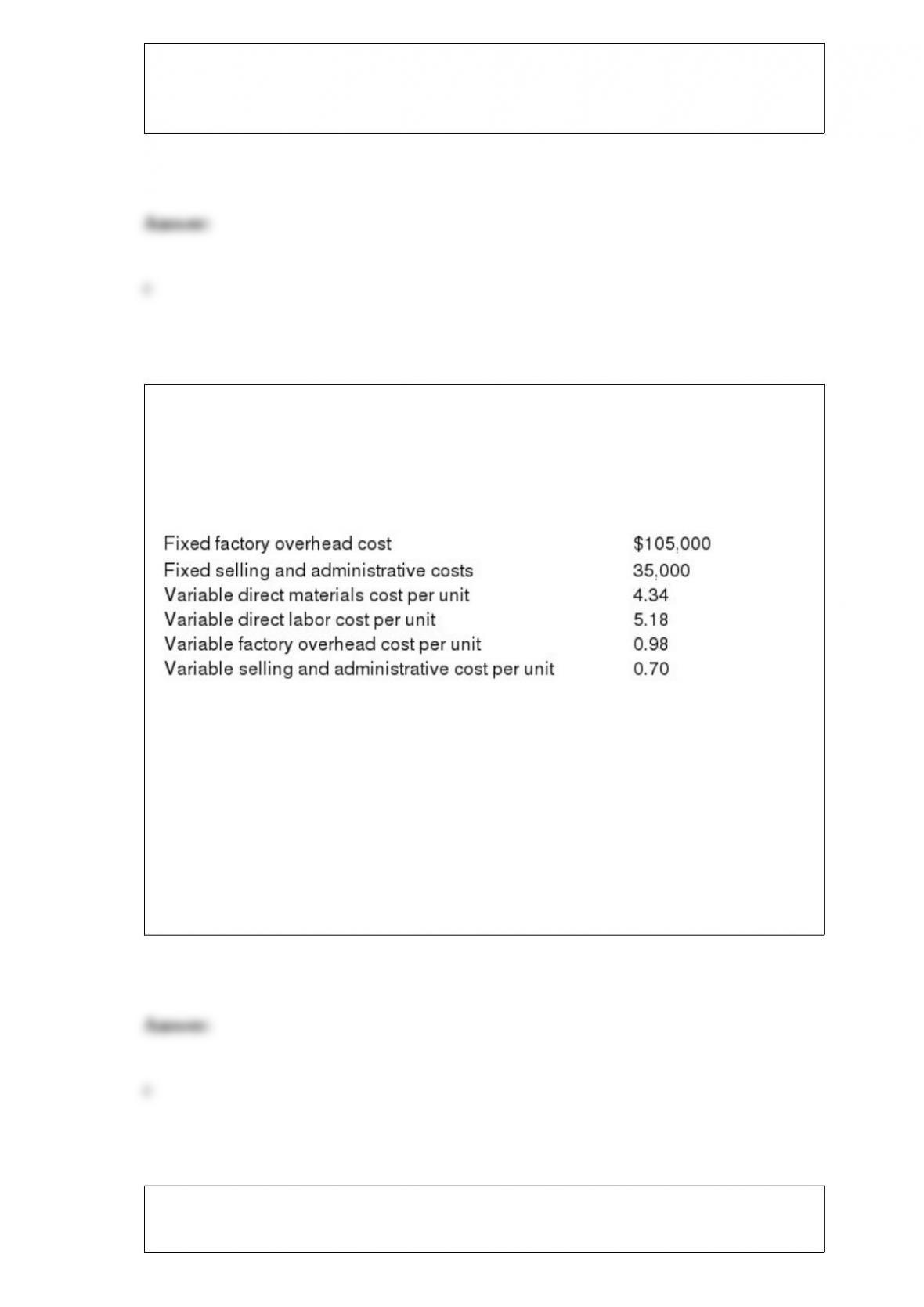
Dotterel Corporation uses the variable cost concept of product pricing. Below is cost
information for the production and sale of 35,000 units of its sole product. Dotterel
desires a profit equal to an 11.2% rate of return on invested assets of $350,000.
The markup percentage for the sale of the company’s product is
a. 14%
b. 5.6%
c. 45.71%
d. 11.2%
Identify the following costs as a (a) product cost or (b) period cost for a cake factory.
1) Frosting
2) _____ Baker’s wages
3) Advertising fees
4) Transportation out
A responsibility center in which the authority over and responsibility for costs and
revenues is vested in the department manager is termed a profit center.
a. True
b. False
Transfer prices may be used when decentralized units are organized as cost, profit, or
investment centers.
a. True
b. False

these make up the work in process subsidiary ledger
Match the following phrases with the term (a-e) that it most closely describes it. Each
term will be used only once.
a. job cost sheets
b. materials requisitions
c. receiving report
d. time tickets
e. cost allocation
focuses on a company’s ability to generate net income
Match each definition that follows with the term (a’“h) it defines.
a. discontinued operations
b. extraordinary items
c. change from one generally accepted accounting principle to another
d. horizontal analysis
e. vertical analysis
f. common-sized financial statements
g. current position analysis
h. profitability analysis
Dove Corporation began its operations on September 1 of the current year. Budgeted
sales for the first three months of business are $250,000, $320,000, and $410,000,
respectively, for September, October, and November. The company expects to sell 25%
of its merchandise for cash. Of sales on account, 70% are expected to be collected in
the month of the sale and 30% in the month following the sale.
The cash collections expected in October are
a. $320,000
b. $248,000
c. $304,250
d. $382,500
Vary in proportion to changes in activity levels
Match the following terms with their definitions.
a. Relevant range
b. Break-even point
c. Contribution margin
d. Fixed costs
e. Variable costs
Direct costs can be specifically traced to a cost object.
a. True
b. False
In a lean environment, the journal entry to record conversion costs would include a
debit to the manufacturing overhead control account.
a. True
b. False
A cost that has characteristics of both a variable cost and a fixed cost is called a
a. variable/fixed cost

b. mixed cost
c. discretionary cost
d. sunk cost
A qualitative characteristic that may impact upon capital investment analysis is
manufacturing productivity.
a. True
b. False