Implementation of an activity-based costing system requires a company to generate
more detailed accounting information than would be required by a traditional product
cost system.
The Purina Company would use a job-order costing system to account for the costs of
making its premium dog food.
The nature of planning changes with the length of the time period being considered.
Generally, the shorter the time period, the more general the plans.
Companies with low operating leverage will experience lower profits when sales
increase than will companies with higher operating leverage.
The unadjusted rate of return is found by dividing the average incremental increase in
annual operating income by the cost of the investment.
The accuracy of cost-volume-profit analysis is limited because it assumes a strictly
linear relationship between the variables.
Period costs are initially recorded in asset accounts and are later expensed in the period
when the related units are sold.
Generally, a company should use the MACRS method to calculate depreciation on its
income tax return, due to the effects of the time value of money.
Outsourcing reduces the extent of a company’s vertical integration.
In preparing the statement of cash flows by the indirect method, an increase in a current
asset is subtracted from net income.
A cost pool should be made up of costs with a common cost object.
Standards that do not allow for normal down time, waste of materials, or machine
breakdowns are known as:
A. Lax standards.
B. Practical standards.
C. Exceptional standards.
D. Ideal Standards.
Which of the following activity costs would likely be included in a batch-level activity
cost pool?
A. Per unit inspection costs
B. Machine set-up costs
C. Quality control costs
D. All of these answers are correct.
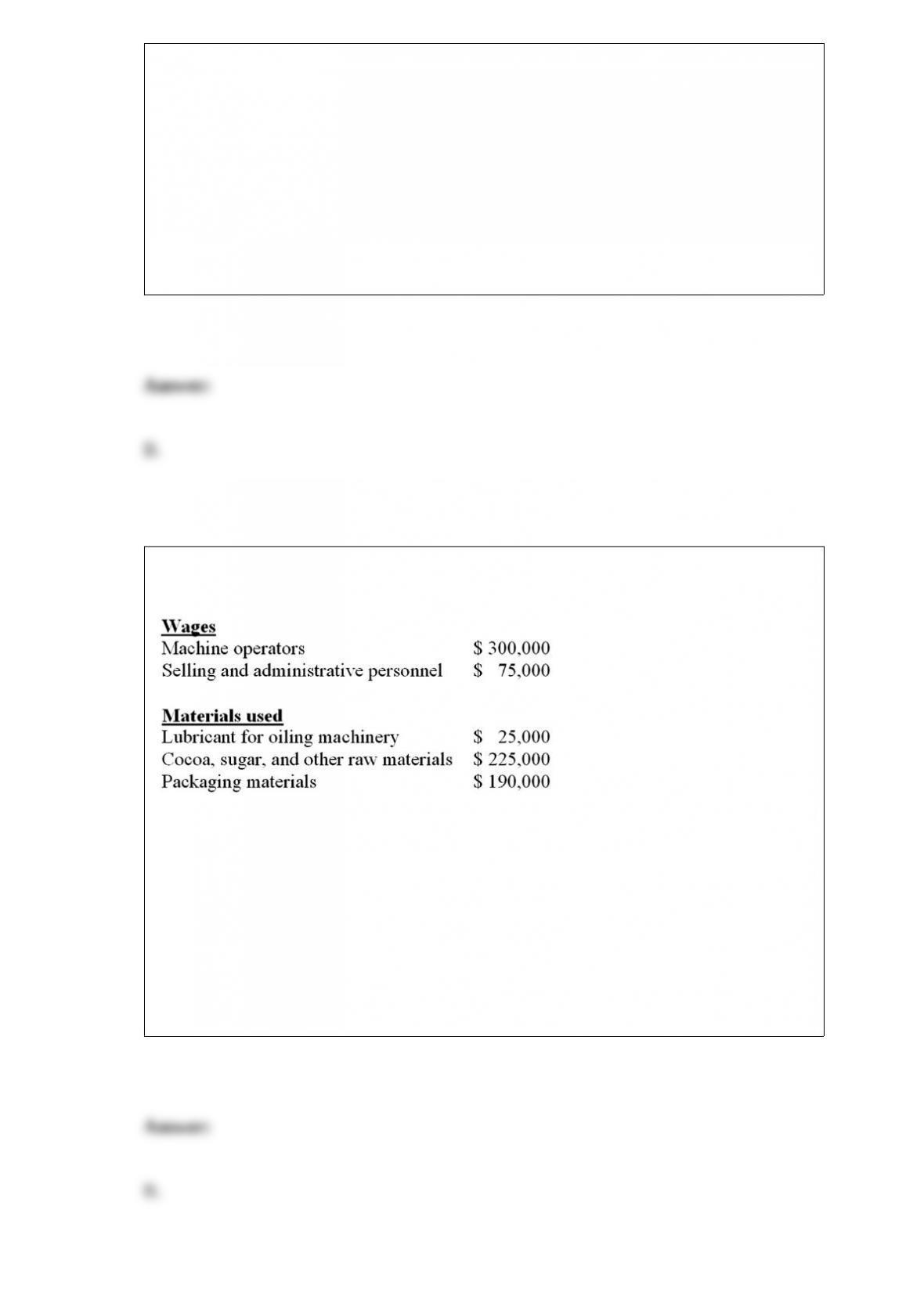
Randall Company manufactures chocolate bars. The following were among Randall’s
2013 manufacturing costs:
Randall’s 2013 direct labor costs amounted to:
A. $400,000
B. $300,000
C. $175,000
D. $375,000

When using the indirect method, an increase in current liabilities is:
A. subtracted in the cash flows from financing activities section.
B. subtracted from net income in the cash flows from operating activities section.
C. added to net income in the cash flows from operating activities section.
D. added in the cash flows from investing activities section.
One company’s practice is to provide bonuses to salespeople who exceed their sales
targets. Which of the following advantages of budgeting enabled the company to
establish its recognition program?
A. Planning
B. Coordination
C. Performance measurement
D. Corrective action
Consider the following cost-volume-profit graph:
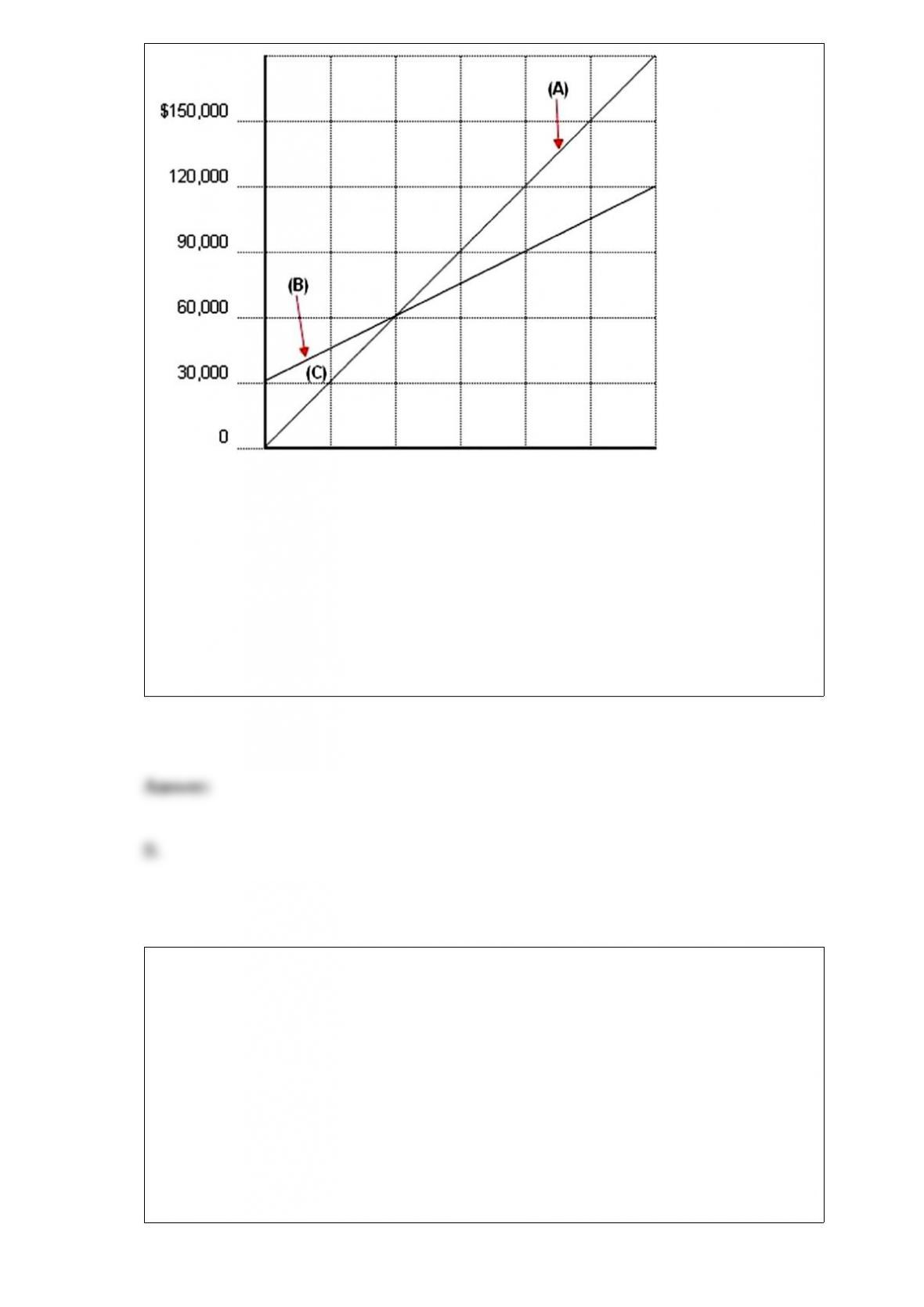
The area designated by the letter (C) represents which of the following?
A. Profit area
B. Loss area
C. Break-even area
D. Fixed cost area
Which of the following is a true statement?
A. Pro forma financial statements are based on the company’s budgets.
B. Companies prepare pro forma financial statements to show how their performance
for the period will “look” if actual results match the budget.
C. Companies usually prepare a pro forma income statement, pro forma balance sheet,
and pro forma statement of cash flows.
D. All of these answers are correct.

Global Company makes a product that is expected to use 2.2 pounds of material per
unit of product. The material has a standard cost of $2 per pound. Global actually used
2.3 pounds of material per unit of product made in January. The actual cost of material
was $1.95 per pound. Based on this information alone, the materials variances for the
January production would be:
A. Favorable for price and unfavorable for usage.
B. Unfavorable for price and favorable for usage.
C. Unfavorable for price and unfavorable for usage.
D. Favorable for price and favorable for usage.
The magnitude of operating leverage for Forbes Corporation is 1.8 when sales are
$200,000 and net income is $24,000. If sales increase by 5%, what is net income
expected to be?
A. $25,200
B. $26,160
C. $24,667
D. $43,200

Burke Company has a break-even of $600,000 in total sales. Assuming the company
sells its product for $50 per unit, what is its margin of safety in units if sales total
$850,000?
A. 5,000 units
B. 250,000 units
C. 12,000 units
D. 17,000 units
The use of raw materials in production is:
A. An asset source transaction.
B. An asset use transaction.
C. An asset exchange transaction.
D. A claims exchange transaction.
When making a long-term cost plus pricing decision, a company should consider:
A. the upstream research and development cost.

B. the allocated portion of facility-level cost.
C. the direct manufacturing cost.
D. All of these answers are correct.
Standards that do allow for normal down time and can be achieved with reasonable
amounts of effort are known as:
A. Ideal standards.
B. Lax Standards.
C. Practical standards.
D. Exceptional standards.
Recording depreciation on manufacturing equipment will:
A. decrease total assets, total equity, and net income.
B. not affect total assets or net income.
C. decrease total assets, decrease net income, and increase total equity.
D. not affect total assets, and decrease net income.

The Sarbanes Oxley Act of 2002:
A. prohibits CPA’s from becoming managerial accountants.
B. created Generally Accepted Accounting principles (GAAP).
C. requires the CEO and CFO to defer responsibility for internal controls to external
auditors.
D. requires management to establish a whistleblower policy.
Indicate whether each of the following statements is true or false.
A pro forma income statement provides a review of a company’s profitability over the
past year.
Budgets are usually prepared using spreadsheet software.
The pro forma statement of cash flows is essentially the same as the cash budget.
Pro forma financial statements must be prepared near the end of the budgeting process
because they are affected by each of a company’s budgets.
Once the master budget is prepared, company managers should continue to review the
budget and adjust it for changes in assumptions or conditions.
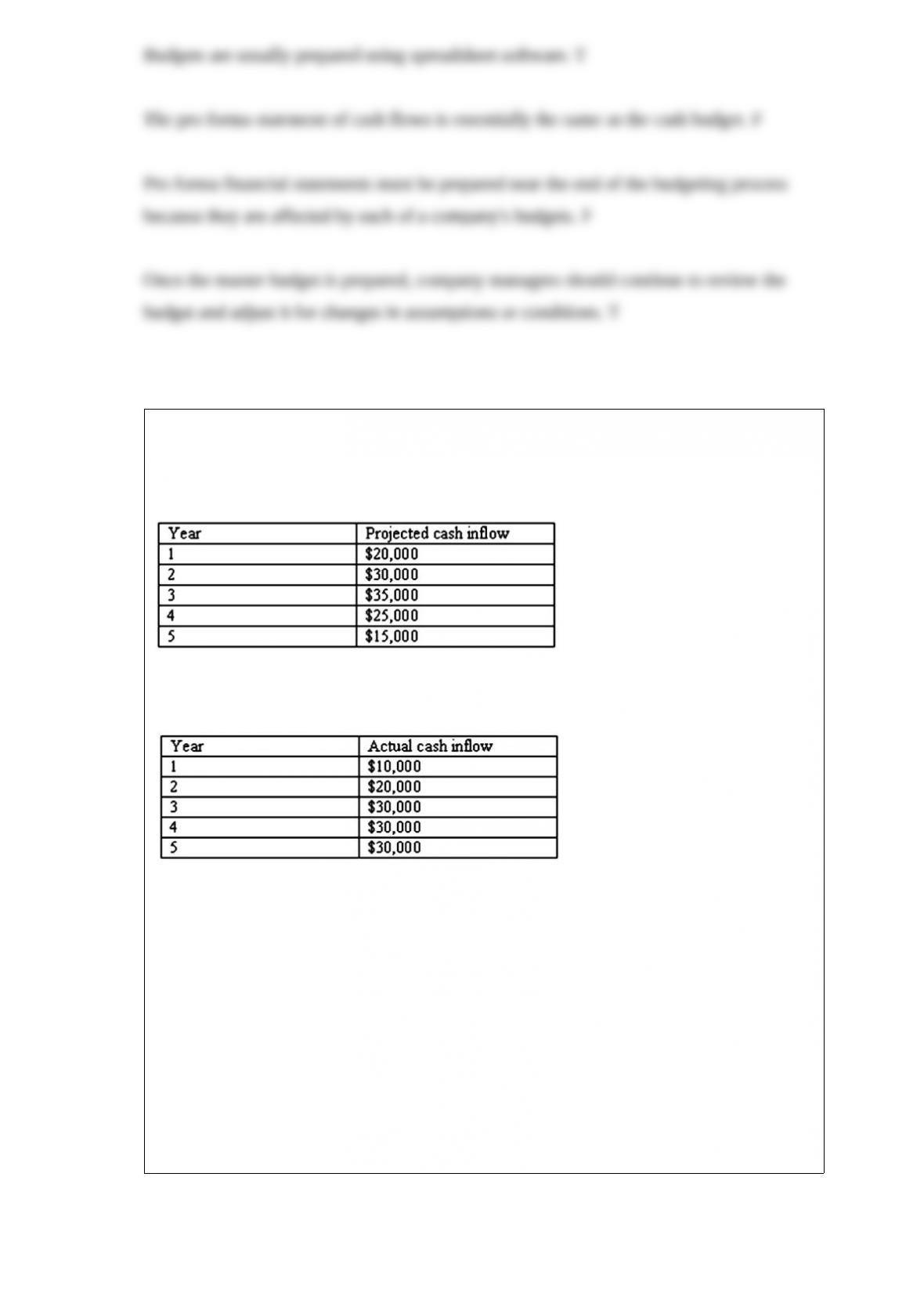
In 2008, Chandler Company purchased equipment with an expected useful life of 5
years. The initial cost of the equipment was $85,000. Chandler’s cost of capital is 12%.
At the time it purchased the equipment, Chandler projected the following cash inflows
from use of the equipment:
In 2013, the equipment had reached the end of its useful life. Chandler determined that
it had actually generated the following cash flows:
Required:
1) What was the net present value that Chandler calculated for the equipment when the
company purchased the asset?
2) Calculate the net present value that the equipment achieved, based on the actual cash
inflows.
3) Comment on the pattern of actual cash inflows, compared to the cash flows that had
been projected.
4) Was the equipment in fact an acceptable investment, based on the cash flows actually
achieved?
Indicate whether each of the following statements is true or false.
Use of an activity-based costing system may identify products that are overcosted or
undercosted by a traditional system.
Use of an activity-based costing system may prove to company managers that it is
incurring losses on some products they believed to be profitable.
The starting point for target pricing is to determine the costs that are incurred in making
the product.
Use of a traditional product costing system may put a company at a competitive
advantage by overcosting some products.
Activity-based costing results could lead managers of a company to decide to eliminate
some products.
Indicate whether each of the following statements is true or false.
A variance is a difference between an expected amount and a standard amount.
When actual sales revenue exceeds the expected revenue, a company has a favorable
sales variance.
A cost variance is considered to be unfavorable when actual costs are less than standard
costs.

A company can calculate variances for both revenues and costs.
Flexible budgets can be used for planning, but not for performance evaluation.
Burke Company has 160 employees, 88 of whom are in Department 1 and 72 in
Department 2. The company expects to incur $166,000 of office supplies costs in 2014.
How much of this cost should be allocated to Department 1?
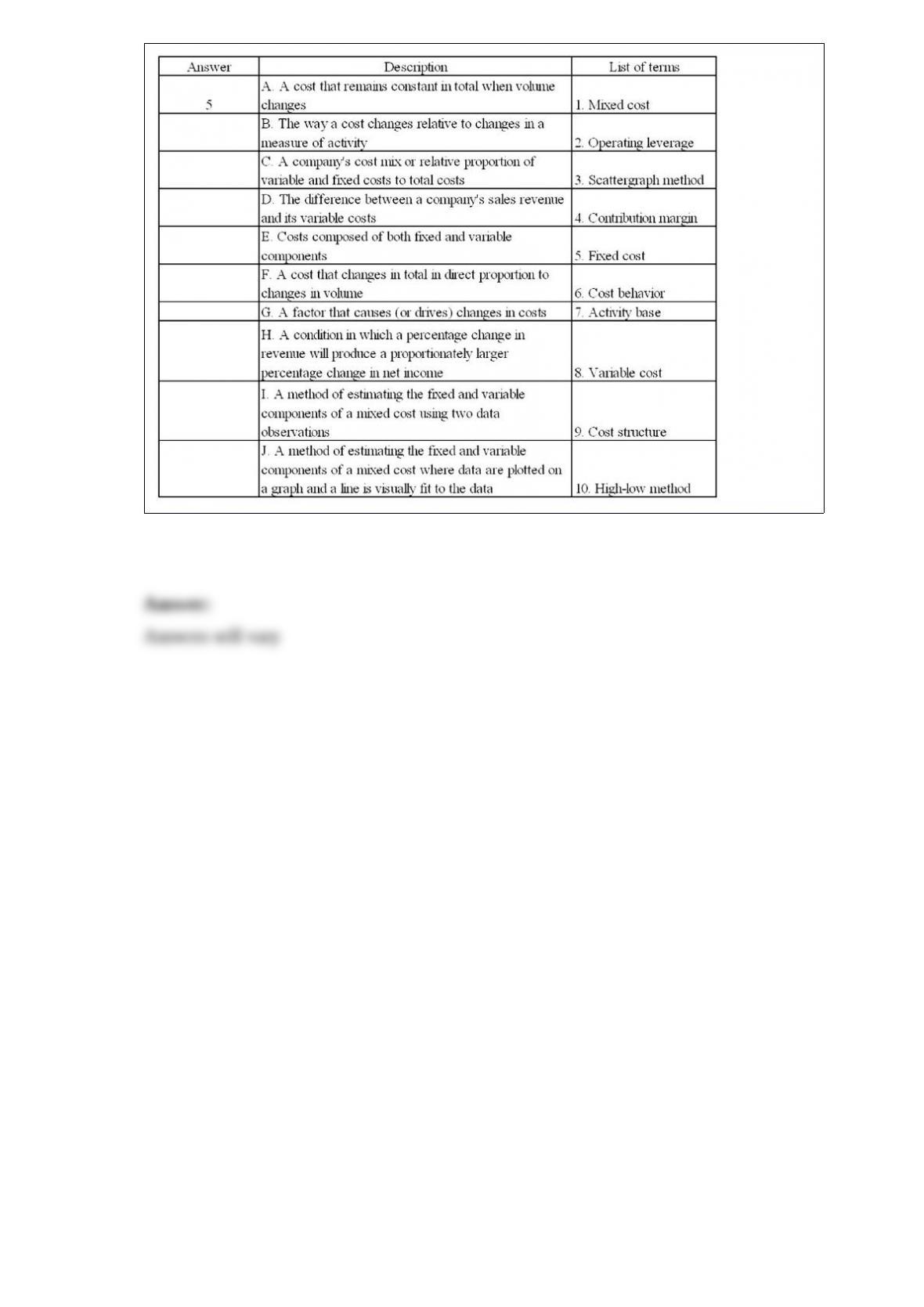
Select the term from the list provided that best matches each of the following
descriptions. The first is done for you.
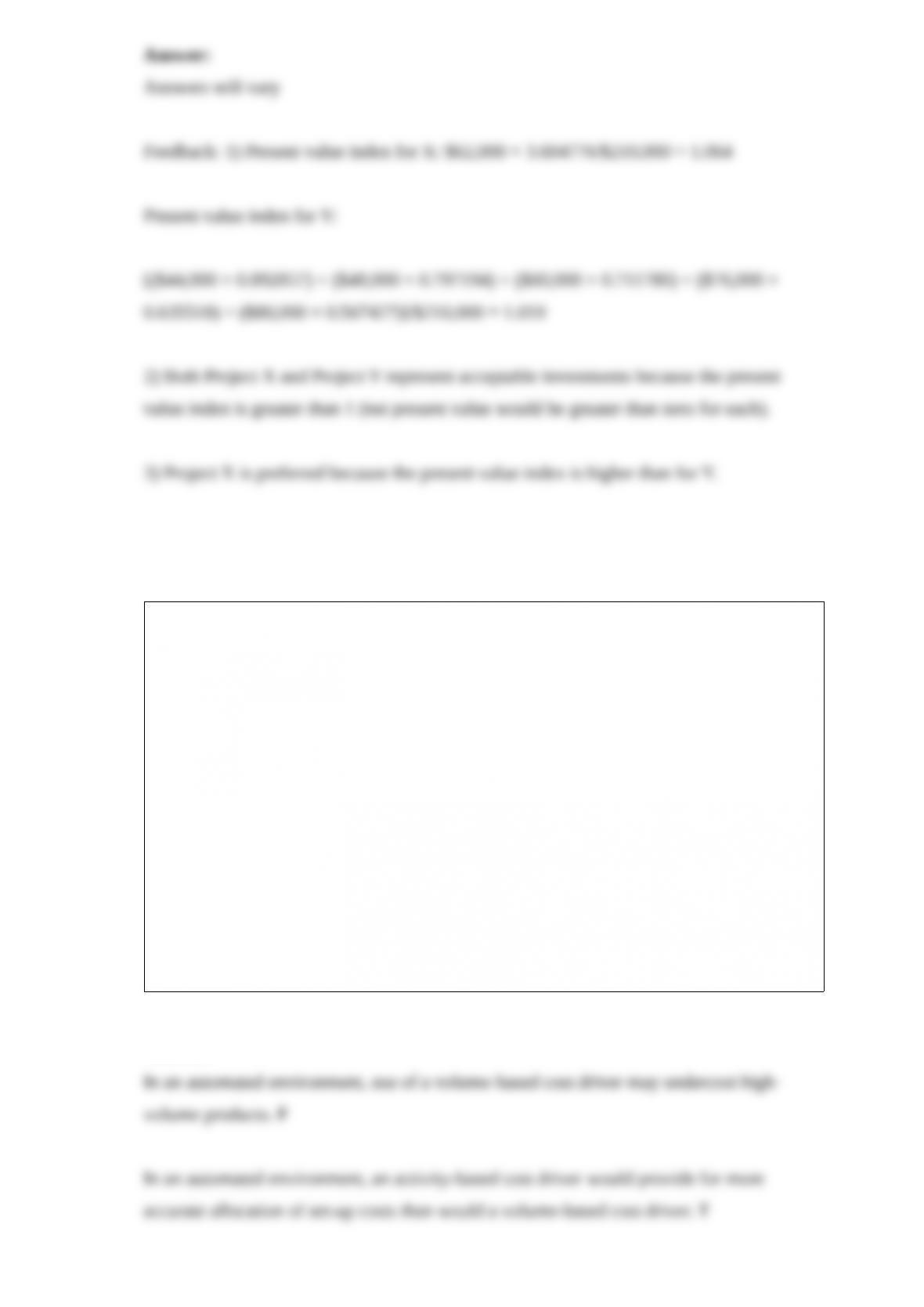
Montana Company is evaluating two different capital investments, Project X and Y.
Either X or Y would cost $210,000, and the company cannot afford to do both. The
company expects that Project X would provide net cash inflows of $62,000 per year for
5 years. For Project Y, the net cash inflows are expected to be as follows:
Montana’s cost of capital is 12%.
Required:
1) Calculate the present value index for Project X and for Project Y. Round your answer
to three decimal places.
2) Indicate whether each of the projects is an acceptable investment.
3) Based on present value index, which of the two projects should Montana implement?
Indicate whether each of the following statements is true or false.
In an automated environment, use of a volume-based cost driver may undercost
high-volume products.
In an automated environment, an activity-based cost driver would provide for more
accurate allocation of set-up costs than would a volume-based cost driver.
Activity based costing is probably not cost beneficial for a company that makes very
similar products.
In an automated manufacturing environment, use of a volume-based cost driver could
lead managers to make poor decisions.
Activity based costing always delivers significantly more accurate cost allocation than
does volume-based costing.

For Marvin Company in 2013, the magnitude of operating leverage was 3.5.
Demonstrate what this magnitude of operating leverage would mean for the company’s
profitability by creating an example.
Indicate whether each of the following statements about financial statement analysis is
true or false.
Solvency ratios measure a company’s short-term debt paying ability and its financial
structure.
A company with a high debt to assets ratio probably would be considered to have a high
level of financial risk.
The debt to equity ratio and debt to assets ratio are two ways to measure the same
relationship.
From the point of view of stockholders, a decline in the debt to equity ratio is always
good news.
The lower the debt to equity ratio, the higher a company’s financial leverage.