Dividing up the continuing life of a company into shorter periods is called the time
period assumption.
The allowance method for uncollectible accounts conforms to the expense recognition
principle.
The receipts of dividends and interest are both reported as cash inflows from investing
activities on the statement of cash flows.
Assuming no additions, replacements, or extraordinary repairs, the book value of a
long-lived asset declines over time.
According to the full disclosure principle, financial reports should present detailed
information about every transaction.
A company has sales revenues of $200,000 and expenses of $50,000. What is its net
profit margin?
A) 4
B) 25%
C) 75%
D) $150,000
Which of the following statements about trend analysis is correct?
A) Time-series analysis is an example of trend analysis.
B) Trend data are always in dollars.
C) Trend analysis is also known as vertical analysis.
D) Common-size analysis is an example of trend analysis.
In October, you sign a note for $50,000 in order to buy new equipment. The note is due
in five years, at 8% annual interest. Semiannual interest payments are due each March
and September. Assuming no other long-term debt, what is the initial balance in the
related long-term debt account?
A) $46,000
B) $50,000
C) $52,000
D) $54,000
Advantages of the corporate form include all of the following except:
A) easy to raise capital.
B) shares can be purchased in small amounts.
C) ownership interests are transferrable.
D) legal liability of its owners is unlimited.
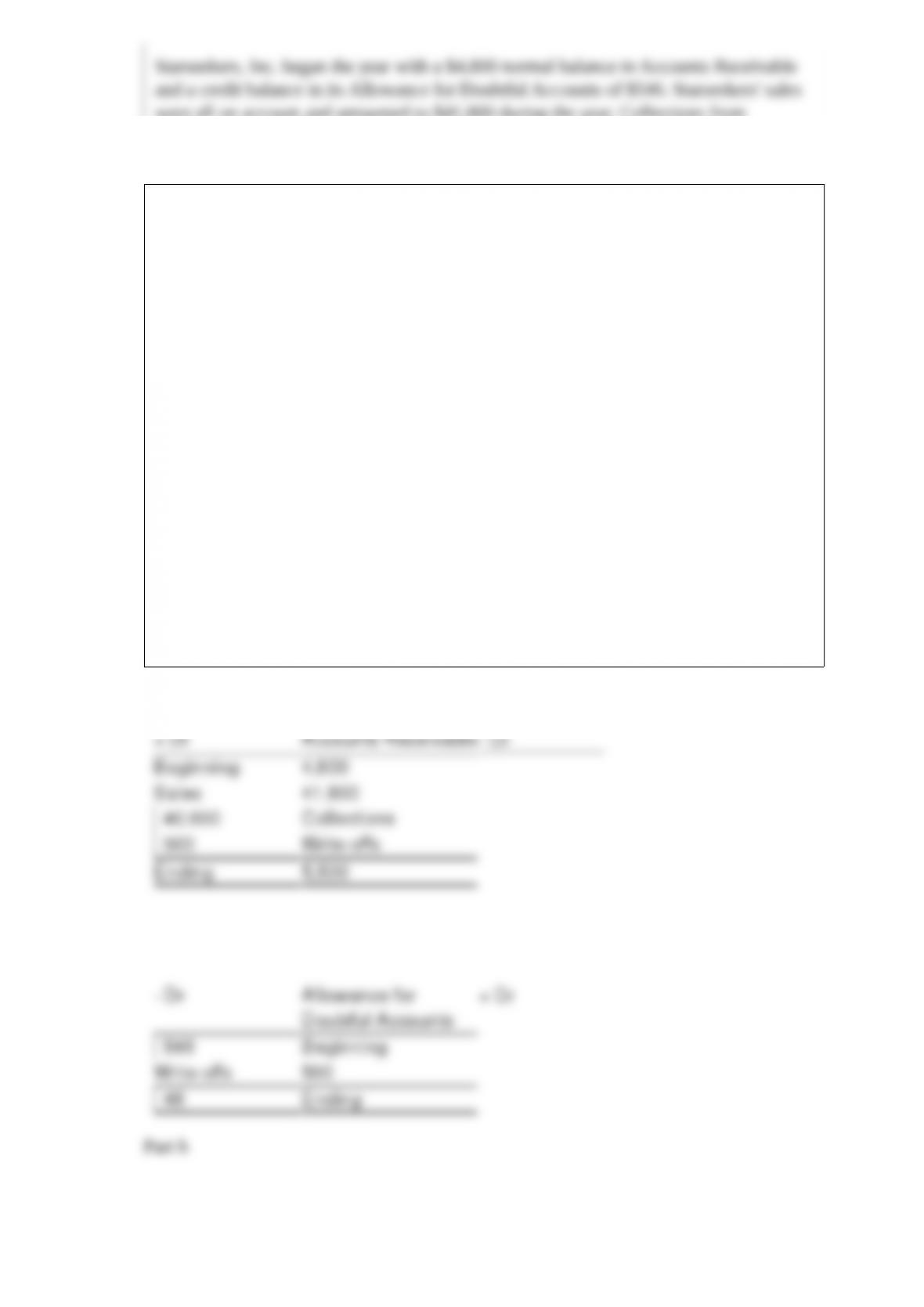
Starseekers, Inc. began the year with a $4,800 normal balance in Accounts Receivable
and a credit balance in its Allowance for Doubtful Accounts of $546. Starseekers’ sales
were all on account and amounted to $41,800 during the year. Collections from
customers amounted to $40,600 and the company wrote-off customer account balances
totaling $500 during the year.
Required:
Part a. Using T-accounts, determine how much Starseekers’ customers owe the company
at year-end and the unadjusted balance in its Allowance for Doubtful Accounts account.
Part b. The company currently uses the percentage of credit sales method for
determining its Bad Debt Expense. Historically, bad debts have approximated 3% of
credit sales. Prepare the related adjusting entry and, using a T-account, determine the
ending balance in the Allowance for Doubtful Accounts account.
Part c. Assume instead that the company uses the aging of accounts receivable method.
This method resulted in an estimate of uncollectible accounts of $1,105. Prepare the
related adjusting entry and, using a T-account, determine the ending balance in the
Allowance for Doubtful Accounts account.
Which of the following nonfinancial factors is most likely to be a cause of a
going-concern problem?
A) Hiring a new CEO
B) Loss of a key patent
C) Announcing a new stock issue
D) Replacing an old product line
Which of the following would be reported on the statement of cash flows, using the
direct method, as a cash flow from operating activities?
A) Payment of income taxes
B) Payment of cash dividends
C) Purchase of a building
D) Purchase of treasury stock
Cash flows from operating activities include all of the following except:
A) a purchase of land.
B) collections from customers on account.
C) payments to employees for hours worked.
D) receipt of cash dividends.
Some bonds allow the issuing company to retire the bond with cash at any time. These
bonds are known as:
A) convertible bonds.
B) debenture bonds
C) callable bonds.
D) coupon bonds.
In a common size income statement, each item on the income statement is expressed as
a percentage of:
A) net income.
B) gross profit.
C) total expenses.
D) sales revenue.
A company was formed with $60,000 cash contributed by its owners in exchange for
common stock. The company borrowed $30,000 from a bank. The company purchased
$10,000 of inventory and paid cash for it. The company also purchased $70,000 of
equipment by paying $10,000 in cash and issuing a note for the remainder.
Use the information above to answer the following question. What is the amount of the
total assets to be reported on the balance sheet?
A) $150,000.
B) $160,000.

C) $90,000.
D) $80,000.
Nonrecurring items such as a loss from discontinued operations is reported on the
income statement:
A) net of income tax.
B) before income tax expense.
C) below the net income line.
D) Nonrecurring items are not subject to income taxes; therefore, they are not reported
on the income statement.