
In an advertiser’s records, a newspaper ad submitted and published this week with the
agreement to pay for it next week would:
A. decrease assets and decrease expenses.
B. increase liabilities and increase expenses.
C. decrease assets and increase revenue.
D. increase assets and decrease liabilities.
Which of the following is the correct calculation for the contribution margin ratio?
A. sales revenue divided by variable costs.
B. sales revenue divided by contribution margin.
C. contribution margin divided by sales revenue.
D. contribution margin divided by variable costs.
Martin & Associates borrowed $15,000 on April 1, 2016 at 8% interest with both
principal and interest due on March 31, 2017.
Which of the following journal entries should the firm use to accrue interest at the end
of each month?

The accounting concept or principle applied when an allowance is provided for
estimated uncollectible accounts receivable is:
A. consistency.
B. matching revenue and expense.
C. original cost.
D. objectivity.
Which of the following costs are not relevant in a decision to continue or discontinue a
segment of the organization?
A. avoidable costs.
B. unavoidable costs.
C. opportunity costs.
D. differential costs.
The gross profit ratio is useful to the manager for each of the following purposes except
that:
A. it can be used to determine the selling price to set for an item.
B. it can be used to estimate the amount of inventory lost in a fire.
C. it can be used to determine the amount available from a given amount of revenue to
cover operating expenses.
D. it can be used to estimate the amount of operating expenses for a period.
The independent auditors’ report usually:
A. presents a “clean bill of health” for the company.
B. refers to the quality of the company’s products or services.
C. includes an opinion that the financial statements are correct.
D. includes an opinion that the financial statements present fairly, in all material
respects, financial information about the company.

The inventory turnover calculation:
A. is wrong unless cost of goods sold is used in the numerator.
B. is wrong unless sales is used in the numerator.
C. is an alternative way of expressing the number of days’ sales in inventory.
D. requires knowledge of the inventory cost flow assumption being used.
Which of the following statements does not describe a characteristic of management
accounting?
A. Management accounting must conform to GAAP.
B. Approximate amounts rather than accurate amounts or refined estimates are often
used in management accounting.
C. Management accounting places a great deal of emphasis on the future.
D. Management accounting is more concerned with units of the organization rather than
with the organization as a whole.
A high-level integrated approach to measuring and reporting organizational
performance is accomplished by using:
A. a DuPont performance analysis.
B. a balanced scorecard.
C. a segmented income statement.
D. a residual income analysis.
Bad debt expense is recognized in the same accounting period as the revenue that is
related to the receivable because:
A. the accounts receivable asset should be stated at original cost.
B. the exact amount of the losses from bad debts is known.
C. revenues should be stated at realizable value.

D. all costs incurred in the current period should be subtracted from current period
revenues.
Which of the following terms do not appear on the contribution margin format income
statement?
A. gross profit.
B. contribution margin.
C. operating income.
D. variable expenses.
Management’s statement of responsibility:
A. usually refers to the company’s system of internal controls.
B. emphasizes that the auditors are responsible for the financial statements.
C. includes a disclaimer of responsibility for the level of the P/E ratio of the company’s
common stock.
D. gives the president of the company an opportunity to explain why profits changed.
One inventory cost flow assumption will result in different cost of goods sold from
another inventory cost flow assumption only if:
A. inventory quantities change from the beginning to end of the year.
B. a new product is added to inventory during the year.
C. the cost of inventory items changes during the year.
D. price levels do not change during the year.
The total budget variance is caused by two factors:
A. quantity and price.
B. time and materials.
C. direct and indirect relationships.
D. fixed and variable cost behavior.
Financial statement ratios support informed judgments and decision making most
effectively:
A. when viewed for a single year.
B. when viewed as a trend of entity data.
C. when compared to an industry average for the most recent year.
D. when the trend of entity data is compared to the trend of industry data.
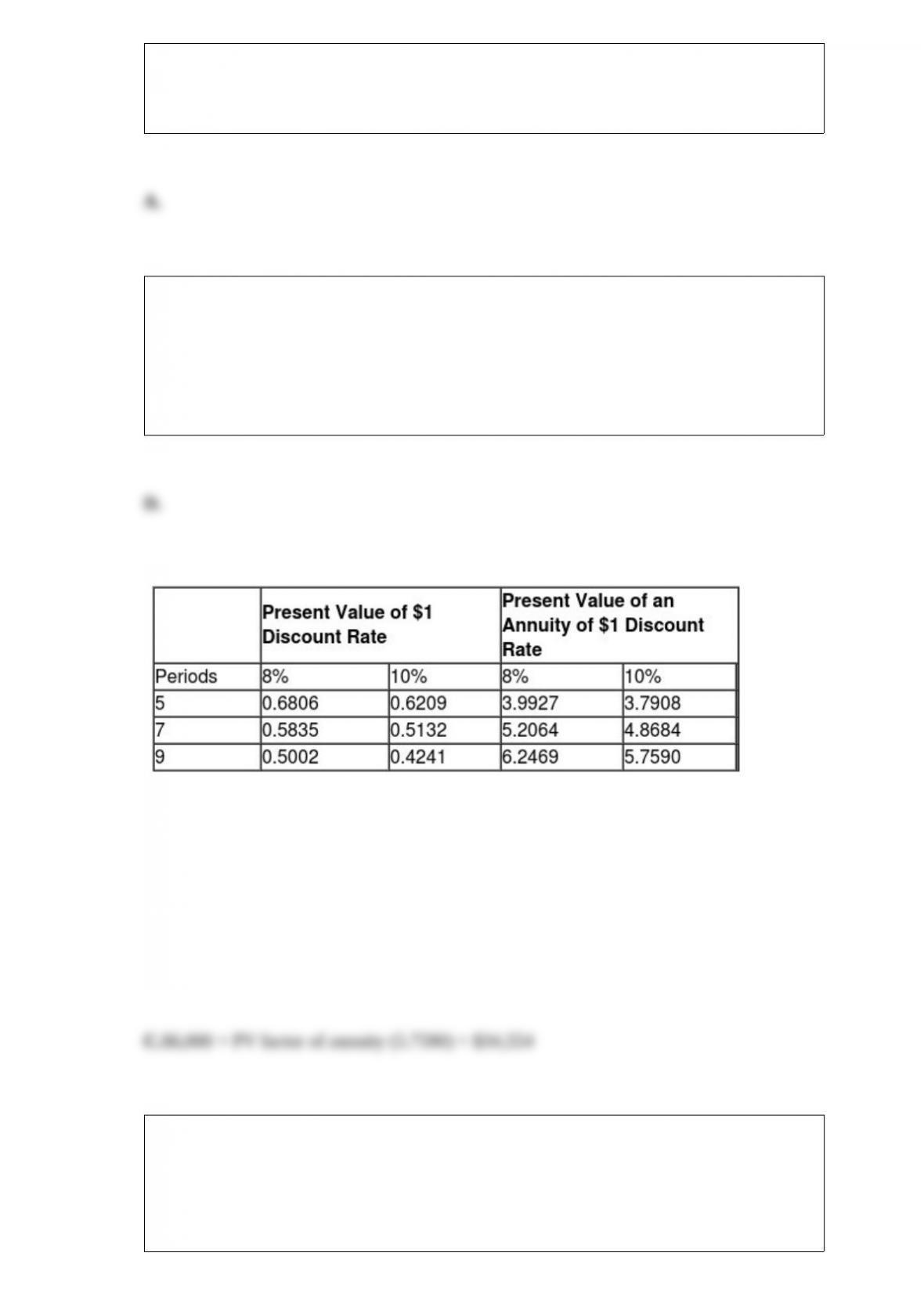
The present value of $6,000 to be received every year for 9 years, at 10%, is:
A. $14,147.60
B. $24,546.00
C. $34,554.00
D. $54,000.00
The term noncontrollable cost:
A. implies that there is really nothing the manager can do to influence the amount of
cost.
B. only applies to long-term costs.
C. never applies to short-term costs.
D. is another term for discretionary cost.
Which of the following items would not be reported on the statement of cost of goods
manufactured?
A. beginning work in process inventory.
B. purchases of raw materials.
C. total manufacturing costs.
D. contribution margin.
Sage, Inc. has 20 employees who work Monday through Friday each week; each
employee earns $200 per day and is paid every Friday. The end of the accounting period
is on a Wednesday. How much wages expense should the firm accrue at the end of the
period?
A. $4,000
B. $2,000
C. $0
D. $12,000
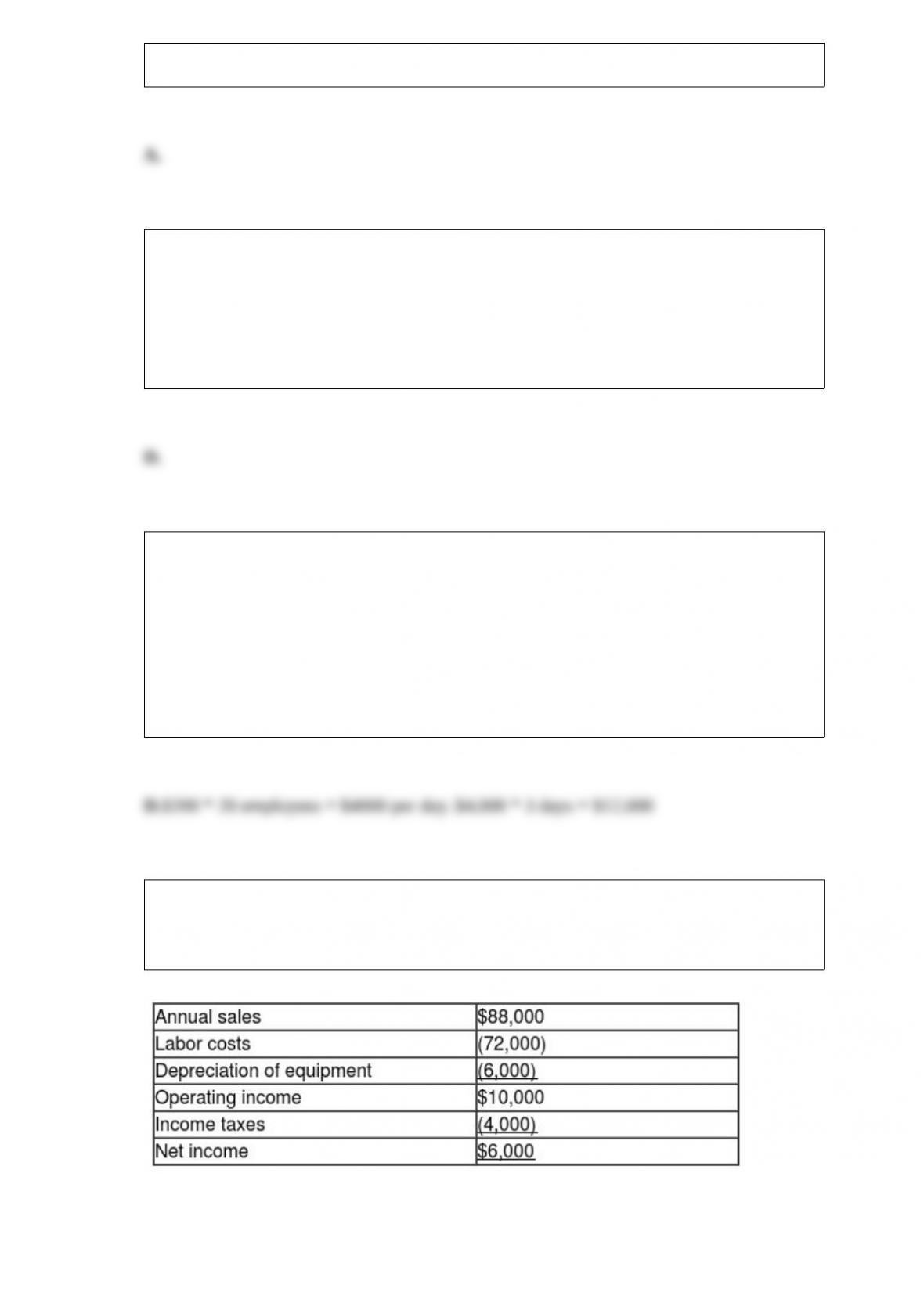
Boccardi Inc., has invested in new pasta manufacturing equipment at a cost of $48,000.
The equipment has an estimated useful life of eight years. Estimated annual sales and
operating expenses related to the pasta equipment follow:
A. 3.0 years.
B. 4.0 years.

C. 6.0 years.
D. 8.0 years.
The time frame associated with a balance sheet is:
A. a point in time in the past.
B. a one-year past period of time.
C. a single date in the future.
D. a function of the information included in it.
A capital budgeting decision method that considers the time value of money is the
A. accounting rate of return method.
B. return on stockholders’ equity method.
C. cash payback method.
D. internal rate of return method.
Which of the following describes the correct sequence of flow of costs for a
manufacturing firm?
A. Raw materials, finished goods, work-in-process, cost of goods sold.
B. Work-in-process, raw materials, finished goods, cost of goods sold.
C. Raw materials, work-in-process, finished goods, cost of goods sold.
D. Raw materials, work-in-process, cost of goods sold, finished goods.
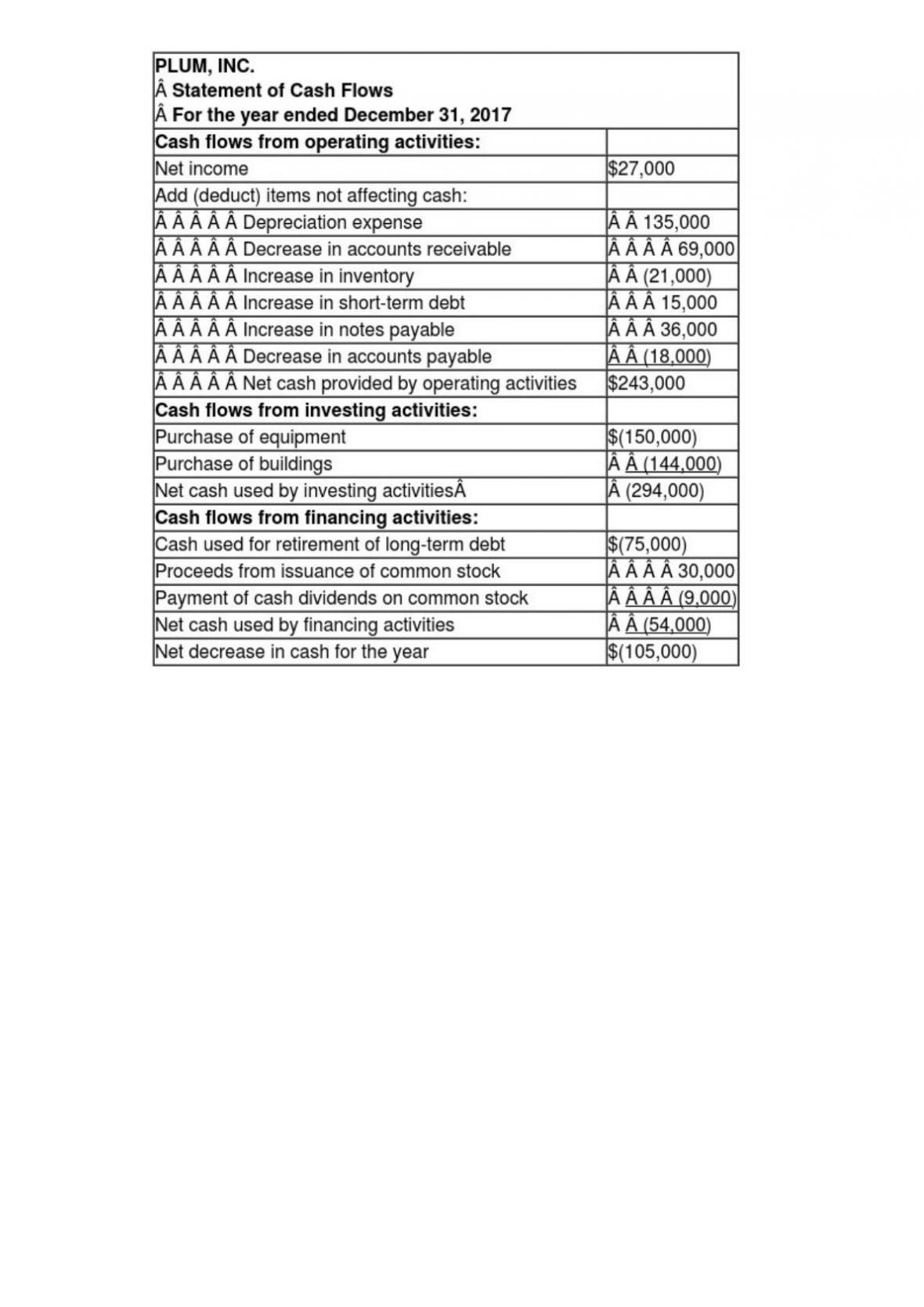
Required:
(a.) Complete the December 31, 2017 and 2016 balance sheets.
(b.) Prepare a Statement of Changes in Retained Earnings for the year ended December 31,
2017.
a. PLUM, INC.
Balance Sheets
Month Total Maintenance Cost Production Volume (units) January $1,880 1,750 units
February $1,800 1,500 units March $2,200 2,500 units April $2,120 2,250 units May
$2,300 2,750 units
Using the high-low method, the monthly fixed component of maintenance cost is:
A. $1,600.
B. $1,200.
C. $1,100.
D. $1,300.
ABC Company’s sales are $100,000, fixed costs are $50,000, and variable costs are
$30,000. ABC Company’s contribution margin and operating income are __________
and __________ respectively.
A. $50,000; $20,000
B. $20,000; $70,000
C. $70,000; $50,000
D. $70,000; $20,000
When an accelerated depreciation method is used to calculate depreciation expense:
A. the net book value of the asset halfway through its useful life will be less than if
straight-line depreciation is used.
B. the net book value of the asset at the end of its useful life will be less than if
straight-line depreciation is used.
C. depreciation expense will be less in the early years of the asset’s life than if
straight-line depreciation is used.
D. the accumulated depreciation account balance will increase by a larger amount in the
last half of an asset’s life than if straight-line depreciation is used.
Greenland Sports, Inc. has been asked to submit a bid to the National Hockey League
on supplying 1,000 pairs of professional quality skates. The cost per pair of skates has

been determined as follows:
Direct materials $80 Direct labor 60 Variable overhead 30 Fixed overhead (allocated)
20
Other non-manufacturing costs associated with each pair of skates are:
Variable selling cost (commission) $25 Fixed selling and administrative cost 10
Assume the commission on the sale of skates to the National Hockey League would be
reduced to $15 per pair and that available production capacity exists to produce the
1,000 pairs of skates, the lowest price the firm can bid is some price greater than:
A. $185.
B. $190.
C. $215.
D. $225. Costs that could not be avoided: $80 + $60 + $30 + $15 = $185
A firm has used LIFO for several years during which costs have trended higher. If this
firm achieves a substantial reduction in inventory quantities in 2017 by selling more
merchandise than it purchases, the effect on 2017 net income of the inventory
reduction, compared to having no change in inventory quantity from the beginning to
the end of 2017, is:
A. net income for 2017 will be greater if the inventory quantity declines.
B. net income for 2017 will be less if the inventory quantity declines.
C. net income for 2017 will not be affected because of the inventory quantity decline.
D. can’t tell from the information given.
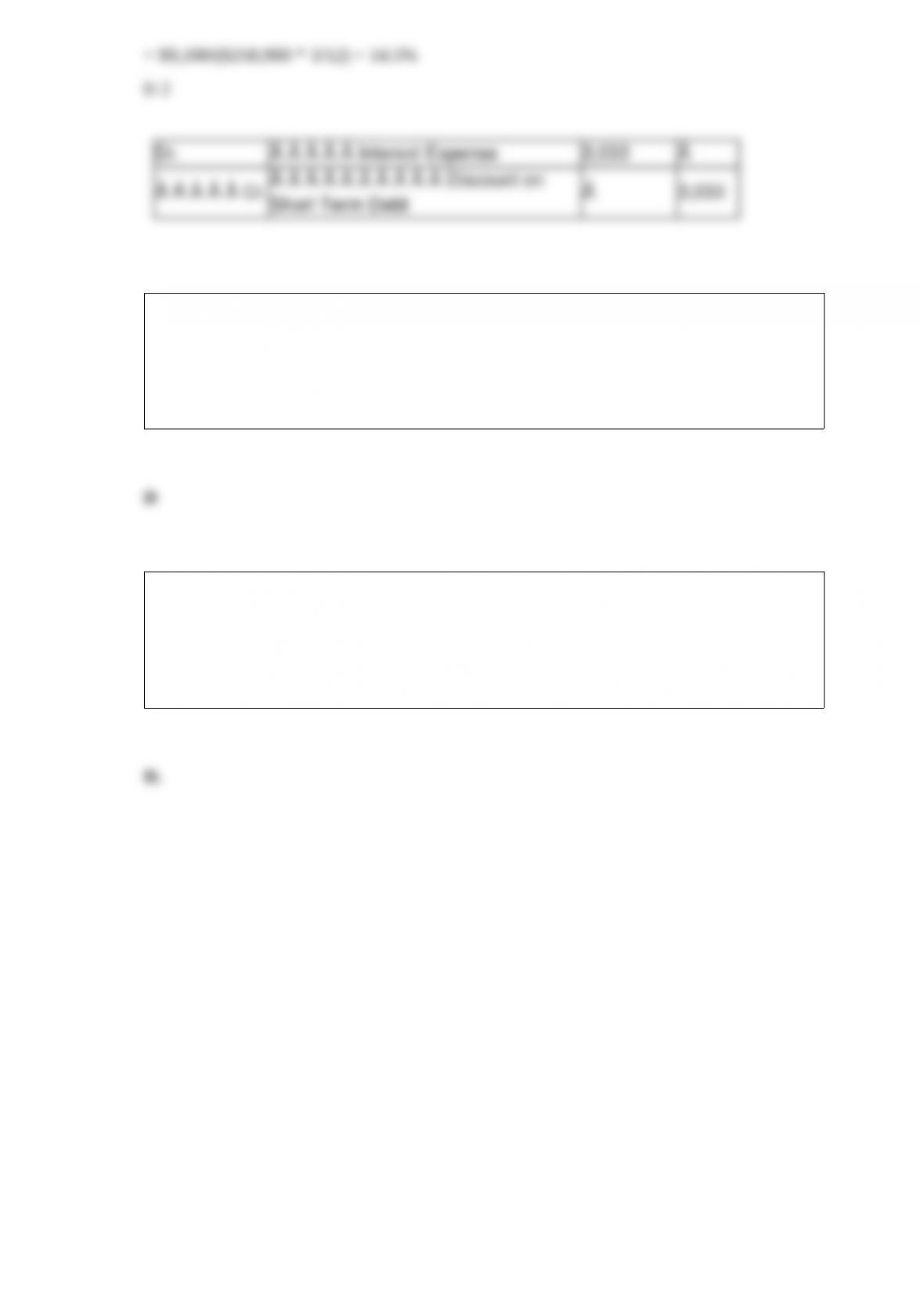
On September 30, 2017, David’s Co.’s treasurer signed a note promising to pay
$260,000 on December 31, 2017. Proceeds of the note were $250,900.
(a.) Calculate the discount rate used by the lender.
(b.) Calculate the effective interest rate on the loan.
(c.) Write the journal entry to show the effect of recording interest expense for the
month of October. (Round to the nearest whole dollar)
The contribution margin format income statement is organized by:
A. responsibility centers.
B. functional classifications.
C. sales territories.
D. cost behavior classifications.
Current maturities of long-term debt:
A. reflect overdue installments of bonds payable.
B. are classified with long-term debt.
C. represent cash that has been set aside for debt payments due within a year.
D. permit a more accurate determination of working capital.