
Which statement is true concerning integrated information systems?
A.Integrated information systems are not technically feasible.
B.Integrated information systems violate generally accepted accounting principles.
C.Integrated information systems are not commercially available.
D.Integrated information systems tie together managerial accounting, financial
reporting, customer databases, supply chain management and other data bases.
Little League Baseball Manufacturer
The Little League Baseball Manufacturer purchases materials for the production of
customized little league baseball bats, hires workers to convert the materials to
customized finished baseball bats, and then offers the customized baseball bats for sale
to little league teams and the general public.
Refer to Little League Baseball Manufacturer.
Manufacturing costs such as depreciation and insurance for the factory building, as well
as heat, light, power, and similar expenses incurred to keep the factory operating, fall
into which of the following categories?
A.direct material costs.
B.direct labor costs.
C.manufacturing overhead costs.
D.opportunity costs.
North Carolina Company produces computers and computer components. The company
is organized into several divisions that operate essentially as autonomous companies.
The firm permits division managers to make investment and production-level decisions.
The division managers can also decide whether to sell to other divisions or to outside
customers. Networks Division produces a critical component for computers
manufactured by Computers Division. It has been selling this component to Computers
for $3,000 per unit. Networks recently purchased new equipment for producing the
component. To offset its higher depreciation charges, Networks increased its price to
$3,200 per unit. The manager of Networks has asked the president to instruct
Computers to purchase the component for the $3,200 price rather than to permit
Computers to purchase externally for $3,000 per unit. The following information is
obtained from the company’s records: Computers’ annual purchases of the component,
400 units; Networks’ variable costs per unit, $2,400; Networks’ fixed costs per unit,
$400.
Required:
a. Assume that the firm has no alternative uses for Networks’ idle capacity. Will the
company as a whole benefit if Computers purchases the component externally for
$3,000? Explain.
b. Assume that the firm can use the idle capacity of Networks for other purposes,
resulting in cash operating savings of $150,000. Will the company as a whole benefit if
Computers purchases the component externally for $3,000? Explain.
c. Assume the same facts as in part b. except that the outside market price drops to
$2,800 per unit. Will the company as a whole benefit if Computers purchases the
component externally for $2,800? Explain.
d. As president, how would you respond to the manager of Networks? Discuss each
scenario described in parts a., b., and c.
At the end of a five-year life, a company will dispose of an asset and recognize a gain
of $6,000. If the company’s cost of capital is 15 percent and its tax rate is 30 percent,
what is the present value of the future cash flow?
A.$14,078.
B.$6,000.
C.$2,087.
D.$895.
The ISO 14000 focuses on communicating the financial impact of
A.make versus buy decisions.
B.worker productivity.
C.outsourcing.
D.environmental issues.
Which statement is true concerning economic value added (EVA)?
A.EVA indicates how much employee wealth is being created by company managers.
B.EVA indicates how much shareholder wealth is being created by company managers.
C.EVA indicates how much customer wealth is being created by company managers.
D.EVA indicates how much national wealth is being created by company managers.
All of the following are characteristics of the value chain except:
A.a linked set of activities
B.activities that are monitored by how they contribute to the final product’s service,
quality, and cost.
C.activities that increase the usefulness of products or services
D.includes activities that can be eliminated without reducing the product’s service
potential
When is the appropriate time to purchase or produce goods and services in a
just-in-time (JIT) environment?
A.when the available inventory equals the economic ordering quantity.
B.when the inventory equals one-half of the next months requirements.
C.when the inventory equals the next months requirements.
D.when the company needs them.
Which costing system is generally used by companies who provide professional
services to their clients, such as accountants and lawyers?
A.process costing system.
B.variable costing system.
C.job costing system.
D.direct costing system.
Which of the following is an example of an organization that would use job-order
accounting?
A.a custom construction company.
B.an oil refinery.
C.a cereal processor.
D.None of the answers is correct.
Which of the following departments would not be a cost center?
A.advertising department
B.city police department
C.building and grounds department
D.sales department
Before applying ROI as a control measure, the manager must answer the following
question(s):
A.How does the firm measure revenues?
B.What costs does the firm deduct in measuring divisional operating costs?
C.How does the firm measure investment?
D.All of the answers are correct.
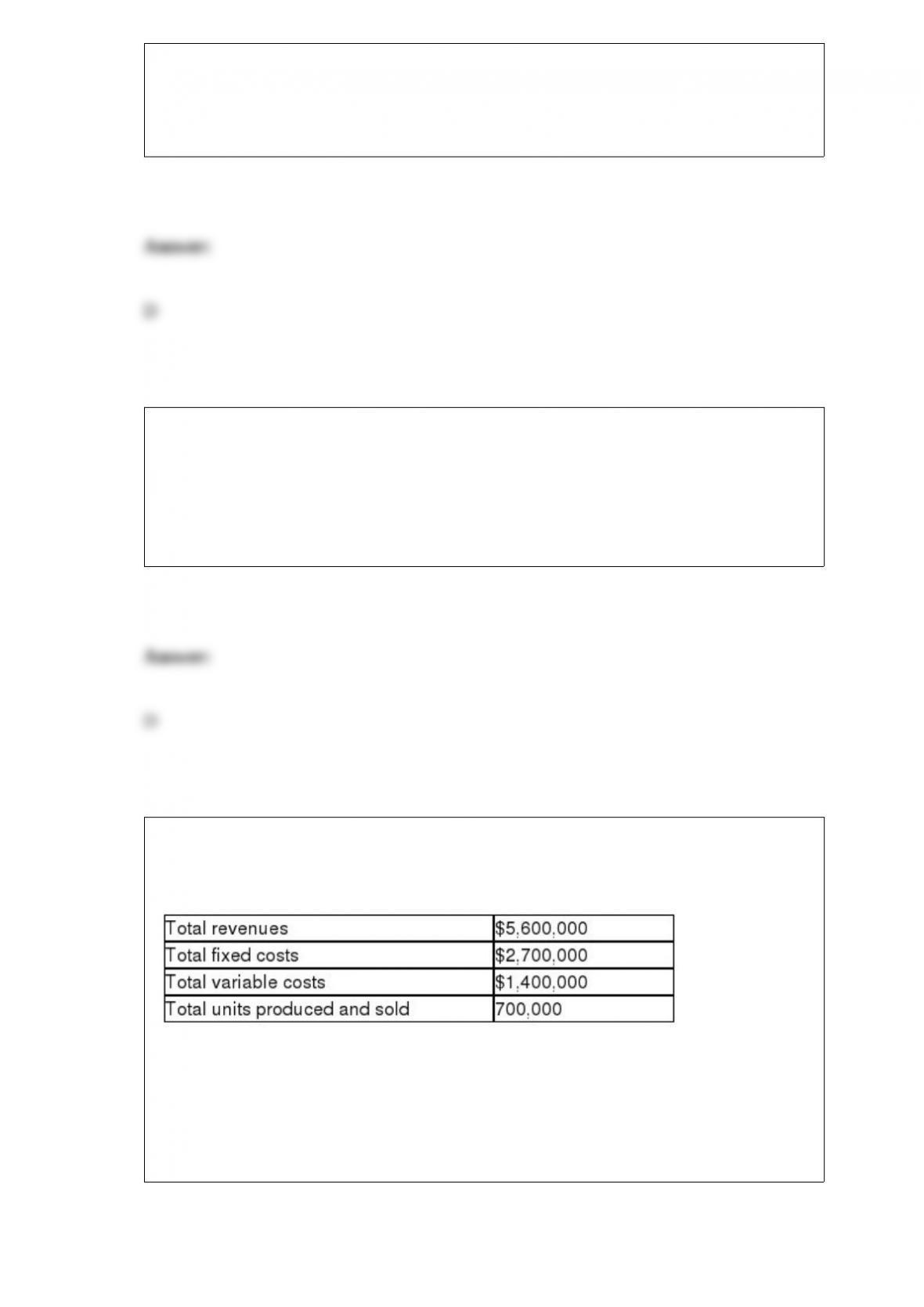
TopSail Company
TopSail Company produces one type of machine with the following costs and revenues
for the year
Refer to the TopSail Company; how many units must be sold to make an operating
profit of $300,000 for the year?
A.500,000
B.1,000,000
C.1,500,000
D.2,000,000
Which of the following is/are abenefitof normal costing?
A.Normal costing enable companies to smooth out, or normalize, seasonal production
fluctuations.
B.Under normal costing, a firm can quickly calculate the cost of items manufactured.
C.Under normal costing, a firm uses a predetermined overhead rate in applying
overhead to each unit as the firm produces it throughout the year, rather than wait for
the actual overhead rate to be determined at the end of the year.
D.All of the answers are correct.
Costs that do not change with changes in activity levels are known as:
A.fixed costs.
B.variable costs.
C.sunk costs.
D.opportunity costs.
List the six business functions in the value chain and describe how they contribute to
the final product’s service, quality, and cost.
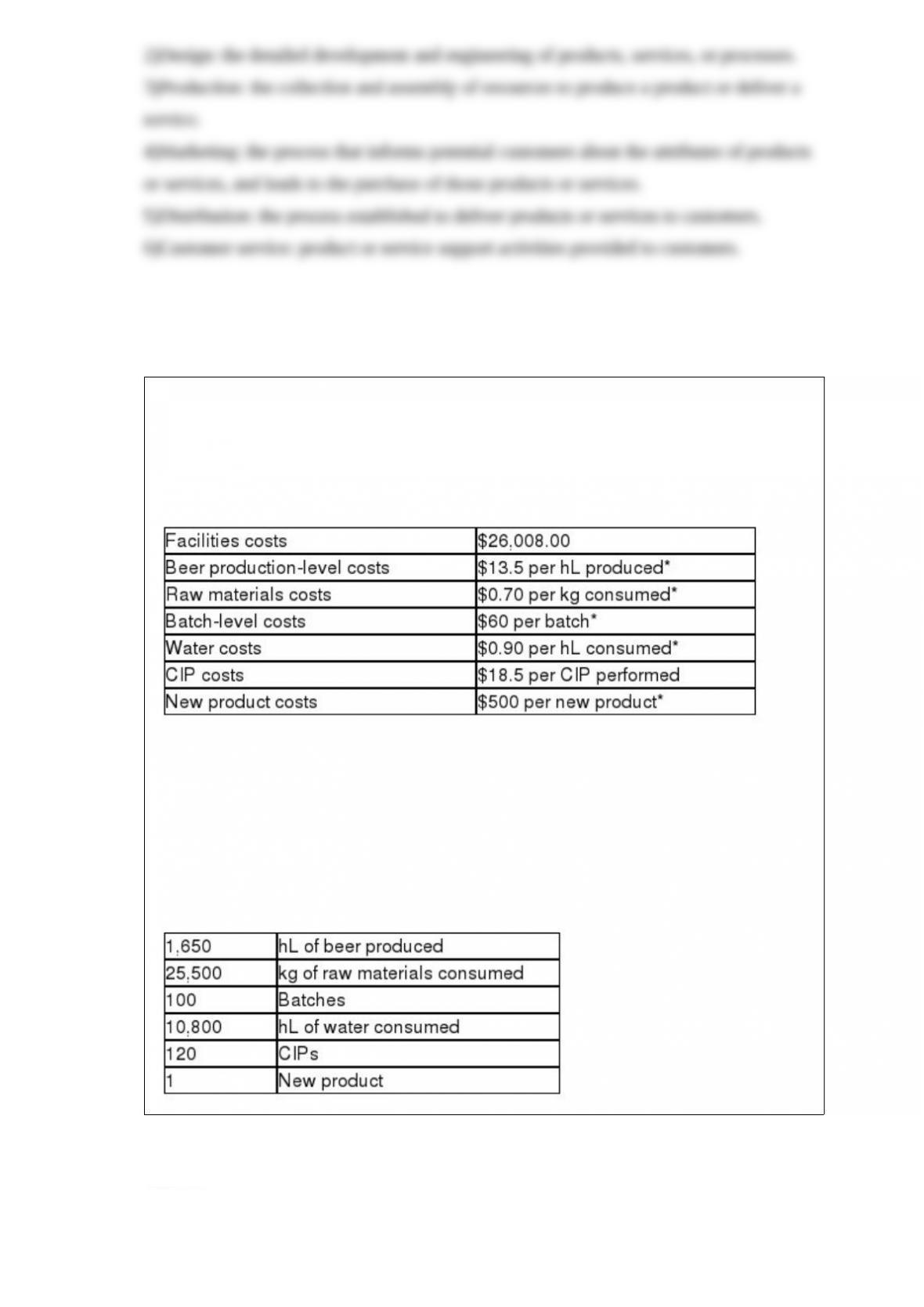
The managers of Rockhurst Brewery are analyzing the costs involved in their beer
production.
Rockhurst hired an engineering consulting firm to perform an engineering estimate of
its business costs. The consulting firm came up with the following monthly cost
estimates based on information for the current period:
*Cost drivers: volume of beer produced (in hectoliters, i.e., 1 hL = 100 L), total amount
of raw materials used (in kilograms), number of batches, volume of water used (in hL),
number of cleaning procedures performed€cleanings in place (CIPs)€and number of
new products.
Required:
Assuming the following level of cost driver volume for a month, what is the estimated
cost using the engineering estimates? (Don’t forget to include the facilities costs in your
estimate.)
Although the “cost of quality” concept is prevalent among companies throughout the
world, a current theme in business today is that “quality is free.” Discuss what that
statement means.
Computing equivalent units (Appendix 2.1). The Assembly Department had 80,000
units
65 percent complete in Work-in-Process Inventory at the beginning of April. During
April, the department started and completed 150,000 units. The department started
another 42,000 units and completed 25 percent as of the end of April.
Required: Compute the equivalent units of work performed during April using FIFO.
Explain why analysts will need more than cash flow analysis to justify or reject an
investment.
Discuss the importance of effective communication between accountants and users of
managerial accounting information?
How can financial modeling be used for profit planning purposes?
How does the balanced scorecard tie performance measures to organizational goals?
How do you analyze overhead variances using the variable cost variance model?