1) Under the weighted-average method, the equivalent units used to compute the unit
costs of ending inventories relate only to work done during the current period.
2) The simple rate of return in any one year may be less than or greater than the internal
rate of return of a project.
3) When a company is involved in only one activity in the entire value chain, it is
vertically integrated.
4) ROI and residual income are tools used to evaluate managerial performance in profit
centers.
5) Issuing common stock will decrease a company’s financial leverage.
6) An unfavorable activity variance indicates that activity was too high for the amount
of sales.
7) A job-order cost system would be used to account for the cost of building an oil
tanker.
8) Defective units should be detected and scrapped or reworked before the bottleneck
operation rather than after it.
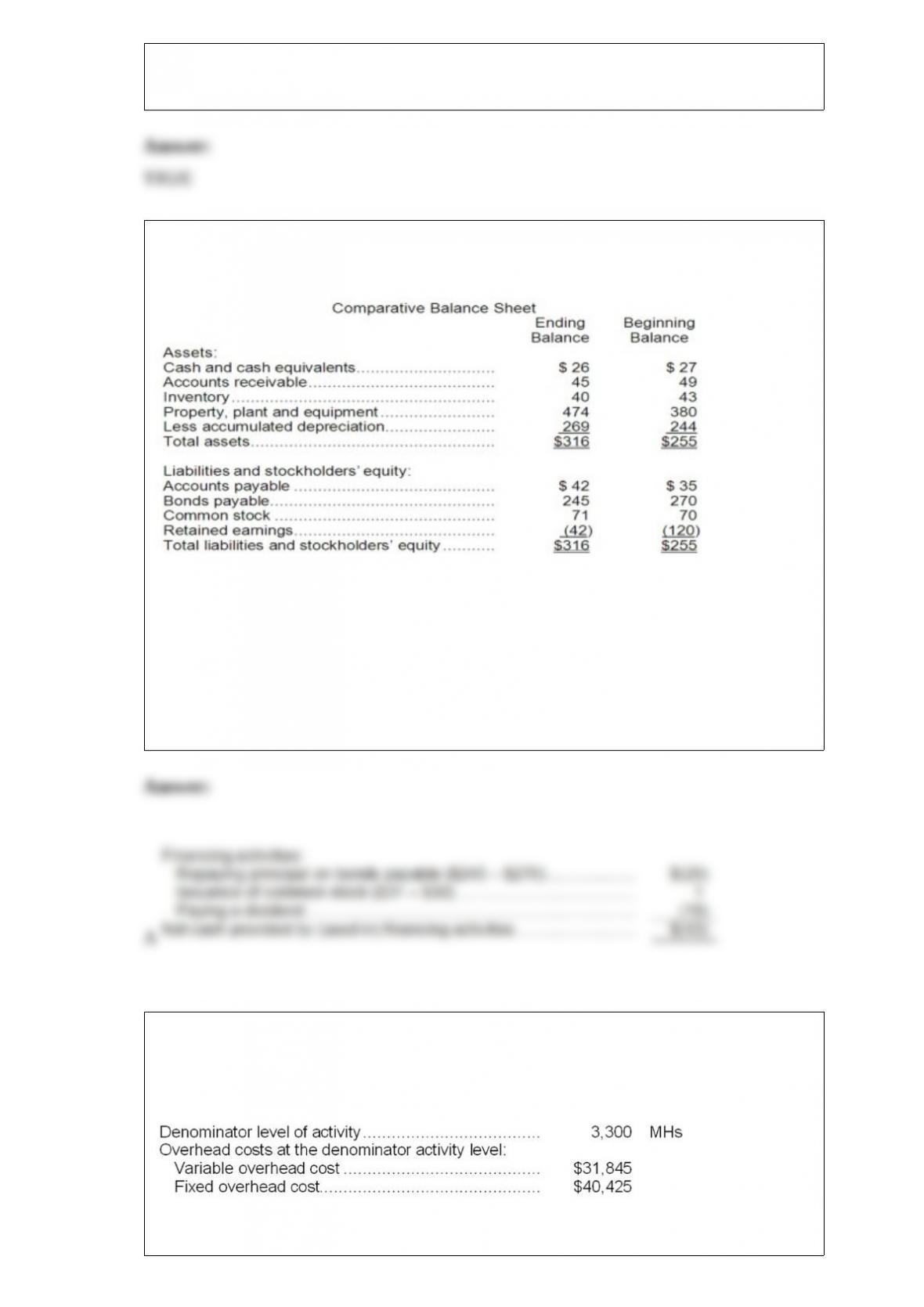
9) Sonier Corporation’s most recent balance sheet appears below:
The net income for the year was $97. Cash dividends were $19. The company did not
issue any bonds or repurchase any of its common stock during the year. The net cash
provided by (used in) financing activities for the year was:
A.($43)
B.($19)
C.($25)
D.$1
10) A furniture manufacturer uses a standard costing system in which standard
machine-hours (MHs) is the measure of activity. Data from the company’s flexible
budget for manufacturing overhead are given below:
The following data pertain to operations for the most recent period:
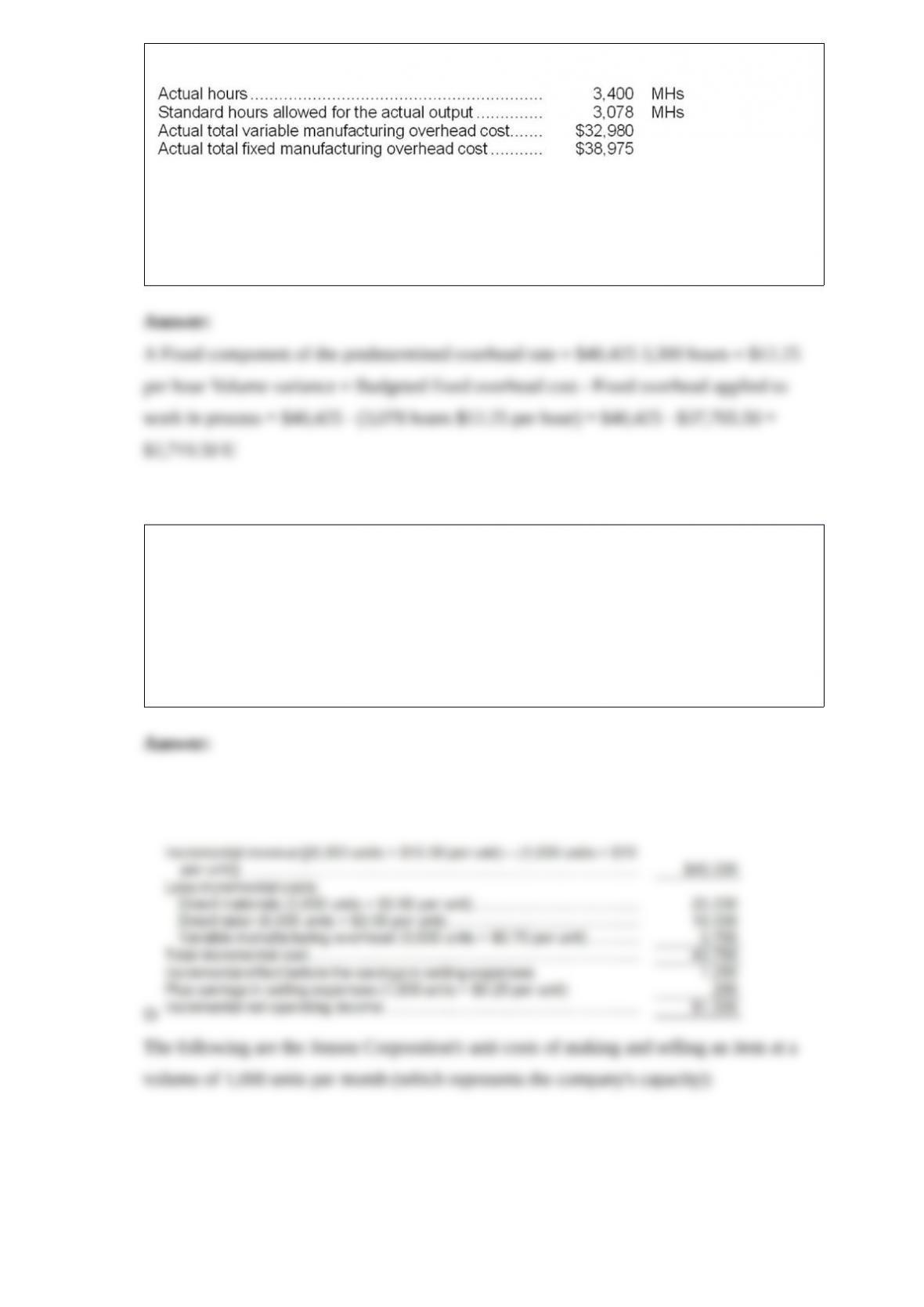
The fixed manufacturing overhead volume variance for the period is closest to:
A.$2,720 U
B.$1,225 F
C.$2,811 U
D.$3,945 U
11) Suppose the special order is for 6,000 haks this month and thus some regular sales
would have to be given up. If this offer is accepted by Molis, the company’s operating
income for the month will:
A.increase by $6,000
B.increase by $7,500
C.increase by $5,000
D.increase by $1,500
12) Computing the present value of future dollars is known as:
A.interpolating.
B.compounding.
C.annualizing.
D.discounting.
13) Suppose the company is already operating at capacity when the special order is
received from the overseas customer. What would be the opportunity cost of each unit
delivered to the overseas customer?
A.$32.50
B.$8.40
C.$9.70
D.$7.20
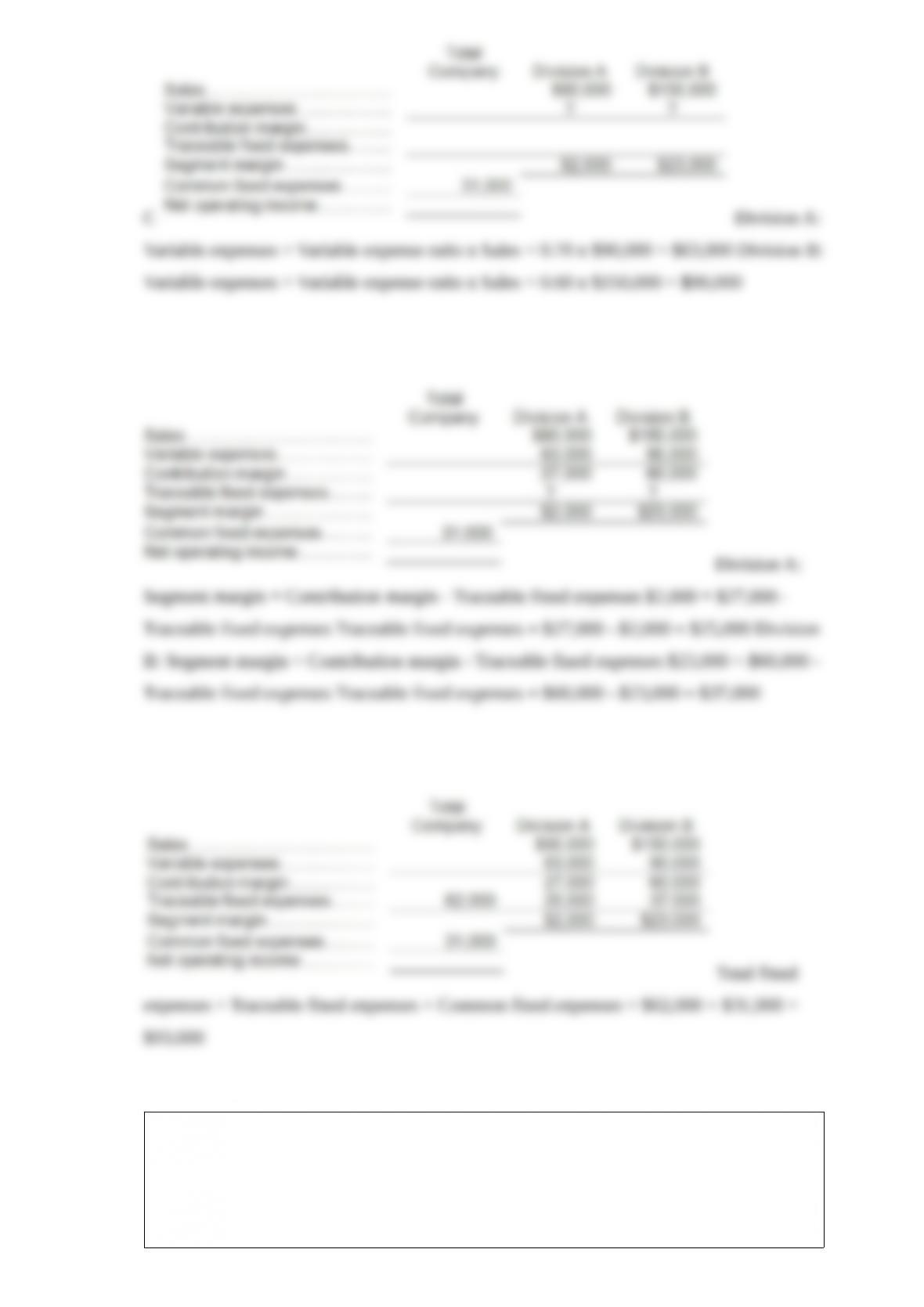
14) Sammis Inc, which produces and sells a single product, has provided its
contribution format income statement for January.
If the company sells 2,600 units, its total contribution margin should be closest to:
A.$107,100
B.$117,000
C.$31,290
D.$130,500
15) Denner Corporation has two divisions, A and B. The following data pertain to
operations in October:
If common fixed expenses were $31,000, total fixed expenses were:
A.$31,000
B.$62,000
C.$93,000
D.$52,000
16) Maraby Corporation’s average sale period for Year 2 was closest to:
A.38.8 days
B.32.6 days
C.46.6 days
D.27.0 days
17) The total cash flow net of income taxes in year 3 is:
A.$32,500
B.$62,500
C.$43,000
D.$50,000
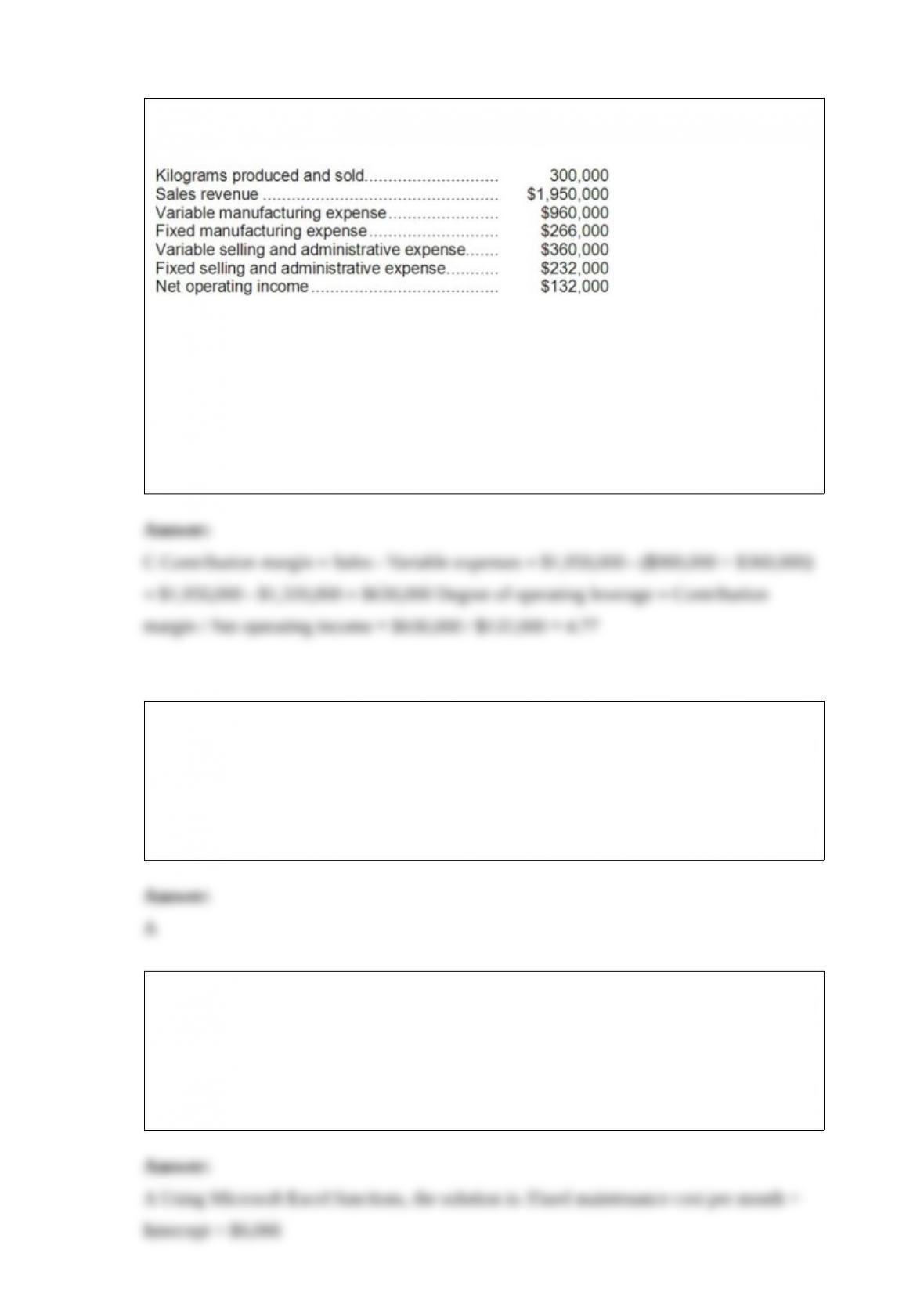
18) A manufacturer of tiling grout has supplied the following data:
The company’s degree of operating leverage is closest to:
A.14.77
B.2.65
C.4.77
D.2.27
19) Property taxes on a manufacturing facility are classified as:
Conversion cost Period cost
A) Yes No
B) Yes Yes
C) No Yes
D) No No
20) Using the least-squares regression method, the estimate of the fixed component of
maintenance cost per month is closest to:
A.$6,066
B.$7,244
C.$5,944
D.$7,130
21) Moonen Corporation produces and sells a single product whose contribution margin
ratio is 57%. The company’s monthly fixed expense is $487,350 and the company’s
monthly target profit is $10,000. The dollar sales to attain that target profit is closest to:
A.$855,000
B.$277,790
C.$872,544
D.$283,490
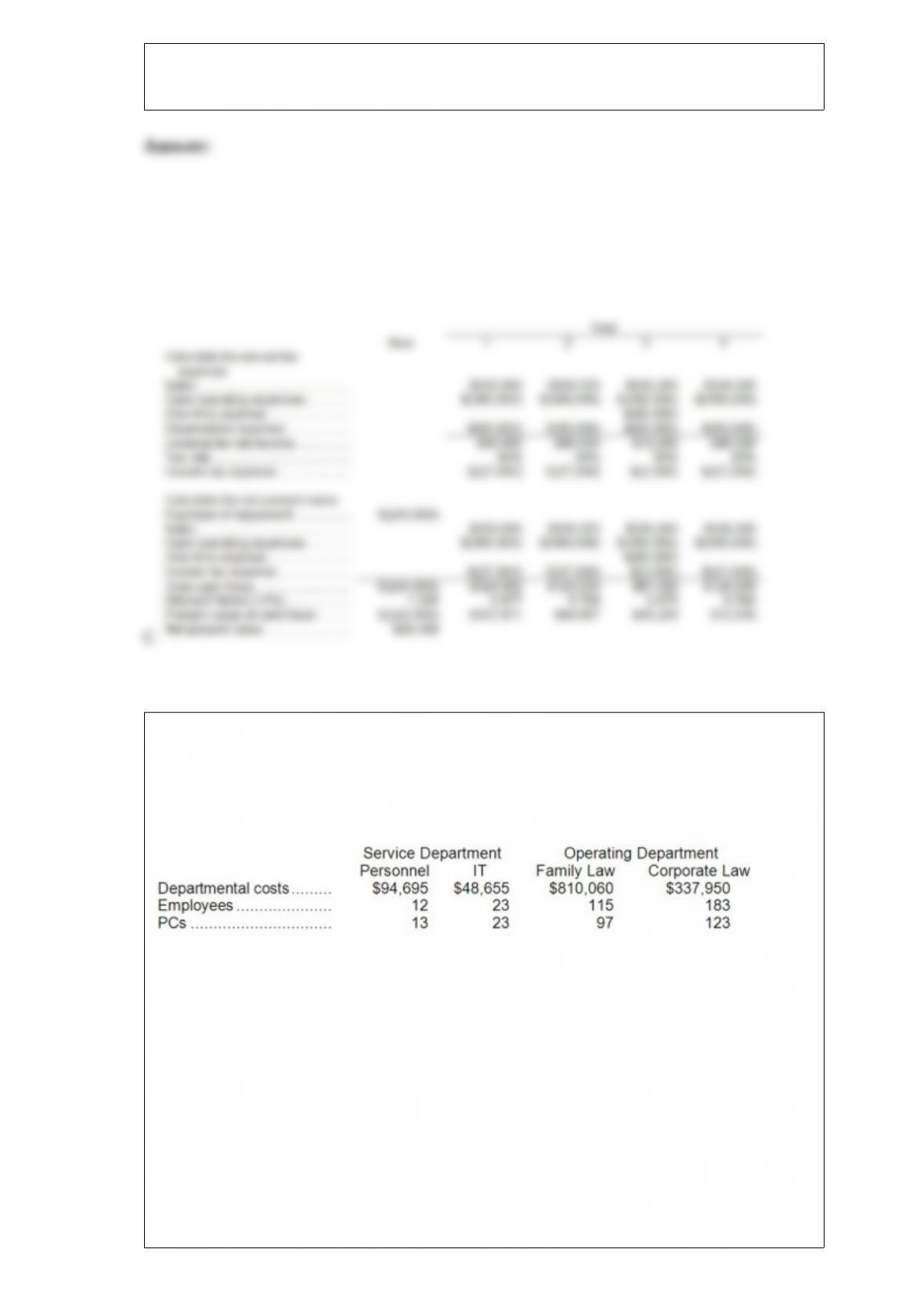
22) Bosell Corporation has provided the following information concerning a capital
budgeting project:
The income tax rate is 30%. The after-tax discount rate is 14%. The company uses
straight-line depreciation on all equipment; the annual depreciation expense will be
$60,000. Assume cash flows occur at the end of the year except for the initial
investments. The company takes income taxes into account in its capital budgeting.
The net present value of the project is closest to:
A.$142,950
B.$320,499
C.$80,499
D.$196,000
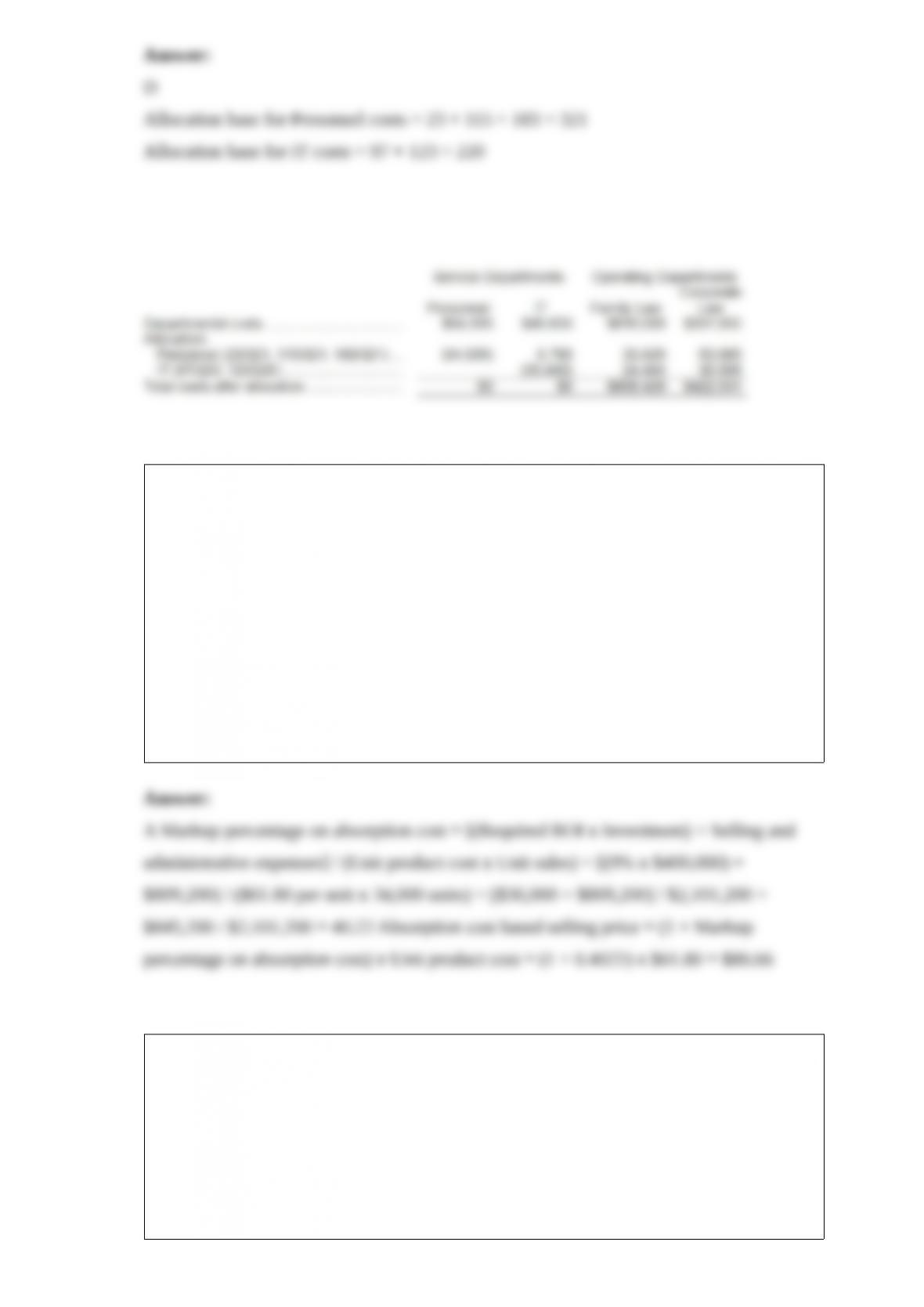
23) Mallery Legal Services, LLC, uses the step-down method to allocate service
department costs to operating departments. The firm has two service departments,
Personnel and Information Technology (IT), and two operating departments, Family
Law and Corporate Law. Data concerning those departments follow:
Personnel costs are allocated first on the basis of employees and IT costs are allocated
second on the basis of PCs.
In the first step of the allocation, the amount of Personnel Department cost allocated to
the Family Law Department is closest to:
A.$36,543
B.$32,702
C.$66,819
D.$33,925
24) Magner, Inc., uses the absorption costing approach to cost-plus pricing described in
the text to set prices for its products. Based on budgeted sales of 34,000 units next year,
the unit product cost of a particular product is $61.80. The company’s selling and
administrative expenses for this product are budgeted to be $809,200 in total for the
year. The company has invested $400,000 in this product and expects a return on
investment of 9%.
The selling price for this product based on the absorption costing approach would be
closest to:
A.$86.66
B.$120.03
C.$67.36
D.$85.60
25) Two products, LB and NH, emerge from a joint process. Product LB has been
allocated $30,800 of the total joint costs of $44,000. A total of 2,000 units of product
LB are produced from the joint process. Product LB can be sold at the split-off point for
$13 per unit, or it can be processed further for an additional total cost of $14,000 and
then sold for $15 per unit. If product LB is processed further and sold, what would be
the effect on the overall profit of the company compared with sale in its unprocessed
form directly after the split-off point?
A) $16,000 more profit
B) $20,800 more profit
C) $40,800 less profit
D) $10,000 less profit
26) Torbert, Inc., produces and sells a single product. The product sells for $190.00 per
unit and its variable expense is $72.20 per unit. The company’s monthly fixed expense
is $353,400.
Required:
Determine the monthly break-even in unit sales. Show your work!
27) Viel Urban Diner is a charity supported by donations that provides free meals to the
homeless. The diner’s budget for April was based on 3,100 meals, but the diner actually
served 3,300 meals. The diner’s director has provided the following cost data to use in
the budget: groceries, $3.95 per meal; kitchen operations, $5,200 per month plus $1.40
per meal; administrative expenses, $3,300 per month plus $0.80 per meal; and
fundraising expenses, $1,800 per month.
Required:
Prepare the diner’s flexible budget for the actual number of meals served in April. The
budget will only contain the costs listed above; no revenues will be on the budget.
28) Medina Corporation has provided the following financial data:
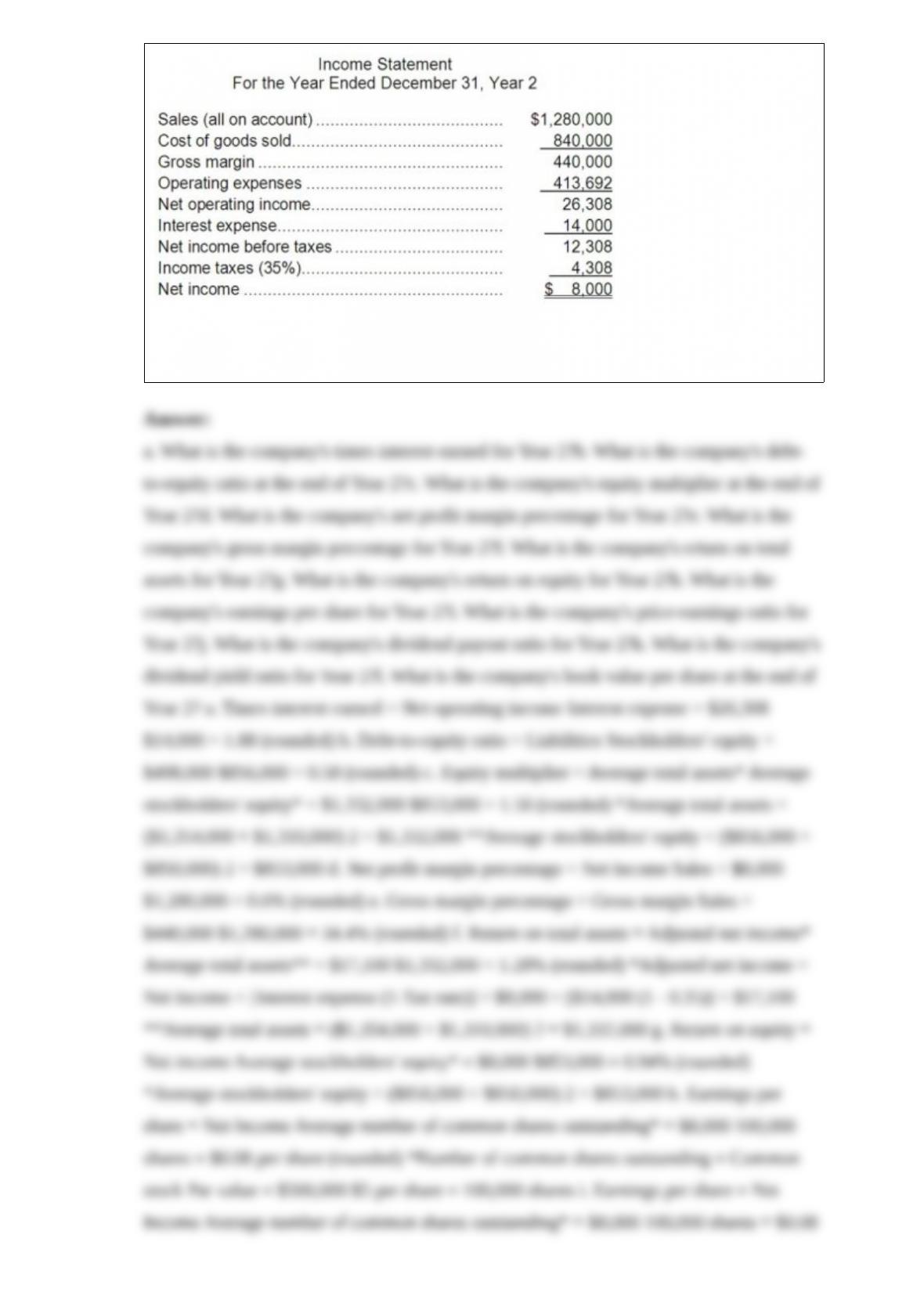
Dividends on common stock during Year 2 totaled $2,000. The market price of common
stock at the end of Year 2 was $1.49 per share.
29) During April, Cheatam Corporation budgeted for 27,000 customers, but actually
served 23,000 customers. The company uses the following revenue and cost formulas in
its budgeting, where q is the number of customers served:
Revenue: $4.10q
Wages and salaries: $33,300 + $1.10q
Supplies: $0.70q
Insurance: $8,600
Miscellaneous expense: $3,700 + $0.40q
Required:
Prepare the company’s flexible budget for April based on the actual level of activity for
the month.
30) In July, one of the processing departments at Gulbranson Corporation had
beginning work in process inventory of $14,000 and ending work in process inventory
of $18,000. During the month, $165,000 of costs were added to production and the cost
of units transferred out from the department was $161,000.
Required:
Construct a cost reconciliation report for the department for the month of July.
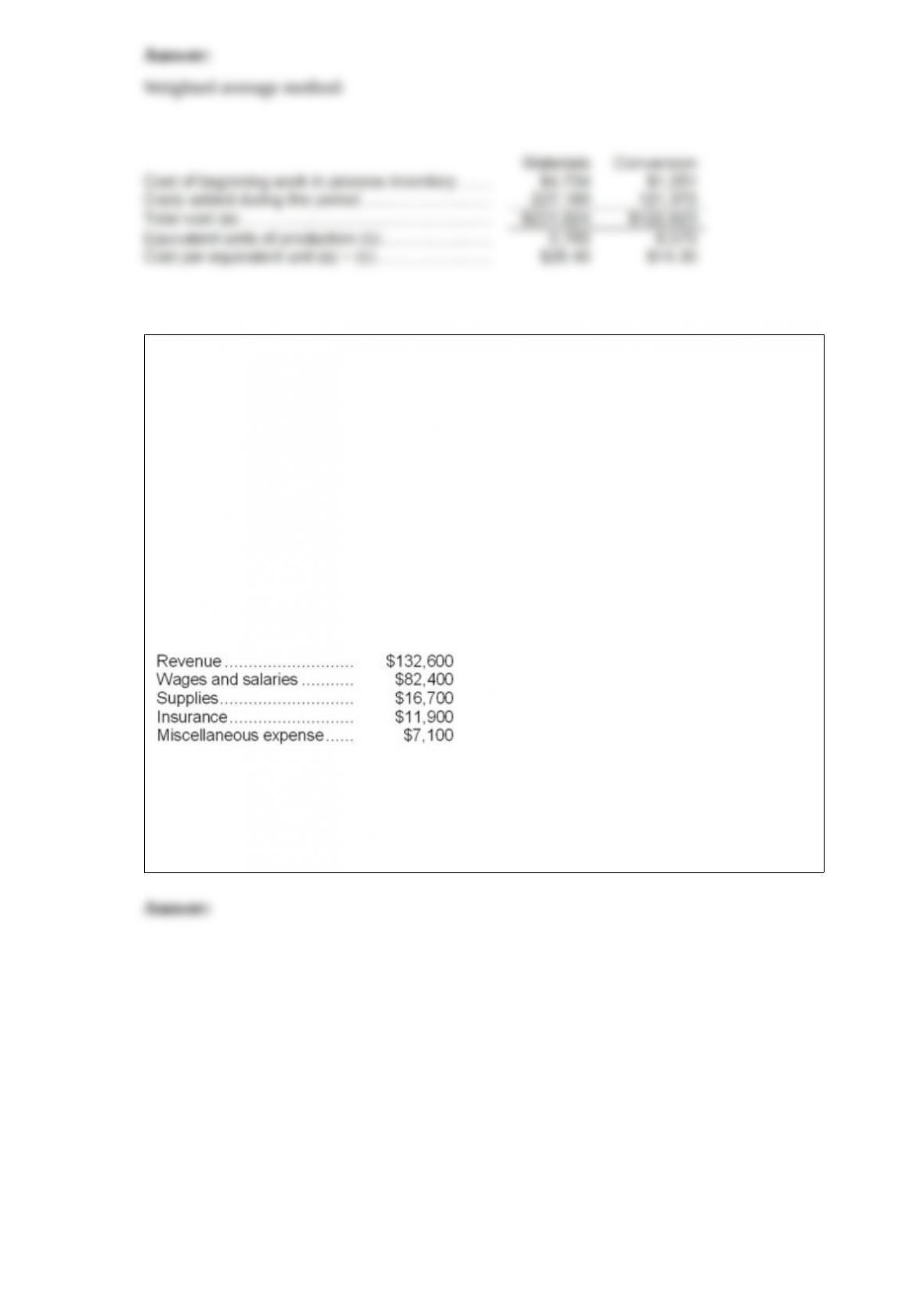
31) Gupta Inc. uses the weighted-average method in its process costing. The following
data concern the company’s Mixing Department for the month of December.
Required:
Compute the cost per equivalent unit for materials and conversion for the Mixing
Department in December.
32) Vangemert Corporation uses customers served as its measure of activity. During
June, the company budgeted for 22,000 customers, but actually served 25,000
customers. The company uses the following revenue and cost formulas in its budgeting,
where q is the number of customers served:
Revenue: $5.30q
Wages and salaries: $35,400 + $1.90q
Supplies: $0.70q
Insurance: $9,600
Miscellaneous expense: $5,000 + $0.10q
The company reported the following actual results for June:
Required:
Prepare a report showing the company’s revenue and spending variances for June. Label
each variance as favorable (F) or unfavorable (U).