Which of the following is a true statement regarding product-level costs?
A. Product-level costs are only relevant to a decision when adding a product to a
company’s product line.
B. Product-level costs are generally relevant to outsourcing decisions.
C. Product-level costs are generally relevant to special order decisions.
D. Product-level costs are incurred to support the entire company.
During its first year of operations, Forrest Company paid $30,000 for direct materials
and $50,000 in wages for production workers. Lease payments, utility costs, and
depreciation on factory equipment totaled $15,000. General, selling, and administrative
expenses were $20,000. The average cost to produce one unit was $2.50. How many
units were produced during the period?
A. 40,000
B. 46,000
C. 38,000
D. None of these.
Which of the following can reduce the amount of employees’ budget gamesmanship?
A. Have superiors and subordinates participate in the standard-setting process.
B. Incorporate standards into the firm’s evaluation system.
C. Avoid using standards for punitive purposes.
D. All of these answers are correct.
Select the correct statement regarding fixed costs.
A. There is a contradiction between the term “fixed cost per unit” and the behavior
pattern implied by the term.
B. Fixed cost per unit is not fixed.
C. Total fixed cost remains constant when volume changes.
D. All of these are correct statements.
Zeus, Inc. produces a product that has a variable cost of $9.50 per unit. The company’s
fixed costs are $40,000. The product sells for $00 a unit and the company desires to
earn a $20,000 profit. What is the volume of sales in units required to achieve the target
profit? (Do not round intermediate calculations.)
A. 24,000
B. 16,000
C. 17,000
D. 4,000

Selection of a cost driver depends on:
A. The availability of information for both the cost and the potential cost driver.
B. A cause-and-effect relationship between the cost driver and the cost.
C. Judgment of management.
D. All of these answers are correct.
Joint products A and B emerge from common processing that costs $200,000 and yields
2,000 units of Product A and 1,000 units of Product B. Product A can be sold for $100
per unit. Product B can be sold for $120 per unit. How much of the joint cost will be
assigned to Product A if joint costs are allocated on the basis of relative sales values?
(Do not round your intermediate calculations.)
A. $75,000
B. $125,000
C. $100,000
D. $133,333
The magnitude of operating leverage for Blue Ridge Corporation is 3.5 when sales are
$200,000 and net income is $36,000. If sales decrease by 6%, net income is expected to
decrease by what amount?
A. $2,160
B. $7,560
C. $3,420
D. $1,260
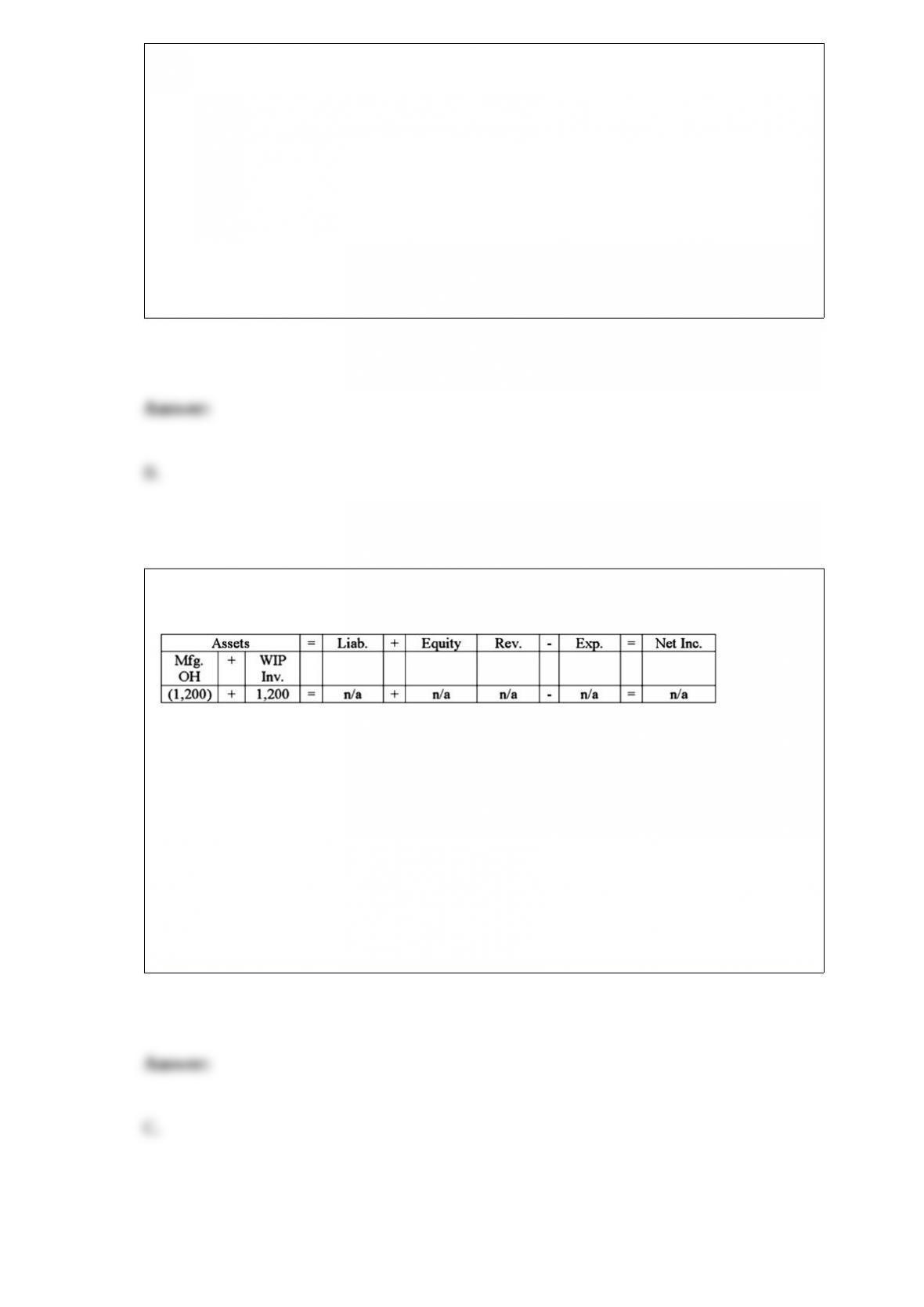
Ringgold Company experienced an event that affected its financial statements as
indicated below:
Which of the following accounting events caused the indicated effects on the company’s
accounting equation?
A. Actual overhead cost was incurred
B. Underapplied overhead was written off
C. Estimated overhead was charged to production
D. None of these.
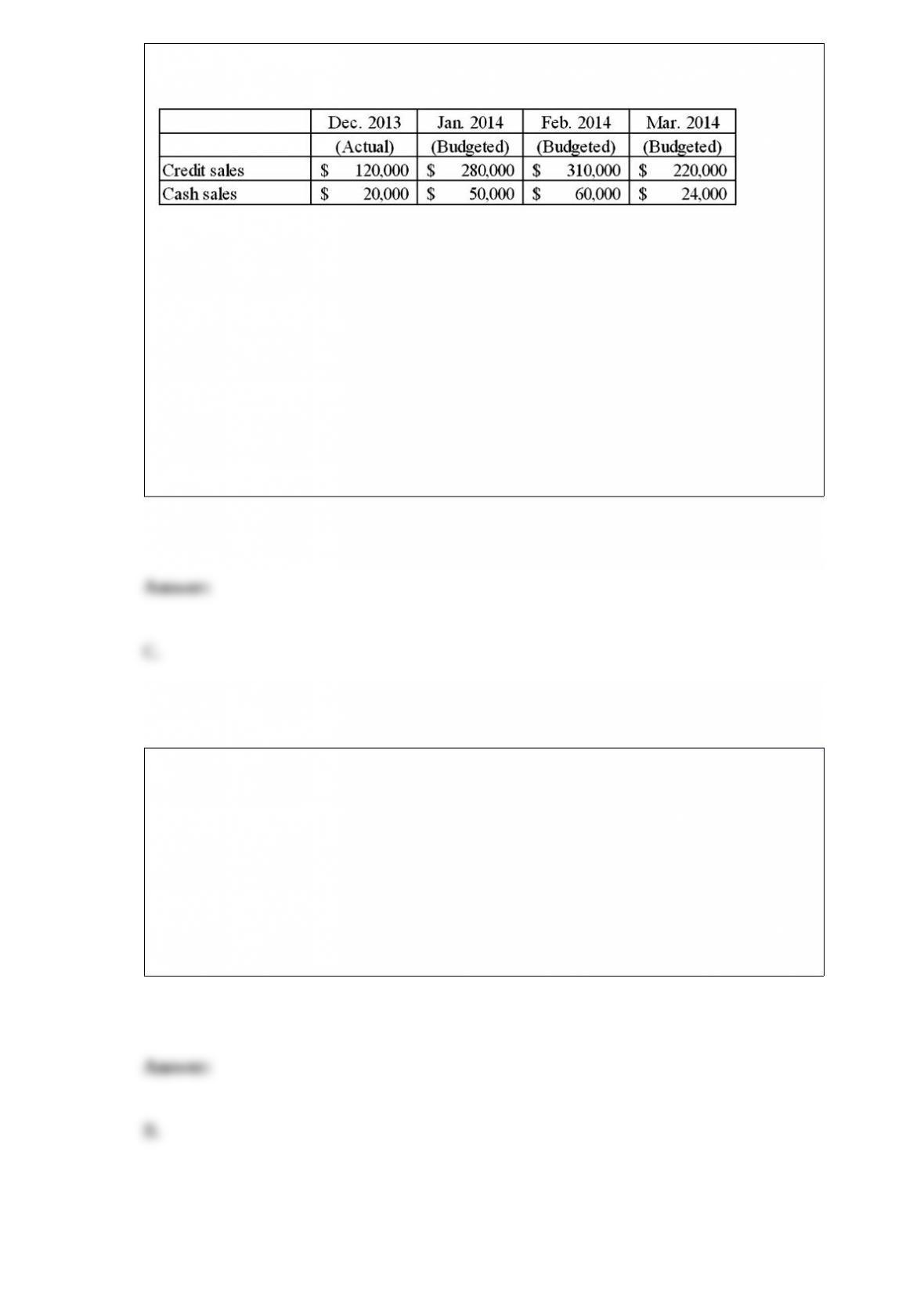
Oakton Furniture provided the following information relevant to its sales for December
2013 and the first quarter of 2014
Based on the company’s collection history, 2% of credit sales are uncollectible, 40% are
collected in month of sale and the remainder is collected in the following month. Total
budgeted cash receipts in February 2014 are expected to be:
A. $60,000.
B. $162,400.
C. $346,400.
D. $228,000.
Which of the following would not be included in the inventory purchases budget?
A. Required purchases
B. Cash collections
C. Budgeted cost of goods sold
D. Desired ending inventory
Which manager is normally held responsible for fixed cost volume variances?
A. Production supervisor
B. Upper level marketing managers
C. Plant manager
D. Purchasing agent
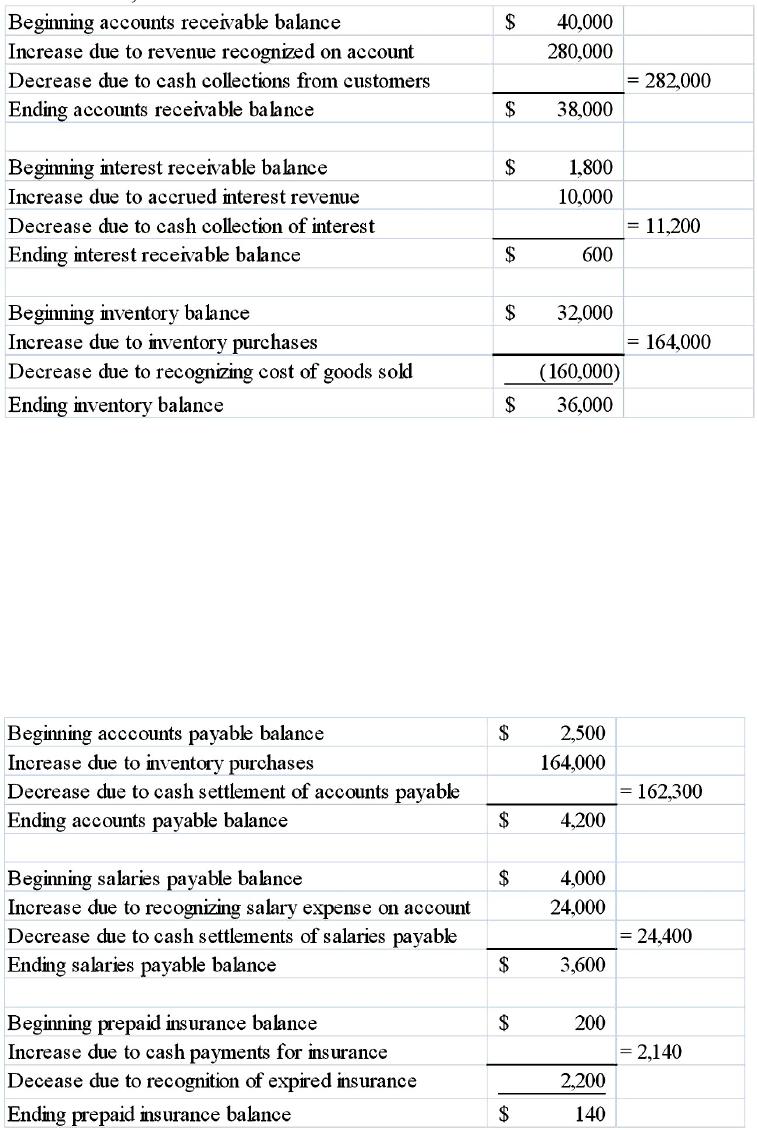
Blair Corporation reported the following for 2014:
Required:
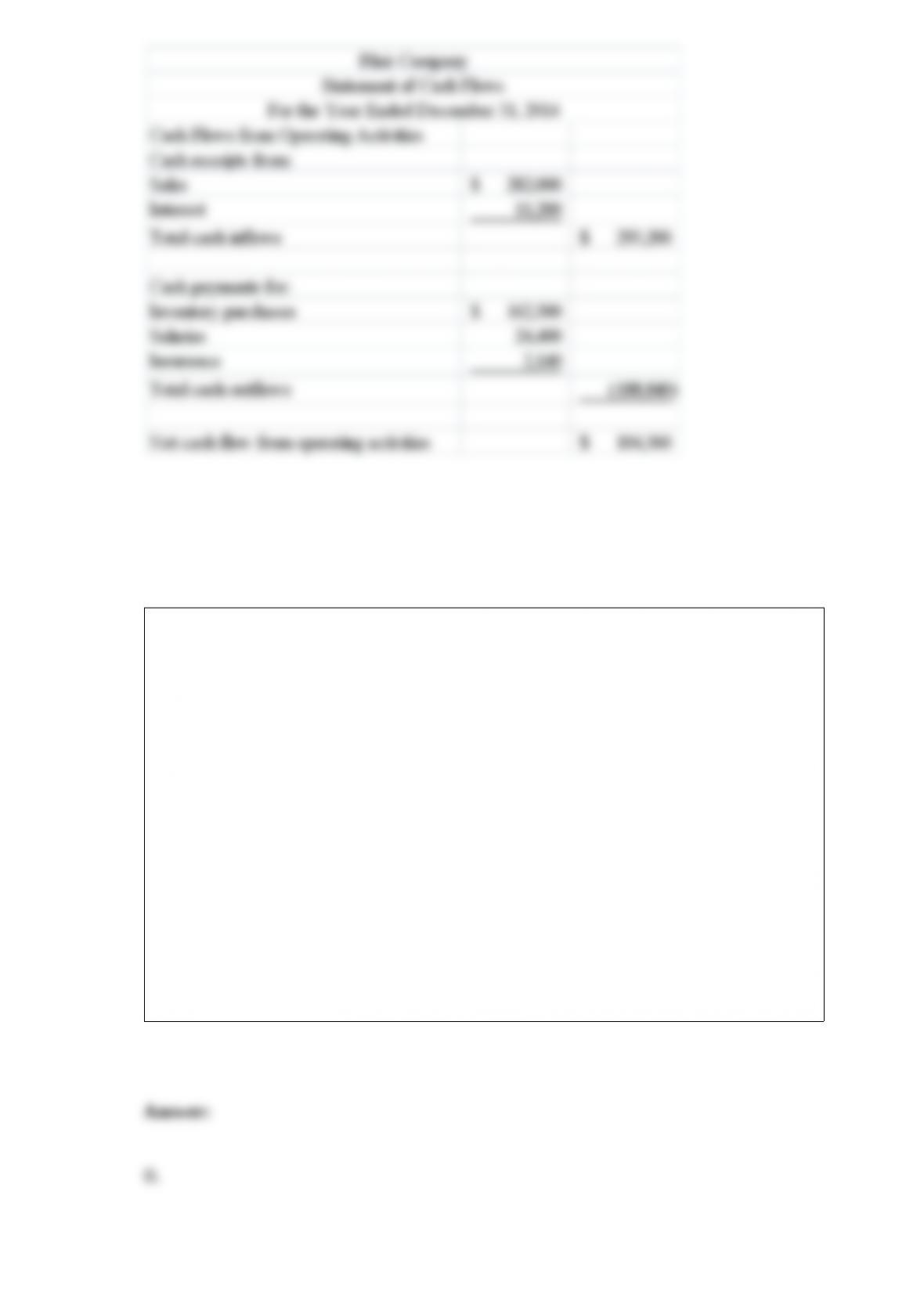
a) Use the reconciliation approach to compute the appropriate figures for cash flows
from operating activities.
b) Present in good form the cash flows from operating activities section of a statement
of cash flows using the direct method.
Which of the following statement(s) is/are correct?
I. It is easy to distinguish the balance sheet of a company that uses a process costing
system from that of a company that uses job-order costing
II. A process cost system requires a work in process account for each processing
department, while a job order system uses a single work in process account
III. Process cost systems use multiple finished goods inventory accounts
A. I only
B. II only
C. II and III
D. I, II, and III
A cash flow that only occurs in equal amounts each year is referred to as:
A. a lump sum.
B. a perpetuity.
C. an annuity.
D. None of these.
Volume variances are computed for which of the following costs?
A. Fixed manufacturing costs only
B. Variable selling and administrative costs only
C. Variable manufacturing and selling and administrative costs
D. Variable manufacturing costs only
During 2014, the Abbot Company had the following changes in account balances:
1) The accumulated depreciation account had a beginning balance of $25,000 and an
ending balance of $35,000. The increase was due to depreciation expense.
2) The long-term notes payable account had a beginning balance of $40,000 and an
ending balance of $15,000. The decrease was due to repayment of debt.
3) The accounts receivable account had a beginning balance of $60,000 and an ending
balance of $50,000.

4) The equipment account had a beginning balance of $25,000 and an ending balance of
$92,500. The increase was due to the purchase of equipment for cash.
5) The long term investments account (marketable securities) had a beginning balance
of $18,000 and an ending balance of $12,500. The decrease was due to the sale of
investments at cost.
6) The amount of cash dividends declared and paid during the year was $22,000.
7) The interest payable account had a beginning balance of $2,250 and an ending
balance of $1,250.
What is the net cash flow from financing activities?
A. $22,000 inflow
B. $25,000 inflow
C. $25,000 outflow
D. $47,000 outflow
Depreciation for the year was $80,000 and net income was $323,000. Assume the rest
of the company’s transactions were cash transactions. How much was net cash from
operating activities?
A. $243,000
B. $403,000
C. $323,000
D. None of these answers is correct.
Taste of the Town, Inc. operates a gourmet sandwich shop. The company orders bread,
cold cuts, and produce several times a week. If the cost of these items remains constant
per customer served, the cost is said to be:
A. Variable
B. Fixed
C. Opportunity
D. Mixed
A credit to the finished goods account represents the:
A. cost of goods available for sale.
B. cost of goods manufactured.
C. cost of goods sold.
D. cost of goods used.
Sometimes the sales staff will deliberately underestimate the amount of expected sales.
This practice is known as:
A. making the numbers.
B. cooking the books.
C. lowballing.
D. budget slack.
Which of the following is a product cost for a construction company?
A. Cost of transporting raw materials to the job site
B. Wages paid to the company’s payroll clerk
C. Rent of the company’s main office
D. All of these.
Which of the following is not a reason management might be tempted to classify costs
as assets rather than expensing them during periods in which production exceeds sales?
A. The company’s bank may be more likely to extend financing to the firm.
B. Income taxes will be lower.
C. Net income will be higher.
D. Management bonuses may be higher.
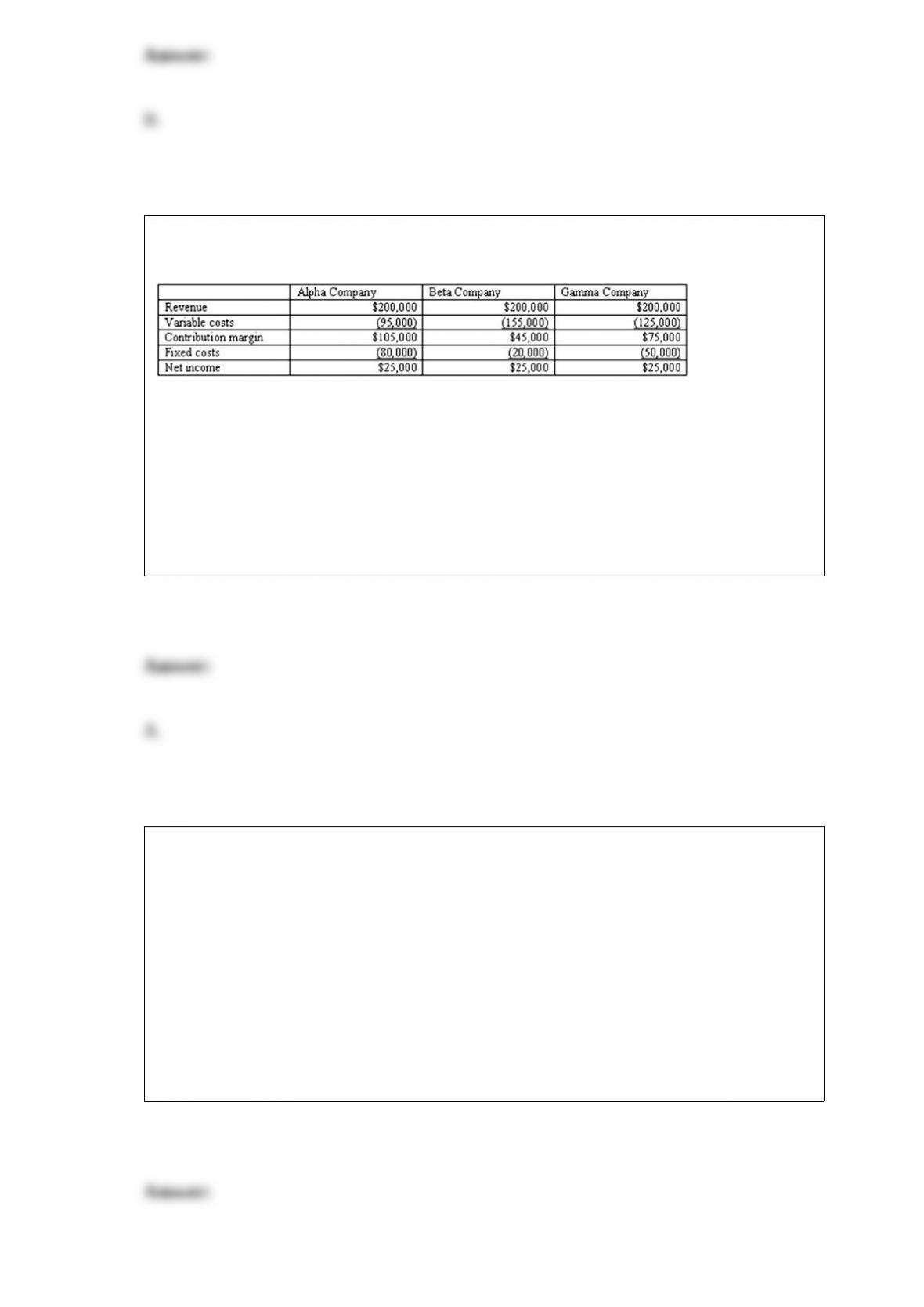
Based on the income statements of the three following retail businesses, which
company has the highest operating leverage?
A. Alpha Company
B. Beta Company
C. Gamma Company
D. They all have same operating leverage
Which of the following is not an important factor in determining the appropriate cost
driver to use in allocating a cost?
A. A cause-and-effect relationship between the cost and the cost driver
B. The availability of information about the cost and cost driver
C. The ability of the cost driver to allocate indirect costs to cost objects
D. All of these are important factors in determining the appropriate cost driver to use in
allocating a cost.
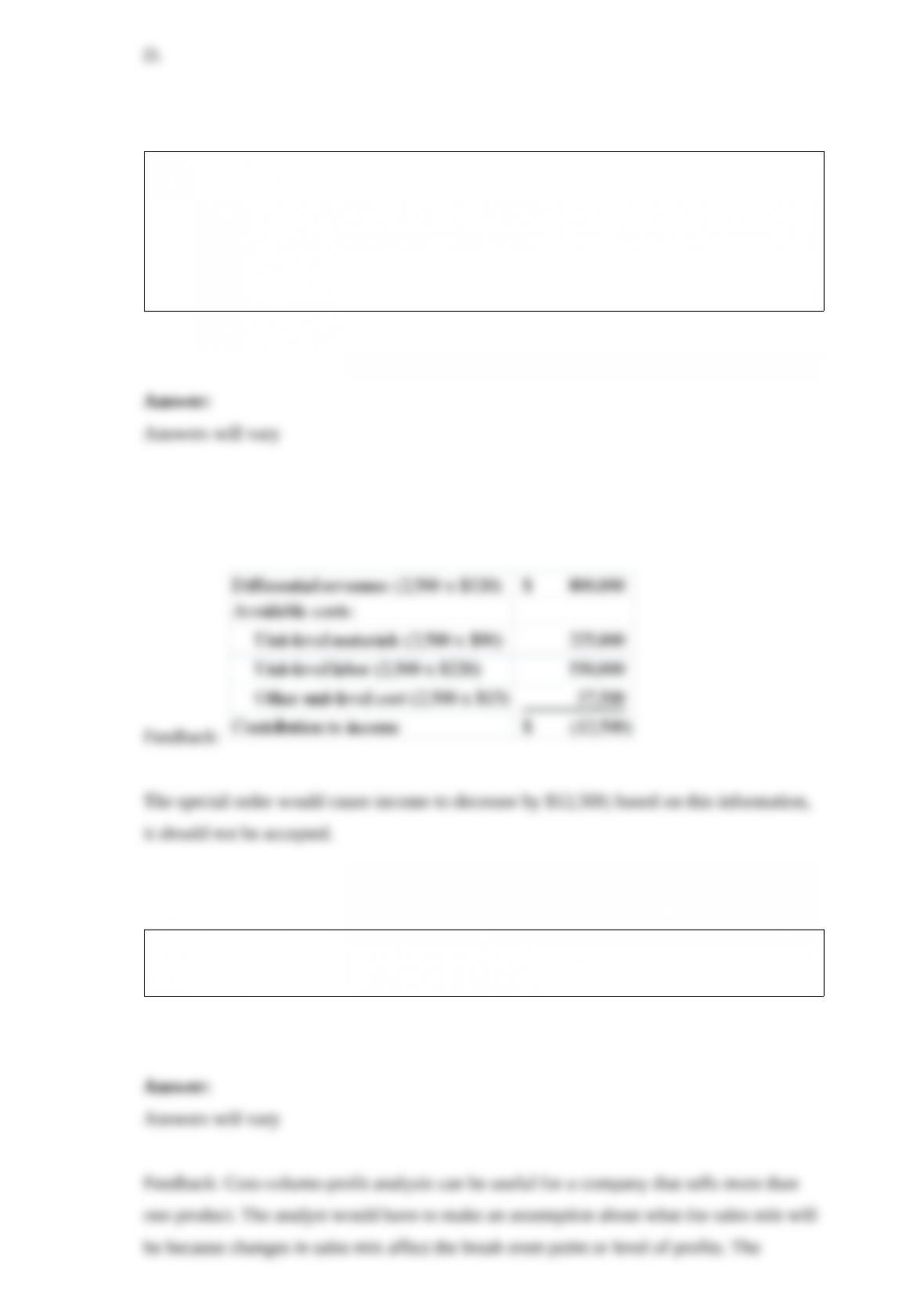
Terrain Tents makes backpacking tents. It has the capacity to produce 10,000 tents per
year and currently is producing and selling 7,000 tents. Normal selling price for a tent is
$450. Unit-level costs are $90 for direct materials, $220 for direct labor, and $15 for
other manufacturing costs. Facility-level costs of $110 are allocated to each tent. Terrain
has received a special order for 2,500 tents at $320 each.Required:Should Terrain
accept the special order? Support your answer with appropriate computations.
Can cost-volume-profit analysis be useful for a company that sells more than one
product? If so, how? If not, why not?
How would an organization benefit from conducting postaudits of its capital investment
decisions?
What advantages does the regression method of cost estimation offer, compared to the
high-low and scattergraph methods of estimating mixed costs?
Indicate whether each of the following statements is true or false.
Cost accumulation refers to identifying whether a particular cost is fixed or variable.
Cost objects may be departments, sales territories, or individual products.
Cost accumulation is not useful in a service-type business.
An allocation base has a cause-and-effect relationship with a cost object.
Timeliness of managerial accounting information is more important than its precision.
Neighbors Company is considering the purchase of new equipment that will cost
$130,000. The equipment will save the company $38,000 per year in cash operating
costs. The equipment has an estimated useful life of five years and a zero expected
salvage value. The company’s cost of capital is 10%.
Required:
1) Ignoring income taxes, compute the net present value and internal rate of return.
Round net present value to the nearest dollar and round internal rate of return to the
nearest whole percent.
2) Should the equipment be purchased? Why or why not?