
1) Management’s intent determines whether an available-for-sale security is classified
as long-term or short-term.
2) A cost variance is the difference between actual cost and standard cost.
3) A good financial statement analysis report often includes the following sections:
executive summary, analysis overview, evidential matter, assumptions, key factors, and
inferences.
4) The direct write-off method of accounting for bad debts records the loss from an
uncollectible account receivable when it is determined to be uncollectible.
5) Long-term bonds have relatively higher interest rates because they carry higher risk
due to the longer time period.
6) Enterprise resource planning software is primarily used for recording journal entries.
7) A voucher is an internal document or file used to accumulate information to control
cash disbursements and to ensure that a transaction is properly recorded.

8) Participating preferred stock has a feature that allows it to share with common
shareholders in any dividends paid in excess of the percent or dollar amount stated on
the preferred stock.
9) Departmental information is important and always disclosed to the public as part of
the company’s annual report and footnotes.
10) Posting is the transfer of journal entry information to the ledger.
11) As the level of output activity increases, fixed cost per unit remains constant.
12) General-purpose financial statements include the (1) income statement, (2) balance
sheet, (3) statement of stockholders’ equity (or statement of retained earnings), (4)
statement of cash flows, and (5) notes to these statements.
13) A company purchased equipment for $150,000 by paying $50,000 and signing a
$100,000 note payable. The entire transaction is disclosed to users on the statement of
cash flows and/or in the notes to the financial statements.
14) It is not necessary for businesses to reconcile their checking accounts since banks
keep accurate records and provide internal control support for cash.

15) Collateral agreements for a note or bond can:
A.Lower the risk in comparison with unsecured debt
B.Increase the risk in comparison with unsecured debt
C.Have no effect on risk
D.Reduce the issuer’s assets
E.Increase total cost for the borrower
16) The total amount of depreciation recorded against an asset or group of assets during
the entire time the asset or assets have been owned:
A.Is referred to as depreciation expense
B.Is referred to as accumulated depreciation
C.Is shown on the income statement of the final period
D.Is only recorded when the asset is disposed of
E.Is referred to as an accrued asset
17) Output devices include all of the following except:
A.Printers
B.Monitors
C.LCD projectors
D.Web communications
E.Bar code readers
18) On August 9, Pierce Company receives a $8,500, 90-day, 8% note from customer
Eric Simms as payment on his account. What entry should be made on August 9 to
record receipt of the note?
A.Debit Accounts Receivable $8,500; credit Sales $8,500
B.Debit Notes Receivable $8,670; credit Sales $8,670
C.Debit Notes Receivable $8,500; credit Accounts Receivable $8,500
D.Debit Notes Receivable $8,500; credit Sales $8,500
E.Debit Notes Receivable $8,725; credit Interest Revenue $225; credit Accounts
Receivable $8,500

19) Medina Corp. uses the weighted average method for inventory costs and had the
following information available for the year. Equivalent units of production for the year
are:
A.3,200 units
B.3,320 units
C.3,240 units
D.3,520 units
E.3,800 units
20) Shamrock Company had net income of $30,000. The weighted-average common
shares outstanding were 8,000. The company declared a $2,700 dividend on its
noncumulative, nonparticipating preferred stock. There were no other stock
transactions. The company’s earnings per share is:
A.$2.87
B.$2.73
C.$3.41
D.$3.16
E.$3.75
21) Bard Manufacturing uses a job order cost accounting system. During one month
Bard purchased $198,000 of raw materials on credit; issued materials to production of
$195,000 of which $30,000 were indirect. Bard incurred a factory payroll of $150,000,
paid in cash, of which $40,000 is classified as indirect labor. Bard uses a predetermined
overhead application rate of 150% of direct labor cost. The journal entry to record the
purchase of materials is:
A.Debit Raw Materials Inventory $198,000; credit Accounts Payable $198,000
B.Debit Goods in Process Inventory $198,000; credit Accounts Payable $198,000
C.Debit Raw Materials Inventory $198,000; credit Goods in Process Inventory
$198,000
D.Debit Goods in Process Inventory $195,000; credit Raw Materials Inventory
$195,000
E.Debit Raw Materials Inventory $198,000; credit Finished Goods Inventory $198,000

22) Match the following accounting system components a through e with the
appropriate application(s) 1 through 10:
1>Input devices A. Computer keyboard
2>Source documents B. Computer hard drive
3>Source documents C. Journal entries
4>Information storage D. Journals
5>Output devices E. Financial statements
6>Output devices F. Invoice from suppliers
7>Output devices G. Employee paychecks
8>Information processor H. Computer monitor
9>Input devices G. Software
10>Information processor I. Electronic files
23) The allowance method based on the idea that a given percent of a company’s credit
sales for the period are uncollectible is:
A.The percent of sales method
B.The percent of accounts receivable method
C.The aging of accounts receivable method
D.Direct write-off method
E.Factoring method
24) Conan Company has total fixed costs of $112,000. Its product sells for $35 per unit
and variable costs amount to $25 per unit. Next year Conan Company wishes to earn a
pretax income that equals 10% of fixed costs. How many units must be sold to achieve
this target income level?
A.1,120
B.8,214
C.11,200
D.12,320
E.14,080
25) On December 31 of the current year, a company’s unadjusted trial balance included
the following: Accounts Receivable, debit balance of $97,250; Allowance for Doubtful

Accounts, credit balance of $951. What amount should be debited to Bad Debts
Expense, assuming 6% of outstanding accounts receivable at the end of the current year
will be uncollectible?
A.$951
B.$3,992
C.$4,884
D.$5,835
E.$6,786
26) Jamesway Corporation has two separate divisions that operate as profit centers. The
following information is available for the most recent year:
The White Division occupies 20,000 square feet in the plant. The Grey Division
occupies 30,000 square feet. Rent is an indirect expense and is allocated based on
square footage. Rent expense for the year was $50,000. Compute gross profit for the
White and Grey Divisions, respectively.
A.$72,000; $193,000
B.$172,000; $352,000
C.$100,000; $241,000
D.$52,000; $163,000
E.$72,000; $163,000
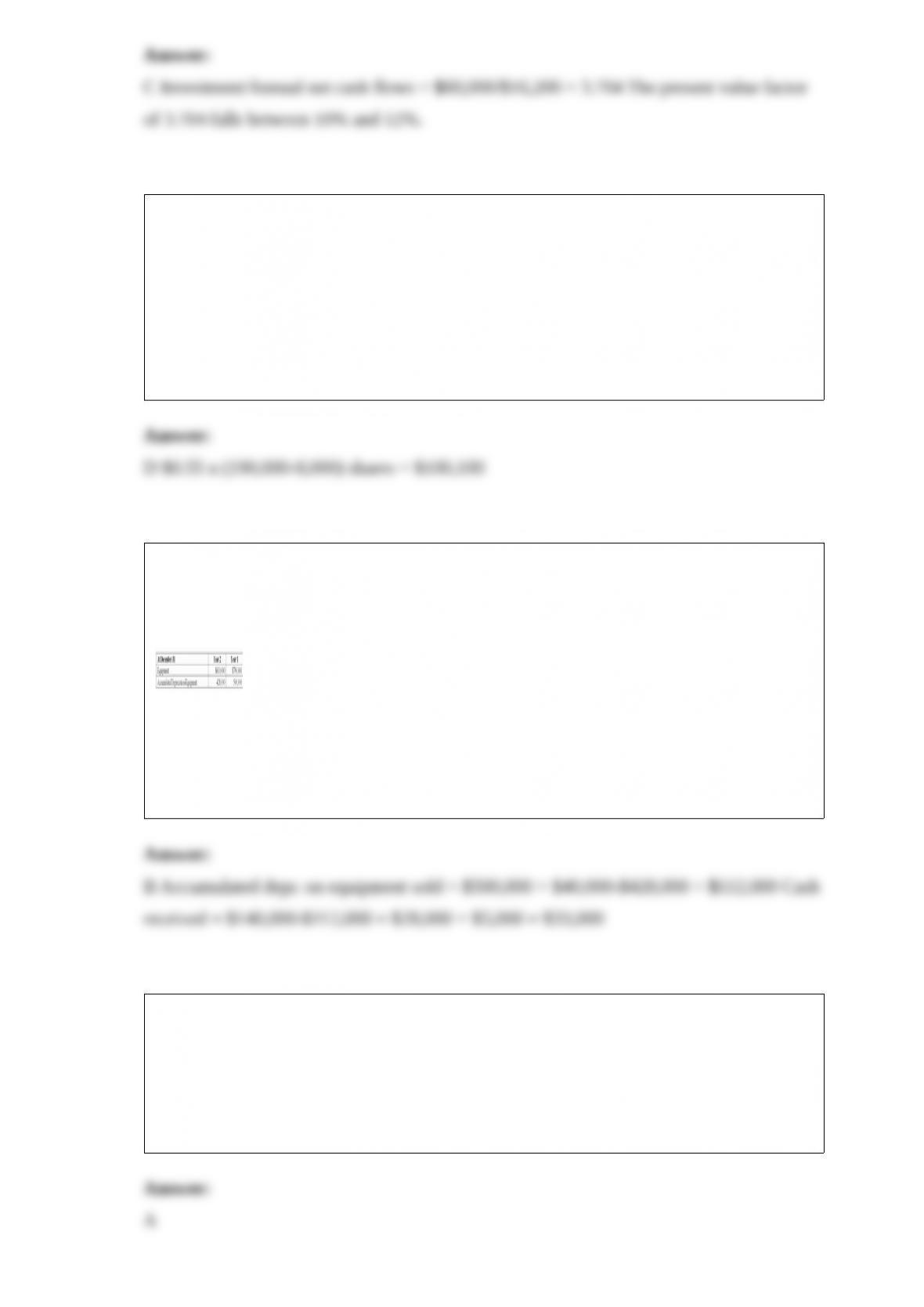
27) A company is considering a 5-year project. The company plans to invest $60,000
now and it forecasts cash flows for each year of $16,200. The company requires a
hurdle rate of 12%. Calculate the internal rate of return to determine whether it should
accept this project. Selected factors for a present value of an annuity of 1 for five years
are shown below:
A.The project should be accepted
B.The project should be rejected because it earns more than 10%
C.The project earns more than 10% but less than 12%. If the hurdle rate is 12%, the
project should be rejected
D.Only 9% is acceptable
E.Only 10% is acceptable
28) A company declared a $0.55 per share cash dividend. The company has 200,000
shares authorized, 190,000 shares issued, and 8,000 shares in treasury stock. The
journal entry to record the payment of the dividend is:
A.Debit Retained Earnings $104,500; credit Common Dividends Payable $104,500
B.Debit Common Dividends Payable $104,500; credit Cash $104,500
C.Debit Retained Earnings $100,100; credit Common Dividends Payable $100,100
D.Debit Common Dividends Payable $100,100; credit Cash $100,100
E.Debit Retained Earnings $110,000; credit Common Dividends Payable $110,000
29) Sebring Company reports depreciation expense of $40,000 for Year 2. Also,
equipment costing $140,000 was sold for a $5,000 gain in Year 2. The following
selected information is available for Sebring Company from its comparative balance
sheet. Compute the cash received from the sale of the equipment.
A.$23,000
B.$33,000
C.$28,000
D.$40,000
E.$68,000
30) The Allowance for Doubtful Accounts:
A.Is a contra asset account
B.Is used instead of reducing accounts receivable directly
C.Is debited when uncollectible accounts are written off
D.All of these
E.Is credited when bad debts expense is estimated and recorded
31) If budgeted beginning inventory is $8,300, budgeted ending inventory is $9,400,
and budgeted cost of goods sold is $10,260, budgeted purchases should be:
A.$860
B.$1,100
C.$1,960
D.$9,160
E.$11,360
32) A company had sales of $375,000 and its gross profit was $157,500. Its cost of
goods sold equals:
A.$(217,000).
B.$375,000.
C.$157,500.
D.$217,500.
E.$532,500.
33) The most useful allocation basis for the departmental costs of an advertising
campaign for a storewide sale is likely to be:
A.Floor space of each department
B.Relative number of items each department had on sale
C.Number of customers to enter each department
D.An equal amount of cost for each department
E.Proportion of sales of each department
34) A company’s internal control system:
A.Eliminates the company’s risk of loss
B.Monitors company and employee performance
C.Eliminates human error
D.Eliminates the need for audits
E.Eliminates the need for managers’ certification of controls

35) A company buys a machine for $60,000 that has an expected life of 9 years and no
salvage value. The company anticipates a yearly net income of $2,850 after taxes of
30%, with the cash flows to be received evenly throughout each year. What is the
accounting rate of return?
A.2.85%
B.4.75%
C.6.65%
D.9.50%
E.42.75%
36) Regarding overhead costs, as volume increases:
A.Unit fixed cost increases, unit variable cost decreases
B.Unit fixed cost decreases, unit variable cost increases
C.Unit variable cost decreases, unit fixed cost remains constant
D.Unit fixed cost decreases, unit variable cost remains constant
E.Both unit fixed cost and unit variable cost remain constant
37) Based on a predicted level of production and sales of 12,000 units, a company
anticipates reporting operating income of $26,000 after deducting variable costs of
$72,000 and fixed costs of $10,000.
Based on this information, the budgeted amounts of fixed and variable costs for 15,000
units would be:
A.$10,000 of fixed costs and $72,000 of variable costs
B.$10,000 of fixed costs and $90,000 of variable costs
C.$12,500 of fixed costs and $90,000 of variable costs
D.$12,500 of fixed costs and $72,000 of variable costs
E.$10,000 of fixed costs and $81,000 of variable costs
38) Comparative financial statements in which each individual financial statement
amount is expressed as a percentage of a base amount are called:
A.Asset comparative statements
B.Percentage comparative statements
C.Common-size comparative statements
D.Sales comparative statements
E.General-purpose financial statements
39) An asset can be disposed of by:
A.Discarding it
B.Selling it
C.Exchanging it for another asset
D.Donating it to charity
E.All of these
40) All of the following statements regarding internal control procedures are true
except:
A.Internal control procedures are designed to ensure reliable financial reports
B.Internal control procedures are designed to safeguards company assets
C.Internal control procedures direct operations toward common goals
D.Internal control procedures include methods to achieve compliance with laws and
regulation
E.Internal control procedures are bit affected by the cost-benefit principle
41) A method that allocates an equal portion of the total depreciable cost for a plant
asset to each unit produced is called:
A.Accelerated depreciation
B.Declining-balance depreciation
C.Straight-line depreciation
D.Units-of-production depreciation
E.Modified accelerated cost recovery system (MACRS) depreciation
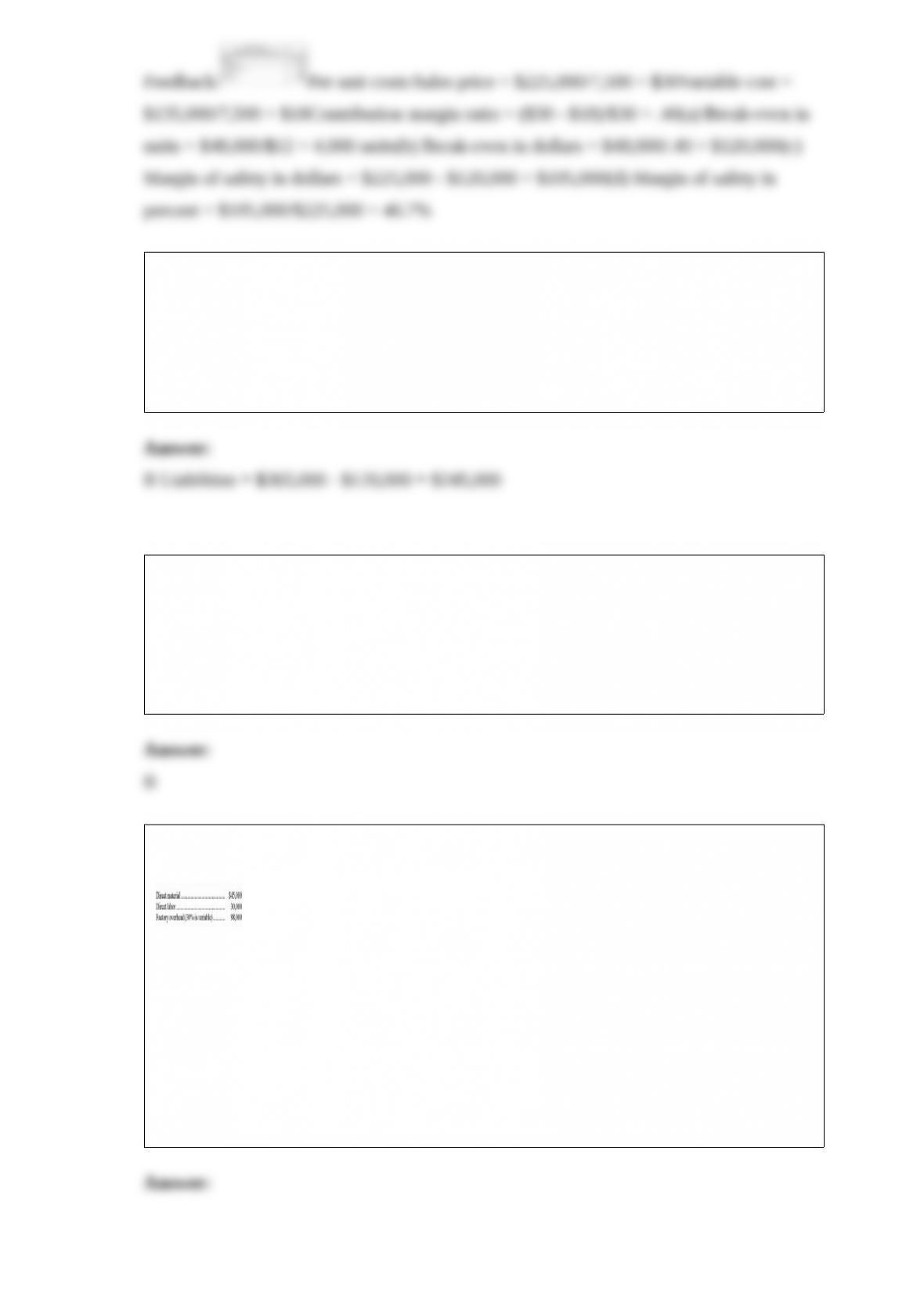
42) Bristol Company’s contribution margin income statement is presented below. Sales
for the current period consisted of 7,500 units. Compute the company’s break-even
point in (a) units, and (b) dollars. Compute the margin of safety in (c) dollars and (d)
percent.
43) If assets are $365,000 and equity is $120,000, then liabilities are:
A.$120,000
B.$245,000
C.$365,000
D.$485,000
E.$610,000
44) The Federal Insurance Contributions Act (FICA) requires that each employer file a:
A.W-4
B.Form 941
C.Form 1040
D.Form 1099
E.All of these
45) Textel is thinking about having one of its products manufactured by a subcontractor.
Currently, the cost of manufacturing 1,000 units follows:
If Textel can buy 1,000 units from a subcontractor for $100,000, it should:
A.Make the product because current factory overhead is less than $100,000
B.Make the product because the cost of direct material plus direct labor of
manufacturing is less than $100,000
C.Buy the product because the total incremental costs of manufacturing are greater than
$100,000
D.Buy the product because total fixed and variable manufacturing costs are greater than
$100,000
E.Make the product because factory overhead is a sunk cost
46) Brig Company had $800,000 in sales, sales discounts of $12,000, sales returns and
allowances of $18,000, cost of goods sold of $380,000, and $275,000 in operating
expenses. Net income equals:
A.$770,000.
B.$402,000.
C.$390,000.
D.$115,000.
E.$408,000.
47) All of the following statements regarding accounting for influential securities under
U.S. GAAP and IFRS are True except:
A.Under the equity method, the share of investee’s net income is reported in the
investor’s income in the same period the investee earns that income
B.Under the consolidation method, investee and investor revenues and expenses are
combined
C.Under the equity method, the investment account equals the acquisition cost plus the
share of investee income plus the share of investee dividends
D.Under the consolidation method, nonintercompany assets and liabilities are combined
(eliminating the need for an investment account)
E.U. S. GAAP companies commonly refer to noncontrolling interests in consolidated
subsidiaries as minority interests whereas IFRS companies use noncontrolling interests
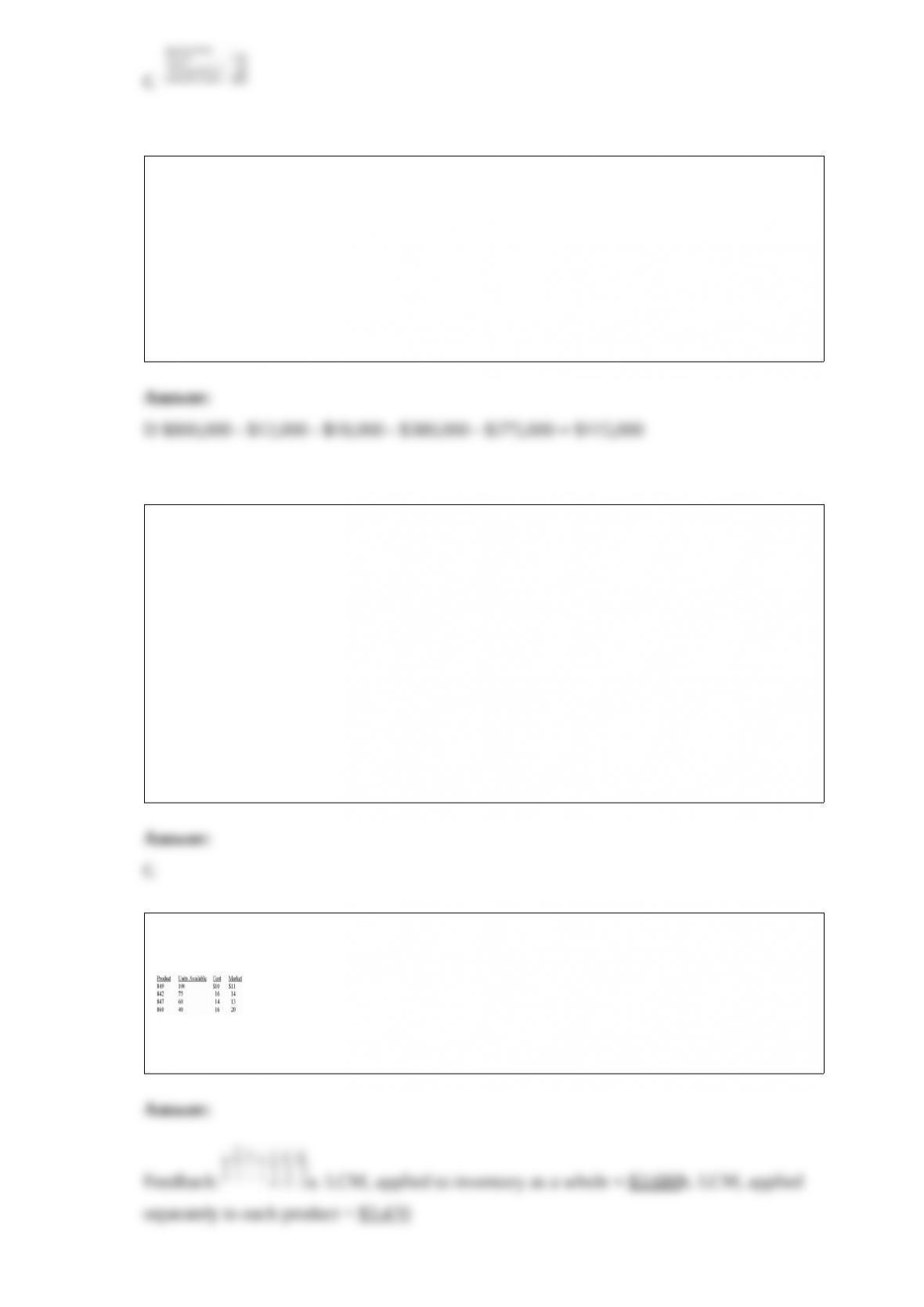
48) A company reported the following data related to its ending inventory:
Calculate the lower-of-cost-or-market on the: (a) Inventory as a whole and (b) inventory
applied separately to each product.
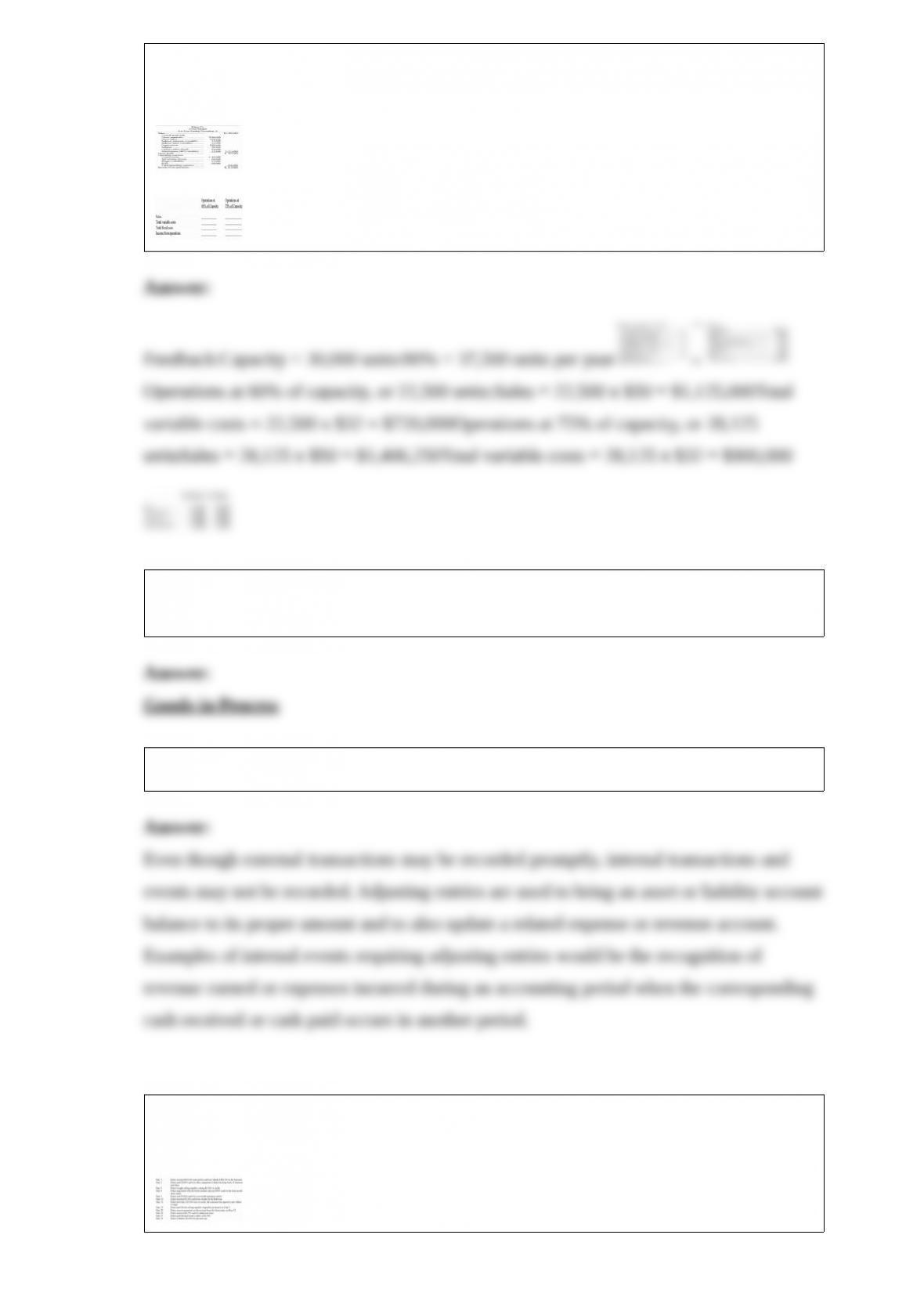
49) Elroy Co. has prepared the following fixed budget for the year, assuming
production and sales of 30,000 units. This level of production represents 80% of
capacity.
Calculate the following flexible budget amounts at the indicated levels of capacity:
50) A manufacturer’s inventory that is not completely finished is called
__________________.
51) Explain the purpose of adjusting entries at the end of a period.
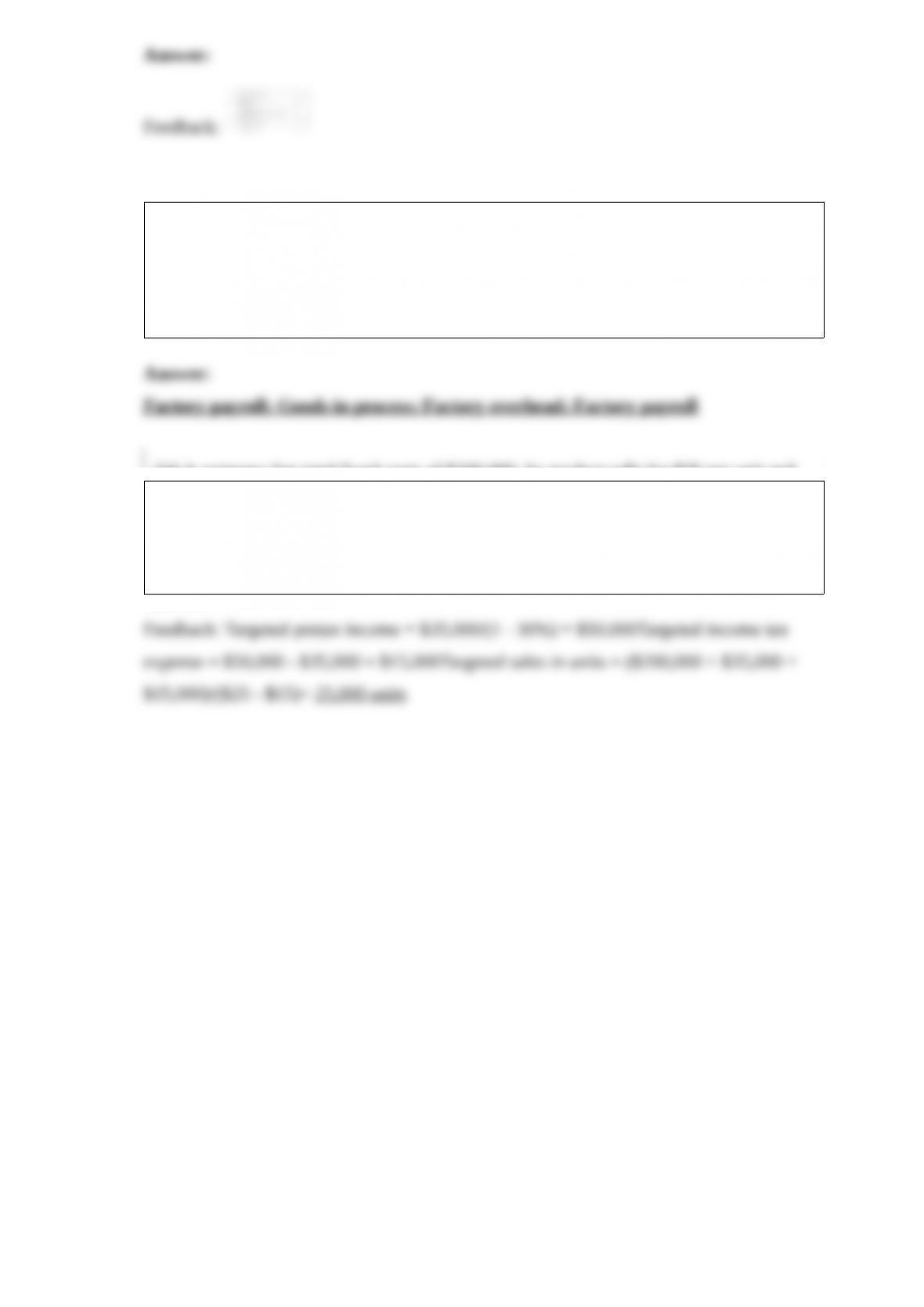
52) James Haley owned a sailboat and was tired of his current job. He decided to open a
business that provides day sails to tourists in his hometown. Prepare journal entries to
record the following transactions.
53) In a process costing accounting system, factory wages are debited to
_____________, and when direct labor is used, that account is credited and
____________________ is debited. When indirect labor is used, the
________________________ account is debited and ______________________ is
credited.
54) A company has total fixed costs of $200,000. Its product sells for $25 per unit and
variable costs amount to $15 per unit. The company wishes to earn an after-tax income
of $35,000. Assume that the company has a 30% tax rate. How many units must be sold
to achieve this after-tax income level?