On June 1, 2014, Aaron Company purchased equipment at a cost of $120,000 that has a
depreciable cost of $90,000 and an estimated useful life of 3 years and 30,000 hours.
Using straight line depreciation, prepare the journal entry to record depreciation
expense for (a) the first year, (b) the second year and (c) the last year.
Answer:
Which of the accounts below would not appear in the balance sheet columns of the
worksheet?
A.Chad Daniels, Drawing
B.Rent Earned

C.Unearned Revenue
D.Chad Daniels, Drawing and Unearned Revenue
Answer:
Which of the following statements is false?
A.There is no overlap between financial and managerial accounting.
B.Managerial accounting sometimes relies on past information.
C.Managerial accounting does not need to conform to GAAP
D.Financial accounting must conform to GAAP.
Answer:
What cost concept used in applying the cost-plus approach to product pricing includes
only desired profit in the “markup”?
A.Product cost concept
B.Variable cost concept
C.Sunk cost concept
D.Total cost concept
Answer:
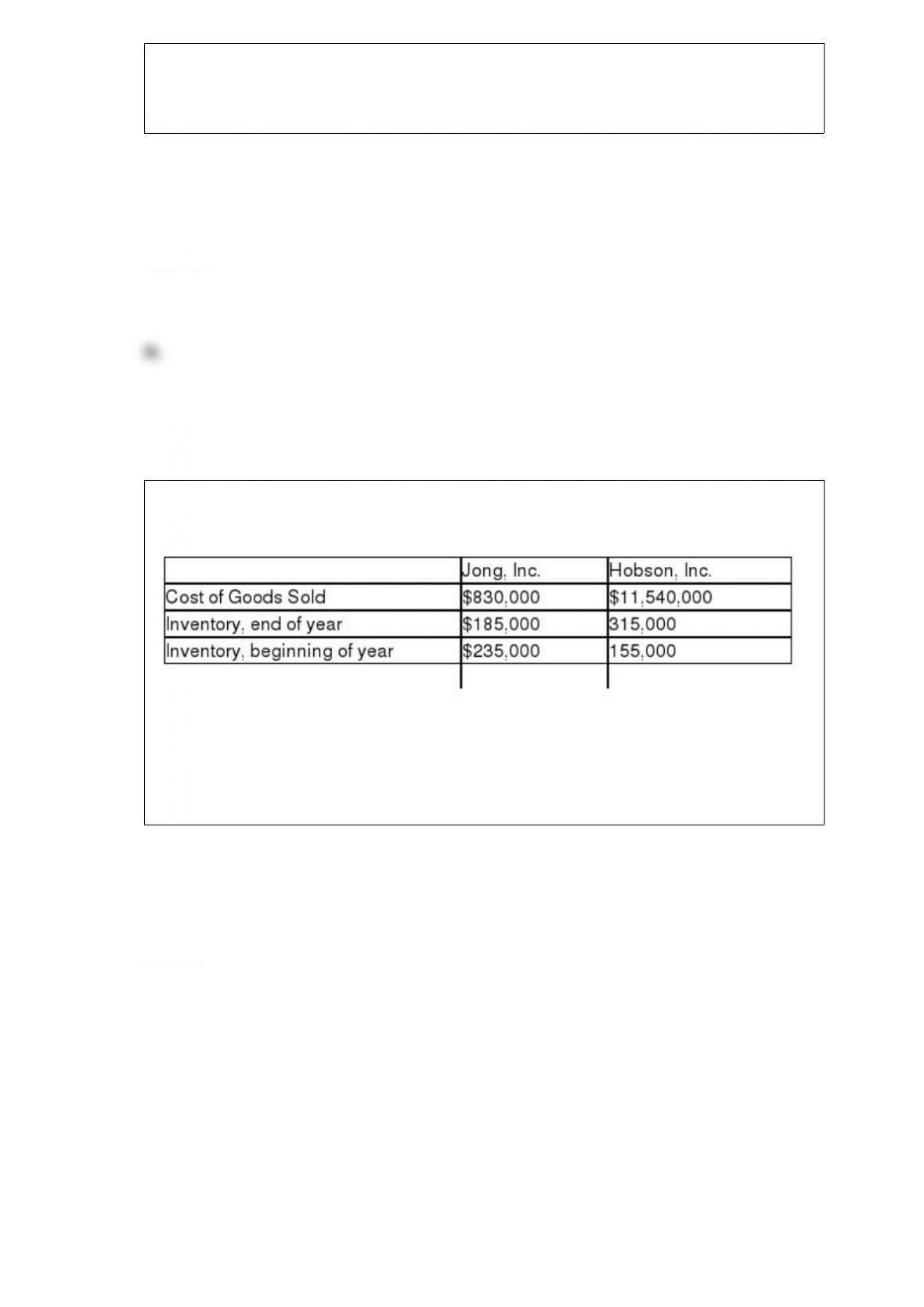
The following data were taken from the annual reports of Jong Inc., a manufacturer of
fireworks, and Hobson Inc., a manufacturer of computers.
(a) Determine the (1) inventory turnover and (2) number of day’s sales in inventory for
Jong and Hobson. Round your answer to two decimal places.
(b) How would you expect these measures to compare between the companies? Why?
Answer:
Which of the following owner’s equity accounts follows the same debit and credit rules
as liabilities?
A.Expense accounts only
B.Drawing accounts only
C.Revenues accounts only
D.Expenses and drawing accounts
Answer:
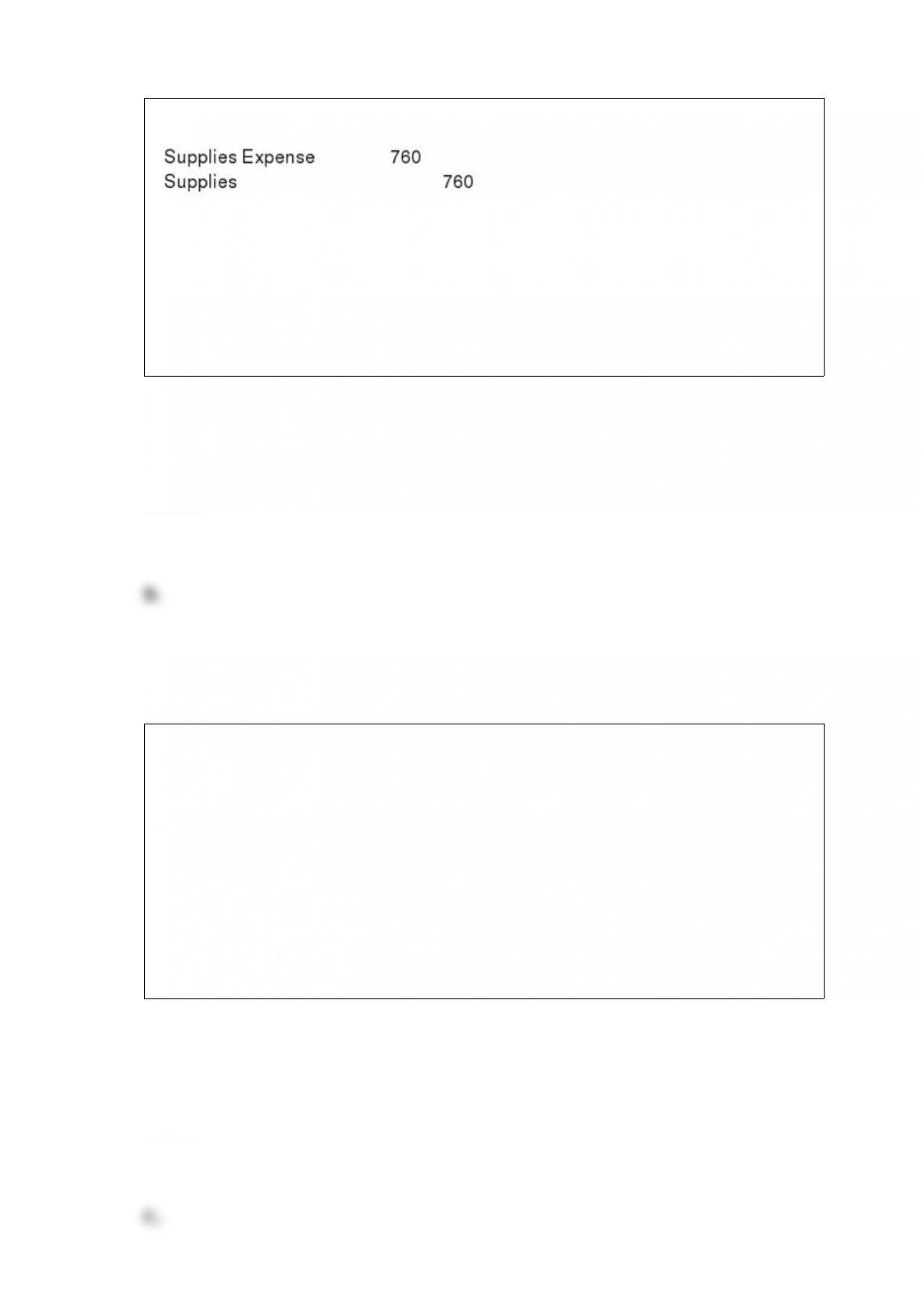
What effect will this adjusting journal entry have on the accounting records?
A.Increase income
B.Decrease net income
C.Decrease expenses
D.Increase assets
Answer:
A partner withdraws from a partnership by selling her interest to another person who
currently is not associated with the firm. As a results of this transaction, the capital
account balance of the other partners in the partnership
A.will increase
B.will decrease
C.will remain the same
D.may increase, decrease, or remain the same
Answer:

A 60-day, 9% note for $10,000, dated May 1, is received from a customer on account.
The maturity value of the note is
A.$10,000
B.$10,150
C.$10,900
D.$9,100
Answer:
Which of the following should be classified as an extraordinary item on the income
statement?
A.Gain on a sale of a long term investment.
B.Loss due to discontinued operations.
C.Restructuring charges.
D.Loss resulting from an infrequent natural disaster.
Answer:
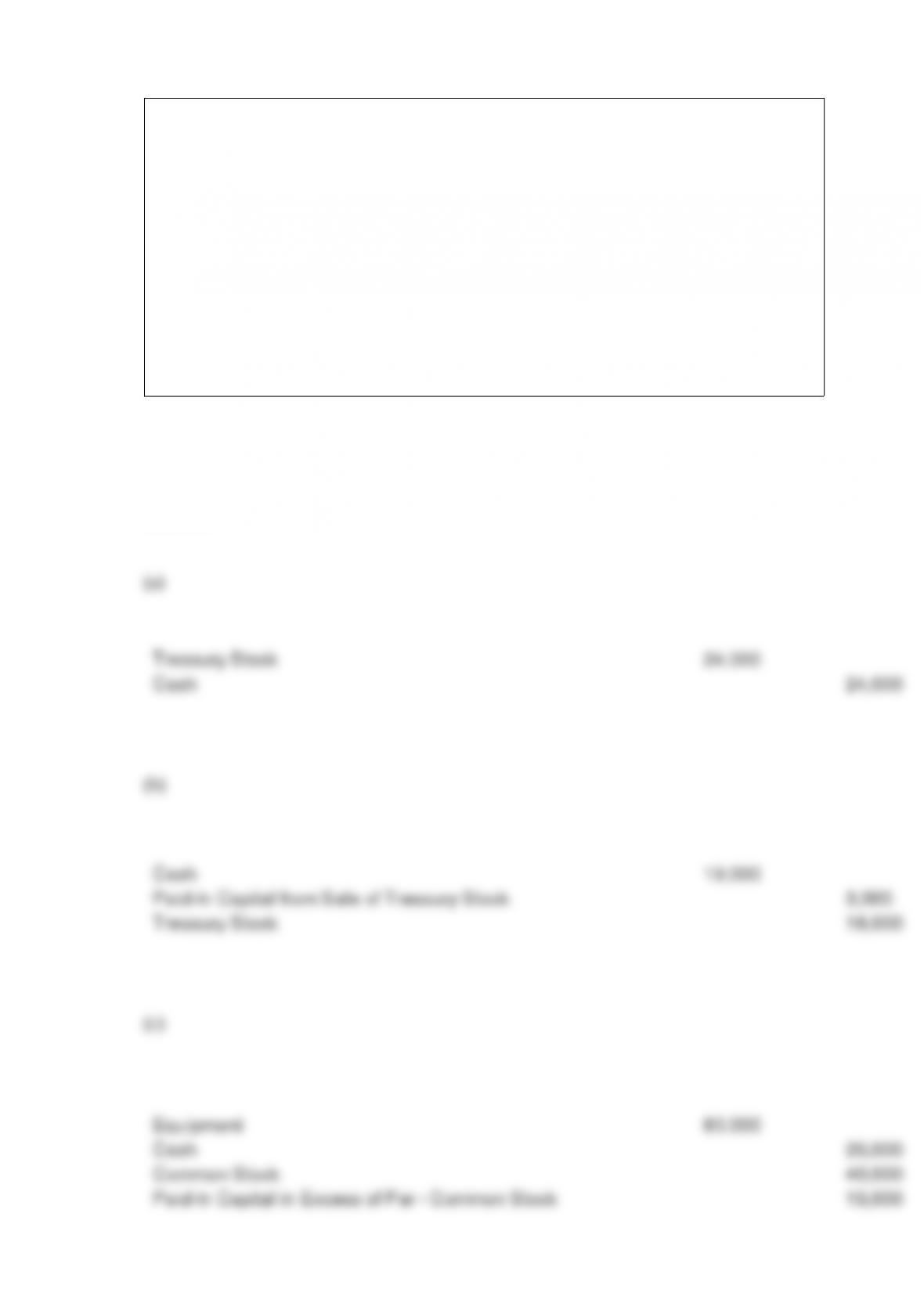
A company has 10,000 shares of $10 par common stock outstanding. Prepare entries to
record the following:
(a) Purchased 1,500 shares of treasury stock at $16. The treasury stock is accounted for
by the cost method.
(b) Sold 1,000 shares of treasury stock at $19.
(c) Purchased equipment for $80,000, paying $25,000 in cash and issuing 4,000 shares
of common stock for the remaining.
(d) Sold 500 shares of treasury stock at $14.
Answer:

If the company can not cut costs any lower than they already are what would the profit
margin on sales be if they meet the market selling price?
A.9.3%
B.7.3%
C.10.3%
D.8.3%
Answer:
Samuels, Inc. reported net income for 2011 is $105,000. During 2011 the company had
5,000 shares of $100 par, 5% preferred stock and 20,000 of $5 par common stock
outstanding. Samuels’ earnings per share for 2011 is
A.$4.00
B.$5.25
C.$6.50

D.$5.00
Answer:
The account Valuation Allowance for Trading Securities is found on the:
A.Income statement as Other Revenue (Expenses)
B.Balance sheet as an adjustment to the asset account
C.Balance sheet as an adjustment to Stockholders’ Equity
D.Statement of Retained Earnings
Answer:
When a company exchanges machinery and receives a trade-in allowance greater than
the book value, this transaction would be recorded with the following entry (assuming
the exchange was considered to have commercial substance):
A.debit Machinery and Accumulated Depreciation; credit Machinery, Cash, and Gain
on Disposal
B.debit Machinery and Accumulated Depreciation; credit Machinery and Cash

C.debit Cash and Machinery; credit Accumulated Depreciation
D.debit Cash and Machinery; credit Accumulated Depreciation and Machinery
Answer:
Which of the following is not an advantage of issuing bonds instead of common stock?
A.Tax savings result
B.Income to common shareholders may increase.
C.Earnings per share on common stock may be lower.
D.Stockholder control is not affected.
Answer:
Which of the following is not an internal control procedure for payroll?
A.observe clocking in and out time for the employees
B.payroll depends on a fired employee’s supervisor to notify them when an employee
has been fired

C.payroll requires employees to show identification when picking up their paychecks
D.changes in pay rates on a computerized system must be tested by someone
independent of payroll
Answer:
A business is operating at 90% of capacity and is currently purchasing a part used in its
manufacturing operations for $15 per unit. The unit cost for the business to make the
part is $20, including fixed costs, and $12, not including fixed costs. If 30,000 units of
the part are normally purchased during the year but could be manufactured using
unused capacity, what would be the amount of differential cost increase or decrease
from making the part rather than purchasing it?
A.$150,000 cost increase
B.$ 90,000 cost decrease
C.$150,000 cost increase
D.$ 90,000 cost increase
Answer:

Which of the following statements concerning taxation is accurate?
A.Corporations pay federal income taxes but not state income taxes.
B.Corporations pay federal and state income taxes.
C.Only the owners must pay taxes on corporate income.
D.Corporations pay income taxes but their owners do not.
Answer:
When using the allowance method to estimate uncollectible accounts receivable based
on an analysis of receivables shows that $640 of accounts receivables are uncollectible.
The Allowance for Doubtful Accounts has a debit balance of $110. The adjusting entry
at the end of the year will include a credit to Allowance for Doubtful Accounts in the
amount of:
A.$110
B.$640
C.$530
D.$750
Answer:
The cost of goods sold for Heedy manufacturing in 2011 was $233,000. The January 1,
2011, finished goods inventory balance was $31,600, and the December 31, 2011,
finished goods inventory balance was $24,200. Cost of goods manufactured during the
period was:
A.$233,000
B.$225,600
C.$288,800
D.$240,400
Answer:
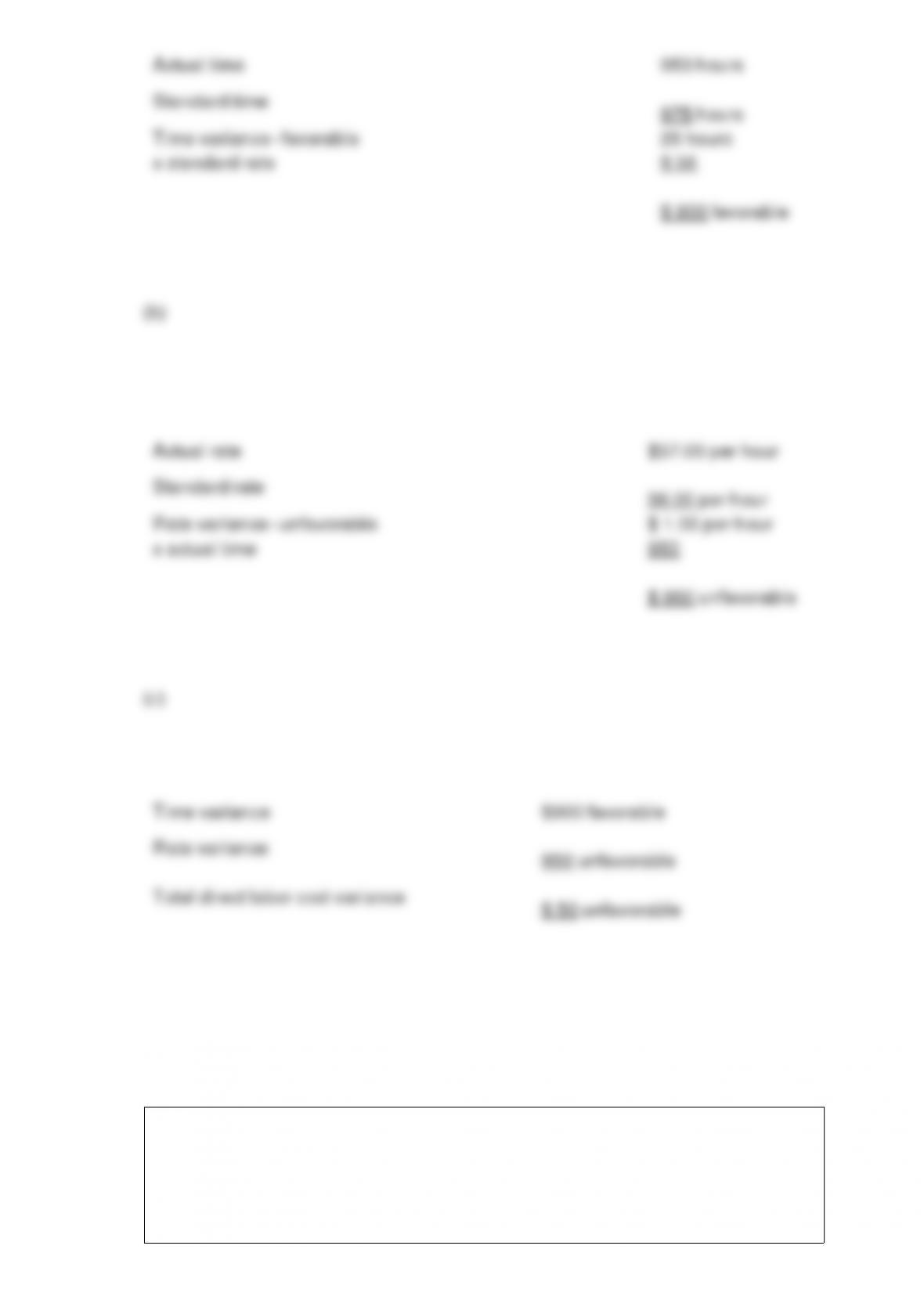
Standard and actual costs for direct labor for the manufacture of 1,000 units of product
were as follows:
Determine the (a) time variance, (b) rate variance, and (c) total direct labor cost
variance.
Answer:
When the maturities of a bond issue are spread over several dates, the bonds are called
A.serial bonds
B.bearer bonds

C.debenture bonds
D.term bonds
Answer:
A manager is responsible for costs only in a(n):
A.profit center
B.investment center
C.volume center
D.cost center
Answer:
The Cardinal Company had a finished goods inventory of 55,000 units on January 1. Its
projected sales for the next four months were: January – 200,000 units; February –
180,000 units; March – 210,000 units; and April – 230,000 units. The Cardinal Company
wishes to maintain a desired ending finished goods inventory of 20% of the following
months sales.

What would be the budgeted production for March?
A.256,000
B.206,000
C.214,000
D.298,000
Answer:
The Thomlin Company forecasts that total overhead for the current year will be
$15,000,000 and that total machine hours will be 300,000 hours. Year to date, the actual
overhead is $16,000,000 and the actual machine hours are 330,000 hours. If the
Thomlin Company uses a predetermined overhead rate based on machine hours for
applying overhead, as of this point in time (year to date) the overhead is over/under
applied by
A.$1,000,000 overapplied
B.$1,000,000 underapplied
C.$500,000 overapplied
D.$500,000 underapplied
Answer:
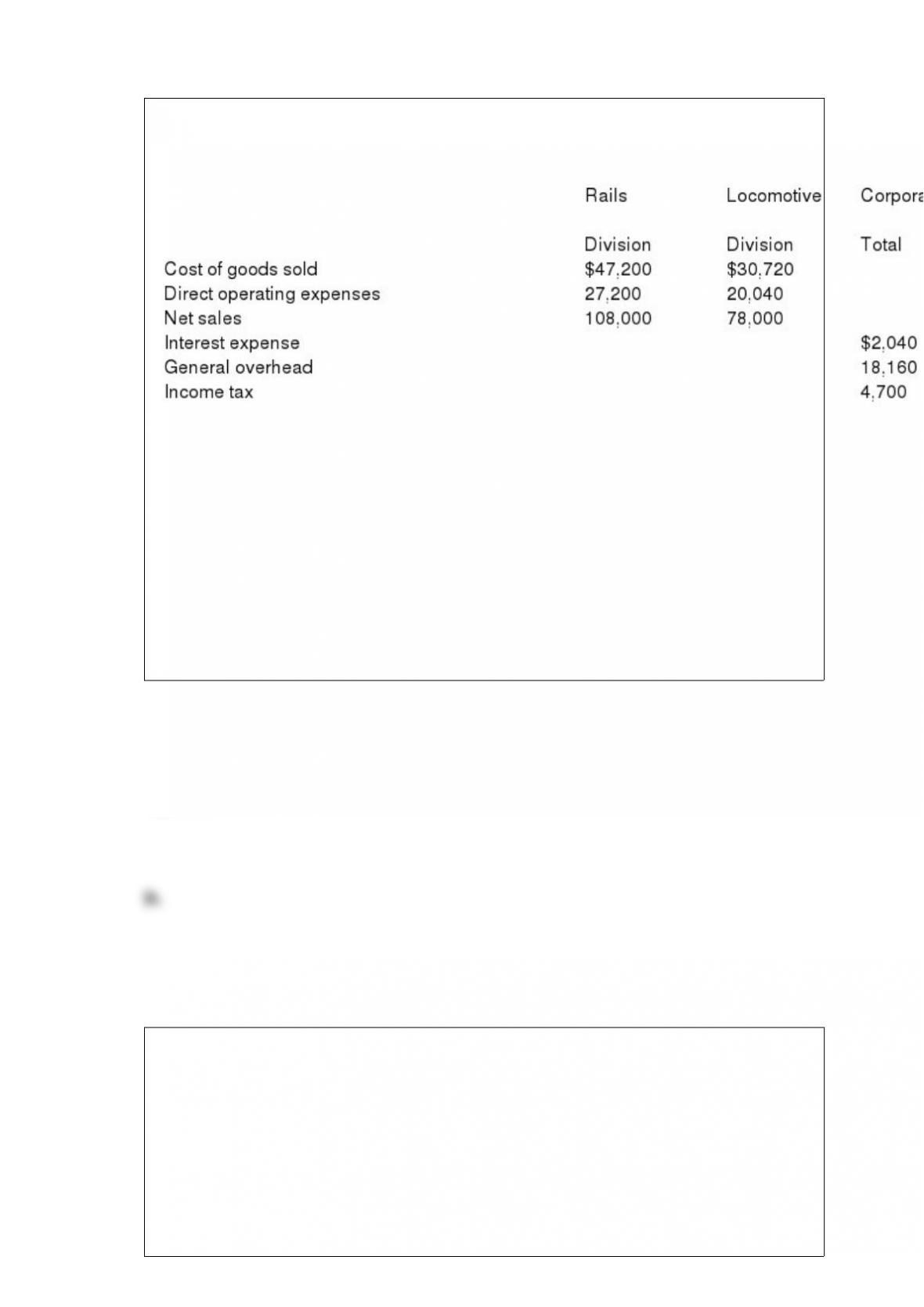
The following financial information was summarized from the accounting records of
Train Corporation for the current year ended December 31:
The gross profit for the Locomotive Division is:
A.$57,960
B.$14,790
C.$27,240
D.$47,280
Answer:
Job order costing and process costing are
A.pricing systems.
B.cost accounting systems.
C.cost flow systems.
D.inventory tracking systems.

Answer:
The following is a measure of a manager’s performance working in an investment
center.
A.rate of return on investment
B.residual income
C.divisional income statements
D.all of the responses
Answer:
Periods in time that experience increasing price levels are known as periods of:
A.inflation
B.recession
C.depression
D.deflation

Answer:
If Department K had 2,000 units, 40% completed, in process at the beginning of the
period, 12,000 units were completed during the period, and 1,200 units were 25%
completed at the end of the period, what was the number of equivalent units of
production for conversion costs for the period if the first-in, first-out method is used to
cost inventories?
A.11,500
B.11,200
C.15,200
D.10,000
Answer:
The condensed income statement for a business for the past year is presented as
follows:
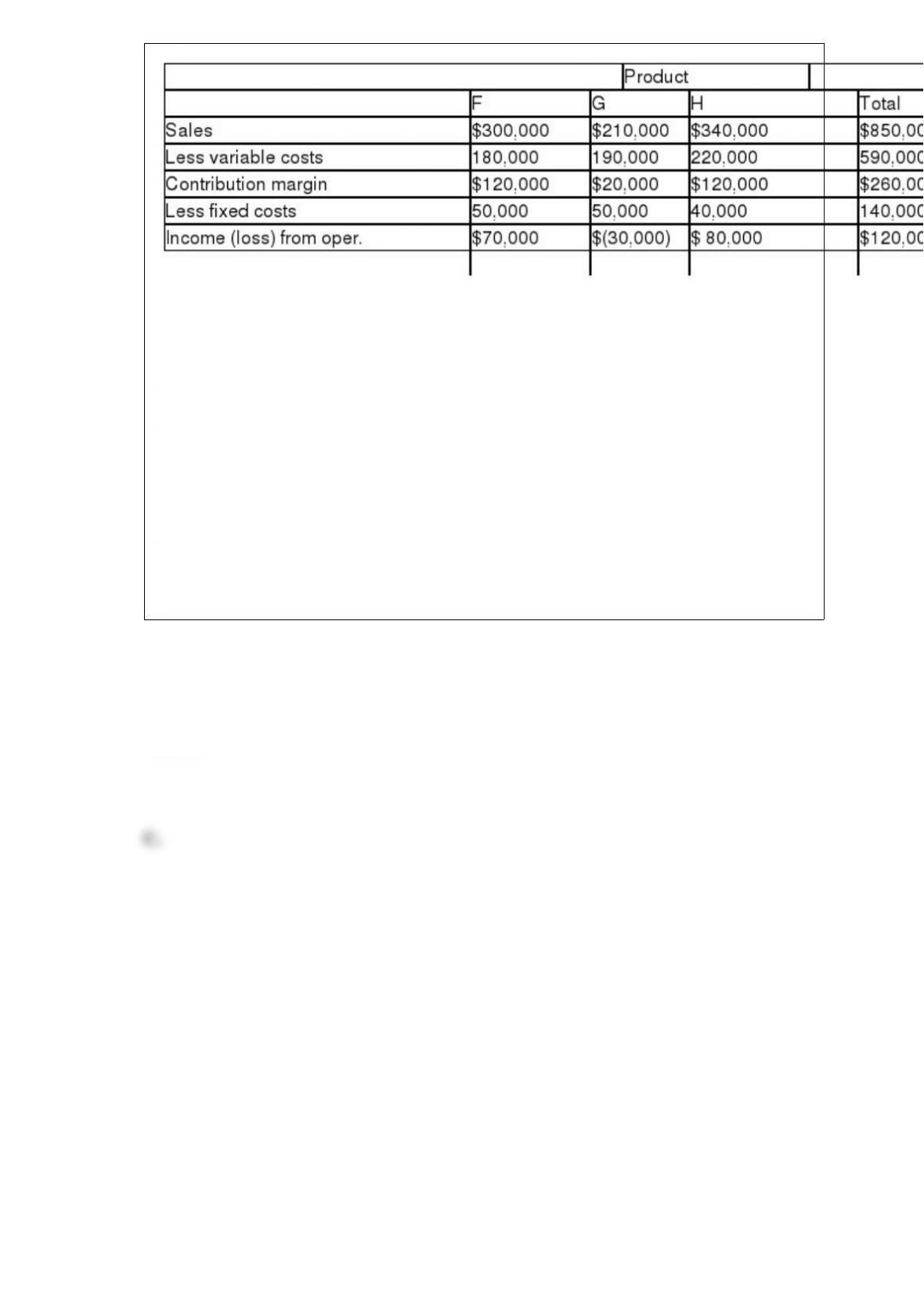
Management is considering the discontinuance of the manufacture and sale of Product
G at the beginning of the current year. The discontinuance would have no effect on the
total fixed costs and expenses or on the sales of Products F and H. What is the amount
of change in net income for the current year that will result from the discontinuance of
Product G?
A.$20,000 increase
B.$30,000 increase
C.$20,000 decrease
D.$30,000 decrease
Answer: