1) The par value of common stock is rarely equal to its market value on the date the
stock is issued.
2) The anticipated purchase of a fixed asset for $400,000, with a useful life of 5 years
and a $40,000 residual value, is expected to yield total net income of $200,000 for 5
years. The expected average rate of return on investment is 18.2%.
3) A production supervisor’s salary that does not vary with the number of units
produced is an example of a fixed cost.
4) A budget procedure that provides for the maintenance at all times of a twelve-month
projection into the future is called continuous budgeting.
5) The range of activity over which changes in cost are of interest to management is
called the relevant range.
6) The ownership of a proprietorship is divided into shares of stock owned by its
stockholders.
7) The rates at which services are charged to each division are called service department
charge rates.
8) Differential revenue is the amount of income that would result from the best
available alternative for the proposed use of cash.
9) If employees accept a wage contract that decreases the unit contribution margin, the
break-even point will decrease.
10) Freight in is the amount paid by the seller to deliver merchandise sold to a
customer.
11) The matching concept requires expenses to be recorded in the same period that the
related revenue is recorded.
12) If the current credit terms are 2/10, n/30 for Jones Inc., an accounts receivable
turnover of 3 for the current year would be considered normal.
13) If the volume of sales is $6,000,000 and sales at the break-even point amount to
$5,000,000, the margin of safety will be 20%.
14) If fixed costs are $450,000 and the unit contribution margin is $50, the sales
necessary to earn an operating income of $30,000 are 14,000 units.
15) If the market rate of interest is 7% and a corporation’s bonds bear interest at 8%, the
bonds will sell at a premium.
16) Generally accepted accounting principles do not normally allow the use of the
allowance method of accounting for uncollectible accounts.
17) Service companies can effectively use activity-based costing to compute product
(service) costs.
18) The two main sources of stockholders’ equity are investments contributed by
stockholders and net income retained in the business.
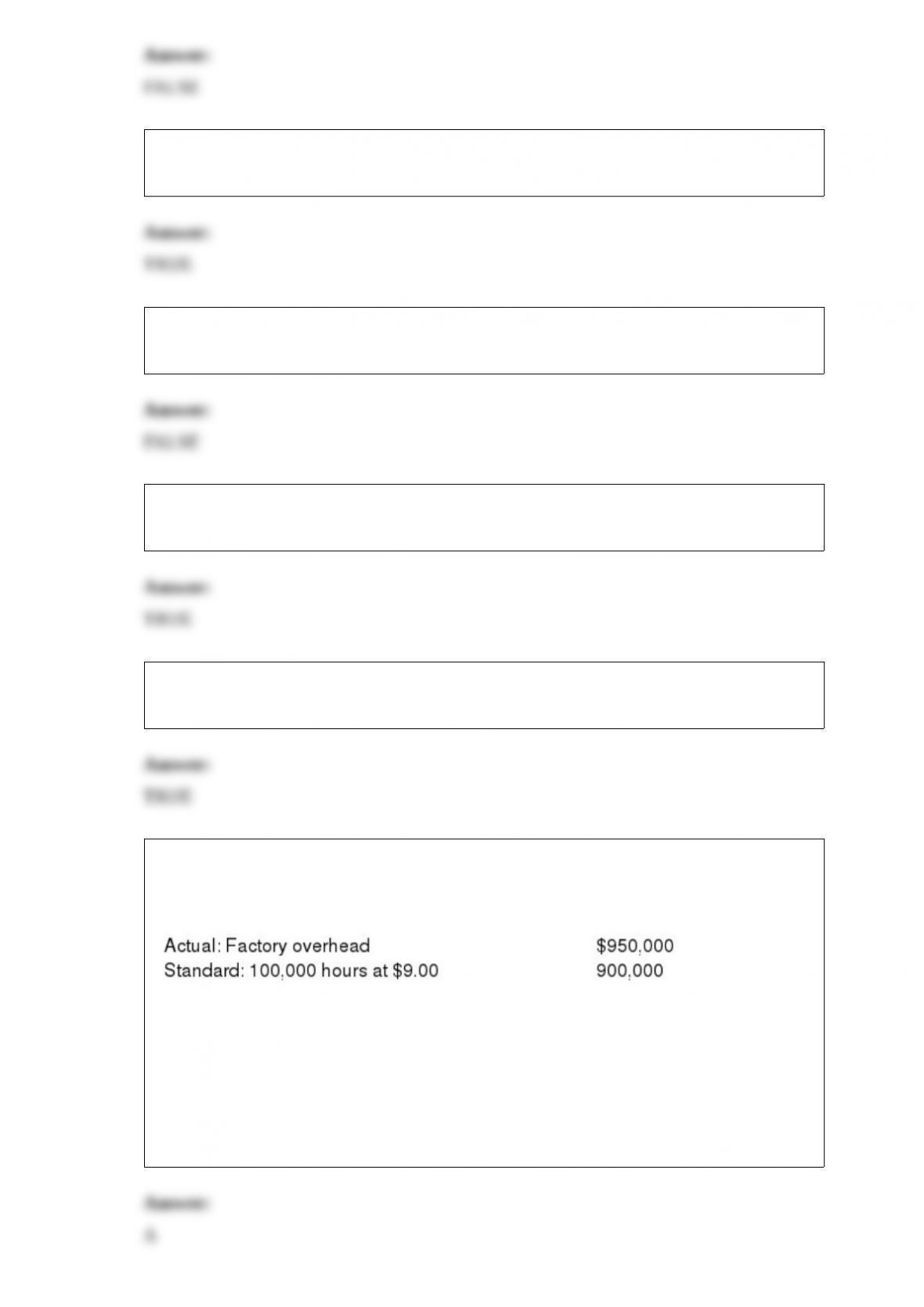
19) The standard fixed factory overhead rate is based on 100% capacity of 120,000
machine hours for Thompson Inc. The standard costs and the actual costs of factory
overhead for the production of 25,000 units during March were as follows:
If there was a $60,000 unfavorable volume variance for March, what is the standard
fixed factory overhead cost rate?
A.$3.00
B.$2.50
C.$6.67
D.$0.60
20) If variable costs per unit decreased because of a decrease in utility rates, the
break-even point would:
A.decrease
B.increase
C.remain the same
D.increase or decrease, depending upon the percentage increase in utility rates
21) The par value per share of common stock represents:
A.the minimum selling price of the stock established by the articles of incorporation
B.the minimum amount the stockholder will receive when the corporation is liquidated
C.the monetary amount assigned to each share of stock in the articles of incorporation
D.the amount of dividends per share to be received each year
22) Cost-volume-profit analysis cannot be used if which of the following occurs?
A.Costs cannot be properly classified into fixed and variable costs
B.The total fixed costs change
C.The per-unit variable costs change
D.Per-unit sales prices change
23) Merchandise is ordered on November 12; the merchandise is shipped by the seller
and the invoice is prepared, dated, and mailed by the seller on November 15; the
merchandise is received by the buyer on November 17; the transaction is recorded in
the seller’s accounts on November 15 . If the credit terms are 1/10, n/30, the discount
period begins with what date?
A.November 12
B.November 15
C.November 17
D.November 22
24) The inventory data for an item for November are:
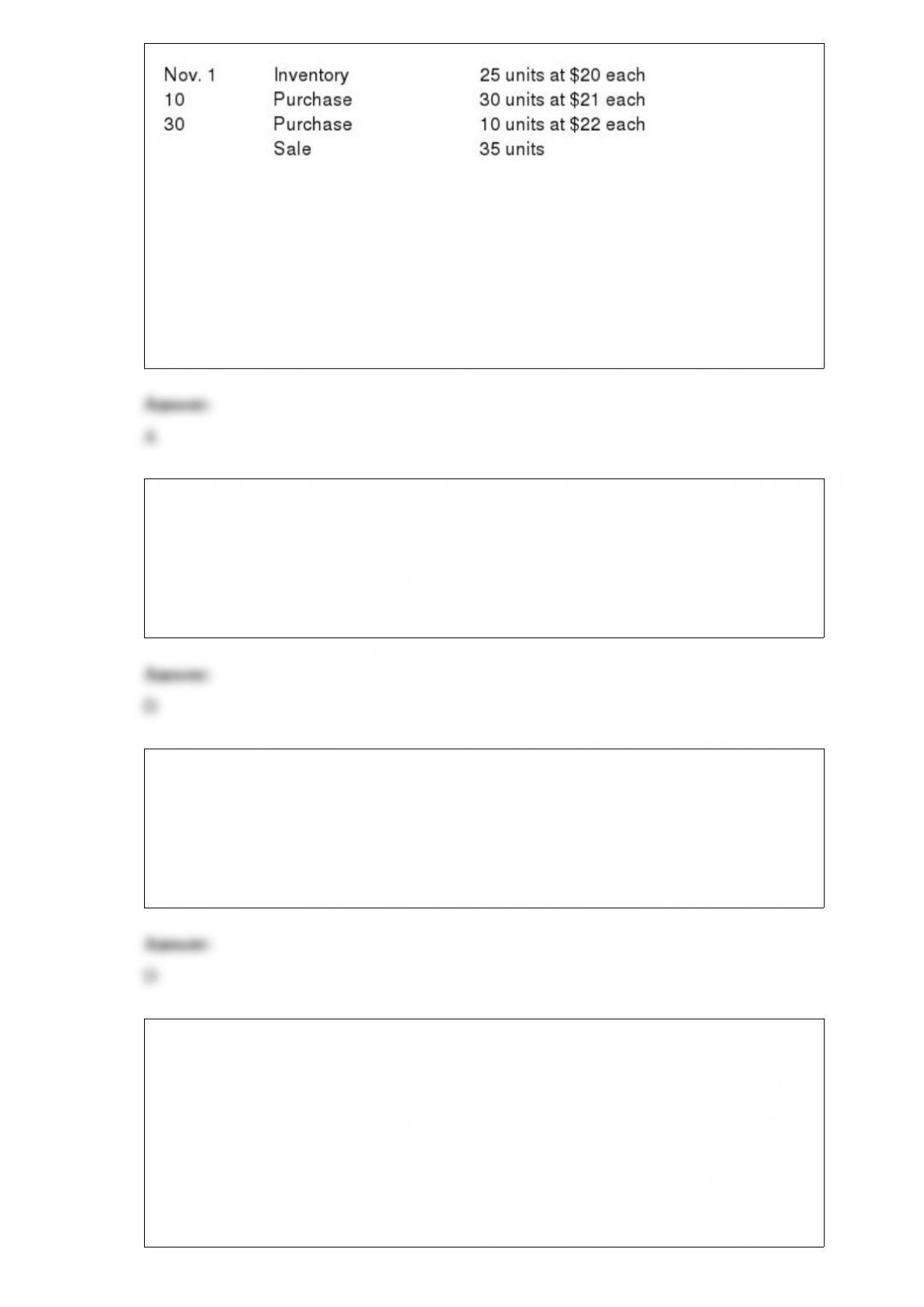
Using the first-in, first-out method, what is the cost of the merchandise inventory of 30
units on November 30?
A.$640
B.$605
C.$630
D.$660
25) BNC Company earns revenues and as a result collects cash. Which of the following
financial statement elements increased?
A.Cash only
B.Stockholders’ equity only
C.Liabilities
D.Cash and stockholders’ equity
26) In an investment center, the manager has responsibility and authority for making
decisions that affect:
A.only costs
B.both costs and revenues
C.only assets
D.costs, revenues, and assets
27) Accounts receivable arising from trade transactions amounted to $50,000 and
$56,000 at the beginning and end of the year, respectively. Net income reported on the
income statement for the year was $105,000. Exclusive of the effect of other
adjustments, the cash flows from operating activities to be reported on the statement of
cash flows prepared by the indirect method are:
A.$105,000
B.$111,000
C.$99,000
D.$156,000
28) In contrast to the total product and variable cost concepts used in setting selling
prices, the target cost approach assumes that:
A.a markup is added to total cost
B.selling price is set by the market price
C.a markup is added to variable cost
D.a markup is added to product cost
29) Which of the following are the principal components of a master budget?
A.Production budget
B.Sales budget
C.Capital expenditures budget
D.All of these
30) Expenditures that add to the utility of fixed assets for more than one accounting
period are called:
A.committed expenditures
B.revenue expenditures
C.current expenditures
D.capital expenditures
31) The liabilities that are due to be paid usually within a year or less are called:
A.long-term liabilities
B.deferred liabilities
C.current liabilities
D.contingent liabilities
32) Which principle determines the amount initially entered into the records for
purchases?
A.Cost principle
B.Going concern concept
C.Business entity concept
D.Objectivity concept
33) The inventory costing method that assigns the most recent costs to cost of good sold
is:
A.FIFO
B.LIFO
C.average cost
D.specific identification
34) When are contingent liabilities required to be recorded?
A.When the liability is probable
B.When the amount is reasonably estimable
C.When the liability becomes legally enforceable
D.When the liability is probable reasonably estimable
35)
36) Under which method of inventory costing is the cost flow assumed to be in the
reverse order in which the expenditures were made?
A.Average cost
B.Last-in, first-out
C.First-in, first-out
D.Specific identification method
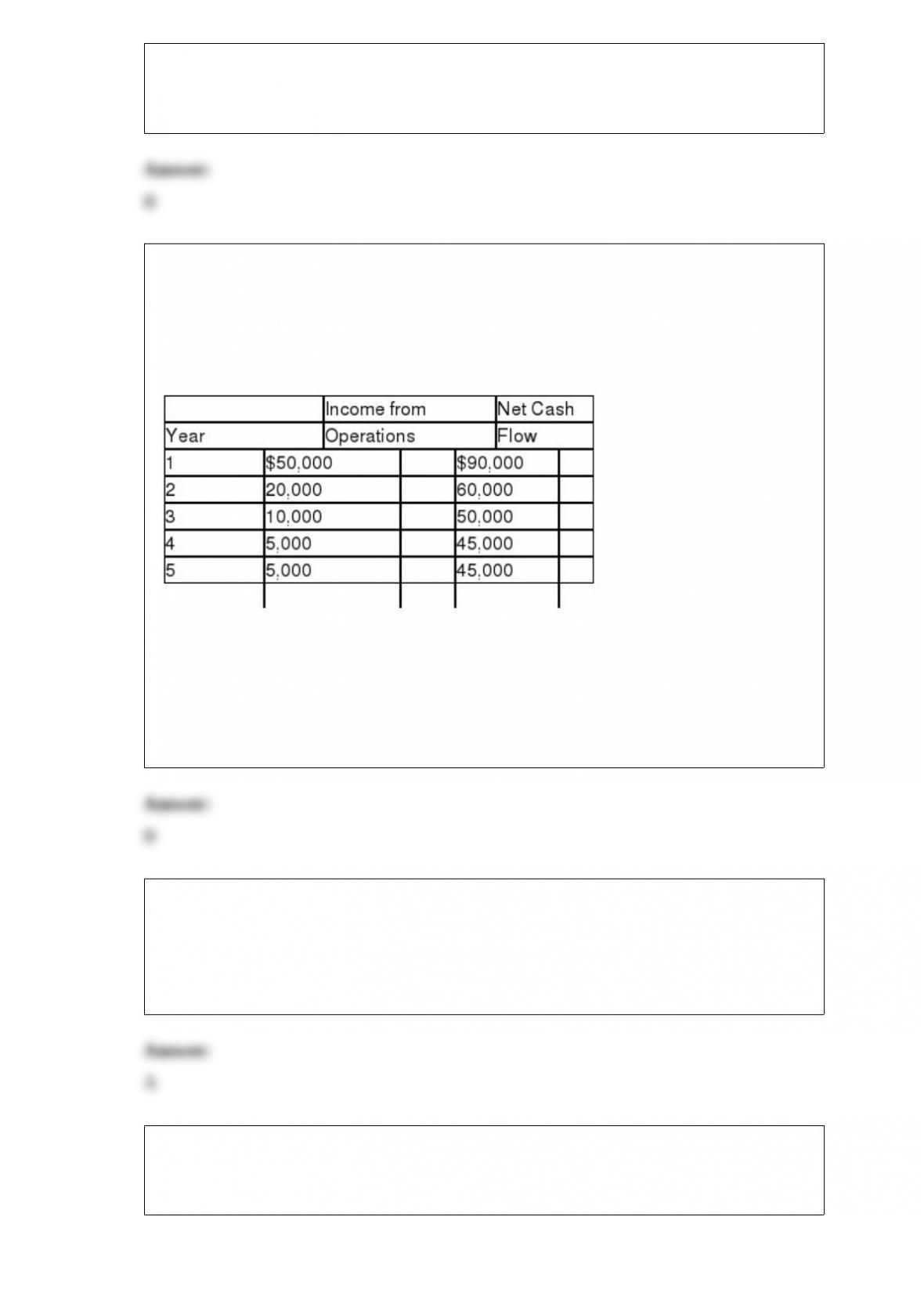
37) The management of Hence Corporation is considering the purchase of a new
machine costing $200,000. The company’s desired rate of return is 10%. The present
value factors for $1 at compound interest of 10% for 1 through 5 years are 0.909, 0.826,
0.751, 0.683, and 0.621, respectively. In addition to the foregoing information, use the
following data in determining the acceptability in this situation:
The cash payback period for this investment is:
A.5 years
B.3 years
C.2 years
D.4 years
38) Merchandise inventory is reported on the balance sheet in the section entitled:
A.current assets
B.fixed assets
C.current liabilities
D.stockholders’ equity
39) Answer Corporation uses standard cost system. The standard costs and actual costs
for direct materials, direct labor, and factory overhead for the manufacture of 2,500
units of product are as follows:
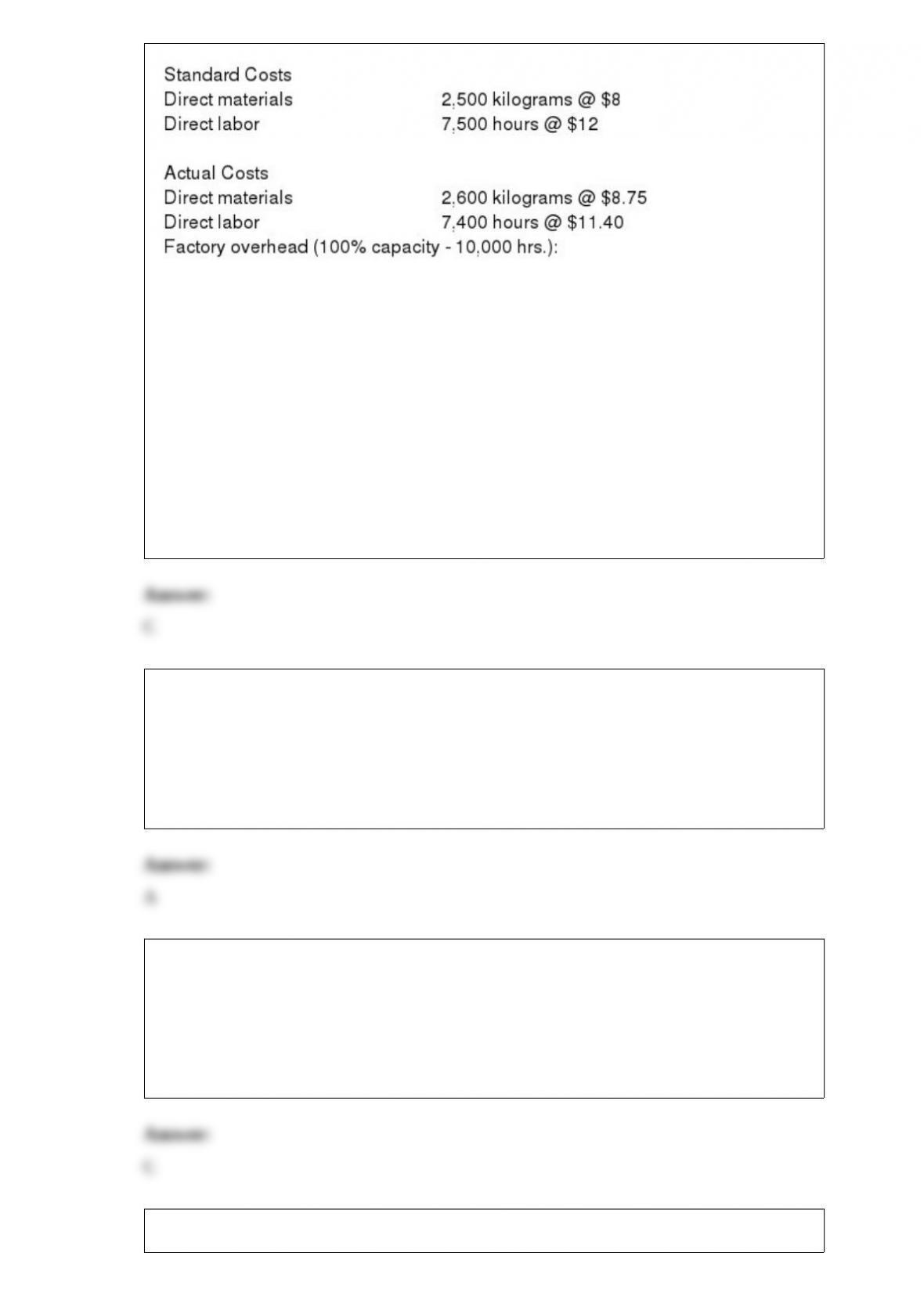
Variable cost @ $2 per hour
Total variable cost, $18,000
Fixed cost @ $0.80 per hour
Total fixed cost, $8,000
Refer to the information provided for Answer Corporation. The amount of the direct
labor rate variance is:
A.$4,440 unfavorable
B.$4,500 favorable
C.$4,440 favorable
D.$4,500 unfavorable
40) A 90-day, 10% note for $10,000 dated April 1 is received from a customer on
account. The face value of the note is:
A.$10,000
B.$11,000
C.$1,000
D.$9,000
41) A business’s organizational structure influences which of the following elements of
internal control?
A.Control procedures
B.Risk assessment
C.Control environment
D.Information and communication
42) Nachos Co. can further process Product J to produce Product D. Product J is
currently selling for $12 per pound and costs $9 per pound to produce. Product D would
sell for $20 per pound and would require an additional cost of $5 per pound to produce.
What is the differential cost of producing Product D?
A.$9 per pound
B.$14 per pound
C.$5 per pound
D.$3 per pound
43) The recording of the jobs completed would increase:
A.Factory Overhead
B.Finished Goods
C.Work-in-Process
D.Cost of Goods Sold
44) The unearned rent account has a balance of $50,000. If $3,000 of the $50,000 is
unearned at the end of the accounting period, the amount of the adjusting entry is:
A.$47,000
B.$53,000
C.$50,000
D.$3,000