Which of the following costs is likely to be driven by machine usage?
A. Factory insurance
B. Depreciation on factory building
C. Factory utilities
D. Factory rent
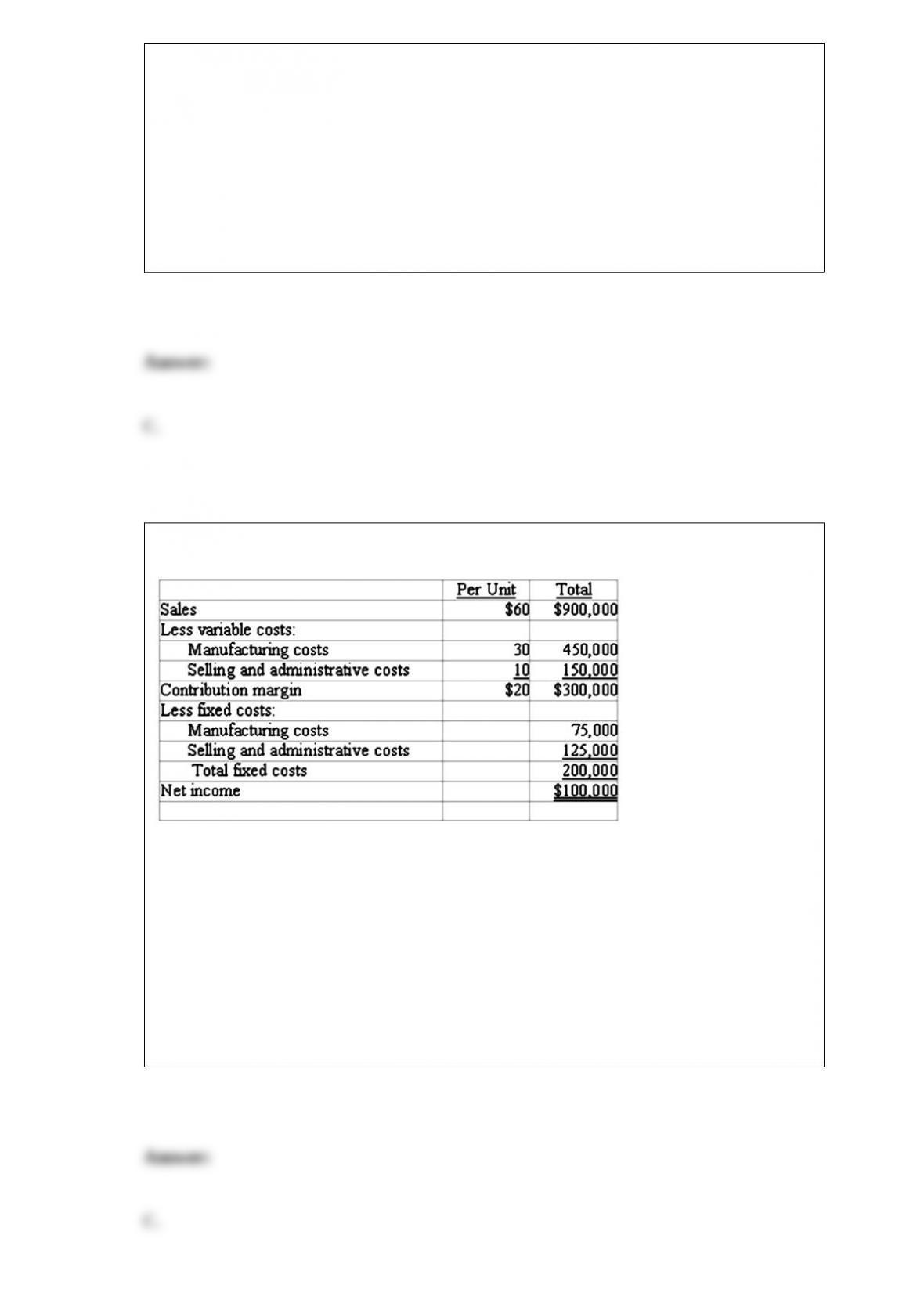
The following static budget is provided:
What will be the overall volume variance if 12,000 units are produced and sold?
A. $80,000 F
B. $80,000 U
C. $60,000 U
D. $160,000 U

For 2013, Fairview Corporation sold 100,000 units of its product for $20 each. The
variable cost per unit was $14, and Fairview’s margin of safety was 40,000 units. What
was the amount of Fairview’s total fixed costs?
A. $240,000
B. $560,000
C. $840,000
D. $360,000
Valley Farm Supply started the period with $80,000 cash. Cash receipts for January
expected to total $350,000. Cash disbursements for January were expected to be
$290,000. What is the expected cash balance at the end of January?
A. $290,000
B. $350,000
C. $80,000
D. $140,000
The Phibbs Company paid total cash dividends of $200,000 on 25,000 outstanding
common shares. On the most recent trading day, the common shares sold at $80. What
is this company’s dividend yield?

A. 25%
B. 6.4%
C. 16.9%
D. 10%
Ng Company sells one product that has a sales price of $20 per unit, variable costs of
$12 per unit, and total fixed costs of $300,000. What is the amount of sales volume in
dollars necessary to attain a desired profit of $100,000?
A. $250,000
B. $750,000
C. $1,000,000
D. $666,667
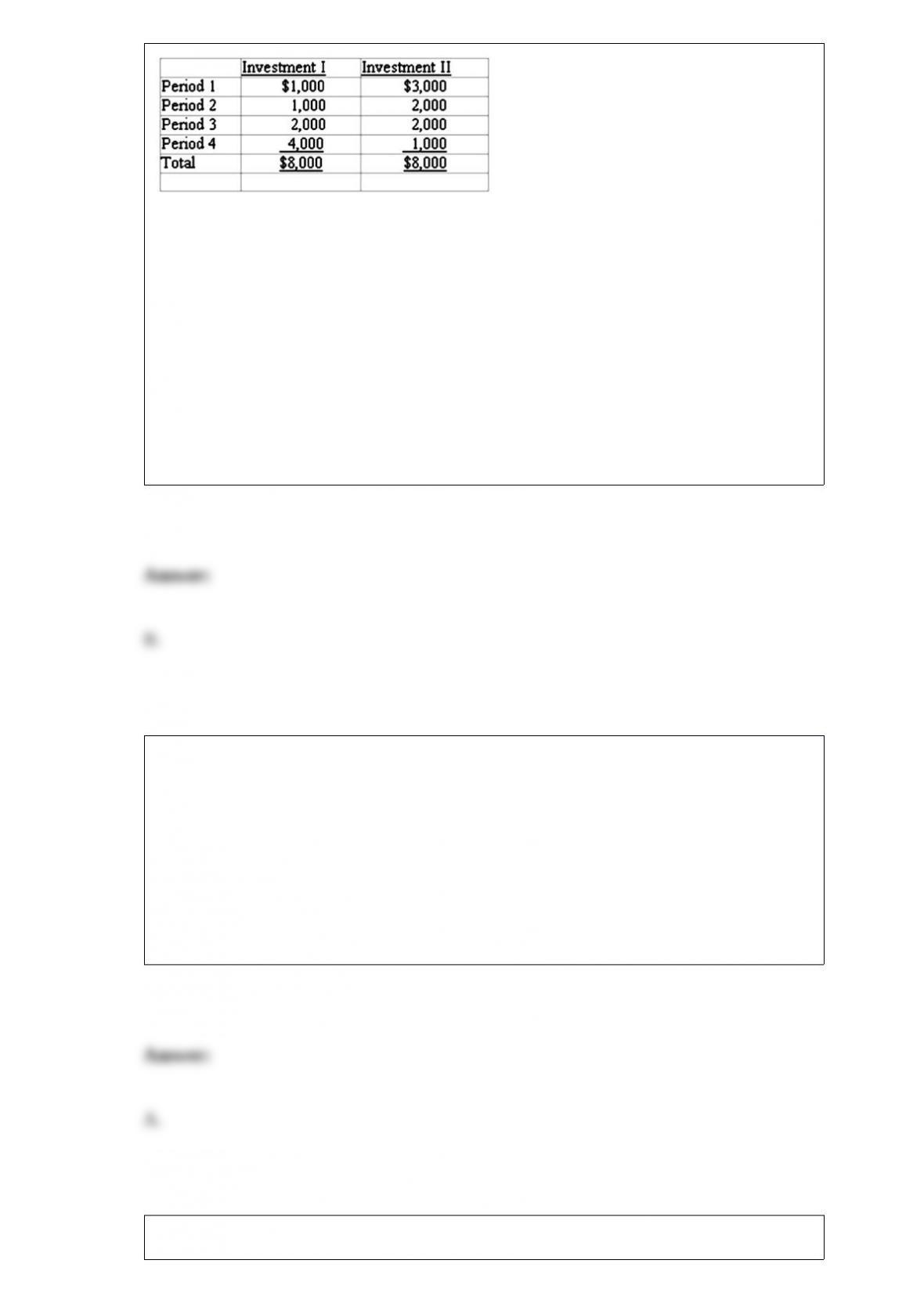
Evergreen Company has two investment opportunities. Both investments cost $5,000
and will provide the same total future cash inflows. The cash receipt schedule for each
investment is given below:
Select the correct statement.
A. Evergreen should choose Investment I because of the time value of money.
B. Evergreen should choose Investment II because it generates more immediate cash
inflows.
C. Evergreen should be indifferent between the two investments because they provide
the same total cash inflows.
D. Time value of money techniques are not useful for comparing these investments.
Which of the following is an upstream cost?
A. Research and development costs
B. Shipping costs to ship completed goods
C. Sales commissions
D. Sales promotion and advertising costs
Concerning the prevention of defects, which of the following statements is true?

A. Zero defects is a cost-effective strategy.
B. When the product falls to the right of the cost minimization point on the total quality
cost curve, then incurring failure costs is wise.
C. It is always wiser to spend money on correcting failures than on preventing defects.
D. When the product falls to the right of the cost minimization point on the total quality
cost curve, then incurring prevention costs is wise.
Which ratio measures how effectively a company is using assets to generate revenue?
A. Net margin
B. Plant assets to long-term liabilities
C. Asset turnover
D. Inventory turnover
Financial ratios can be used to assess which of the following aspects of a firm’s
performance?
A. Liquidity
B. Solvency
C. Profitability
D. All of these answers are correct.
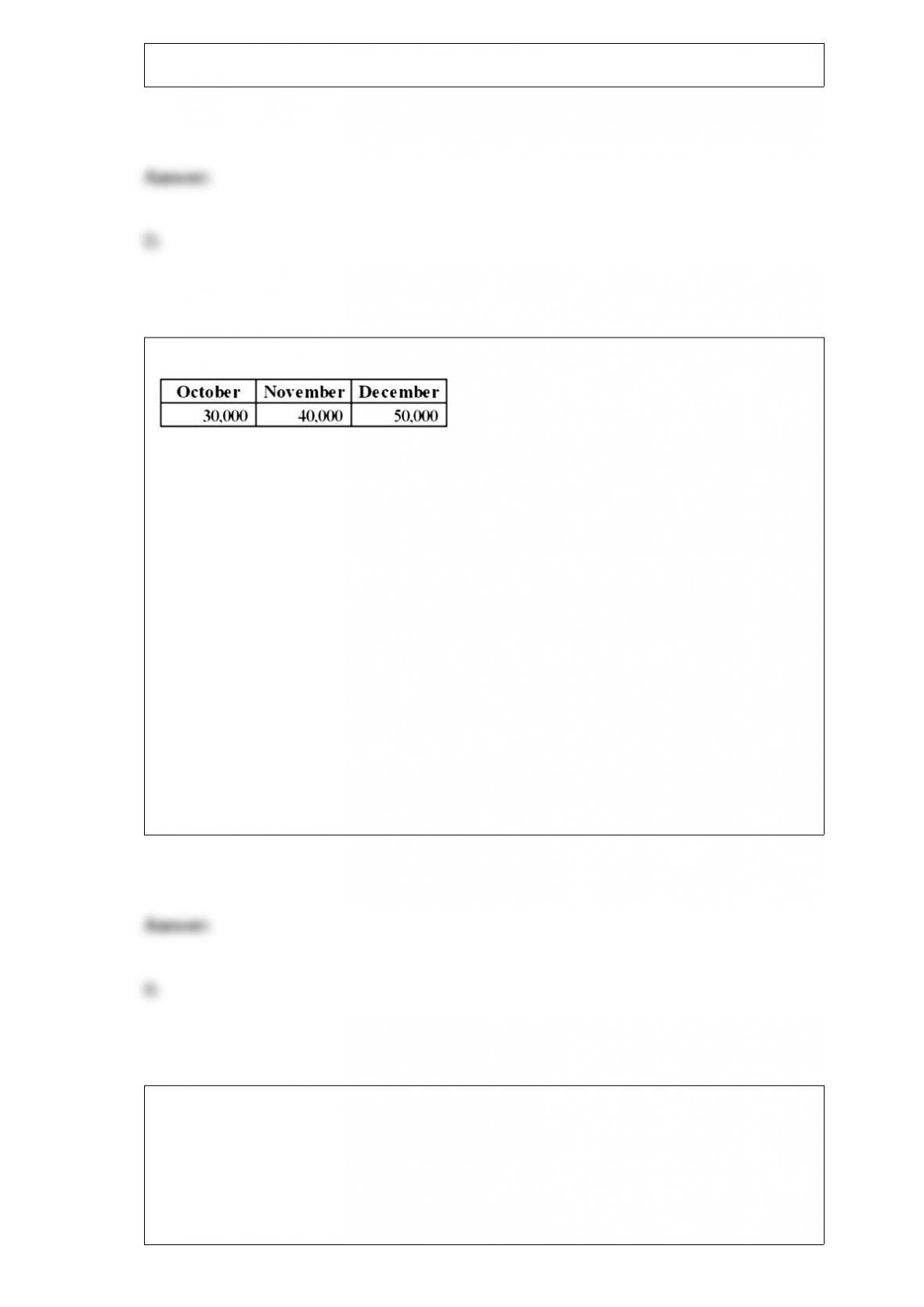
Purchases on account are given below:
55% of the month’s purchases will be paid in the month of the purchase; the remaining
45% will be paid in the following month.
The accounts payable balance at the beginning of the year was $85,000. The company
purchased $380,000 worth of goods on account, and the ending balance of the payables
account was $70,000.
What were the total payments on account?
A. $450,000
B. $395,000
C. $535,000
D. $465,000
Ethan paid $3 for a bottle of ThirstAid. Later while on a hiking trip, she was offered $8
for the ThirstAid. Select the correct statement from the following:
A. The $8 offer is not relevant if Ethan refuses to sell the ThirstAid.
B. If Ethan drinks the ThirstAid, no opportunity cost is associated with his decision.

C. The $3 original purchase price is irrelevant to his decision to sell the ThirstAid.
D. All of these.
A process cost system is used when:
A. Homogenous items are produced in a continuous flow production process.
B. Batches of identical inventory items are produced.
C. A company produces unique, one-of-a-kind inventory items.
D. All of these.
Recognizing estimated manufacturing overhead costs at the end of a month is a(n):
A. asset source transaction.
B. asset use transaction.
C. asset exchange transaction.
D. claims exchange transaction.

Which of the following statements concerning payback analysis is true?
A. An investment with a shorter payback is preferable to an investment with a longer
payback.
B. The payback method ignores the time value of money concept.
C. The payback method and the unadjusted rate of return are different approaches that
will not consistently lead to the same conclusion.
D. All of the other answers are correct.
The Ling Corporation reported a beginning balance of $1,200 in its prepaid insurance
account for 2014. During the year, a total of $16,000 was recognized as insurance
expense and the prepaid insurance account had an ending balance of $1,600. How much
cash did Ling pay for insurance during 2014?
A. $17,200
B. $16,000
C. $16,400
D. $14,800
Bates Company recognized $16,000 of estimated manufacturing overhead costs at the
end of the month. As a result of this transaction the:
A. temporary account manufacturing overhead increases and the work in process
account decreases.
B. temporary account manufacturing overhead decreases and the work in process
account increases.
C. temporary account manufacturing overhead decreases and the wages expense
account increases.
D. none of these.
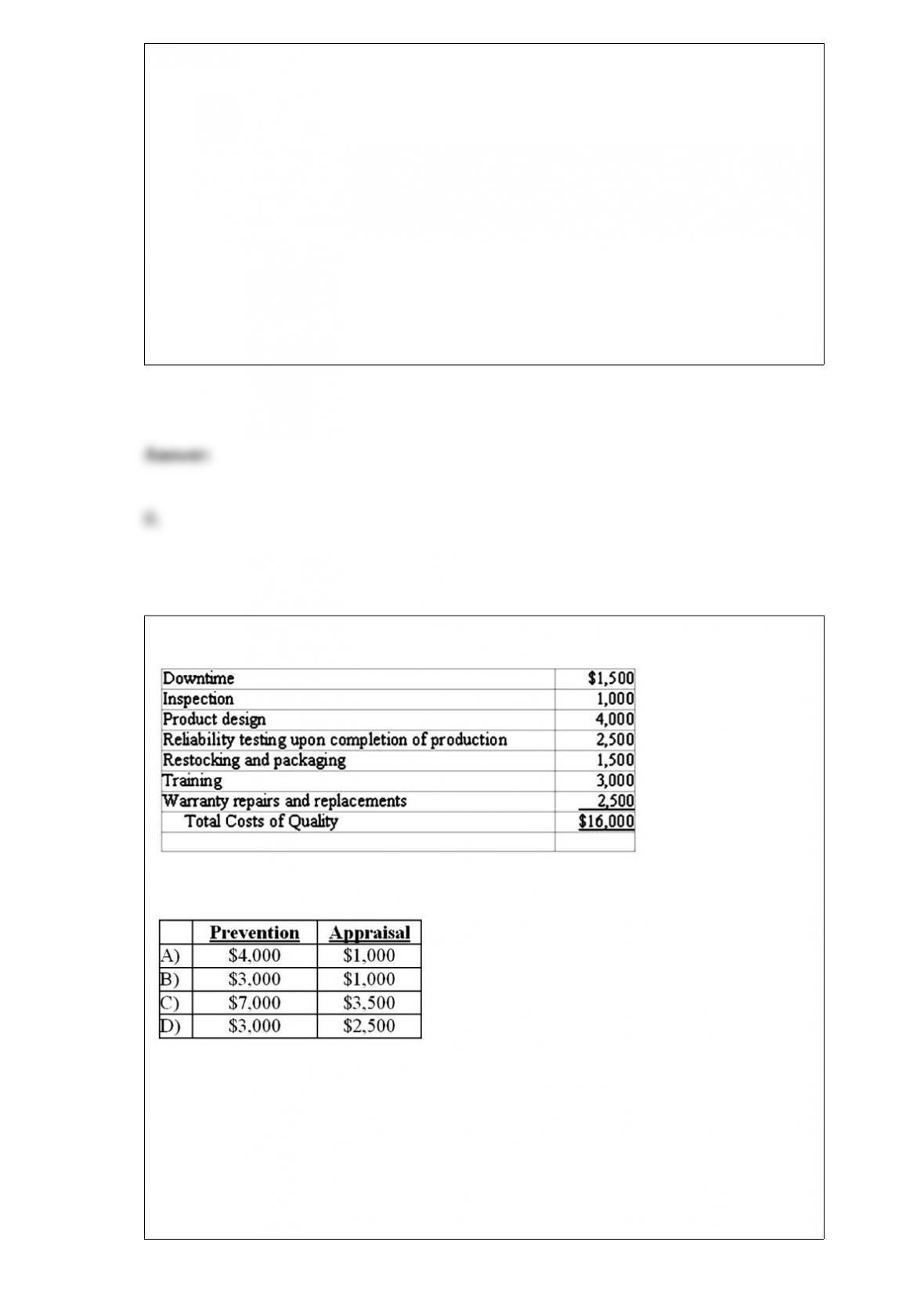
The Farber Company recorded the following costs of quality during the current period:
Which choice below represents the correct amount of prevention and appraisal costs?
A. Choice A
B. Choice B
C. Choice C
D. Choice D

A product-level activity center would likely include all of the following costs except:
A. engineering development costs.
B. legal fees to obtain and protect patents.
C. packaging design costs.
D. materials handling costs.
Which of the following statements is true?
A. An unfavorable materials price variance could have resulted from actions taken by
the purchasing agent.
B. An unfavorable materials usage variance could have resulted from actions taken by
the production supervisor.
C. An unfavorable labor usage variance could have resulted from actions taken by the
personnel department.
D. All of these answers are correct.

Which of the following correctly computes cost of goods manufactured?
A. Beginning work in process + Direct materials used + Direct labor + Overhead –
Ending work in process
B. Beginning work in process + Cost of goods sold – Ending finished goods
C. Beginning work in process + Direct materials used + Direct labor + Overhead
D. None of these.
Indicate whether each of the following statements is true or false.
Most manufacturers use three accounts to report inventory on the balance sheet.
Work in Process includes completed units that are ready for sale.
For a manufacturer, the cost of materials received is recorded in the Work in Process
account.
For a manufacturer, the costs of materials, labor, and estimated overhead are recorded in
the Work in Process account.
At the end of the period, the balances that remain in Raw Materials, Work in Process,
and Finished Goods are reported on the balance sheet.
How does the use of standard costs fit with the philosophy of management by
exception?
Hatfield Company sells several different products. It calculated that, for the current
year, it would break even if it achieved sales of $850,000. The company actually
achieved sales of $856,000, but it incurred a loss of $6,500. What could have caused
this result? The costs and selling prices for the individual products did not change.
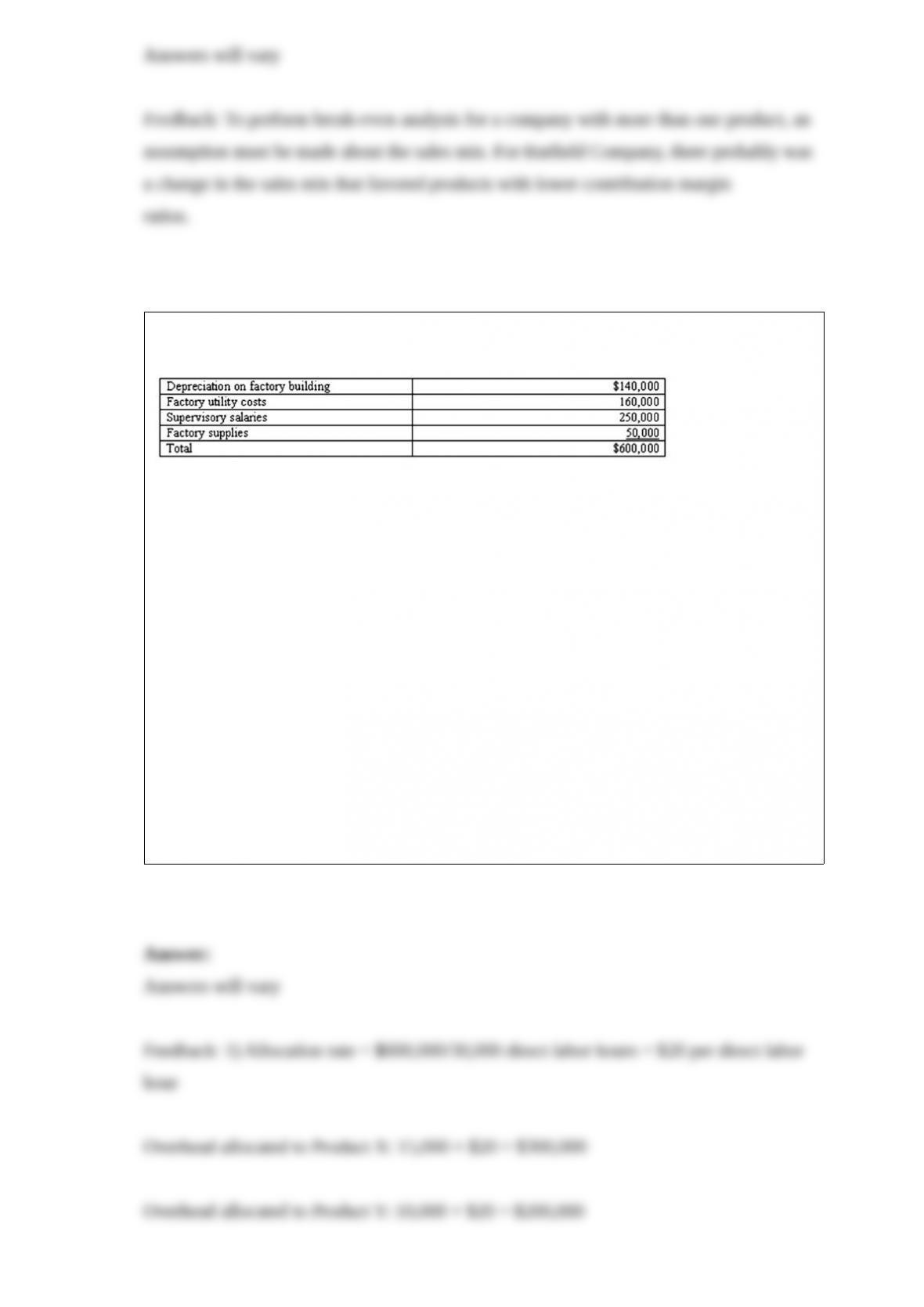
Parr Corporation makes three products, X, Y, and Z. Expected overhead costs for the
coming year include:
Parr uses direct labor hours as the cost driver to allocate overhead costs. Budgeted
direct labor hours for each product are:
Product X, 15,000 direct labor hours
Product Y, 10,000 direct labor hours
Product Z, 5,000 direct labor hours
Required:
1) Determine the amount of manufacturing overhead that should be allocated to each of
the three products.
2) Assume that each unit of Product X requires $40 in direct materials and 3 direct labor
hours at a rate of $15 per hour. Calculate the budgeted or expected cost of each unit of
X.
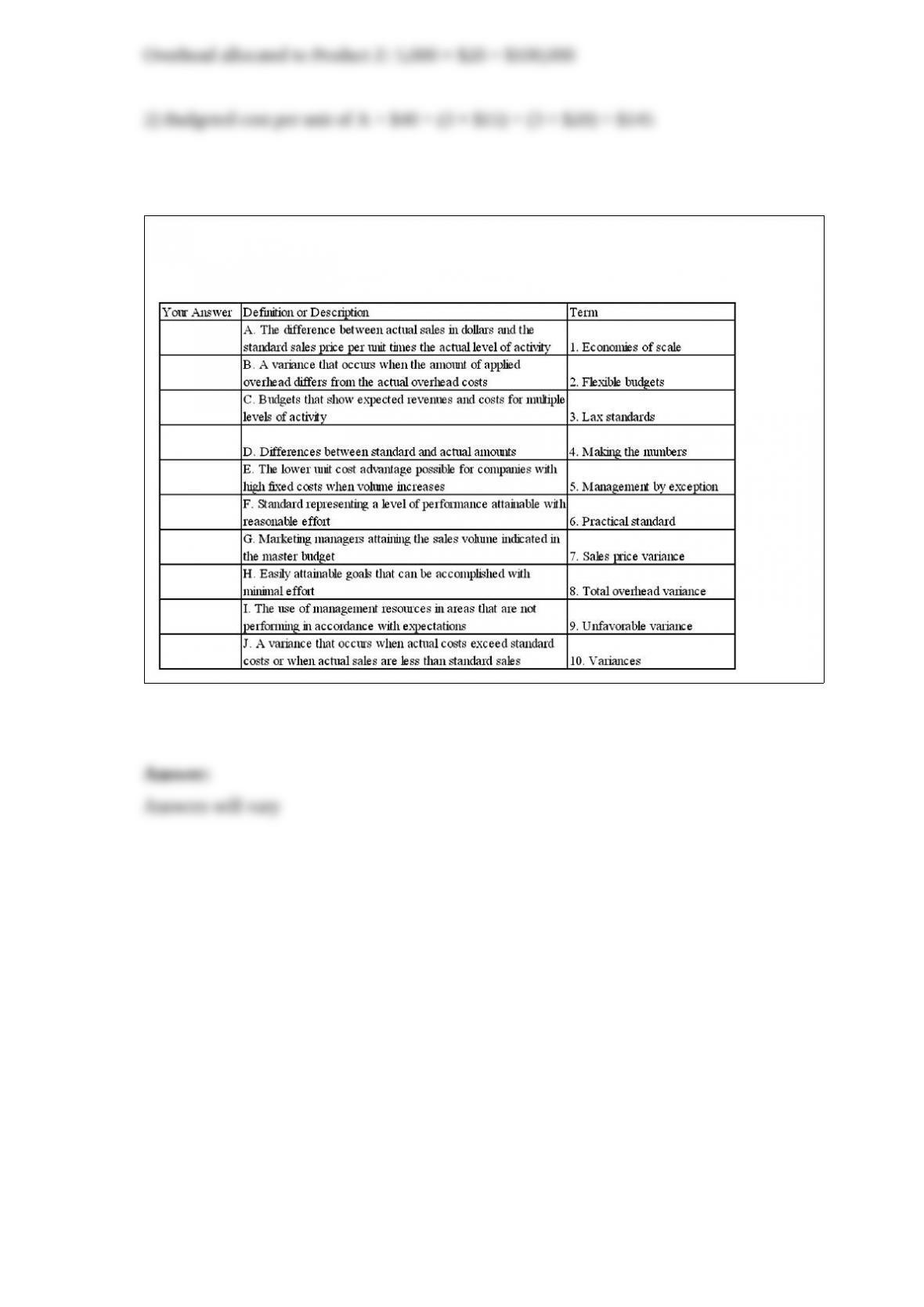
Select the term that best fits the definition or description; enter the number of the term
in the column for Your Answer.
Indicate whether each of the following statements about process costing systems is true
or false.
The use of a predetermined overhead rate is not required with process costing because
the method calculates an average unit cost.
When manufacturing overhead is applied to units of product, total assets do not change.
For Morris Company, the cost per equivalent whole unit was $3.58. If the ending work
in process was 8,000 units 85% complete, the total cost assigned to these units would be
$28,640.
A company with three processing departments generally would calculate a cost per
equivalent whole unit for each department.
With a process costing system, a company will not have to deal with over- or
underapplied overhead.
Goff Corporation sells products for $75 each that have variable costs of $50 per unit.
Goff’s fixed cost is $350,000.
Required:
Calculate the contribution margin per unit, then use the per unit contribution margin
approach to find the break-even point in units and dollars.
Levin Company is considering two new machines that should produce considerable cost
savings in its assembly operations. The cost of each machine is $14,000 and neither is
expected to have a salvage value at the end of a 4-year useful life. Levin’s required rate
of return is 12% and the company prefers that a project return its initial outlay within
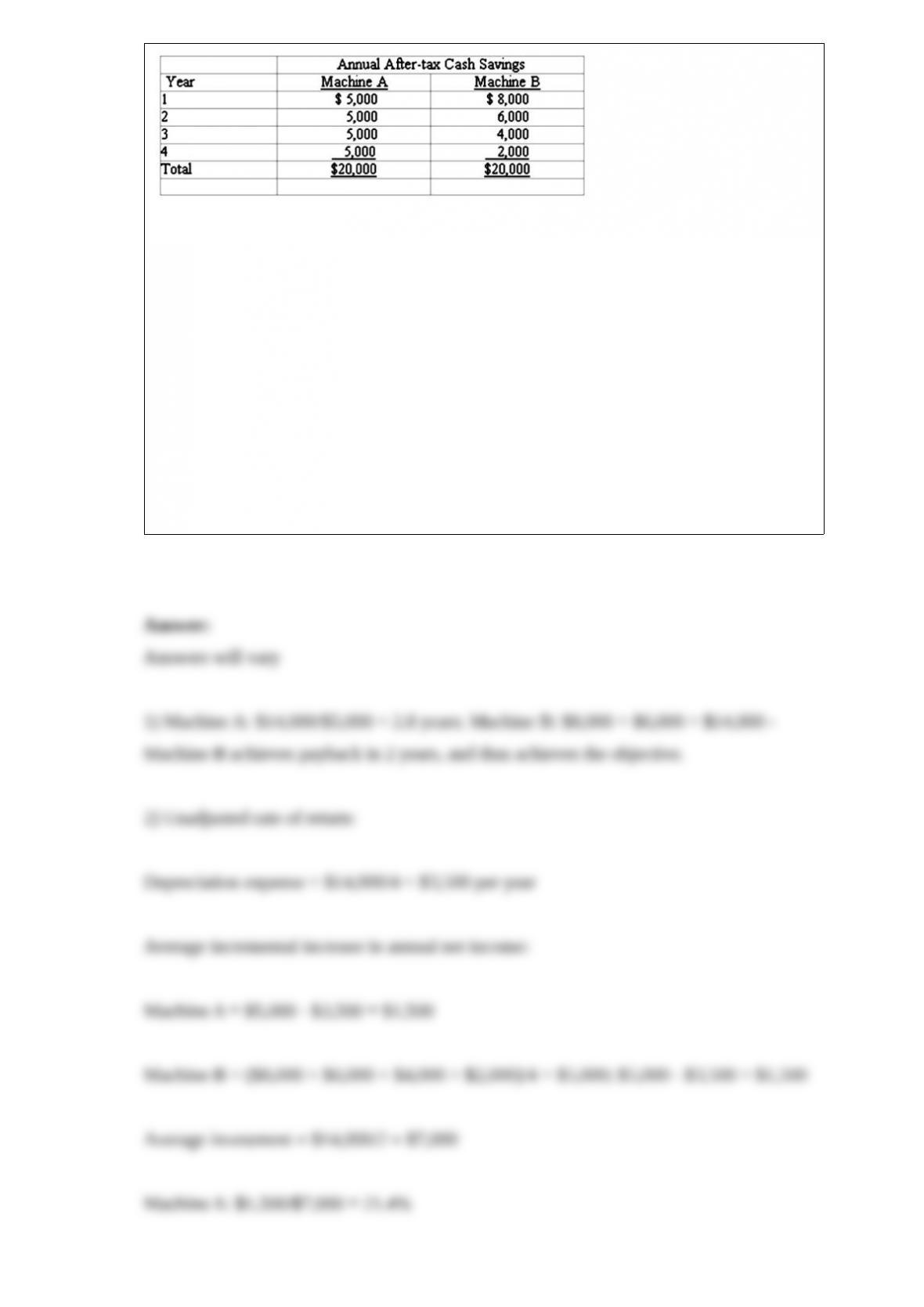
the first half of the project’s life. The annual after-tax cash savings for each machine are
provided in the following table:
Required:
1) Compute the payback period for each machine using the incremental approach and
comment on the results.
2) Compute the unadjusted rate of return based on average investment for each
machine. The machines will be depreciated on a straight-line basis.
3) Compute the net present value for each machine.
4) Which machine would you recommend? Explain your reasoning.
5) Use the present value table to compute the approximate internal rate of return for
Machine.
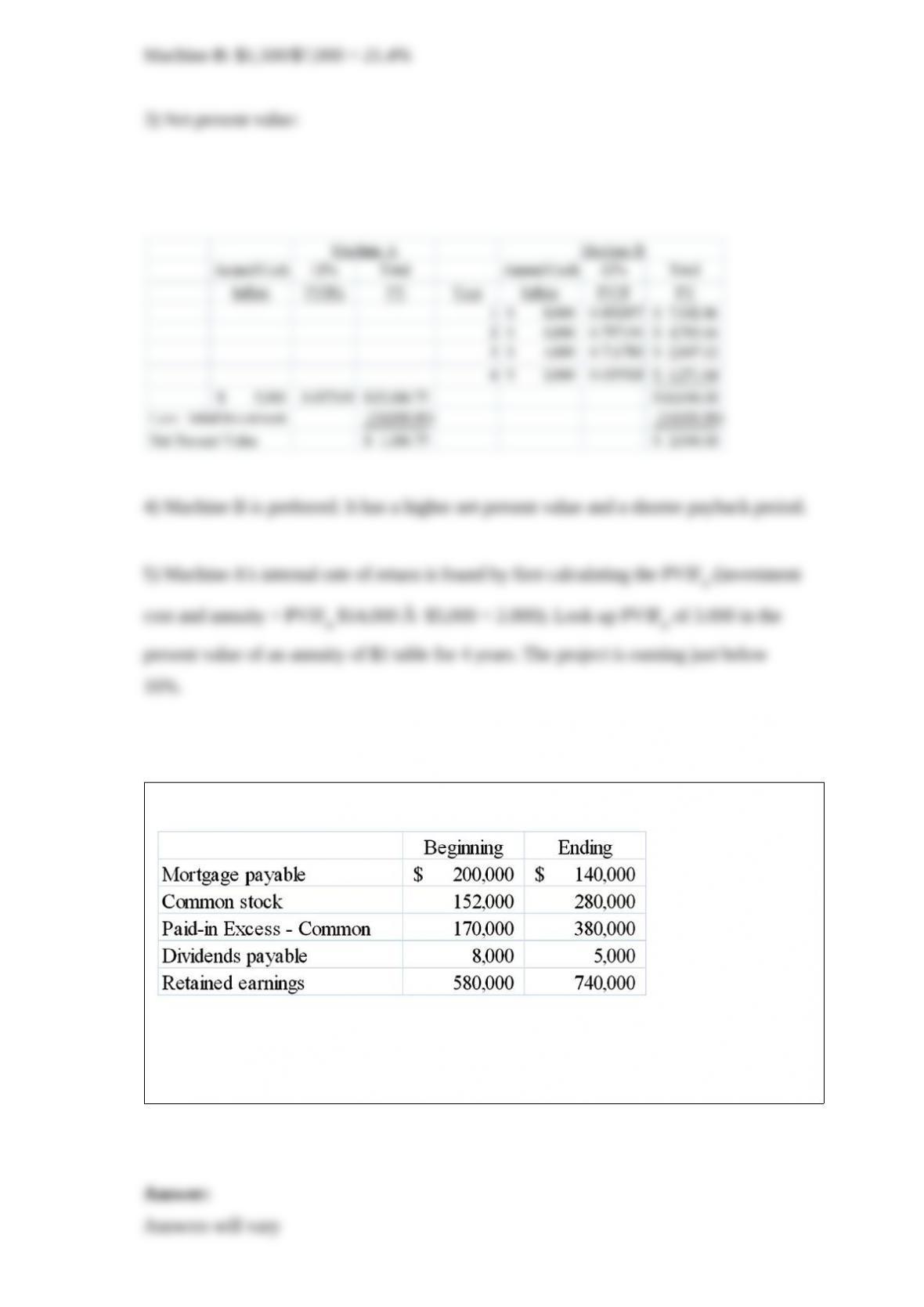
The Penn Corporation provided the following for 2014:
Net income for 2014 was reported as $200,000.
Required:Use the reconciliation approach to prepare the financing activities section of
the statement of cash flows.